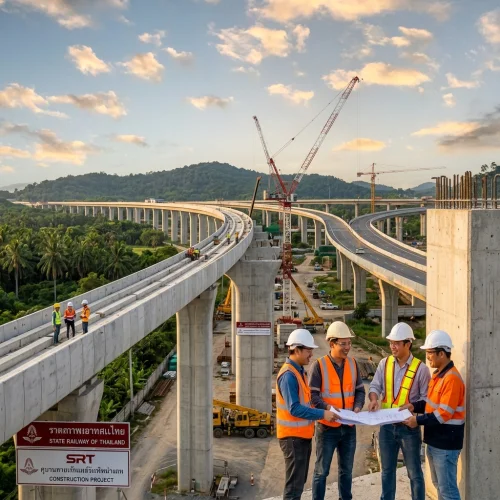
Chinese state-owned firm PowerChina is establishing a local subsidiary to fund and build major transport networks across Thailand. The move will directly affect British expatriates. Extensive upgrades are planned for domestic rail routes, local road systems, and international airports, altering how foreign residents navigate the country.
Aviation Upgrades
For UK nationals flying internationally, the investment targets terminal expansions at both Suvarnabhumi and Don Mueang airports. Two entirely new aviation facilities are also proposed. The Lanna Airport will serve the northern provinces, while the Andaman Airport is planned for the south. These developments are designed to increase flight availability and ease terminal congestion, ultimately providing more travel options for residents returning to Britain or exploring Asia.
Rail and Road Networks
Expats relying on overland border runs will see changes to the southern double-track railway. This route connects Chumphon, Surat Thani, and Hat Yai. It terminates at Padang Besar on the Malaysian border. Furthermore, the Thai government is advancing a high-speed rail network linking the country with Laos and China, which will eventually simplify long-distance transit across the broader Mekong region. Those living in Phuket will also experience local infrastructure changes. PowerChina intends to construct the Kathu-Patong tunnel. This specific project aims to improve daily commutes and reduce road hazards in one of the most heavily populated expatriate areas in the country.
Project Delivery
PowerChina is entirely state-funded. The firm has already completed fifteen transit and energy projects in Thailand worth over four billion pounds. Safety remains a strict requirement for the Thai Transport Ministry. The Chinese contractor holds a zero-accident record on its previous local developments, which include the Blue and Green Line urban transit systems in the capital. Thai officials will inspect these upcoming sites closely to assess readiness. They intend to ensure the new infrastructure meets international safety standards before any construction begins. This oversight provides reassurance for future users.
Reviewed by the Thailand Guide Editorial Team • Last reviewed: 1 June 2026
This page is provided for general information only. While we aim for accuracy, details can change — please verify anything important independently before relying on it.