Thailand Marriage Visa
The Thailand Marriage Visa allows UK nationals legally married to a Thai citizen to live in the country long-term, provided they can show either 400,000 THB (£8,800) in a Thai bank account or a monthly income of 40,000 THB (£880). Securing this Non-Immigrant O visa requires extensive documentation of both your relationship and your finances, but it grants you the right to apply for a Thai work permit.
This guide explains exactly how to secure and maintain a Non-Immigrant O Marriage Visa, whether you are applying from the UK or converting a tourist entry inside Thailand. It covers strict financial thresholds, document legalisation, and the reality of annual renewals. This visa is exclusively for legally married spouses of Thai citizens; it is not available to unmarried partners, fiancés, or those who cannot meet the financial criteria. Read on to understand the exact steps to legalise your stay.
| Cost (THB) | Cost (GBP approx) | |
|---|---|---|
| Visa Application Fee | 1,900 THB | £42 |
| Required Bank Deposit (Single Applicant) | 400,000 THB | £8,800 |
| Or Monthly Income Alternative | 40,000 THB/month | £880/month |
| Annual Extension Fee | 1,900 THB | £42 |

Eligibility and Financial Requirements
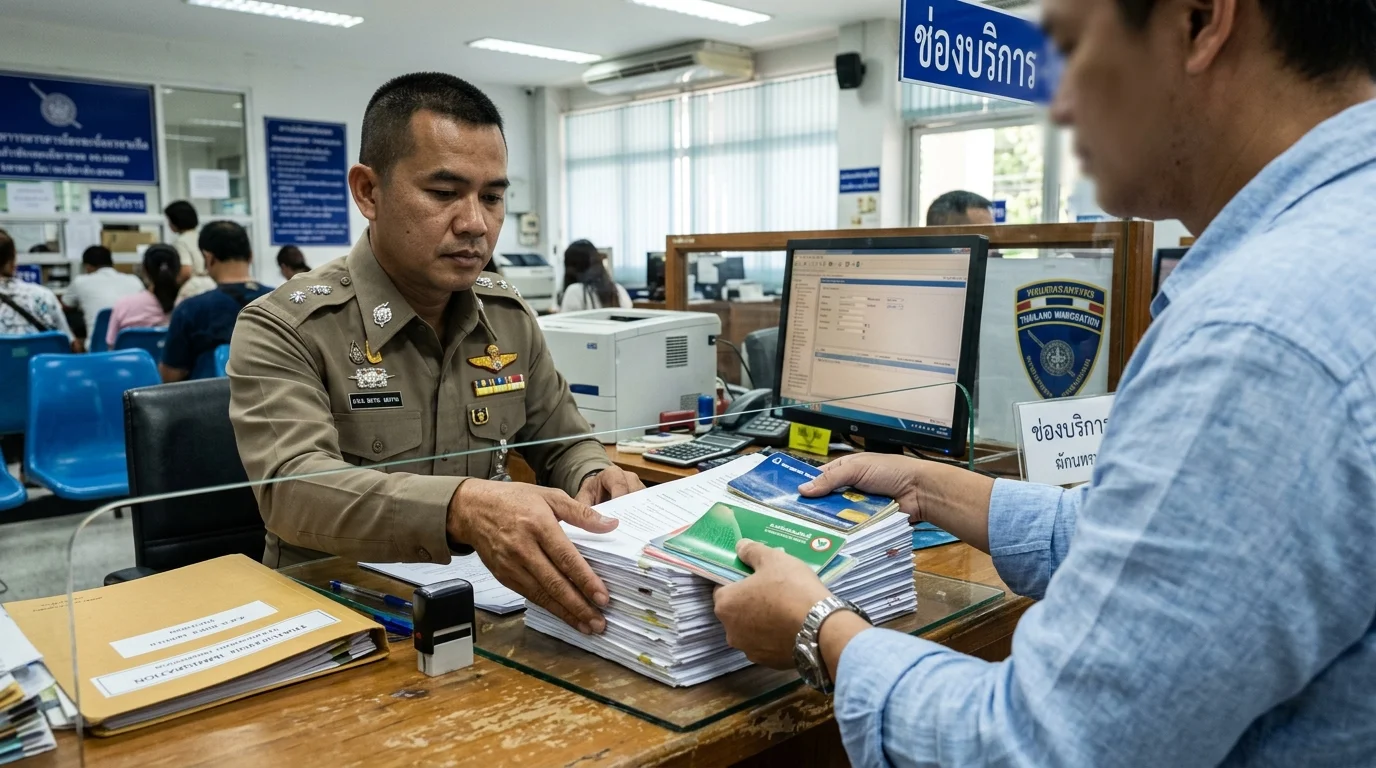
To qualify for the Marriage Visa, you must prove you can support your spouse financially. You have two distinct routes to satisfy Thai Immigration. The first option is the deposit method. This requires holding at least 400,000 THB (£8,800) in a Thai bank account solely in your name. You must deposit and clear these funds at least two months before your initial application. The alternative is the income method, demonstrating a monthly income of at least 40,000 THB (£880). If this money comes from a UK pension or salary, you must transfer it into a Thai bank account monthly and keep meticulous records. You cannot combine the deposit and income methods. Choose one route and meet its criteria completely. Ensure your name matches exactly across your passport, bank book, and marriage certificate to avoid rejection. Choose your financial route early and ensure the funds are seasoned in a Thai account for the required duration before your application date.
Plan your Thailand border run with exact requirements for UK nationals. Discover the rules, crossing points, costs, and documents needed for overland entry.
| Financial Route | Minimum Requirement | Key Condition |
|---|---|---|
| Deposit Method | 400,000 THB (£8,800) | Must be in a Thai bank account in your sole name for 2 months prior to application. |
| Income Method | 40,000 THB (£880) per month | Must show consistent monthly international transfers into a Thai bank account. |
| Combined Method | Not permitted | You must satisfy either the deposit or the income requirement in full. |
Validating Your Marriage Documents
Sponsored
Thai Immigration strictly scrutinises relationship documents to prevent sham marriages. If you married in Thailand, the paperwork is lighter. You must provide your original Kor Ror 3 certificate. Alongside this, you need an updated Kor Ror 2 registry document printed within six months. Officers reject laminated originals. Marriages registered in the UK demand a heavier administrative process. You cannot simply present a British marriage certificate. First, your UK certificate requires legalisation by the FCDO in London. Next, a certified translator must convert it into Thai. The Thai Ministry of Foreign Affairs must then authenticate this translation. Only then can your spouse register the foreign marriage locally at their district office. Beyond certificates, you must supply photographic evidence of your home life. Treat your relationship evidence like a court case; gather recent, officially stamped documents and heavily contextual photographs to prove cohabitation.
| Marriage Location | Required Primary Document | Additional Authentication Required |
|---|---|---|
| Thailand | Kor Ror 3 (Original) & Kor Ror 2 (Recent) | None |
| United Kingdom | UK Marriage Certificate | FCDO Legalisation, Thai Translation, MFA Authentication, Amphoe Registration |
| Third Country | Foreign Marriage Certificate | Embassy Legalisation, Thai Translation, MFA Authentication, Amphoe Registration |
Application Process Options
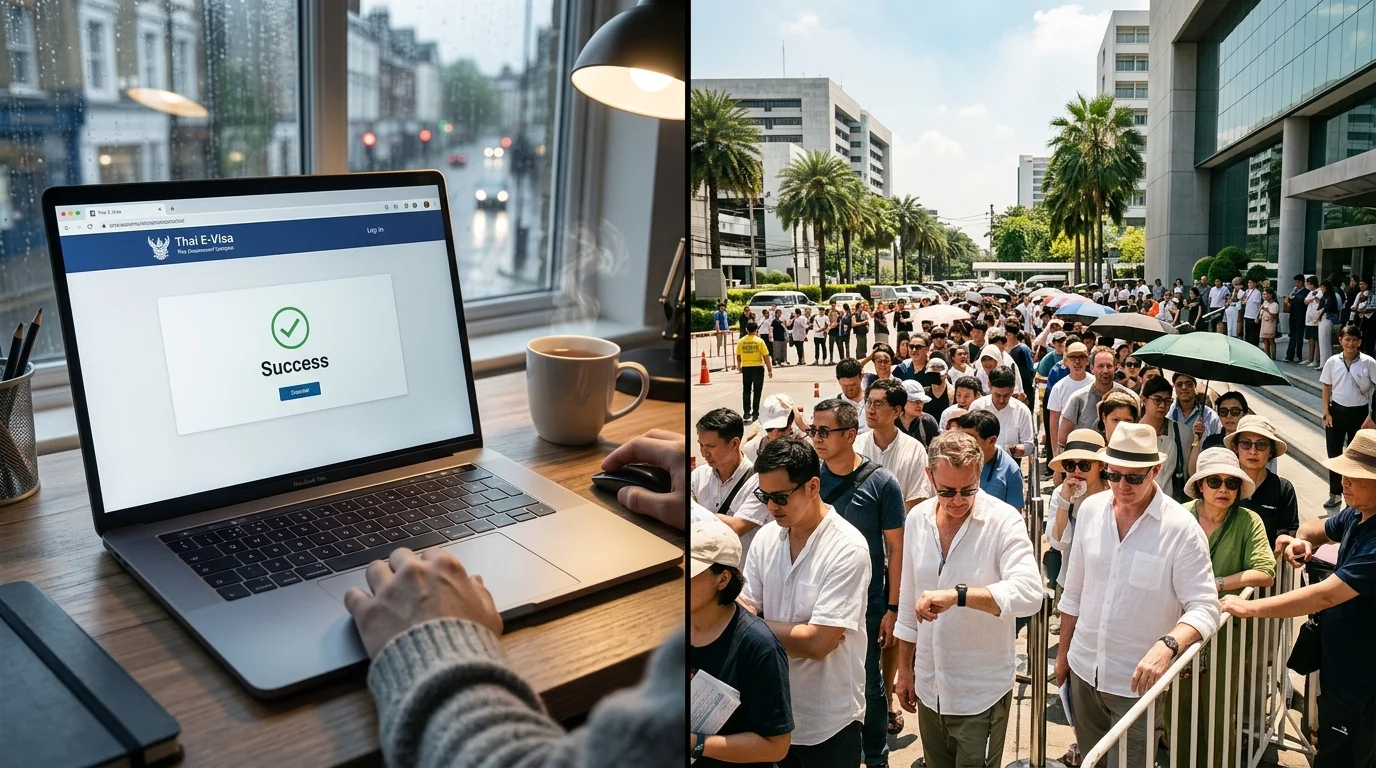
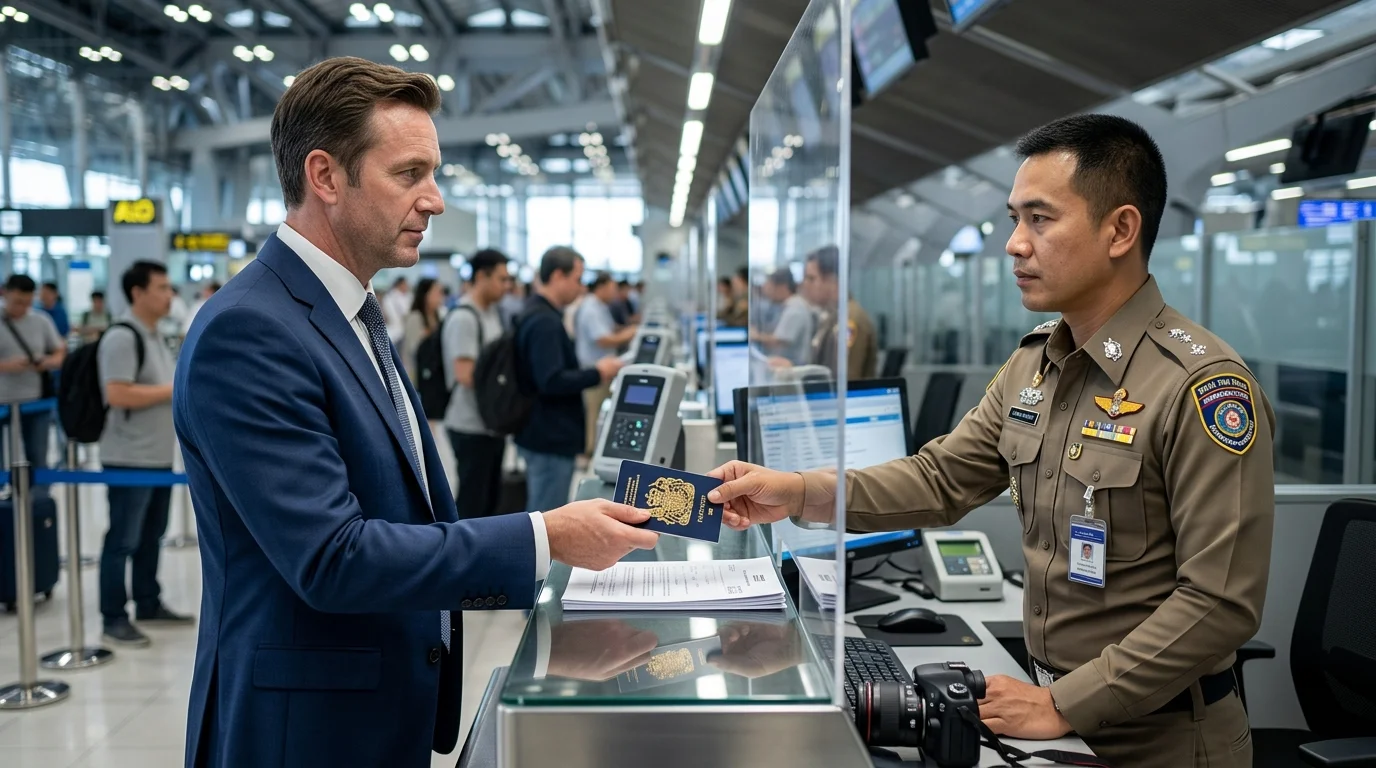
You can begin your application online from the UK or enter Thailand first and apply in person. Applying via the Thai E-Visa system in the UK grants a 90-day visa before you travel. You will upload digital copies of your passport, marriage certificate, spouse’s Thai ID, and financial proof to the portal. Processing via the London embassy takes up to four weeks. Alternatively, you can enter Thailand on a 60-day visa exemption and convert it locally. This conversion costs 2,000 THB (£44). It gives you a 90-day Non-Immigrant O stamp. To convert in-country, you must have at least 15 days remaining on your current entry stamp. In-country applications demand physical copies of every document signed in blue ink. Your Thai spouse must accompany you to the immigration office. Officers will interview them directly to confirm the relationship status. Applying from the UK offers peace of mind before flying, whereas converting in Thailand allows you more time to open a local bank account and season your funds.
| Application Route | UK E-Visa Portal | In-Country Conversion |
|---|---|---|
| Processing Time | Up to 4 weeks | 2 to 3 weeks |
| Official Fee | 3,000 THB (£65) approx | 2,000 THB (£44) |
| Spouse Attendance Required | No (digital submission only) | Yes (mandatory interview) |
Annual Renewals and Reporting Obligations
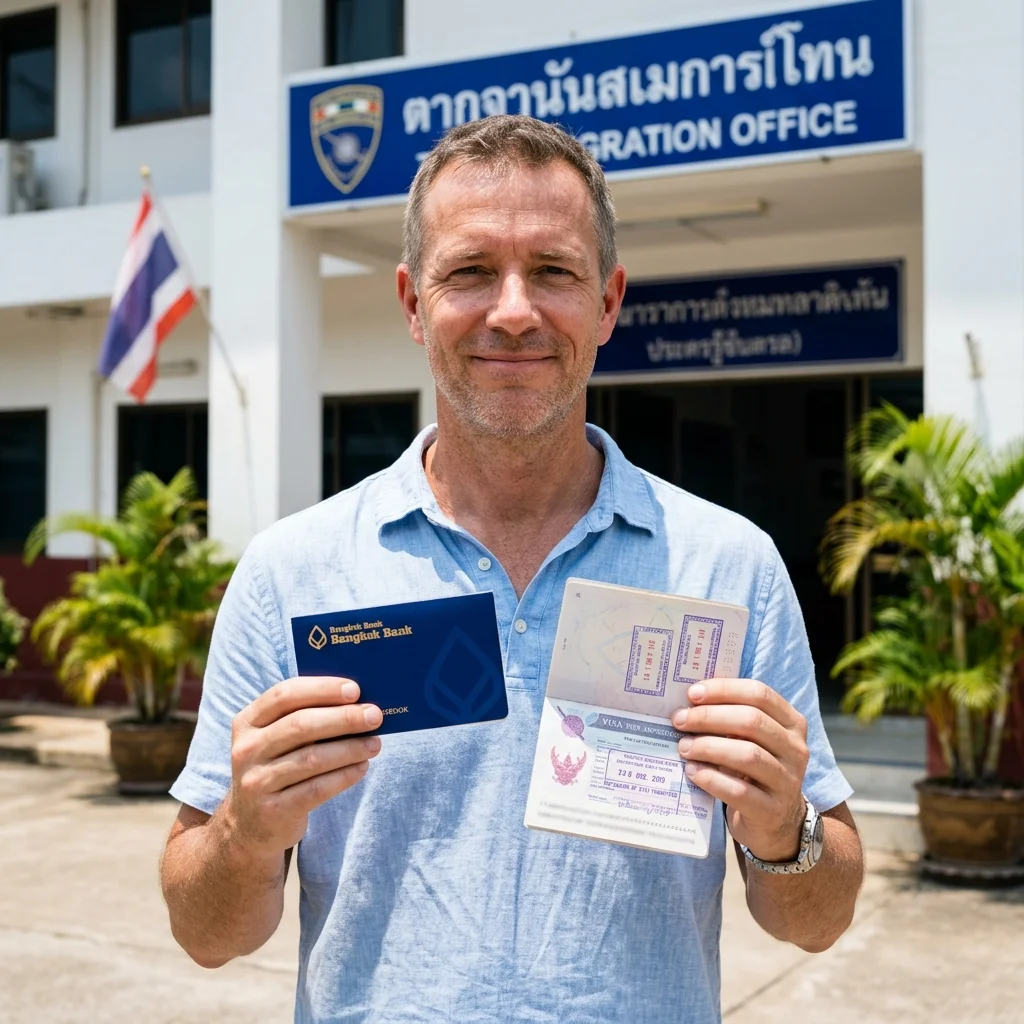
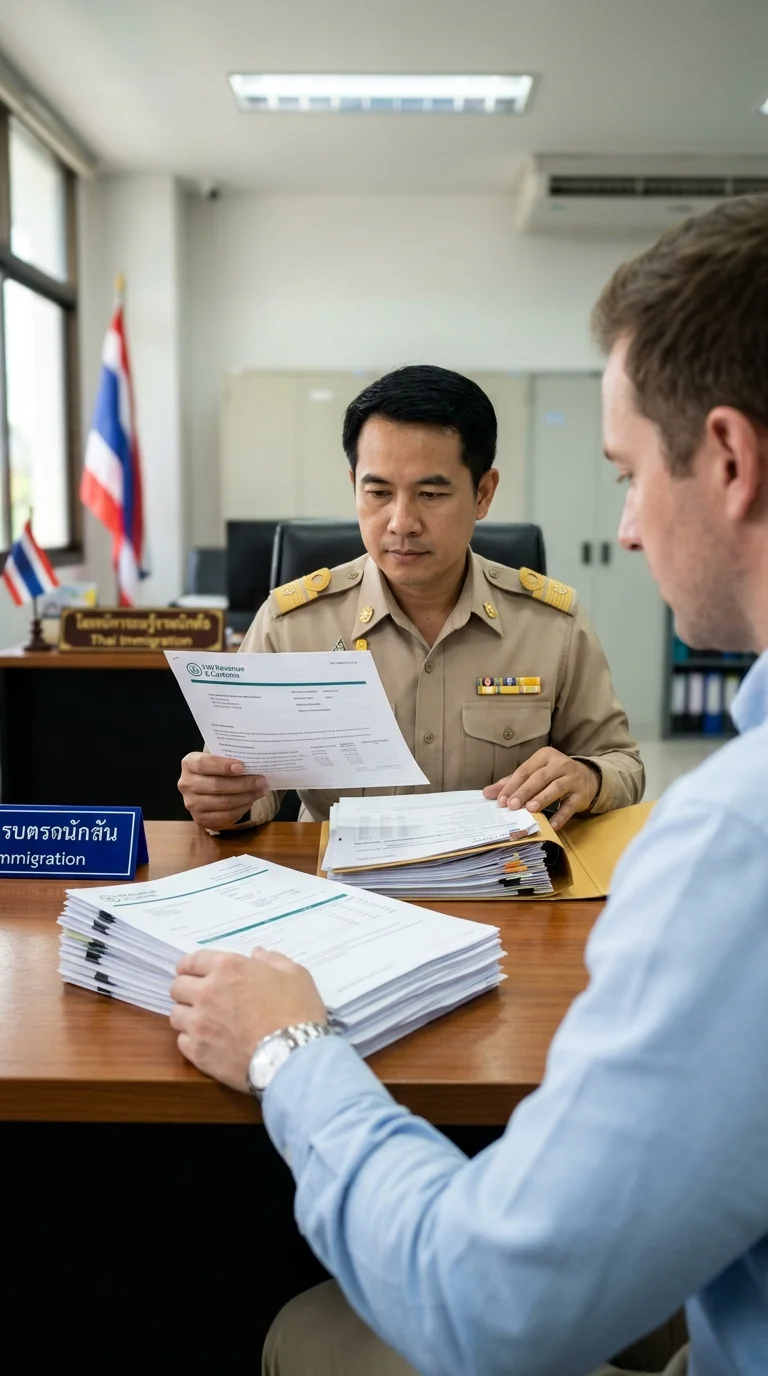
Securing your initial 90-day visa is merely the first phase of living in Thailand. During the final 30 days of that initial stamp, you must apply for a one-year extension. This yearly renewal requires updated financial evidence and fresh photographs of your home life. You must also supply a newly printed Kor Ror 2 marriage registry document. Financial requirements become stricter during these renewals. If you use the 400,000 THB deposit method, the money must sit in your account for two months before the application. It must then remain untouched for three months after approval. Immigration officers often visit your registered address unannounced to verify you genuinely live together. This inspection happens during the one-month consideration period. Alongside the annual extension, you must comply with the 90-day reporting rule. Every 90 days, you must notify immigration of your current address. Failing to report results in a 2,000 THB (£44) fine. Maintain your financial threshold year-round and set calendar reminders for your 90-day reports to avoid fines and renewal complications.
Marriage Visa Versus Retirement Visa
UK nationals over 50 frequently face a choice between the Marriage Visa and the Retirement Visa. The Marriage Visa allows you to obtain a Thai work permit. This is strictly prohibited on a retirement extension. It also carries a lower financial threshold, requiring 400,000 THB (£8,800) instead of the retirement route's 800,000 THB (£17,600). However, the administrative burden of the Marriage Visa is significantly higher. Retirement extensions do not require your spouse to attend immigration. They also skip home inspections and invasive relationship documentation. Because the Marriage Visa relies entirely on your relationship status, any separation immediately invalidates your right to stay. For older expats who do not intend to work, the higher financial requirement of the Retirement Visa is often worth the reduced paperwork. You can switch from a Marriage extension to a Retirement extension at the end of your annual cycle. If you are over 50 and have 800,000 THB available, the Retirement Visa offers a much less intrusive application process provided you do not plan to work.
| Feature | Marriage Visa (Non-O) | Retirement Visa (Non-O/O-A) |
|---|---|---|
| Minimum Age | None | 50 years old |
| Financial Deposit | 400,000 THB (£8,800) | 800,000 THB (£17,600) |
| Work Permit Eligibility | Yes | No (strictly prohibited) |
| Spouse Attendance | Mandatory at application | Not required |
Navigating Relationship Breakdowns
Living in Thailand on a Marriage Visa ties your immigration status directly to your marital harmony. If your relationship breaks down and you legally divorce, your visa extension is cancelled immediately. There is no grace period to remain in the country. You must leave Thailand on the exact day your divorce is finalised. Overstaying results in fines of 500 THB (£11) per day. If you need more time to pack, you can visit an immigration office with your divorce certificate. You can pay 1,900 THB (£42) for a seven-day extension to organise your departure. If you separate but do not legally divorce, your current visa remains valid until its expiry date. However, you cannot renew it, as your spouse must attend the renewal appointment. To remain in Thailand post-divorce, you must secure a different visa category entirely independently of your former spouse. Plan your transition to another visa category carefully before finalising a divorce, as your right to stay ends the moment the paperwork is signed.
Costs and Budgeting
Budgeting for a Marriage Visa involves far more than just the official application fee. The baseline cost for a single-entry Non-Immigrant O visa via the London E-Visa system is roughly 3,000 THB (£65). Once in Thailand, your annual extension of stay costs an additional 1,900 THB (£42). However, you must factor in the hidden costs of document preparation. If you married in the UK, legalising and translating your marriage certificate will cost approximately 7,000 THB (£155) in FCDO, MFA, and translation fees. You will also incur domestic travel expenses visiting your local Amphoe and the provincial immigration office. Many UK expats choose to hire a visa agent to navigate the complex paperwork. Agent fees for a marriage extension typically range from 15,000 to 25,000 THB (£330 to £550), which includes document checking and guided visits. Maintaining the required 400,000 THB (£8,800) in a Thai bank account represents a significant capital commitment that you cannot access during the application window.
| Item | Cost (THB) | Cost (GBP approx) | Notes |
|---|---|---|---|
| UK E-Visa Application | 3,000 THB | £65 | Paid online via the official Thai E-Visa portal. |
| In-Country Conversion | 2,000 THB | £44 | Paid at the local immigration office in Thailand. |
| Annual Extension Fee | 1,900 THB | £42 | Required every year to renew your stay. |
| UK Marriage Legalisation | 7,000 THB | £155 | Includes FCDO, certified translation, and MFA authentication. |
| Professional Visa Agent | 15,000 - 25,000 THB | £330 - £550 | Optional service for document preparation and immigration liaison. |
Common Mistakes and How to Avoid Them
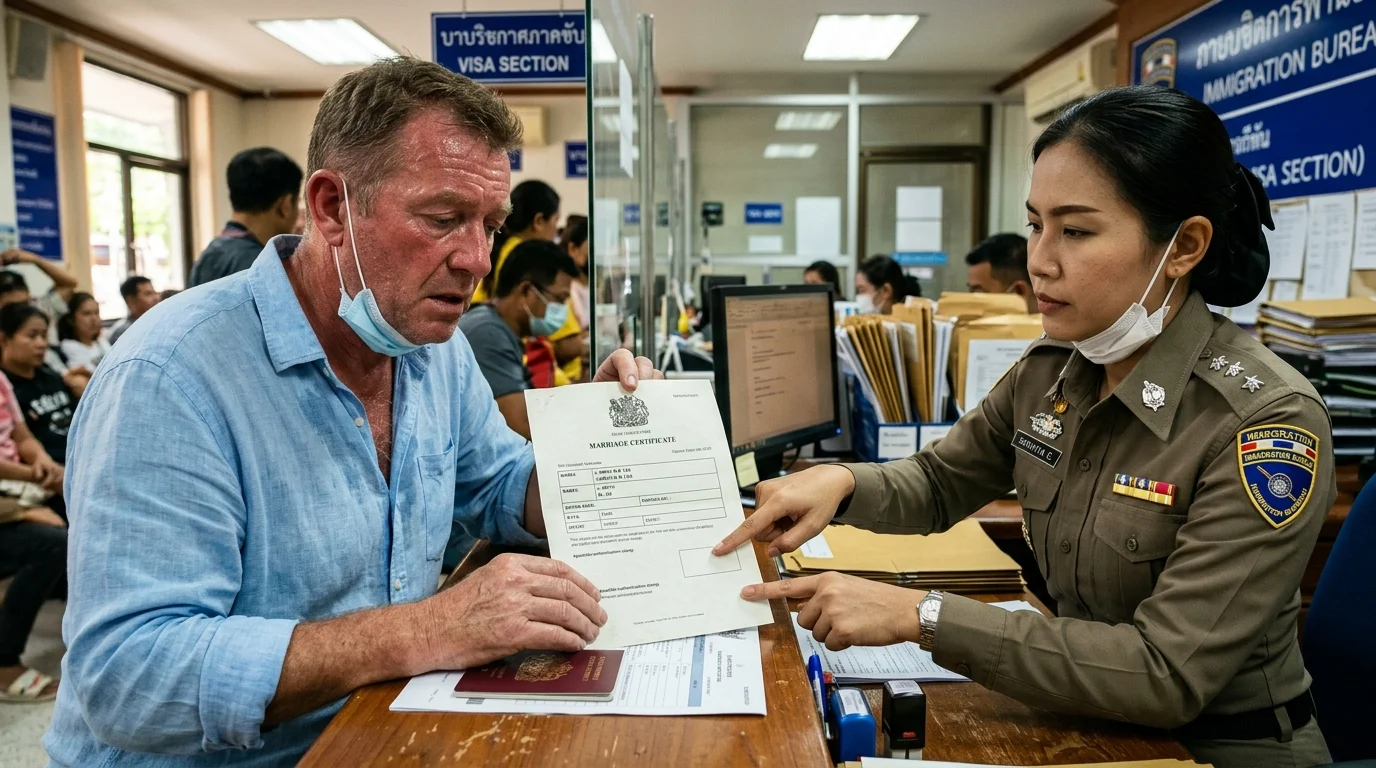
Failing to legalise a foreign marriage certificate guarantees an application rejection. Officers will halt your process, forcing a lengthy authentication scramble between London and Bangkok. Always get your UK certificate stamped by the FCDO and Thai MFA beforehand.
Using joint bank accounts to prove financial eligibility violates immigration protocols. Your visa will be denied because the 400,000 THB deposit must sit in an account solely in your name. Open an individual Thai savings account exclusively for visa funds.
Letting your bank balance drop below the threshold triggers an automatic cancellation. You will lose your pending status and must restart the entire process. Treat the 400,000 THB as locked funds until your final approval stamp is issued.
Submitting an outdated Kor Ror 2 document delays your extension appointment. Officers will send you away, wasting time as your visa expiry looms. Print a fresh Kor Ror 2 from the Amphoe within seven days of your visit.
Practical Tips

Print out physical maps detailing the route from the immigration office to your home. Officers require this hand-drawn or printed map to conduct their unannounced residence checks during the consideration period.
Ensure your spouse’s Thai ID card matches your current registered address exactly. Immigration will flag discrepancies between the ID card address, the house registration book, and your actual residence.
Dress formally when visiting the immigration office and for your submitted relationship photographs. Thai officials expect a high standard of presentation, and collared shirts make the interview process smoother.
Ask your bank for a specific visa confirmation letter rather than a standard statement. Thai banks know exactly what this document is, and it includes the critical bank manager's signature required by immigration.
Keep copies of your UK passport stamps and boarding passes to prove your entry dates. These documents help establish a timeline of your relationship and periods of cohabitation in Thailand.
Include photographs showing your clothes in the wardrobe and toothbrushes in the bathroom. Officers look for these mundane details in your photo evidence to confirm you genuinely share a life together.
Update your UK bank statements the day before you fly if using the income method. You must prove the foreign income trail is active immediately prior to entering the Thai immigration system.
Let experts handle the paperwork while you focus on your life in Thailand.
[DISCLAIMER: Visa rules and fees are subject to change. Always verify current requirements with the official Thai Immigration Bureau at immigration.go.th or the Royal Thai Embassy before applying.]
Quick Reference Table
| Item | Detail | Notes |
|---|---|---|
| Visa Category | Non-Immigrant O (Marriage) | Exclusively for legal spouses of Thai citizens. |
| Maximum Initial Stay | 90 days | Must be extended internally for a one-year permit. |
| Financial Requirement | 400,000 THB or 40,000 THB/month | Deposit must be in a solo Thai bank account. |
| Application Route | UK E-Visa or In-Country Conversion | In-country requires 15 days remaining on current stamp. |
| Official Application Fee | 3,000 THB (£65) from UK | In-country conversion is 2,000 THB (£44). |
| Extension Options | 1-year annual renewals | Costs 1,900 THB (£42) per year. |
| Reporting Obligation | Every 90 days | Mandatory address check, can be done online. |
| Work Permit Status | Eligible to apply | Visa does not grant the right to work on its own. |