Red Mountain Golf Club Phuket
Red Mountain Golf Club occupies a rugged, undulating basin in central Phuket's Kathu district, shaped directly by the island's twentieth-century tin-mining heritage. Cut through sheer red-rock faces, thick tropical jungle, and flooded mining gullies, the course provides one of the island's most distinctive sporting landscapes. Significant elevation changes define the experience, with sheer drops of up to 50 metres requiring players to balance shot distance against steep vertical descents.
Developed and operated by the MBK Group, Red Mountain is an 18-hole, par-72 championship layout established alongside its more forgiving sister course, Loch Palm. It commands higher green fees and presents a substantially sterner test of ability than its neighbour. The layout penalises errant shots heavily: narrow fairways are tightly bordered by exposed mine tailings, dense undergrowth, and deep ravines, meaning off-target strikes frequently result in lost balls. The course is suited primarily to mid- and low-handicap golfers who have the ball control and course management skills to navigate tight landing corridors and severe gradient changes under tropical playing conditions.

The Landscape Architecture of Jon Morrow
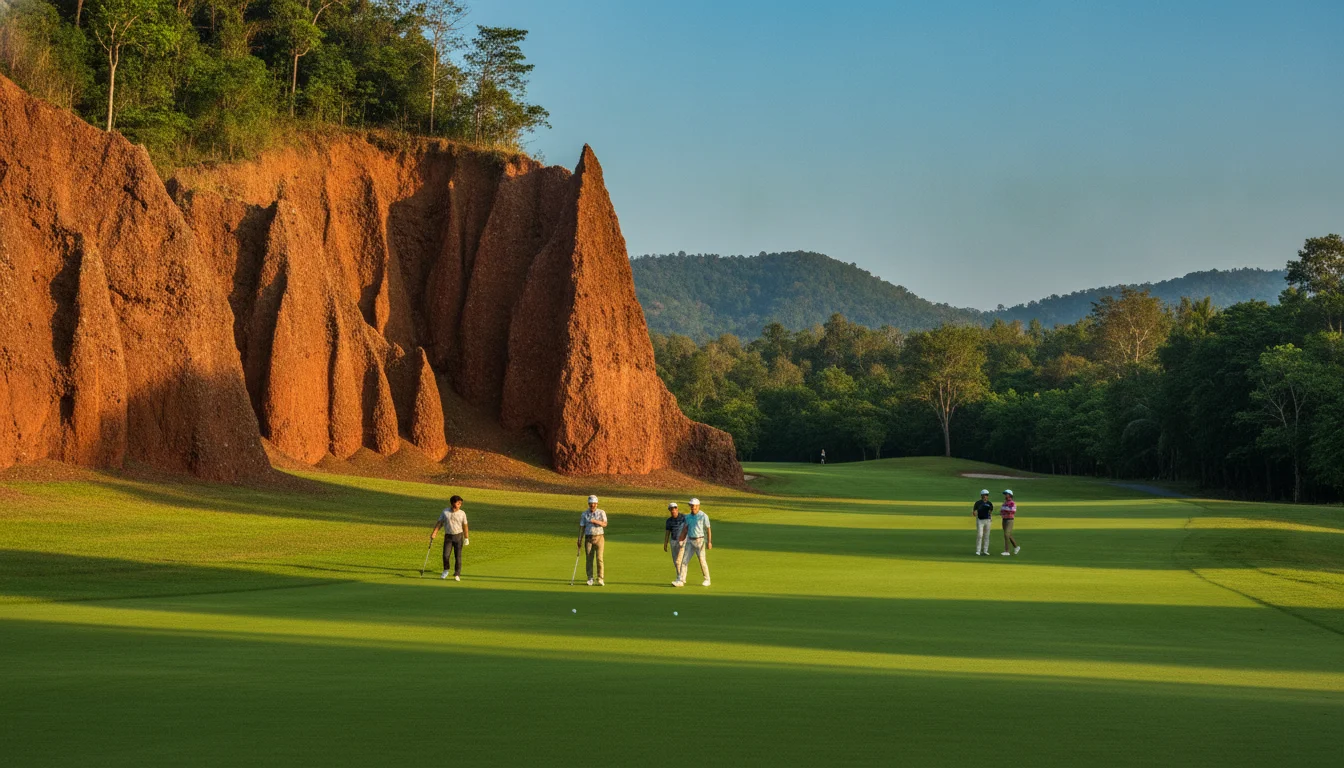
Red Mountain Golf Club owes its striking visual identity to the remnants of an abandoned opencast tin mine. Rather than flattening the scarred Kathu terrain into conventional fairways, course architect Jon Morrow and co-designer Al Tikkanen designed the 18-hole routing around the industrial features left behind by decades of excavation. Flooded mining pits form natural water hazards, while jagged gullies, sheer rock faces, and towering red-clay embankments frame the playing corridors.
The layout passes through several distinct ecological zones as it tracks the topography. Lower holes wind past marshland, bamboo thickets, and deep ravines before climbing sharply into higher ridges that overlook the Kathu basin. Throughout the grounds, bright green Seashore Paspalum fairways and Bermuda grass greens stand in sharp visual contrast to the deep ochre soil and exposed granite cliffs. Thick secondary jungle lines the boundaries, with native ferns, wild orchids, and pitcher plants colonising the old workings alongside established forest trees.
Morrow’s routing frequently uses extreme changes in grade to create amphitheatre-like perspectives. Several tee boxes sit perched on high rocky ledges well above the landing areas, presenting clear lines of sight across the fairways while forcing golfers to calculate the effect of elevation drops, crosswinds, and dense timber flanking the rough. By working with the contours of the quarry rather than reshaping them, the architects produced an unyielding landscape where the natural environment dictates every shot.
A Technical Analysis of the 18-Hole Layout
The 18-hole championship layout plays to a par of 72 and measures 6,781 yards from the back black tees, with alternative tees stepping down through yellow and blue at 6,341 yards, white at 5,925 yards, and red forward tees at 5,203 yards. While total yardage appears moderate on the scorecard, the extreme vertical changes alter effective distances across the round. Tight fairway corridors wind through jungle margins and old open-cast mining scars, where misaligned tee shots frequently disappear into dense secondary forest or deep ravines. Blind drives on several holes require precise alignment guided by caddie advice, as narrow landing areas often angle across the line of play rather than straight ahead.
The back nine delivers dramatic topographic shifts, climaxing in a memorable closing stretch. Hole 16 is a 301-yard par-4 that tees off from the highest point on the course, requiring an accurate drive to a fairway shelf angled below before approaching a guarded green. Hole 17, the signature par-3 playing at 169 yards from the tips, drops an estimated 40 to 50 metres from an elevated ridge down to a small green enclosed by rainforest. Swirling air currents in the ravine complicate club choice, with players regularly needing several clubs less than the flat distance indicates. On the front nine, the 167-yard par-3 3rd hole forces a carry across eroded red-earth gullies left by tin mining to an island-style green complex. Greens throughout the property run fast and feature multi-tiered surfaces and deceptive breaks that naturally follow the fall of the surrounding valleys.
| Hole Number | Par | Length (Yards - Gold) | Key Feature |
|---|---|---|---|
| Hole 3 | 3 | 167 | Tin mine wasteland carry to an island green |
| Hole 9 | 4 | 351 | Downhill fairway returning toward the clubhouse |
| Hole 16 | 4 | 301 | Elevated tee at Phuket's highest golf viewpoint |
| Hole 17 | 3 | 169 | Vertical jungle drop to a sunken valley green |
Uneven lies are standard on sloping fairway contours, leaving little room for error between tee and green. Golfers reserving a round on this course should prepare for a technically demanding test that rewards ball control and positional discipline over distance.
Discover Phuket's diverse landscapes, from granite mountains and tropical forests to stunning beaches and eastern bays. Plan your Thai island adventure now!
Clubhouse Facilities and Open-Air Dining
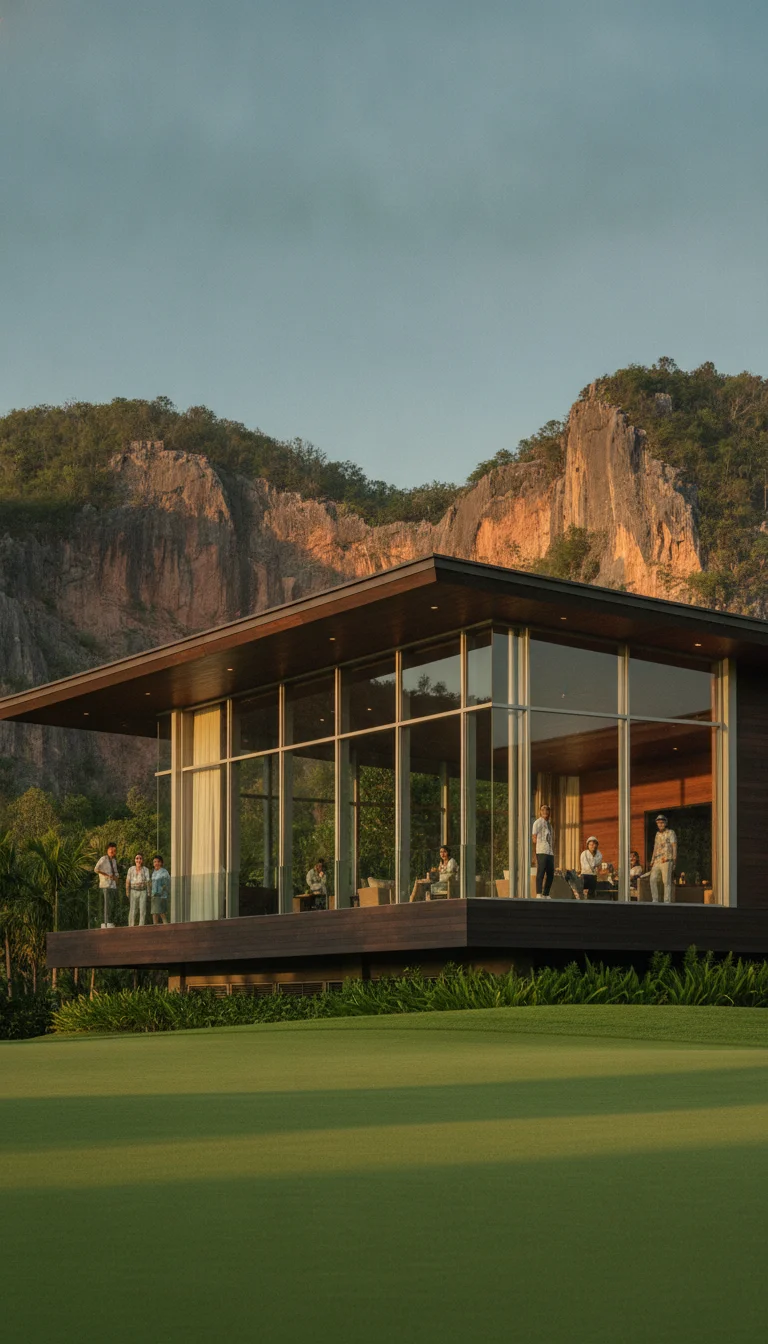
The clubhouse at Red Mountain adopts a modern tropical design, built across multiple levels with open breezeways and deep overhangs to stay cool in the Kathu heat. The building acts as a base before and after a round, housing player changing facilities, equipment services, and dining areas.
On the ground level, the pro shop stocks golf apparel, balls, gloves, and playing accessories, alongside club hire sets from major brands for golfers travelling without their own equipment. Rental shoes and umbrellas are also available at reception. Nearby, separate male and female air-conditioned locker rooms provide complimentary lockers, changing spaces, and showers stocked with toiletries, allowing players to freshen up after navigating Phuket's high humidity.
Dining centres on a restaurant split between an air-conditioned dining room and a broad, shaded open-air terrace that catches the valley breeze. Elevated directly above the 18th green, the terrace provides clear views across the closing approach and over towards the 9th fairway and quarry cliffs. It makes a welcoming spot to watch other groups tackle the final green over a cold local beer. The kitchen opens early for breakfast before the first tee times and serves an all-day menu combining Thai classics, including pad krapow and noodle dishes, with Western staples like burgers and club sandwiches.
Navigating the Extreme Terrain and Mandatory Cart Use
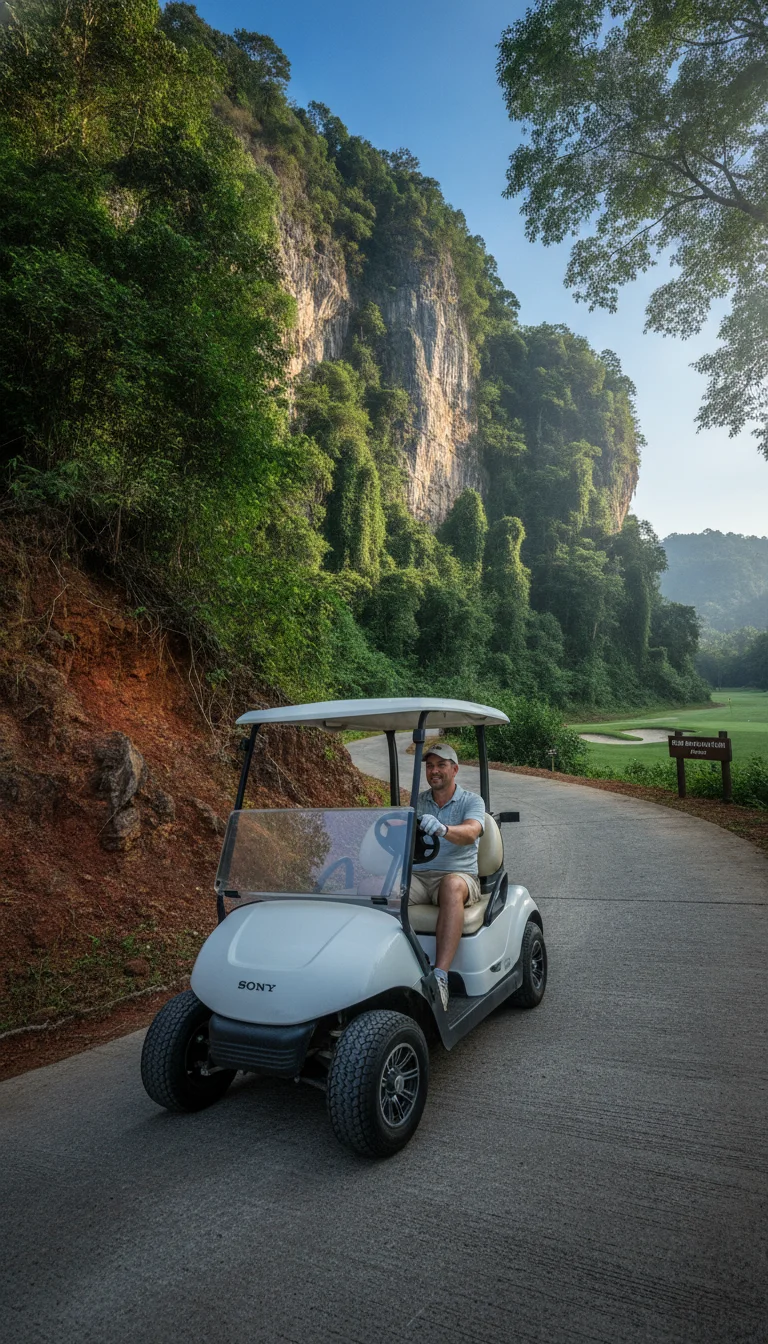
Walking the fairways at Red Mountain is not permitted. Due to severe elevation changes, rugged former tin mine topography, and substantial distances between greens and the subsequent tee boxes, the club enforces a strict policy requiring every player to use an individual golf cart. Sharing a buggy between two golfers is not allowed. The concrete cart paths form an intricate transit network across the property, winding along red laterite cliffs, cutting through dense jungle corridors, and descending steep ravine banks where climbing on foot in tropical heat and humidity would quickly deplete your stamina.
Players do not drive the buggies. Caddies take the wheel for the duration of the round, navigating tight switchbacks, blind turns, and sudden gradient drops while you sit back and study your next shot. Golf bags stay mounted to the rear, and caddies pull up along the cart path before selecting clubs. The vertical climbs between holes can span dozens of metres, elevating golfers high above earlier fairways with open vistas across the Kathu valley before plunging into shaded forest hollows. Higher sections along the ridges benefit from occasional breezes, but the tropical sun remains intense, making the buggy's overhead canopy welcome shelter.
This compulsory motorised system maintains a steady pace of play across a layout that would otherwise grind to a halt. The club marshals monitor a target round time of roughly four hours and fifteen minutes for 18 holes, ensuring groups move efficiently through the dramatic terrain without unnecessary delays between tees.
Location and Getting There
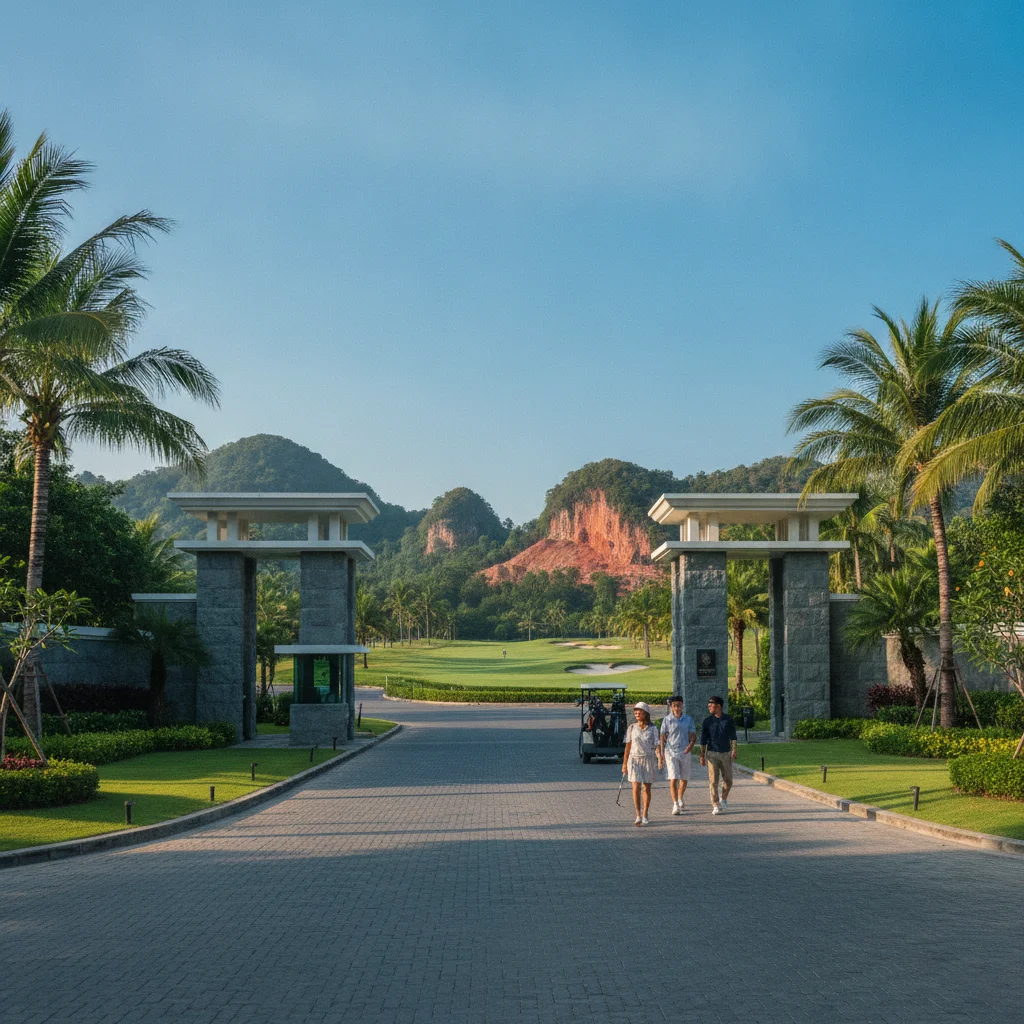
Red Mountain Golf Club sits in the Kathu valley in central Phuket, accessed just off Vichitsongkram Road alongside its sibling layout, Loch Palm. Its mid-island location places it within easy reach of the main resort areas on the west coast and commercial centres in Phuket Town.
From the beachfront resort of Patong, the seven-kilometre drive eastward takes roughly 15 to 20 minutes, though journeys can take longer during peak hours when traffic slows over Patong Hill. Golfers travelling south from Bang Tao or the Laguna resort complex should expect a run of roughly 30 to 40 minutes covering around 18 kilometres. From Phuket International Airport, the 35-kilometre route south down Thepkrasattri Road typically takes 45 to 55 minutes, depending on highway conditions.
Private taxis and ride-hailing apps such as Grab and Bolt operate regularly across the island. A standard one-way fare between Patong and the course typically runs between 500 THB and 700 THB (approximately £11.50 to £16). Because the club sits deep in the Kathu hills away from passing traffic, arrange a round-trip hire or book a return car ahead of time; securing an on-demand taxi from the clubhouse gates during the late afternoon can involve frustrating delays.
Costs and Booking
Playing at Red Mountain represents one of the higher golfing expenditures in Thailand, with standard visitor green fees set at 6,000 THB (approximately £138) for 18 holes during the peak dry season from November to March. This rate reflects the extensive maintenance required for carved mountain terrain and sits well above the green fee of neighbouring Loch Palm, also operated by the MBK Group. During the low season from April to October, 18-hole green fees drop to between 3,200 and 3,500 THB (£74 to £80), with reduced promotional packages commonly available.
Beyond the baseline green fee, every golfer pays two mandatory surcharges at the pro shop: a 400 THB (£9.20) caddie fee and a 700 THB (£16.15) golf cart fee. Carts cannot be shared due to the steep inclines and narrow cliff paths, meaning every player in a group pays an individual cart charge. After finishing the round, golfers customarily hand a cash tip directly to their caddie; while 400 THB (£9.20) represents the standard minimum, 500 THB (£11.50) is the figure recommended by the club. Golfers who travel without equipment can hire club sets from the pro shop for 1,500 to 1,800 THB (£34.50 to £41.40), while non-playing companions who ride along pay a follower fee of 1,700 THB (£39.10).
| Fee Type | Cost (THB) | Cost (GBP approx) | Notes |
|---|---|---|---|
| High Season Green Fee | 6,000 | 138.00 | 18 holes; excludes caddie and cart |
| Low Season Green Fee | 3,200–3,500 | 73.60–80.50 | 18 holes; April to October |
| Mandatory Caddie Fee | 400 | 9.20 | Per player; paid at check-in |
| Mandatory Cart Fee | 700 | 16.15 | Per player; single use compulsory |
| Recommended Caddie Tip | 400–500 | 9.20–11.50 | Cash only; paid directly to caddie |
| Pro Shop Club Rental | 1,500–1,800 | 34.50–41.40 | Per set; full 18-hole hire |
Who the Course Suits
Red Mountain is laid out for competent golfers with low to mid-handicaps who relish a strategic, high-risk round. Tight fairways, severe elevation drops, and forced carries across former mining scars and jungle ravines heavily penalise wayward ball striking. High-handicappers and beginners often find the layout punishing, with frequent ball losses and demanding approach angles that can turn a round into an arduous outing rather than a relaxed game.
While popular with visiting golf societies and small groups seeking a visually dramatic round, the layout does not lend itself to casual family outings. Walking is prohibited because of the steep inclines and lengthy distances between greens and tees. Non-playing companions may follow a group on the course, but the club requires them to pay a spectator fee at the pro shop, ride in a golf cart, and follow standard golf etiquette and attire.
What to Know Before You Book

The club maintains a formal dress code. Men must wear collared polo shirts with tailored trousers or tailored shorts, socks, and soft-spike golf shoes. Women must wear collared shirts or tailored golf blouses with appropriate shorts, skirts, or trousers. Denim, collarless t-shirts, athletic vests, cargo shorts, swimwear, and sandals are prohibited. Golfers who arrive in non-compliant casual wear must purchase suitable apparel at the pro shop before the starter permits them onto the first tee.
Bring an ample supply of balls—at least two spare sleeves for steady players, and considerably more for higher handicaps. Dense jungle vegetation, flooded canyons, and red rock bluffs border the fairways, making balls that leave the mown grass virtually unrecoverable. For post-round expenses, ensure you carry cash in Thai Baht for the caddie tip. While green fees, cart rentals, and pro-shop purchases can be settled by credit card, gratuities are paid directly to caddies in cash. During the peak winter season from November to March, morning tee times are heavily booked by tour operators, so securing slots three to four weeks ahead is recommended.
Practical Tips
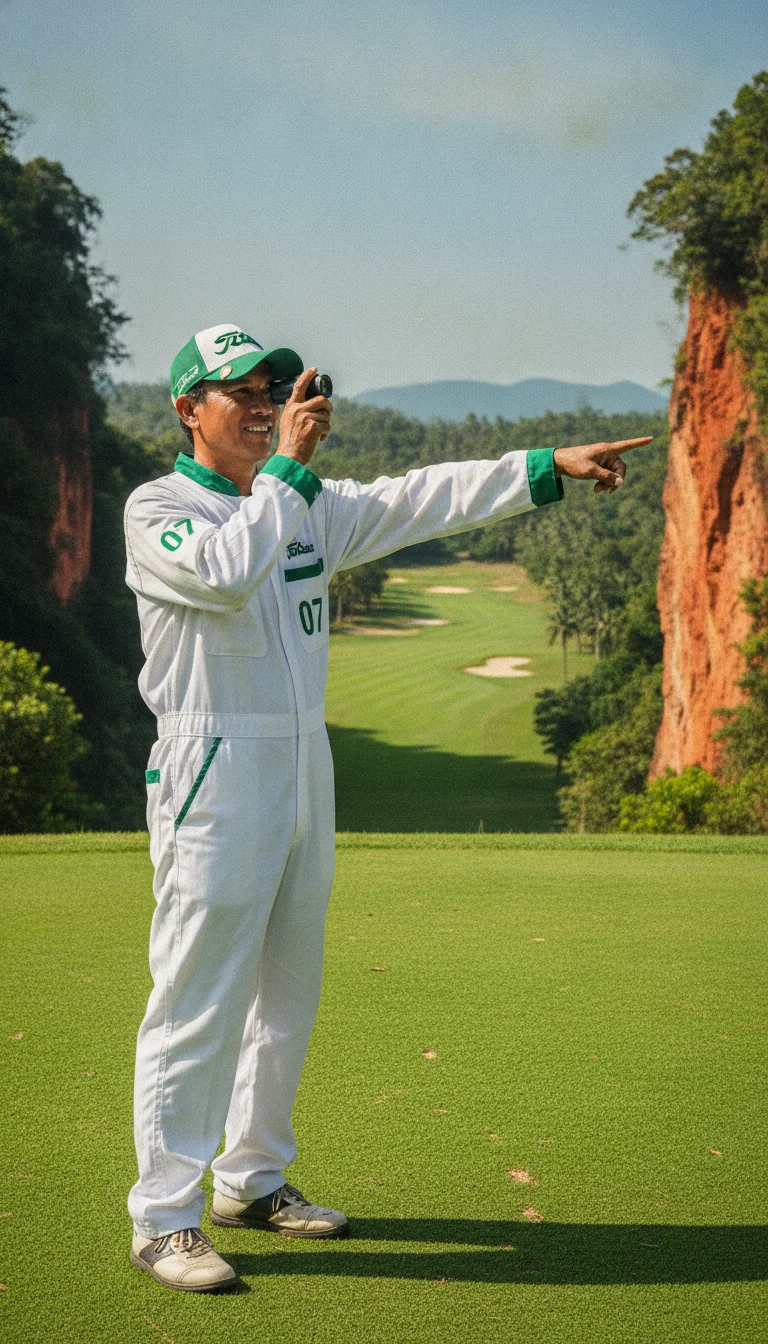
On the dramatic downhill par-3s, particularly the 17th, defer to your caddie on club selection. The sheer vertical drop means your ball hangs in the air far longer and travels noticeably further than the measured yardage indicates, often requiring one to two clubs less than standard distance calculations. Off the tee on tighter holes, leave the driver in the bag. Aiming for the centre of the fairway with a fairway wood or long iron pays dividends, as wayward drives beyond the narrow rough invariably plunge into thick jungle ravines where recovery is impossible. Packing an extra sleeve or two of golf balls is sensible insurance against the unforgiving terrain.
Kathu's humid microclimate takes a heavy physical toll over an 18-hole round. Apply high-factor sun cream and mosquito repellent before stepping out of the clubhouse, as the course borders dense rainforest where biting insects thrive. Keep a dry towel clipped to your bag and consider rotating two or three golf gloves, since sweaty grips quickly undermine club control in the tropical heat. Take advantage of the on-course refreshment kiosks positioned every few holes to stock up on chilled water and electrolyte drinks, keeping small-denomination Thai Baht notes to hand for quick payments.
Arrive with ample time to spend at least fifteen minutes on the practice putting green beside the clubhouse. The greens run considerably faster and firmer than most neighbouring courses in Phuket, making it crucial to calibrate your stroke and understand green speeds before the opening hole. While the elevated 17th tee offers a striking vantage point that invites photographs, take your pictures promptly. Course marshals actively patrol the back nine to maintain flight intervals, and lingering on the tee creates immediate bottlenecks behind you.
Quick Reference Table
| Item | Detail | Notes |
|---|---|---|
| Course layout | 18 holes, par 72 | 6,781 yards from back tees; four tee sets down to 5,203 yards |
| Target pace of play | 4 hours 15 minutes | Monitored by course marshals |
| High season green fee | 6,000 THB (£138) | November to March; 18 holes; excludes cart and caddie |
| Low season green fee | 3,200–3,500 THB (£74–£80) | April to October; 18 holes |
| Mandatory caddie fee | 400 THB (£9.20) | Per player; paid at check-in |
| Mandatory golf cart fee | 700 THB (£16.15) | Per player; single use only, driven by caddie |
| Recommended caddie tip | 400–500 THB (£9.20–£11.50) | Cash only; paid directly to caddie after round |
| Club hire | 1,500–1,800 THB (£34.50–£41.40) | Full set rental available at pro shop |
| Non-playing spectator fee | 1,700 THB (£39.10) | Follower must ride in cart and follow dress code |
| Distance from Patong | 7 km (15–20 minutes) | Taxi fare approx. 500–700 THB (£11.50–£16) |
| Distance from Bang Tao / Laguna | 18 km (30–40 minutes) | Mid-island transit |
| Distance from Phuket Airport | 35 km (45–55 minutes) | South via Thepkrasattri Road |
| Website | https://www.mbkgolf.com/red-mountain | Official MBK Group property site |
FAQ: Red Mountain Golf Club Phuket - Guide
Who is Red Mountain Golf Club best suited for?
How should golfers adjust their club selection for downhill par-3s like the 17th hole at Red Mountain?
Can golfers rent equipment at Red Mountain Golf Club?
Is walking permitted on the golf course at Red Mountain Golf Club?
Do golfers drive their own carts at Red Mountain Golf Club?
What is the best way to arrange transportation to and from Red Mountain Golf Club?
How far in advance should I book a tee time at Red Mountain Golf Club during peak season?
What is the recommended caddie tip at Red Mountain Golf Club?
Are non-playing companions allowed to follow a group on the course at Red Mountain Golf Club?
What is the dress code for golfers at Red Mountain Golf Club?
Reviewed by the Thailand Guide Editorial Team • Last reviewed: 9 September 2026
This page is provided for general information only. While we aim for accuracy, details can change — please verify anything important independently before relying on it.