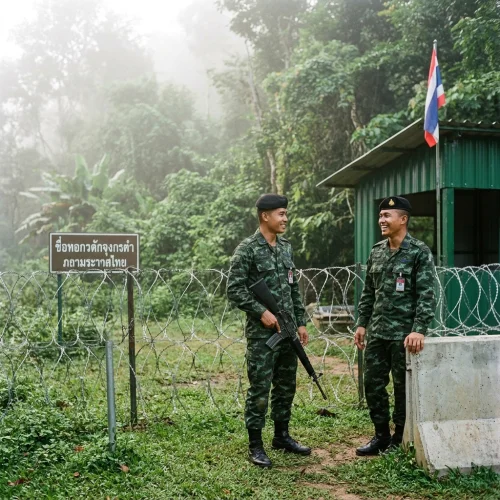
The Royal Thai Army has formally rejected allegations from the Cambodian government that Thai forces are deploying troops and barbed-wire barriers to alter the international border unilaterally.
Army spokesperson Major General Winthai Suvaree confirmed the military position on Tuesday, responding directly to claims made by Cambodian government spokesperson Pen Bona. The dispute centres on security operations along contested stretches of the frontier, where Thai units have placed physical obstacles to prevent unauthorised access. Cambodian officials argue that these measures constitute an unlawful expansion into their territory, violating bilateral agreements. In contrast, Bangkok maintains that all defensive measures sit entirely within sovereign Thai territory and serve solely to maintain order.
For the estimated tens of thousands of British citizens residing in Thailand, particularly those living in eastern border provinces or relying on overland crossings for immigration purposes, the development underscores ongoing regional sensitivities.
The Border Dispute and Military Positions
The formal exchange follows weeks of heightened tension over un-demarcated sections of the frontier.
Cambodia contends that Thai troops have placed barbed-wire fencing, shipping containers, and field fortifications across land that remains subject to joint negotiation. Pen Bona stated that Phnom Penh would refuse to recognise boundaries established by military force and intended to pursue the matter through diplomatic channels and international law. Cambodia insists that all border questions must be resolved exclusively through the bilateral Joint Boundary Commission.
The Thai military dismissed these claims as unfounded.
Major General Winthai stated that Thailand has not deployed personnel to establish a new frontier line. The barriers, he explained, are protective measures designed to reduce the risk of armed confrontations and civilian encroachment. Bangkok argues that physical barriers are essential for local policing. By defining the limits of Thai administration on the ground, the military aims to prevent skirmishes between local populations and armed border patrols.
Disagreements Over Displaced Populations
The dispute also involves conflicting claims regarding civilian displacement in the frontier zone.
Cambodian authorities stated that more than 20,000 people remain unable to return to their homes as a result of Thai security operations. Thai authorities reject this figure entirely. Winthai clarified that Thai assessments account for approximately 4,600 people linked to three specific border settlements: Ban Nong Chan, Ban Nong Ya Kaeo, and Ban Khlong Phaeng.
Thailand classifies these locations as sovereign territory that experienced civilian settlement following regional conflicts during the 1970s. The Thai government previously submitted documentation to the United Nations indicating that these communities began as temporary refugee sanctuaries. Over four decades, these settlements expanded into permanent villages. Thailand regards this expansion as unlawful civilian encroachment rather than modern displacement caused by military operations.
Cambodia rejects this historical view. Phnom Penh maintains that the villages fall within Cambodian sovereignty, pending formal demarcation.
Implications for British Nationals and Overland Travel
The friction along the eastern border directly affects UK nationals who travel overland between Thailand and Cambodia.
Commercial crossings remain open. The primary land checkpoint between Aranyaprathet in Sa Kaeo province and Poipet in Cambodia continues to process international travellers, freight, and tourist transport. However, British expatriates undertaking border runs to renew Thai entry stamps or visas must exercise caution. Minor checkpoints and unpaved rural routes in Sa Kaeo, Surin, and Si Sa Ket provinces face heavy military surveillance.
The Foreign, Commonwealth and Development Office (FCDO) maintains longstanding travel advice regarding the Thai-Cambodian border. British citizens are advised to avoid remote, un-demarcated border areas and disputed heritage sites, including the areas surrounding the Preah Vihear temple complex and the Ta Krabey temple.
Unmarked landmines remain an active hazard in rural border districts. Military activity in these zones increases the risk of inadvertent entry into restricted or dangerous terrain. UK nationals travelling by car or motorbike through border provinces should stick entirely to main arterial roads. You must carry your original British passport with valid immigration stamps at all times, as internal military checkpoints operate regularly across Sa Kaeo, Surin, Buriram, and Ubon Ratchathani.
Property, Leases, and Rural Residence
A growing number of British retirees and long-term expatriates reside in Thailand’s rural northeastern and eastern provinces.
While foreign nationals cannot directly own freehold land in Thailand, many UK citizens hold registered long-term leases on residential plots or own detached houses built on land leased through a Thai spouse. The ongoing border friction highlights the importance of thorough legal due diligence when leasing land or purchasing a residential unit in frontier provinces.
Disputed areas often feature ambiguous land title deeds. In remote districts of border provinces, plots may be classified under agricultural land reform categories (such as Sor Por Kor) or lack definitive title deeds (Chanote). Land near contested borders may be subject to military administration or future demarcation adjustments.
British expatriates securing leases or investing in domestic property outside major municipal centres should verify that all real estate possesses clear, undisputed title registered with the provincial Land Department. Holding a lease on land subject to boundary claims creates severe legal vulnerabilities, as civilian courts cannot override state security designations.
Diplomatic Outlook and Frontier Stability
Both governments have reiterated their commitment to peaceful negotiations, despite the strong rhetoric exchanged this week.
Major General Winthai confirmed that Thailand remains bound by the ceasefire framework agreed on 27 December 2025. This agreement requires both nations to maintain existing troop deployments, halt provocative physical expansions, and resume formal surveying through the Joint Boundary Commission.
Bangkok has urged Phnom Penh to resolve differences through bilateral mechanisms based on verifiable geographic data rather than public accusations. The Thai government has made clear that while it will defend its border administration, it seeks no armed escalation.
For British residents in Thailand, daily life in the major urban centres of Bangkok, Chiang Mai, and the southern islands remains entirely unaffected by these developments. The regional economy remains integrated, and trade continues across established international corridors.
Nevertheless, UK expatriates living in border regions should monitor local news, check FCDO travel updates before planning cross-border holidays, and ensure their immigration paperwork is strictly in order when travelling near the eastern frontier.
Source: nationthailand.com
Reviewed by the Thailand Guide Editorial Team • Last reviewed: 28 October 2026
This page is provided for general information only. While we aim for accuracy, details can change — please verify anything important independently before relying on it.