Thailand Visa Services
The official Thai electronic visa portal requires precise digital documentation, and the Royal Thai Embassy in London enforces rigorous submission standards. Submitting incomplete paperwork, invalid file formats, or clerical errors can lead to application rejection, with official government fees remaining non-refundable under all circumstances. For UK passport holders managing complex documentation or navigating unfamiliar platform rules, private visa services offer a structured alternative to submitting an application independently.
This guide details what commercial Thailand visa services deliver across varying levels of support, from document pre-checks to comprehensive agency representation. It explains how third-party handling compares with the direct government portal, helping you evaluate when paying an administrative service fee provides genuine value and when a direct submission remains the practical choice.

Direct Application versus Third-Party Visa Services

Applying directly for a Thai visa requires using the official government electronic visa portal (thaievisa.go.th). Applicants must create an account, complete digital forms, and manage all document formatting independently. This process includes compressing passport scans and supporting evidence to under 3 MB per upload, proving UK residency, and uploading compliant financial evidence. Direct applicants bear sole responsibility for accuracy. The Royal Thai Embassy does not refund fees for rejected submissions, meaning mistakes such as selecting the wrong consular post, entering names that do not match the passport biodata page, or uploading incorrect bank documentation result in a lost fee and a rejected application.
Third-party visa services operate as commercial intermediaries between the applicant and consular authorities. They do not grant visas, modify eligibility criteria, or bypass immigration rules. Consular processing times remain the same whether applying directly or through an agency, typically requiring 5 to 15 working days at the Royal Thai Embassy in London. Commercial services instead offer administrative checking: reviewing raw documents, resizing files to portal specifications, verifying information against passport records, and managing digital submissions on the applicant's behalf.
The practical distinction between applying directly and using an intermediary centres on administrative workload and error prevention. For complex itineraries or visa categories involving higher non-refundable fees, delegating file preparation provides structured pre-submission checks to minimise technical rejections before consular review.
Types of Visa Services Available
The visa service market for UK nationals divides into three distinct tiers of assistance, ranging from light oversight to complete application management. Basic document checking services require you to complete the application, but an expert reviews your files before you press submit. Full-service digital platforms take your raw information via a simplified questionnaire, handling the entire official Thai e-Visa portal data entry for you. Concierge or premium agency services provide dedicated account managers who physically collect your passport if necessary, liaise directly with embassy staff, and handle complex long-stay routes like the Non-Immigrant O-A (Retirement) visa. Basic services usually turn around document checks within 24 hours to keep your application moving. Digital platforms process your data within 48 hours before official embassy submission. Premium concierge services often include vital additional perks, such as arranging the mandatory medical certificates or securing the exact Thai health insurance required for specific long-stay tiers. You must choose a service tier that matches the complexity of your visa type. A simple 60-day Tourist Visa rarely requires premium concierge handling, whereas a Non-Immigrant B (Business) application heavily benefits from expert oversight.
Takeaway: Select a service tier based on your visa complexity, matching basic digital platforms to tourist entries and full concierge services to long-stay relocation.
| Service Tier | What They Do | Best Suited For | Typical UK Cost |
|---|---|---|---|
| Document Checking | Reviews your self-prepared files before you submit | Confident applicants needing peace of mind | £20 to £40 |
| Digital Platform | Takes raw data, formats files, completes official portal entry | Tourist Visas, Destination Thailand Visas | £30 to £80 |
| Premium Concierge | Dedicated agent, direct embassy liaison, arranges supporting docs | Retirement, Business, Marriage Visas | £150 to £500+ |
Understand how the Thai legal system works for UK nationals, including when to hire a licensed Thai lawyer, legal fee structures, and embassy limits.
When Using a Paid Service Makes Financial Sense

Paying for third-party visa assistance becomes economically sensible when applying for higher-tier immigration categories that carry substantial, non-refundable government charges and strict documentation requirements. Category fees on the Thai e-Visa portal range from £150 for a multiple-entry Non-Immigrant O-A retirement visa to £300 for the Destination Thailand Visa (DTV). Because the Royal Thai Embassy does not refund application fees if a submission is rejected due to incorrect documentation, upload errors, or mismatched financial evidence, a rejected application forfeits the entire fee.
For these routes, financial thresholds are high. The DTV requires proof of at least £11,000 (500,000 THB), while the Non-Immigrant O-A requires 800,000 THB (approximately £18,000) or certified monthly income. Sourcing, formatting, and presenting months of bank statements, employment contracts, medical certificates, or criminal record checks to exact consular standards creates significant room for procedural errors. Paying an agency a modest service charge to audit files before submission functions as financial protection against losing the primary embassy fee and having to repay it on reapplication.
A paid service also suits travellers facing fixed departure dates who cannot absorb multi-week delays caused by consular requests for resubmissions. Conversely, paying a commercial agent £50 to £100 to process a standard £30 single-entry Tourist Visa rarely represents good value for applicants who are comfortable formatting PDFs and uploading digital documents themselves. The calculation rests on balancing the non-refundable government fee and administrative complexity of your specific visa against the agent's service cost and your own time.
Red Flags When Choosing a Visa Agent
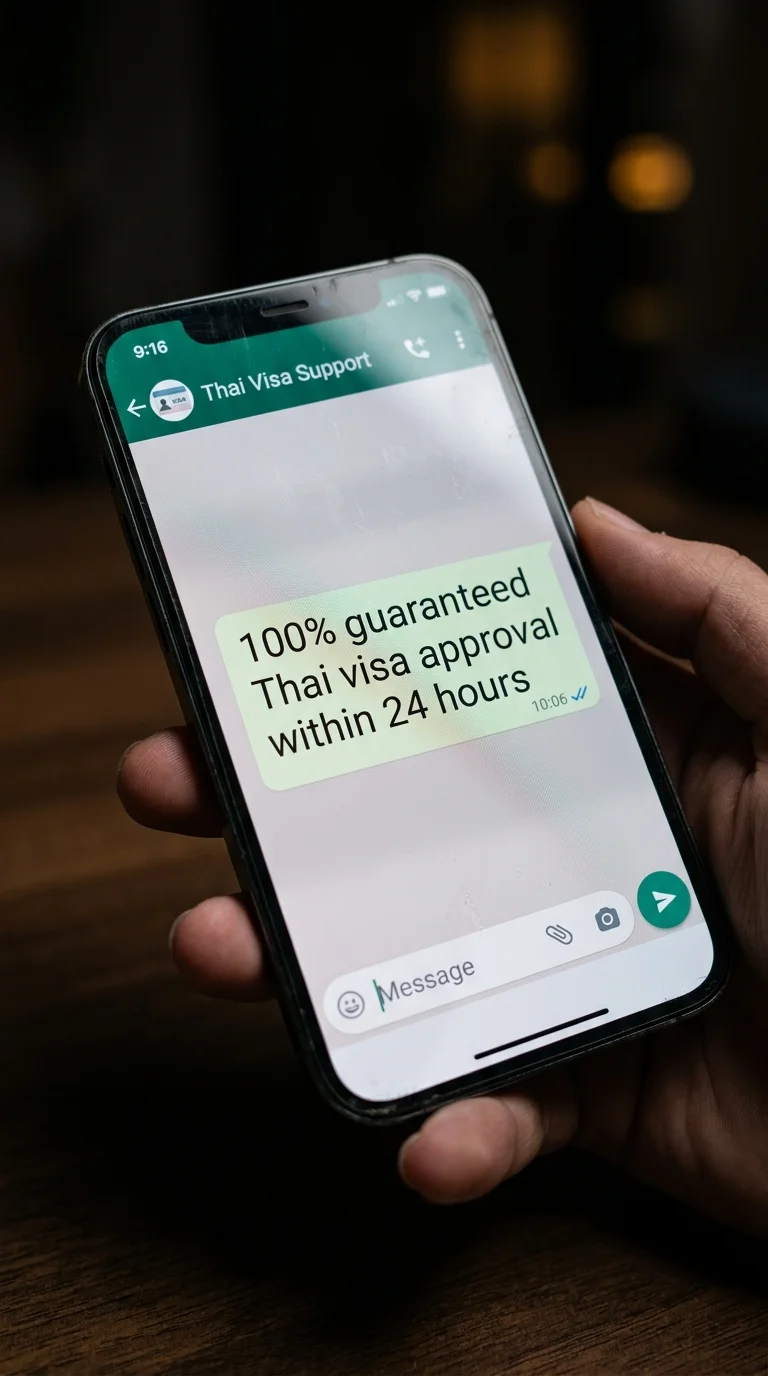
Private visa assistance operates without statutory regulation, meaning UK applicants must filter out fraudulent or incompetent intermediaries before handing over personal data. The clearest warning sign is any agency claiming it can promise visa approval or bypass statutory immigration rules. Consular officials at the Royal Thai Embassy evaluate and decide e-Visa submissions, while officers from the Thai Immigration Bureau hold sole authority over permission to enter at border control points. No commercial intermediary has the standing or authority to influence either decision.
Physical document handling presents another indicator. The Royal Thai Embassy in London operates a digital, stickerless e-Visa platform for all standard routes, including Tourist Visas and the Destination Thailand Visa. Legitimate services require clear digital scans to assemble your application. Any agency demanding your physical passport by post for standard online applications is either working from obsolete procedures or misrepresenting its operational model.
Payment and document collection practices also reveal questionable operators. Avoid services requesting direct transfers to personal bank accounts or asking for online banking login credentials to retrieve proof of funds. Legitimate services ask for official PDF statements downloaded from your UK bank and process transactions through secure corporate payment gateways.
Before sharing personal documents, verify the company's registration details and privacy practices. UK-based agencies should provide a registered company address, a visible privacy policy complying with UK GDPR standards, and verifiable commercial contact details. Intermediaries operating solely through informal messaging channels without published terms of business create substantial financial and data security risks.
How Online Visa Platforms Operate for Thailand
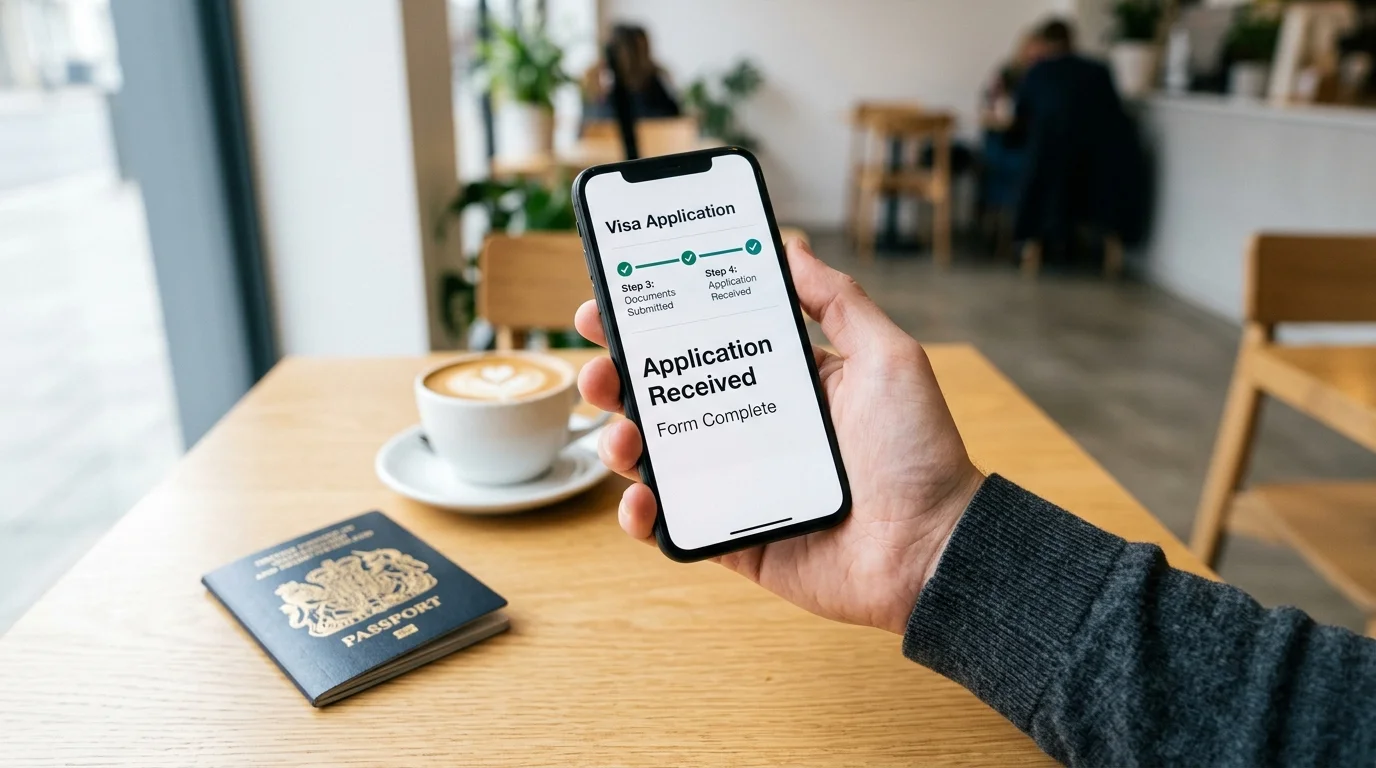
Online visa platforms act as a digital intermediary between applicants and the official Thai e-Visa portal. Rather than navigating the government system directly, applicants complete a structured intake questionnaire on the platform's website or mobile interface.
These platforms simplify document handling. The official Thai government portal enforces strict image dimensions, file size ceilings, and format restrictions for items such as passport data pages, flight itineraries, and proof of accommodation. Commercial platforms allow users to upload standard smartphone photos or scans, which processing teams reformat, crop, and compress to meet the embassy's technical submission specifications.
Once documentation is prepared, the provider inputs the applicant's details into the official Thai e-Visa system, uploads the compliant files, and settles the embassy fee. Platform staff monitor the official dashboard for status updates, relaying any consular requests for additional evidence directly to the applicant. When the Thai embassy approves the application, the service retrieves the official electronic visa document and forwards it by email for the traveller to print before departure.
Users pay a single bundled transaction that covers both the official, non-refundable Thai government visa fee and the platform's commercial service charge. While these services eliminate digital formatting hurdles and interface confusion, they operate strictly as administrative processors. Final authority over application timelines, document assessments, and entry approvals remains entirely with Thai consular officials.
Costs and Budgeting
Budgeting for a Thai visa requires separating non-refundable government embassy fees from optional third-party service charges and UK-side administrative expenses. When applying through the official Thai e-Visa portal from the United Kingdom, embassy fees are charged in British pounds. At the time of research, the Royal Thai Embassy in London charges £30 (around 1,350 THB) for a single-entry 60-day Tourist Visa. A five-year Destination Thailand Visa (DTV) incurs an official fee of £300 (around 13,500 THB), while a standard one-year multiple-entry Non-Immigrant visa costs £150 (around 6,750 THB), or £60 for a 90-day single entry. The Thai government does not refund these application fees if an application is rejected or withdrawn.
Applicants using commercial assistance pay agency fees on top of the government tariff. Automated digital submission platforms generally add a service fee between £30 and £80 (roughly 1,350 THB to 3,600 THB) per application. Full concierge and legal relocation agencies handling documentation-heavy routes, such as Non-Immigrant O retirement or marriage categories, charge higher professional retainers, typically ranging from £150 to £500 (around 6,750 THB to 22,500 THB).
Long-stay categories also involve mandatory UK supporting document expenses before submission. An official ACRO police certificate currently costs £65 for standard processing (or £115 for express turnaround). A comprehensive medical certificate from a private UK GP or travel clinic usually costs between £100 and £200. Where the Royal Thai Embassy requires UK documents to be apostilled, standard paper document legalisation through the Foreign, Commonwealth & Development Office (FCDO) costs £45 per document, plus return postage or courier fees.
| Expense | Cost (THB) | Cost (GBP) | Details |
|---|---|---|---|
| Official Tourist Visa (Single Entry) | 1,350 THB | £30 | Fixed embassy fee, non-refundable |
| Official 1-Year Non-Immigrant Visa | 6,750 THB | £150 | Fixed embassy fee for multiple-entry O / O-A |
| Official Destination Thailand Visa (DTV) | 13,500 THB | £300 | Fixed 5-year multiple-entry embassy fee |
| Digital Platform Service Fee | 1,350 - 3,600 THB | £30 - £80 | Third-party checking and submission margin |
| Premium Concierge Agent Fee | 6,750 - 22,500 THB | £150 - £500 | Full casework management for complex visas |
| ACRO Police Certificate | 2,925 THB | £65 | Standard UK police check for long-stay visas |
| Private Medical Certificate | 4,500 - 9,000 THB | £100 - £200 | Private UK clinic fee for required health forms |
| FCDO Document Legalisation | 2,025 THB | £45 | Standard paper apostille per document via GOV.UK |
Common Mistakes and How to Avoid Them
Failing to check an agency's refund policy before making payment leaves applicants out of pocket if the embassy refuses clearance. The Royal Thai Embassy treats all official e-Visa application fees as strictly non-refundable once submitted, regardless of the outcome. Third-party service fees are likewise forfeited unless the company explicitly provides a written refund policy for rejected submissions. Review the service terms beforehand to determine whether any portion of the commercial fee is returned if official approval is denied.
Expecting a visa service to expedite consular turnaround times creates severe disruption for late applicants. Commercial agencies possess no special processing channels with the Ministry of Foreign Affairs or the Royal Thai Embassy. Standard e-Visa processing in London generally takes between five and fifteen working days, but consular requests for further evidence can extend this timeline significantly. Factor in the agency's initial document-review period and initiate your application at least three to four weeks before your scheduled departure.
Submitting low-resolution document scans or cropped photographs to an agency portal leads directly to embassy delays. Consular officers require full-colour, flat scans of your passport information page, with all text and both machine-readable lines clearly legible. Identity photos must feature a plain white background without facial obstructions or heavy shadows. An agency cannot repair flawed images, and illegible files inevitably trigger formal requests for resubmission that stall the entire process.
Relying on a general travel agent rather than a dedicated Thai visa specialist often leads to the wrong visa category being selected. Mainstream travel consultants frequently lack up-to-date familiarity with complex Non-Immigrant categories or the Destination Thailand Visa. Using an experienced Thai immigration specialist helps ensure your financial records, employment proofs, and purpose-of-visit letters meet the exact administrative criteria of the London embassy.
Practical Tips

Check the website address before entering payment details. The official Thai government portal is thaievisa.go.th. If you choose to use a commercial visa agency or digital intermediary instead, ensure you know whose platform you are on, and request an itemised invoice that clearly distinguishes the mandatory, non-refundable Thai embassy fee from the private agency's administration charge.
When paying commercial agency fees online, use a UK credit card rather than a debit card. Under Section 75 of the Consumer Credit Act 1974, eligible credit card purchases between £100 and £30,000 provide joint liability protection with your card issuer if a private service provider breaches its contract or fails to deliver the promised administrative service.
Prepare your financial evidence by exporting formal PDF statements directly from your online banking portal or mobile app. Thai consular officers routinely reject unverified mobile screenshots or cropped account summaries. If you use a digital-only bank such as Monzo or Starling, download a full monthly account statement that clearly displays your full name and registered UK residential address, as Thai consular posts use this documentation to confirm your location and residency within the UK jurisdiction.
Ensure your UK passport has at least six months of validity remaining from your intended date of entry into Thailand, alongside at least two blank visa pages. No third-party visa service can bypass this statutory immigration requirement. If your passport is nearing expiry, renew it with HM Passport Office before starting an application.
Assemble all required digital files into a single organised folder on your device before beginning the agency questionnaire. Save clear, high-resolution scans of your passport biodata page, confirmed flight itineraries, and accommodation vouchers as standard PDF or JPEG files within standard upload size limits.
Check that personal details on all supporting travel bookings match your passport biodata page exactly. Any discrepancy between your passport name and flight or accommodation documentation—including missing middle names or reversed surnames—can lead to processing delays, queries from consular reviewers, or outright rejection of the submission.
DISCLAIMER: Visa rules and fees are subject to change. Always verify current requirements with the official Thai Immigration Bureau at immigration.go.th or the Royal Thai Embassy before applying.
Quick Reference Table
| Item | Detail | Notes |
|---|---|---|
| Official Government Portal | thaievisa.go.th | Managed by the Royal Thai Embassy in London; digital stickerless e-Visa system |
| Embassy Processing Time | 5 to 15 working days | Third-party services cannot expedite consular review times |
| Recommended Application Window | 3 to 4 weeks before departure | Allows time for agency document checks and potential consular queries |
| Passport Validity Requirement | Minimum 6 months validity | Must have at least 2 blank visa pages from the date of entry |
| Single-Entry Tourist Visa Fee | £30 (around 1,350 THB) | Non-refundable official embassy fee for 60-day stay |
| Destination Thailand Visa (DTV) Fee | £300 (around 13,500 THB) | Non-refundable official embassy fee for 5-year multiple-entry visa |
| 1-Year Non-Immigrant Visa Fee | £150 (around 6,750 THB) | Non-refundable official embassy fee for multiple-entry O or O-A (£60 for 90-day single entry) |
| Document-Checking Service Fee | £20 to £40 | Pre-submission audit of self-prepared e-Visa files |
| Digital Platform Service Fee | £30 to £80 (1,350 to 3,600 THB) | Document formatting, portal data entry, and submission handling |
| Premium Concierge Agency Fee | £150 to £500+ (6,750 to 22,500 THB) | Dedicated casework for complex retirement, marriage, or business routes |
| ACRO Police Certificate Fee | £65 standard (£115 express) | Required UK police clearance for specific long-stay visa categories |
| Private Medical Certificate Fee | £100 to £200 | Required health check from a private UK GP or clinic |
| FCDO Legalisation Fee | £45 per document | Standard paper apostille fee via GOV.UK, excluding courier costs |
FAQ: Thailand Visa Services for UK Citizens
What happens if I make mistakes on my Thai visa application?
What do third-party Thai visa services do?
How should I choose a Thai visa service tier?
When is it financially sensible to use a paid Thai visa service?
What is a major red flag when choosing a Thai visa agent?
Should a Thai visa agent ask for my physical passport?
Can a visa service expedite my Thai visa application?
What kind of document scans are required for a Thai visa application?
What are the passport validity requirements for a Thai visa?
Why is it important for my travel booking details to match my passport for a Thai visa?
Reviewed by the Thailand Guide Editorial Team • Last reviewed: 25 August 2026
This page provides general information only and is not financial, legal, or immigration advice. Always verify current rules with official Thai government sources or a qualified professional before making decisions.