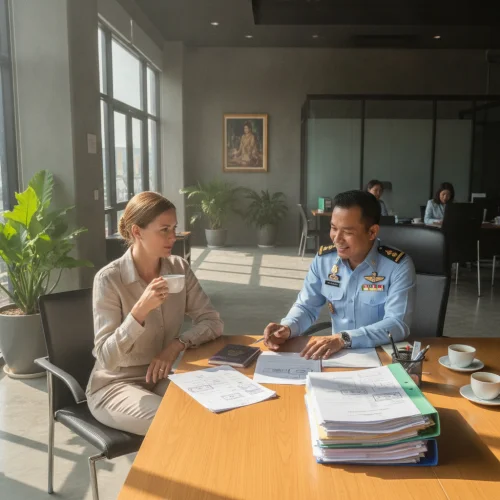
Thai authorities have introduced stricter enforcement measures against foreign residents and businesses following a series of public confrontations in resort destinations. The clampdown affects visa security, business ownership structures, and routine policing. While the initial public anger stemmed from disputes involving short-term tourists in Phuket and Pattaya, the administrative response directly alters the legal environment for British citizens living in the country permanently. Authorities are no longer treating minor public disturbances as isolated incidents. Instead, immigration officers and provincial governors are using these events to justify broader regulatory sweeps.
The Catalysts for Enforcement
Recent street disputes across Phuket have acted as the primary catalyst for the current operations. In one widely shared incident in Phuket, an unidentified foreign national refused to pay a 40-baht motorbike taxi fare after an app-booked journey, arguing with the driver for an hour before mocking him and leaving. The sum amounted to less than one British pound. Yet, the incident followed several violent or disorderly altercations involving overseas visitors. These included an 8,000-baht unpaid restaurant bill in Patong, physical assaults on hospitality staff, and disputes involving car and scooter rentals. Public patience has worn thin. In response, civic groups such as "Save Phuket" and "Thais Won't Tolerate It" staged street demonstrations calling for the strict enforcement of Thai laws against unruly foreigners.
Accelerated Deportation and Visa Cancellations
For British nationals resident in Thailand, the most immediate consequence is the implementation of revised deportation procedures. The Ministry of Interior enacted new regulations on 28 August. These rules streamline the process by which immigration officials can revoke long-stay permissions and expel foreign nationals deemed a threat to public order or local welfare. Discretionary powers have increased. Previously, minor altercations, payment disagreements, or traffic arguments rarely threatened an expatriate's residency status unless criminal charges were formally filed. Under the revised framework, provincial police can swiftly recommend the cancellation of Non-Immigrant visas, retirement extensions, or digital nomad permits if an individual becomes involved in public disorder. Deportation follows quickly. Appeals are difficult to mount once immigration authorities cancel a residency stamp. Consequently, minor arguments with service staff, taxi drivers, or landlords carry far higher legal risks for long-term British residents than in previous years.
Scrutiny of Foreign Business and Nominee Structures
The official reaction has extended far beyond public order policing into commercial compliance. State agencies are now conducting forensic investigations into corporate ownership models commonly used by foreign nationals to acquire land and run local businesses. Thai law prohibits foreign individuals from owning freehold land directly, leading many expatriates to set up private limited companies with majority Thai shareholding. Inspectors are targeting these entities. Officials in Phuket, Surat Thani, and Chonburi are actively auditing company registers to identify nominal Thai shareholders who hold equity without investing real capital. British entrepreneurs operating bars, restaurants, property agencies, and rental services face rigorous examinations of their corporate filings. Investigators examine bank records to determine whether Thai partners contributed genuine funds. If the Department of Business Development finds that a company exists solely to circumvent foreign ownership restrictions, it can dissolve the business and seize the underlying assets. Directors face custodial sentences. This renewed enforcement is concentrated on Koh Samui, Koh Phangan, and Phuket, where multi-agency task forces have already closed dozens of foreign-operated enterprises.
Increased Police Checks and Traffic Operations
Daily policing has also tightened in major expatriate centres. In Pattaya and Phuket, police departments have intensified checkpoints targeting traffic violations, vehicle registrations, and licensing compliance. This follows frequent complaints regarding aggressive driving and rented motorbikes. British residents commuting by scooter or car must ensure their documentation is complete. Officers frequently demand an International Driving Permit, an appropriate domestic Thai driving licence, valid tax stickers, and compulsory third-party insurance. Fines are levied on the spot. Moreover, officers are monitoring venues where disputes frequently emerge. In Pattaya, police reassigned three officers to administrative roles following complaints regarding irregular fine collection from tourists, demonstrating that traffic enforcement itself is under greater internal review. Nevertheless, the overall density of checkpoints has grown. Motorcyclists without approved helmets or valid documentation face immediate vehicle impoundment.
Shifting Public Sentiment Towards Foreigners
The public nature of these disputes has altered community dynamics in resort regions. Protests outside foreign embassies in Bangkok and community meetings in Phuket reflect a notable hardening of local attitudes. While protests originally targeted specific nationalities following prominent rows in Patong and Koh Phangan, the general frustration often spills over to all Western and Middle Eastern residents. Social media channels routinely publicise minor infractions by expatriates. Footage of arguments over bills, noise complaints, or traffic errors quickly attracts millions of views and calls for official intervention. For British nationals, maintaining polite and respectful interactions in daily life is no longer just good manners; it is a defensive necessity. De-escalation is critical. A refusal to pay a contested fee, even one as small as 40 baht, can trigger public filming and police engagement that places an expatriate's visa under review.
Risk Mitigation for British Residents
British citizens living in Thailand must adapt to this stricter regulatory climate by auditing their personal and commercial affairs. Legal compliance should be prioritised across three key areas.
First, visa holders must ensure that their extensions of stay, 90-day address notifications, and TM30 accommodation reporting remain completely up to date.
Second, property owners relying on corporate structures should seek qualified, independent legal advice to review their shareholder registers and verify that their capital contributions comply fully with the Foreign Business Act. Relying on standard nominee packages arranged by informal agents carries significant exposure in the current climate.
Third, expatriates should avoid public confrontations at all costs. If a financial disagreement arises with a service provider, the safest course of action is to resolve the matter calmly or involve the Tourist Police directly rather than engaging in prolonged street arguments. Thailand's authorities are determined to demonstrate firm control over foreign residents. British nationals who conduct their affairs transparently and respect local sensibilities will navigate this period safely, but the era of casual non-compliance has ended.
Source: thaiexaminer.com
Reviewed by the Thailand Guide Editorial Team • Last reviewed: 12 September 2026
This page is provided for general information only. While we aim for accuracy, details can change — please verify anything important independently before relying on it.