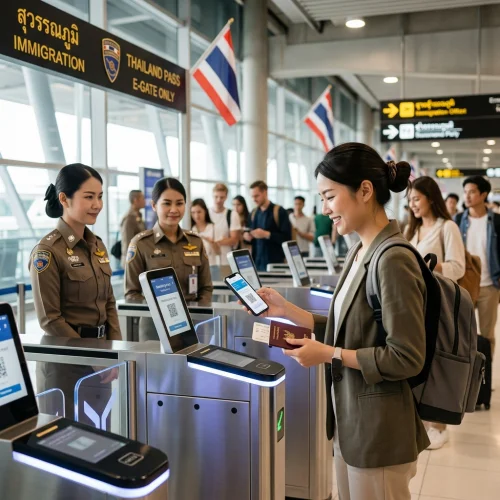
Thailand’s Immigration Bureau has introduced a centralised mobile software application, named THIM, designed to consolidate border entry and domestic immigration procedures for foreign nationals.
The software operates under the authority of the Royal Thai Police. For British citizens residing in or relocating to Thailand, the platform represents a transition from fragmented paper-based and provincial desk processes towards a unified digital system. Thai authorities confirmed that the platform will eventually absorb daily administrative duties, including ninety-day reporting, queue management, and applications for extensions of stay. The bureau developed the system in response to escalating arrival volumes at international airports and land borders. These passenger numbers have frequently overwhelmed checkpoint infrastructure, leading to severe delays during peak travel windows.
According to Police Lieutenant General Panumas Boonyalug, commissioner of the Immigration Bureau, the state objective is to modernise verification protocols without diminishing national border security checks.
Initial Rollout and Immediate Functions
The platform is available on Apple’s App Store, Google Play, and the Huawei AppGallery. Official records show that more than 600,000 individuals downloaded the application during its initial release phase, resulting in roughly 580,000 registered accounts.
Currently, the primary live feature for incoming travellers is the Thailand Digital Arrival Card, known as the TDAC. This digital card replaces the older blue-and-white paper TM6 form that historical visitors completed by hand on inbound flights. British nationals can now submit arrival information directly through the application before boarding flights to Bangkok, Phuket, or Chiang Mai.
The standard browser-based portal for the arrival card remains accessible on the immigration department’s website. However, the app functions as a permanent repository for personal details. This setup eliminates the need for expatriates to re-enter fixed data on subsequent journeys.
Alongside arrival documentation, the app includes an introductory module called Explore Thailand. This section provides general visitor guidance alongside retail and hospitality discounts managed by third-party commercial vendors.
Forthcoming Visa and Reporting Services
Long-term British residents face substantial routine administrative requirements under the Thai Immigration Act B.E. 2522. The most demanding of these is the ninety-day reporting rule, filed via form TM47, which mandates that foreigners notify officials of their current residential address every three months.
The bureau plans to integrate direct ninety-day notifications into the THIM interface.
Currently, British expatriates must choose between queueing in person at provincial offices, posting physical documents, or attempting to use a legacy web portal that frequently suffers from technical outages. Migrating this function to an integrated application is intended to reduce the burden on regional offices such as Chaengwattana in Bangkok, Promenada in Chiang Mai, and Jomtien in Chonburi.
Planned software iterations will also handle applications for certificates of residence. Expatriates require these documents to open local bank accounts, register vehicles, and obtain Thai driving licences.
Appointment scheduling will also migrate to the app. Users will reserve timed processing slots at regional branches to avoid dawn queues. Crucially, the bureau intends to facilitate full visa extensions across the digital network. While officials have not confirmed whether in-person interviews will be eliminated entirely for marriage and retirement categories, shifting the preliminary document submission and fee settlement online will substantially reduce counter processing intervals.
Passport Verification and Technical Requirements
The registration architecture relies on biometric identity checks built into modern personal smartphones.
Users must possess a smartphone equipped with Near Field Communication, commonly abbreviated to NFC. British passport holders will use this feature to scan the embedded biometric microchip positioned inside the cover of their standard HM Passport Office travel documents. The application reads the cryptographic key stored on the passport chip to confirm validity and extract official photographic records.
The software then requires a live facial recognition scan.
This process checks for physical presence through micro-movements, matching the live camera feed directly against the biometric image retrieved from the chip. This step prevents fraudulent registration using static photographs or purloined credentials.
For British expatriates with older, damaged, or non-biometric travel documents, identity validation may fail within the software. Such individuals will have to attend local immigration offices in person to verify their profiles manually. Handsets operating modified software, such as rooted Android devices or jailbroken iPhones, may also be blocked by the app's security protocols.
Data Governance and Legal Safeguards
Storing personal identification documents, residential addresses, and biometric records on a mobile application presents distinct privacy concerns for expatriates.
The Immigration Bureau stated that user information is governed under Thailand’s Personal Data Protection Act B.E. 2562. This legislation, known locally as the PDPA, mirrors several primary components of the UK General Data Protection Regulation, including restrictions on lawful processing and strict boundaries regarding data retention.
Digital architecture for the platform is hosted on Amazon Web Services infrastructure located inside Thailand, within the AWS Asia Pacific Bangkok Region. Storing information on local servers ensures compliance with domestic data sovereignty rules.
System protocols separate biometric indicators from biographical data files. Identity files, residential histories, and facial templates are stored across isolated server clusters using industry-standard transmission encryption. The bureau maintains administrative access logs to record every instance where an official views, alters, or exports an individual expatriate profile.
Integration of Commercial and Healthcare Services
The application departs from traditional public-sector designs by integrating commercial partnerships directly into the user interface.
The Explore Thailand section features promotional agreements with major domestic corporations. These include retail operators such as The Mall Group, telecommunications provider True Corporation, and private transport network GrabTaxi Thailand. Discounts are also offered through Minor International, which operates restaurant franchises and leisure facilities nationwide.
Of direct relevance to British retirees, Bangkok Dusit Medical Services is listed among the launch partners.
BDMS operates extensive private hospital networks, including Bangkok Hospital, Samitivej, and BNH, which many British expatriates use for outpatient care and statutory visa medical certificates. The application incorporates promotional health packages, screening discounts, and access portals linked to these private medical providers. Transactions are facilitated via digital QR codes and promotional vouchers managed by local payment processor Wipay.
The inclusion of consumer and medical businesses within an official policing app underlines the Thai government's strategy of linking administrative oversight with commercial activity.
Operational Considerations for British Residents
The transition to THIM will occur gradually rather than immediately superseding existing procedures.
British nationals are advised to maintain physical backups of all residency paperwork, entry stamps, and TM30 notification receipts. While the digital arrival card is fully active, the broader visa management systems remain under active development. Expatriates should not assume physical immigration visits are obsolete until regulatory decrees formally amend current reporting statutes.
Furthermore, users should review smartphone compatibility, maintain access to their registered UK or Thai phone numbers for verification messages, and inspect their passports for NFC readability.
Official updates concerning platform feature rollouts are published directly by the Immigration Bureau at www.immigration.go.th. Expatriates should verify any changes to visa regulations through official channels before altering their standard renewal schedules.
Source: nationthailand.com
Reviewed by the Thailand Guide Editorial Team • Last reviewed: 26 September 2026
This page is provided for general information only. While we aim for accuracy, details can change — please verify anything important independently before relying on it.