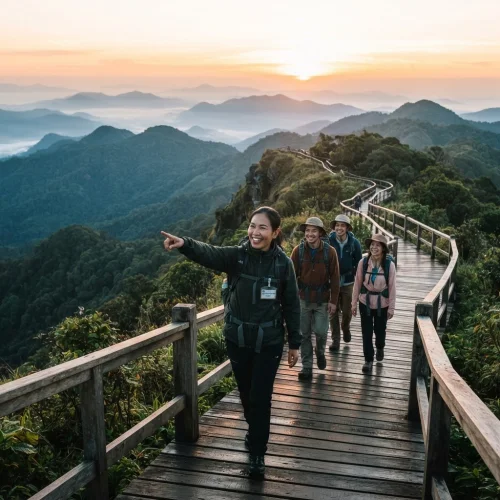
Glamping in Thailand
Thailand's glamping sector spans a broad spectrum of comfort and price, from budget geodesic domes perched in Chiang Mai's Mon Jam highlands at roughly £35 per night to all-inclusive tented pavilions in the Golden Triangle costing upwards of £2,000 a night. Across northern mountain ridges, central riverbanks, and southern island headlands, the concept bridges the gap between basic national park campsites and conventional concrete resorts. Stays combine outdoor immersion with upscale hotel comforts, commonly providing air conditioning, en-suite bathrooms with pressurised hot showers, and freestanding bathtubs or private plunge pools positioned beneath the forest canopy.
Properties are run by a diverse mix of operators, including local community homestays, independent boutique retreats, and luxury international brands such as Four Seasons. The market caters primarily to couples, honeymooners, and wildlife enthusiasts who want direct proximity to misty peaks, jungle rivers, or rainforest lakes without surrendering reliable climate control, quality dining, and comfortable bedding.

Northern Highlands and Mountain Tented Lodges
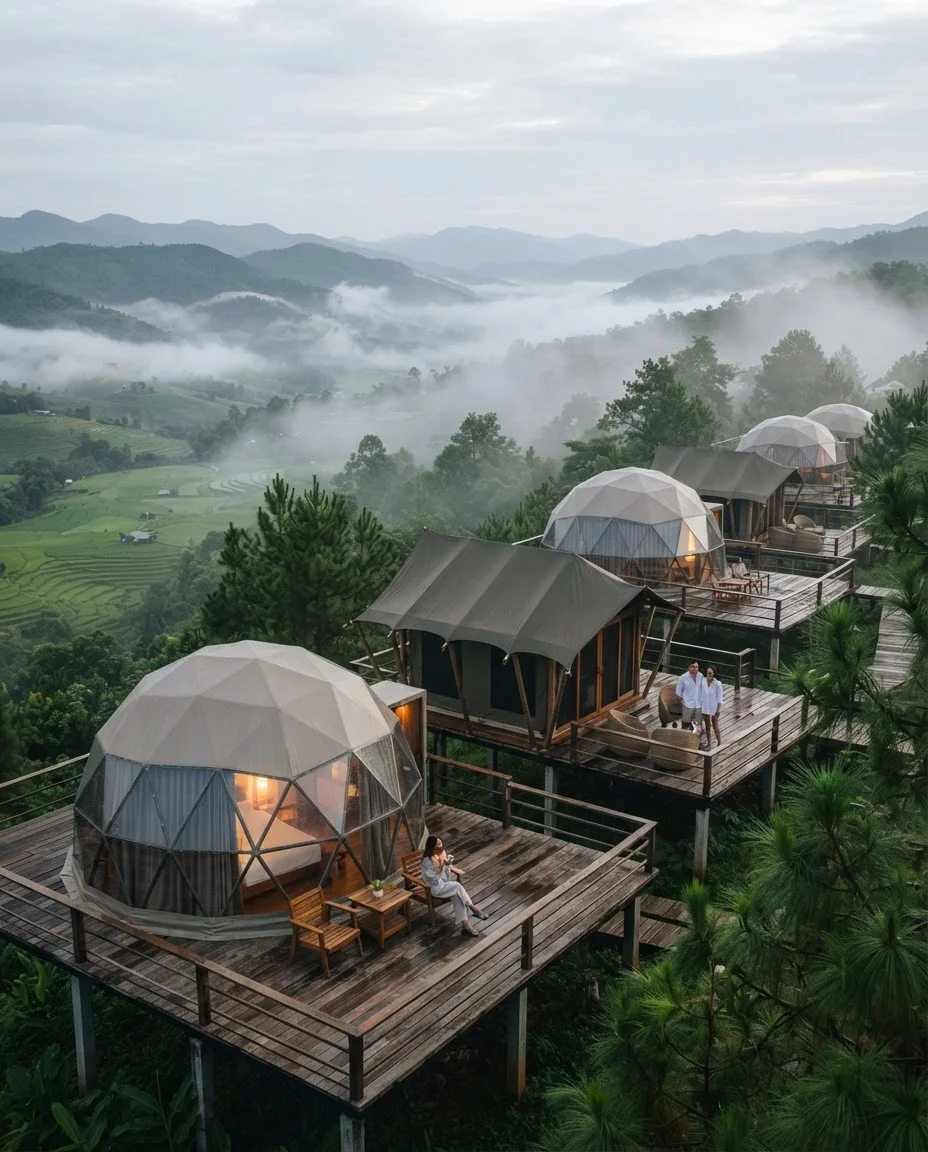
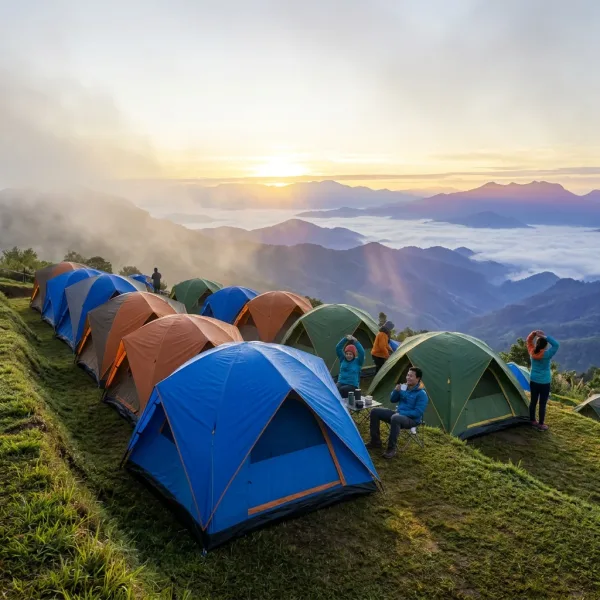
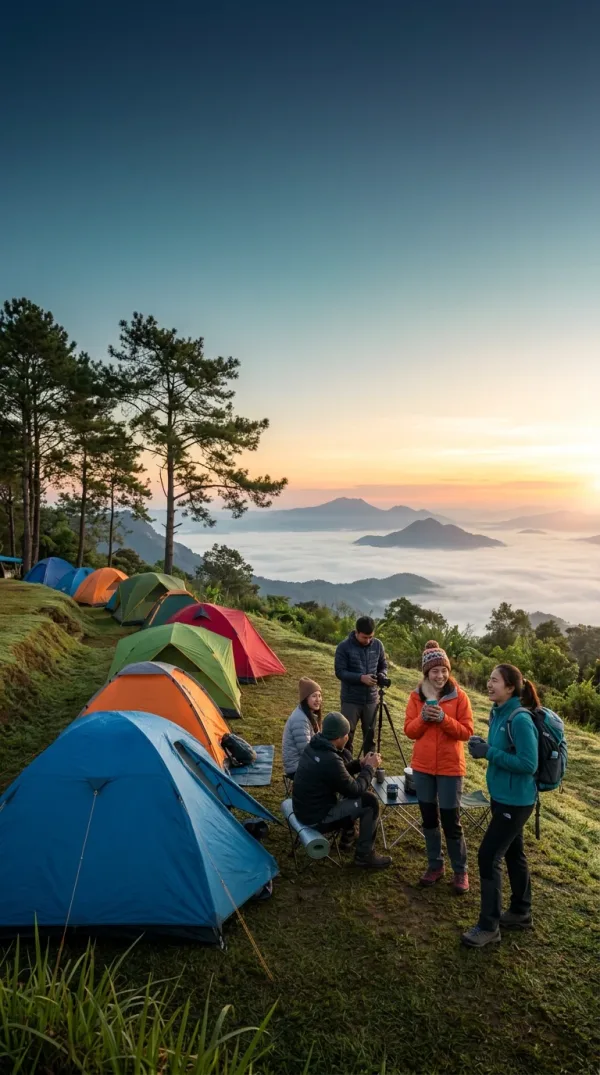
Northern Thailand represents the regional heartland of mountain glamping. High elevations create cool microclimates, with valleys filling with thick mist between November and February. In the Mae Rim and Mae Taeng districts north of Chiang Mai, agricultural ridges around Mon Jam sit at an elevation of approximately 1,350 metres. The ridge hosts clusters of boutique camps equipped with weatherproof geodesic domes and semi-permanent safari tents. These setups feature clear viewing panels directed towards terraced vegetable plots, private timber sundecks, outdoor soaking tubs, and en-suite bathrooms with hot-water showers. Bookings between November and February coincide with crisp morning temperatures that frequently drop below 15°C, requiring warm layers before sunrise.
Further north in Chiang Rai, Four Seasons Tented Camp Golden Triangle occupies bamboo jungle along a ridge overlooking the Ruak River near its confluence with the Mekong. Reached by traditional long-tail boat, the camp maintains fifteen luxury safari tents alongside the two-bedroom Explorer’s Lodge. Accommodations feature hand-hammered copper bathtubs, outdoor rain showers, and expansive verandas facing the river and neighbouring hills. Fully inclusive packages incorporate guided excursions, spa treatments, sundowners at Burma Bar, and managed interactions with rescued elephants in partnership with the Golden Triangle Asian Elephant Foundation.
Central Thailand’s forested ranges around Khao Yai National Park and the historic River Kwai valley provide accessible safari-style retreats within overland driving distance of Bangkok. In the Pak Chong district of Nakhon Ratchasima, Lala Mukha Tented Resort sits against a backdrop of limestone mountains near Khao Yai. The property provides 40 air-conditioned canvas units and elevated treehouses, spanning entry-level Safari Tents, en-suite Savanna Tents, Signature Tents, and two-storey timber structures. Communal facilities include Jabulani Restaurant, an outdoor swimming pool facing the hills, and evening fire pits arranged for open-air barbecues.
Further west in Kanchanaburi's Sai Yok District, Hintok River Camp at Hellfire Pass sits on a natural cliff above the River Kwai Noi. The site features spacious canvas safari tents ranging from 26 to 35 square metres, each built on hardwood platforms with en-suite bathrooms, open-air stone showers, and private verandas. Guests have access to a natural spring-fed rock pool overlooking the river gorge, the on-site Hintok Story Museum, and bicycles for riding through teak forest to the historic Death Railway cutting at Hellfire Pass. Across both Khao Yai and Kanchanaburi, scheduling stays from Monday to Thursday avoids heavy weekend travel from Bangkok, ensures quieter grounds, and regularly secures lower nightly rates.
Southern Beachfront Glamping and Island Canvas Pavilions
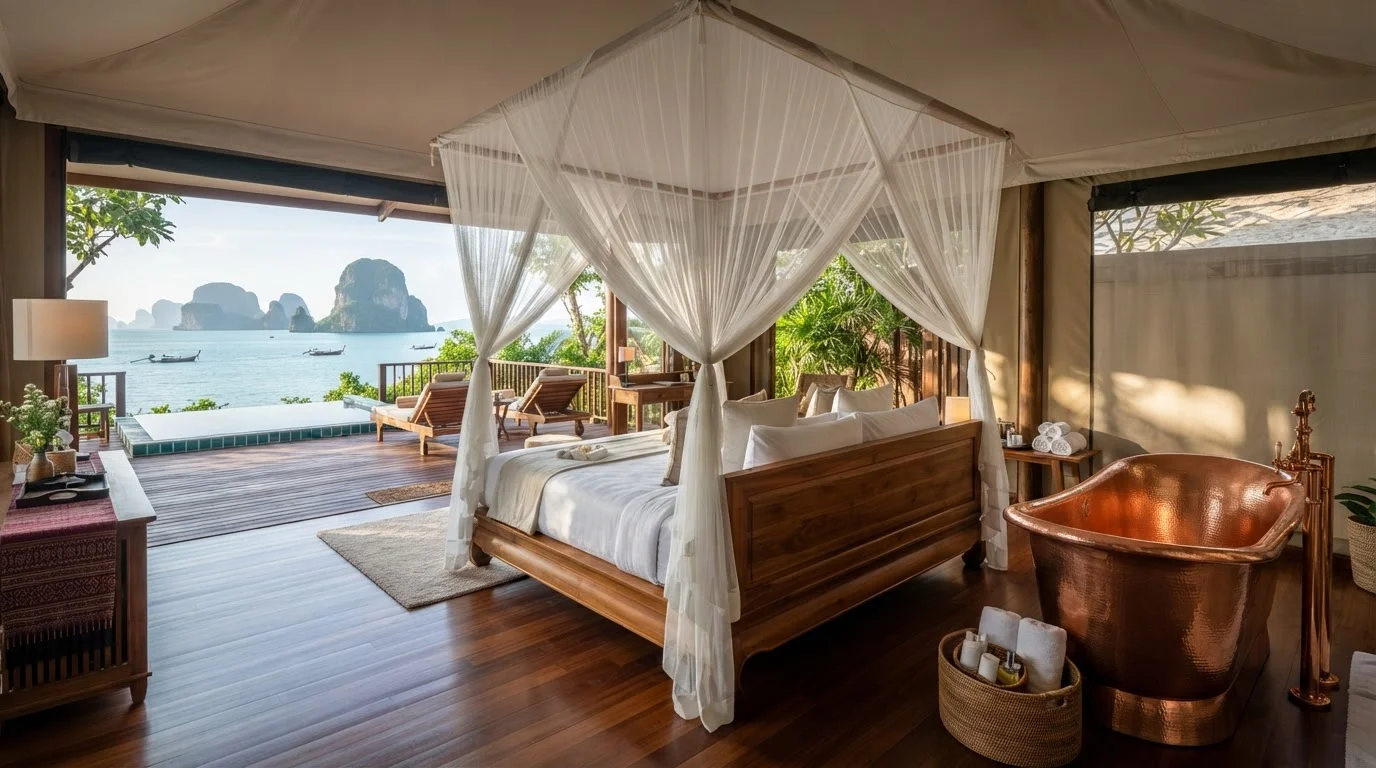
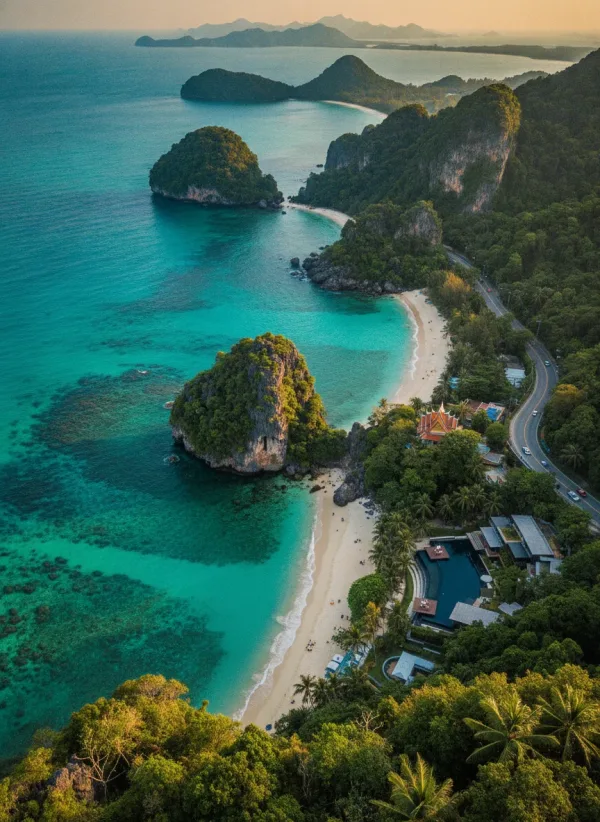
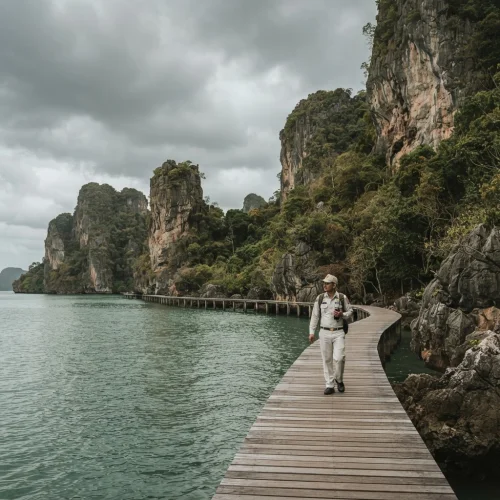
Southern Thailand combines coastal headlands, island ridges, and freshwater lakes with luxury canvas accommodation. On Koh Yao Noi in Phang Nga Bay, 9 Hornbills Tented Camp operates 10 elevated safari villas positioned on a ridge above the Andaman Sea, looking towards the bay's limestone karst formations. Each 108-square-metre villa provides an eight-metre private infinity pool, a king-sized bed with dedicated canopy air conditioning, a roll-top clawfoot bath, an open-air rain shower, and a shaded outdoor lounge. An on-call buggy service transports guests down the hillside to the private beach and dining facilities at sister property Koyao Island Resort, while complimentary kayaks and bicycles allow guests to explore the surrounding waters and island lanes.
Along the mainland coast, beachfront canvas options include Twinpalms Tented Camp on Bang Tao Beach in Phuket, where air-conditioned canvas suites sit directly along the shoreline. Further inland in Surat Thani province, Elephant Hills runs its safari camp bordering Khao Sok National Park alongside the floating Rainforest Camp on Cheow Lan Lake. At the lake location, 20 solar- and wind-powered canvas tents sit directly on anchored pontoon platforms connected by wooden boardwalks. Each tent contains solid wood beds, an en-suite bathroom with hot shower, and a private deck with individual kayaks for navigating the surrounding limestone gorges. Stays at the lake camp are arranged through multi-day guided safari packages combining wildlife observation with lake canoeing.
These coastal and lakeside setups maintain high-grade linens, enclosed bathrooms, and reliable electricity, avoiding tropical damp while keeping guests close to marine breezes and rainforest birdsong.
Plan a Northern Thailand trip covering Chiang Mai, Chiang Rai, Sukhothai, mountain routes, Lanna food, transport, seasons and air quality.
Glamping Versus Standard Hotel Resorts and National Park Camping
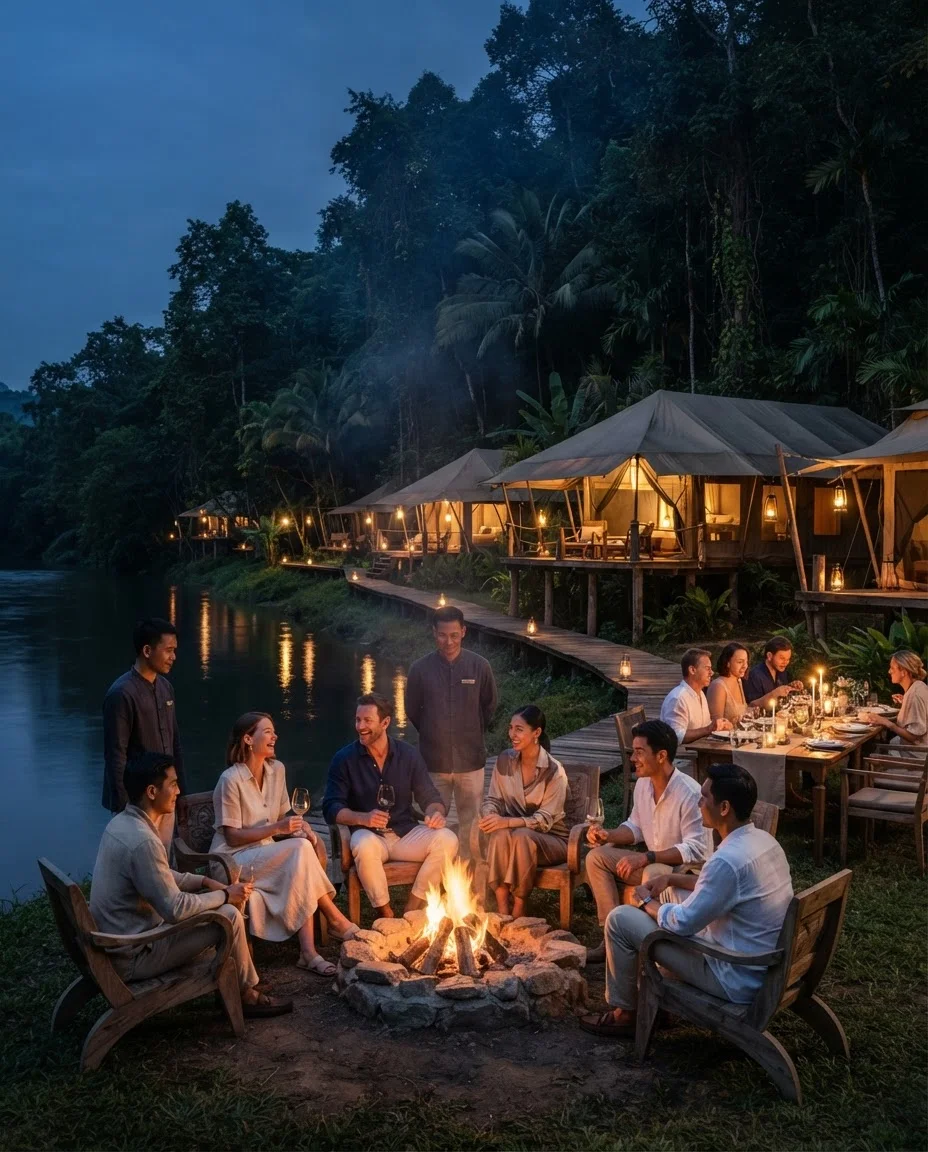
Choosing between glamping, conventional concrete resorts, and basic national park campgrounds requires balancing environmental immersion against acoustic privacy, climate control, and facility scale. Each option serves a distinct style of travel in Thailand, with vastly different levels of comfort, infrastructure, and expenditure.
At one end of the spectrum, Department of National Parks (DNP) campgrounds—such as those at Khao Yai, Kaeng Krachan, and Doi Inthanon—provide direct wilderness access at minimal cost. Renting an official three-person dome tent through the DNP system costs 225 THB (around £5) per night, with sleeping mats and sleeping bags available to hire for 20 to 30 THB apiece. Pitching your own tent costs 30 THB per person per night. However, park camping involves clear compromises: accommodation relies on natural ventilation without climate control, electrical outlets are confined to communal kiosks, and guests share public wash blocks with cold ambient-water showers.
Conventional four-star hotel resorts sit at the opposite extreme. Built from concrete, brick, and glass, these properties provide acoustic insulation, reliable central air conditioning, and expansive leisure facilities like multi-lane swimming pools, fitness centres, and multiple dining venues. Yet this sealed environment inevitably separates guests from the natural surroundings behind double glazing and air-conditioned corridors, with larger resorts accommodating several hundred guests across a dense commercial footprint.
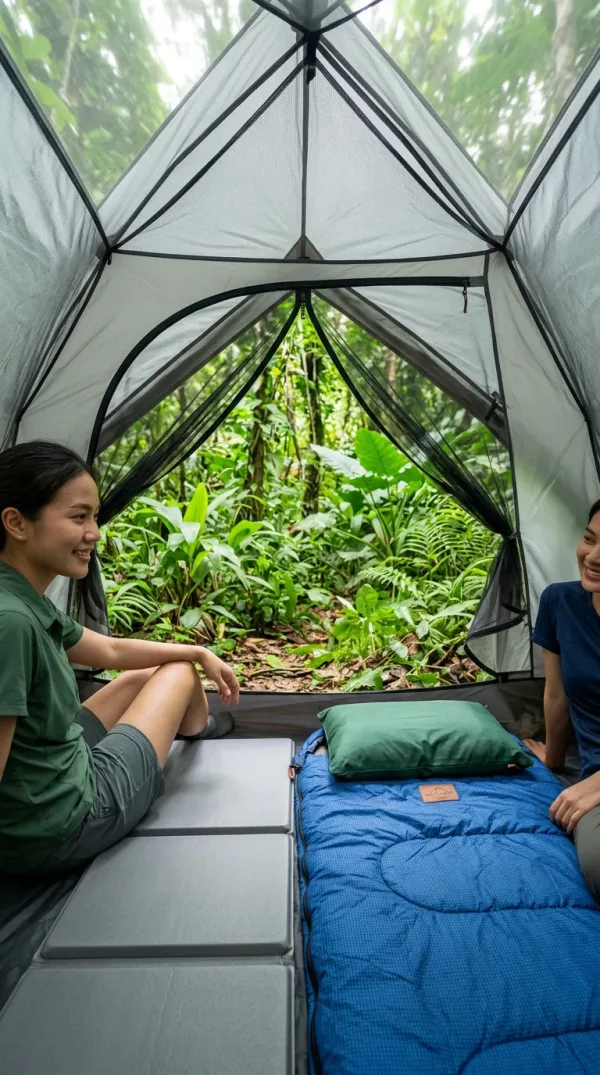
Glamping occupies a deliberate middle ground. By capping inventory—typically at 10 to 40 tents or geodesic domes—properties maintain low density, attentive hosting, and uncrowded grounds. Guests stay on raised timber decks equipped with proper mattresses, hot showers, and inverter air conditioning or fans. However, canvas walls cannot block ambient noise: insect choruses, calling gibbons, torrential rain, and river traffic remain audible throughout the night, and daytime sun warms canvas faster than insulated masonry.
Choose glamping when you value outdoor immersion, panoramic scenery, and boutique privacy, and are content to trade commercial hotel facilities and acoustic isolation for a direct connection to nature.
| Feature | Glamping | Standard Hotel Resort | National Park Camping |
|---|---|---|---|
| Accommodation Structure | Heavy canvas safari tents or geodesic domes on timber decks | Concrete-and-glass hotel blocks or standalone brick villas | Basic nylon dome tents pitched directly on grass or gravel |
| Climate Control & Power | Inverter air conditioning or fans; Thai sockets (Type A/C) | Central climate control; full grid power with generator backup | Natural ventilation only; charging points at communal kiosks |
| Bathroom Facilities | Mostly private en-suite bathrooms with hot pressurised showers | Fully enclosed private bathrooms with bathtubs and showers | Shared public ablution blocks with cold ambient-water showers |
| Acoustic Privacy | Low; rainfall, wildlife, and ambient outdoor sounds audible | High; insulated masonry walls and sealed double-glazed windows | Very low; thin synthetic fabric provides no noise buffering |
| Inventory & Density | Small footprint; typically 10 to 40 individual units | Medium to large scale; typically 80 to 400 commercial rooms | High density; up to several hundred pitches in shared grounds |
| Typical Cost Range | 2,500 to 18,000 THB (£58 to £415) per night | 3,000 to 12,000 THB (£70 to £275) per night | 225 to 600 THB (£5 to £14) per night |
Location and Getting There
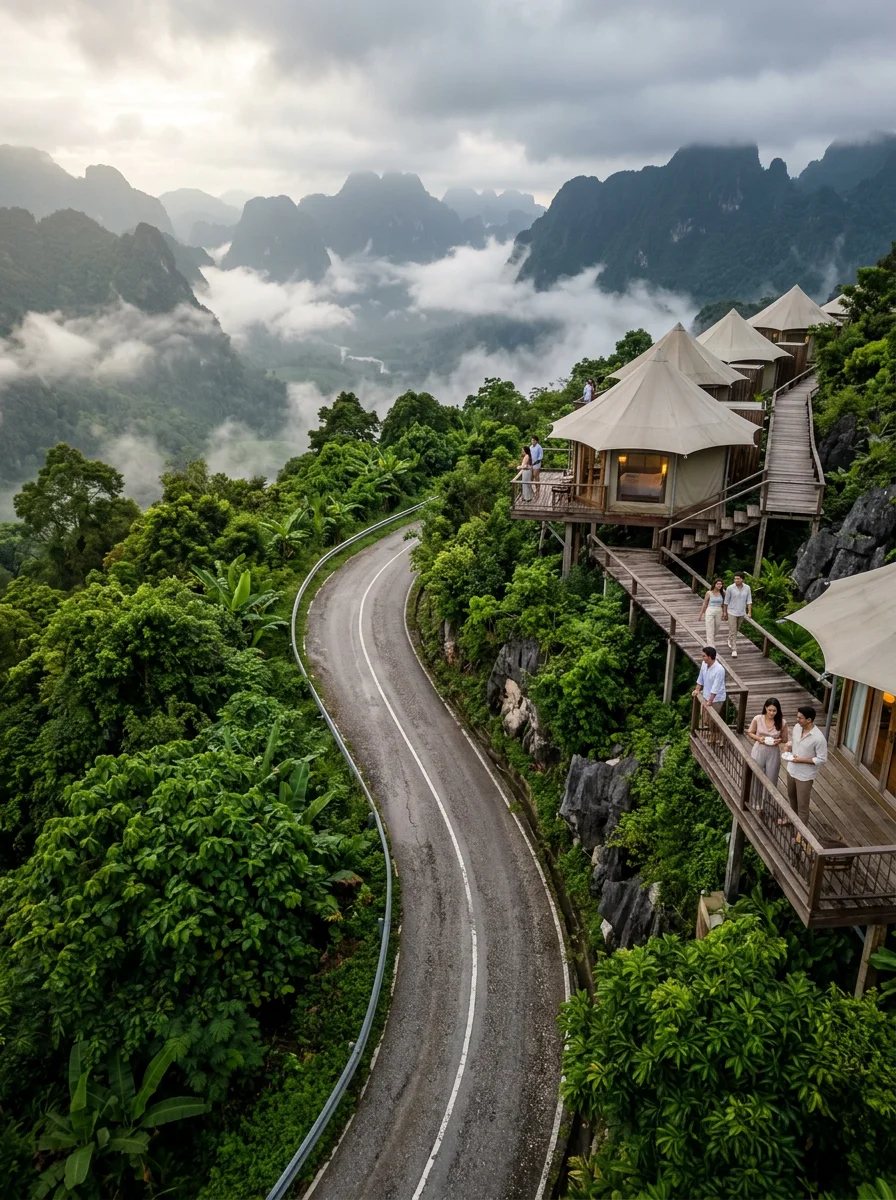
Reaching Thailand's primary glamping retreats requires tailored overland and water transfers from major international entry hubs.
For Chiang Mai highland camps around Mon Jam, fly into Chiang Mai International Airport (CNX) and take a private taxi for the 45-kilometre journey northwest. The route follows Highway 107 and Route 1096 into Mae Rim, taking about an hour and costing between 1,000 THB and 1,500 THB (£23 to £35).
Khao Yai properties sit roughly 160 to 180 kilometres northeast of Bangkok. Private car transfers from Suvarnabhumi Airport (BKK) take 2.5 to 3 hours along Route 2 towards Pak Chong, with fares generally between 2,200 THB and 2,800 THB (£50 to £64).
In Kanchanaburi, Hintok River Camp lies approximately 200 kilometres west of Bangkok along Highway 323 in Sai Yok. A private taxi takes about 3.5 hours and costs around 2,500 THB (£57). Alternatively, the State Railway of Thailand runs daily third-class trains from Bangkok's Thonburi station to Nam Tok (100 THB / £2.30 for foreign travellers); from the station, local songthaews or pre-arranged transfers cover the final road stretch.
Island glamping on Koh Yao Noi requires a 20-minute taxi from Phuket International Airport (HKT) to Bang Rong Pier (around 600 THB / £14), followed by a 30-minute public speedboat crossing (300 THB to 400 THB / £7 to £9 per person) to Manoh Pier.
Costs and Booking
Nightly rates for Thai glamping vary significantly based on location, tier, and inclusions. Entry-level highland geodesic domes in Mon Jam and Chiang Dao range from 1,500 THB to 3,500 THB (£35 to £80) per night, typically including a simple breakfast. Established mid-tier safari camps such as Lala Mukha in Khao Yai and Hintok River Camp in Kanchanaburi charge between 3,000 THB and 6,500 THB (£70 to £150) per night for air-conditioned canvas units with private en-suite bathrooms. High-end private pool canvas villas on Koh Yao Noi command 12,000 THB to 25,000 THB (£275 to £575) per night. Ultra-luxury all-inclusive properties such as Four Seasons Tented Camp Golden Triangle charge 80,000 THB to 135,000 THB (£1,840 to £3,100) per night, covering private airport transfers, elephant welfare programmes, all meals, drinks, and daily spa treatments.
Seasonal timing heavily dictates pricing and availability. The cool, dry high season from November to February brings peak rates; boutique camps with small unit counts routinely book out three to five months ahead. Low-season stays from May to October feature price cuts of 30% to 50%. Stays over 31 December routinely incur mandatory New Year's Eve gala dinner supplements of 2,500 THB to 8,000 THB (£58 to £184) per adult. Top-tier wilderness lodges frequently enforce a two-night minimum stay, and base quotes may exclude Thailand's 7% Value Added Tax and 10% service charge.
| Option | Cost (THB per night) | Cost (GBP approx) | Notes |
|---|---|---|---|
| Highland Geodesic Dome (Chiang Mai) | 1,500 - 3,500 | £35 - £80 | Includes breakfast, private balcony, external view bathtub; nightly rate |
| Safari Tented Camp (Khao Yai / River Kwai) | 3,000 - 6,500 | £70 - £150 | Air-conditioned canvas unit with private bathroom and breakfast; nightly rate |
| Luxury Private Pool Tent (Koh Yao Noi) | 12,000 - 25,000 | £275 - £575 | Ocean view, private plunge pool, outdoor roll-top tub, breakfast; nightly rate |
| Ultra-Luxury Safari Lodge (Golden Triangle) | 80,000 - 135,000 | £1,840 - £3,100 | All-inclusive: dining, drinks, elephant activities, spa, transfers; nightly rate |
| Mandatory New Year Eve Gala Supplement | 2,500 - 8,000 | £58 - £184 | Applied per adult at mid-to-luxury camps on 31 December |
Who It Suits Best
Glamping in Thailand suits couples, honeymooners, nature photographers, and small adult groups seeking outdoor immersion alongside conventional hotel amenities such as solid beds and en-suite bathrooms. It appeals to travellers wishing to avoid crowded coastal resort centres. Conversely, it is poorly suited to those seeking nightlife, loud communal pool scenes, or urban entertainment districts. Families with active toddlers and travellers with reduced mobility may find the physical terrain difficult, as many sites rely on steep hillside steps, elevated timber boardwalks, and unpaved paths.
What to know before booking
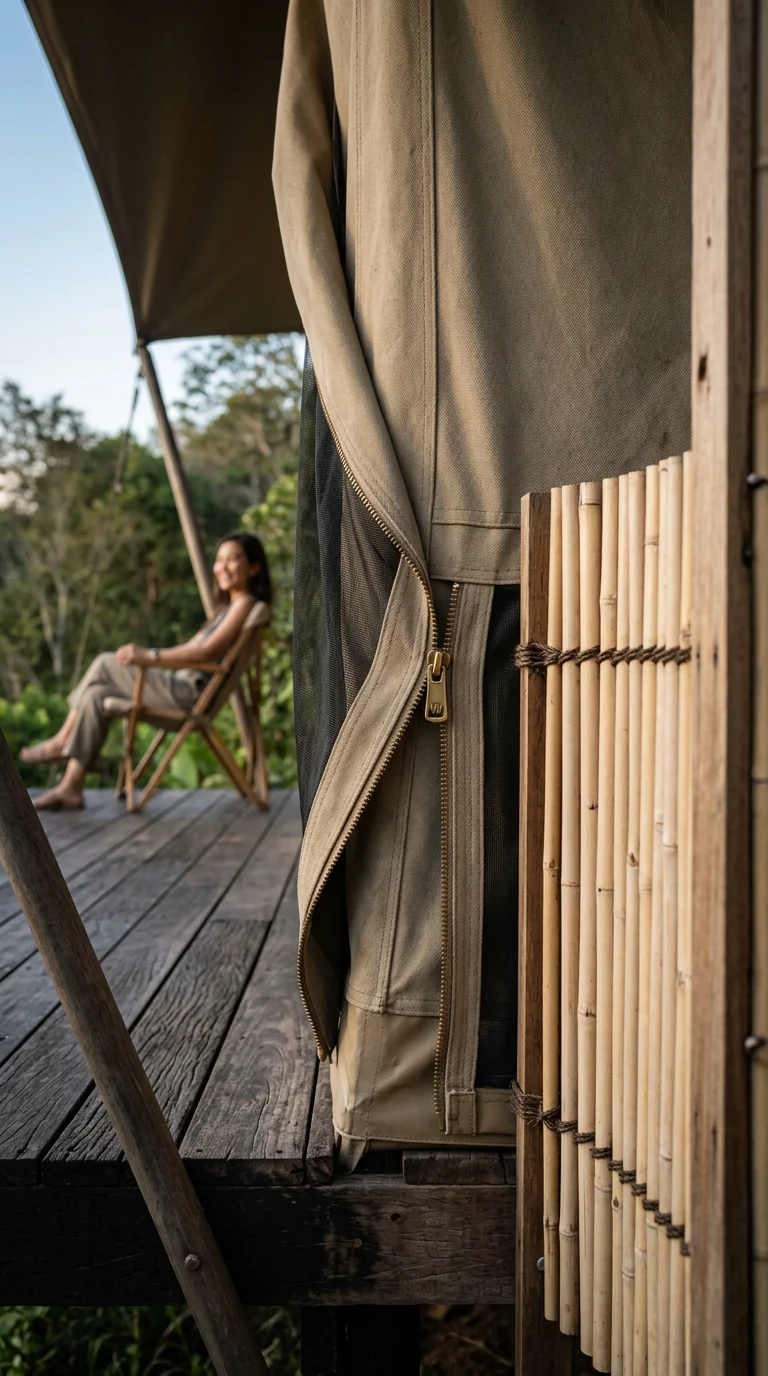
Canvas walls offer minimal acoustic insulation compared with brick or concrete masonry. Guests will hear cicadas, nighttime frogs, dawn birdcalls, heavy tropical downpours, and footsteps on shared timber decking. Those requiring unbroken quiet for sleep should factor these soundscapes into their planning.
Climate control operates within physical limits. Inverter air conditioning units effectively cool tent interiors overnight, but direct mid-afternoon sunshine drives substantial heat gain through canvas and dome fabrics, causing units to struggle during peak daylight hours.
Dining logistics require foresight at remote riverside or hillside camps. Many properties sit kilometres from the nearest town, and unlit rural tracks make walking to off-site street stalls or convenience shops impractical after sunset. Checking on-site kitchen operating hours and meal menus in advance prevents unexpected dining limitations.
Northern highland locations experience pronounced diurnal temperature variations. In elevated districts like Mae Rim and Mon Jam, daytime temperatures of around 30°C routinely fall to 12°C or below after sunset between December and January, catching unprepared visitors off guard.
Practical Tips

Pack lightweight thermal layers and a fleece for northern highland stays. Night-time temperatures in Mon Jam, Doi Inthanon, and the hills of Chiang Rai can drop below 15°C between November and February, making open-air deck dining chilly.
Bring insect repellent containing DEET or picaridin for dusk activities. Riverside locations in Kanchanaburi and forest clearings in Khao Yai attract mosquitoes and biting midges during sunset transitions around water. Keep tent zips firmly closed whenever leaving your quarters, as moths, geckos, and beetles quickly head towards interior lamps.
Pack earplugs and a contoured eye mask in your cabin bag. Canvas walls let early morning sunlight filter through, while local wildlife—from loud cicadas and calling geckos to dawn birdsong—creates a steady natural chorus across open grounds.
Arrange transfers directly through your resort or hire a high-clearance vehicle rather than relying on on-demand ride-hailing apps or standard city taxis. Hillside tracks leading to retreats around Mae Rim or forested valley camps are often steep, unpaved, and unlit after dark.
Confirm on-site dining arrangements and restaurant operating hours before arriving. Most glamping properties sit several miles from town centres along dark country lanes, meaning walking out to local street food stalls or night markets is rarely feasible after dark. Many camp kitchens close relatively early, with last food orders taken by 20:00 or 20:30.
Carry a portable power bank and prepare for intermittent cellular coverage. Mountain ridges in Chiang Mai and deep river valleys in Kanchanaburi or Khao Sok frequently lose mobile data reception, making resort Wi-Fi your primary connection. Certain off-grid floating camps also run generator power on restricted schedules.
Plan highland ridge stays between November and January if you want to witness morning cloud inversions. Cool valley condensation produces thick seas of white mist across northern mountain basins at sunrise, usually burning off by mid-morning as daytime warmth builds.
Quick Reference Table
| Item | Detail | Notes |
|---|---|---|
| Highland Geodesic Domes | 1,500 – 3,500 THB (£35 – £80) | Nightly rate; includes breakfast and viewing tub (e.g. Mon Jam) |
| Mid-Tier Safari Tents | 3,000 – 6,500 THB (£70 – £150) | Nightly rate; air-conditioned with en-suite (Khao Yai, Kanchanaburi) |
| Luxury Island Pool Tents | 12,000 – 25,000 THB (£275 – £575) | Nightly rate; ocean-view canvas villa with plunge pool (Koh Yao Noi) |
| Ultra-Luxury Jungle Lodges | 80,000 – 135,000 THB (£1,840 – £3,100) | Nightly rate; all-inclusive excursions, spa, and dining (Chiang Rai) |
| National Park Camping Baseline | 225 THB (~£5) | Nightly rental for 3-person DNP tent; pitch own tent for 30 THB |
| Peak Travel Season | November to February | Crisp, dry weather; early morning mountain temperatures fall below 15°C |
| Low Season Savings | May to October | Nightly accommodation rates drop 30% to 50% |
| Mandatory NYE Supplements | 2,500 – 8,000 THB (£58 – £184) | Applied per adult for 31 December gala dinners |
| Property Footprint | 10 to 40 units | Typical boutique capacity ensuring low density and quiet grounds |
| Chiang Mai Transfer | 45 km (approx. 1 hour) | Private taxi from CNX Airport to Mon Jam costs 1,000 – 1,500 THB (£23 – £35) |
| Khao Yai Transfer | 160 – 180 km (2.5 – 3 hours) | Private car from BKK Airport costs 2,200 – 2,800 THB (£50 – £64) |
| Kanchanaburi Transfer | ~200 km (approx. 3.5 hours) | Private taxi ~2,500 THB (£57); train from Thonburi to Nam Tok is 100 THB (£2.30) |
| Koh Yao Noi Transfer | 20-min taxi + 30-min speedboat | Phuket Airport to Bang Rong Pier (~600 THB) then boat to Manoh Pier (300 – 400 THB) |
| Website | https://www.fourseasons.com/goldentriangle | Four Seasons Tented Camp Golden Triangle |
| Website | https://www.lalamukha.com | Lala Mukha Tented Resort Khao Yai |
| Website | https://www.hintokrivercamp.com | Hintok River Camp at Hellfire Pass |
| Website | https://www.9hornbills.com | 9 Hornbills Tented Camp |
| Website | https://www.elephanthills.com | Elephant Hills |
| Phone | +66 53 910 200 | Four Seasons Tented Camp Golden Triangle |
| Phone | +66 44 300 691 | Lala Mukha Tented Resort Khao Yai |
| Phone | +66 81 754 3898 | Hintok River Camp at Hellfire Pass |
| Phone | +66 2 642 5497 | Hintok River Camp (Central Enquiries) |
| Address | 499 Moo 1, T. Vieng, Chiang Saen District, Chiang Rai 57150 | Four Seasons Tented Camp Golden Triangle |
| Address | 515 Moo 5, Tambon Mu Si, Amphur Pak Chong, Nakhon Ratchasima 30450 | Lala Mukha Tented Resort Khao Yai |
| Address | 109 Moo 9, Ban Wang Yen, Tambon Tha Sao, Sai Yok District, Kanchanaburi 71150 | Hintok River Camp at Hellfire Pass |
| Address | 54/9 Moo 5, Koh Yao Noi, Koh Yao, Phang Nga 82160, Thailand | 9 Hornbills Tented Camp |
FAQ: Glamping in Thailand
What amenities can I expect at a glamping site in Thailand?
Who is glamping in Thailand best suited for?
When is the best time to visit glamping sites in central Thailand to avoid crowds?
What are the main advantages of choosing glamping over a standard hotel or national park camping in Thailand?
What is the typical cost range for glamping in Thailand?
Who might find glamping in Thailand unsuitable?
What should I know about noise levels when glamping in Thailand?
What should I consider about dining options at remote glamping sites in Thailand?
What clothing should I pack for glamping in the northern highlands of Thailand?
How should I arrange transportation to glamping resorts in Thailand?
Reviewed by the Thailand Guide Editorial Team • Last reviewed: 18 November 2026
This page is provided for general information only. While we aim for accuracy, details can change — please verify anything important independently before relying on it.