Mountain Biking
Dropping into the evergreen forest off the high ridge of Doi Pui, tyres bite through damp red loam before rattling across exposed bamboo roots and granite boulders. Over the course of a single morning, riders can plunge more than 1,200 vertical metres from cool pine-clad crests down to the tropical valley floor.
This guide covers off-road mountain biking across Thailand, spanning technical singletrack, gravity-fed enduro descents, cross-country networks, and remote jungle tracks. It provides the practical intelligence UK riders need to choose suitable riding hubs, organise vehicle uplifts, hire capable full-suspension trail bikes, and handle demanding tropical ground conditions. You will learn where to find marked public trails, when to hire experienced local guides, and how to steer clear of the northern agricultural burning season while building a sensible off-road itinerary.

Northern Gravity and Enduro: The Doi Suthep-Pui Network

Rising directly above Chiang Mai's western suburbs, Doi Suthep-Pui National Park contains northern Thailand's primary network of gravity and enduro descents. The massif reaches 1,685 metres at the summit of Doi Pui, creating vertical drops of up to 1,200 metres that terminate at the valley edge. Rides generally launch from the high ridge accessed via Route 1004, beginning either from the turn-offs below Bhubing Palace (around 1,300 metres) or further along the narrow mountain road at the Hmong village of Khun Chang Kian (around 1,400 metres). From these crests, trails plunge through highland evergreen forest into dense deciduous woodland, providing rapid transitions across differing soil types and technical gradients.
The classic run down the southern face is Bamboo Trail, the area's benchmark intermediate route. Covering 5.5 kilometres and shedding roughly 850 vertical metres, it begins below Bhubing Palace with built jumps and fast flow sections before funnelling into sweeping natural berms and root steps through bamboo groves, eventually depositing riders near Wat Pong Noi along Canal Road. For experienced riders, technical lines such as Gee's House and Crazy Dust demand precise brake modulation and sharp line choice. Gee's House delivers steep chutes, off-camber root webs, and granite rock compressions that finish near the Scout Camp. Crazy Dust, a regular stage in regional enduro competitions, features plunge sections with gradients exceeding 35 per cent, where dry silt turns to deep powder during the winter months.
Riders seeking distance rather than steep technicality typically head north from Khun Chang Kian on the Summit to Lake route. This 22-kilometre run descends approximately 1,180 vertical metres down to Huay Tung Tao reservoir along wide doubletrack, forestry tracks, and packed gravel jeep roads, punctuated by water bars and open views across the Mae Ping valley.
The descent profiles, terrain styles, and technical demands across the main ridge vary substantially between lines:
| Trail Name | Length & Vertical Drop | Difficulty Rating | Terrain Profile | Key Technical Features |
|---|---|---|---|---|
| Bamboo Trail | 5.5 km / -850 m | Intermediate (Blue) | Hardpack clay, loam, bamboo woods | Bermed corners, small root drops, loose shale exit |
| Gee's House | 5.4 km / -920 m | Advanced (Black) | Steep loam, deep roots, rock slabs | Off-camber chutes, tight switchbacks, rocky compressions |
| Crazy Dustman | 3.2 km / -640 m | Advanced (Black) | Loose silt, dry red clay, exposed stone | Steep drop-ins, loose braking bumps, off-camber ruts |
| Summit to Lake (Huay Tung Tao) | 22.0 km / -1,180 m | Beginner–Intermediate | Wide doubletrack, gravel jeep trails, forest road | Sustained descent, water bars, loose gravel corners |
Climbing Route 1004 under pedal power involves a gruelling 15-kilometre paved ascent with sustained gradients. Most riders hire private red songthaew trucks near Chiang Mai University or arrange an organised shuttle service to manage uplifts. Deep inside the forest canopy, unmarked singletrack forks, disused hunting trails, and agricultural paths cross frequently, making offline digital mapping or local guiding necessary to stay on the intended descent line.
Cross-Country and Trail Riding: Chiang Rai and the Northern Valleys
Cross-country riders will find extensive trail networks outside northern Thailand's gravity-focused downhill hubs, stretching across working agricultural terraces, river corridors, and low-altitude foothills. In Chiang Rai, Singha Park maintains purpose-built dirt and gravel trails winding through manicured tea plantations, orchards, and reservoir perimeters. The estate covers rolling terrain with dedicated cycling tracks, providing a controlled environment for cross-country laps. On-site bicycle hire is available from the sports centre for 200 THB (approx £4.70) for 90 minutes.
West of Chiang Rai city, the Kok River valley transitions into demanding backcountry riding. Unpaved farm roads and narrow dirt footpaths connect Akha, Lahu, and Karen villages, crossing agricultural slopes and bamboo suspension bridges. These valley tracks follow undulating river benches with steep, punchy gradients and loose sandbars, where self-sufficient navigation and plentiful drinking water are necessary due to long distances between rural shops.
South of Chiang Mai, the foothills around Doi Kham and the Nam Phrae Grand Canyon area in Hang Dong supply distinct, rolling cross-country terrain. Unlike the steep rainforest descents of Doi Suthep, trails here traverse dry dipterocarp forest and open scrub over sandy clay and sandstone shelves. Established routes including Ticket to Ride on Doi Kham and Runny Rabbit behind the Grand Canyon water park feature technical 20-percent climbs and twisty singletrack that reward aerobic fitness. Because this lower-elevation ground drains rapidly, it provides rideable conditions when higher mountain peaks are clouded over or soaked by seasonal showers.
Cross-country riding across the north divides into distinct, manageable riding zones:
| Riding Zone | Primary Location | Trail Type | Fitness Requirement | Surface Conditions |
|---|---|---|---|---|
| Singha Park Trails | Mueang, Chiang Rai | Dedicated dirt loops | Low to moderate | Smooth rolling clay, manicured gravel paths |
| Kok River Valley | West of Chiang Rai | Village singletrack, farm tracks | High | Packed dirt, sandbars, rocky riverbank climbs |
| Doi Kham Loops | South Chiang Mai | Undulating forest singletrack | Moderate to high | Sandy clay, punchy root climbs, dry gullies |
| Nam Phrae Grand Canyon | Hang Dong, Chiang Mai | Open scrub, desert-style trail | Moderate | Loose sandy hardpack, sandstone shelves, dry washes |
Backcountry valley tracks lack clean drinking water sources once away from main village roads, meaning riders should carry a high-volume hydration pack holding at least two to three litres for remote rural loops.
Plan a journey along Thailand’s Andaman coast, with practical guidance on island gateways, marine parks, diving, ferries and monsoon travel.
Central and Peninsular Trails: Khao E-To and Hin Lek Fai
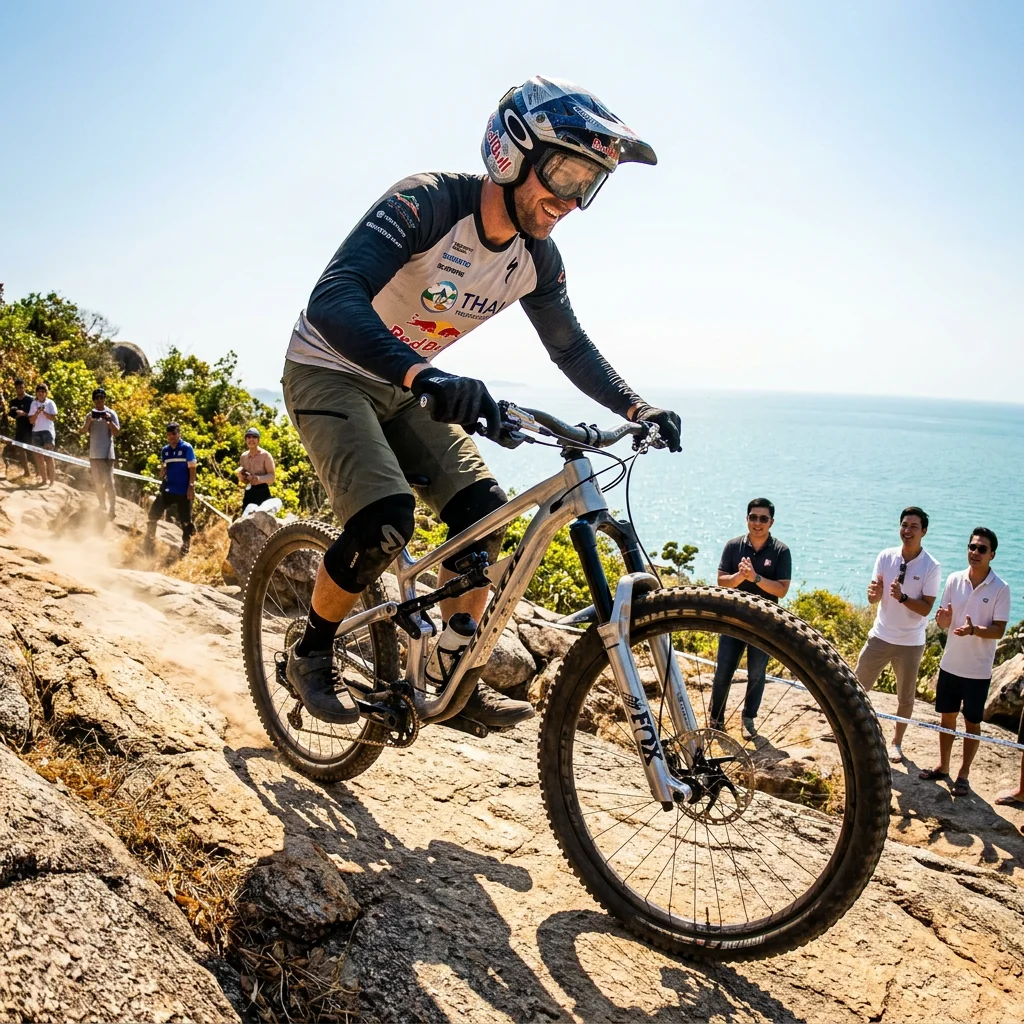
Riders based in Bangkok or travelling through the southern peninsula have access to several established off-road trail systems that provide technical riding without a journey to the northern mountains. These networks span forested hills, coastal granite ridges, and reservoir catchments across central and southern Thailand.
Prachinburi province, roughly two hours east of Bangkok, contains Khao E-To Forest Park beside Chakraphong Reservoir. Widely regarded by domestic riders as the historic training ground for Thai cross-country and enduro sport, the hillside features three colour-coded singletrack circuits alongside dedicated downhill runs. The Red Trail delivers fast, flowing descents with tabletop jumps and bermed sweepers, while the Blue Trail navigates technical rock gardens, root steps, and narrow bamboo thickets. Uplift is practical here: riders either pedal the paved access road or hire local pickup trucks to shuttle bikes up to the radio tower and upper trailheads.
In the coastal resort town of Hua Hin, Khao Hin Lek Fai rises roughly 210 metres above sea level just four kilometres west of the town centre. Known locally as Flintstone Hill, its steep slopes have regularly staged rounds of the Thailand Gravity Series. Trails such as Thara, G-Spot, and Wall Ride—the latter incorporating a curved timber wall feature—differ sharply from northern loam. Loose granite stones, sharp quartzite edges, and thorny coastal scrub punish lightweight rubber, making reinforced tyre casings and disciplined brake modulation sensible precautions. Local cycling shops and volunteer trail builders maintain these tracks, though heavy summer downpours regularly rearrange the rock gardens.
North-east of the capital, Saraburi province features natural singletrack and flow descents at the Chet Khot-Pong Kon Sao eco-tourism centre, giving riders an accessible downhill venue on the western fringe of Khao Yai. Further south on Phuket, the hills enclosing Bang Wad Reservoir in Kathu provide cross-country loops through working rubber plantations, combining slick clay climbs with root-strewn forest singletrack.
These central and southern networks offer dependable options for riders travelling beyond the northern provinces:
| Destination | Elevation Profile | Primary Trail Style | Difficulty Range | Distance From Major City |
|---|---|---|---|---|
| Khao E-To | 100 m – 450 m | Jungle singletrack, jump lines | Intermediate to Advanced | 135 km east of Bangkok |
| Khao Hin Lek Fai | 50 m – 210 m | Rocky gravity trails, enduro | Advanced | 4 km west of Hua Hin centre |
| Bang Wad Reservoir | 30 m – 180 m | Forest cross-country loops | Intermediate | 12 km west of Phuket Town |
| Chet Khot Forest | 150 m – 380 m | Natural singletrack, fire roads | Intermediate | 140 km north-east of Bangkok |
Tropical foliage grows quickly across these networks between race weekends. Before heading out, check recent trail reports on local cycling forums or drop into independent bike shops in Prachinburi or Hua Hin to confirm current clearing schedules.
Terrain Dynamics, Elevation, and Tropical Soil Profiles
Riding off-road trails in Thailand requires a distinct mechanical approach because tropical soil types transform rapidly with moisture. Much of the northern mountain belt around Chiang Mai and Chiang Rai consists of decomposed granite bedrock overlaid by iron-rich red clay. During dry spells, this earth bakes into an unyielding hardpack crust covered by a skittering layer of loose dust and fine gravel, where softer tyre compounds and pronounced shoulder knobs are vital for maintaining cornering grip.
When tropical downpours hit, that same red clay turns into a dense, greasy paste. It packs tightly into knobbly tread patterns within minutes, quickly reducing tyres to slick rubber and packing out fork arches. Beneath the dense forest canopy, trail surfaces are criss-crossed by sprawling networks of exposed bamboo and hardwood roots sitting proud of the dirt. Polished smooth and stripped of their bark by passing wheels, these roots become exceptionally treacherous when damp.
Steep elevation profiles compound the physical challenge. Starting a ride along high ridgelines at 1,400 to 1,500 metres often feels refreshingly cool at 18 degrees Celsius, but descending over 1,000 vertical metres to the valley floor at 350 metres plunges riders into thick heat reaching 32 to 34 degrees Celsius, often paired with humidity exceeding 80 per cent.
To cope with sharp granite edges and root steps, fit robust tyres with reinforced casings, such as Maxxis EXO+ or DoubleDown. Running tubeless pressures two to three psi lower than typical UK trail settings enlarges the contact patch, helping rubber conform over slick roots.
Seasonal Riding Windows and Forest Fire Avoidance
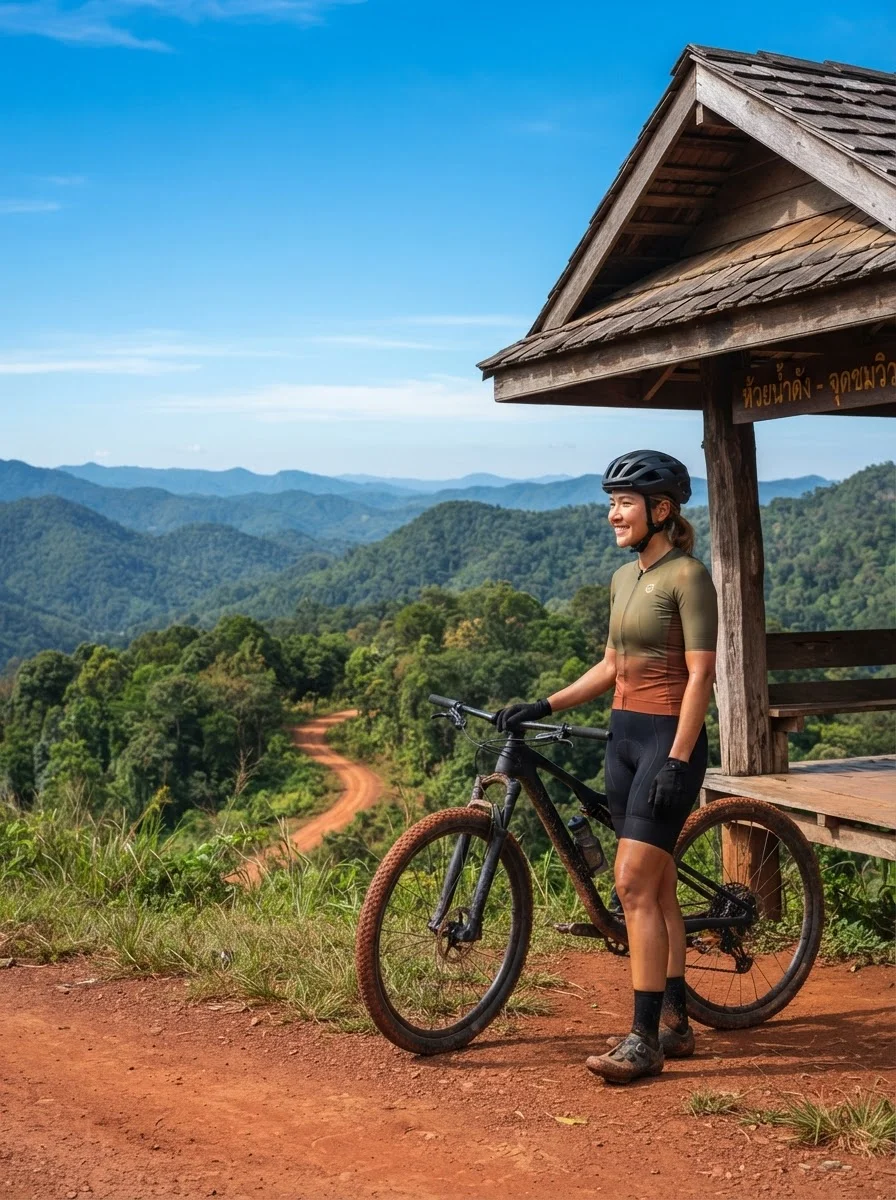
Seasonal weather patterns dictate trail conditions across Thailand, making ride timing fundamental to any itinerary. In Northern Thailand, the primary mountain biking window runs from November through February. During these cooler months, daytime temperatures remain moderate, morning air stays crisp, and recently dried trails provide firm, predictable grip with minimal dust. Ridgelines around Chiang Mai and Chiang Rai offer clear mountain vistas before the dry heat sets in.
From mid-February through April, the northern climate shifts drastically. Agricultural burning and seasonal forest fires trap dense plumes of fine particulate matter (PM2.5) across lowland valleys and highland bowls. The Pollution Control Department routinely records air quality indices well into hazardous bands during March and April. Strenuous cardiovascular exertion outdoors becomes a genuine health risk, making trail riding in Chiang Mai, Chiang Rai, and neighbouring northern valleys ill-advised. Riders visiting during this period should consult official monitoring applications such as Air4Thai before attempting any physical activity.
By late May, the southwest monsoon sweeps in, persisting through October. Heavy downpours transform red clay tracks into slick chutes, scour out deep rain ruts, and leave exposed tree roots treacherous. To preserve delicate forest ecosystems and protect riders from flash flooding and landslides, the Department of National Parks, Wildlife and Plant Conservation (DNP) enforces scheduled seasonal closures across numerous trail networks and backcountry sectors.
If you must travel between February and May, look south of the northern smoke basin. Central and peninsular destinations—notably the granite hills of Hua Hin and the pine-fringed tracks of Khao E-To in Prachinburi—remain largely unaffected by northern smoke, providing dependable riding conditions while the north clears.
Guided Outfits, Uplifts, and Equipment Standards
Sourcing modern mountain bike equipment and reliable uplift logistics in Thailand requires vetting operators carefully. Chiang Mai is the country's primary base for gravity and trail riding, where established guiding outfits maintain fleets of full-suspension bikes. Trailhead Thailand, for example, equips riders with YT Jeffsy full-suspension models featuring 150mm of travel, hydraulic disc brakes, dropper seatposts, and tubeless setups, alongside Kona bikes for larger groups. Full-day guided tours typically cost between 2,800 THB and 3,500 THB (approx £65 to £81). These packages generally include bike hire, certified helmets with optional chin guards, knee and elbow pads, national park fees, trail-side lunch, and hotel transfers. Riders supplying their own bike and protective gear receive a discount of around 300 THB to 500 THB (approx £7 to £12) against the package price.
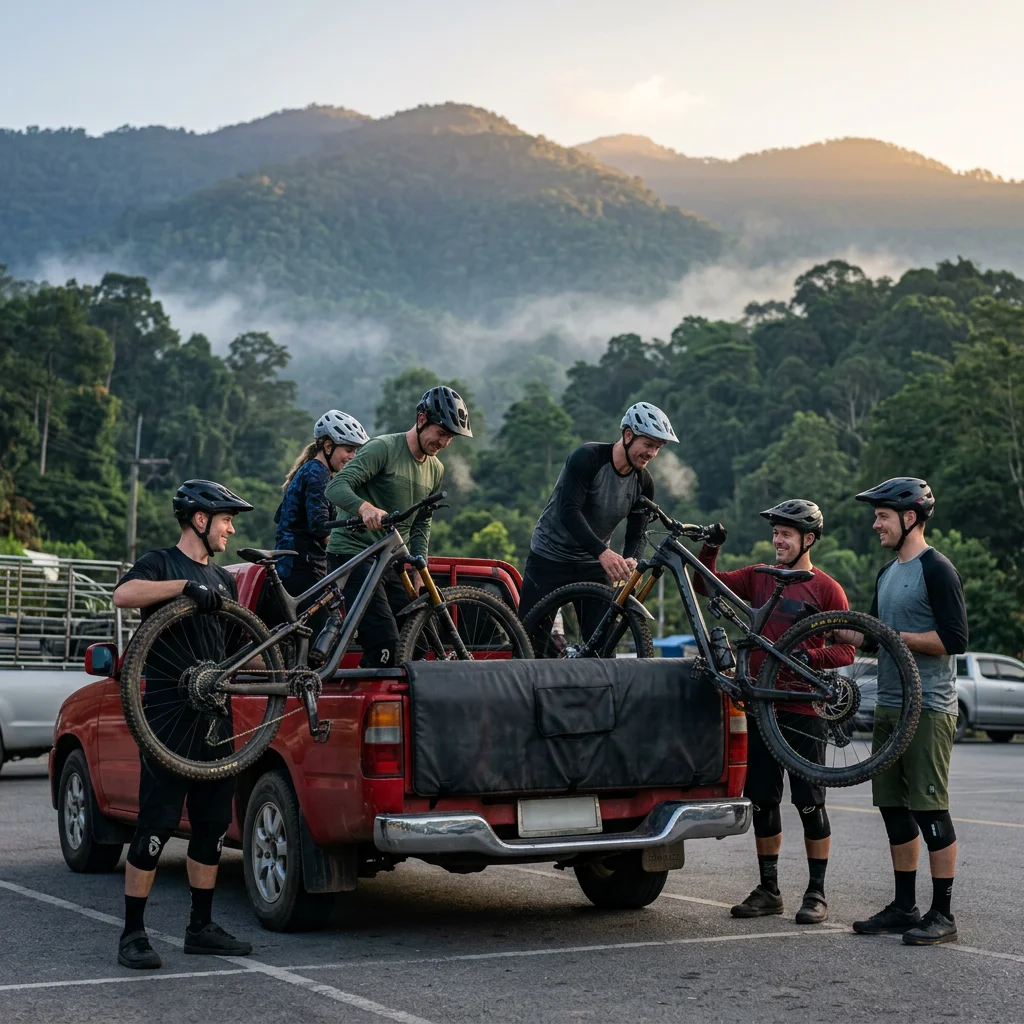
Self-guided groups bringing personal machines or hiring independently can charter private uplift transport rather than pedalling up steep mountain switchbacks. A dedicated 4WD truck or modified songthaew fitted with protective tailgate pads and a driver costs approximately 4,800 THB (approx £111) per day for up to six riders across Doi Suthep-Pui. This charter covers unlimited uplift runs, fuel, and trailhead drop-offs, though operators enforce a final shuttle departure by 15:30 to clear national park trails before dusk. Charter rates exclude guides, park fees, and spare parts.
Rental bikes across Thailand come fitted with standard flat platform pedals. Riders using clipless systems should pack their own SPD pedals and matching shoes, which shop mechanics will fit during morning prep. General roadside hire shops frequently supply worn entry-level hardtails fitted with low-grade components unsuited to steep mountain descents. Before leaving any shop, inspect brake rotor straightness, pad thickness, tyre tread, and suspension seals. Remote forest trails provide zero mobile mechanical backup, so ensure you carry a spare inner tube, tyre levers, a shock pump, and a multi-tool from the shop.
| Service | Inclusions | Cost (THB) | Cost (GBP) | Suitable For |
|---|---|---|---|---|
| Full-Day Guided Enduro Tour | Premium full-sus bike, guide, gear, shuttles, lunch, park fees | 2,800 – 3,500 | £65 – £81 | Visiting riders wanting maximum trail access without navigation |
| Private Uplift Truck Charter | 4WD truck/songthaew with driver, rack/pads, fuel, 6-person capacity | 4,800 | £111 | Self-sufficient groups with their own bikes and GPS tracks |
| Independent Full-Sus Rental | 140–160mm trail/enduro bike, basic open helmet, flat pedals | 1,500 – 2,200 | £35 – £51 | Competent riders arranging their own trail access |
| Park Hardtail Rental | Basic aluminium cross-country bike, basic commuter helmet | 100 – 150 / hr | £2.30 – £3.50 / hr | Casual riders exploring flat estate paths (e.g. Singha Park) |
Where to Ride: Top Mountain Biking Hubs
Chiang Mai forms Thailand's primary mountain biking base, supported by an established network of trail builders, mechanics, and songthaew uplift drivers. The northern provincial capital centres its gravity and enduro riding on Doi Suthep-Pui National Park, where highland singletrack drops through dense forest into the valley floor. South of the city, districts such as Hang Dong and Nam Phrae provide dry, rolling cross-country circuits around red-dirt quarries and open woodland.
Roughly three hours northeast, Chiang Rai provides an alternative northern hub focused on endurance and cross-country riding. Here, manicured dirt pathways and farm roads weave through the tea plantations of Singha Park, while rugged backcountry trails track along the banks of the Kok River toward rural hill-tribe settlements.
Riders staying near Bangkok travel east into Prachinburi Province to reach Khao E-To Forest Park, located roughly two hours from the capital by road. The park features waymarked cross-country circuits and technical rocky descents through dense bamboo jungle. Further south along the western Gulf coast, Hua Hin draws downhill and trail riders to Khao Hin Lek Fai. Situated just inland from the town centre, this steep granite hill features rocky drop-offs, berms, and fast lines that have staged national gravity competitions. Southern peninsular riding extends further down to Phuket, where red-clay singletrack loops encircle inland venues such as Bang Wad Reservoir.
For riders new to Thailand, Chiang Mai remains the most practical starting point, providing reliable bike rental, guided day trips, and established routes such as Doi Suthep's Bamboo Trail to help you get used to tropical forest dirt and exposed root systems.
Costs and Budgeting
Mountain biking in Thailand provides good value across all rider budgets. Those travelling with their own bikes can ride public trails for little more than park entry and shared transport. On Doi Suthep, red songthaew shared taxis carry riders and bikes to ridge trailheads for 100 to 150 THB (approx £2.30 to £3.50) per run. Foreign adult entry fees for protected national park trailheads typically range from 100 to 300 THB (approx £2.30 to £7.00), including the 100 THB (approx £2.30) charge at Doi Suthep-Pui.
Riders hiring equipment generally choose full-day guided enduro packages costing 2,800 to 3,500 THB (approx £65 to £81). These cover a full-suspension bike, protective armour, helmet, uplifts, guiding, and lunch. Self-guided groups can charter a private uplift vehicle with bike racks for 4,800 THB (approx £111) per day, working out at 800 THB (approx £18.50) per rider for six people. For relaxed cross-country routes, front-suspension hardtails rent for 600 to 900 THB (approx £14 to £21) for half a day, while Singha Park in Chiang Rai hires bicycles for 200 THB (approx £4.60) per 90-minute session.
| Option | Cost (THB) | Cost (GBP approx) | Notes |
|---|---|---|---|
| National Park Entrance Fee | 100 – 300 | £2.30 – £7.00 | Per adult foreigner, required for protected trailheads |
| Shared Single Songthaew Uplift | 100 – 150 | £2.30 – £3.50 | Per run from base to Doi Suthep ridge |
| Full-Day Private Uplift Truck | 4,800 | £111 | Split between up to 6 riders (approx THB 800 / £18.50 each) |
| Full-Day Guided Enduro Tour | 2,800 – 3,500 | £65 – £81 | Includes full-sus bike, protection, guiding, lunch, uplifts |
| Half-Day Cross-Country Rental | 600 – 900 | £14 – £21 | Standard front-suspension hardtail from local shop |
| Singha Park Bicycle Hire | 200 | £4.60 | Per 90 minutes for recreational estate loops |
What to Know Before You Go
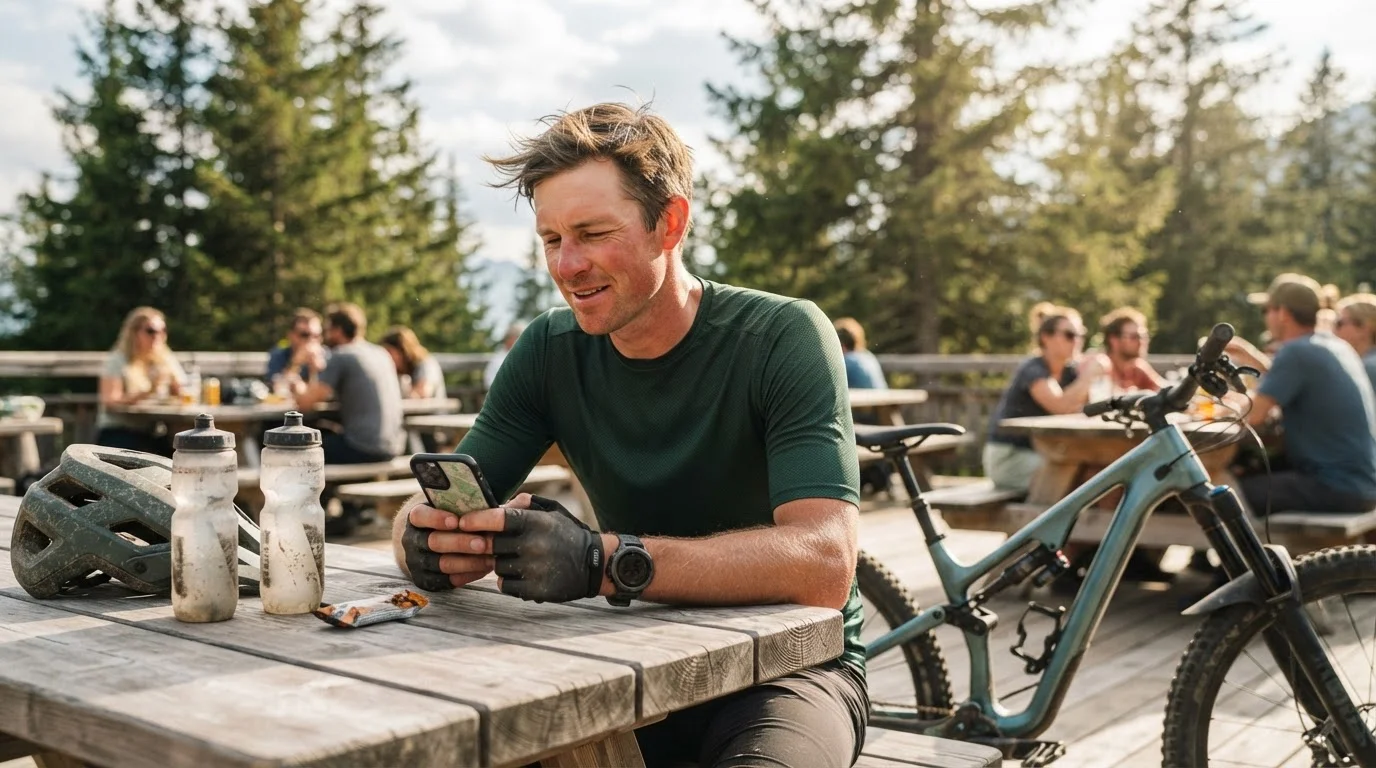
Securing adequate travel insurance before departure is vital. Standard UK holiday policies routinely exclude off-road cycling, downhill tracks, and emergency extraction, leaving riders liable for substantial private hospital costs. Thai hospitals require payment guarantees before treatment, so verify that your policy explicitly covers non-tarmac mountain biking and medical evacuation. Dial 1669 for national emergency medical dispatch, or 1155 for the English-speaking Tourist Police.
Trail access across Thailand's national parks is regulated by the Department of National Parks, Wildlife and Plant Conservation. Protected zones enforce seasonal closures and limit riding to approved routes. Entering restricted forest areas without an authorised guide or registered permit violates the National Park Act, risking formal fines and enforcement action by rangers.
Free-roaming village dogs and orchard guard dogs frequently patrol remote trail intersections and settlement boundaries. Attempting to sprint past them on loose, off-camber dirt often causes crashes. Dismount steadily, keep the bike frame between yourself and the animals, and back away slowly. UK travel health authorities confirm rabies is present in Thailand; if bitten or scratched, wash the wound thoroughly and seek immediate medical evaluation.
High humidity and tropical temperatures accelerate fluid and salt loss far faster than riding in Britain. Drinking plain water alone risks hyponatraemia, muscle cramps, and slowed reaction times on technical descents. Pack electrolyte tablets, hydrate frequently, and buy sealed bottled water from village shops rather than untreated forest streams.
Practical Tips
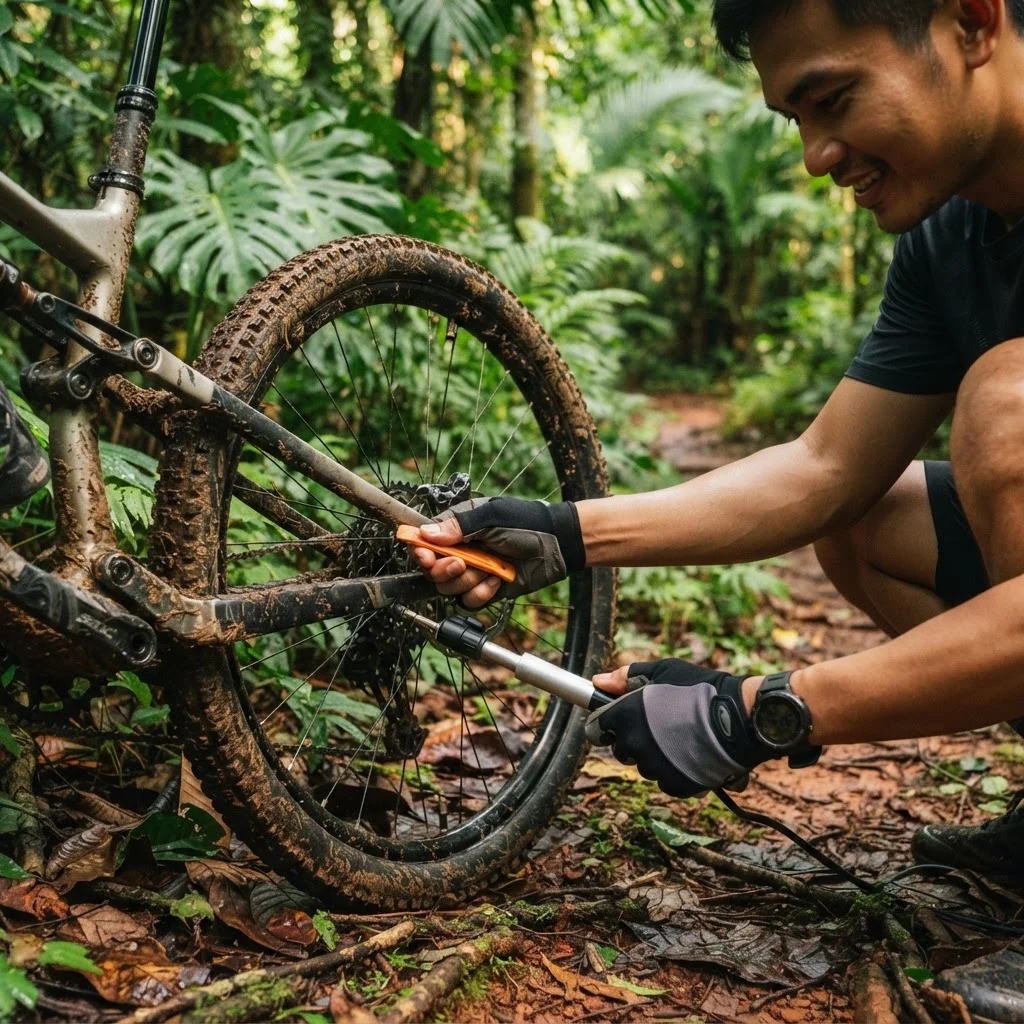
Navigating Thailand’s mountain bike trails requires careful preparation before leaving paved roads. Dense tropical jungle canopies frequently block mobile reception and degrade satellite signals, particularly in steep ravines across northern national parks. Download offline topographic route files on Trailforks or Komoot well in advance. At unmarked forks and overgrown logging junctions, having cached maps with elevation profiles prevents confusing game tracks with established descents. Carrying a compact, sealed power bank is equally sensible, as continuous satellite tracking in humid heat drains smartphone batteries rapidly.
Protective equipment must strike a sensible balance between downhill impact resistance and tropical heat management. For technical enduro routes and gravity runs, a lightweight full-face helmet with a removable chin bar or generous ventilation is far more practical than a standard downhill shell. Pair this with breathable, slip-on knee pads made from flexible impact foam. Tropical trails are bordered by decomposed granite rocks and sharp bamboo stumps, which can turn an ordinary low-speed slip into deep cuts requiring hospital stitches. Clear or lightly tinted riding glasses also protect your eyes from low-hanging spider webs, whipping bamboo fronds, and flying insects.
Mechanical self-reliance is a priority once you head into the forest. There are no mobile repair services or vehicle recovery points on backcountry singletrack, so pack a comprehensive trailside kit. Useful spares include tubeless tyre repair plugs (often called bacon strips), a tyre plugger tool, a high-volume mini pump, and a multi-tool equipped with a chain breaker. Carry spare quick-links matching your drivetrain and an inner tube wrapped in plastic to guard against sharp thorn punctures or sidewall tears that sealant cannot close.
If you are riding in Chiang Mai, choose accommodation along the western edges of the city, such as Nimmanhaemin Road or the Suthep Road corridor. Staying west of the old city cuts travel times to the base of Doi Suthep down to roughly ten to fifteen minutes each morning, bypassing congested downtown traffic when meeting early songthaew uplifts or pedalling up to the trailheads.
Keep at least 1,000 THB (approx £23) in small banknotes—such as 20, 50, and 100 THB notes—inside a waterproof pouch. Highland fruit stalls, remote hill-tribe noodle shops, and rural songthaew drivers operate strictly on cash and cannot accept digital payments or foreign bank cards. A sealed dry bag also stops sweat and afternoon downpours from ruining paper money and phones.
Avoid riding demanding backcountry descents such as Gee's House or Crazy Dustman alone. Thick canopy cover and steep drop-offs make it almost impossible for searchers to spot an injured rider from access roads. Ride with a partner or hire an experienced local guide, and inform your accommodation of your intended route and expected return time.
Wash and dry your riding kit as soon as you finish for the day. High ambient humidity prevents thick technical fabrics and padded chamois liners from drying overnight, creating a breeding ground for bacteria and fungal infections. Rinse gear thoroughly and dry it in an air-conditioned room or under a fan.
Before heading out onto technical Thai singletrack, ensure you have arranged dedicated adventure travel cover designed for off-road riding.
Quick Reference Table
| Item | Detail | Notes |
|---|---|---|
| Prime Northern Season | November to February | Clear skies and firm dirt; avoid mid-February to April due to smoke and burning |
| Central & Southern Season | February to May | Hua Hin and Khao E-To provide reliable riding during the northern smoky period |
| Primary Gravity Hub | Doi Suthep-Pui, Chiang Mai | Over 1,200 m vertical drop; routes include Bamboo Trail, Gee's House, and Crazy Dust |
| Cross-Country Hubs | Chiang Rai, Doi Kham, Hang Dong | Singha Park estate trails, Kok River singletrack, and Nam Phrae sandstone loops |
| Central & Peninsular Hubs | Khao E-To (Prachinburi), Khao Hin Lek Fai (Hua Hin) | Forest singletrack near Bangkok and steep, rocky gravity runs on the western Gulf |
| Full-Day Guided Enduro Tour | 2,800 – 3,500 THB (approx £65 – £81) | Includes full-suspension bike, protective armour, uplifts, guiding, and lunch |
| Private Uplift Truck Charter | 4,800 THB (approx £111) per day | Covers 4WD truck/songthaew for up to 6 riders on Doi Suthep; last run departs 15:30 |
| Independent Bike Rental | 1,500 – 2,200 THB (approx £35 – £51) per day | 140–160mm trail/enduro bike; flat pedals supplied, pack your own SPD pedals and shoes |
| National Park Entrance Fees | 100 – 300 THB (approx £2.30 – £7.00) | Per adult foreigner for protected trailheads; Doi Suthep-Pui entry is 100 THB |
| Single Songthaew Uplift | 100 – 150 THB (approx £2.30 – £3.50) | Per person per run from Chiang Mai base up to Doi Suthep ridge trailheads |
| Recommended Cash to Carry | At least 1,000 THB (approx £23) | Small notes (20, 50, 100 THB) in a waterproof bag for uplifts and rural fruit stalls |
| Emergency Contacts | 1669 (Medical Emergency) / 1155 (Tourist Police) | Ensure travel insurance explicitly covers off-road cycling and medical extraction |
| Official source (Air Quality) | air4thai.pcd.go.th | Real-time PM2.5 pollution monitoring across northern and central provinces |
| Official source (National Parks) | portal.dnp.go.th | Department of National Parks trail regulations, entry rules, and wet-season closures |
| Guiding & Uplifts (Chiang Mai) | trailhead.co.th | Full-suspension bike rental, guided tours, and private vehicle uplift shuttles |
| Venue (Chiang Rai) | singhapark.com | Purpose-built estate cross-country loops with on-site bicycle hire |
FAQ: Mountain Biking
What is the best time of year for mountain biking in Northern Thailand?
When should mountain bikers avoid riding in Northern Thailand due to air quality?
Where can mountain bikers ride in Thailand during the northern burning season?
What type of travel insurance is essential for mountain biking in Thailand?
How should mountain bikers react if they encounter dogs on trails in Thailand?
How can mountain bikers prevent dehydration and electrolyte imbalance in Thailand's climate?
What navigation and power considerations are important for mountain biking in Thailand?
What essential repair kit should mountain bikers carry on trails in Thailand?
Is it safe to mountain bike alone on demanding trails in Thailand?
How much cash should mountain bikers carry in Thailand and why?
Reviewed by the Thailand Guide Editorial Team • Last reviewed: 17 November 2026
This page is provided for general information only. While we aim for accuracy, details can change — please verify anything important independently before relying on it.