Cycling Tours in Thailand
Cold towels, chilled water, and fresh tropical fruit waiting at the tailgate of an air-conditioned support van make a welcome sight when cycling in Thailand's tropical heat. Booking an organised cycling holiday removes the stress of navigating unfamiliar roads, chaotic junctions, and remote mechanical breakdowns, replacing them with planned rural routes, pre-arranged luggage transfers, and experienced local ride leaders.
Tour options in Thailand cater to almost every schedule and ability, spanning gentle half-day canal excursions through Bangkok's waterways to demanding multi-day expeditions crossing northern mountain passes or tracing the southern coastline. Whether you are considering a leisurely small-group holiday on a hybrid bike or an intensive road-cycling training camp, choosing the right operator requires clear information on route grading, support vehicle provisions, bike hire fleets, and safety standards. This guide provides UK cyclists with the practical facts needed to compare tour formats, evaluate operators, and plan a cycling holiday matched to their fitness and budget.

Tour Formats: Guided Groups, Self-Guided Tracks, and Private Charters
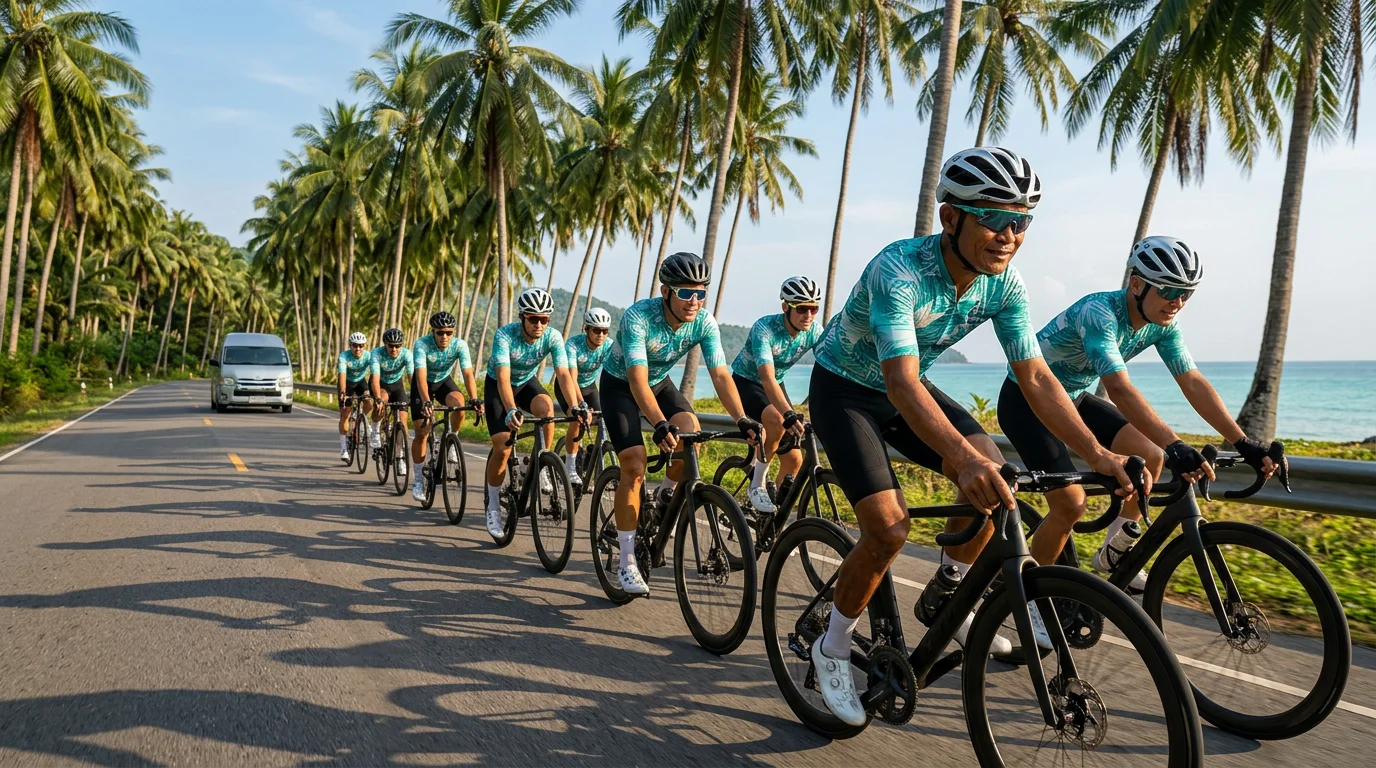
Selecting the right tour format determines your daily pacing flexibility, route autonomy, and overall holiday budget. Organised cycling across Thailand falls into four main commercial structures, ranging from fully escorted group pelotons to independent, map-led routes.
Scheduled small-group tours represent the standard commercial format from established regional operators such as SpiceRoads Cycling and Grasshopper Adventures. Departures run on fixed calendar dates, typically bringing together 2 to 16 international riders under the direction of an English-speaking Thai tour leader. An escort vehicle shadows the group along rural backroads, carrying passenger luggage, chilled water, fresh tropical fruit, and spare parts. Daily distances generally range from 45 to 95 km, divided by regular refreshment breaks. Solo travellers and couples often prefer this format because it removes navigation stress and creates a shared social dynamic without requiring private charter premiums.
Private custom tours follow identical itineraries or bespoke routes tailored to your specific group, usually accommodating 2 to 12 riders. They grant UK cycling clubs, friend groups, and families complete authority over departure times, rest frequencies, and average rolling speeds. A private departure is particularly practical for groups of mixed fitness: riders needing a rest can step into the air-conditioned support vehicle at any point without feeling self-conscious about inconveniencing unfamiliar cyclists.
Supported self-guided packages suit experienced cyclists who prefer pedalling independently without the structure of a group. Operators provide pre-programmed GPS units or downloadable GPX files, detailed route notes, pre-booked boutique hotels, and point-to-point luggage transfers. Because your bags travel ahead to each evening stop, you ride light with only daytime supplies. You pedal unaccompanied without a support van shadowing your wheels, meaning you must be comfortable reading digital maps and handling basic roadside puncture repairs.
Urban day excursions operate in hubs like Bangkok and Chiang Mai on fixed morning or late-afternoon departures, typically capping group sizes at 10 participants. Covering 12 to 35 km at a gentle sightseeing pace, these rides navigate quiet alleyways, temple precincts, and elevated canal footpaths away from main-road traffic, frequently integrating riverboat crossings to link older neighbourhoods.
| Tour Format | Group Size | Typical Daily Distance | Support Level | Best Suited For |
|---|---|---|---|---|
| Scheduled Small Group | 2–16 riders | 45–95 km | Lead guide, tail guide, support van, snacks | Solo travellers, social couples |
| Private Custom Tour | 2–12 riders | Tailored (30–120 km) | Dedicated crew, private vehicle, custom pace | Families, UK club pelotons |
| Supported Self-Guided | 1–6 riders | 40–80 km | GPX route files, luggage transfers, on-call repair | Experienced independent riders |
| Urban Day Excursion | 2–10 riders | 12–35 km | Lead guide, local riverboat connections | Beginners, short-stay visitors |
Equipment and Fleets: Road Bikes, Gravel Rigs, and E-Bike Provision
High-specification bicycles provided by professional Thai operators eliminate the expense and mechanical risk of flying personal bikes from the UK. Reputable tour companies maintain commercial fleets featuring recognised brands such as Trek, Giant, Specialised, and Cannondale, serviced before every departure by in-house mechanics.
Touring itineraries along mixed asphalt and rural concrete lanes usually supply lightweight aluminium hybrid bikes. Fitted with flat handlebars, 32mm to 38mm puncture-resistant tyres, and wide-ratio Shimano gearing, these rigs offer the upright stability and climbing range needed in tropical conditions.
Dedicated road cycling itineraries—such as the coastal corridor between Bangkok and Phuket—provide performance carbon-fibre machines. Operators like Siam Bike Tours maintain fleets such as the Giant TCR Advanced fitted with Shimano 105 or Ultegra components. Individual rentals start from 1,200 THB (approx £27) per day or 5,500 THB (approx £125) per week, typically subject to a one-off 200 THB (approx £5) cleaning fee.
Pedal-assist e-bikes have transformed commercial touring in Thailand. Equipped with mid-drive motors from manufacturers such as Giant SyncDrive and Bosch, e-bikes allow partners of differing fitness levels to comfortably tackle steep northern climbs and sustained coastal headwinds together.
Tour packages routinely provide a standard helmet, flat pedals, and water bottle cages with bottles. Operators gladly fit personal equipment during the initial briefing, so UK cyclists should bring their own cycling shoes, clipless pedals, and preferred saddle (excluding the seatpost). During the day-one bike fit at the depot, inspect the tyre sidewalls, chain lubrication, brake pad clearance, and gear shifting across the full cassette before rolling out.
Plan a Northern Thailand trip covering Chiang Mai, Chiang Rai, Sukhothai, mountain routes, Lanna food, transport, seasons and air quality.
Support Logistics: Escort Vans, Luggage Transfers, and Route Nutrition
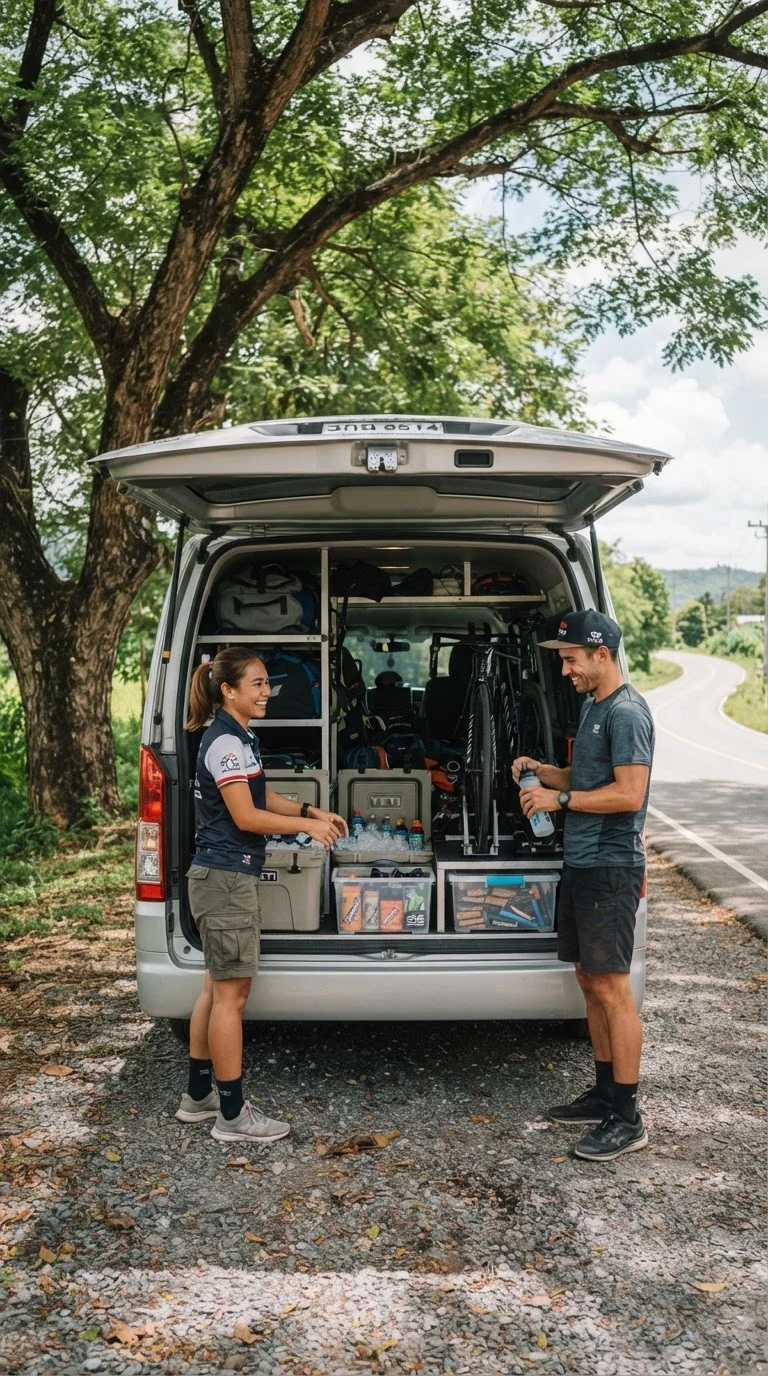
Dedicated vehicular support changes the nature of long-distance cycling across Thailand, turning what could be an exhausting test of endurance in tropical heat into a manageable holiday. Commercial multi-day tours rely on air-conditioned minibuses—commonly high-roof Toyota Commuter vans—fitted with specialised bike racks, toolkits, floor pumps, and spare parts. Your main luggage travels inside the vehicle from hotel to hotel, keeping bags clean and dry while leaving you free to ride without panniers or heavy rucksacks.
Every 15 to 25 kilometres, the support van leaps ahead of the peloton to set up a roadside rest stop, often in a shaded temple courtyard, village pavilion, or palm grove. These checkpoints provide chilled drinking water, electrolyte mixes, fresh local fruit such as watermelon and bananas, and iced towels to bring down your core temperature. If heat exhaustion, muscle fatigue, or steep gradients take their toll, you can simply flag the guide and climb into the air-conditioned passenger cabin for a stage or the rest of the day.
Support drivers also help coordinate midday meals, steering groups towards provincial open-air kitchens for freshly cooked noodle soups, stir-fried rice, and local curries rather than processed snacks. For mechanical trouble, the crew carries spare inner tubes, tyres, chains, and replacement bikes, allowing swift repairs or an immediate swap so the group itinerary stays on schedule. Keep daily items—such as high-factor sunscreen, lip balm, personal medication, and a photocopy of your passport—in a separate small daypack placed in the van's passenger cabin for quick access at refreshment stops, rather than buried in your stowed main luggage.
Signature Itineraries: Northern Passes, Central Plains, and Coastal Corridors
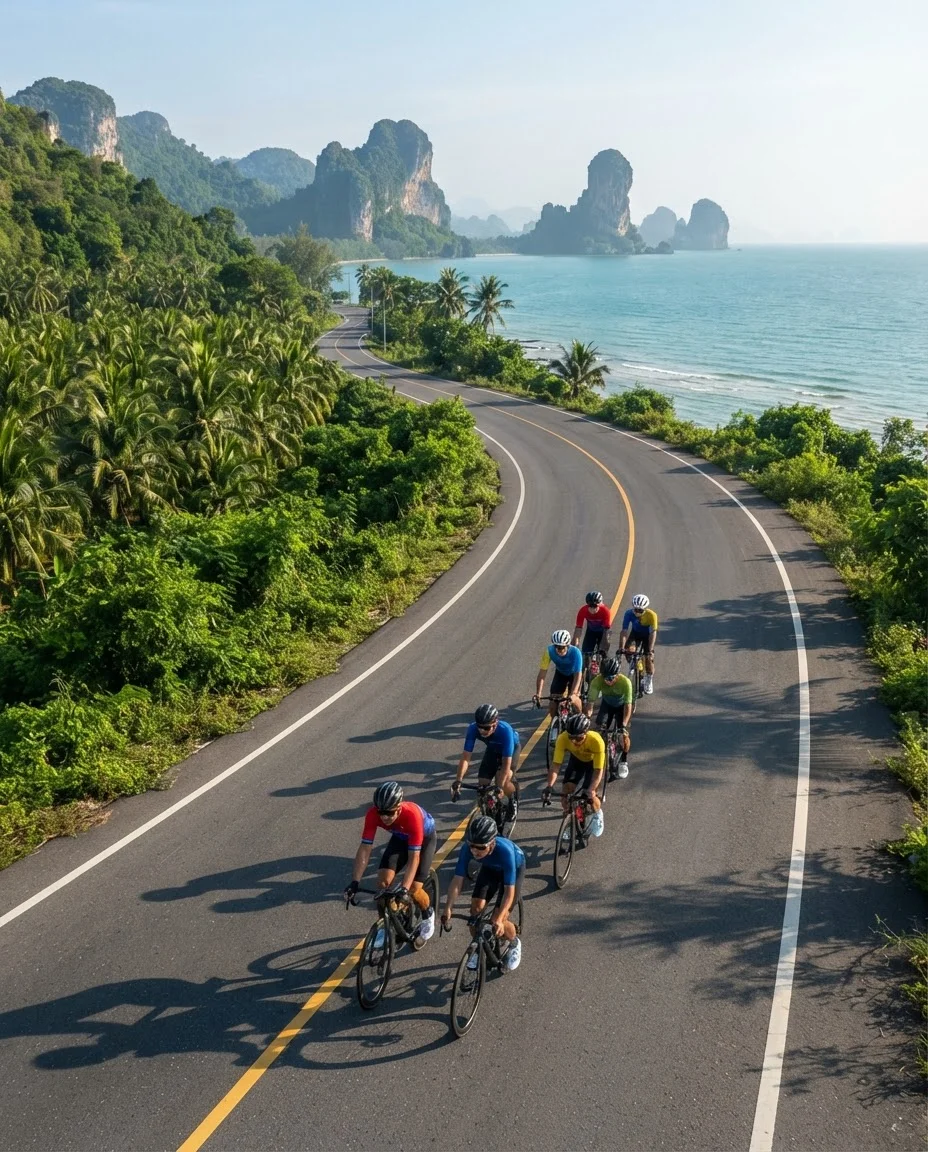
Thailand's geography divides into distinct cycling corridors that cater to contrasting riding preferences, fitness levels, and seasonal weather patterns. Supported multi-day itineraries concentrate in three major regions: the southern coastal peninsula, the northern highlands, and the central river basin, alongside half-day routes around Bangkok.
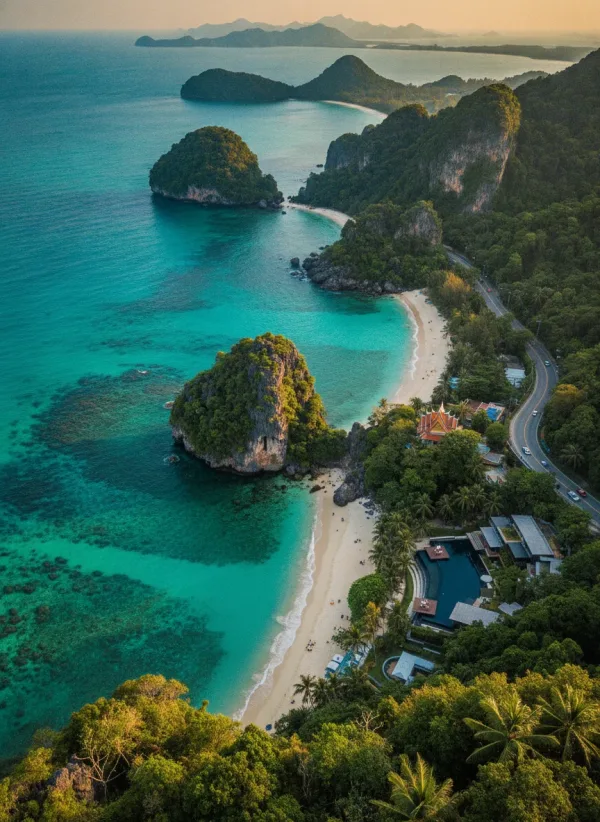
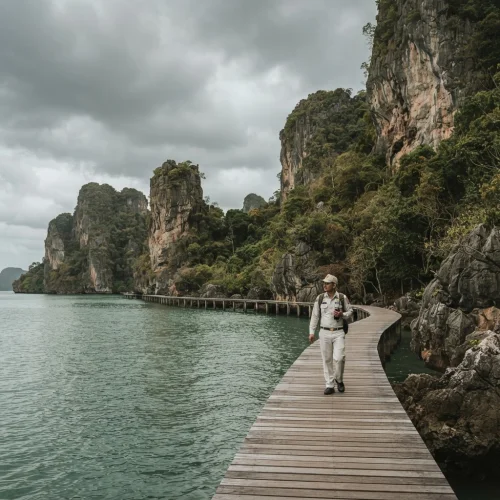
The southern corridor between Bangkok and Phuket forms Thailand's classic long-distance road route. Commercial tours typically cover 800 to 850 kilometres across ten days, following the Gulf of Thailand southwards before turning west across the peninsular divide. Escort-supported groups avoid major highways by threading quiet rural backroads, including paved stretches of the Royal Coast scenic corridor through Hua Hin, Prachuap Khiri Khan, and Chumphon. This section delivers flat riding on smooth tarmac alongside coastal bays and coconut groves. The route turns inland near Khao Sok National Park, introducing steeper rainforest ascents and dramatic limestone karst formations before descending towards the Andaman Sea and crossing the Sarasin Bridge into Phuket.
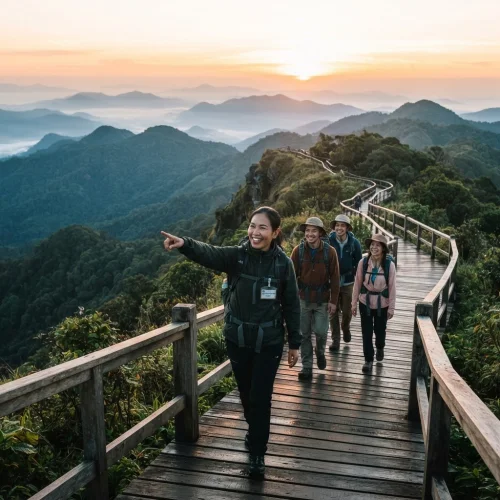
Northern itineraries linking Chiang Mai with Chiang Rai or traversing the Mae Hong Son loop provide an alpine contrast. These highland journeys climb through teak forests, river valleys around Mae Rim and Mae Taeng, and rural hill villages. Ascents are demanding, with mountain passes confronting riders with gradients exceeding ten per cent. Cyclists benefit from cooler morning temperatures, lush mountain scenery, and Lanna heritage. Several operators incorporate longtail boat transfers along the Kok River to link remote cycling stages between Chiang Dao, Tha Ton, and Chiang Rai.
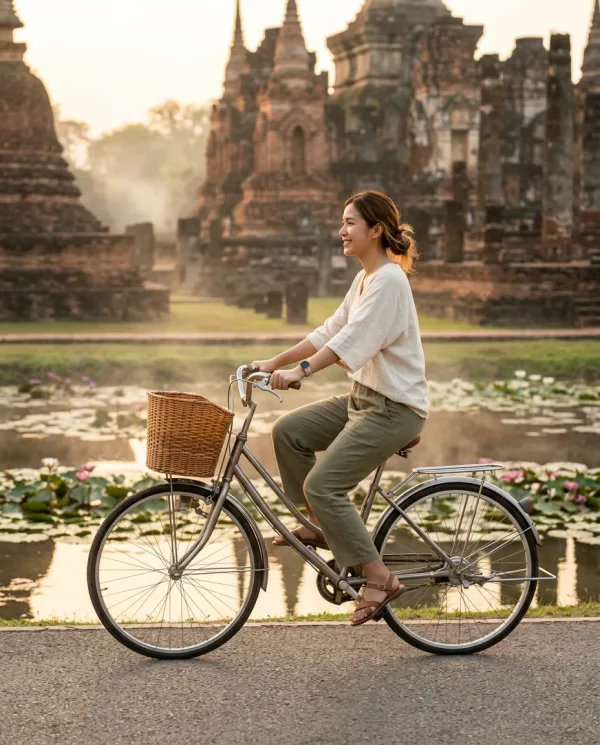
Central heritage routes connect ancient Siamese capitals, including the UNESCO World Heritage ruins of Ayutthaya, Lopburi, and Sukhothai Historical Park. Covering roughly 280 to 320 kilometres over six to seven days, these itineraries navigate flat canal banks, irrigation dykes, and secondary rural lanes with minimal motor traffic, allowing steady cultural touring.
Seasonal timing matters when selecting a route. Peninsular coastal journeys run from November to March, dodging the southwest monsoon and Gulf squalls. Northern mountain tours should be booked between November and early February to secure crisp air and clear mountain views before agricultural burning generates seasonal haze from mid-February.
| Itinerary Name | Primary Region | Duration & Distance | Terrain Profile | Highlights |
|---|---|---|---|---|
| Bangkok to Phuket Coast | Gulf & Andaman Coast | 10 days / 820 km | Flat tarmac, coastal undulations | Quiet fishing hamlets, Khao Sok limestone, beach hotels |
| Chiang Mai to Chiang Rai | Northern Highlands | 4–6 days / 280 km | Mountain passes, gravel trails | Kok River boat transfer, mountain temples, fruit farms |
| Central Heritage Route | Central River Basin | 7 days / 320 km | Flat secondary roads, canal banks | Ayutthaya ruins, Sukhothai Historical Park, river villages |
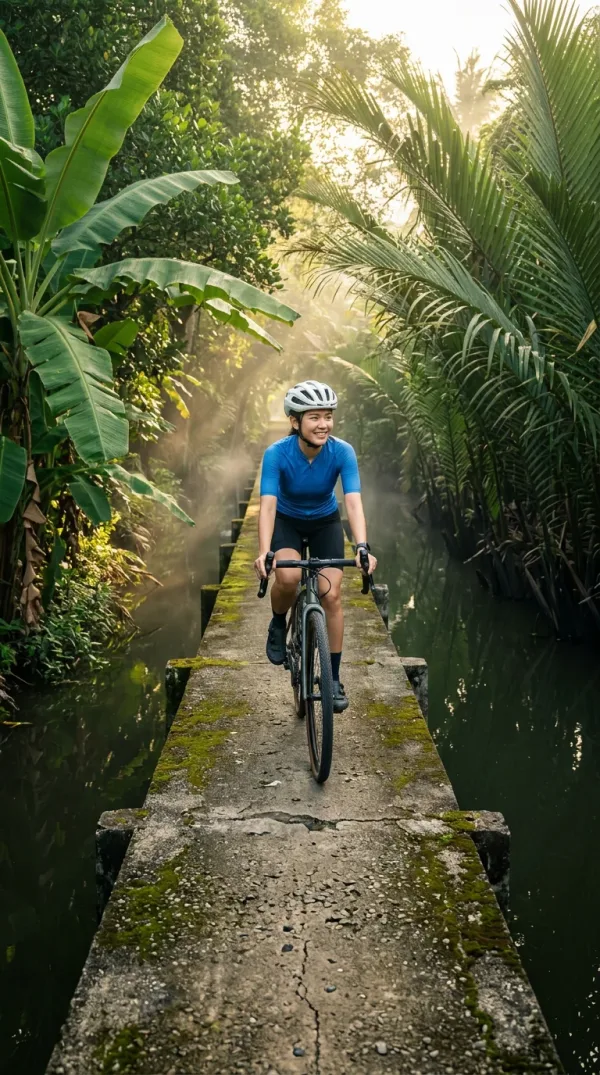
| Bangkok Jungle & Canals | Bang Krachao & Thonburi | Half day / 18–25 km | Elevated concrete boardwalks | Tropical fruit plantations, canal longtails, hidden shrines |
Fitness Grading: Matching Distances, Heat, and Climbs to Ability
Underestimating tropical humidity and thermal stress causes far more difficulty for visiting cyclists than route distance or hill profiles. Ambient temperatures frequently sit above 32°C with high humidity, so UK riders accustomed to cooler conditions should drop down at least one difficulty tier from their usual domestic comfort zone.
Most commercial tour operators in Thailand grade their itineraries on a scale from level one to five. Leisure tours at levels one and two cover 25 to 45 kilometres daily across flat, paved terrain at an easy rolling pace of 15 to 18 km/h. These departures require only basic bike-handling confidence and reasonable baseline health, with frequent refreshment breaks and sightseeing stops built into each morning.
Level three itineraries step up to active touring, averaging 50 to 75 kilometres per day across gently undulating rural roads with modest climbing of up to 500 metres. These trips suit regular cycle commuters or weekend club cyclists who can comfortably sustain three or four hours in the saddle over consecutive days.
Sporting and endurance itineraries at levels four and five are aimed at seasoned road cyclists. Daily stages range from 85 to 130 kilometres, tackling sustained elevation gains between 600 and 1,500 metres over northern mountain passes or the peninsular divide. Groups on these departures typically hold a disciplined rolling pace of 24 to 28 km/h, which demands strong pack-riding skills and thorough heat acclimatisation.
While the accompanying support vehicle offers a seat whenever legs give out, matching your genuine fitness to the itinerary ensures you spend your holiday on two wheels rather than in the minibus. Preparing with back-to-back weekend rides in the UK helps condition your lower back and sit bones for repeated days in the saddle.
Operator Standards: Licensing, Guide Ratios, and Safety Protocols
Vetting an operator's operational standards protects your holiday against unlicensed guides, neglected equipment, and insufficient medical cover. Under the Tourism Business and Guide Act, any commercial tour company in Thailand must hold an active licence issued by the Department of Tourism. Legitimate operators display their registration number—typically in a two-digit province prefix format such as 11/XXXXX—on their website, booking paperwork, and vehicles. Tour guiding is legally restricted to Thai nationals, and guides must carry official Department of Tourism identification cards.
By law, licensed operators must provide basic tourist accident insurance, which covers at least 500,000 THB (approx £11,600) for injury and 1,000,000 THB (approx £23,200) for death. This statutory cover is minimal and does not cover medical repatriation, so you must secure comprehensive UK travel insurance specifically covering non-competitive cycle touring at your planned elevations and distances.
On the road, guide ratios dictate your safety. Established operators cap group sizes and assign staff accordingly: Grasshopper Adventures limits groups to 16 with one tour leader for every eight riders, while technical outfits like Trailhead Thailand use a maximum of four riders per guide. On road-touring departures with more than six to eight guests, reputable firms deploy a lead rider and a tail "sweep" guide, both in radio or phone contact with an air-conditioned escort van. Guides should hold recognised first-aid qualifications, carry supplies for heat stress and road rash, and follow written emergency plans with mapped regional hospital networks along rural stages. Confirm the operator's licence number and passenger vehicle insurance before paying your deposit.
Where to Find Reputable Cycling Tour Operators
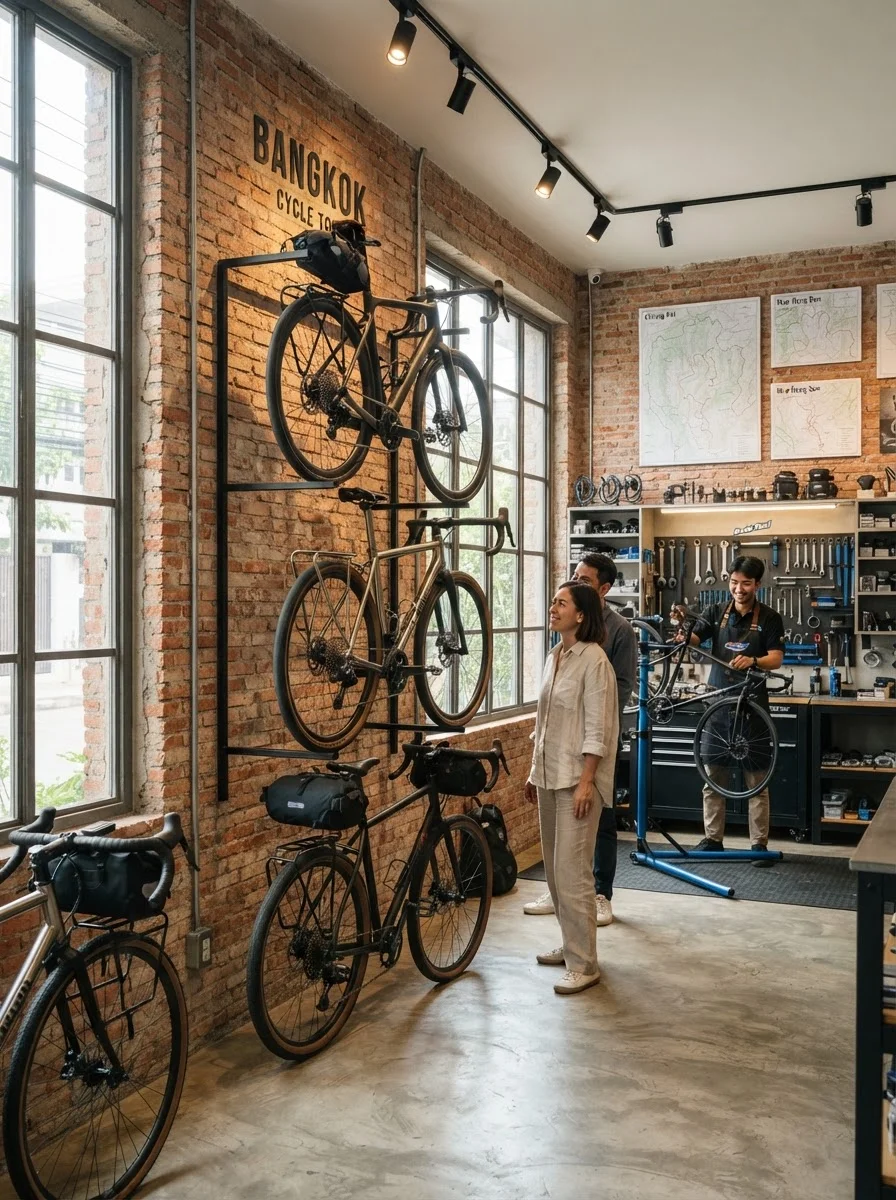
Bangkok is the primary hub for organised cycling in Thailand, home to long-running pioneer operators alongside specialist urban outfits. Choosing a vetted company with dedicated equipment and established local route knowledge ensures reliable mechanical support and proper route safety.
Co van Kessel, based at the River City Bangkok complex in Samphanthawong, pioneered Bangkok's canal-side rides. The company runs three-to-five-hour itineraries exploring Chinatown alleyways and Thonburi orchards using custom upright utility bicycles. Standard rates run from 1,290 THB (approx £29) for the three-hour city ride up to 2,650 THB (approx £60) for the five-hour bicycle and longtail boat combo.
Grasshopper Adventures operates from a shop near Democracy Monument on Ratchadamnoen Klang Road. Its team coordinates guided evening rides through illuminated temples, central heritage loops, and multi-day excursions heading west into Kanchanaburi Province.
In northern Thailand, Trailhead Thailand runs mountain biking expeditions from Pra Pokklao Road in Chiang Mai's Old City. The outfitter specialises in technical downhill descents and cross-country singletrack through Doi Suthep-Pui National Park, with day rides starting from 1,990 THB (approx £45) including protective gear and uplift transport.
For long-distance touring, SpiceRoads Cycling coordinates operations from Bangkok, organising supported multi-day itineraries across northern, central, and southern Thailand with dedicated escort vans and luggage transfers.
Riders targeting southern road cycling should look to Siam Bike Tours, situated at Boat Avenue in Thalang, Phuket. The operator provides supported coastal training holidays, multi-day peninsular tours along the Andaman and Gulf coasts, and high-spec carbon road bike and e-bike fleets.
First-time visitors will find it sensible to start with a half-day guided city ride in Bangkok or Chiang Mai. This provides an easy way to adjust to left-hand traffic, tropical heat, and narrow passageways before committing to demanding multi-day expeditions.
Costs and Budgeting
Commercial cycling holidays in Thailand deliver reliable value for UK travellers because standard packages bundle accommodation, luggage transfers, support vehicles, mechanical care, route nutrition, and licensed guides into a single fee.
Budget day excursions in Bangkok or Chiang Mai cost between 1,250 THB and 2,500 THB (£28 to £56), covering bicycle and helmet hire, river ferry crossings, drinking water, and local snacks. Full-day countryside rides to outlying temples or rural national parks range from 2,200 THB to 3,500 THB (£49 to £78), reflecting longer vehicle transfers and entrance fees.
Multi-day touring itineraries average 7,500 THB to 11,000 THB (£167 to £246) per day. A typical seven-day central heritage tour costs between 48,000 THB and 62,000 THB (£1,071 to £1,384), incorporating three-star character hotels, private van escort, meals, and standard hybrid bikes. Dedicated ten-day coastal road tours between Bangkok and Phuket generally run from 64,000 THB to 85,000 THB (£1,429 to £1,897).
Solo riders willing to share twin accommodation with another cyclist of the same gender often avoid extra charges. Those requesting a private room pay single supplements that typically range from 12,000 THB to 23,000 THB (£268 to £513) on weekly tours. Performance upgrades, such as carbon road bikes or e-bikes, carry separate equipment surcharges rather than sitting inside base fees. Tour balances are customarily due 60 days before departure, with schedule changes allowed without penalty outside 45 days. Base packages exclude alcoholic drinks, soft drinks at meals, personal laundry, and discretionary crew tips.
| Option | Cost (THB) | Cost (GBP approx) | Notes |
|---|---|---|---|
| Half-Day City Tour | 1,250–1,850 THB | £28–£41 | Includes bike, helmet, snacks, and canal ferry |
| Full-Day Countryside Ride | 2,200–3,500 THB | £49–£78 | Includes transport, lunch, guide, and national park fees |
| 7-Day Central Heritage Tour | 48,000–62,000 THB | £1,071–£1,384 | Includes 3-star lodging, support van, all meals, and hybrid bike |
| 10-Day Coastal Road Tour | 64,000–85,000 THB | £1,429–£1,897 | Includes coastal resorts, full vehicle support, and luggage transfers |
| Carbon Road Bike Surcharge | 9,000–16,000 THB | £201–£357 | Upgraded lightweight fleet for 7 to 10 days |
| E-Bike Rental Surcharge | 7,000–12,000 THB | £156–£268 | Weekly motor-assist provision on guided departures |
What to Know Before You Go
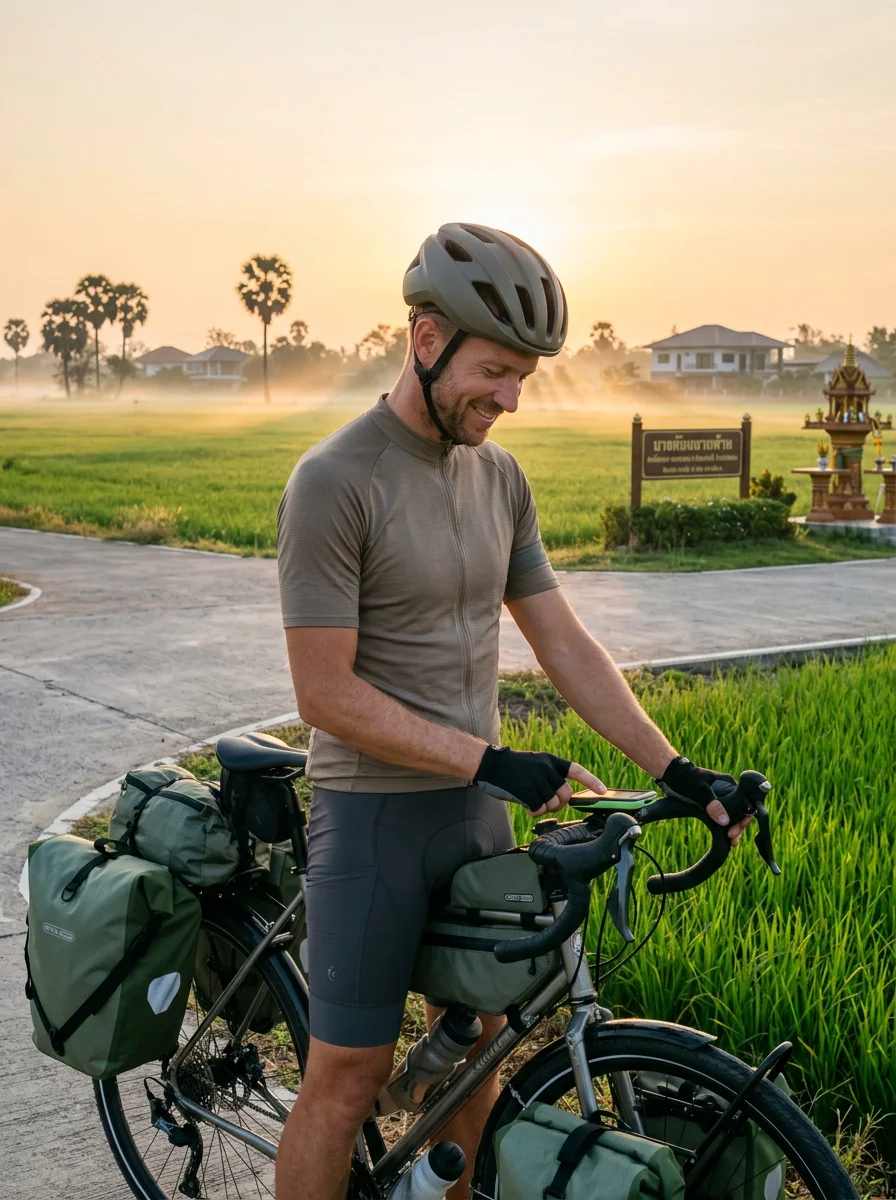
Thailand drives on the left, making junctions and roundabouts familiar to British cyclists. Under the Land Traffic Act, bicycles must keep to the left edge of the road. Even so, provincial road habits require vigilance: local scooters often travel against the flow along paved shoulders, and agricultural vehicles pull out from blind field tracks. Staying predictable, riding steadily, and following your ride leader keeps the pack clear of conflict with passing traffic.
Booking terms vary across operators. While some local firms invoice in Thai baht or US dollars without an advance deposit, others require a down payment upon confirmation. When booking directly with an overseas operator, paying by UK credit card rather than international bank transfer provides statutory protection under Section 75 for arrangements costing over £100 if an operator ceases trading. Check whether merchant surcharges apply, or book via a UK travel specialist for Package Travel Regulations coverage.
Temple visits feature on many rural itineraries, where modest dress codes apply. Tight lycra shorts and sleeveless cycling jerseys are not acceptable within temple grounds. Keep a lightweight sarong, scarf, or thin pull-on trousers in your day bag to cover your shoulders and knees before entering, and prepare to remove your shoes before stepping into prayer halls.
Rural villages also have free-roaming domestic and community dogs. Spinning pedals can trigger barking or chasing, but dogs generally halt at their territory line. Rather than braking sharply or swerving into traffic lanes, hold a predictable line and let Thai guides defuse the animal using firm verbal commands or water squirts.
Practical Tips
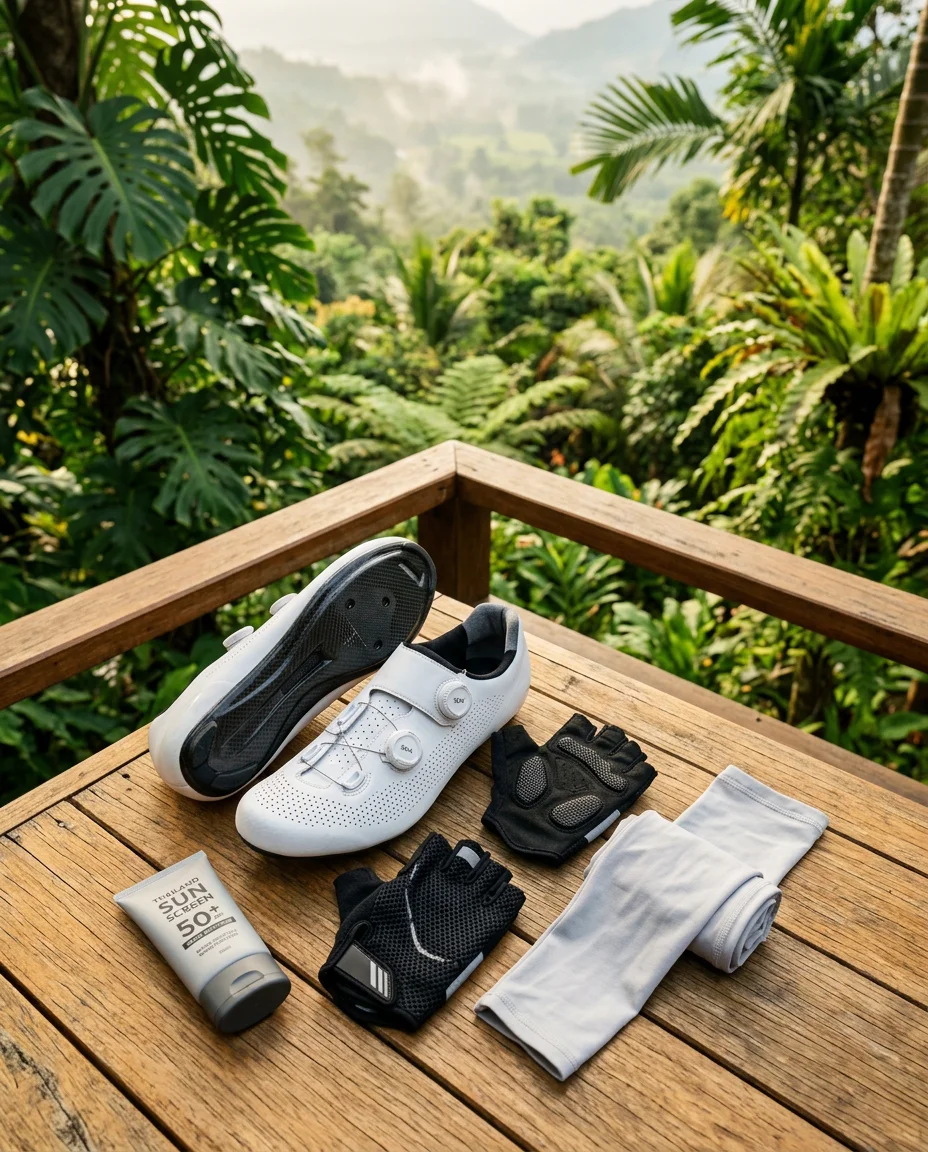
Pack high-UPF arm and leg sun sleeves rather than relying solely on sun cream. In tropical humidity, heavy perspiration rapidly washes away lotions, whereas lightweight UV-deflecting fabric provides reliable physical cover and breathes to support natural evaporative cooling on long afternoon rides.
Bring your own saddle and clip-in pedals in your hold luggage if you ride with specific touchpoints at home. Tour mechanics routinely fit personal pedals and saddles onto rental frames during the pre-departure bike fit, though you should leave seat posts at home and remember your matching cycling shoes. Swapping familiar contact points onto a hired frame significantly reduces the risk of saddle sores and joint irritation over consecutive days.
Add electrolyte powder or effervescent hydration tablets to your water bottles at support vehicle stops rather than drinking pure water alone. Heavy sweating in Southeast Asian humidity flushes sodium and potassium from your system, which can cause severe muscle cramps if minerals are not replaced throughout the day. Support vans provide chilled water and fresh fruit, but packing your preferred rehydration sachets ensures consistent salt balance.
Choose tour itineraries that schedule daily departures between 07:00 and 07:30. Riding through the cooler morning hours allows groups to complete most of the daily distance before midday temperatures peak, leaving the humid afternoon free for hotel check-ins, swimming, or local sightseeing.
Apply anti-chafing chamois cream generously each morning before getting dressed. Tropical moisture combined with repetitive pedalling creates friction that can quickly cause skin abrasion. Pack three or four pairs of padded cycling shorts so you have fresh kit available each day, as high evening humidity often delays overnight drying.
Keep small cash notes—specifically 20 THB (approx 45p), 50 THB (approx £1.10), and 100 THB (approx £2.25)—in a waterproof zip-lock bag inside your jersey pocket. Rural roadside vendors selling chilled coconuts, bottled drinks, or sliced watermelon rarely accept credit cards or electronic payments from UK mobile banking apps.
Confirm that your travel insurance policy explicitly lists cycle touring as an insured activity and includes emergency medical evacuation within Thailand. Standard holiday cover frequently excludes supported cycling holidays or restricts payouts if you fail to wear an approved helmet while riding. Ensure your policy covers the full scope of your itinerary before departure.
Quick Reference Table
| Item | Detail | Notes |
|---|---|---|
| Signature Coastal Route | Bangkok to Phuket: 10 days / 820 km | Flat tarmac and coastal undulations via Hua Hin, Chumphon, and Khao Sok |
| Signature Highland Route | Chiang Mai to Chiang Rai: 4–6 days / 280 km | Mountain passes exceeding 10% gradients, Kok River boat transfers |
| Signature Heritage Route | Central River Basin: 7 days / 320 km | Flat canal dykes and backroads linking Ayutthaya, Lopburi, and Sukhothai |
| Urban Day Excursions | Bangkok & Chiang Mai: 12–35 km | Gentle pace through backstreets, canal boardwalks, and temple precincts |
| Best Season (Coast) | November to March | Dodges southwest monsoon rainfall and Gulf of Thailand storms |
| Best Season (North) | November to early February | Avoids the agricultural burning haze that begins in mid-February |
| Day Tour Costs | 1,250–3,500 THB (£28–£78) | Covers bicycle, helmet, ferry/entry fees, snacks, and guide |
| Multi-Day Tour Costs | 7,500–11,000 THB (£167–£246) per day | Covers accommodation, escort van, meals, luggage transfers, and hybrid bike |
| Bike Upgrade Fees | Road: 9,000–16,000 THB; E-bike: 7,000–12,000 THB | Surcharge per week-long tour for carbon road bikes or motor assist |
| Support Provisions | Toyota Commuter escort minibus every 15–25 km | Chilled water, fresh fruit, electrolyte drinks, iced towels, and passenger seats |
| Recommended Kit to Bring | Own pedals, cycling shoes, preferred saddle, sun sleeves | Technicians fit personal pedals and saddles during the day-one briefing |
| Operator Licensing | Department of Tourism licence mandatory | Format 11/XXXXX; statutory cover is basic, so UK travel cover is essential |
| Road Rule Essentials | Ride on the left edge under the Land Traffic Act | Watch for scooters riding against traffic flow and agricultural vehicles |
| Temple Dress Code | Shoulders and knees fully covered | Carry a sarong, scarf, or light pull-on trousers to cover cycling lycra |
| Daily Start Time | 07:00 to 07:30 recommended | Clears bulk of mileage before peak afternoon heat and humidity |
| Operator Website (Bangkok City) | Co van Kessel | https://www.covankessel.com |
| Operator Website (Mountain Biking) | Trailhead Thailand | https://www.trailhead.co.th |
| Operator Website (Southern Road) | Siam Bike Tours | https://siambiketours.com |
| Operator Website (Multi-Day Touring) | SpiceRoads Cycling | https://www.spiceroads.com |
| Official Source (Licensing) | Department of Tourism | tourism.go.th |
| Emergency Contact | Tourist Police | Call 1155 |
FAQ: Cycling Tours in Thailand
Why should I book an organised cycling tour in Thailand?
What is the best time of year for a cycling tour in Thailand?
What should I bring for temple visits during a cycling tour in Thailand?
What essential cycling gear should I bring from home for a tour in Thailand?
How can I protect myself from the sun while cycling in Thailand's humidity?
What should I drink to stay hydrated during a cycling tour in Thailand?
What is the recommended daily start time for cycling tours in Thailand?
What kind of travel insurance do I need for a cycling holiday in Thailand?
How should I prepare for the tropical heat and humidity when cycling in Thailand?
What should I do if I encounter dogs on rural cycling routes in Thailand?
Reviewed by the Thailand Guide Editorial Team • Last reviewed: 15 November 2026
This page is provided for general information only. While we aim for accuracy, details can change — please verify anything important independently before relying on it.