Cycling in Bangkok



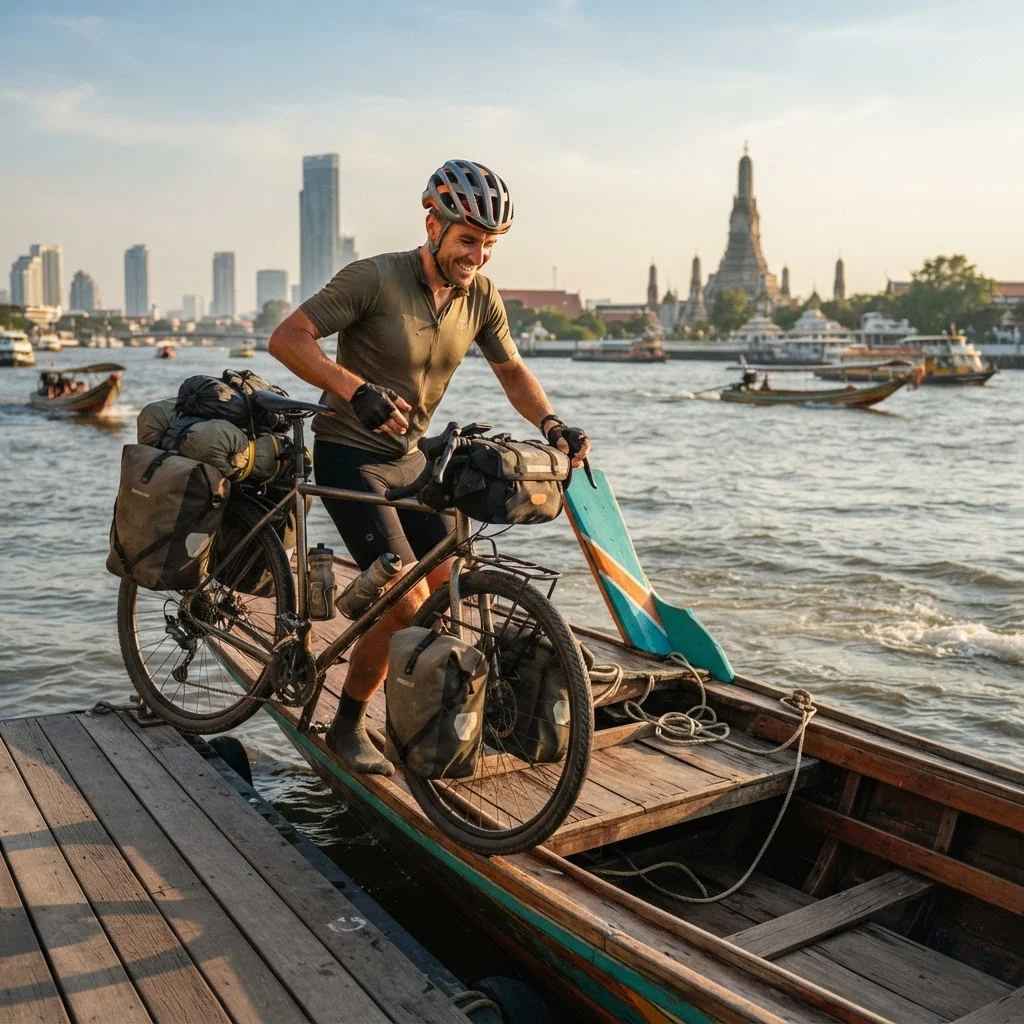
Navigating a metre-wide concrete path suspended above a tidal mangrove swamp or cruising along a dedicated, floodlit 23.5-kilometre airport circuit reveals a side of Bangkok far removed from its notorious traffic gridlock. While the capital's multi-lane thoroughfares and elevated expressway flyovers can be daunting for riders accustomed to tranquil UK cycleways, an alternative network of canal boardwalks, quiet backstreet alleys, and car-free recreational tracks provide remarkable riding across the city.
This guide maps out Bangkok's primary cycling territories, from the lush rural peninsula of Bang Krachao and the historic lanes of Thonburi to purpose-built training loops and downtown viaducts. Whether you plan to hire an inexpensive city runabout at a river pier, bring a road bike for endurance training, or join a guided group tour through hidden residential quarters, you will find practical guidance on route surfaces, ferry crossings, and public transport connections. The sections below also detail how to manage tropical heat, monitor seasonal air quality, and choose routes suited to your cycling experience.

Bang Krachao: The Green Lung Elevated Boardwalks
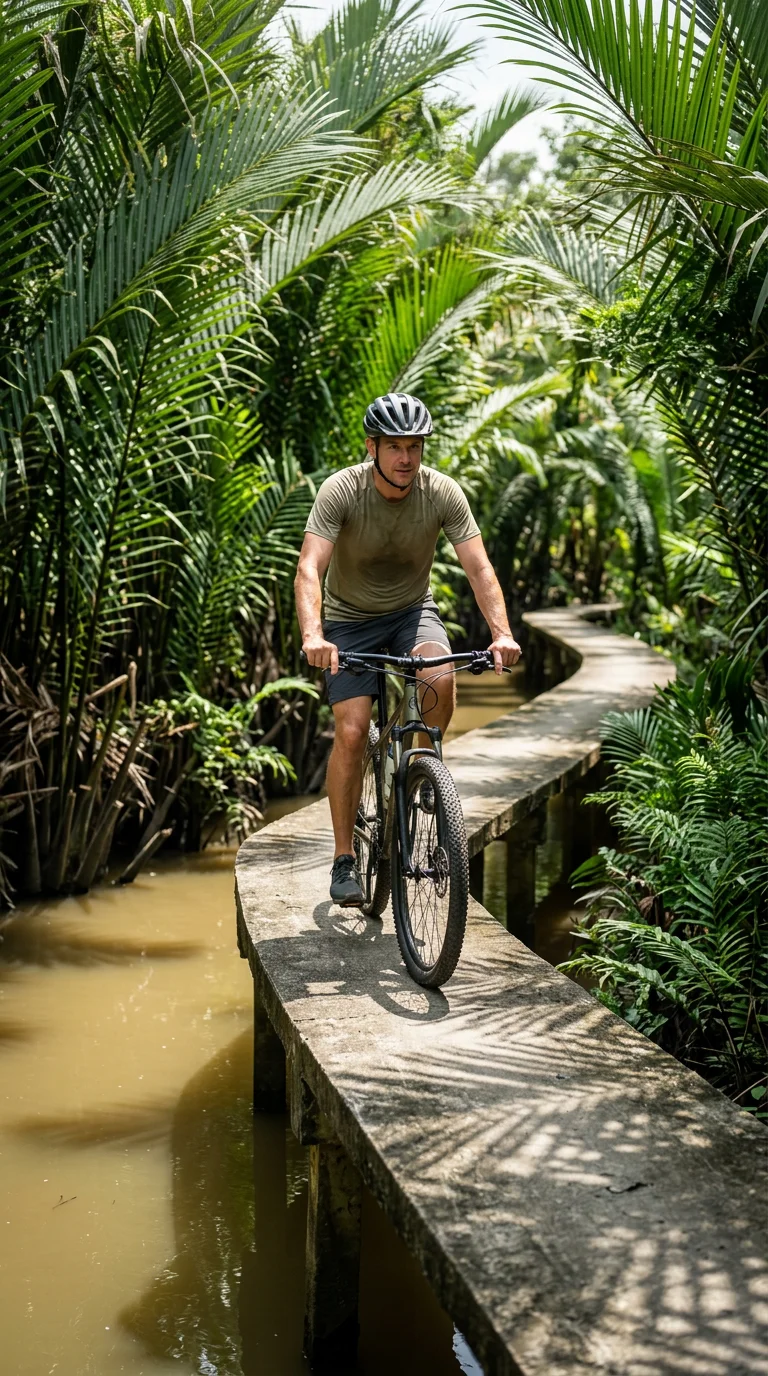
Bang Krachao occupies a pronounced oxbow loop of the Chao Phraya River directly opposite central Bangkok's port district. Known colloquially as the city's green lung, this low-lying expanse of fruit orchards, mangrove wetlands, and agricultural canals remains protected from high-rise development by strict conservation zoning. To reach the loop, cyclists take a small cross-river passenger boat from Wat Khlong Toei Nok Pier, which costs between 10 and 20 THB (approx £0.23 to £0.46) each way for the five-minute river crossing. An alternative crossing runs from the eastern riverbank between Wat Bang Na Nok Pier and Wat Bang Nam Phueng Nok Pier for roughly 5 THB (approx £0.12).
Rental stalls clustered around the pier landings hire out basic Dutch-style upright bicycles, generally charging between 50 and 100 THB (approx £1.15 to £2.30) for the day, with baskets and basic cable locks supplied. Riding the island is physically flat but requires steady handling. Beyond the quiet two-lane asphalt roads, much of the internal cycling network relies on raised concrete causeways. These paths typically measure 1.2 to 1.8 metres across and sit one to two metres above tidal marshes, drainage ditches, and fruit gardens without side railings. Local residents regularly use these boardwalks on motor scooters. When an oncoming moped approaches on a narrow span, practical courtesy dictates slowing to a stop and resting one foot on the concrete rather than trying to pass while moving.
Near the northern edge of the loop sits Sri Nakhon Khuean Khan Park and Botanical Garden, a 148-rai (approximately 24-hectare) public ecological park open daily from 05:00 to 19:00 with free admission. Paved tracks wind past ornamental ponds, planted timber groves, and canal bridges completely separated from motorised vehicles. A seven-metre wooden birdwatching tower rises into the forest canopy, providing vantage points for spotting kingfishers, herons, and water monitor lizards.
On Saturdays, Sundays, and public holidays, Bang Nam Phueng Floating Market trades from roughly 08:00 to 16:00. Most stalls sit on solid ground along the canal walkways, selling fresh produce, hand-pressed coconut cakes, and iced teas. Shaded concrete pathways can turn slick with moss or river silt after morning damp, so keeping speeds below 15 km/h on unrailed boardwalk sections helps avoid skidding off the edge.
| Route / Circuit | Distance | Surface & Difficulty | Traffic Conditions | Best Suited For |
|---|---|---|---|---|
| Bang Krachao Boardwalks | 15–25 km loop network | Narrow concrete planks and flat asphalt; Easy to Moderate | Zero cars on boardwalks; occasional local mopeds | Confident beginners, couples, and leisure riders |
| Happy and Healthy Bike Lane | 23.5 km per lap | Banked asphalt; Easy (flat) to Intense | Completely closed to all motorised vehicles | Road cyclists, fitness training, and time trials |
| Thonburi & Talat Noi Alleys | 10–18 km maze | Paved lanes, footbridges, and flagstones; Moderate | Motorised sois mixed with pedestrian-only paths | Explorers and guided cultural tour groups |
| Lumphini to Benjakitti Park | 5–8 km link | Elevated timber and tarmac viaduct, smooth park loops; Easy | Zero road traffic; shared with runners and walkers | Casual city riders and families with children |
Whether exploring independently on a rented city bike or joining an organised day ride across the river, cycling through these canopy corridors provides a distinct perspective on the capital's waterways.
The Sky Lane: Suvarnabhumi Airport Circuit
Encircling the perimeter of Suvarnabhumi Airport, the Happy and Healthy Bike Lane—widely known by its former title, the Sky Lane—provides a dedicated, 23.5-kilometre closed tarmac circuit built for uninterrupted fitness riding. Jointly established by Airports of Thailand and Siam Commercial Bank, the floodlit, one-way facility runs parallel to the airport runway and is free to enter if you bring your own bicycle.
The track divides cyclists by pace across two coloured bands: the wider blue outer lane accommodates leisure riders cruising at lower speeds, while the purple inner lane caters to experienced cyclists and fast pacelines travelling above 30 km/h. Distance markers appear every 250 metres, and three rest stations spaced roughly five kilometres apart provide water points, shade, and basic conveniences. Track stewards enforce safety rules strictly: cycling helmets and closed-toe trainers or cycling shoes are mandatory.
First-time visitors must register on arrival at the main entrance hub using an original passport (or Thai identity card for nationals) to receive an RFID-enabled smart wristband. This wristband logs you through the security turnstiles and functions as an on-site cashless payment system for refreshments.
For travellers without their own equipment, the on-site rental centre hires out well-maintained bikes in four-hour blocks, including a helmet. Rates run from 420 THB (approx £10) for flat-bar hybrids to 720 THB (approx £17) for aluminium road bikes and 920 THB (approx £21) for carbon road models, with premium race bikes reaching 1,700 THB (approx £39).
Because the asphalt circuit is completely unshaded, the open airfield generates heavy crosswinds along the western straight alongside intense tropical heat. Track access runs daily from 06:00 to 21:00, making early mornings before 08:30 or floodlit evening sessions after sundown the most comfortable options.
Plan your Bangkok trip with practical advice for UK travellers, covering top neighbourhoods, BTS and MRT transit, realistic daily costs, and street food.
Old Town and Thonburi: Historic Alleys and Canal Paths
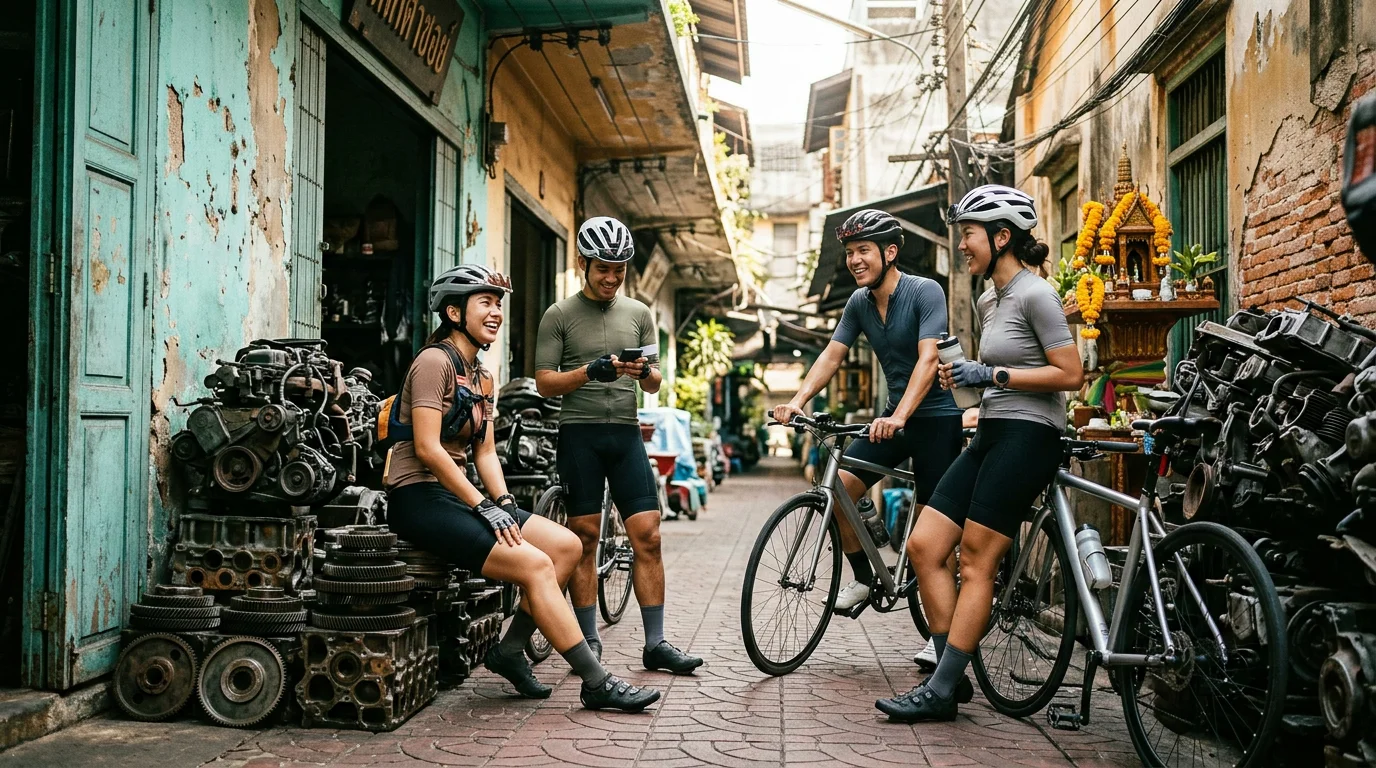
Exploring the backstreets of Talat Noi, historic Chinatown, and the cross-river district of Thonburi reveals an older Bangkok inaccessible to conventional traffic. Riding here means threading through passages scarcely wider than a bicycle handlebar, weaving past greasy second-hand engine workshops, courtyard spirit shrines, and front-room kitchens smelling of fried garlic and dried chillies.
From the eastern bank around Charoen Krung Soi 24 and Song Wat Road, riders navigate tight alleyways before wheeling their bikes onto local cross-river commuter ferries. These broad passenger shuttles carry cyclists across the Chao Phraya River for 5 to 10 THB (approx £0.11 to £0.23), payable at the pier gate.
On the Thonburi bank, the urban density abruptly softens. The modern city yields to elevated concrete walkways running alongside canals such as Khlong Bangkok Yai and Khlong San, shaded by overhanging banyan roots and banana trees. This side of the river retains quiet waterfront communities, including the historic Portuguese-influenced neighbourhood of Kudi Chin and temple precincts like Wat Prayoon and Wat Kalayanamit.
These canal boardwalks present distinct handling challenges. Many elevated concrete paths have no railings on the water side, leaving little margin for error when passing oncoming pedestrians or cautious motor scooters. Ring your bell before blind corners, yield to pedestrians, and keep speeds low. Crossing arched footbridges over tributary canals requires dismounting: these structures feature steep flights of central steps flanked by narrow concrete wheel runners, designed for pushing a bike up and easing it down the other side.
You will encounter free-roaming street dogs resting in the shade. Pedalling steadily without sudden movements and using a calm, neutral voice avoids provoking territorial reactions. While confident riders can navigate using offline satellite maps, the maze of branching walkways and blind alleys can quickly steer you onto dead-end canal landings or private verandahs.
The Green Mile and Benjakitti Urban Forest
The elevated Green Mile viaduct and the adjoining Benjakitti Forest Park form central Bangkok's primary off-road cycling connection. Linking Lumphini Park in Pathum Wan with Benjakitti Park in Khlong Toei, the Green Mile is a 1.6-kilometre raised corridor running above canal waters and residential rooftops. Resurfaced with a slip-resistant sports coating for bicycles alongside a segregated pedestrian path, the viaduct lets riders bypass the gridlocked junctions of Witthayu and Rama IV roads without encountering street-level motor traffic.
At its eastern end, the elevated route enters Benjakitti Forest Park, a public wetland created on former tobacco factory grounds. Cyclists can use a dedicated 3.4-kilometre smooth asphalt circuit that loops past retention ponds, mangrove wetlands, and native tree groves. The cycling route remains separate from the pedestrian skywalks and running paths. Speed on this circuit is capped at 15 km/h, making it suitable for unhurried cruising rather than high-speed training.
Cycling hours differ sharply between the two connected spaces. Benjakitti's dedicated cycle circuit opens from 06:00 to 17:30 daily, even though the wider park grounds remain open later into the evening. Lumphini Park, by comparison, enforces an even tighter window: cycling on its perimeter loop is restricted to between 10:00 and 15:00, with a 20 km/h speed limit. Park marshals strictly monitor the gates and will stop anyone attempting to ride outside this midday slot.
Riders planning a combined journey should time their arrival to match Lumphini's midday window, or stay on the Green Mile and Benjakitti circuit during morning hours. Queen Sirikit National Convention Centre MRT station provides direct access to Benjakitti's southern edge, while Si Lom MRT station sits beside Lumphini's southwest entrance.
Suburban Loops: Phutthamonthon and Khlong Mahasawat
Venturing west from Bangkok into neighbouring Nakhon Pathom province leads to flat agricultural corridors, quiet canal paths, and expansive parklands suited to longer weekend touring. The natural anchor for western cycling is Phutthamonthon, a 400-hectare Buddhist park marked by broad tree-lined avenues, ornamental ponds, and a 15.8-metre walking Buddha statue at its centre. Wide asphalt loops circle the perimeter grounds, giving road cyclists and touring riders a tarmac circuit with minimal vehicular traffic outside major religious gatherings.
North of the park, rural backroads track Khlong Mahasawat, a historic 28-kilometre canal built in the nineteenth century. Paved farm lanes hug the water, passing commercial orchid nurseries, lotus ponds, and fruit orchards growing pomelos and guavas. While motor traffic on these agricultural roads is sparse compared with metropolitan Bangkok, riders share narrow shoulders with local pickup trucks, farm machinery, and occasional stray dogs. Several bridges cross the canal, allowing riders to build loops of varying distances through the surrounding farmland.
Transit logistics require careful planning. The MRT Blue Line terminus at Lak Song sits roughly 16 kilometres east, but rapid-transit metro regulations only permit folding bicycles on the network. Cyclists with full-sized rigid road or touring bikes generally catch a State Railway of Thailand (SRT) commuter train out to Salaya Station. Trains equipped with a luggage van carry bicycles for a cargo ticket fee of around 90 THB (approx £2), and Salaya sits just three kilometres north of Phutthamonthon. Pack ample water and electrolyte powder, as local fruit-growing tracks can run for several kilometres between village shops.
Where to Hire Bikes and Join Guided Tours
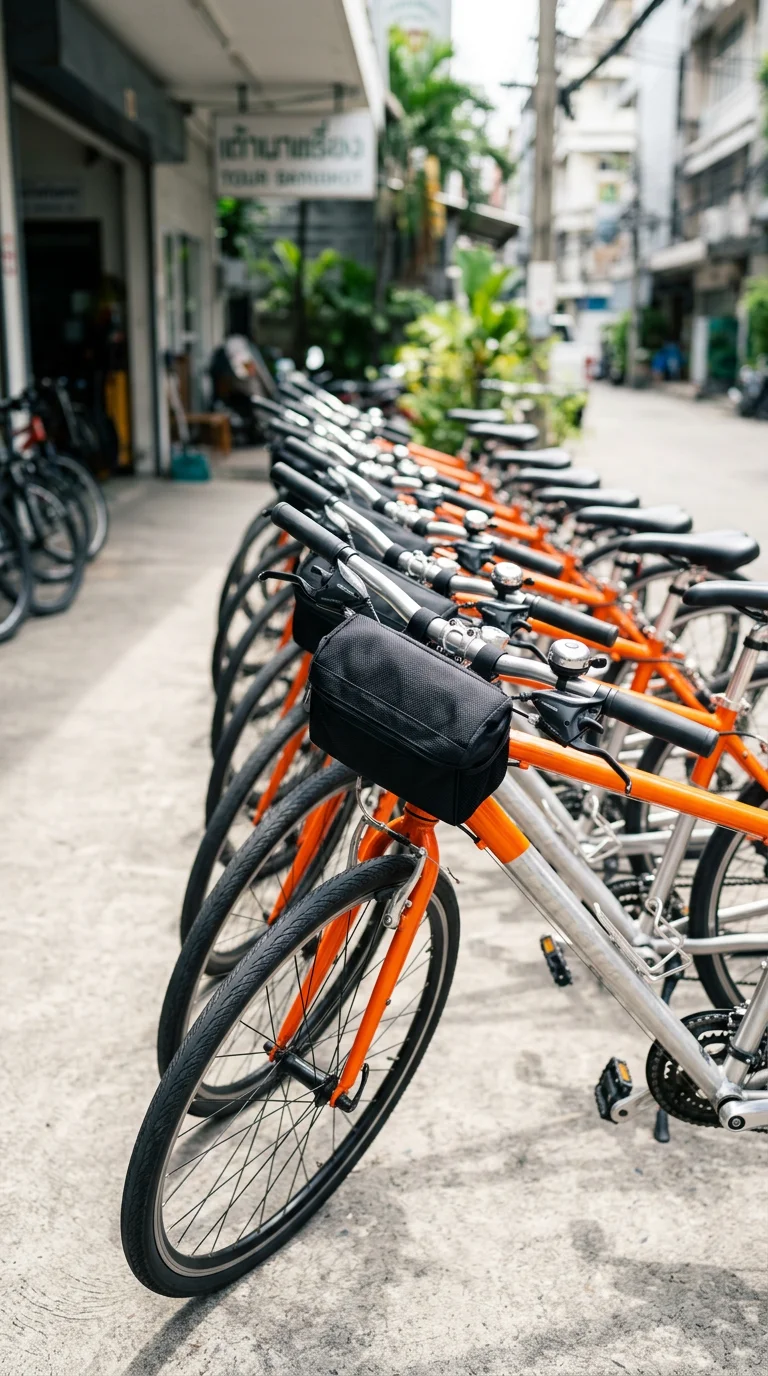
Bangkok has a distinct divide between basic neighbourhood rental stalls, dedicated cycling hubs, and guided tour operators. For independent exploration in Bang Krachao, informal rental kiosks sit directly at the pier exits on the peninsula, including Wat Bang Nam Phueng Nok Pier. These stalls hire sturdy single-speed utility bicycles with front wire baskets for roughly 80 to 100 THB (approx £1.80 to £2.25) per day. Operators typically request a small cash deposit or a passport photocopy; do not surrender your physical passport as collateral.
Riders seeking high-performance road bikes will not find rental fleets at central retail shops like ProBike on Sarasin Road, which focuses on sales, parts, and servicing. Instead, road and hybrid machinery is hired directly on-site at the Happy and Healthy Bike Lane encircling Suvarnabhumi Airport. The track's official rental facility supplies well-maintained road bikes, extending up to high-end models such as the Pinarello Dogma F for 1,700 THB (approx £38) per four-hour session.
For guided exploration, established outfitters navigate the city's intricate alley networks and canal paths. Co Van Kessel, based at River City Bangkok on Charoen Krung Soi 24, runs signature three- to five-hour routes combining backstreet cycling with longtail boat transfers across the Chao Phraya; excursions typically cost between 1,250 THB and 2,350 THB (approx £28 to £52). In Phra Nakhon near Democracy Monument, Grasshopper Adventures operates city and canal rides using multi-gear hybrid bikes. Just Nok Tours, based in Banglamphu, guides small groups across the river through the narrow walkways and orchards of Thonburi. Joining a guided morning departure provides a controlled introduction to Bangkok's maze of alleyways before you attempt independent route-finding.
Costs and Budgeting
Cycling in Bangkok remains an economical way to navigate the city, with expenses depending on whether you ride independently or book an organised excursion. Self-guided cyclists visiting Bang Krachao or public parks can comfortably spend under 250 THB (£5.75) for a full day, covering cross-river passenger ferries, basic bicycle hire, and roadside drinking water.
Renting dedicated road equipment for training rides at the Happy and Healthy Bike Lane near Suvarnabhumi Airport costs more. At the track's rental centre, four-hour rates run from 420 THB (£9.65) for hybrid bikes to 720 THB (£16.55) for aluminium and 920 THB (£21.15) for carbon road bikes, with safety helmets included; flagship models reach 1,700 THB (£39.10). In central Bangkok, specialist workshops hire performance road and gravel rigs for roughly 800 to 1,500 THB (£18.40 to £34.50) daily. Guided half-day city tours average 1,200 to 1,950 THB (£27.60 to £44.85), bundling bikes, helmets, guiding, refreshments, and river crossings.
In Bangkok's heat, hydration requires a small daily allowance. Cold water and electrolyte drinks such as Sponsor or Royal-D cost 15 to 25 THB (£0.35 to £0.58) at convenience stores; plan for 100 to 200 THB (£2.30 to £4.60) across an active day. Cyclists taking non-folding bicycles on State Railway of Thailand passenger services pay a cargo van fee of roughly 90 to 130 THB (£2.10 to £3.00) on trains with freight bogies.
| Item | Cost (THB) | Cost (GBP) | Notes |
|---|---|---|---|
| Bang Krachao day bike hire | 80–100 THB | £1.80–£2.30 | Basic single-speed; hire at pier |
| Chao Phraya ferry crossing | 5–10 THB | £0.11–£0.23 | Per person, per single crossing with bike |
| Sky Lane road bike hire | 420–920 THB | £9.65–£21.15 | Four-hour slot; helmet included; flagship frames up to 1,700 THB |
| Guided half-day city tour | 1,200–1,950 THB | £27.60–£44.85 | Includes bike, guide, snacks, and river crossings |
| Pro workshop daily road rental | 800–1,500 THB | £18.40–£34.50 | Quality carbon or gravel bike from central shop |
| 7-Eleven cold electrolyte drink | 15–25 THB | £0.35–£0.58 | Per bottle or pouch; to replenish lost minerals |
| State Railway carriage fee | 90–130 THB | £2.10–£3.00 | Cargo van fee for non-folding full-size bicycle |
What To Know Before You Go
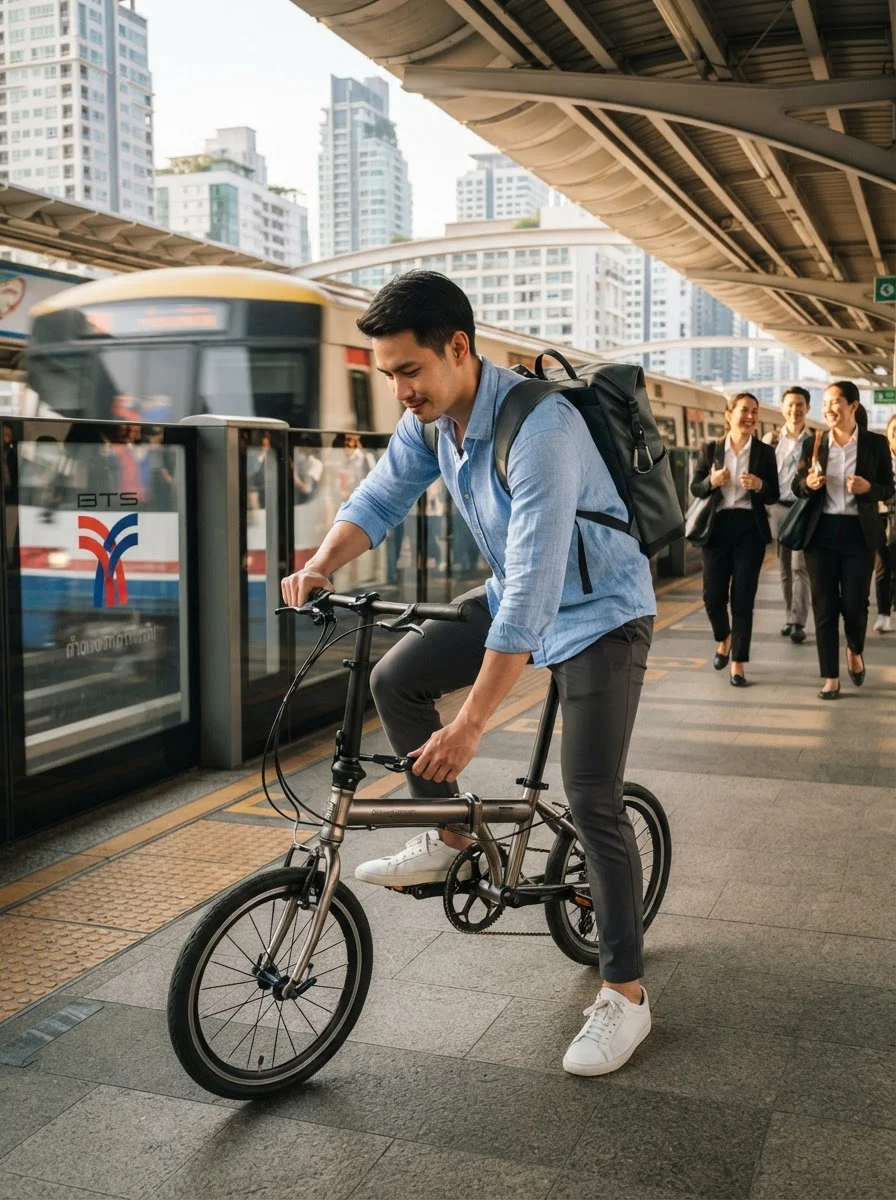
Navigating Bangkok by bicycle requires an understanding of city transit bylaws, seasonal air pollution, and local driving customs.
Taking bicycles onto mass transit involves strict rules. Foldable bicycles are permitted across the network at all times, provided they are folded before passing through ticket barriers. For rigid, non-folding bicycles, regulations differ sharply by operator. The MRT subway system—including the Blue, Purple, Yellow, and Pink lines—prohibits non-folding bicycles completely. The BTS Skytrain restricts standard, non-folding bikes to specific off-peak windows: between 06:00 and 06:30 and from 22:00 to midnight on weekdays, and between 06:00 and 09:00 plus 22:00 to midnight on weekends and public holidays.
Air quality warrants careful attention from December to March. Cooler, still conditions during these months create atmospheric inversions that trap vehicle exhaust and regional agricultural smoke, causing fine particulate matter (PM2.5) to rise to unhealthy levels. Check monitoring platforms like Air4Thai or IQAir before heading out, and consider postponing long rides on heavy smog days.
On the roads, traffic drives on the left, matching the UK layout. However, formal right-of-way rules are rarely observed. Thai road culture operates on practical hierarchy: larger vehicles, turning lorries, and motorcycle taxis routinely pull out without yielding to cyclists. Ride defensively, hold a predictable line, and assume emerging traffic has not seen you.
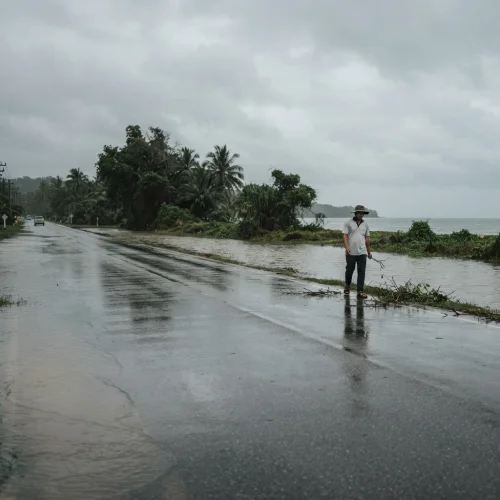
During the rainy season, particularly from July to October, track weather radar closely. Torrential tropical downpours can submerge low-lying concrete canal boardwalks and side streets under murky standing water within minutes, hiding potholes, broken slabs, and open drains.
Practical Tips
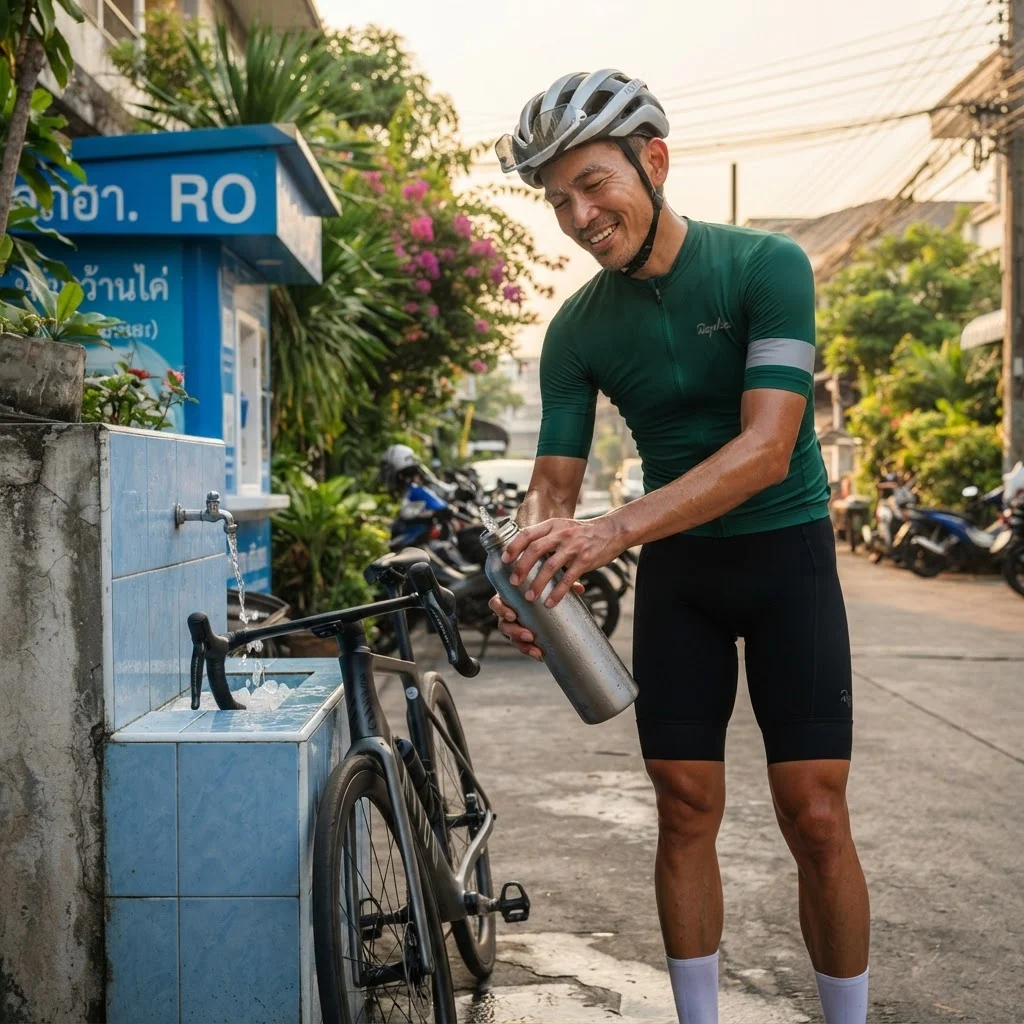
Setting off before 07:00 allows you to clear busier arterial roads before morning rush-hour traffic peaks and avoids the harshest tropical sun. By midday, Bangkok's asphalt road surfaces frequently exceed 40°C, and high relative humidity accelerates fluid loss. If you plan to ride for longer than an hour, carry two water bottles and replenish electrolytes consistently. Convenience stores and pharmacies across the city sell mineral rehydration sachets—such as Royal-D—for roughly 6 to 10 THB (approx 15p to 25p) each. Dissolving a sachet into cold drinking water restores sodium lost through heavy sweating and helps stave off heat exhaustion and painful cramps.
Tackling the labyrinthine alleys of Chinatown or Thonburi's network of canal paths requires dependable offline navigation. Dense clusters of concrete shophouses, corrugated tin overhangs, and elevated expressway viaducts frequently degrade mobile data and satellite reception. Downloading offline maps in applications such as Komoot, Maps.me, or Google Maps before departing prevents you from becoming stranded at dead ends or stepped footbridges. Fitting a clear, audible bicycle bell to your handlebars is equally useful. Concrete canal boardwalks rarely feature safety railings, and blind corners around canal homes conceal wandering neighbourhood pets, laundry racks, and delivery motorbikes. A quick chime warns oncoming foot traffic of your approach without causing alarm.
Bangkok's secondary roads and outer shoulders collect tyre wire, glass shards, and construction grit, making punctures common. Rather than running tyres at maximum pressure—which creates a harsh, skittish ride across wet ceramic shop tiles, wooden planks, and uneven concrete slabs—opt for moderate pressures with puncture-resistant casings. Carry a compact hand pump, tyre levers, and a spare inner tube or vulcanising patch kit. Cyclists exploring riverside boardwalks along the Chao Phraya should also monitor local tide tables, particularly between October and December. High seasonal tides combined with northern river runoff frequently breach low-lying boardwalks, submerging walkways under several inches of murky water and hiding hazardous steps and canal drop-offs.
Lightweight, breathable technical jerseys with long sleeves or separate UV arm-cooling sleeves work far better than sleeveless tops. Full arm coverage reflects intense sun without trapping sweat, and it shields your forearms against abrasive overhanging vines and thorny bougainvillea along narrow residential paths. If you intend to join an organised cycling excursion or hire specialist road bikes during the dry winter season between November and February, reserve your place well ahead of time, as guided group outings routinely fill up.
Where to Cycle Next in Thailand
Moving beyond Bangkok's flat canal paths, elevated boardwalks, and purpose-built tarmac circuits opens up contrasting regional riding across Thailand. Roughly 80 kilometres north of the capital, Ayutthaya Historical Park provides gentle day touring around fourteenth-century temple ruins and moat canals on level paved roads. Local commuter trains link central Bangkok directly to Ayutthaya, where simple single-speed city bicycles rent near the railway station for around 50 THB to 100 THB (approx £1.15 to £2.30) per day.
Cyclists seeking prolonged climbs and cooler mountain air head north to Chiang Mai, the country's primary road-cycling hub. The classic local ascent up Doi Suthep gains approximately 620 metres of elevation over 10.8 kilometres at an average gradient of 6 per cent, beginning near Chiang Mai Zoo and ending at the temple terrace. Steeper mountain switchbacks and gravel tracks extend further into Doi Suthep-Pui National Park and up towards Doi Inthanon for experienced endurance riders.
South of the capital, the upper Gulf of Thailand coastline presents long-distance coastal riding across Phetchaburi, Hua Hin, and Prachuap Khiri Khan. These routes hug quiet secondary roads between fishing villages and limestone peaks, maintaining mostly flat profiles suited to multi-day endurance runs. Across regional provinces, fully supported touring operators run scheduled and bespoke journeys complete with air-conditioned support minibuses, luggage transfers, mechanical assistance, and road bike hire, letting you tackle multi-stage itineraries without carrying loaded panniers in tropical humidity.
Quick Reference Table
| Item | Detail | Notes |
|---|---|---|
| Bang Krachao (The Green Lung) | 15–25 km network of unrailed concrete boardwalks and flat roads | Cross-river passenger ferries cost 5–20 THB each way; basic pier bike hire runs 50–100 THB per day |
| Happy and Healthy Bike Lane | 23.5 km dedicated floodlit tarmac circuit at Suvarnabhumi Airport | Free entry with own bike; open daily 06:00–21:00; mandatory helmets and closed-toe footwear; passport required for RFID wristband registration |
| Thonburi and Old Town | 10–18 km maze of historic backstreets and elevated canal paths | Cross-river commuter ferries cost 5–10 THB; narrow causeways lack safety railings; offline maps and bicycle bell strongly advised |
| Green Mile and Benjakitti Park | 1.6 km elevated viaduct linking to a 3.4 km dedicated park circuit | Resurfaced, car-free route with a 15 km/h limit; Benjakitti cycle track open 06:00–17:30; Lumphini Park cycling strictly restricted to 10:00–15:00 |
| Phutthamonthon & Khlong Mahasawat | 400-hectare parkland loop and 28 km rural canal lanes in Nakhon Pathom | Flat touring route; reached via Salaya railway station with bicycles carried on SRT commuter trains for a 90–130 THB cargo fee |
| Bike hire rates | 80–100 THB/day (city runabouts); 420–920 THB/4 hours (Sky Lane); 800–1,500 THB/day (pro shops) | Single-speeds hired at Bang Krachao river piers; performance aluminium and carbon road bikes rented at the airport circuit or specialist city workshops |
| Guided bicycle tours | 1,200–1,950 THB per person for half-day excursions | Includes bicycle, helmet, local guide, snacks, and longtail boat transfers; operators include Co Van Kessel, Grasshopper Adventures, and Just Nok Tours |
| Mass transit bicycle rules | Folding bicycles permitted across BTS and MRT; rigid bicycles prohibited on MRT | BTS allows full-sized non-folding bikes only during restricted off-peak hours (06:00–06:30 and 22:00–24:00 weekdays; 06:00–09:00 and 22:00–24:00 weekends) |
| Best riding times | Early mornings before 07:00 or floodlit evenings after sunset | Avoids peak commuter congestion and dangerous midday road heat exceeding 40°C; pack water and electrolyte sachets (6–10 THB) |
| Seasonal hazards | Unhealthy PM2.5 smog (Dec–Mar); flash flooding (Jul–Oct); seasonal canal high tides (Oct–Dec) | Monitor Air4Thai or IQAir before riding; avoid flooded canal boardwalks that submerge drop-offs and open drainage holes |
| Official source (Happy and Healthy Bike Lane) | hhblbikelane.com | Official circuit regulations, facility information, and visitor opening hours |
| Book direct (Happy and Healthy Bike Rental) | hhblbikerental.com | On-site hybrid and road bike hire reservations at Suvarnabhumi Airport |
| Official source (Sri Nakhon Khuean Khan Park) | suansri-bangkachao.com | Ecological botanical garden visitor guide and location details in Bang Krachao |
| Website (Co Van Kessel) | covankessel.com | Guided Bangkok backstreet, canal, and longtail boat cycling excursions |
FAQ: Cycling in Bangkok
How do I get to Bang Krachao for cycling?
What should cyclists do when encountering a moped on narrow paths in Bang Krachao?
What safety gear is mandatory for cycling on the Happy and Healthy Bike Lane (Sky Lane)?
What safety precautions should cyclists take on Thonburi's canal boardwalks?
What are the cycling hours and speed limits in Lumphini Park?
Are non-folding bicycles allowed on Bangkok's MRT and BTS public transport?
When is air quality a concern for cycling in Bangkok and what should cyclists do?
What should cyclists know about driving customs and road safety in Bangkok?
What is the best time to start cycling in Bangkok?
How can cyclists prevent punctures and what should they carry for repairs in Bangkok?
Reviewed by the Thailand Guide Editorial Team • Last reviewed: 17 November 2026
This page is provided for general information only. While we aim for accuracy, details can change — please verify anything important independently before relying on it.