Liveaboard Yachting in Thailand
Waking up at dawn to the metallic creak of mooring lines and the thrum of a saltwater washdown reveals a Thailand few tourists ever encounter. Living aboard a private yacht in Southeast Asia trades the predictability of a suburban terrace for 30-degree waters, hands-on power management, and the rhythmic cycle of the Andaman and Gulf monsoons. Far from a perpetual holiday, setting up home on the water is an active, demanding lifestyle that requires self-reliance, technical vigilance, and careful bureaucratic navigation.
Thailand has established itself as Southeast Asia's primary marine hub, drawing long-distance cruisers, British retirees, and remote workers to the sheltered anchorages of Phuket, Krabi, and the Gulf islands. Yet the transition from charter sailing or land-based expat life to a permanent saloon berth brings distinct hurdles. Saltwater corrosion, tropical humidity, and strict immigration timelines sit alongside the pleasures of secluded anchorages and year-round sailing.
This guide examines the practical realities, legal frameworks, and genuine financial outgoings of full-time liveaboard life in Thai waters. You will find clear breakdowns of marina berthing contracts, swing moorings, customs rules for foreign-flagged craft, and realistic monthly budgets to help you decide whether trading dry land for a life afloat is sustainable over the long term.

Day-to-Day Realities: Power, Water, Waste, and Climate Control
Living aboard in tropical waters requires deliberate domestic utility management. At anchor, solar power provides your primary electricity. A 40-foot monohull typically requires at least 600 to 800 watts of solar generation alongside a lithium battery bank to keep refrigeration, cabin fans, navigation instruments, and freshwater pumps running without firing up the diesel engine.
Air conditioning alters onboard power consumption drastically. Running a 16,000-BTU air conditioning unit through humid nights of 30°C or more requires either shore power from a marina pontoon or a marine diesel generator burning roughly 1.5 to 2.5 litres of fuel per hour. Many liveaboards reserve air conditioning for marina berths, relying at anchor on windscoops, low-draw 12-volt brushless fans, and mesh hatch screens to maintain cross-ventilation.
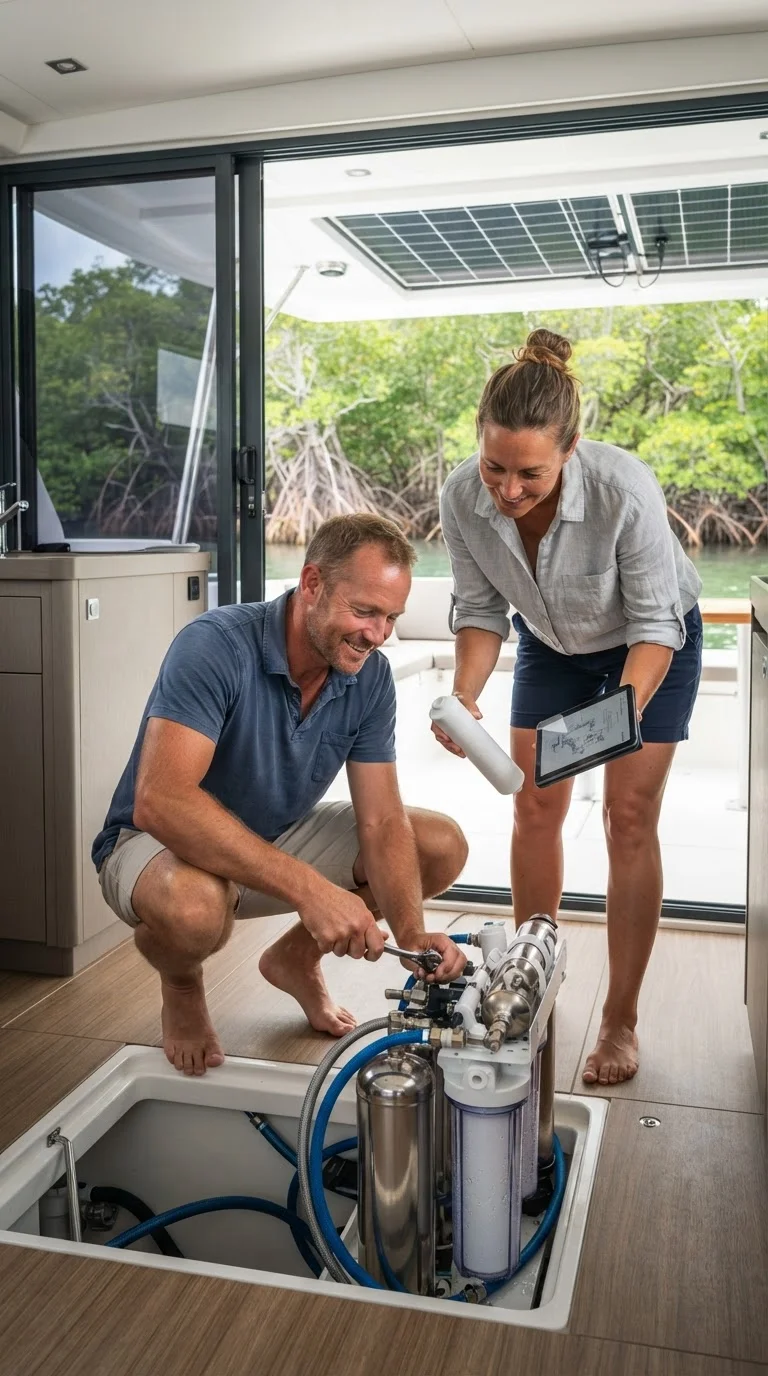
Freshwater management depends on your cruising pattern. While marina pontoons provide piped fresh water, municipal supplies across coastal Thailand carry high mineral content and are rarely potable without secondary filtration. At anchor, an efficient 12-volt or engine-driven reverse-osmosis watermaker provides complete self-sufficiency, though it should only be operated in clear, open water away from silty estuaries and commercial harbours. Spare pre-filters are necessary, as tropical plankton blooms quickly clog five-micron cartridges.
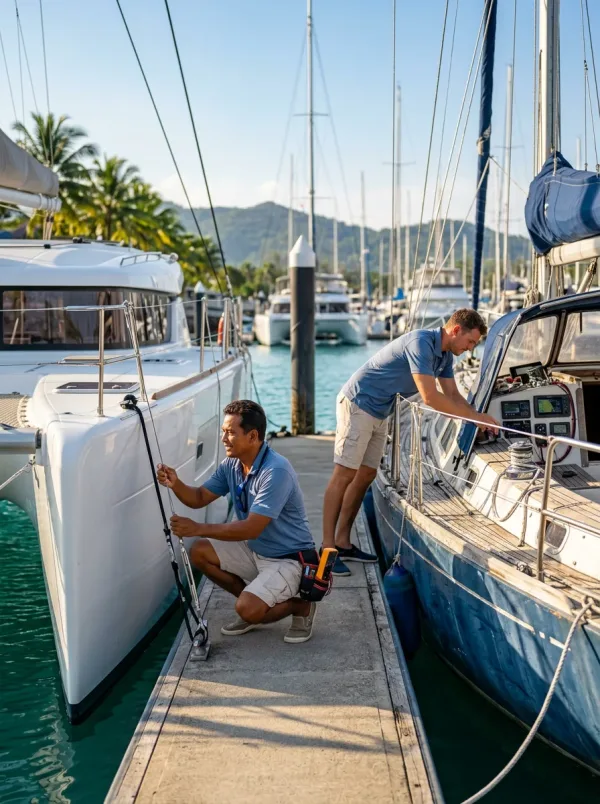
Waste management requires strict discipline. Discharging untreated sewage in enclosed marinas or marine parks is prohibited; vessels berthed in marinas such as Phuket Boat Lagoon must use dedicated holding tanks or ashore facilities.
Mobile internet across Thai anchorages is remarkably robust. Both AIS and True provide extensive 5G coastal coverage across Phuket, Phang Nga Bay, and the Gulf islands. Unlimited 30-day mobile data packages cost between 800 THB and 1,200 THB (approx £18 to £27), providing sufficient bandwidth for video calls and remote work directly from the saloon table. Ashore, drop-off laundry shops and fresh-food wet markets sit within dinghy reach of major anchorages.
Choosing Your Vessel: Monohulls Versus Multihulls in the Tropics
When selecting a liveaboard boat for Thai waters, shallow draft, airflow, and deck living space influence day-to-day comfort far more than heavy-displacement offshore pedigree. Monohulls and multihulls present distinct trade-offs across the Andaman Sea and the Gulf of Thailand, where tidal ranges, shallow anchorages, and tropical heat dictate practical cruising life.
Catamarans have become widely favoured by full-time liveaboards throughout Southeast Asia. With a typical draft of 1.0 to 1.3 metres, a cruising multihull can cross shallow river bars, enter mangrove channels, and tuck behind fringing reefs that exclude deep-keeled monohulls. This is particularly advantageous in Phang Nga Bay and around Krabi, where semi-diurnal tides fluctuate by up to three metres and leave extensive mudflats at spring low water. At anchor, multihulls remain upright without the rolling motion triggered by passing longtail boats or swell entering exposed bays. The elevated saloon layout, opening forward hatches, and wide cockpit decks capture light coastal breezes, reducing the need to run generators for air conditioning during humid evenings.
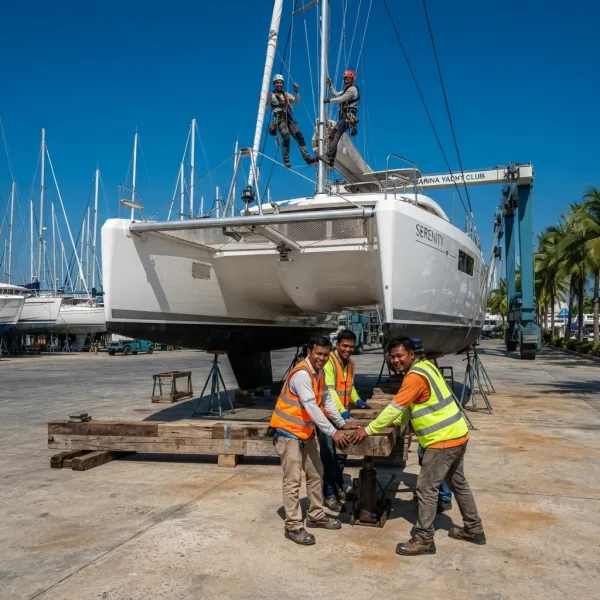
The principal drawback of a multihull appears on the invoice at the marina office. Because a catamaran’s beam occupies two standard marina berths or requires a dedicated wide finger pier, Thai marinas routinely levy a multihull surcharge of 50 to 100 per cent over standard monohull rates. A 42-foot catamaran can incur monthly berthing fees equal to or higher than a 70-foot monohull. Furthermore, a wide beam—often between 6.5 and 7.5 metres—limits your haul-out options, as only yards equipped with wide travel lifts or specialised trailer ramps can accommodate the boat for annual anti-fouling and bottom work.
Monohulls retain tangible advantages for cost-conscious cruisers. Deep-keeled vessels—typically drawing 1.8 to 2.3 metres—must anchor further out in open water and watch tidal heights carefully when crossing coastal bars, but they avoid punitive berthing surcharges in marinas. Monohulls fit into every standard boatyard lift, sail more efficiently to windward when punching into seasonal monsoon chop, and carry robust payload capacities at a substantially lower initial purchase price. For couples or solo sailors, berthing a narrower boat is also far easier when manoeuvring alongside in congested marinas with gusting crosswinds.
For life aboard in Thailand, prioritising ample shaded deck space, efficient canvas biminis, and large opening portlights matters far more than deep-water ballast.
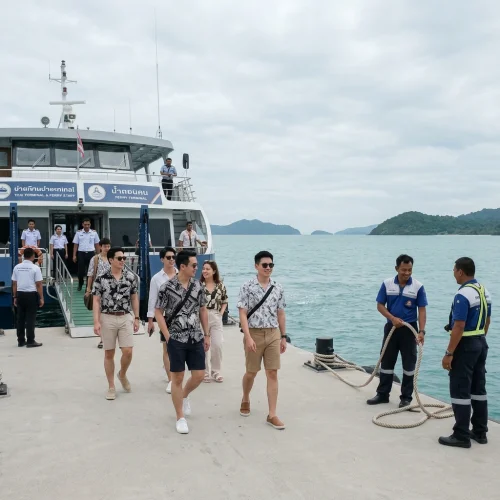
Plan a Gulf of Thailand trip with clear guidance on island groups, ferries, weather, marine parks, accommodation costs and mainland gateways.
Cruising Seasons, Monsoons, and Tropical Hull Maintenance
The rhythm of liveaboard life in Thailand is governed by the biannual monsoon system. From November to April, the northeast monsoon delivers clear skies, calm seas, and predictable winds of 10 to 18 knots across the Andaman Sea. During this dry spell, anchorages along Phuket’s western coastline, such as Nai Harn, Kata, and Bang Tao, provide comfortable, scenic roadsteads.
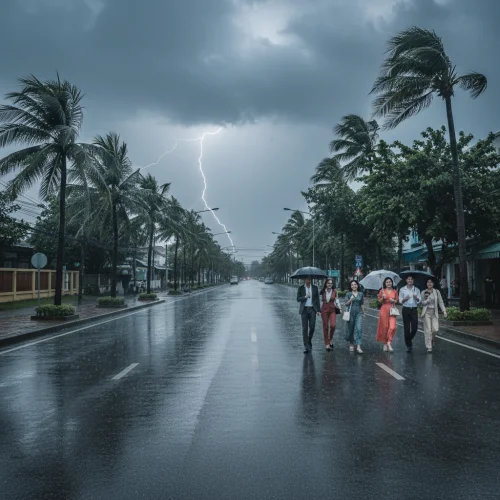
By May, conditions shift. The southwest monsoon sets in, bringing sustained ocean swells, sudden squalls, and frequent rain to west-facing shores through to October. West coast anchorages quickly become untenable lee shores. Cruisers relocate their vessels to the sheltered eastern side of Phuket, picking up moorings in Chalong Bay or dropping anchor amid the protected limestone channels of Phang Nga Bay. For broader cruising, the lower Gulf of Thailand follows an offset meteorological cycle. Islands such as Koh Samui, Koh Phangan, and Koh Tao enjoy settled cruising conditions and lighter rainfall between February and September, offering a workable refuge while the Andaman coast is wet.
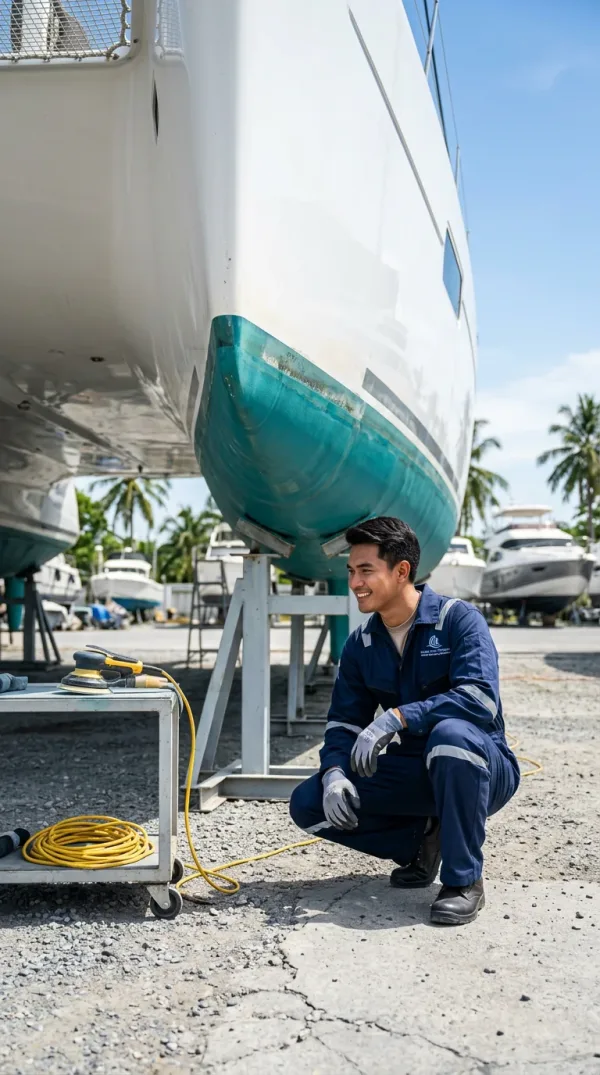
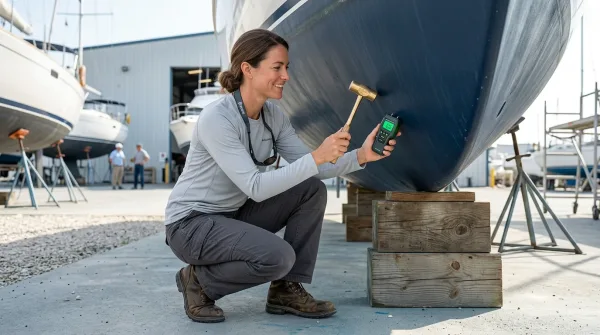
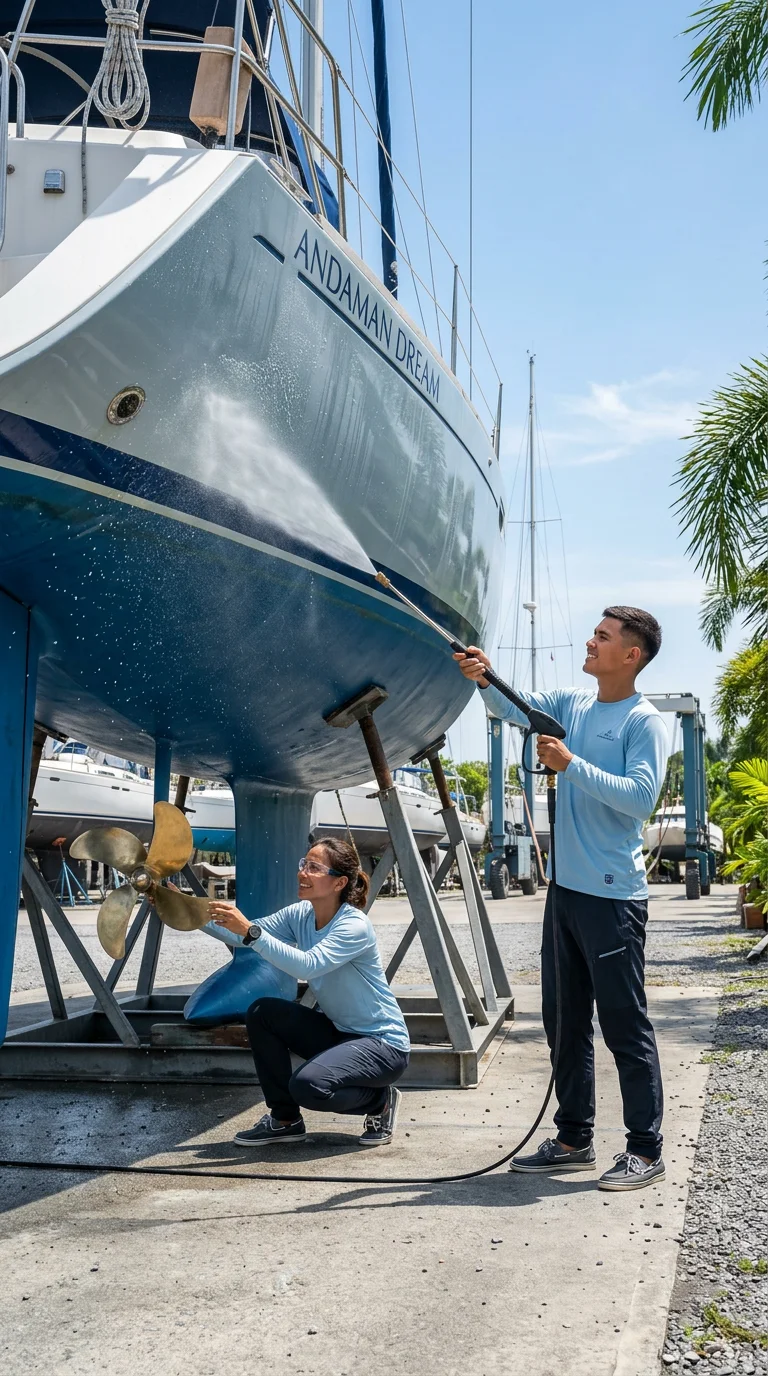
Living aboard in tropical waters presents specific vessel maintenance challenges. Sea temperatures consistently hovering around 28°C to 30°C spur aggressive biofouling. Slime, weed, and encrusting barnacles colonise underwater surfaces rapidly, requiring liveaboard owners to scrub their hulls every two to four weeks to prevent heavy drag and propeller fouling. Annual haul-outs are necessary to renew copper-based, tin-free antifouling coatings and inspect sacrificial zinc anodes, which erode quickly in warm, highly conductive saltwater.
Interior maintenance is equally demanding. Ambient relative humidity frequently exceeds 80%, encouraging black mould in unventilated bilges, lockers, and headliners. Preventing damp requires continuous airflow using 12-volt cabin fans and windscoops at anchor, alongside dedicated dehumidifiers whenever the yacht is hooked up to marina shore power. Boatyards in Phuket and Pattaya often offer discounted hardstand rates during the low-season shoulder months of May and October, making these ideal windows to schedule major maintenance.
Visas, Customs, and Vessel Regulations for British Sailors
A foreign-flagged pleasure craft enters Thailand under a Temporary Importation Entry administered by the Customs Department. This permit operates independently of your personal immigration status, allowing the yacht to stay in national waters initially for six months. You can renew this permission in six-month increments up to a total of 30 to 36 months without incurring permanent customs duties or seven per cent Value Added Tax. Cruising yachts process these extensions at provincial maritime customs offices, including Phuket, Krabi, or U-Tapao for vessels based around Pattaya and the eastern Gulf.
Your vessel's customs permit grants no right of residence to anyone aboard. British sailors over fifty typically obtain an annual Non-Immigrant O retirement visa, which requires showing 800,000 THB (approx £18,180) in a Thai bank account or a verifiable monthly pension of at least 65,000 THB (approx £1,477). Remote workers and younger liveaboards frequently use the Destination Thailand Visa, a five-year multiple-entry permission granting stays of up to 180 days per visit. For shorter cruising stints, standard 60-day tourist entries can be extended once for 30 days at a provincial immigration office for 1,900 THB (approx £43).
Leaving your yacht in Thailand to fly home temporarily requires careful administrative handling. Thai Immigration treats anyone listed on the inward clearance manifest as crew under maritime regulations. If you depart by air without your vessel, you must formally sign off the crew list, show confirmation that the boat is berthed in an authorised marina or boatyard, and sometimes lodge a refundable cash security bond of 20,000 THB (approx £455). Listing family or guests as passengers rather than active crew upon entry removes this bond requirement for them.
Skippers are legally permitted to navigate port clearance themselves, but hiring an established local agent for inward and outward clearance saves substantial transit time between widely dispersed port offices and avoids paperwork discrepancies between your vessel inventory and official logs.
Marina Berths Versus Anchorages: The Land Versus Sea Cost Equation
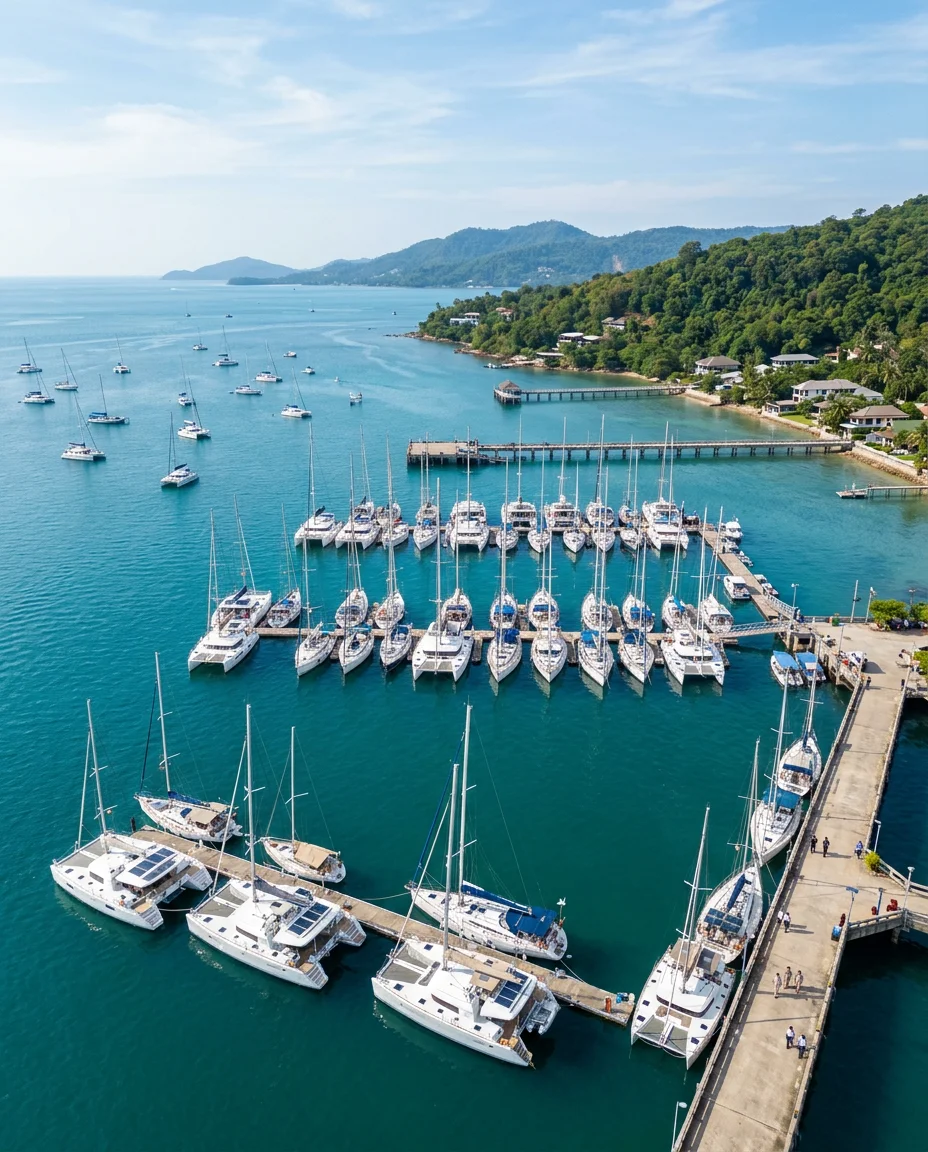
Prospective liveaboards frequently assume that living afloat is substantially cheaper than renting an equivalent flat on solid ground. In practice, that financial advantage disappears if you spend every night connected to a fully serviced marina pontoon. A modern one- to two-bedroom apartment in southern Phuket hubs like Chalong or Rawai typically rents for THB 25,000 to THB 35,000 (£568 to £795) per month, covering air conditioning, swimming pool access, estate security, and broadband connections. By comparison, keeping a 45-foot cruising monohull on a wet berth at Phuket Yacht Haven or Ao Po Grand Marina costs between THB 30,000 and THB 42,000 (£682 to £955) per month in base berthing fees alone.
Marina utility surcharges quickly widen that gap. Marinas bill shore power separately through dedicated pedestals, typically charging THB 10 to THB 12 (approx £0.23 to £0.27) per kilowatt-hour, alongside fresh water at roughly THB 100 to THB 120 (approx £2.27 to £2.73) per cubic metre. Running marine air conditioning units through humid tropical evenings routinely adds THB 4,000 to THB 8,000 (£91 to £182) to your monthly marina invoice. Multihull owners face even steeper overheads, as most Thai marinas levy a 50% to 100% surcharge on catamarans due to beam width. Consequently, a pontoon berth provides step-aboard convenience and secure shore facilities, but its monthly running cost matches or exceeds modern expat housing on land.
Substantial living savings emerge when you transition to swinging moorings or free anchorages. Dropping anchor in public coastal waters such as Chalong Bay or Nai Harn incurs no mooring rental fees. In sheltered cruising locations off Krabi or Koh Samui, serviced swing moorings cost roughly THB 4,000 to THB 8,000 (£91 to £182) monthly. However, anchoring off-grid shifts expenditure into equipment upkeep. You must generate your own freshwater through a reverse-osmosis watermaker, maintain robust solar and battery banks, run an outboard tender for shore runs, and pay occasional landing fees at local piers.
| Living Arrangement | Monthly Base Cost (THB) | Monthly Base Cost (GBP) | Monthly Utilities & Fuel | Practical Trade-Off |
|---|---|---|---|---|
| Full-Service Marina Berth (Phuket / Pattaya) | THB 28,000 – 48,000 | £636 – £1,090 | THB 4,000 – 8,000 (£91 – £182) | Walk-on pontoon access and shore mains, matching land apartment costs |
| Managed Swing Mooring (Krabi / Chalong) | THB 4,000 – 8,000 | £91 – £182 | THB 2,500 – 5,000 (£57 – £114) | Sheltered and economical; requires daily dinghy trips for shore access |
| Free Anchorage (Nai Harn / Phang Nga) | Nil | Nil | THB 3,000 – 6,000 (£68 – £136) | Zero rental cost; relies entirely on onboard power and watermaker systems |
| Rented Land Apartment (1-2 Bed, Phuket) | THB 22,000 – 35,000 | £500 – £795 | THB 2,500 – 4,500 (£57 – £102) | Spacious shore base with pooled amenities; leaves vessel unattended |
Experienced liveaboards generally adopt a hybrid schedule, anchoring out across the settled northeast monsoon dry season and reserving marina berths for foul southwest monsoon weather or deep maintenance.
Where to Anchor and Berth in Thailand
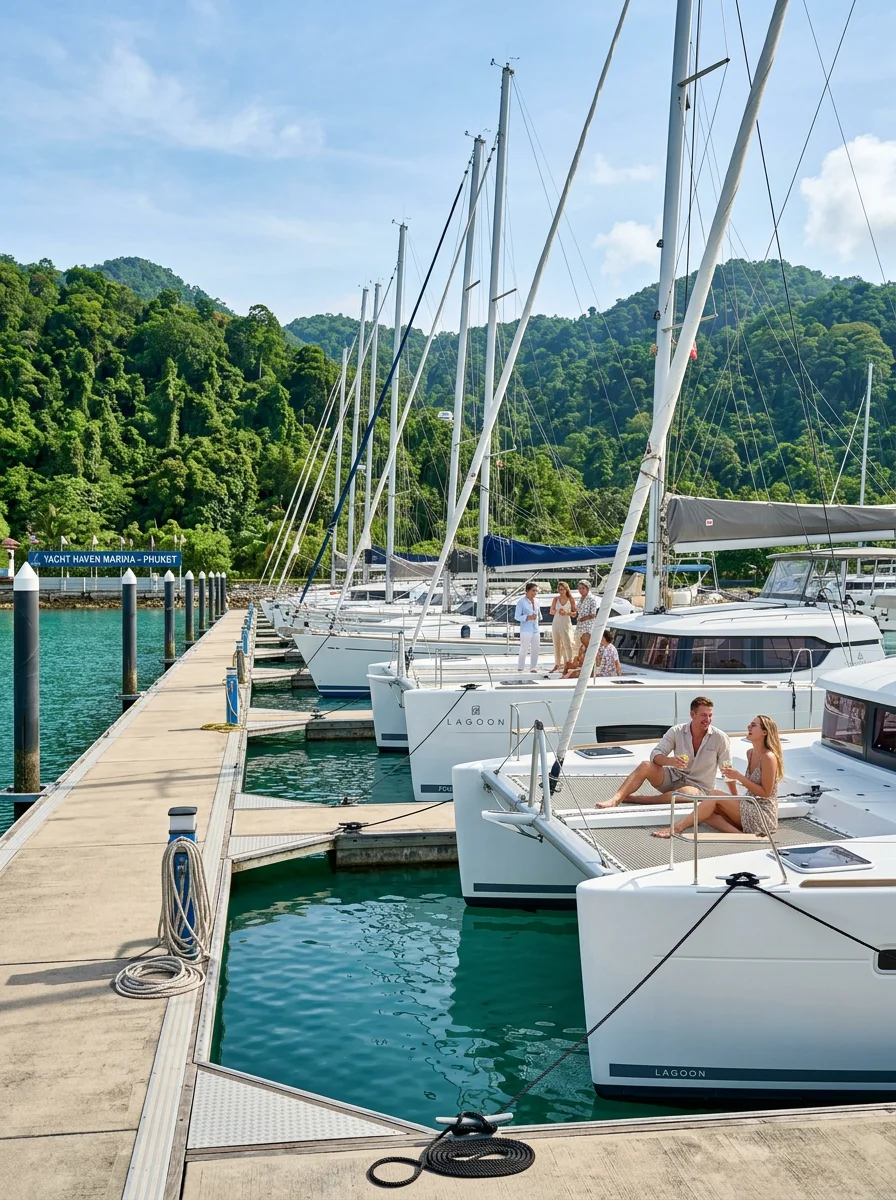
Selecting a cruising base in Thailand hinges on whether you require full boatyard facilities or sheltered natural anchorages. The Andaman Sea coast, led by Phuket and Krabi, forms the primary hub for international liveaboards, while the Gulf of Thailand provides reliable mainland bases and quieter island outposts.
Phuket contains Thailand's most developed leisure marine infrastructure. On the island's northeast coast, Phuket Yacht Haven features 332 fully serviced pontoon berths capable of handling vessels up to 100 metres, complete with an onshore clubhouse, fitness suite, swimming pool, and direct deep-water channels leading into Phang Nga Bay. Nearby, Ao Po Grand Marina maintains 230 berths with unhindered 24-hour access at any tidal state, providing a minimum depth of three metres inside the basin. This unrestricted approach eliminates the shallow mud-bar restrictions of the Koh Kaew channel, where vessels entering Phuket Boat Lagoon or Royal Phuket Marina must wait for high-water windows. Arriving foreign yachts must complete official port clearance at the Ao Chalong One-Stop Marine Centre on the southern coast rather than at these northern marinas.
Across Phang Nga Bay, Port Takola Yacht Marina sits along the Isara Estuary near the mouth of the Krabi River. It provides a peaceful, lower-density alternative to Phuket, with serviced concrete pontoons, a dedicated hardstand boatyard with a 38-tonne lift, and convenient access to the markets and administrative offices of Krabi Town.
In the Gulf of Thailand, Ocean Marina Jomtien, situated south of Pattaya in Chonburi, is the largest marina complex in the country. Protected by an extensive 1.5-kilometre breakwater, it accommodates over 450 wet berths alongside commercial travel lifts, professional marine engineering workshops, and on-site chandleries, positioned around 90 minutes by road from Bangkok's Suvarnabhumi Airport. Farther east, Salak Phet Bay on the south coast of Koh Chang provides a deep, landlocked natural harbour with good mud and sand holding, giving self-reliant sailors a tranquil, storm-sheltered anchorage.
Costs and Budgeting
A realistic liveaboard budget in Thailand depends primarily on how often you tie up to a marina pontoon versus dropping anchor in open water. Budget sailors anchored full-time, cooking local produce, and conducting their own mechanical servicing can manage on THB 45,000 to THB 60,000 (£1,023 to £1,364) per month. A mid-range couple splitting time between anchorages and marinas, dining ashore, and maintaining medical insurance spends between THB 75,000 and THB 110,000 (£1,705 to £2,500) monthly. A premium marina-based lifestyle on a modern multihull with continuous air conditioning and professional yard support routinely reaches THB 150,000 to THB 210,000 (£3,409 to £4,773) per month.
| Option | Cost (THB) | Cost (GBP approx) | Notes |
|---|---|---|---|
| Budget Liveaboard (40ft at Anchor) | THB 45,000 – 60,000 | £1,023 – £1,364 | Zero marina fees; self-maintenance; local market provisioning |
| Mid-Range Liveaboard (42ft Hybrid) | THB 75,000 – 110,000 | £1,705 – £2,500 | Part-time marina berth; haul-out fund; dining out; medical insurance |
| Premium Liveaboard (45ft+ Catamaran in Marina) | THB 150,000 – 210,000 | £3,409 – £4,773 | Full marina berth; continuous air conditioning; outsourced yard labour |
| Annual Haul-Out & Antifouling (45ft) | THB 80,000 – 120,000 | £1,818 – £2,727 | Lift, pressure wash, cradle, hardstand, and bottom paint application |
| Marine Third-Party & Hull Insurance | THB 45,000 – 90,000 | £1,023 – £2,045 | Annual cost; requires recent survey for boats over fifteen years |
Annual yard upkeep represents a major operational commitment in tropical waters, where rapid marine growth and sun exposure accelerate wear. Allocating a maintenance sinking fund of THB 10,000 to THB 15,000 (£227 to £341) monthly covers routine engine servicing and prepares for the yearly haul-out. A standard yard haul for a 45-foot yacht—including travel-lift handling, pressure washing, cradle rental, hardstand lay fees, and fresh antifouling paint—costs THB 80,000 to THB 120,000 (£1,818 to £2,727). Annual hull and third-party insurance adds THB 45,000 to THB 90,000 (£1,023 to £2,045), with marine underwriters requiring an independent condition survey for craft over fifteen years of age.
Domestic provisioning choices also shift monthly outlays significantly. Cooking fresh seafood, fruit, and vegetables from local morning markets costs roughly THB 12,000 to THB 18,000 (£273 to £409) a month for a couple, whereas stocking imported western supermarket goods can easily double that figure. For marina tenants, metered electricity for continuous air conditioning typically adds THB 5,000 to THB 12,000 (£114 to £273) to monthly pontoon invoices.
What To Know Before You Go
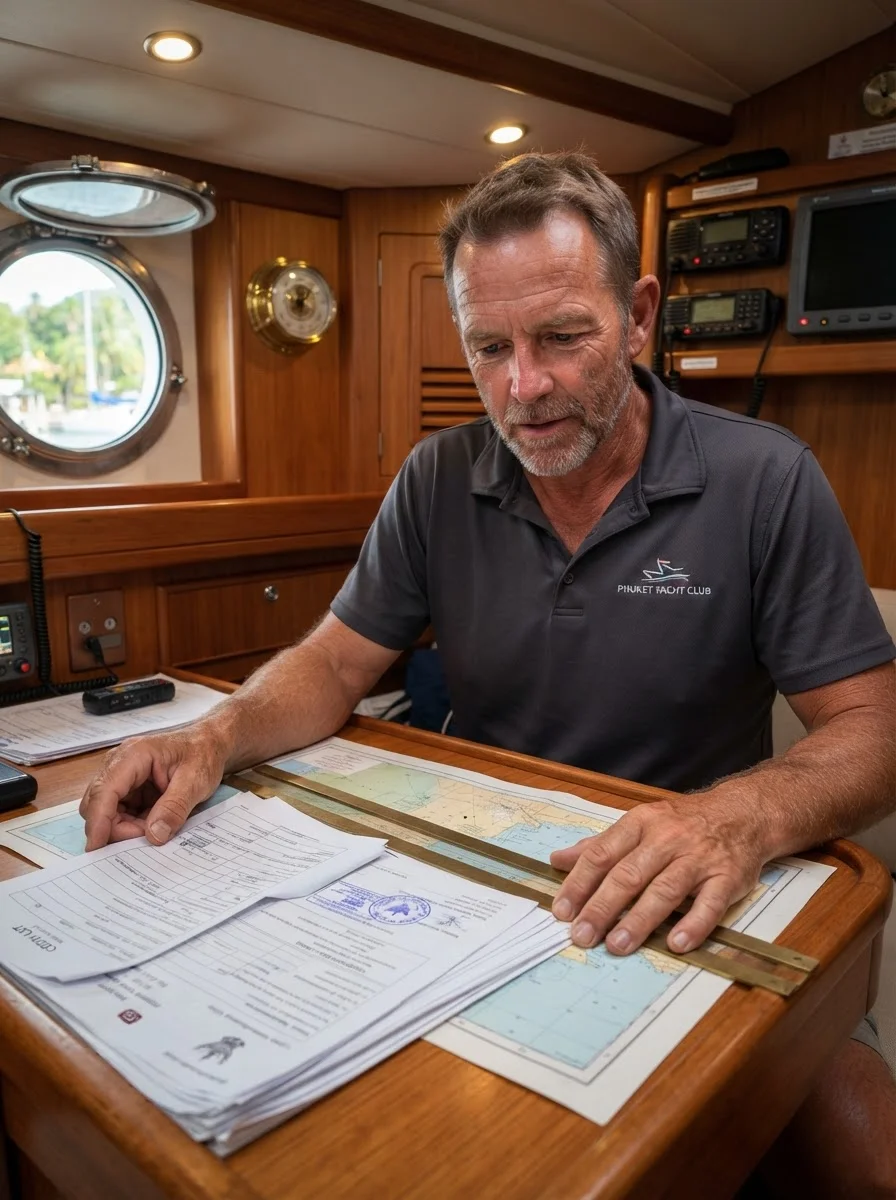
Foreign-flagged yachts arriving in Thai waters must proceed directly to an official port of entry—such as Phuket, Krabi, Pattaya, or Koh Samui—while flying the yellow quarantine flag. Skippers must report to Immigration, the Customs Department, and the Marine Department within 24 hours of arrival. Stepping ashore beforehand, bypassing inspection, or anchoring in unauthorised bays invites hefty statutory fines and risks vessel impoundment.
Environmental compliance in marine protected areas is strictly policed. Under the National Park Act, discharging untreated sewage, chemicals, or contaminated bilge water within national marine parks—including the Phi Phi and Similan archipelagos—is illegal. Department of National Parks rangers enforce strict zero-discharge rules, making functional blackwater holding tanks indispensable if you plan to cruise beyond commercial marinas.
Insurance terms require meticulous scrutiny before setting sail from home waters. Standard UK and European marine policies often exclude waters east of Singapore entirely or impose rigorous tropical cyclone exclusions. Insurers providing Southeast Asian navigation extensions frequently warrant specific storm-management protocols during the southwest monsoon, such as hauling out or mooring in designated sheltered hurricane holes.
Practical logistics also demand advance planning for maintenance. While skilled local labour for hull work and marine engineering remains affordable, imported technical hardware is not. Sourcing European rigging components, canvas work fabrics, or marine electronics in Thailand incurs customs tariffs reaching up to 30 per cent, alongside standard 7 per cent value-added tax on landed CIF (cost, insurance, and freight) value. Cruisers frequently save substantial sums by freighting critical spares to duty-free hubs like neighbouring Langkawi before entering Thailand.
Practical Tips
Fit fine insect mesh over every opening deck hatch and companionway before arriving in Thai waters. Biting midges and mosquitoes thrive around mangrove-fringed anchorages and tidal rivers at dusk, and mosquito-borne illnesses such as dengue fever remain a genuine hazard throughout coastal Thailand. Quality stainless steel or fitted magnetic mesh screens allow vital cross-ventilation through cabins without inviting pests below.
Choose your tender carefully. In Thailand, a dinghy functions as your everyday car, ferry, and provisioning workhorse. Tropical ultraviolet radiation and intense heat rapidly degrade standard Polyvinyl Chloride (PVC) fabrics, causing seams to delaminate within a few seasons. Opt for a rigid inflatable boat with Hypalon (CSM) tubes and an aluminium or fibreglass hull. Hypalon withstands relentless tropical sun, and a solid hull resists the abrasion of coral rubble, barnacles, and concrete landing piers. Secure the outboard engine and fuel tank with a heavy-duty locking cable at public dinghy docks.
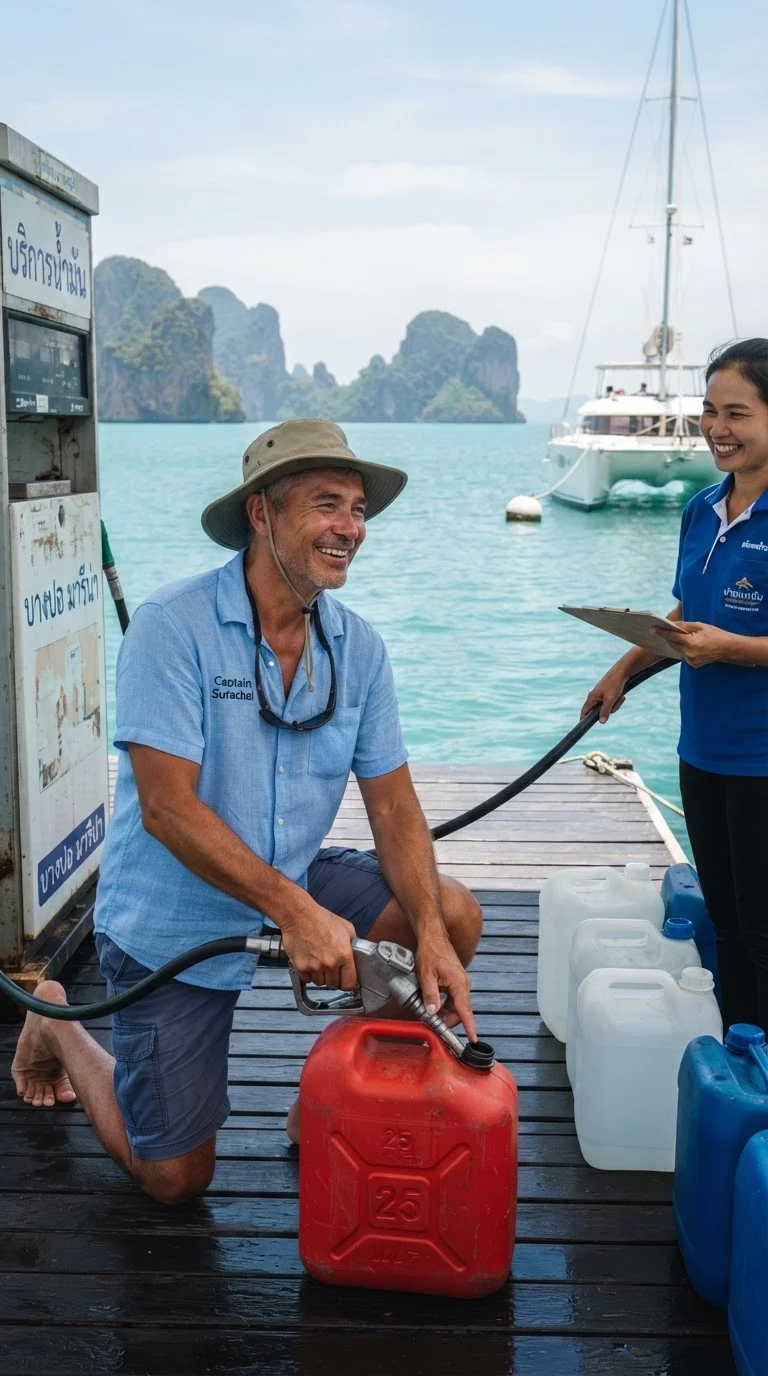
Diesel fuel management requires constant vigilance. High humidity and warm seawater cause heavy condensation inside tanks, encouraging bacterial contamination (diesel bug). Fuel bunkered from remote island piers or fishing barges frequently contains suspended water and biological sediment. Install dual primary fuel filters with transparent water-separator bowls on a changeover manifold, and treat every bunkering with a marine biocide.
Prepare for severe tropical downpours. Southwest monsoon squalls can dump 100 millimetres of rain within a few hours, easily overwhelming cockpit drains and testing hatch seals. Fit at least two independent electric bilge pumps with dedicated high-water alarms in each bilge compartment.
Keep physical copies of your vessel registration, previous port clearance, crew lists, and passport details in waterproof folders. Thai Marine Department, Customs, and Immigration officials require physical stamped documents and paper duplicates alongside any digital submissions.
Upon dropping anchor in hubs like Ao Chalong or Pattaya, connect with the local cruising community through VHF radio channels and messaging groups. Experienced liveaboards provide reliable, up-to-date recommendations for trustworthy mechanics, sailmakers, and clearance agents.
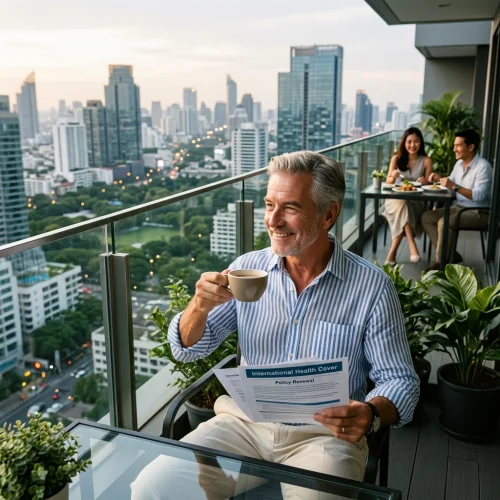
Protect your investment and personal wellbeing with comprehensive marine hull coverage and international expat medical insurance before setting sail.
Quick Reference Table
| Item | Detail | Notes |
|---|---|---|
| Andaman Cruising Season | November – April (Northeast Monsoon) | Settled weather, clear skies, and 10–18 knot winds; west Phuket anchorages viable |
| Southwest Monsoon Season | May – October | Ocean swells and heavy squalls; shelter in east Phuket, Phang Nga Bay, or the Gulf islands |
| Gulf of Thailand Dry Season | February – September | Favourable cruising window around Koh Samui, Koh Phangan, and Koh Tao during Andaman wet season |
| Vessel Customs Entry | 6-month Temporary Importation Entry | Extendable in 6-month blocks up to 30–36 months without customs duties or 7% VAT |
| Long-Stay Visa Routes | Non-Immigrant O (Retirement) or Destination Thailand Visa (DTV) | Vessel entry grants no stay rights; Non-O requires 800,000 THB savings or 65,000 THB/month pension |
| Full-Service Marina Berth | THB 28,000 – 48,000 (£636 – £1,090) per month | Monohull base rate (40–45ft); catamarans incur a 50%–100% beam surcharge |
| Managed Swing Mooring | THB 4,000 – 8,000 (£91 – £182) per month | Available in Chalong or Krabi; economical shelter requiring regular dinghy runs |
| Free Anchorage | Nil rental fee | Public roadsteads such as Nai Harn and Phang Nga Bay; requires solar, battery, and watermaker self-sufficiency |
| Monthly Operating Budget | THB 45,000 – 60,000 (budget) to THB 150,000 – 210,000 (premium) | Budget (£1,023–£1,364) anchored full-time; premium (£3,409–£4,773) covers full marina berth and air conditioning |
| Annual Haul-Out & Antifouling | THB 80,000 – 120,000 (£1,818 – £2,727) | Typical cost for a 45ft hull covering lift, pressure wash, cradle, lay days, and bottom paint |
| Port Clearance Procedure | Clear within 24 hours of arrival | Report under quarantine flag to Customs, Immigration, and Marine Department; Ao Chalong One-Stop Centre in Phuket |
| Departure Security Bond | 20,000 THB (approx £455) | Refundable cash bond occasionally required when flying out if registered as crew rather than passenger |
| Phuket Boat Lagoon Website | phuketboatlagoon.com | Official site for Phuket Boat Lagoon marina and service boatyard |
| Phuket Yacht Haven Website | pyhmarina.com | Official site for deep-water marina on Phuket's northeast coast |
| Ao Po Grand Marina Website | aopograndmarina.com | Official site for 24-hour tidal access marina in northeast Phuket |
| Port Takola Yacht Marina Website | porttakola.com | Official site for boutique marina on the Krabi River estuary |
| Ocean Marina Jomtien Website | oceanmarinajomtien.com | Official site for major marina complex south of Pattaya in Chonburi |
FAQ: Liveaboard Yachting in Thailand
How much solar power is typically needed for a liveaboard yacht in Thailand?
What are the main advantages of choosing a catamaran for liveaboard sailing in Thailand?
What are the financial drawbacks of owning a catamaran in Thai marinas?
When is the best time of year to cruise the Andaman Sea in Thailand?
What are the specific maintenance challenges for yachts in tropical Thai waters?
How long can a foreign-flagged pleasure yacht legally stay in Thai waters?
Is it cheaper to live on a yacht in a Thai marina compared to renting a land-based apartment?
What are the required arrival procedures for foreign yachts entering Thai waters?
Why should liveaboards fit insect mesh on their yacht in Thailand?
What type of dinghy is recommended for liveaboard life in Thailand?
Reviewed by the Thailand Guide Editorial Team • Last reviewed: 8 November 2026
This page is provided for general information only. While we aim for accuracy, details can change — please verify anything important independently before relying on it.