Importing a Boat from Thailand to the UK
Thai shipyards produce advanced composite cruising catamarans, custom aluminium workboats, and long-range expedition motor yachts, pairing high build specifications with competitive yard labour rates. Bringing a Thai-built or brokerage boat into the United Kingdom, however, involves far more than booking deck space on a cargo ship. Relocating a vessel from Southeast Asian waters to a British home berth demands methodical planning across maritime customs declarations, international transport, and statutory UK safety standards.
Importing a recreational boat or commercial vessel from Thailand into the UK requires formal clearance through HM Revenue & Customs (HMRC), product conformity certification under the Recreational Craft Regulations 2017, and vessel registration overseen by the Maritime and Coastguard Agency (MCA). Importers must pay 20% import VAT assessed on the complete landed cost, which combines the purchase price, freight charges, and marine transit insurance. Vessels placed on the Great Britain market without existing UKCA or recognised CE certification require a Post-Construction Assessment through a designated Approved Body before entering service. The precise requirements depend on whether the craft is new, previously owned, or eligible for statutory customs relief.

Purchasing and Export Procedures in Thailand
Acquiring a vessel in Thailand for export to the UK requires aligning the purchase contract with international delivery terms, customs clearance, and registry transfers before shipping or setting sail. Buyers generally pursue one of four routes: commissioning a bespoke new build from shipyards in Chonburi or Rayong, buying a production yacht, acquiring a Thai-flagged pre-owned vessel, or purchasing a foreign-flagged yacht berthed in hubs such as Phuket under Thai temporary admission.
Commissioning a new build gives you direct control over UK product compliance. You can contractually mandate that the builder supplies a complete technical construction file and fits components certified to British standards from the outset. For newly built vessels directly exported from Thailand under customs supervision, Thai value-added tax is zero-rated under Section 80/1 of the Thai Revenue Code, avoiding the standard 7% domestic tax.
When purchasing a second-hand Thai-registered vessel, transactions involve the Thai Marine Department. The seller must cancel the local boat licence and obtain an official Certificate of Deregistration. Without this formal deletion document, the Registry of Shipping and Seamen at the Maritime and Coastguard Agency (MCA) will reject applications to register the boat under the British flag.
If buying an existing foreign-flagged yacht in Thailand, inspect the seller’s customs documentation thoroughly. Visiting leisure craft enter Thailand under temporary importation bonds. The seller must formally close out their temporary admission entry and discharge all customs guarantees before ownership transfers and the vessel departs. Unresolved customs entries remain attached to the vessel and trigger substantial administrative fines under Thai maritime customs regulations.
Engaging an established yacht broker provides structured security, routing staged payments through a segregated client escrow account. Contracts should stipulate that final settlement depends on delivering an original Builder's Certificate or a notarised Bill of Sale alongside the Thai export customs declaration. For comprehensive guidance on shipyard contracting and pre-purchase surveys, consult Thailand Guide's dedicated features on Buying a Yacht in Thailand and Commissioning a Boat in Thailand.
| Purchase Route | Key Documentation | Thai Tax and Export Status | UK Import Implications |
|---|---|---|---|
| New Custom Build | Builder's Certificate, Construction Agreement, technical file | Zero-rated Thai VAT for genuine export under customs supervision | Subject to 20% UK import VAT and UK conformity assessment |
| Thai-Registered Used Craft | Thai Bill of Sale, Marine Department Deregistration Certificate, previous logbooks | Local transfer fees cleared; export declaration filed with Thai Customs | Requires complete title history and Post-Construction Assessment |
| Foreign-Flagged Used Craft | Notarised Bill of Sale, original registry deletion, Thai Customs inward clearance | Must close out Thai temporary importation bond before departure | Full UK import procedures apply unless eligible for customs reliefs |
| Commercial Vessel | Classification society certificates, Builder's Certificate, export declaration, stability book | Commercial export manifests and shipyard discharge clearances | Must satisfy MCA Workboat Codes or Passenger Vessel Regulations |
UK Customs Valuation, Import VAT, and Duty Reliefs
Cruising vessels entering the United Kingdom from Thailand face import taxation calculated on total landed value rather than ex-factory purchase price alone. HM Revenue & Customs (HMRC) processes import entries through the Customs Declaration Service (CDS). Recreational vessels fall under Chapter 89 of the UK Integrated Online Tariff, primarily heading 8903, which covers yachts, sailing boats, and motor craft for pleasure or sports. Under the UK Global Tariff, the standard customs duty on heading 8903 is 0%. The UK and Thailand do not maintain a preferential trade agreement eliminating domestic consumption taxes, so the primary charge on arrival is UK Import VAT at 20%.
HMRC bases import VAT on the CIF valuation (Cost, Insurance, and Freight), combining the vessel purchase price, international freight, transit insurance, and port handling or discharge costs incurred before customs release. For example, importing a Thai-built motor yacht purchased for 6,450,000 THB (approx. £150,000) with ocean freight of 774,000 THB (approx. £18,000) and marine transit insurance of 86,000 THB (approx. £2,000) establishes a CIF customs value of 7,310,000 THB (approx. £170,000). At 0% customs duty, the 20% import VAT payable to HMRC prior to release totals 1,462,000 THB (approx. £34,000).
Customs relief schemes operate under strict statutory parameters. Returned Goods Relief (HMRC Notice 236) waives duty and VAT for vessels previously exported from the UK that return within three years without undergoing modifications beyond routine maintenance. To claim VAT relief under this mechanism, the person re-importing the vessel must be the same party who exported it, and original UK VAT payment evidence must be intact. Purchasing a new or used yacht in Thailand cannot qualify for Returned Goods Relief.
Temporary Admission provides duty and VAT relief when non-UK residents bring a foreign-registered leisure vessel into British waters for personal recreation. The relief window allows eligible craft to remain for up to 24 months in Great Britain, or 18 months in Northern Ireland. UK resident buyers cannot use Temporary Admission when importing a vessel acquired in Thailand; full import VAT falls due upon initial clearance.
Under the Windsor Framework, vessels arriving in Northern Ireland follow the EU Union Customs Code rather than the Great Britain customs regime. Vessels entering Northern Ireland must reconcile EU VAT status if subsequently moved between Northern Ireland, the Republic of Ireland, or the Great Britain mainland.
Do not state a deflated purchase figure on the customs entry. HMRC cross-references declared amounts with professional valuation surveys, marine surveyor reports, and international brokerage records, applying civil penalties and compounding interest charges to fraudulent or inaccurate declarations.
Plan a Central Thailand trip through Ayutthaya, Kanchanaburi, Lopburi and Amphawa, with current costs, transport advice and seasonal guidance.
UK Product Conformity and Technical Documentation
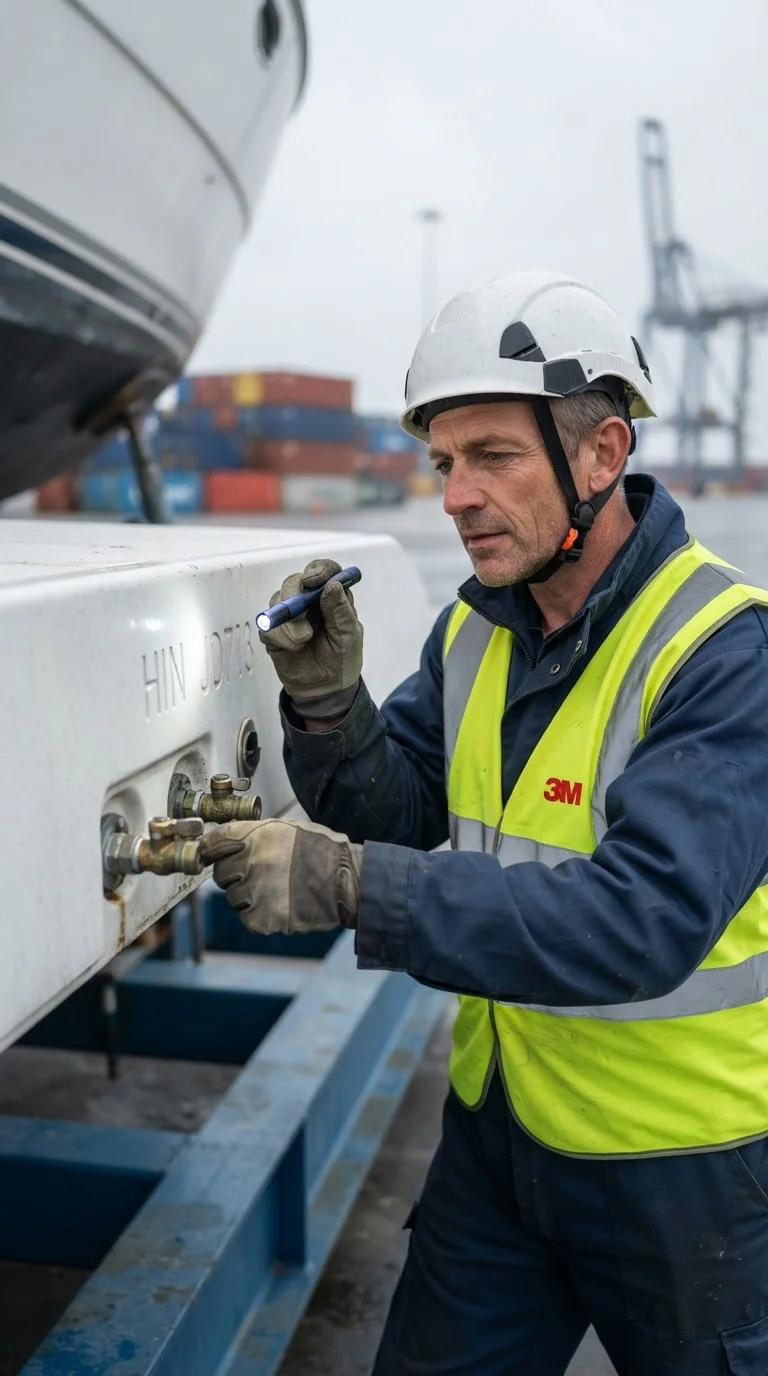
Recreational vessels brought into service or placed on the market in Great Britain must satisfy statutory safety and environmental standards set out in the Recreational Craft Regulations 2017 (SI 2017/737). If you purchase a craft in Thailand and ship it to the UK for personal leisure, British law categorises you as a private importer. Under Regulation 43, a private importer assumes direct legal responsibility for ensuring the vessel satisfies all essential design, construction, noise, and exhaust emission criteria before putting it into service on UK waters.
Conformity Markings and Builder Documentation - New boats commissioned from export-focused Thai shipyards can be built directly to British or European standards. Under the Product Safety and Metrology etc. (Amendment) Regulations 2024, Great Britain indefinitely recognises both the UKCA mark and the EU CE mark for recreational craft. For imports landing in Northern Ireland, CE marking remains mandatory under the Windsor Framework. A fully compliant craft arrives with an official Declaration of Conformity, an Owner's Manual compiled to ISO standards, and a builder's plate specifying its design category—Ocean (Category A), Offshore (Category B), Inshore (Category C), or Sheltered Waters (Category D).
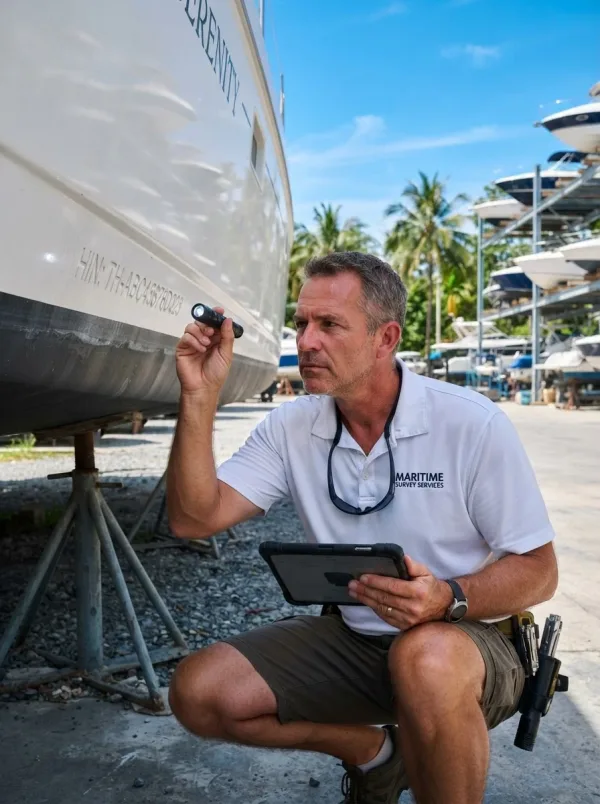
Post-Construction Assessment for Sourced Craft - Most pre-owned vessels and domestic custom builds in Thailand lack recognised UK or European conformity certification. When a craft arrives without valid UKCA or CE documentation from the original builder, you must commission a Post-Construction Assessment (PCA) through an accredited UK Approved Body before operating the boat. Under Schedule 5 of the regulations, an Approved Body surveyor carries out a comprehensive physical inspection and technical evaluation. This review examines hull scantlings, stability calculations, downflooding angles, electrical wiring insulation, fuel containment, fire safety gear, and engine exhaust compliance.
Following a successful assessment, the Approved Body issues a PCA Certificate of Conformity and assigns a unique Watercraft Identification Number (WIN) stamped directly onto the starboard transom. As the private importer, you then complete and sign the final UK Declaration of Conformity. Scheduling a PCA surveyor in Thailand prior to shipment—or arranging an inspection immediately upon discharge at a UK port—prevents costly impoundment.
Commercial Craft and Statutory Enforcement - Vessels imported for commercial operations, such as skippered charters, dive excursions, or passenger transport, do not fall under the Recreational Craft Regulations. Instead, these craft must comply with Maritime and Coastguard Agency (MCA) small commercial vessel codes of practice, requiring formal stability books, commercial coding inspections, and statutory safety equipment. For recreational vessels, local Trading Standards departments act as the market surveillance authority across Great Britain. Operating an uncertified boat without an authorised Declaration of Conformity exposes the owner to enforcement notices, potential vessel seizure, and invalidated marine insurance.
Ocean Transport Logistics from Thai Shipyards to UK Ports
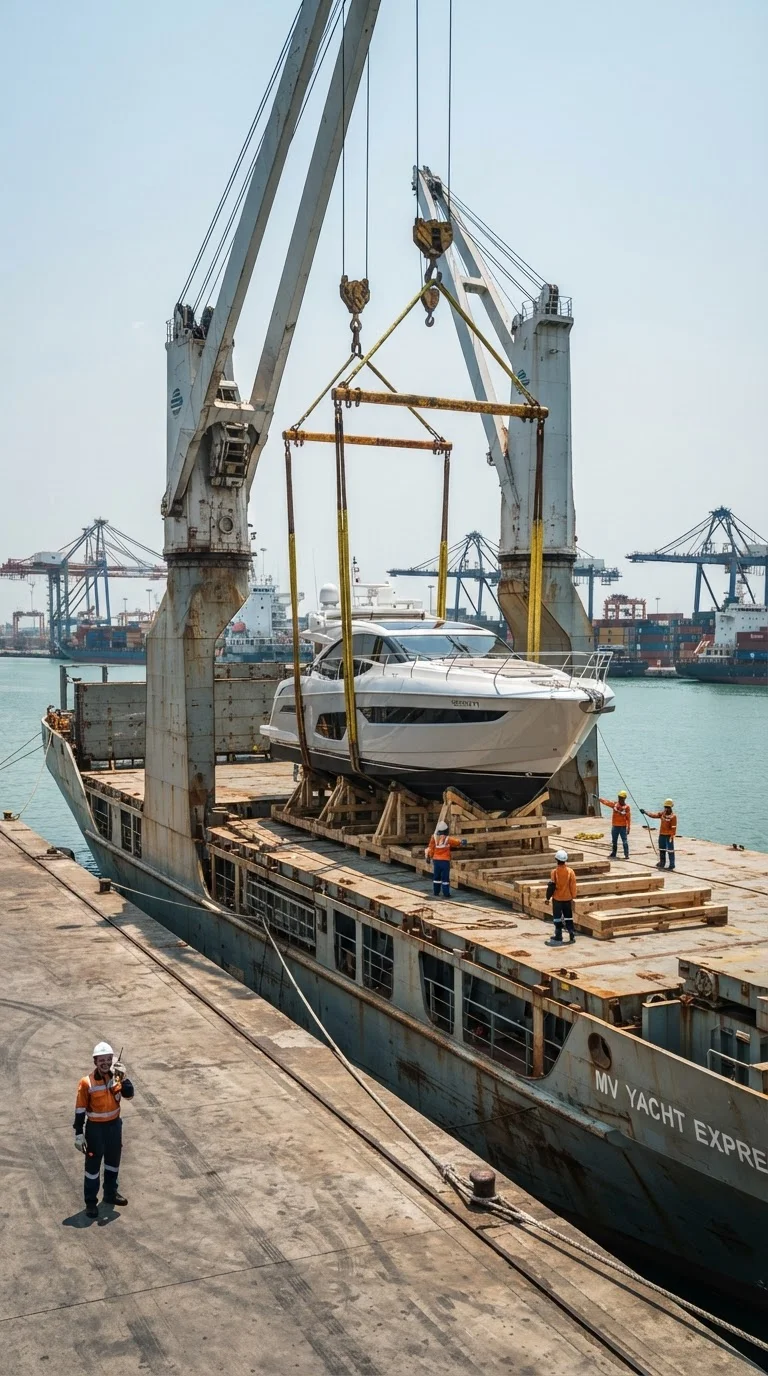
Transporting a private vessel from the Gulf of Thailand or the Andaman Sea to the British Isles covers a passage of roughly 6,600 to 7,500 nautical miles via the Suez Canal, or more than 11,500 nautical miles via southern Africa. For most buyers, commercial ocean freight represents the most practical and predictable method of delivery, though it remains the largest single operational expense of the import process.
Owners generally choose between four primary transit options:
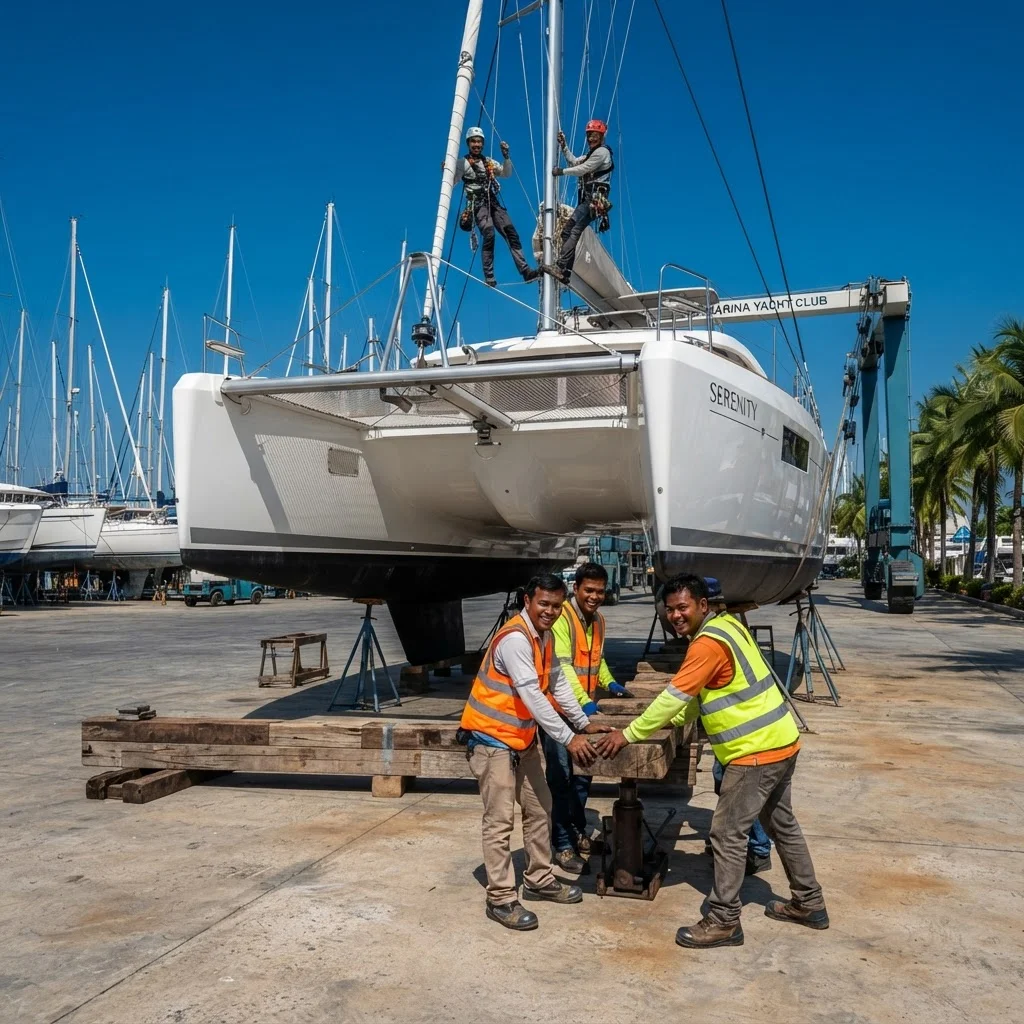
Lift-on/Lift-off (Lo-Lo) services operate as the principal method for motor cruisers and sailing yachts between 35 and 75 feet. Specialist yacht transport carriers charter geared heavy-lift cargo vessels equipped with shipboard dual cranes. Divers position certified lifting strops below the hull in open water, lifting the vessel directly onto tailored steel and timber cradles welded to the cargo ship's weather deck.
Float-on/Float-off (Flo-Flo) carriers use dedicated semi-submersible ships. The transport vessel ballasts down, submerging its cargo deck so yachts can motor directly into the flooded dock bay under their own power. Divers position supports beneath the hulls before the carrier de-ballasts, raising the yachts completely clear of the water. Flo-Flo drastically reduces lifting stresses on the structure, making it particularly advantageous for wide-beam sailing catamarans and delicate composite motor yachts.
Flat-rack shipping accommodates powerboats under 40 feet with manageable beams. The boat secures onto an open flat-rack platform fitted with custom supports, which is then loaded onto a standard container vessel as out-of-gauge cargo. For compact craft with a beam under 2.3 metres, such as rigid inflatable boats or small dayboats, roll-in stowage inside an enclosed 40-foot High-Cube shipping container provides complete protection from weather at substantial freight savings.
Delivery on the vessel's own keel requires a licensed commercial delivery skipper and experienced offshore crew. The conventional route across the Indian Ocean via the Gulf of Aden and the southern Red Sea exposes craft to serious maritime security risks, steep war-risk insurance premiums, and Suez Canal tolls. Diverting around the Cape of Good Hope avoids these security zones but adds thousands of ocean miles through severe southern ocean weather, often resulting in crew fees, bunker bills, and machinery wear that exceed dry-deck freight costs.
Cargo preparation requires careful planning before handover. Transport lines require cooling systems flushed, battery banks disconnected and isolated, and gas cylinders removed or isolated with valves shut tight. International Maritime Dangerous Goods regulations permit no more than one-quarter of a tank (or 250 litres) of fuel, though individual carriers typically demand tanks be drained to below 10% capacity—leaving only enough fuel for basic loading and discharge manoeuvres. For deck-loaded sailing yachts, riggers must unstep the mast, lash spars securely to the deck, and stow all sails, biminis, and loose deck equipment below to prevent wind damage.
Ensure your transport agreement explicitly details which party covers crane hire, cradle construction, lashings, and stevedoring, as well as terminal wharfage charges at both the Thai departure facility and the UK destination port.
Customs Clearance, UK Vessel Registration, and Commercial Craft
Bringing a vessel from the transport ship's slings into British waters requires completing statutory border clearance before securing registration under the Red Ensign. When the transport ship arrives at a major UK discharge port such as Southampton, Tilbury, or Felixstowe, an appointed customs clearing agent submits an import declaration through HM Revenue and Customs' (HMRC) Customs Declaration Service (CDS). The agent presents the commercial invoice, bill of lading, transit insurance documents, packing lists, and proof of technical conformity. Once HMRC verifies the declared valuation and import VAT is settled, customs releases the cargo. Private importers receive a digital CDS customs declaration and payment receipt containing a specific Movement Reference Number (MRN), while VAT-registered businesses receive a monthly C79 certificate. Retain this clearance documentation permanently in the vessel's master file as definitive proof of UK VAT-paid status for future resale or inspection.
Clear border release must not be confused with vessel registration. Customs clearance satisfies tax and border control laws, whereas registration establishes legal nationality, British flag protection, and recognised title. The UK Ship Register (UKSR), administered by the Maritime and Coastguard Agency (MCA) in Cardiff, provides two registration routes for private pleasure craft.
Recreational Vessel Registration
Part 1 Registration functions as a complete public register of legal title and is legally required if financing the purchase with a marine mortgage. It requires an unbroken five-year chain of title supported by builder's certificates and formal bills of sale, an approved non-conflicting vessel name, and an official tonnage measurement survey carried out by an authorised Certifying Authority such as the Yacht Brokers, Designers and Surveyors Association (YDSA) or Mecal. Following approval, the MCA issues a Carving and Marking Note that must be completed and certified on board. The statutory Part 1 registration fee is £153 for five years.
Part 3 Registration, commonly known as the Small Ships Register (SSR), provides a fast, lower-cost option for pleasure craft under 24 metres in overall length. Eligibility requires the owner to be ordinarily resident in the UK for at least 185 days per 12-month period. Part 3 registration costs £35 for five years. Crucially, the SSR records British nationality for overseas voyaging and international port formalities, but it does not record title, verify ownership, or permit the registration of marine mortgages.
Commercial Craft and Passenger Vessels
Vessels imported from Thailand for commercial charter, commercial passenger transport, or utility operations operate under a separate statutory framework from private pleasure craft. Thailand houses a substantial commercial maritime manufacturing sector, including SeaCat Ships in Jomtien producing aluminium passenger catamarans and fast ferries, Austhai Marine in Sattahip building composite dive and transfer boats, and Sakun C Innovation manufacturing aluminium service craft.
Commercial craft cannot enter service under recreational craft conformity declarations. Prior to carrying fare-paying passengers or operating commercially in UK waters, the vessel must undergo inspection and certification by an MCA-authorised Certifying Authority. Workboats up to 24 metres must comply with the MCA Workboat Code Edition 3 (or applicable provisions of MGN 280), while vessels carrying more than 12 passengers must meet full MCA passenger ship construction rules. Operators must obtain approved intact and damage stability books, install commercial-grade life-saving equipment, implement structural fire protection, and establish a documented Safety Management System (SMS) before commencing operations.
Key Departure Hubs and Shipyards Across Thailand
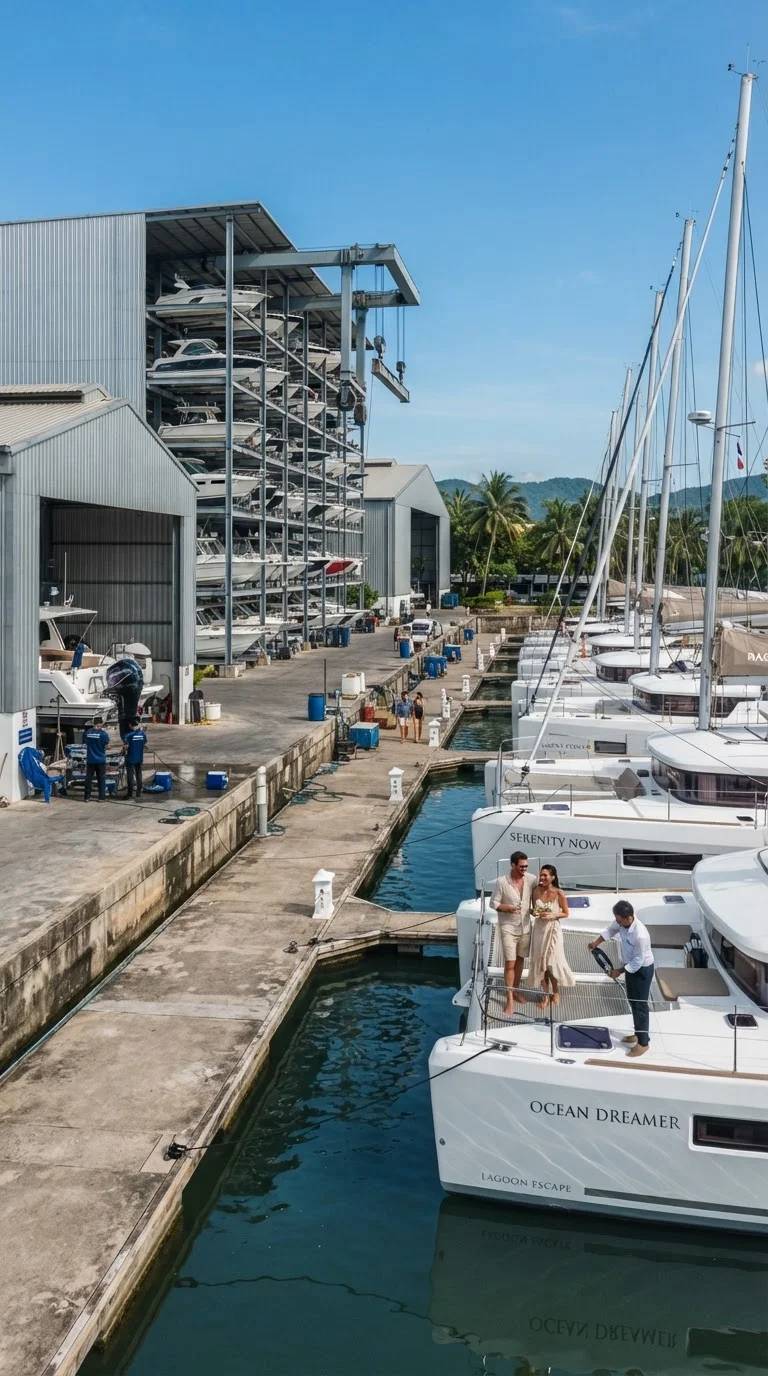
Exporting a vessel from Thailand requires selecting a departure facility matched to the boat's draught, beam, and shipping arrangement. Thailand's marine export infrastructure divides between the eastern Gulf coast and the Andaman Sea.
On the Gulf coast, Ocean Marina Jomtien south of Pattaya provides 455 wet berths, a 75-tonne travel lift, and hardstanding facilities. Its position places vessels within easy reach of commercial shipyards in Sattahip and heavy-lift loading berths at Laem Chabang deep-sea port. Further east in Rayong, commercial yards such as SeaCat Ships construct aluminium catamarans and workboats with direct sea access for outward load-outs.
On the Andaman coast, Phuket concentrates the country's main yacht refit and staging infrastructure. Phuket Boat Lagoon and Royal Phuket Marina provide sheltered inland basins, full-service boatyards, and rigging workshops. Both marinas sit behind a shallow mangrove channel, meaning vessels drawing more than two metres must time their entry and departure around high tide.
For deep-draught monohulls and wide-beam catamarans unable to navigate tidal channels, Ao Po Grand Marina on Phuket's north-east coast provides 24-hour deep-water access directly into Phang Nga Bay, with outer pontoon depths of up to seven metres. Semi-submersible yacht transport ships and heavy-lift cargo vessels typically load either at Laem Chabang on the Gulf or at the Phuket Deep Sea Port at Ao Makham. Starting logistics arrangements through marine agents at Ocean Marina or Ao Po Grand Marina gives buyers direct access to specialists experienced in handling Thai Customs export clearances and transport load-outs.
Costs and Budgeting
Importing a vessel from Thailand involves ocean freight, statutory taxes, conformity assessments, and marine insurance that typically add 30% to 50% to the initial shipyard purchase price. Securing an accurate total landed cost before signing a purchase contract prevents unexpected capital demands at the UK border.
Ocean freight charges depend on total cubic volume (length overall, beam, and air draft) rather than hull displacement alone. Because freight carriers charge for deck footprint, a 40-foot cruising catamaran incurs substantially higher shipping costs than a 40-foot monohull of similar length. In addition to ocean freight, budget for UK discharge port fees, including heavy-lift crane hire, stevedoring, and temporary marina pontoon berthing while clearing customs.
Recreational craft imported into Great Britain must satisfy the Recreational Craft Regulations 2017. If a Thai shipyard cannot provide valid UKCA or recognised CE conformity documentation, you must fund a Post-Construction Assessment (PCA) conducted by an authorised UK Approved Body.
HM Revenue & Customs assesses import VAT at 20% on the total CIF value (vessel purchase price, freight, and marine transit insurance). While recreational pleasure craft classified under UK Trade Tariff heading 8903 currently enter at a baseline customs duty rate of 0%, the 20% import VAT remains payable upon arrival unless a specific statutory relief applies.
The table below outlines typical costs associated with importing a recreational craft from Thailand into Great Britain:
| Cost Item | Typical Cost (THB) | Typical Cost (GBP) | Details |
|---|---|---|---|
| Flat-Rack Shipping (under 35ft) | 387,000–645,000 THB | £9,000–£15,000 | Port-to-port on container carriers; narrow beam craft |
| Heavy-Lift Lo-Lo Freight (40–50ft) | 774,000–1,505,000 THB | £18,000–£35,000 | Professional cradle fabrication, deck lifting, and securing |
| Wide-Beam Flo-Flo Freight (Catamarans) | 1,290,000–2,150,000 THB | £30,000–£50,000 | Semi-submersible yacht carrier from Phuket or Singapore |
| Marine Cargo Transit Insurance | 64,500–172,000 THB | £1,500–£4,000 | Typically 0.8% to 1.5% of total declared hull value |
| UK Import VAT (payable to HMRC) | Variable | 20% of CIF Value | Standard tax calculated on purchase price + freight + insurance |
| UK Customs Clearance Agent Fee | 15,000–30,000 THB | £350–£700 | Broker filing CDS entry and managing border formalities |
| Post-Construction Assessment (PCA) | 129,000–301,000 THB | £3,000–£7,000 | Approved Body survey fee, technical stability file, UKCA mark |
| UK Ship Registry: Part 1 | 6,580 THB | £153 | MCA 5-year registration fee (excludes tonnage survey) |
| Tonnage Measurement Survey | 17,200–34,400 THB | £400–£800 | Required for Part 1 title registration by YDSA/Mecal surveyor |
| UK Ship Registry: Part 3 (SSR) | 1,505 THB | £35 | Simple 5-year leisure registration under 24 metres |
Common Importing Pitfalls to Avoid

Local registration with the Thai Marine Department does not satisfy British construction standards. A boat legally registered in Thailand cannot be put into service in Great Britain without verified conformity documentation under the Recreational Craft Regulations 2017. If a vessel lacks valid UKCA or recognised CE marking from the manufacturer, a UK Approved Body must conduct a Post-Construction Assessment. Rectifying non-compliant fuel installations, electrical wiring, or bilge systems at UK shipyard labour rates can add substantial unforeseen expense.
HM Revenue & Customs calculates the standard 20% import VAT on the full landed customs value rather than the vessel's invoice price alone. Under UK valuation rules, this customs base comprises the boat's purchase price plus ocean freight, transit insurance, and port handling. Budgeting tax solely on the shipyard invoice creates an immediate cash shortfall when the vessel arrives at a UK port. Securing registration on the UK Ship Register does not establish VAT-paid status or customs clearance; British vessel registration and HMRC border formalities remain separate legal obligations.
Securing an official Deletion Certificate from the Thai Marine Department is required before transferring flag. The Maritime and Coastguard Agency requires formal written proof that the vessel has been deleted from its foreign register before approving an application for Part 1 or Part 3 British registration. Transit insurance must also be arranged separately before departure. Standard marine cruising policies exclude commercial cargo shipment, heavy lifting, and ocean deck transport, leaving uninspected cargo exposed to severe financial loss if damage occurs on the passage.
Practical Tips for Importers
Audit the vessel's technical documentation during construction or purchase negotiations to confirm that propulsion engines meet British exhaust emission limits under the Recreational Craft Regulations 2017. Thai boatbuilders occasionally source machinery built to regional emissions standards rather than the stricter standards recognised in Great Britain. Replacing non-compliant inboard diesels or modifying exhaust runs after arrival to pass a Post-Construction Assessment is prohibitively expensive.
Structure the transaction using recognised industry contract forms, such as those published by BIMCO or British Marine. Standard agreements establish clear title transfer milestones, dictate that deposits remain held in segregated client escrow accounts, and require formal vendor warranties certifying that the hull is free of unrecorded maritime liens, mortgages, or local yard debts before export.
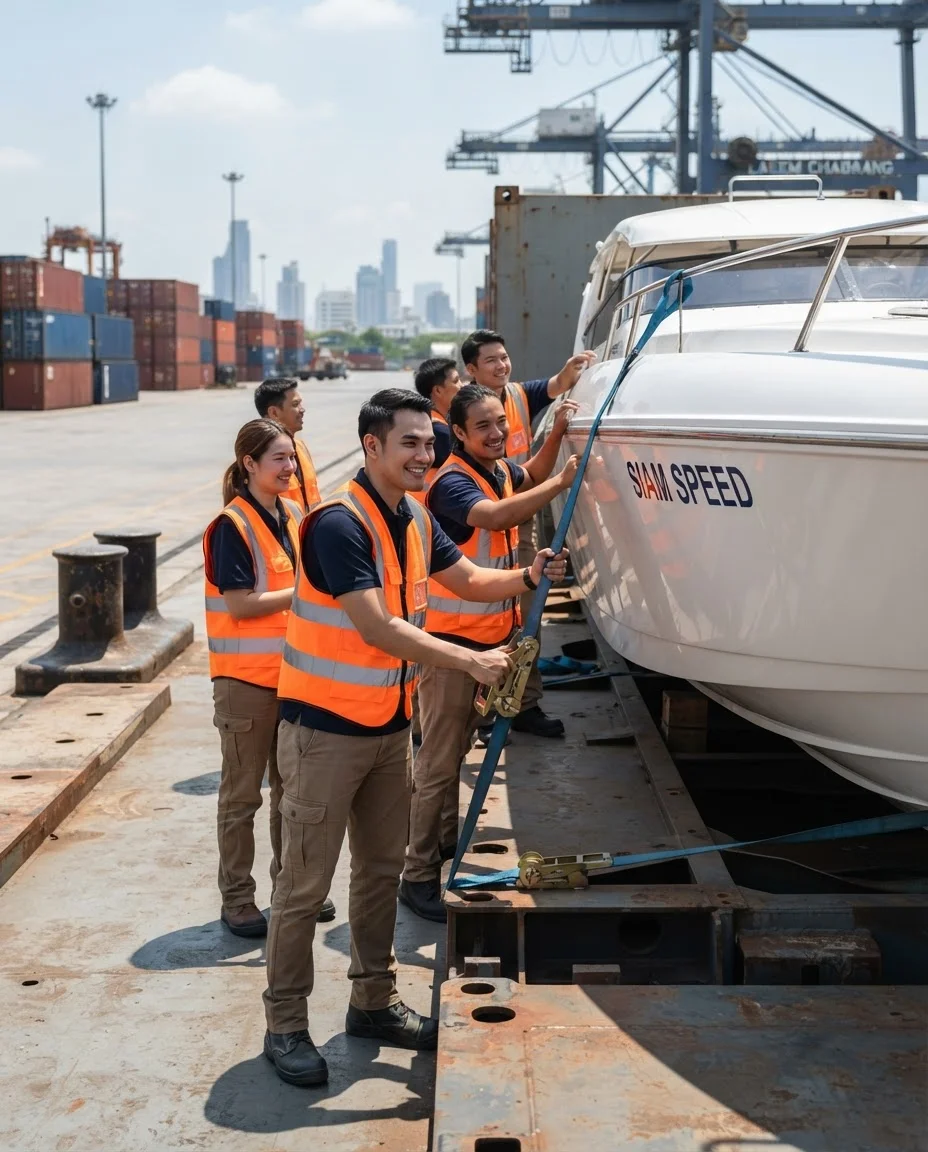
Prepare the vessel rigorously for commercial ocean carriage. Shipping lines operating out of Laem Chabang or Phuket enforce strict safety protocols under maritime dangerous goods regulations: fuel tanks must generally be drawn down to a minimal working reserve (typically below 10% to 15% of tank capacity), cooking gas cylinders disconnected and removed, and fresh water or grey water holding tanks fully emptied before crane arrival.
Appoint an independent, qualified marine surveyor in Thailand to inspect cradle fabrication and supervise lifting at the departure terminal. Custom steel or timber transport cradles must align precisely with internal structural bulkheads. Unpadded supports or incorrectly positioned lifting slings can distort composite hulls under the dynamic forces experienced during sea transit.
Engage an established UK marine customs broker to prepare import documentation well before the transport ship docks. Submitting electronic entries into the Customs Declaration Service (CDS) in advance—or obtaining an Advance Tariff Ruling from HMRC if commodity classification is ambiguous—prevents costly port storage charges and container demurrage while awaiting customs clearance.
Budget for immediate operational adaptations once the vessel arrives in British waters. Boats specified for tropical Southeast Asian conditions usually feature robust air conditioning and open ventilation, but rarely include diesel cabin heating, demisting equipment, or insulated domestic water lines required for damp British winters. Check and replace sacrificial anodes promptly: while zinc anodes are standard in warm, high-salinity Thai waters, aluminium or magnesium anodes are frequently required for the brackish estuaries, coastal harbours, and inland waterways of the United Kingdom.
Quick Reference Table
| Item | Detail | Notes |
|---|---|---|
| UK Import Taxation | 20% Import VAT; 0% customs duty under Tariff heading 8903 | Assessed on total CIF landed value (purchase price + ocean freight + marine insurance) |
| Thai Export VAT Status | Zero-rated under Section 80/1 of the Thai Revenue Code | Applies to new builds exported directly from Thailand under formal customs supervision |
| Product Conformity | UKCA or CE mark required under Recreational Craft Regulations 2017 | Uncertified vessels require a Post-Construction Assessment (PCA) via a UK Approved Body (£3,000–£7,000) |
| Primary Shipping Methods | Lift-on/Lift-off (Lo-Lo), Float-on/Float-off (Flo-Flo), and Flat-rack | Covers 6,600–7,500 nm via Suez Canal; Flo-Flo recommended for wide-beam catamarans |
| Typical Freight Costs | £9,000–£15,000 (Flat-rack); £18,000–£35,000 (Lo-Lo); £30,000–£50,000 (Flo-Flo) | Marine cargo transit insurance adds approximately 0.8% to 1.5% of declared hull value (£1,500–£4,000) |
| Key Departure Hubs | Laem Chabang & Ocean Marina Jomtien (Gulf); Phuket Deep Sea Port & Ao Po Grand Marina (Andaman) | Ao Po Grand Marina offers 24-hour deep-water access with outer pontoon depths up to 7 metres |
| Thai Flag Deletion | Certificate of Deregistration issued by Thai Marine Department | Mandatory document before the UK Registry of Shipping and Seamen will approve British flagging |
| UK Flag Registration | MCA Part 1 (£153 for 5 years) or Part 3 Small Ships Register (£35 for 5 years) | Part 1 proves title and requires a tonnage survey (£400–£800); Part 3 requires 185 days UK residency |
| Commercial Vessel Rules | Must meet MCA Workboat Code Edition 3 or Passenger Vessel Regulations | Commercial craft cannot enter service under Recreational Craft Regulations conformity declarations |
| Official source: Thai Marine Department | md.go.th | Vessel deregistration and local flag deletions |
| Official source: Thai Customs Department | customs.go.th | Export declarations and temporary importation bond discharge |
| Official source: Thai Revenue Department | rd.go.th | Section 80/1 zero-rated export VAT rules |
| Official source: UK Ship Register (MCA) | ukshipregister.co.uk | Part 1 and Part 3 (SSR) British vessel registration |
| Official source: YDSA | ydsa.co.uk | Authorised tonnage measurement surveys for Part 1 title registry |
| Marina contact: Ocean Marina Jomtien | oceanmarinajomtien.com | Gulf coast departure berth and staging facility |
FAQ: Importing a Boat from Thailand to the UK
What are the main requirements for importing a boat from Thailand to the UK?
How is import VAT calculated when bringing a boat from Thailand to the UK?
What is required if a boat imported from Thailand lacks UKCA or CE certification?
What document is essential for registering a second-hand Thai-registered boat under the British flag?
Should I declare a lower purchase price to reduce import VAT?
What are the risks of operating an uncertified boat in the UK?
Which shipping method is recommended for wide-beam catamarans and delicate yachts?
Why is it important to retain customs clearance documentation for an imported boat?
What is a common mistake when budgeting for import VAT on a boat from Thailand?
What operational adaptations might be needed for a boat imported from Thailand to the UK?
Reviewed by the Thailand Guide Editorial Team • Last reviewed: 7 November 2026
This page is provided for general information only. While we aim for accuracy, details can change — please verify anything important independently before relying on it.