Registering a Boat in Thailand
Navigating recreational boating in Thailand requires uncoupling four legal concepts that overseas skippers often conflate: personal title, flag-state registration, customs status, and local cruising permissions. Holding legal ownership of a yacht does not automatically entitle an owner to fly the Thai flag, nor does bringing a foreign-registered vessel into Thai waters grant an open-ended right to remain or carry paying passengers. Each element is governed by distinct statutory frameworks and administered by separate authorities, principally the Marine Department and the Customs Department.
A foreign national may legally buy and own a pleasure boat in Thailand. Yet registering that vessel under the Thai flag entails strict statutory criteria, distinct administrative categories, and specific tax liabilities. Conversely, keeping a vessel on a foreign registry—such as the United Kingdom's Part 1 register—demands strict adherence to temporary importation terms, immigration controls for skippers and crew, and timely departure or renewal formalities. Private recreational cruising also sits under entirely separate licensing and safety rules from commercial charter operations, which face strict domestic ownership quotas, crew qualifications, and commercial coding.
This guide provides an authoritative overview of boat registration, legal ownership structures, and maritime compliance across Thailand. Whether you plan to buy an existing Thai-registered cruiser, commission a new build in a local boatyard, or cruise into the kingdom aboard your own foreign-flagged yacht, understanding these distinctions protects your vessel from administrative penalties, unexpected tax demands, and maritime impoundment.

Thai Vessel Law and Foreign Ownership Realities
Foreign nationals can hold direct legal title to a private boat in Thailand, but owning a physical hull and holding eligibility to register it under the Thai flag remain distinct legal matters. Under Thai law, watercraft are treated as movable property governed by the Civil and Commercial Code. The statutory prohibitions that prevent foreign nationals from buying freehold land do not apply to pleasure boats. A foreign buyer can purchase a sailing yacht or motor cruiser, receive a formal bill of sale in their personal name, and hold lawful asset ownership. However, holding legal title does not grant an automatic entitlement to fly the Thai flag or conduct commercial operations in coastal waters.
Legal Title and the Marine Department Framework
The Marine Department oversees vessel registrations, safety certificates, and operating permissions throughout the country. International buyers keeping a private vessel long term in Thailand can register the craft under the Thai flag through the Sports and Recreation classification. This recreational registration permits private leisure cruising across Thai territorial waters, provided the applicant satisfies specific administrative criteria. The Marine Department requires an original passport, a formal bill of sale, and verified proof of local domicile, typically submitted as an immigration residence certificate or a registered long-term lease. When registering or transferring a vessel measuring 5 gross tonnage or larger, the Revenue Department requires both the buyer and seller to possess an individual Thai Tax Identification Number to process official stamp duty.
Plan a journey along Thailand’s Andaman coast, with practical guidance on island gateways, marine parks, diving, ferries and monsoon travel.
Commercial Restrictions and Section 7 Cabotage Rules
Commercial maritime transport and passenger trade face strict statutory protectionism. Section 7 of the Thai Vessels Act B.E. 2481 (1938) restricts commercial trading and passenger operations in domestic waters to Thai nationals and qualifying domestic corporate entities. For a private limited company to register a commercial vessel under the Thai flag, at least 70% of the registered share capital must belong to Thai citizens, at least half of the directors must hold Thai nationality, and the articles of association cannot permit bearer shares. General partnerships require 100% Thai partners. Registering a vessel in a personal foreign name under the Sports and Recreation category prohibits carrying paying passengers, running charter excursions, or charging fees for passage.
Purchasing a newly commissioned yacht from a domestic shipyard follows a parallel legal process. Under Section 13 of the Thai Vessels Act, the shipyard issues a formal Builder's Certificate alongside official construction inspection records. These engineering records allow the owner to register the completed vessel directly under a private Thai sports permit or clear customs formalities to export the vessel to an international registry. Navigating Thai maritime regulations, ownership structures, and Marine Department filings requires meticulous due diligence before completing a transaction.
Choosing whether to register a yacht directly in your personal name, form a domestic corporate structure, or maintain foreign registration depends on your cruising itinerary and commercial plans.
| Ownership Route | Legal Asset Ownership | Thai Flag Eligibility | Permitted Operating Scope |
|---|---|---|---|
| Foreign Individual (Direct) | 100% foreign legal title | Sports & Recreation category | Private recreational cruising; zero commercial charter |
| Thai Limited Company (70/30) | Corporate entity holds title | Full commercial Thai vessel registry | Commercial charter, dive operations, passenger transport |
| Foreign Registry in Thai Waters | 100% foreign legal title | None (Remains on foreign registry) | Private cruising under customs temporary import permit |
| Board of Investment (BOI) Firm | Up to 100% foreign equity | Special commercial dispensation | Approved maritime tourism schemes subject to statutory criteria |
Thai-Flagged Versus Foreign-Flagged Vessels
Operating a recreational craft under the Thai flag grants unrestricted domestic navigation throughout national waters, whereas retaining a foreign flag maintains international cruising flexibility under customs supervision. Hoisting the Thai flag eliminates customs guarantee bonds, temporary admission deadlines, and inter-port customs clearances between the Andaman Sea and the Gulf of Thailand. Permanent importation incurs tax exposure: registering an overseas vessel permanently in Thailand subjects the hull to 7% Value Added Tax on the assessed Cost, Insurance, and Freight (CIF) valuation, alongside Marine Department registration. While customs import duty on pleasure yachts is zero, the 7% VAT applies to all permanent imports.
Retaining an overseas registration—such as the UK Part 1 Registry, Jersey, or Langkawi—keeps the vessel under an internationally recognised administration while cruising Thai waters under customs temporary admission rules. British owners frequently choose this arrangement because it avoids upfront Thai import tax and simplifies cruising across Southeast Asia, including passages into Malaysia and Singapore. Foreign-flagged craft face rigorous administrative requirements: they must clear customs and immigration at every international crossing, report movements, and renew temporary import permits before statutory deadlines expire.
Cruising limits and commercial rights also differ fundamentally. A Thai-flagged yacht remains in national waters indefinitely, whereas a foreign-flagged craft receives an initial temporary admission period of six months, extendable in intervals up to 30 to 36 months before requiring customs re-export. Foreign-flagged recreational boats cannot engage in commercial trade, bareboat hire, or charter operations in Thai waters. The sole exception applies to foreign superyachts measuring at least 24 metres in length overall, which may obtain a specialised one-year charter licence under Ministry of Transport regulations.
A Thai flag suits owners planning to base a vessel permanently in domestic waters without routine cross-border cruising, avoiding customs renewals. Keeping a foreign registry remains ideal for yachts cruising internationally throughout Southeast Asia.
| Feature | Thai-Flagged Vessel | Foreign-Flagged Vessel (e.g. UK / Langkawi) |
|---|---|---|
| Primary Regulatory Authority | Marine Department | Flag State Administration and Thai Customs |
| Import Tax Liability | 7% VAT payable on CIF value upon import | Duty-free under Temporary Import Permit |
| Cruising Duration in Thailand | Indefinite (no customs exit requirements) | Initial 6 months, extendable up to 30–36 months |
| Commercial Charter Eligibility | Permitted via commercial licence and Thai company | Prohibited under 24m LOA; charter licence available for 24m+ |
| Annual Regulatory Filings | Annual Marine Department inspection and licence renewal | Customs extension filings and home-flag registry renewals |
Registration Procedures and Transferring Vessel Ownership
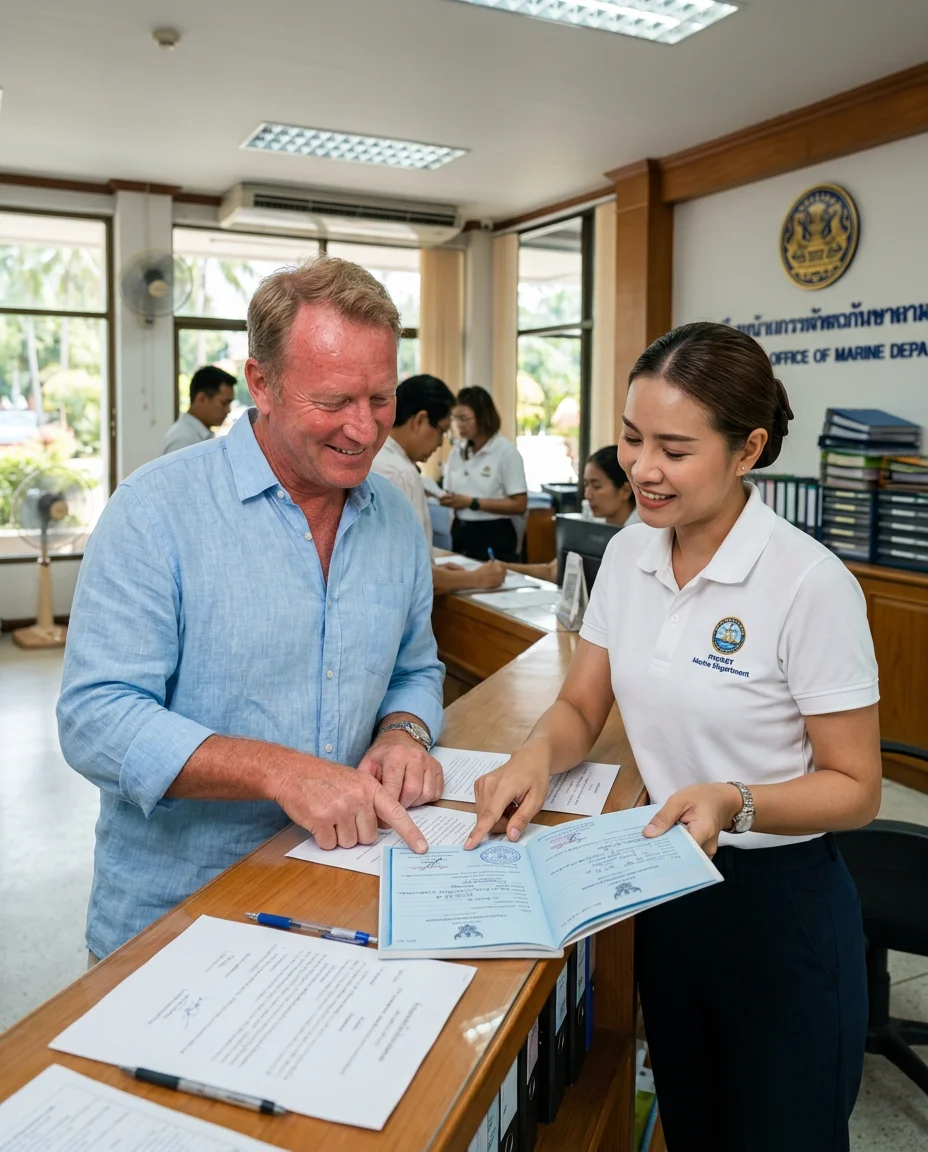
Registering a private vessel under the Thai flag requires submitting an application to the provincial Marine Department office overseeing your home port, such as Phuket, Chonburi, or Samut Prakan. Applicants must provide an original bill of sale, a builder's certificate for newly constructed hulls or a certificate of deletion from the previous flag state for imported craft, certified passport copies, an immigration certificate of residence, and a Thai tax identification number. For vessels measuring five gross register tonnage or more, both buyer and seller require a tax identification number, and the Revenue Department levies a mandatory stamp duty of 0.5% on the vessel's official purchase price. Department surveyors inspect the craft to verify hull measurements, engine serial numbers, structural condition, and statutory safety gear before calculating gross tonnage. Once approved, the Marine Department assigns a Thai registration number and issues the vessel registration certificate, commonly referred to as the blue book.
Acquiring a pre-owned Thai-registered boat involves a formal administrative transfer rather than an informal contract. Under Section 456 of the Thai Civil and Commercial Code, the sale of any vessel displacing five gross tons or more is legally void unless made in writing and registered with the competent official. Both buyer and seller must attend the Marine Department in person or appoint a representative through a formal power of attorney. The seller must provide the original blue book, proof of tax clearance, and verified evidence that the vessel is free from maritime liens, outstanding mortgages, or boatyard debt.
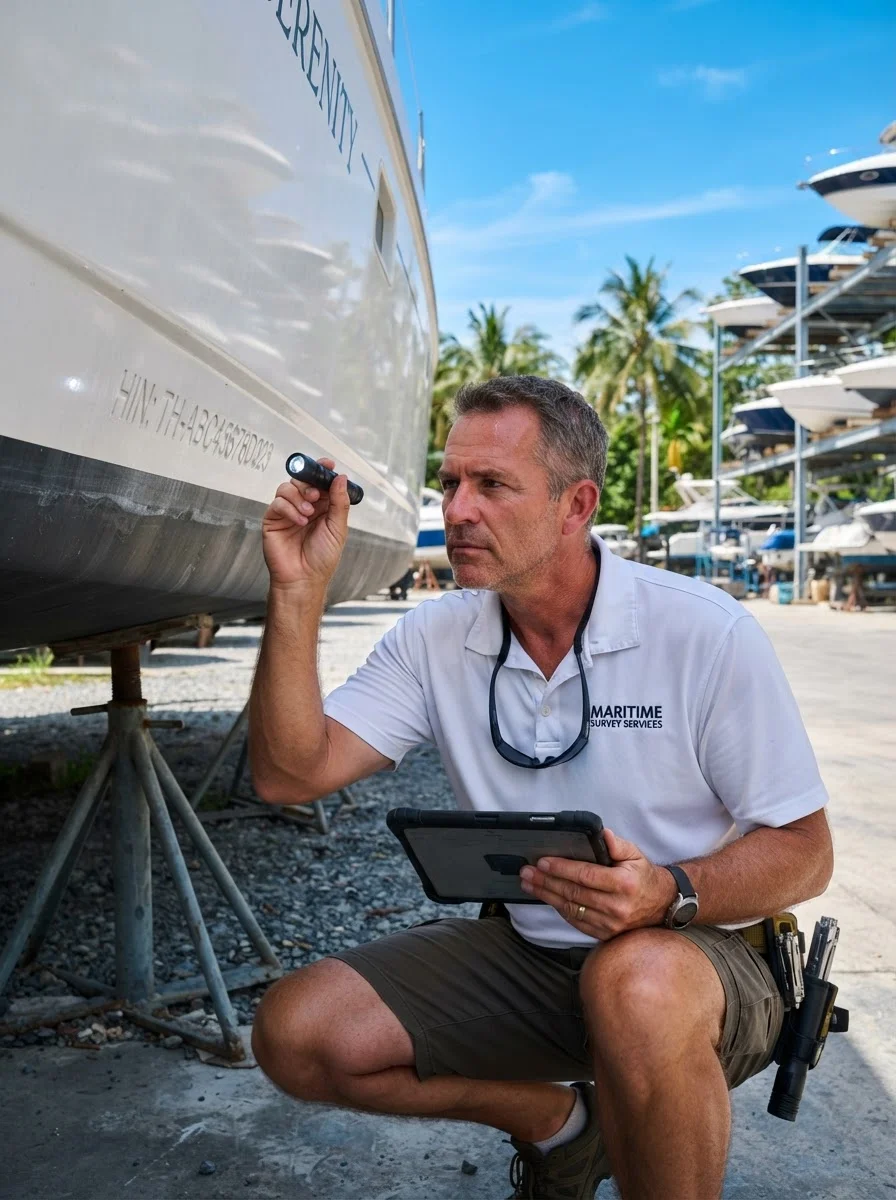
Before the registrar issues an updated vessel operating licence, a marine surveyor inspects the boat to verify functioning bilge pumps, firefighting equipment, navigation lights, and life-saving gear. These statutory checks establish baseline regulatory compliance; they do not assess engine wear, moisture ingress, or laminate osmosis. For this reason, commissioning an independent pre-purchase survey remains strongly advised, as detailed in our guide to marine surveys in Thailand. Buyers should hold final purchase funds until the Marine Department registrar has formally cancelled the seller's endorsement and entered the purchaser's name into the official registration book.
Temporary Importation and Foreign Yacht Cruising Regulations
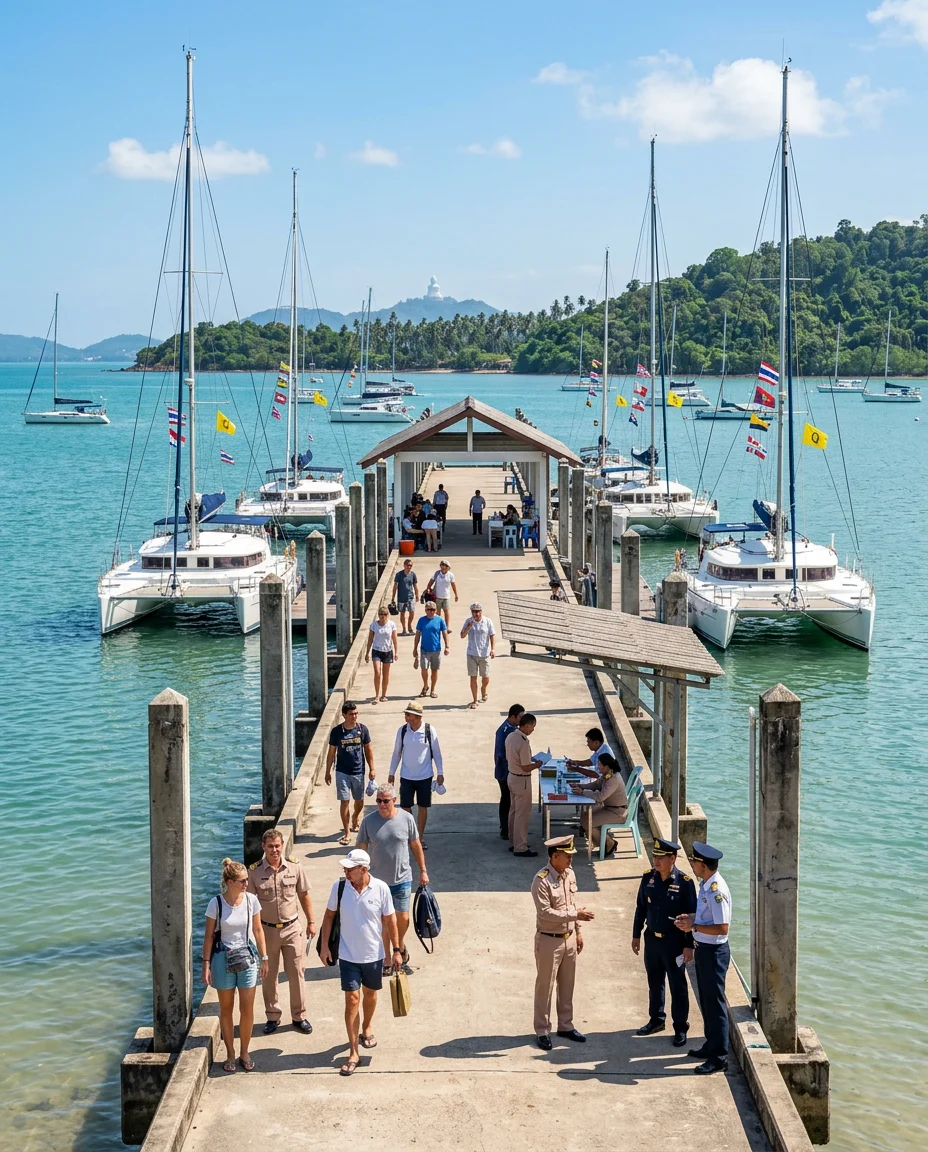
Entering Thai waters aboard a foreign-flagged pleasure craft requires proceeding directly to a designated port of entry before dropping anchor elsewhere or going ashore. Arriving vessels must fly the yellow quarantine flag (Q flag) and report to the authorities—Customs, Immigration, and the Marine Department—within 24 hours of arrival. Established clearance ports include Chalong Bay in Phuket, where a dedicated one-stop service centre operates at the pier, as well as Krabi, Pattaya, and Koh Samui. The skipper must present the vessel's original certificate of registry, port clearance from the last port of departure, passports for everyone on board, an itemised crew and passenger list, and ship radio or Automatic Identification System (AIS) details.
Thai Customs admits foreign pleasure yachts under temporary importation regulations, exempting visiting owners from standard import duty and value-added tax (VAT) during recreational cruising. Customs issues an initial temporary admission permit, typically valid for up to six months. Owners may renew this permission in person or through an authorised yacht agent in six-month increments, allowing a foreign vessel to remain in Thai waters for up to 30 months without undergoing permanent importation. Applications for each extension should be submitted at least two weeks before the current document expires.
A vessel's customs permit operates on a completely different timetable from the immigration status of the people on board. While the yacht may hold permission to remain for many months, crew and passengers receive standard tourist entry permissions based on their nationality. If a captain or crew member needs to leave Thailand by air while leaving the yacht berthed in a marina, the Immigration Bureau requires a refundable cash security bond of 20,000 THB (approx £445). This deposit ensures departure compliance and prevents arriving crew from overstaying without their vessel.
Failing to re-export the vessel or renew temporary admission before the permit deadline triggers statutory fines under Thai Customs regulations. The standard overstay penalty is 1,000 THB (approx £22) per day, capped at 10,000 THB (approx £220) where there is no fraudulent intent. Unauthorised overstays or operating in commercial charter without specific government licensing can lead to immediate vessel detention, backdated tax assessments, and seizure.
Commercial Charter Licences and Passenger Operations
Registering a pleasure craft in Thailand strictly prohibits accepting payment for passage, bareboat hire, or passenger transport. Operating commercially requires full compliance with the Thai Vessels Act, Board of Investment frameworks where applicable, and Department of Tourism licensing for tour operators. Thai maritime authorities—including the Marine Department and Royal Thai Navy—actively enforce commercial charter regulations. Operating an unlicensed charter vessel risks vessel detention, fines reaching 500,000 THB (approx £11,110), vessel blacklisting, and potential deportation or criminal prosecution for foreign skippers.
Domestic commercial operations require a Thai-flagged vessel registered to an eligible commercial entity. Under the Thai Vessels Act, commercial vessels operating in Thai territorial waters must be owned by a Thai-majority entity with at least 51% Thai shareholding. These craft must carry certified Thai commercial skippers and qualified engineers, maintain commercial passenger liability insurance, and pass regular Marine Department safety surveys scaled to commercial passenger thresholds.
Foreign-flagged superyachts have access to a dedicated charter route. Under Ministry of Transport regulations (B.E. 2568), foreign-flagged pleasure yachts measuring at least 24 metres Length Overall (LOA) and carrying no more than 12 passengers can secure a one-year Superyacht Charter Licence. This permit allows the vessel to charter commercially in Thai territorial waters without paying the standard 7% import VAT on the vessel's hull value. Instead, the owner must apply through an authorised local agent, appoint a Thai fiscal representative, and remit 7% VAT alongside a 5% corporate income tax levy on gross charter revenue generated in Thailand.
Vessels measuring under 24 metres LOA cannot access the foreign-flag charter framework. To charter legally, smaller craft must be permanently imported, customs-cleared, and registered under a Thai-majority commercial company. Do not advertise charter availability, paid cabin trips, or bareboat hire on social media or public booking platforms without holding a valid commercial operating licence, as Thai enforcement teams actively monitor online listings.
Where to Berth and Keep a Vessel in Thailand
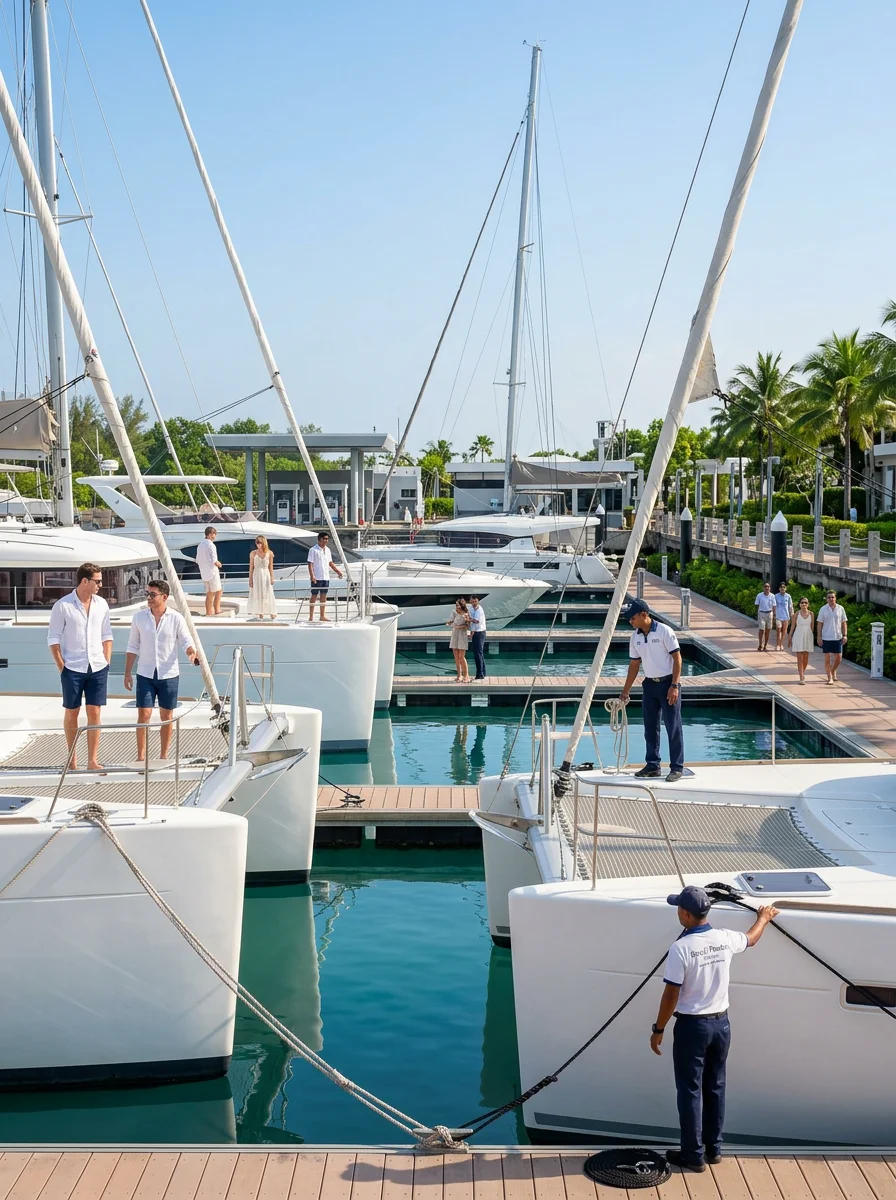
Choosing where to keep a boat in Thailand depends on draft, tidal range, and proximity to marine engineering services. Phuket and the Andaman coast represent the country's most developed yachting hub, supported by sheltered anchorages across Phang Nga Bay, commercial haul-out yards, and established supply chains. Across the peninsula, the Gulf of Thailand provides reliable sailing grounds within easy reach of Bangkok.
In Phuket, deep-draft vessels and multihulls favour Phuket Yacht Haven in the north and Ao Po Grand Marina on the eastern coast. Both facilities provide deep-water pontoon berths accessible across all tidal states without shallow bar restrictions. By contrast, Phuket Boat Lagoon and neighbouring Royal Phuket Marina sit inland along dredged tidal channels that require arrivals around mid-to-high water, though both maintain extensive hardstands, engineering workshops, and yacht brokerage offices. Across Phang Nga Bay, Krabi offers a quieter base at Port Takola, which provides river-sheltered berths and haul-out facilities, with border clearance formalities completed across the river in Krabi Town.
On the eastern seaboard of the Gulf, Ocean Marina Jomtien near Pattaya operates as the region's primary recreational marine facility, with more than 450 floating berths, heavy travel-lift infrastructure, and an on-site government port of entry for customs and immigration. Cruising east toward the Koh Chang archipelago reveals protected natural anchorages, though formal marina slips remain limited to small private facilities. On the western Gulf coast south of Hua Hin, Racer Marina in Pran Buri accommodates moderate-draft vessels along a sheltered river bend with 80 floating berths and haul-out capabilities. For complete regional breakdowns of facilities and fees, consult our dedicated guides to marinas in Phuket and berthing in Pattaya.
International skippers bringing a foreign-flagged vessel into Thailand must confirm local clearance protocols before proceeding to their home berth. While Ocean Marina Jomtien accommodates clearance on site, foreign yachts arriving in Phuket waters must anchor in Chalong Bay and report to the One Stop Service Centre at Chalong Pier to clear customs, immigration, and port authorities.
Costs and Budgeting
Owning or keeping a recreational vessel in Thailand involves fixed administrative fees, transaction taxes, and recurring berthing commitments. Direct statutory charges for Thai-flagged craft remain low. Under the Marine Department schedule, ownership transfers and initial registrations for private pleasure craft incur statutory fees between 500 THB and 2,000 THB (£11 to £45), scaled by gross tonnage. Purchasing an existing Thai-registered vessel triggers a mandatory Revenue Department stamp duty of 0.5 per cent on the purchase price stated in the official bill of sale. For a yacht purchased at 5,000,000 THB (£111,110), this stamp duty amounts to 25,000 THB (£555), payable at the local revenue office before title endorsements are entered into the vessel registration book.
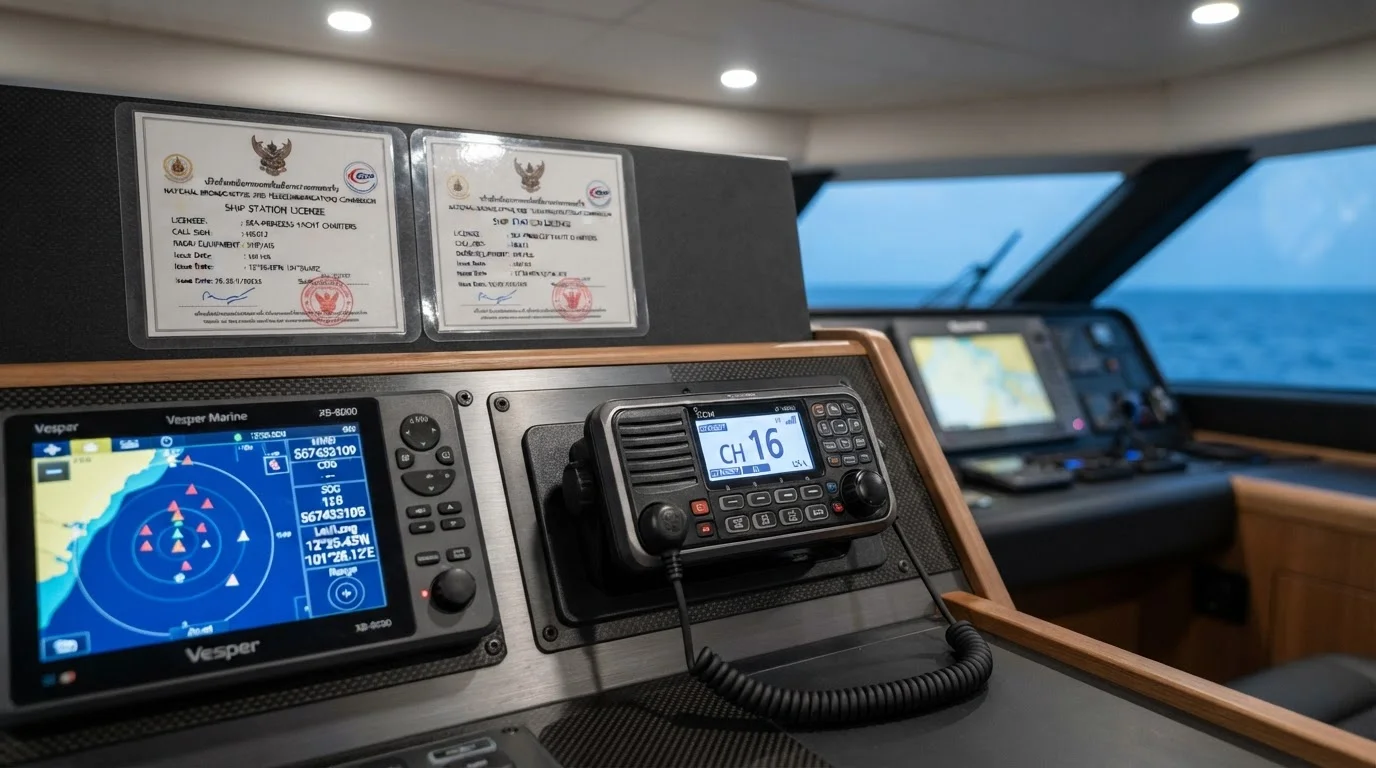
Annual operating permissions also carry statutory costs. The Marine Department issues vessel use permits following an annual safety inspection, with renewal charges ranging from 300 THB to 1,500 THB (£7 to £33). Craft fitted with marine VHF radios, AIS units, or radar require a five-year ship station licence from the National Broadcasting and Telecommunications Commission (NBTC), costing between 5,000 THB and 8,000 THB (£111 to £178) for frequency allocation and station authorisation. Foreign-flagged yachts visiting Thai waters incur administrative customs and harbour clearance fees of 100 THB to 500 THB (£2 to £11) on arrival, with official overtime surcharges applying outside standard office hours. If visiting crew members depart Thailand by air leaving the vessel behind, immigration authorities collect a refundable security deposit of 20,000 THB (£445) per crew member.
| Option | Cost (THB) | Cost (GBP approx) | Notes |
|---|---|---|---|
| Marine Department Registration Transfer | 500 – 2,000 THB | £11 – £45 | Statutory fee per transaction; varies by tonnage |
| Revenue Department Stamp Duty | 0.5% of bill of sale | 0.5% of bill of sale | Mandatory for official transfer of title |
| Annual Vessel Permit Renewal | 300 – 1,500 THB | £7 – £33 | Payable upon passing annual safety survey |
| NBTC VHF/AIS Radio Licence (5 Years) | 5,000 – 8,000 THB | £111 – £178 | Covers frequency allocation and ship station permit |
| Foreign Yacht Customs Entry Clearance | 100 – 500 THB | £2 – £11 | Administrative port entry fee per clearance |
| Immigration Crew Guarantee Deposit | 20,000 THB | £445 | Refundable deposit if crew leaves Thailand by air |
| Annual Marina Berth (40-ft Monohull) | 250,000 – 450,000 THB | £5,555 – £10,000 | Varies by location; higher rates apply in Phuket |
| Third-Party Liability Marine Insurance | 15,000 – 40,000 THB | £333 – £889 | Minimum required for marina slip agreements |
Berthing and insurance represent the primary recurring operational expenses. Annual wet-berth contracts for a 40-foot monohull range from 250,000 THB to 450,000 THB (£5,555 to £10,000). Harbours in Phuket occupy the higher end of this range, whereas facilities in the Gulf of Thailand, including Pattaya and Pran Buri, generally cost 20 to 40 per cent less. Multihulls face standard beam surcharges of 20 to 50 per cent over monohull tariffs. Pontoon electricity and water are metered and billed separately. Commercial marinas also require proof of third-party liability marine insurance before allocating a berth, with basic annual coverage typically running between 15,000 THB and 40,000 THB (£333 to £889).
What to Know Before You Go
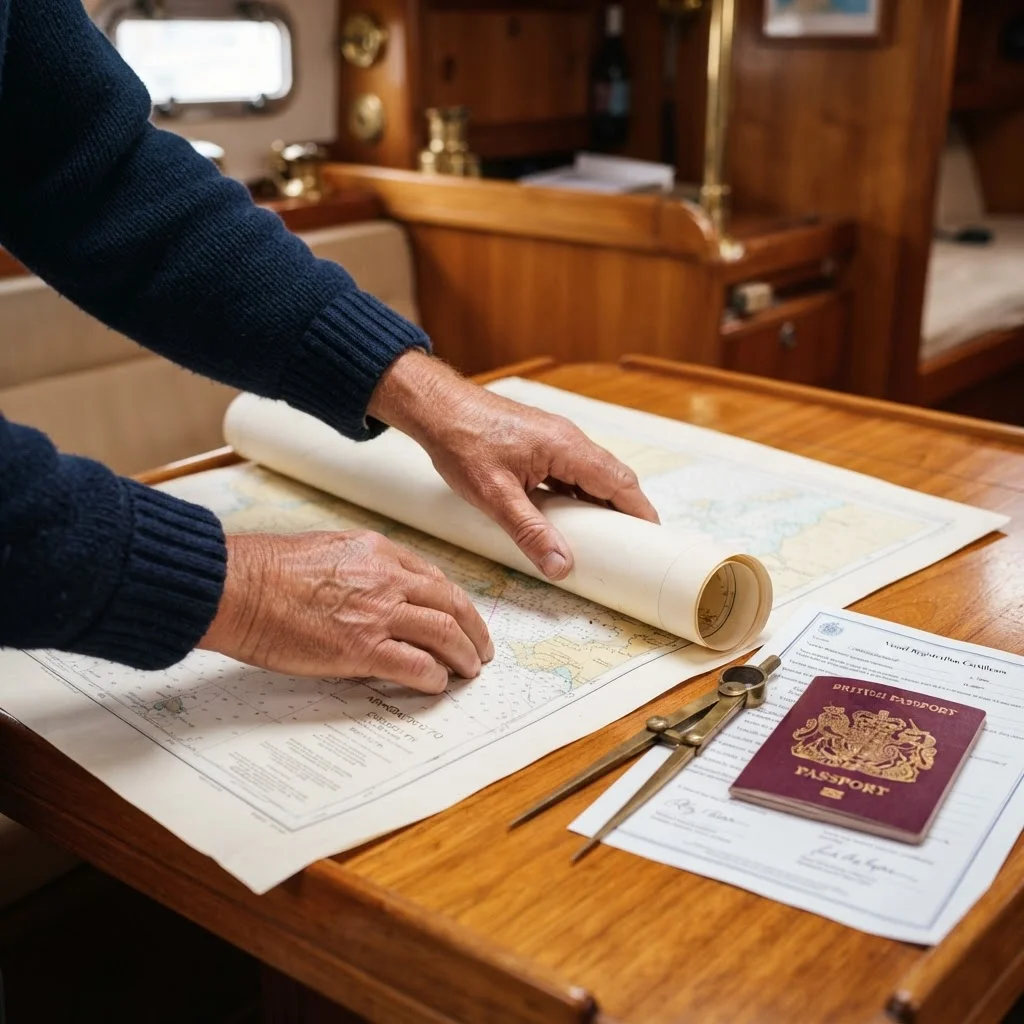
Establish your legal domicile in Thailand well before lodging any domestic ownership transfer with the Marine Department. As a foreign national buying a Thai-registered boat in your own name, you must provide formal proof of your local address. The Marine Department requires an official Certificate of Residence issued by the Thai Immigration Bureau (or your embassy), and officials inspect your visa status closely. Ensure your entry permit has at least two weeks of remaining validity when submitting paperwork, as applications tied to expiring visas are routinely turned away.
For British nationals keeping a foreign-registered vessel in Thai waters, flag-state paperwork requires careful attention. Do not rely on the UK Small Ships Register (Part 3) if you live in Thailand permanently. The Maritime and Coastguard Agency (MCA) restricts Part 3 eligibility to individuals ordinarily resident in the UK for at least 185 days in a 12-month period. Expatriates cruising long term on an invalid Part 3 certificate risk having claims repudiated or facing registry disputes during official checks. Qualify instead under UK Ship Register Part 1, which confers full British title without UK physical residency constraints.
Marina access demands proactive insurance planning. Facilities across Phuket, the Gulf of Thailand, and Pattaya require proof of third-party liability insurance before granting pontoon berths or yard access. Most operators stipulate minimum liability limits—frequently 100,000 USD (approx 3,500,000 THB / £78,000)—and dockmasters can refuse berthing or fuel dock services without an active certificate.
If entering under a foreign flag, keep your Customs temporary importation permit securely with your ship papers and monitor renewal deadlines. Letting temporary admission lapse without an approved extension strips your duty-free status, exposing the yacht to immediate customs fines, backdated import taxes, and potential impoundment under the Thai Customs Act.
Practical Tips for Vessel Owners
Navigating Thai maritime bureaucracy requires strict adherence to local paperwork conventions, as administrative oversights can delay registrations, complicate sales, or lead to customs penalties.
Secure a personal Thai Tax Identification Number and an immigration Certificate of Residence before finalising a vessel purchase. When buying or transferring a Thai-registered boat measuring 5 Gross Registered Tonnage or more, the Revenue Department assesses stamp duty at 0.5% of the declared contract value. Both the buyer and the seller must hold an active tax number to process this filing. For foreign nationals registering ownership in their own name, the Marine Department also requires a certified Certificate of Residence from Thai Immigration confirming a local residential address, typically requiring at least several weeks of validity remaining on the applicant's visa.
Ensure that the sale and purchase contract contains an explicit indemnity against outstanding maritime liens and unpaid boatyard fees. Under the Thai Civil and Commercial Code, shipyards, dry docks, and marinas possess a statutory right of retention over craft in their custody for unpaid repairs or storage. If a previous owner left bills unsettled, a yard can refuse to launch or release the boat until the debt is cleared. A thorough pre-purchase audit of past maintenance invoices and written clearance from the host marina provide vital protection against inherited liabilities.
Check that onboard marine radios and transponders meet local licensing rules. Marine VHF sets, radar units, and Automatic Identification System transponders fall under the authority of the National Broadcasting and Telecommunications Commission. Equipment imported into or operated within Thailand requires an official equipment type-approval sticker. Operating these devices without an active ship station licence and individual equipment permits exposes skippers to regulatory fines during equipment surveys or marine police inspections.
Retain physical, stamped port clearance documents from your last foreign port of call when cruising into Thai waters. Marine authorities and customs officers at designated arrival ports, including Chalong in southern Phuket and Port Takola in Krabi, demand original paper clearance-out certificates. Digital clearances or email confirmations on a smartphone are routinely turned away, leaving the master unable to complete inbound immigration and customs clearance.
Track temporary importation deadlines rigorously if operating a foreign-flagged vessel. Yachts entering Thailand under temporary customs admission receive a permit that must be renewed before its expiry date. Allowing a permit to lapse without an official extension or customs checkout converts the boat into an unnotified import under the Customs Act, which incurs daily overstay fines and risks liability for backdated import duties and taxes.
Keep certified copies of your vessel registration certificate, annual operating licence, radio permits, and the skipper's qualification inside the navigation station. Marine police and harbour master officials conduct random checks at anchorages across Phuket and the Gulf of Thailand, and presenting organised documentation prevents on-water disputes.
Employing an experienced maritime documentation agent remains a sensible precaution against administrative snags. Dealing with bilingual statutory forms and Marine Department filings involves specialised terminology, and an established local agent handles the procedural details efficiently.
Quick Reference Table
| Item | Detail | Notes |
|---|---|---|
| Foreign Ownership Status | 100% legal title permitted | Registered under Sports and Recreation category; private leisure cruising only |
| Marine Department Transfer Fee | 500 – 2,000 THB (£11 – £45) | Statutory administrative charge scaled by gross register tonnage |
| Revenue Department Stamp Duty | 0.5% of official bill of sale | Mandatory for vessels displacing 5 gross tons or more; requires Thai Tax ID |
| Annual Vessel Permit Renewal | 300 – 1,500 THB (£7 – £33) | Issued following successful statutory Marine Department safety inspection |
| NBTC Marine Radio Licence | 5,000 – 8,000 THB (£111 – £178) | Five-year authorisation covering VHF sets, AIS units, and radar transponders |
| Temporary Importation Window | 6 months initial; extendable up to 30–36 months | Available to foreign-flagged yachts; submit renewal requests two weeks prior to expiry |
| Immigration Crew Guarantee Bond | 20,000 THB (£445) per crew member | Refundable cash deposit required if crew departs Thailand by air leaving vessel behind |
| Customs Overstay Fine | 1,000 THB (£22) per day | Capped at 10,000 THB (£220) where no fraudulent intent exists |
| Annual Wet Berth (40-ft Monohull) | 250,000 – 450,000 THB (£5,555 – £10,000) | Rates higher in Phuket than Gulf marinas; multihulls incur 20–50% beam surcharges |
| Third-Party Liability Marine Insurance | 15,000 – 40,000 THB (£333 – £889) annually | Required by commercial marinas, typically mandating 100,000 USD minimum cover |
| Designated Ports of Entry | Chalong Bay (Phuket), Krabi, Pattaya, Koh Samui | Must fly Q flag and report within 24 hours with original paper port clearances |
| Official source | Marine Department: md.go.th | Statutory vessel registration, tonnage measurement, and annual safety surveys |
| Official source | Thai Customs Department: customs.go.th | Temporary admission rules, customs extensions, and import duty regulations |
| Website | Ao Po Grand Marina: aopograndmarina.com | Deep-water marina berths on the east coast of Phuket |
| Website | Port Takola: porttakola.com | River-sheltered marina berths and boatyard facilities in Krabi |
| Website | Ocean Marina Jomtien: oceanmarinajomtien.com | Gulf coast marina with on-site customs and immigration clearance near Pattaya |
| Website | Racer Marina: racermarinahuahin.com | Sheltered pontoon berthing and haul-out in Pran Buri, south of Hua Hin |
FAQ: Registering a Boat in Thailand
Does owning a boat in Thailand automatically allow me to fly the Thai flag or carry passengers?
Can a foreign national legally own a boat in Thailand?
What documents are needed for a foreign national to register a private boat under the Thai flag?
Can a foreign national use a privately registered Thai boat for commercial charter operations?
What taxes apply when permanently importing a boat to Thailand for Thai flag registration?
How long can a foreign-flagged boat stay in Thai waters under temporary admission?
What is the stamp duty for transferring ownership of a Thai-registered boat?
What are the initial steps for a foreign-flagged boat arriving in Thai waters?
Is a deposit required if a foreign crew member leaves Thailand by air while their yacht remains in the country?
Can foreign-flagged superyachts charter commercially in Thailand?
Reviewed by the Thailand Guide Editorial Team • Last reviewed: 7 November 2026
This page is provided for general information only. While we aim for accuracy, details can change — please verify anything important independently before relying on it.