Cycling in Prachuap Khiri Khan



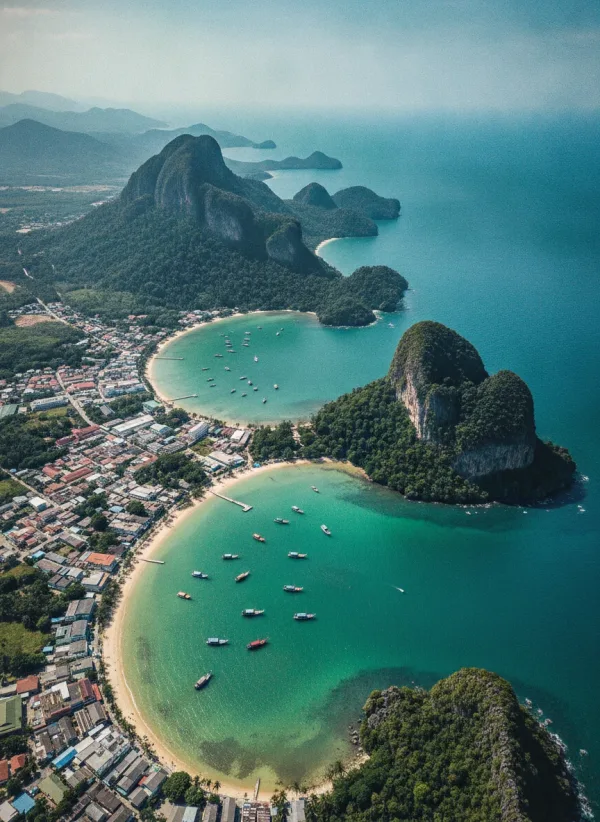
Prachuap Khiri Khan forms Thailand's narrowest coastal corridor, stretching more than 200 kilometres along the western Gulf of Thailand. With quiet secondary roads, designated rural scenic routes, and purpose-built beachfront cycle tracks, the province provides an extensive network for flat-to-rolling cycle touring. Routes range from the smooth, red-surfaced beachfront cycleway at Pak Nam Pran to paved rural circuits through the limestone wetlands of Khao Sam Roi Yot and the calm, secure airbase roads around Ao Manao.
The cycling territory links Hua Hin and Pranburi in the north to fishing communities such as Thap Sakae and Bang Saphan in the south. Established local outfits including Hua Hin Bike Tours run guided trips and bicycle rentals, alongside independent touring infrastructure supported by local municipal cycleways. Independent bikepackers, weekend road cyclists travelling from Bangkok, and leisure riders value the province for its paved secondary routes that bypass the heavy commercial traffic of Highway 4. The combination of level terrain, clear coastal signposting, and dramatic karst scenery makes Prachuap Khiri Khan well suited to both endurance touring and easy day rides.

Coastal Corridors: Pak Nam Pran to Khao Kalok and Sam Roi Yot
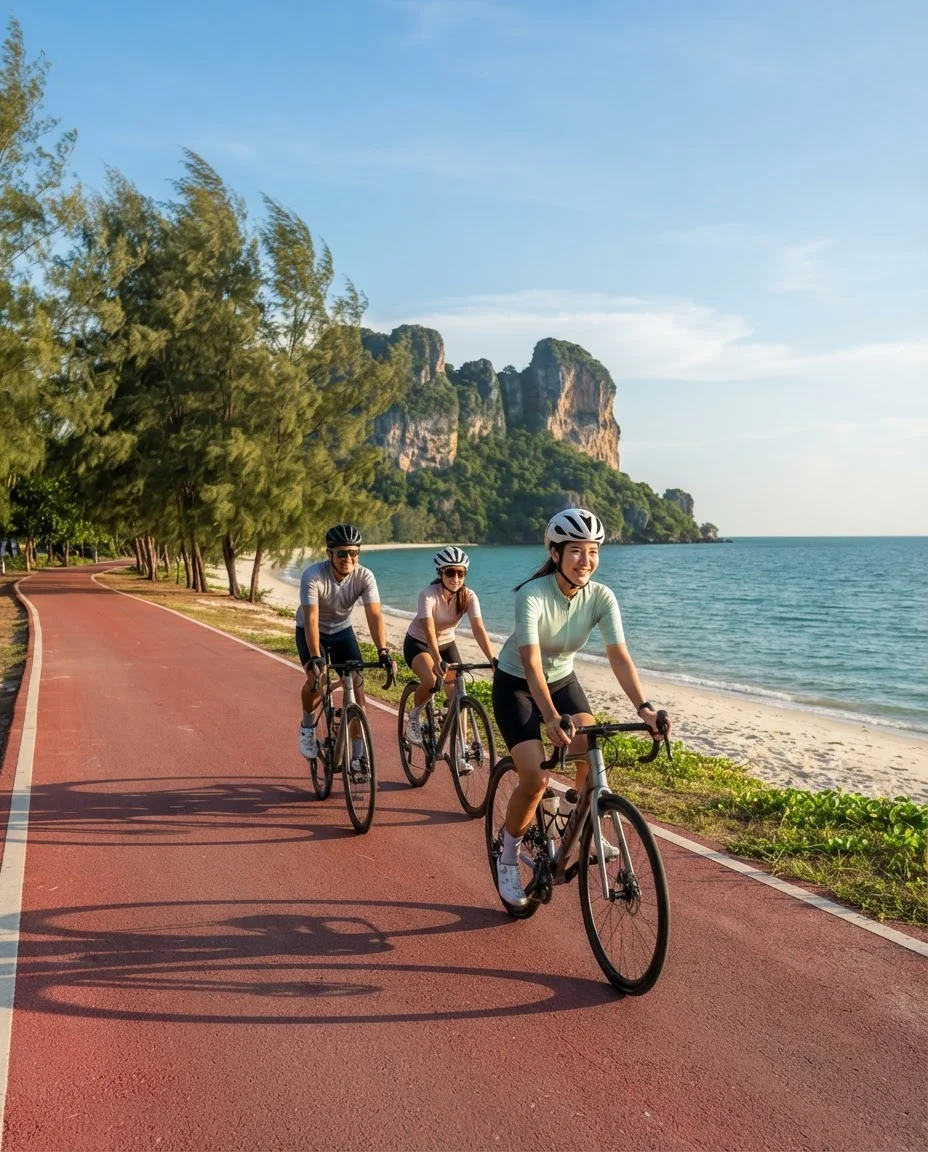
The coastal belt extending south from Pran Buri toward Khao Sam Roi Yot contains some of the flattest, most accessible cycling in Prachuap Khiri Khan province. Separated beachside cycle paths, wide rural road shoulders, and low vehicle traffic create reliable conditions for relaxed day rides and structured road training alike.
Pak Nam Pran Beach Track
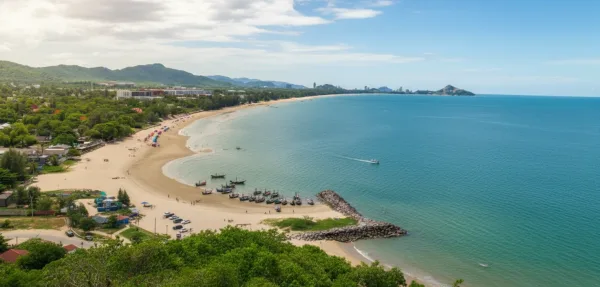
The signature seaside spin centres on Pak Nam Pran, situated roughly thirty kilometres south of Hua Hin. Riders reaching the coast follow the waterfront corridor south toward the prominent limestone headland of Khao Kalok. The route starts conveniently near Pran Buri Forest Park at the mouth of the Pran Buri River. Along the Pak Nam Pran promenade, a designated red-surfaced cycling path runs directly beside the Gulf of Thailand for approximately 12 kilometres. This corridor remains separate from motor traffic across long sections, giving riders an uninterrupted run past working fishing docks, open-air cafes, rows of drying squid on wire frames, and low-rise resorts. Motor vehicle traffic stays light during weekdays, though domestic visitors increase car volume on Saturday and Sunday afternoons. The asphalt surface is smooth and predictable, with virtually no gradient; total elevation change across the coastal run stays well under 35 metres. The primary variable is coastal wind. Stiff afternoon breezes off the Gulf frequently create strong headwinds on northward return legs, making early morning departures the sensible choice for easy pedalling in cooler air. Paved rural roads continue south past Khao Kalok, providing a direct link onward toward the national park.
Khao Sam Roi Yot National Park Circuit
Directly south of Pran Buri, the landscape shifts into dramatic karst scenery around Khao Sam Roi Yot National Park. Road cyclists can follow Rural Road 1020 (also marked as PK.4020) to complete a 45-to-65-kilometre loop skirting the perimeter of the national park reserve. While the park features vertical limestone cliffs rising hundreds of metres above the coastal plain, the rural roads encircling them remain remarkably level, seldom accumulating more than 60 metres of climbing over an entire circuit. This flat profile, combined with good-quality tarmac and broad shoulders, allows road cyclists to maintain a steady endurance rhythm without constant gear shifting. On the western flank, the circuit passes close to the Bueng Bua freshwater marsh, an internationally recognised Ramsar wetland where lotus ponds sit beneath sheer rock faces. On the coastal side, the route weaves past working prawn farms and through Bang Pu village, which provides a convenient rest point. Bicycles can be secured near the beach staging area where visitors set off on foot or board longtail boats toward Tham Phraya Nakhon. Traffic on the rural road network remains low, restricted primarily to agricultural pick-ups and scooters. Resupply is straightforward, as small family grocery shops and fresh fruit stalls appear every few kilometres along the tarmac.
Provincial Capital Waterfront: Ao Noi, Ao Prachuap, and Wing 5
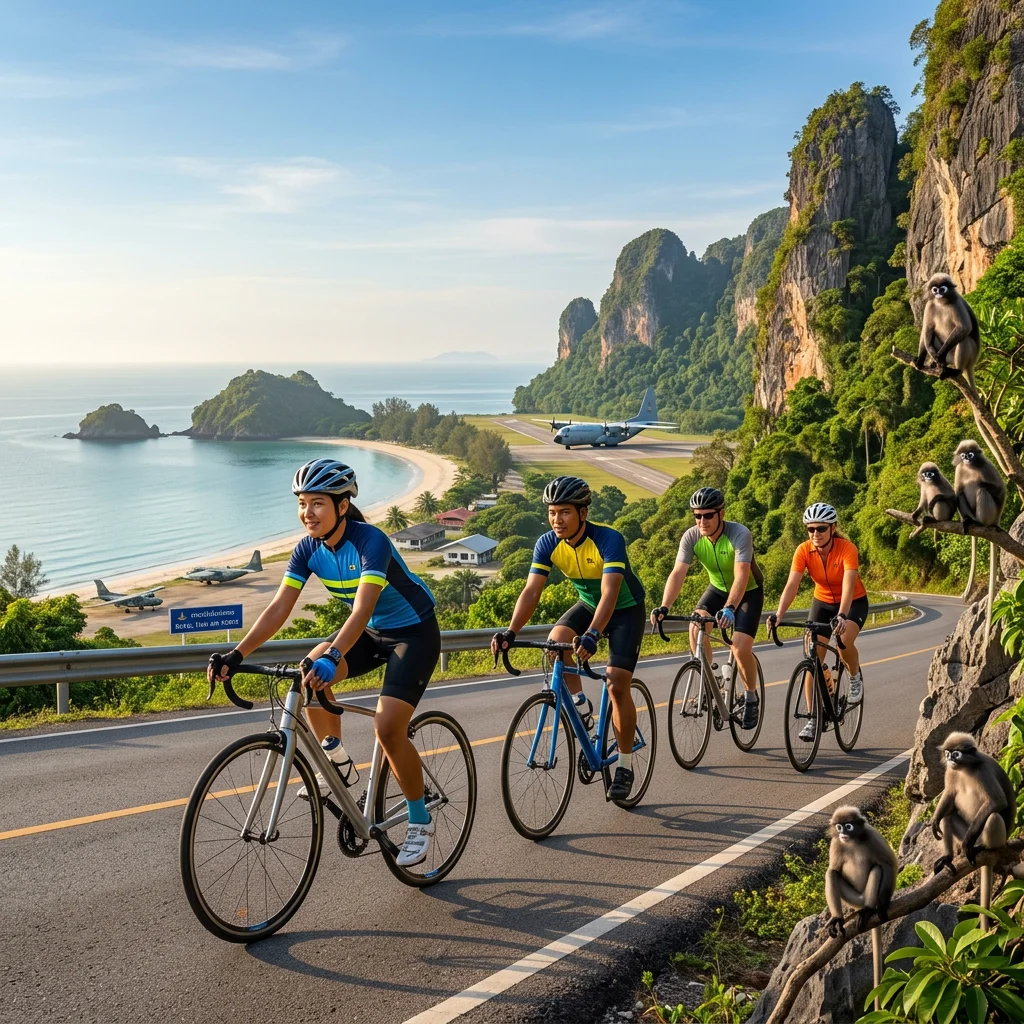
This coastal route links three adjacent bays across Prachuap Khiri Khan town, an arrangement that gives the provincial capital its traditional moniker, Mueang Sam Ao (City of Three Bays). Unlike the long, open touring corridors across the wider province, cycling through the municipal waterfront is compact, completely flat, and straightforward to navigate.
The ride starts at the working fishing harbour of Ao Noi, roughly eight kilometres north of the town centre. Here, fishing trawlers moor beside a quiet pier beneath limestone bluffs, with the route passing the ornate teak shrine of Wat Ao Noi. Heading south on quiet asphalt lanes, riders join the broad coastal promenade along Ao Prachuap, pedalling past the town pier and the prominent karst outcrop of Khao Chong Krachok with views across offshore islands.
At the southern end of Ao Prachuap promenade, the route enters Royal Thai Air Force Wing 5. Access is open to the public during daylight hours, though foreign cyclists must stop at the guard post to present a physical passport and sign the visitor ledger. Once past the barrier, riders follow well-paved, tree-shaded roads that skirt the active airfield and wrap around the base of Khao Lom Muak. A protected colony of gentle dusky leaf monkeys resides in the trees at the foot of the peak. The road continues directly to Ao Manao, a pine-fringed crescent beach with calm waters and open-air food stalls.
Covering roughly 20 to 25 kilometres for a complete return ride, this flat, paved route suits casual cycling on basic single-speed city bikes, which seafront guesthouses and local shops hire out for around 50 THB per day.
Plan your visit to Pala-U Waterfall in Kaeng Krachan National Park near Hua Hin. Find entry fees, trail details, transport options, and wildlife tips.
Southern Touring and Challenging Corridors: Thap Sakae to Bang Saphan
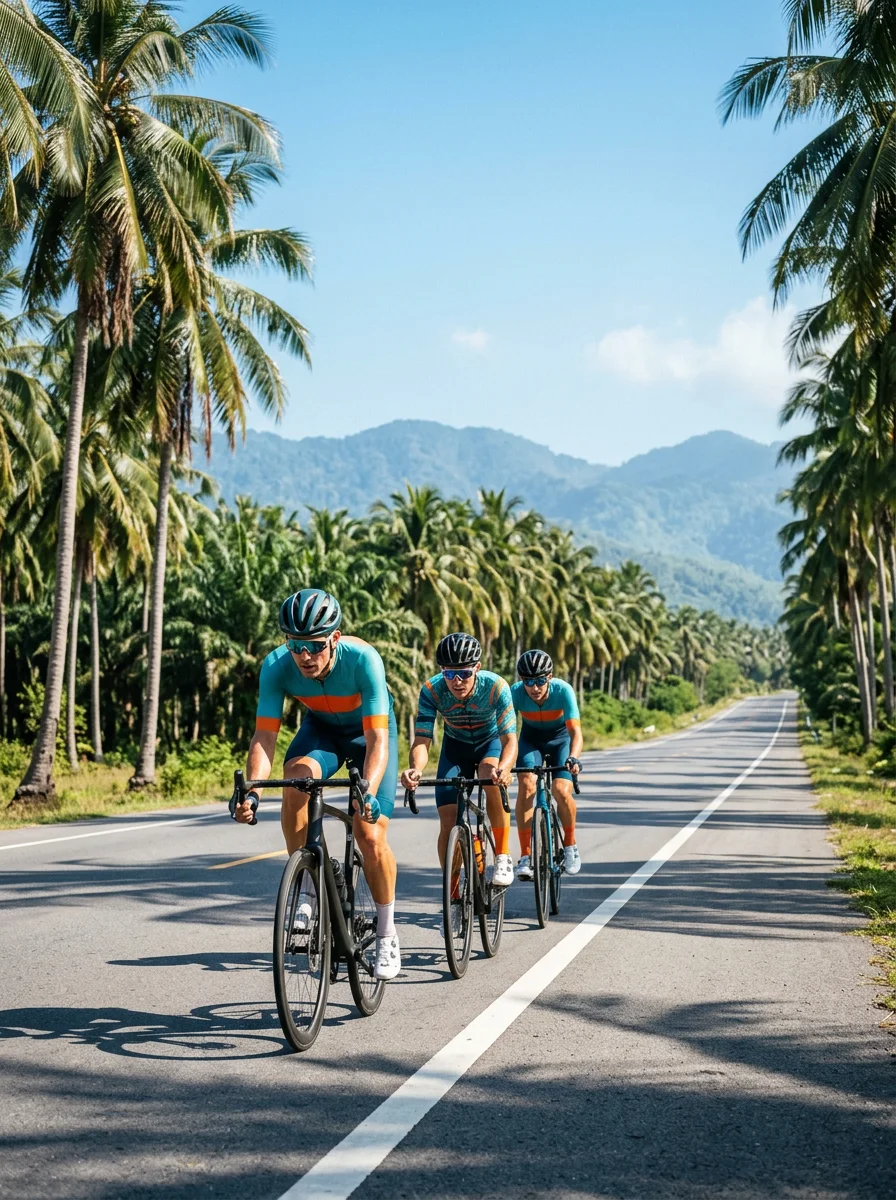
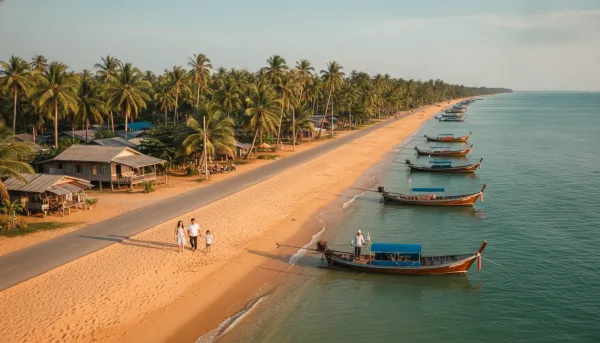
The southern districts of Prachuap Khiri Khan provide long-distance touring terrain across flat to undulating coastal plains. Between Thap Sakae, Ban Krut, Bang Saphan, and Bang Saphan Noi, touring cyclists can pedal secondary corridors such as Rural Road 1029 and connecting minor roads that form part of the Department of Rural Roads' Royal Coast Scenic Route initiative. Using these coastal lanes allows cyclists to avoid the intense commercial traffic and heavy goods vehicles on Highway 4 (Phetkasem Road). Touring stages through this southern stretch typically cover 80 to 110 kilometres per day, winding between agricultural hamlets, coconut plantations, and quiet Gulf beaches.
Pavement conditions alternate between smooth asphalt and older jointed rural concrete. Occasional loose grit and expansion cracks mean that road bikes set up with 28 mm tyres or gravel configurations with wider rubber handle the terrain far better than narrow racing tyres. The coastal topography is mostly gentle, but riders encounter short, punchy gradients between 3% and 6% where headlands meet the sea, particularly around Khao Thong Chai near Ban Krut, Bo Thong Lang Bay, and Mae Ramphueng Beach. Bo Thong Lang features a circular sheltered cove where exposed sandbars appear at low tide, providing an easy rest stop before tackling the rolling hills towards Bang Saphan Noi and the red sandstone cliffs near the Koh Talu coastline.
Cyclists seeking substantial climbing can divert west from the coastal corridor into the foothills of the Tenasserim (Tanao Si) range towards the Myanmar border. These inland spurs traverse pineapple fields and rubber plantations before rising onto demanding mountain roads with continuous ascents that exceed 400 metres of elevation gain. South of Thap Sakae, the coastal settlements remain peaceful and unhurried. Ban Krut and Bang Saphan function as practical overnight touring bases, offering independent guesthouses, beachfront bungalows, and fresh seafood stalls at evening night markets.
Takeaway: This southern corridor provides multi-day touring cyclists with high-mileage riding on quiet secondary roads while bypassing arterial highway traffic.
| Route Name | Distance | Elevation Gain | Road Surface | Traffic Level | Rider Suitability |
|---|---|---|---|---|---|
| Pak Nam Pran to Khao Kalok | 12–15 km | Under 35 m | Red cycle lane & smooth asphalt | Very low (separated path) | Novice & families |
| Sam Roi Yot Perimeter Loop | 48–65 km | 50–120 m | Paved rural road with hard shoulder | Low to moderate | Intermediate & road cyclists |
| Prachuap Three Bays & Wing 5 | 22–26 km | Under 40 m | Smooth seaside asphalt & military lanes | Very low (speed restricted) | All abilities & leisure riders |
| Thap Sakae to Bang Saphan Coastal | 85–105 km | 250–450 m | Mixed asphalt & rural concrete | Low (secondary highway) | Experienced tourers & endurance |
| Pala-U & Western Foothills | 60–80 km | 400–750 m | Paved undulating highway | Moderate | Advanced road cyclists |
Location and Getting There
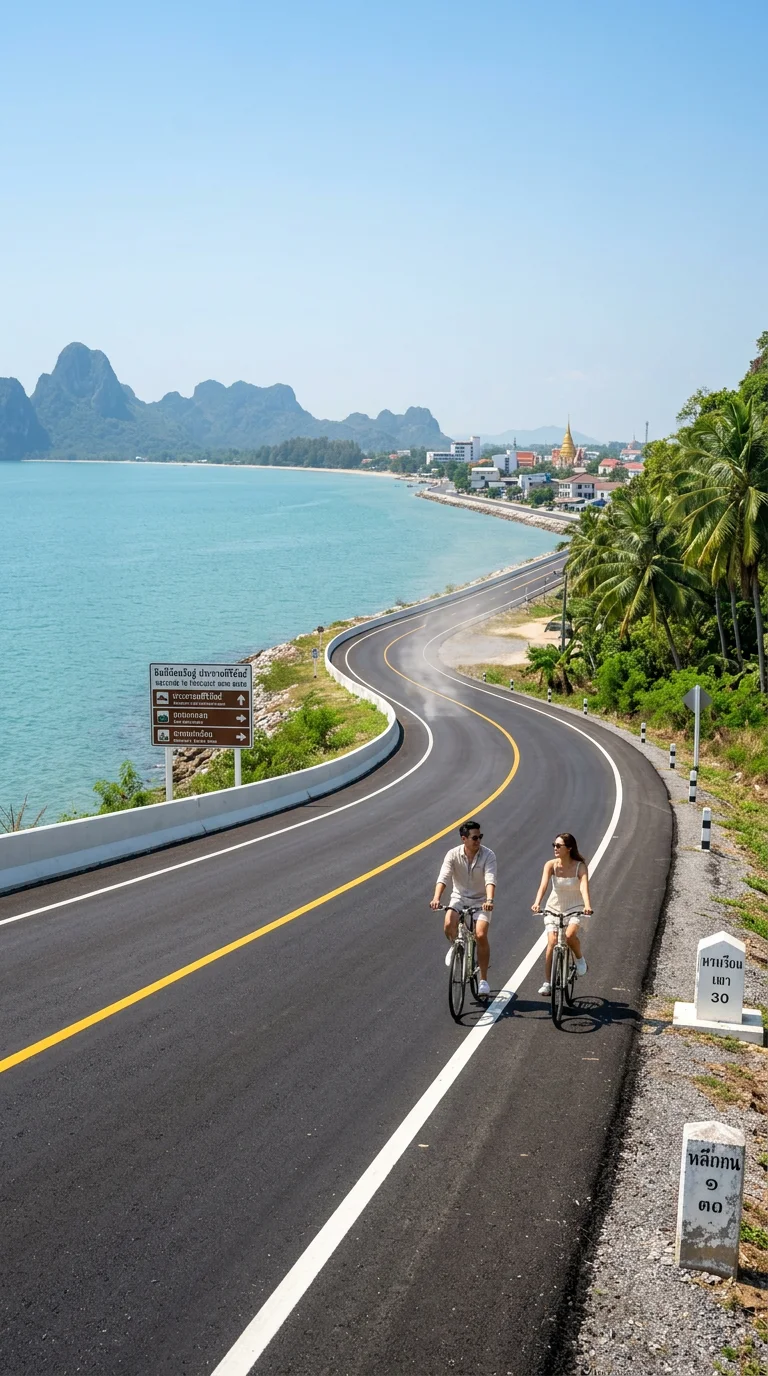
Prachuap Khiri Khan province occupies a narrow, 212-kilometre coastal strip along the western Gulf of Thailand, running between Phetchaburi province to the north and Chumphon to the south. The Tenasserim mountain range defines its western boundary with Myanmar’s Tanintharyi Region, tapering the province to a width of roughly 12 kilometres near the Dan Singkhon border crossing. The primary northern cycling bases, Hua Hin and Pranburi, sit approximately 200 and 230 kilometres south of central Bangkok, while the provincial capital of Prachuap Khiri Khan town lies 280 kilometres south.
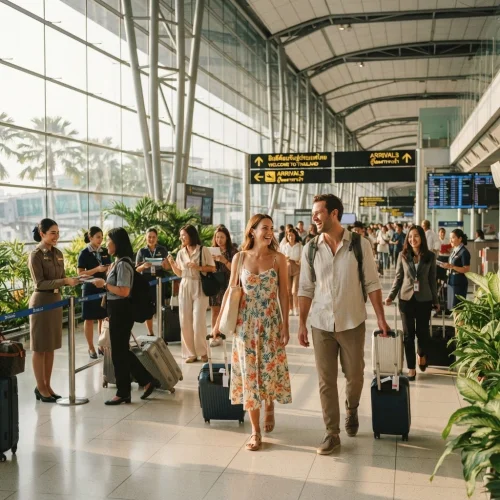
Arriving cyclists travelling from Bangkok or Suvarnabhumi Airport can charter a private multi-seat minivan directly to Hua Hin or Pranburi. The road journey via Highway 35 and Highway 4 takes roughly three to three and a half hours, with one-way vehicle hire typically ranging between 2,500 THB and 3,500 THB (£57 to £80) depending on vehicle size and luggage requirements.
By rail, the State Railway of Thailand operates daily Southern Line services from Bangkok’s Krung Thep Aphiwat Central Terminal, calling at Hua Hin, Pran Buri, and Prachuap Khiri Khan town. Travel times to Hua Hin take around three to three and a half hours following double-track upgrades. Cyclists travelling with unboxed bicycles must select a service equipped with a dedicated freight van, as diesel railcars and newer sleeper sets do not carry bikes. Station parcel desks issue the required bicycle cargo ticket on the day of travel.
Costs and Booking
Bicycle hire and tour pricing across Prachuap Khiri Khan is reasonable compared to Western European destinations. Casual seaside pedalling along the promenades of Pak Nam Pran, Prachuap Khiri Khan town, or Ban Krut is well served by basic single-speed bicycles with front baskets, available from local guesthouses and beachfront shops for 50 THB to 100 THB (£1.15 to £2.30) per day.
Performance bikes are concentrated mainly in Hua Hin, where specialist cycle shops rent quality multi-gear aluminium hybrids for 400 THB to 500 THB (£9.10 to £11.40) per day, dropping to around 300 THB (£6.85) daily for rentals of a week or longer. High-specification carbon road bikes or gravel bikes equipped with Shimano groupsets cost between 1,000 THB and 1,500 THB (£22.80 to £34.20) per day. Rental outfits usually include a pump, spare tube, and helmet, while requesting a passport copy or a refundable security deposit of 5,000 THB to 15,000 THB.
Fully guided day tours covering 25 to 60 kilometres—such as coastal routes between Dolphin Bay and Khao Kalok—generally cost between 2,200 THB and 3,850 THB (£50 to £88) per rider, including bike hire, guide, support vehicle, snacks, and lunch. Self-guided multi-day packages running three to four days with pre-booked hotels, route GPX files, luggage transfers, and bike hire range from 12,000 THB to 22,000 THB (£274 to £502) per person. Pricing remains stable year-round, but reservations are recommended several weeks ahead for the peak holiday season between mid-December and January.
| Service / Option | Cost (THB) | Cost (GBP) | Notes |
|---|---|---|---|
| Basic Town Bike Hire (Single-speed) | 50–100 per day | £1.15–£2.30 | Seaside guesthouses; cash deposit or ID copy |
| Quality Hybrid Bike Hire | 400–500 per day | £9.10–£11.40 | Multi-gear aluminium frame; helmet and lock |
| Carbon Road / Gravel Bike Hire | 1,000–1,500 per day | £22.80–£34.20 | Drop bars, Shimano groupset, repair kit |
| Full-Day Guided Coastal Cycle Tour | 2,200–3,850 per person | £50–£88 | Support vehicle, guide, lunch, bike hire |
| Train Bicycle Cargo Surcharge | 100–150 per journey | £2.30–£3.40 | Freight car ticket on intercity rail services |
| Self-Guided GPS Multi-Day Package | 12,000–22,000 per person | £274–£502 | 3–4 days; hotels, luggage transfer, bike |
Who It Suits Best
Prachuap Khiri Khan suits independent cycle tourers, road cyclists, and active travellers who value quiet coastal corridors with manageable elevation. Endurance riders find long stretches of smooth asphalt across the flat plains of Sam Roi Yot and the rolling coconut groves between Thap Sakae and Bang Saphan. Leisure cyclists and families can take advantage of short, dedicated routes, including the red seaside cycle track along Pak Nam Pran and the calm, controlled roads through the Wing 5 airbase in Prachuap town.
The province is ill-suited to technical or downhill mountain bikers, as local trails lack dedicated downhill infrastructure and rugged singletrack. Cyclists seeking punishing, multi-kilometre mountain passes with high-altitude gradients will also be disappointed; Thailand's northern provinces, such as Chiang Mai, cater far better to alpine climbing. Outside specific seaside promenades and military parkways, routes follow rural roads shared with local traffic rather than purpose-built, segregated cycle networks.
What to Know Before You Book
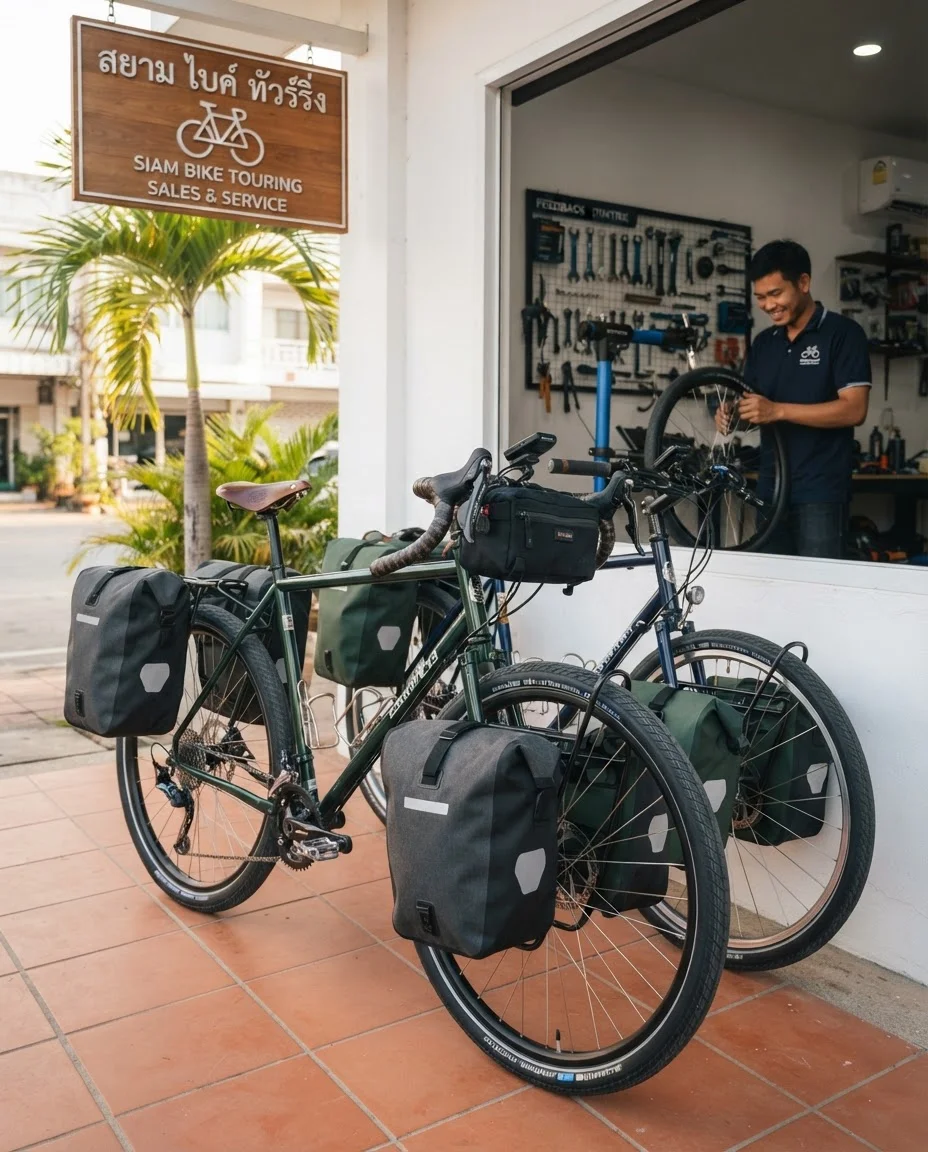
Booking a cycling trip across Prachuap Khiri Khan requires advance planning around equipment availability and transit rules. Specialist hire fleets for carbon road bikes, gravel models, and touring set-ups are concentrated in Hua Hin and Pak Nam Pran. Further south, local rental options rarely extend beyond basic single-speed cruisers and utility bikes. Cyclists requiring a specific frame size, clip-in pedals, or multi-day delivery to southern districts such as Bang Saphan should reserve well ahead, particularly during the dry season between November and February.
Transporting a personal bicycle by train also demands careful coordination before booking. State Railway of Thailand regulations prohibit non-folding bicycles in passenger carriages, requiring them to travel in dedicated freight cars. Because diesel railcars and select express services operate without cargo wagons, verify the train's carriage composition before securing your passenger seat, as bicycle cargo tickets are issued at station parcel offices on the day of travel.
Valid identification is another practical requirement when plotting routes through the provincial capital. Cyclists intending to ride the coastal road through Royal Thai Air Force Wing 5 around Ao Manao must present physical identification at the base security gate. Sentries require foreign visitors to show an original passport, and smartphone scans or driving licences are routinely turned away. Thai nationals may present a national identity card.
Practical Tips
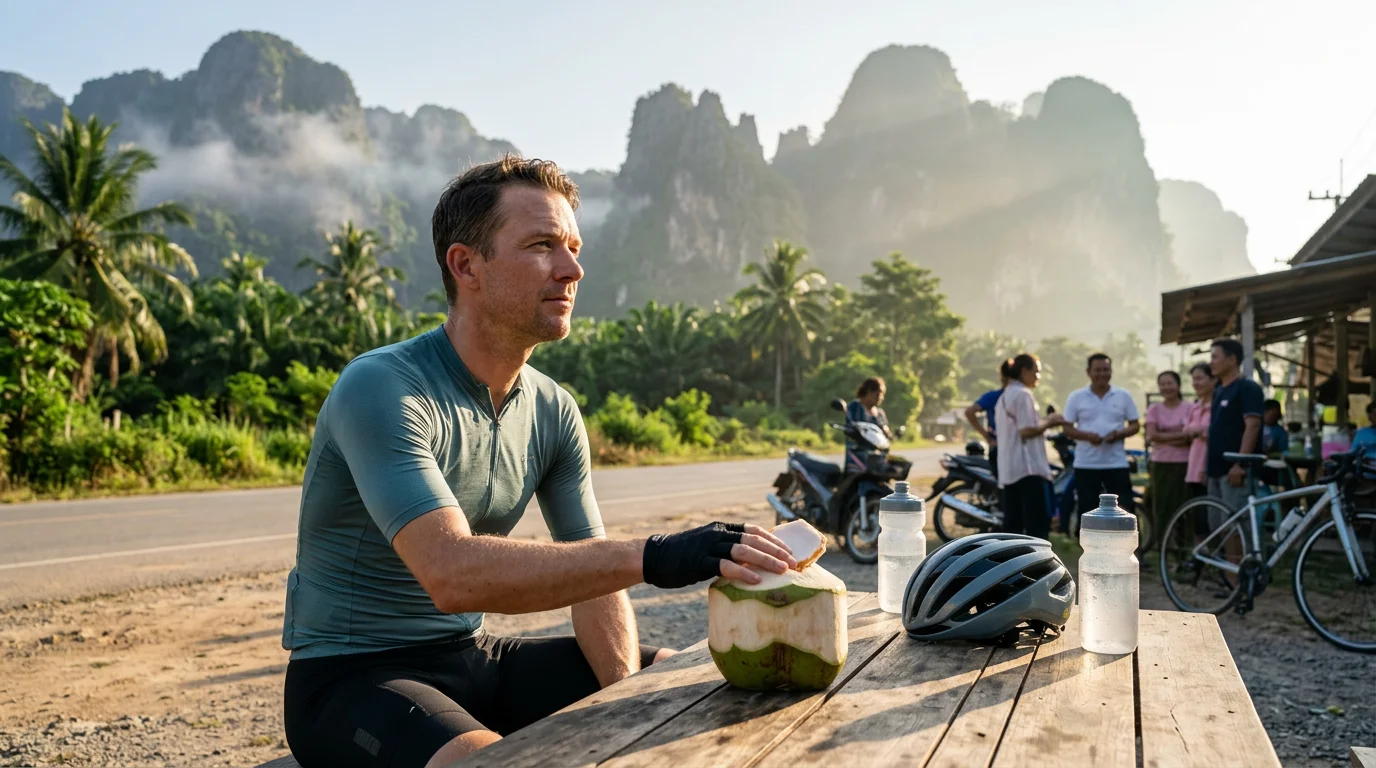
Starting rides around 06:30 is the most practical way to manage coastal conditions. Solar radiation and humidity climb rapidly from 09:00 onwards, with midday temperatures regularly exceeding 33°C. Planning daily stages so that major distances are completed before 11:00 keeps you off the road during peak heat and avoids coastal headwinds that often strengthen by early afternoon.
Carry at least two 750ml water bottles on your frame. While convenience stores and village grocery shops appear regularly in fishing ports, rural stretches between Kui Buri, Thap Sakae, and Bang Saphan pass through agricultural corridors where water points and tree shade are sparse. Electrolyte powders, available cheaply across local pharmacies, are well worth adding to your bottles to prevent dehydration.
Avoid cycling along Highway 4 (Phetkasem Road). As the primary transport artery connecting Bangkok with southern Thailand, this multi-lane road carries high-speed articulated lorries and intercity buses. Instead, use the network of parallel rural roads and the signed Royal Coast routes. These secondary corridors, often designated with four-digit route numbers, provide well-maintained asphalt, quieter riding, and far more scenic countryside.
Fit puncture-resistant tyres or carry two spare inner tubes, tyre levers, and a pump. Secondary roads threading through coconut plantations and pineapple fields frequently carry palm thorns, sharp gravel, and agricultural debris. While village mechanics can patch a standard puncture, specialist parts for modern road and gravel bikes are virtually unavailable south of Pranburi.
Keep snacks and loose food zipped inside frame bags rather than open handlebar baskets. Long-tailed macaques near Khao Chong Krachok in Prachuap town will brazenly approach stationary bicycles to snatch visible fruit or food packages. A compact lock is sensible for temple visits and cave walks, even with low regional crime rates. Before setting out, download offline routing files; mobile data is generally dependable along the coast, but the maze of rural tracks winding through prawn farms around Sam Roi Yot can disorient unfamiliar riders.
Quick Reference Table
| Item | Detail | Notes |
|---|---|---|
| Geographic Span | 212 km coastal strip | Stretches from Hua Hin south to Bang Saphan Noi |
| Pak Nam Pran Beach Track | 12–15 km (under 35 m elevation) | Dedicated red-surfaced coastal path; flat and traffic-free |
| Sam Roi Yot Circuit | 48–65 km (50–120 m climbing) | Paved rural loop skirting limestone karst and Bueng Bua marsh |
| Prachuap Three Bays & Wing 5 | 20–26 km return (under 40 m climbing) | Level route across Ao Noi, Ao Prachuap, and Ao Manao airbase |
| Southern Touring Corridor | 85–105 km per day (250–450 m climbing) | Secondary coastal route from Thap Sakae to Bang Saphan |
| Private Minivan Transfer | 2,500–3,500 THB (£57–£80) | One-way hire from Bangkok or Suvarnabhumi Airport |
| Train Bike Cargo Fee | 100–150 THB (£2.30–£3.40) | Unboxed bikes require services with dedicated freight cars |
| Basic Town Bike Hire | 50–100 THB (£1.15–£2.30) per day | Single-speed utility bikes from seaside guesthouses |
| Quality Hybrid Bike Hire | 400–500 THB (£9.10–£11.40) per day | Multi-gear aluminium bikes; drops to ~300 THB for week+ rentals |
| Performance Road/Gravel Hire | 1,000–1,500 THB (£22.80–£34.20) per day | Carbon frames, Shimano groupsets; 5,000–15,000 THB deposit |
| Guided Day Tours | 2,200–3,850 THB (£50–£88) per rider | 25–60 km routes; includes bike hire, guide, support van, and lunch |
| Self-Guided Multi-Day Packages | 12,000–22,000 THB (£274–£502) per person | 3–4 days; includes hotels, luggage transfers, GPX, and bike hire |
| Wing 5 Access Requirement | Original physical passport | Foreign visitors must register at gate; scans not accepted |
| Recommended Riding Hours | From 06:30 onwards | Complete stages by 11:00 to avoid midday heat (33°C+) and coastal headwinds |
FAQ: Cycling in Prachuap Khiri Khan
What is the best time of day to cycle the Pak Nam Pran Beach Track?
What do foreign cyclists need to access Royal Thai Air Force Wing 5 in Prachuap Khiri Khan?
What type of bicycle tires are recommended for cycling in southern Prachuap Khiri Khan?
Can I take my bicycle on a train to Prachuap Khiri Khan from Bangkok?
How much does it cost to rent a basic bicycle in Prachuap Khiri Khan?
When should I book bicycle rentals or tours for cycling in Prachuap Khiri Khan?
Is Prachuap Khiri Khan suitable for mountain biking?
Where can I rent specialist road or gravel bikes in Prachuap Khiri Khan?
What is the best time to start cycling in Prachuap Khiri Khan?
What should cyclists carry for hydration on rural routes in Prachuap Khiri Khan?
Reviewed by the Thailand Guide Editorial Team • Last reviewed: 17 November 2026
This page is provided for general information only. While we aim for accuracy, details can change — please verify anything important independently before relying on it.