Running in Phuket


Phuket is southern Thailand’s primary endurance sports destination, pairing purpose-built training facilities with diverse natural terrain. Runners visiting the island encounter an established training environment that ranges from shaded reservoir loops and flat lakeside paths to technical rainforest tracks across the central hills. Major annual events, particularly the Laguna Phuket Marathon, alongside specialist endurance facilities at Thanyapura in Thalang, provide structured athletic infrastructure that complements the island's demanding coastal topography.
Training in Phuket demands greater physical adaptation than mainland city running, shaped by sharp elevation changes, tropical heat, and high morning humidity. The island appeals particularly to road runners, visiting marathoners, and multi-sport competitors seeking disciplined mileage alongside sports recovery amenities. Paved public loops, reservoir perimeters, and protected forest trails accommodate varied sessions across the island, provided runs are scheduled around dawn before temperatures peak.

Bang Wad Dam and Central Reservoir Circuits
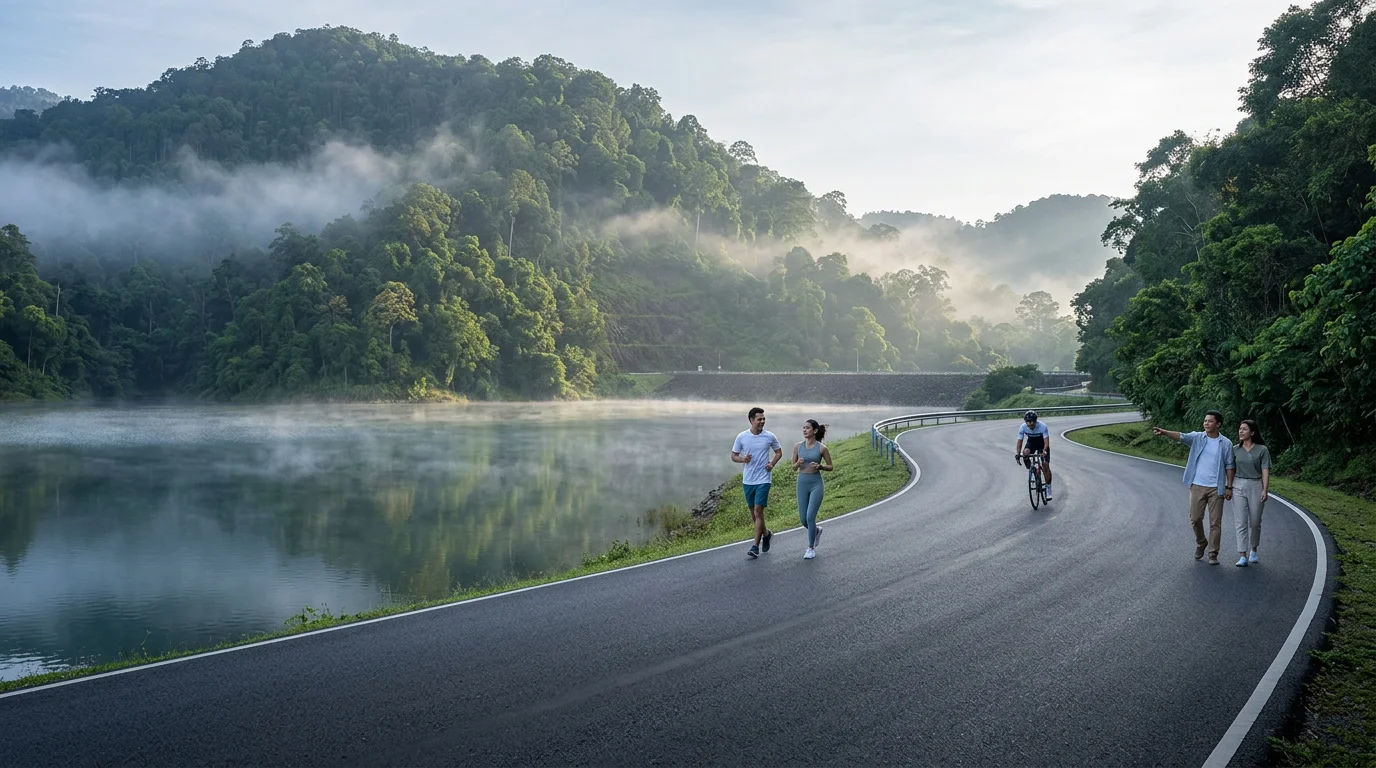
Bang Wad Dam in Kathu provides a dedicated, closed-loop paved perimeter around a freshwater reservoir, free from commercial vehicle traffic. Located in Phuket's central Kathu district, this freshwater reservoir features a 6.4-kilometre circular asphalt course that functions as a key training ground for local running clubs and distance athletes. The course undulates gently along the water's edge, presenting roughly 130 metres of cumulative elevation gain per lap. Mature rubber plantations and secondary jungle canopy flank the tarmac, providing consistent natural shade that keeps ambient ground temperatures lower than exposed coastal routes during morning training sessions.
Motorised traffic is restricted at the entrance gate, with access limited to occasional park maintenance transport and local scooters, allowing runners to train with minimal vehicular disturbance. Painted distance markers appear every 500 metres along the tarmac to support split pacing and interval targets. Local vendor stalls set up near the northern barrier dam, stocking bottled drinking water, electrolyte drinks, and fresh fruit at standard local rates. Long-distance road runners can link multiple consecutive laps to complete half-marathon or marathon mileage without needing to cross public highways. Gate access runs from 05:00 to 18:30, with early morning sessions between 05:45 and 08:00 providing manageable humidity before midday heat sets in. Macaques occasionally congregate in the forested margins near the dam wall, so keep food and personal items securely zipped away.
On the southern coast, Nai Harn Lake delivers a flat, accessible perimeter circuit suited to speed intervals, tempo pacing, and recovery jogs. Located directly behind Nai Harn Beach in Rawai, the freshwater lagoon is encircled by a 2.2-kilometre asphalt path. Casuarina and palm trees line sections of the route, throwing shade across the surface in the early morning while onshore sea breezes clear residual humidity. The lake perimeter acts as a regular training venue for local distance runners, visiting Muay Thai athletes from Chalong gyms completing morning roadwork, and the community-organised Nai Harn 5 km parkrun staged every Saturday at 07:00. The site includes public toilets, outdoor exercise machines, and perimeter vehicle parking, with immediate access to Nai Harn Beach for a post-session sea swim.
On the eastern seaboard of Phuket Town, Saphan Hin Park provides a dedicated waterfront exercise ground combining coastal promenades and paved park paths. The main seaside loop measures approximately 2.5 to 3.0 kilometres, with broader park path networks allowing runners to extend circuits up to 4.0 kilometres. Open waterfront paths expose runners to steady sea breezes that help offset warm air temperatures, though the route offers limited tree canopy compared to inland reservoir circuits. For structured interval training, an adjacent 400-metre synthetic track sits within the municipal sports stadium complex at the edge of the park grounds. The park features public toilets, outdoor fitness apparatus, and parking areas, alongside local evening food carts that assemble along the promenade after 16:30.
| Running Spot | Loop Distance & Surface | Elevation Profile & Traffic | Best Running Use |
|---|---|---|---|
| Bang Wad Dam (Kathu) | 6.4 km paved asphalt | Rolling hills (130 m gain); closed to cars | Marathon pace work, long endurance runs |
| Nai Harn Lake (Rawai) | 2.2 km paved path | Completely flat; strictly pedestrian | 5 km parkrun, recovery laps, interval repeats |
| Saphan Hin (Phuket Town) | 2.5–4.0 km paved promenade | Flat waterfront; zero car traffic on interior | Speed intervals, sunset tempo runs, 400m track work |
| Khao Phra Thaeo (Thalang) | 8.0 km technical dirt trail | Steep jungle inclines; off-road footpaths | Technical hill training, tropical trail running |
Scheduling workouts around local daylight and temperature patterns remains critical across all three circuits. Starting before 06:30 allows you to complete sessions before solar radiation peaks, while late afternoon runs from 17:00 benefit from cooling coastal breezes and active community training groups.
Rainforest Singletrack: Khao Phra Thaeo Trails

Khao Phra Thaeo Non-Hunting Area protects Phuket’s last primary virgin rainforest, providing experienced off-road runners with technical singletrack terrain.
Covering roughly 22 square kilometres across the hills of northern Thalang, this protected reserve contrasts sharply with the island’s flat coastal roads and paved reservoirs. Its primary cross-forest route connects Ton Sai Waterfall on the western perimeter with Bang Pae Waterfall on the east. Depending on the exact line taken over the ridge, the traverse spans between four and eight kilometres across dense networks of exposed tree roots, steep muddy ascents, and slick granite boulders.
While the high jungle canopy shields runners from direct sunshine, trapped interior humidity regularly exceeds ninety percent, creating severe cardiovascular strain. Monsoonal downpours frequently wash away soft topsoil, creating slick descents and leaving fallen branches across the path. Navigation requires care: the deep interior trail lacks continuous waymarking, and park rangers advise against attempting an unguided cross-sanctuary traverse without offline mapping or local orientation.
Runners along the eastern approach frequently hear the distinctive morning calls of white-handed gibbons from the Gibbon Rehabilitation Project at Bang Pae, accompanied by cicadas and resident forest birds. For traction across wet clay and mossy rocks, shoes with deep, aggressive lugs are necessary. Carry a dedicated hydration vest or handheld flasks, as no potable drinking water is available once you enter the jungle interior.
Discover Phuket's diverse landscapes, from granite mountains and tropical forests to stunning beaches and eastern bays. Plan your Thai island adventure now!
Regional Comparison: Phuket Versus Bangkok and Chiang Mai

Phuket provides varied coastal elevation and maritime breezes that mainland urban circuits cannot replicate, though it demands far more logistical planning than Bangkok or Chiang Mai.
When comparing island routes with the capital, running in Bangkok centres on flat, traffic-free park circuits such as Lumphini and Benjakitti. Those venues offer dedicated running tracks, late-evening lighting, and direct access from the BTS Skytrain and MRT networks. Runners in Bangkok can step off a train straight into an enclosed park loop. In contrast, Phuket has no urban mass transit connecting its running spots. Reaching quiet reservoir perimeters or coastal circuits requires private transport, such as a hired scooter or car. What Phuket lacks in transit convenience, however, it balances with demanding hill gradients, coastal sea air, and open water vistas that municipal city parks cannot provide.
Compared to northern Thailand, Phuket presents a sharply different training stimulus. Trail running in Chiang Mai revolves around sustained mountain ascents such as Doi Suthep and Doi Inthanon, where dry-season mornings bring crisp, cooler air. Phuket lacks high-altitude peaks—its highest ridges sit around 500 metres above sea level—and delivers heavy coastal humidity year-round. Even so, Phuket holds an advantage for multi-sport conditioning, combining hilly tarmac and rainforest trails with open-water swimming and specialised endurance facilities. The island also serves as the southern anchor for Thailand's winter racing calendar, hosting major road marathons and triathlons.
Athletes targeting hill strength, warm-weather conditioning, or multi-sport preparation will find Phuket well suited to their training blocks, provided they arrange independent transport and base themselves near their preferred routes.
Visiting runners can also draw on an active community for group pacing, social runs, and structured interval training. The Phuket Hash House Harriers, one of the island's longest-standing recreational clubs, gathers every Saturday afternoon at 16:00 for non-competitive trail and road runs across rotating rural locations. In the south, a free community 5 km timed run takes place every Saturday morning at 07:00 at Nai Harn Lake, drawing local residents, expatriates, and visitors for roughly two and a half laps of the flat, paved two-kilometre circuit.
For structured track work and coached endurance sessions, Thanyapura Sports & Health Resort in northern Thalang maintains a 400-metre synthetic athletics track, hosting organised workouts and triathlon clinics. In the south, running groups and fitness clubs around Chalong frequently tackle the tarmac access road climbing Nakkerd Hill to the Big Buddha monument. This steep four-kilometre route climbs approximately 360 metres of vertical elevation, providing a demanding uphill session. Local community runs operate with minimal formality, allowing visiting runners to join single sessions without advance membership.
Location and Getting There
Phuket’s main running spots sit far apart across the island, requiring careful transport planning depending on where you stay. Bang Wad Dam is situated in central Kathu, roughly 34 kilometres south of Phuket International Airport (HKT) and 10 kilometres west of Phuket Town. Nai Harn Lake lies near the southern coast in Rawai, approximately 48 kilometres from the airport.
From the airport, metered taxis and ride-hailing services such as Grab and Bolt run to Kathu for roughly 600 THB to 900 THB (£14.00 to £21.00), taking about 45 minutes in light traffic. Fares to Nai Harn typically run from 900 THB to 1,200 THB (£21.00 to £28.00), with journey times lasting around 75 minutes outside peak hours. The Phuket Smart Bus travels from the airport down the western coastline to its Rawai Beach terminus for a flat fare of 100 THB (£2.30), though reaching Nai Harn Lake requires a brief onward connection. Because public buses do not operate before sunrise and ride-hailing availability is unpredictable before 06:00, hiring a small automatic car for 800 THB to 1,200 THB (£18.60 to £28.00) per day provides reliable access to reservoir loops and trailheads across the island.
Costs and Booking
Public running circuits across Phuket require no entry fees and remain accessible without booking. The paved reservoir perimeter at Bang Wad Dam, the lake loop at Nai Harn, and the coastal circuits around Saphan Hin Park are entirely free to the public year-round. Trail runners visiting Khao Phra Thaeo Non-Hunting Area to run between the Ton Sai and Bang Pae waterfalls must pay the standard Department of National Parks foreign visitor entrance fee of 200 THB (£4.65) per adult. This fee is payable in cash at the ranger checkpoint upon arrival; no advance booking system operates for the sanctuary trails.
Entry fees for organised road races on the island depend on the distance and registration window. The flagship event is the Laguna Phuket Marathon, staged each June with AIMS-certified courses. Standard online registration fees are 1,600 THB (£37.20) for the 42.2-kilometre marathon and 1,300 THB (£30.20) for the 21.1-kilometre half marathon. The accompanying 10 km and 5 km events generally range from 600 THB to 850 THB (£13.95 to £19.75). Entry slots for the longer distances should be booked three to six months in advance through the event's registration platform, as field caps are enforced and registrations close once quotas fill.
Track runners have both free municipal facilities and fully equipped commercial options. Phuket Town’s Surakul Stadium provides free public entry to its 400-metre synthetic track during late-afternoon community hours (generally 16:30 to 20:00, except on match days). For dedicated sports resort facilities, Thanyapura Sports & Health Resort in Thalang houses a 500-metre cushioned athletics track. A sports day pass costs 900 THB (£20.95), granting access to the track, fitness centre, and recovery pools. One-on-one running coaching, video gait analysis, and structured interval training with resident coaches typically cost between 1,500 THB and 2,500 THB (£34.90 and £58.10) per hour, which should be reserved a few days ahead.
| Option | Cost (THB) | Cost (GBP) | Notes |
|---|---|---|---|
| Public Park & Reservoir Circuits | Free | Free | Applies to Bang Wad Dam, Nai Harn Lake, and Saphan Hin |
| Khao Phra Thaeo Trail Entry | 200 THB per entry | £4.65 per entry | Foreign adult conservation tariff paid in cash at gate |
| Laguna Phuket Marathon (42.2 km) | 1,600 THB per entry | £37.20 per entry | Standard online registration fee for certified road race |
| Laguna Phuket Half Marathon (21.1 km) | 1,300 THB per entry | £30.20 per entry | Standard online registration fee for certified half marathon |
| Laguna 10 km / 5 km Road Races | 600–850 THB per entry | £13.95–£19.75 per entry | Mass-participation shorter weekend race categories |
| Thanyapura Sports Day Pass | 900 THB per person | £20.95 per person | Full-day pass including 500-metre cushioned running track |
| Professional Running Coaching Session | 1,500–2,500 THB per hour | £34.90–£58.10 per hour | One-on-one running technique and private fitness coaching |
Who It Suits
Phuket suits marathon trainees, road runners, and multi-sport endurance athletes who value warm-weather acclimatisation and coastal recovery swims. The island works well for runners who follow a structured programme and are comfortable hiring a scooter or car to travel between separate venues, such as dedicated reservoir loops, municipal sports tracks, and quiet beachhead circuits.
Conversely, the island is poorly suited to casual runners who expect to step directly out of a hotel onto continuous, well-maintained roadside pavements. Outside gated resorts and designated public parks, island roads are narrow, shoulders are broken or obstructed, and scooter traffic is heavy. Trail runners looking for cool, high-altitude mountain ascents will also find Phuket unsuitable, as northern destinations like Chiang Mai provide far better high-elevation terrain.
What to Know Before You Book
Phuket's road network rarely features dedicated pedestrian pavements outside resort enclaves and municipal parks. Running along main thoroughfares is risky due to dense scooter traffic and narrow shoulders, which makes proximity to dedicated circuits or arranged transport a vital planning factor when choosing accommodation.
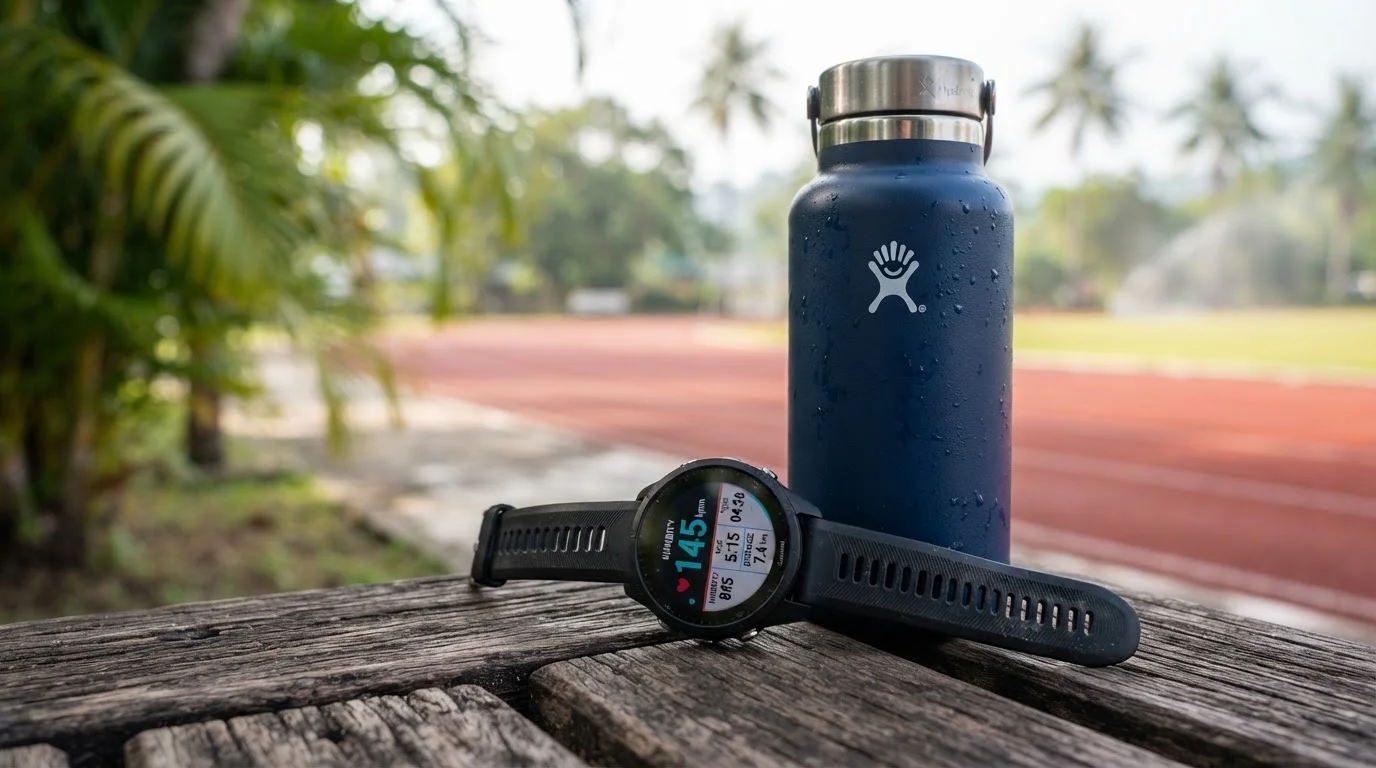
Tropical humidity routinely hovers around or above eighty percent during the early morning. UK runners should expect standard training paces to produce noticeably higher heart rates and rapid cardiovascular fatigue. Pacing targets need moderating from day one to avoid heat illness.
Territorial semi-domesticated dogs frequently patrol rural sois and jungle margins. Selecting well-used running locations, such as Bang Wad Dam or Nai Harn Lake, substantially reduces encounters with aggressive strays compared to open roadside routes.
Sunlight arrives swiftly in southern Thailand. Sunrise shifts between roughly 06:10 in summer and 06:45 in winter, providing a narrow window of roughly ninety minutes of cooler conditions. Planning workouts to conclude by 08:00 avoids the most punishing radiant heat and direct sun exposure.
Practical Tips
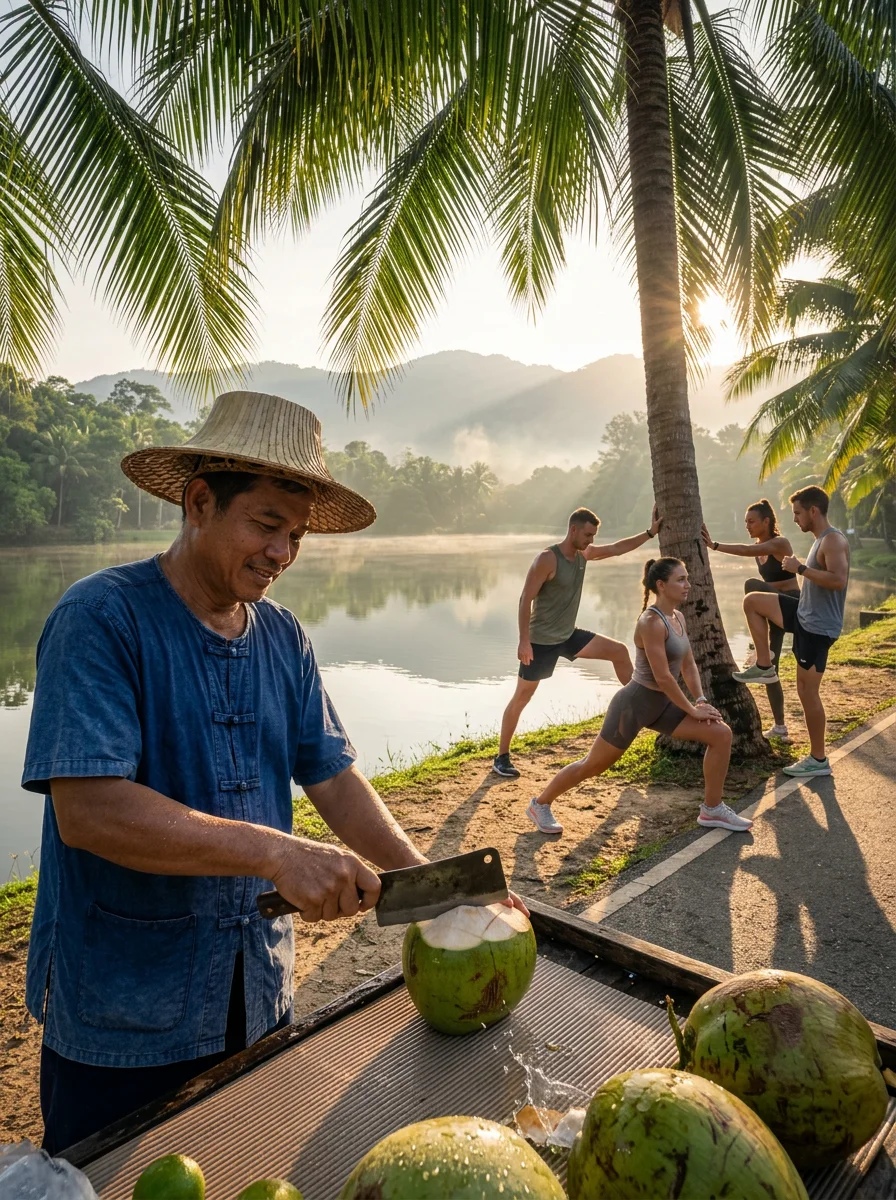
Outdoor runs should start at or before 06:30. Daylight arrives around 06:00 across Phuket, and while early morning relative humidity is high, the ambient air temperature remains manageable. Once the sun climbs past 08:00, radiant heat off exposed asphalt loops like Bang Wad Dam quickly turns even moderate training into a severe dehydration risk. Evening runs after 17:30 provide a cooler alternative, though the brief twilight window leaves little room for delays.
Carry water mixed with electrolyte powders rather than plain water alone. Heavy perspiration in tropical conditions rapidly depletes sodium and potassium, increasing the risk of sudden, painful heat cramps over modest distances. Keeping 20-baht and 50-baht notes in a pocket or running belt is equally sensible: roadside stalls and drink vendors near reservoir car parks do not accept international contactless payment cards, relying strictly on cash or local mobile banking transfers.
Choose lightweight, loose technical synthetics and apply anti-chafing lubricant before heading out; sweat-soaked cotton clings and causes painful skin friction within kilometres. Runners planning off-road outings should pack separate road and trail shoes. Rainforest paths feature wet clay and slick granite rocks that demand aggressive outsole lugs, whereas abrasive tarmac circuits rapidly wear down soft trail rubber. Before tackling forested trails in Khao Phra Thaeo Non-Hunting Area, download offline route maps to your phone, as dense valley canopies frequently cut cellular reception.
When exploring quiet backstreets or rural rubber plantation lanes beyond dedicated parks, carrying a firm stick helps keep territorial soi dogs at a distance. Selecting your kit and routes carefully allows you to manage training comfortably in the island's tropical climate.
Quick Reference Table
| Item | Detail | Notes |
|---|---|---|
| Bang Wad Dam Circuit | 6.4 km paved loop; ~130 m elevation gain | Kathu; traffic-free asphalt around reservoir; open 05:00–18:30; free entry |
| Nai Harn Lake Circuit | 2.2 km flat paved perimeter path | Rawai; pedestrian path; hosts free weekly 5 km timed run Saturdays at 07:00; free entry |
| Saphan Hin Waterfront | 2.5–4.0 km paved coastal promenades | Phuket Town; flat seaside route; adjacent to municipal 400 m synthetic track; free entry |
| Khao Phra Thaeo Singletrack | 4.0–8.0 km technical rainforest trail | Thalang; connects Ton Sai and Bang Pae waterfalls; 200 THB (£4.65) cash entry at ranger gate |
| Nakkerd Hill / Big Buddha Climb | 4.0 km steep tarmac road climb | Chalong; ~360 m elevation gain; popular uphill interval route |
| Optimal Running Windows | Dawn (before 06:30) or late afternoon (after 17:00) | Morning humidity regularly exceeds 80%; finish morning sessions before 08:00 to avoid heat |
| Laguna Phuket Marathon Entry | 42.2 km: 1,600 THB (£37.20); 21.1 km: 1,300 THB (£30.20) | Annual AIMS-certified June race; 10 km / 5 km options cost 600–850 THB (£13.95–£19.75) |
| Thanyapura Sports Day Pass | 900 THB (£20.95) per person | Thalang; includes 500 m cushioned athletics track, fitness facilities, and recovery pools |
| Local Car Hire | 800–1,200 THB (£18.60–£28.00) per day | Recommended for reaching trailheads and reservoirs before sunrise when taxis are limited |
| Website | phuketmarathon.com | Laguna Phuket Marathon official race information and online registration |
| Website | thanyapura-phuket.com | Thanyapura Sports & Health Resort track facilities, day passes, and coaching |
| Website | phuket-hhh.com | Phuket Hash House Harriers weekly non-competitive trail and road runs |
FAQ: Running in Phuket
What kind of physical challenges should runners expect when training in Phuket?
Who is Phuket best suited for as a running destination?
When is the best time to schedule running workouts in Phuket?
What should runners know before attempting the Khao Phra Thaeo trails in Phuket?
What are the risks of running on main roads in Phuket?
How does tropical humidity affect running in Phuket?
How can runners avoid encounters with aggressive dogs in Phuket?
What should runners drink during workouts in Phuket's tropical conditions?
What kind of clothing is best for running in Phuket?
What is the recommended way to get to running spots in Phuket, especially for early morning sessions?
Reviewed by the Thailand Guide Editorial Team • Last reviewed: 18 November 2026
This page is provided for general information only. While we aim for accuracy, details can change — please verify anything important independently before relying on it.