Mangrove Kayaking
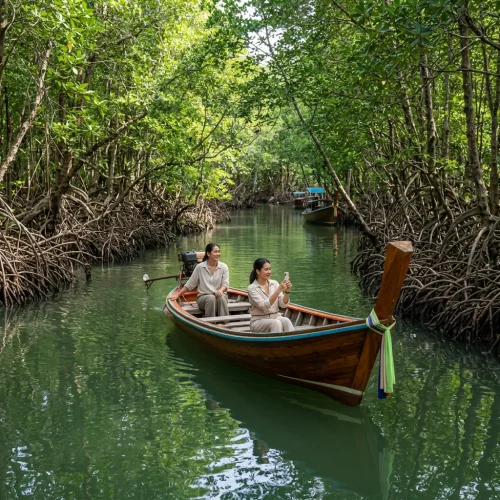
The moment a kayak enters a sheltered estuarine creek, open-water swell dissipates into calm, brackish channels hemmed in by dense vegetation. In Thailand’s coastal mangrove forests, paddling requires compact strokes, constant tidal awareness, and careful manoeuvring beneath tangled stilt roots that keep motorised tour boats at bay. The forest canopy dampens coastal winds, creating an acoustic shift where quiet paddle dips give way to the popping of fiddler crabs on exposed banks and the splash of falling propagules.
This guide provides the practical foundation for exploring Thailand’s tidal mangrove systems from the water, spanning the limestone karst corridors of the Andaman Sea to the sheltered bays along the eastern Gulf. You will find clear guidance on assessing daily tidal windows, managing the risk of mudbank stranding, and navigating narrow channels independently or with local community boatmen. Understanding these estuarine conditions ensures a well-timed paddle through one of the country's most ecologically vital coastal environments.

The Hydraulic Realities of Mangrove Paddling
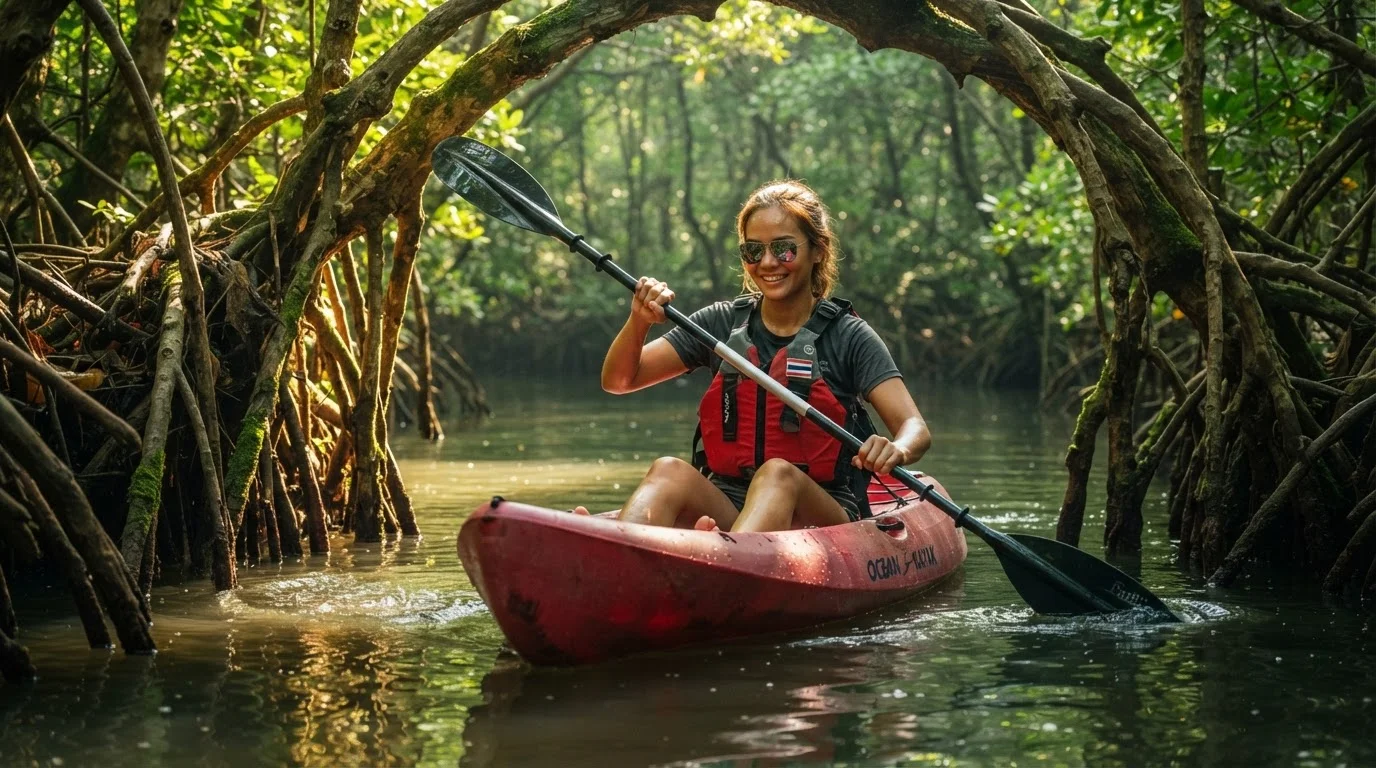
Paddling through an estuarine mangrove forest presents hydrographic conditions fundamentally distinct from open-water sea kayaking. Coastal paddling along Thailand's open bays exposes kayakers to rolling ocean swell, surface chop, and maritime crosswinds that dictate heading and tempo. Within mangrove waterways, dense lateral tree lines and interlaced canopy cover largely neutralise surface breezes. While this wind baffling creates a flat, glassy water surface that removes any risk of motion sickness, it substitutes open wave action for constricted tidal hydraulics. Narrow channels funnel incoming and receding tides into rapid currents, accelerating water flow through bottlenecks and generating reverse eddies along the inner bends of forested creeks.
These confined watercourses fundamentally alter kayak handling. On open coastal stretches, long sea kayaks rely on wide, sweeping low-angle strokes, foot rudders, and deployable skegs for straight-line tracking. In a tight mangrove channel, extended low-angle strokes cause paddle blades to strike overhead foliage or jam against tangled root buttresses. Paddlers must adopt a compact, high-angle forward stroke that keeps the shaft close to the gunwales. Mechanical rudders and drop skegs prove ineffective here, as they snag on submerged branches or collect thick mud in shallow water. Directional control instead relies on active blade work: drawing water laterally to slip past obstructions, prying against the current, and using stern rudders to pivot the boat smoothly through tight hairpin bends.
Acoustics and craft construction also dictate how you move. The ambient roar of breaking coastal surf gives way to a quiet, enclosed corridor where mangrove mud and thick foliage absorb background noise. Paddle drips, clattering gear, or raised voices carry down the water for hundreds of metres, startling birds and arboreal wildlife long before a boat rounds the bend. Equipment choice reflects these physical hazards. Rental operations across Thailand overwhelmingly deploy solid, rotomoulded polyethylene sit-on-top kayaks. While heavier and slower than lightweight fibreglass or composite touring craft, thick plastic hulls glance safely off submerged timber and sharp oyster clusters without suffering structural fractures or gelcoat gouges.
Understanding these hydrodynamic differences helps paddlers adjust their expectations and boat control when transitioning from open sea to sheltered creek systems.
| Feature | Mangrove Estuary Paddling | Open-Water Sea Kayaking | Practical Impact on Paddlers |
|---|---|---|---|
| Water Surface Dynamics | Flat, sheltered water without ocean swell or surf | Continuous swell, surface chop, and breaking waves | Eliminates seasickness but demands constant micro-corrections for snags |
| Current Behaviour | Constricted, fast-moving tidal flush in narrow creeks | Broad oceanic drift, tidal rips, and longshore currents | Requires paddling with the tide to avoid fighting heavy channel flow |
| Wind Exposure | Heavily baffled by dense overhead and lateral tree canopies | Full exposure to coastal gusts and offshore thermal winds | Lowers physical fatigue from wind resistance but increases humid heat |
| Steering Mechanics | High-angle draw strokes, stern prying, and sculling | Low-angle touring strokes, skeg tracking, and foot rudders | Demands agile boat handling in tight spaces rather than straight-line tracking |
| Hull Obstacles | Submerged root elbows, oyster clusters, and fallen timber | Coral heads, breaking reefs, and submerged marine boulders | Favours impact-resistant polyethylene sit-on-top craft over fragile composites |
Estuarine Root Architecture and Waterway Geometry
Paddling through Thailand’s coastal mangroves requires reading the living timber that dictates water depth, shoreline boundaries, and channel width. The architecture of these waterways is primarily shaped by two dominant mangrove genera, each producing distinct root formations that interact differently with passing kayaks.
Along channel margins and outer estuarine fringes, red mangroves (Rhizophora apiculata and Rhizophora mucronata) establish dense, looping stilt roots. These arched prop roots descend from trunks and lower branches like flying buttresses, trapping suspended silt and creating steep, canyon-like edges along the deeper channels. While these root networks buffer open water, they form underwater lattices that can wedge a paddle blade or trap a drifting boat hull. In moving water, currents naturally sweep toward the outside bends where these arches gather; drifting into them risks pinning the kayak against wood encrusted with sharp rock oysters.
Further into the shallows and consolidated mudbanks, black mangroves (Avicennia) alter the channel floor. Rather than branching arches, they send up thousands of slender, vertical breathing roots known as pneumatophores. These pencil-thick aerial roots emerge across the tidal mud, remaining submerged and invisible during intermediate water levels where they create unseen snag hazards for rudders and skegs.
Tidal movement continuously reconfigures this waterway geometry. High water floods narrow secondary passages, letting paddlers glide through shallow interior glades sheltered beneath the canopy. As water recedes, these side cuts drain rapidly, funnelling remaining flow back into main arterial rivers. Without continuous orientation toward the central channel, retreating water can strand a kayak across exposed root shelves, cutting off return routes long before the mudbanks fully emerge.
Plan a Northern Thailand trip covering Chiang Mai, Chiang Rai, Sukhothai, mountain routes, Lanna food, transport, seasons and air quality.
Ethical Wildlife Observation Along the Waterline
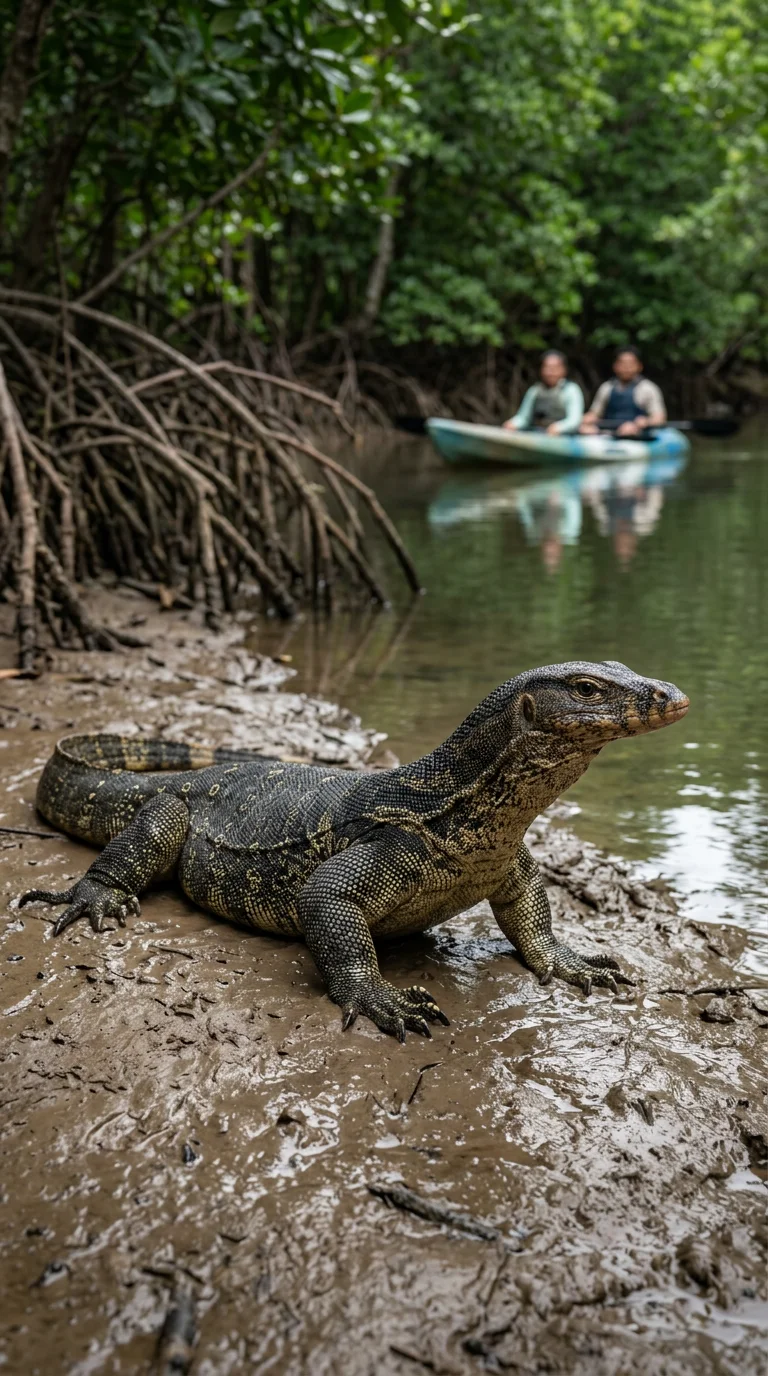
Drifting through estuarine channels in a kayak provides an unobtrusive vantage point for watching intertidal wildlife. Unlike motorised longtail boats, whose engine noise and vibrations flush timid creatures into the interior forest, a paddle craft sits flat on the water and approaches in near-total silence. This quiet entry allows paddlers to observe species that would otherwise flee before an engine draws near. Ethical viewing along these waterways hinges on deliberate paddle control: glide parallel to banks rather than heading directly towards animals, maintain a buffer of at least ten metres, and stop the kayak using gentle sculling strokes with blades kept submerged to prevent splashing.
At low tide, exposed mudbanks and tangled roots become active feeding grounds. Blue-spotted mudskippers haul themselves across the silt on muscular pectoral fins to graze on algae, while colonies of fiddler crabs emerge, the males waving an enlarged claw to defend territory. Asian water monitors frequently sun themselves on mud shelves or slip into the creek between prop roots. Paddlers should let the current carry them smoothly past these mudflats, using small rudder strokes to avoid grounding the bow into feeding zones or blocking an animal's retreat into the water.
Crab-eating macaques forage along tidal shorelines for molluscs and small crabs. In popular paddling routes such as Ao Thalane in Krabi, frequent human traffic has left several troops habituated. These primates associate kayaks with food; if a boat drifts within grabbing range, inquisitive monkeys will jump onto the deck, pry into dry bags, and seize water bottles. To prevent aggressive encounters, stow all food, drinks, and loose items inside sealed hatches before entering narrow cuts, avoid direct eye contact, and do not attempt to feed them.
Looking up into the vegetation requires equal care. The upper canopy shelters Brahminy kites, white-bellied sea eagles, and kingfishers, while mid-level boughs overhanging narrow passages are daylight resting spots for mangrove pit vipers. These venomous snakes rely on mottled camouflage, remaining motionless on horizontal limbs just above head height. Paddlers should keep their hands on the paddle shaft rather than grabbing overhead branches or prop roots to steer or steady the kayak. Checking foliage overhead before paddling beneath low overhangs prevents accidental disturbance.
| Forest Stratum | Dominant Species | Typical Behaviour | Observation Distance & Protocol |
|---|---|---|---|
| High Canopy (6m–15m) | Brahminy kites, white-bellied sea eagles, Pacific reef herons | Perching on dead branches and soaring above channel openings | Observe through binoculars; maintain quiet paddle strokes to prevent flushing |
| Mid-Level Branches (1m–4m) | Mangrove pit vipers, black-capped kingfishers, collared kingfishers | Coiling along horizontal limbs; perching to scan for prey | Keep at least four metres away; avoid grabbing overhead branches to steer or brake |
| Waterline & Root Margin | Crab-eating macaques, smooth-coated otters | Foraging among oyster-encrusted roots and swimming across channels | Maintain ten-metre clearance; keep all food and loose gear inside sealed hatches |
| Intertidal Mudbanks | Blue-spotted mudskippers, fiddler crabs, Asian water monitors | Digging burrows, grazing algae on silt, and sunning on mud ramps | Drift parallel to bank; use rudder strokes to avoid grounding bow into feeding zones |
Community Cooperatives Versus Independent Self-Navigated Hire
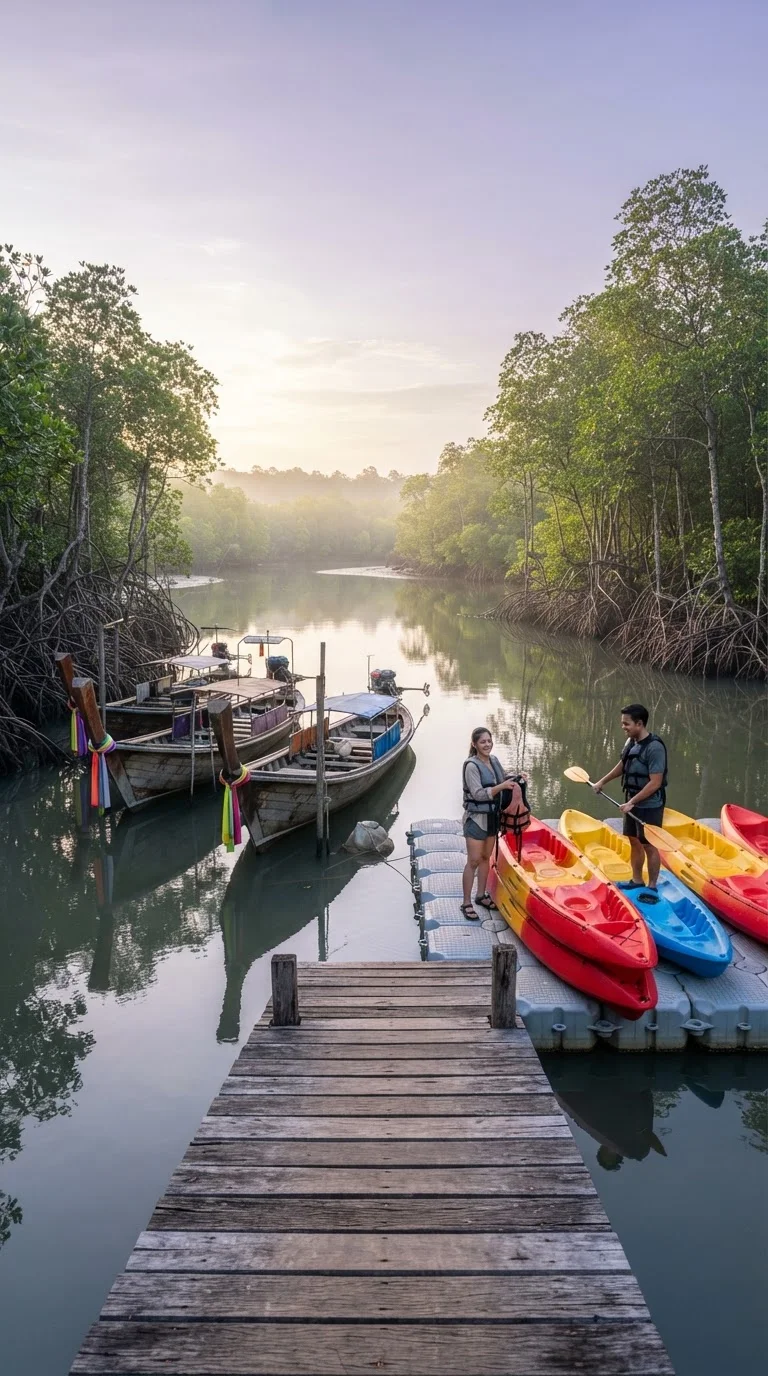
Choosing between a community-guided excursion and independent kayak hire hinges on your navigational confidence and local tidal literacy. Thailand’s estuarine ecosystems feature an intricate labyrinth of braided creeks where every bend looks remarkably similar once you penetrate beyond the main river mouth. Community-led eco-tourism cooperatives, such as the fishing collective at Ban Salak Khok on Koh Chang or the local village operators at Bang Rong in northeast Phuket, provide an immersive introduction to these waterways. Rather than operating as standard commercial concessions, these initiatives channel revenue directly into village conservation funds and community welfare. Across wider regional hubs like Krabi's Ao Thalane, standard guided half-day group paddles typically cost 800 THB to 1,200 THB (approx £18.20 to £27.30) per person. These outings employ local fishers who understand seasonal tide tables instinctively, knowing exactly which channels remain passable at specific lunar phases and where resident wildlife concentrates.
In contrast, self-navigated hourly rentals—available from mainland piers and village kayak stations for 100 THB to 200 THB (approx £2.30 to £4.50) per hour—grant complete solitude and freedom of pace. However, independent paddlers carry full responsibility for navigation. Standard mobile phone mapping and GPS receivers frequently fail under dense mangrove canopies, where overlapping foliage scatters satellite signals, and mobile reception weakens near karst cliffs and limestone fissures. Drifting into a side creek on a falling tide can swiftly leave you stranded in impassable, knee-deep silt. If you choose an unguided hire, ask the boatmaster for the local high-water time, secure an offline topographic satellite map, and establish a firm turn-around deadline at least ninety minutes before the tide turns, ensuring you return with the current rather than fighting an outgoing flush.
Booking a local community guide on your first visit to any estuarine network allows you to learn the navigable corridors and tidal landmarks before attempting solo exploration. Dedicated small-group and private outings cater to specialist requirements, matching departure times to ideal light and water levels.
| Format | Typical Cost (THB / GBP) | Navigational Complexity | Ideal Paddler Profile |
|---|---|---|---|
| Independent Hourly Pier Rental | 100–200 THB (approx £2.30–£4.50) per hour | High; requires manual route tracking and local tide awareness | Experienced paddlers wanting solitude along clearly defined main channels |
| Community Half-Day Guided Tour | 800–1,200 THB (approx £18.20–£27.30) per person | Low; led by village fishers familiar with changing water levels | Beginners, families, and nature enthusiasts seeking cultural and ecological insight |
| Small-Group Sunset Eco-Tour | 1,200–1,800 THB (approx £27.30–£40.90) per person | Low; includes transfers, guide, and post-paddle seafood dinner | Travellers wanting cooler afternoon temperatures and twilight bird activity |
| Private Expedition Charter | 2,500–3,500 THB (approx £56.80–£79.50) per boat | Customised; tailored timing mapped strictly to peak spring high water | Serious photographers and birdwatchers needing unhurried, silent access |
Arranging an organised excursion ensures you have verified safety equipment, route guidance, and an experienced local paddler who knows the channels intimately.
Tidal Windows, Channel Silt, and Grounding Protocols
Tidal variation is a decisive factor when paddling through shallow estuarine mangrove networks. Along Thailand's Andaman coast, including Phang Nga and Krabi, semi-diurnal tides produce two daily cycles with spring ranges often exceeding 2.5 metres. The Gulf of Thailand operates on mixed, predominantly diurnal tides with lower amplitudes, frequently producing a single usable high-water window each day. In both regions, a falling tide quickly drains secondary channels, turning navigable waterways into wide banks of exposed silt. Launching roughly two hours before peak high tide provides sufficient water depth to cross shallow bars, enter tight interior channels, and use the incoming current for inward momentum before riding the initial ebb back out.
If you misjudge the water level and find your kayak grounded on an exposed bank, stay seated inside the boat. Estuarine mangrove mud is unconsolidated and highly deceptive. Stepping overboard can cause you to sink past the knees into anaerobic silt, making walking nearly impossible while exposing feet and legs to lacerations and bacterial infections from hidden mangrove oyster clusters and broken shells. Instead, remain in the hull to distribute your weight across the surface. Lay your paddle blade flat against the mud to create a wide bearing surface, and lever the vessel backwards towards the deeper central channel. If the tide has dropped too far to push off, remain in the craft, stay shaded beneath the canopy, and wait for the incoming flood tide to refloat the hull.
Where to Kayak in Thailand's Mangroves
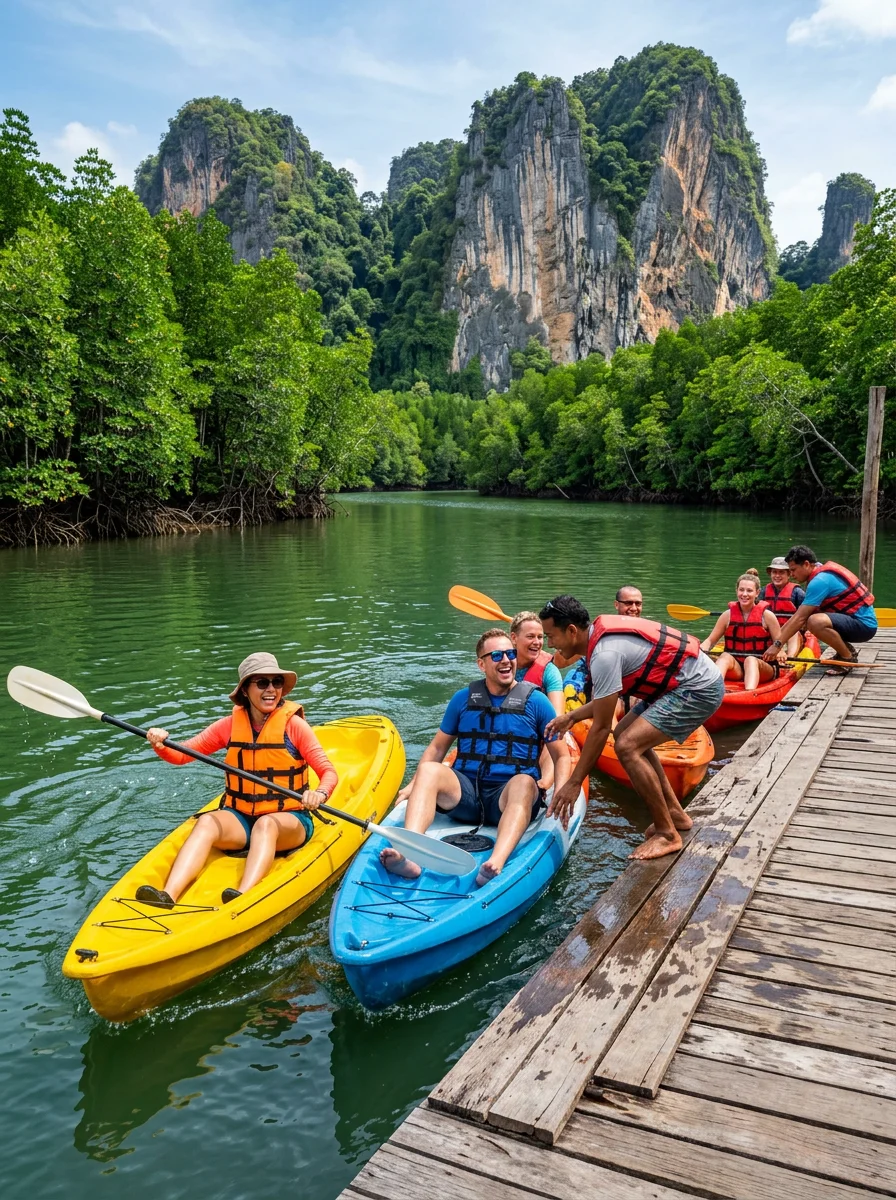
Thailand’s mangrove waterways span both maritime coastlines, presenting distinct paddling environments shaped by local geography. On the Andaman coast, Ao Thalane in Krabi is an established hub where tidal channels wind through towering limestone karst canyons, flooded caverns, and dense forest canopies. Half-day guided tours booked through established regional operators typically cost between 800 THB and 1,200 THB (approx £18 to £27). Further west, on Phuket’s north-east coast, Bang Rong Pier provides access to estuarine channels flowing past floating fish farms and coastal thickets into Phang Nga Bay. The surrounding Muslim fishing village runs an active community-based tourism cooperative that oversees local mangrove conservation; independent paddlers should contact the cooperative or enquire at the pier to confirm current hourly kayak hire rates.
Across the Gulf of Thailand, Ban Salak Khok sits on Koh Chang’s quiet south-eastern shore. Here, a community-run cooperative protects a sheltered mangrove basin, allowing paddlers to explore quiet channels flanked by stilt roots before opening into the wider bay. Independent kayak hire is arranged directly at the village pier, with current rates confirmed on arrival. Further north in Prachuap Khiri Khan, roughly 25 kilometres south of Hua Hin, Pranburi Forest Park protects estuarine wetlands along the Pranburi River. Established under royal initiative to restore former aquaculture land, the park features navigable river channels alongside raised boardwalks, with standard statutory entry fees levied by the forestry department for foreign adult visitors.
Water conditions differ between regions. Ao Thalane and Ban Salak Khok provide deep, enclosed channels largely protected from open-sea swell, whereas the river mouths at Bang Rong and Pranburi experience stronger tidal currents and frequent working longtail boat traffic.
Costs and Budgeting
Paddling Thailand's mangrove waterways remains an accessible outdoor activity, with options ranging from independent hourly rentals to fully guided excursions. Budget paddlers can hire a sit-on-top kayak from local village piers for 100 THB to 200 THB (£2.30 to £4.50) per hour, keeping total expenditure below 500 THB (£11.40) for a morning on the water.
Half-day guided group tours in primary mangrove hubs such as Ao Thalane typically cost between 800 THB and 1,200 THB (£18.20 to £27.30) per person. These trips include return minivan transfers from local resorts, an experienced guide, buoyancy aids, dry bags, and fresh drinking water. Afternoon sunset tours ending with a seaside barbecue or seafood dinner generally range from 1,200 THB to 1,800 THB (£27.30 to £40.90). For private tours with dedicated nature guides and schedules tailored to peak tides, budget between 2,500 THB and 3,500 THB (£56.80 to £79.50) per person.
Incidental costs are minimal but require cash in Thai baht. Mangrove routes traversing national parks or gazetted forest reserves charge foreign visitors a statutory entrance fee of 100 THB to 200 THB (£2.30 to £4.50). Carrying small cash notes is practical, as pier stalls rarely accept cards, and customary tips for local guides average 100 THB to 200 THB (£2.30 to £4.50).
| Option | Cost (THB) | Cost (GBP approx) | Notes |
|---|---|---|---|
| Independent Pier Kayak Hire | 100–200 THB | £2.30–£4.50 | Hourly rate at village piers; includes basic paddle and buoyancy aid |
| Half-Day Guided Group Tour | 800–1,200 THB | £18.20–£27.30 | Includes hotel minivan transfers, local guide, dry bag, and drinking water |
| Sunset Kayak Tour with Dinner | 1,200–1,800 THB | £27.30–£40.90 | Afternoon paddle avoiding midday heat, ending with a local barbecue meal |
| Private Eco-Guide & Boat Charter | 2,500–3,500 THB | £56.80–£79.50 | Custom timing matched to peak tide; dedicated nature guide and private vehicle |
| Protected Area / Park Entry | 100–200 THB | £2.30–£4.50 | Standard statutory entry fee levied at specific national parks and forest reserves |
What To Know Before You Go
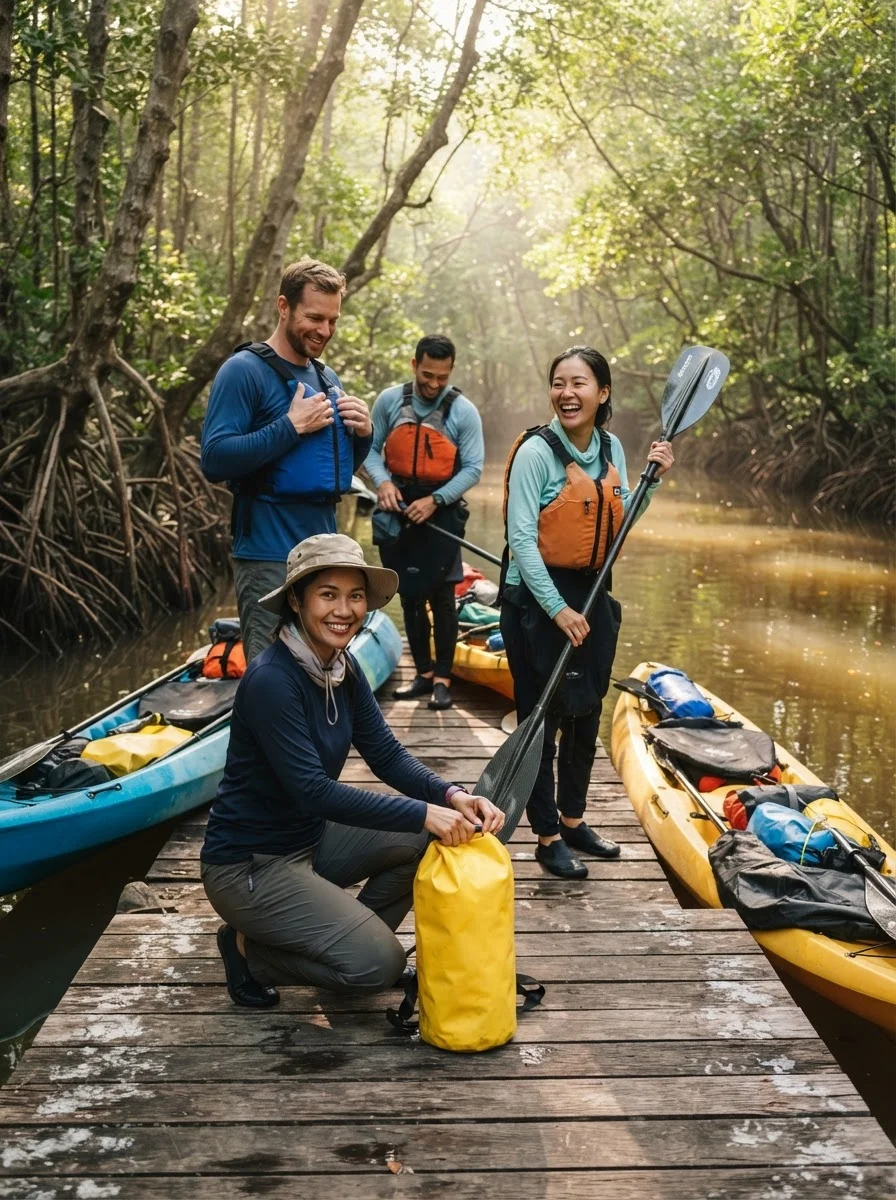
Paddling into a mangrove ecosystem requires practical preparation that differs markedly from open-sea kayaking. Departure times depend strictly on local water levels rather than personal convenience, as ebbing water can leave waterways impassable.
Clothing choices make a substantial difference to comfort. Long-sleeved rash vests and lightweight, quick-drying trousers prove far more sensible than standard swimwear. Dense mangrove stands shelter biting midges and mosquitoes in the humid, windless interior, while jagged stilt roots and low-hanging branches easily scratch exposed shoulders and arms.
Navigation requires self-reliance or local knowledge. Cellular reception drops quickly within tidal river networks, and multi-layered foliage can degrade mobile satellite positioning. From water level, repeating forks and identical walls of prop roots quickly disorient unguided paddlers, making a magnetic compass or an experienced local guide indispensable.
Cockpit discipline is equally critical. Secure every loose item inside a clipped, roll-top dry bag tethered firmly to your deck rigging. Habitual crab-eating macaques along channel bends frequently jump onto passing hulls to scavenge accessible provisions or plastic packaging. Any unsecured belonging knocked overboard vanishes immediately into opaque, silty sediment with virtually no chance of recovery.
Practical Tips
Launching on a rising tide approximately one to two hours before local high water gives you the easiest journey. The incoming current carries the kayak smoothly into the interior creeks and provides adequate water clearance above submerged root systems.
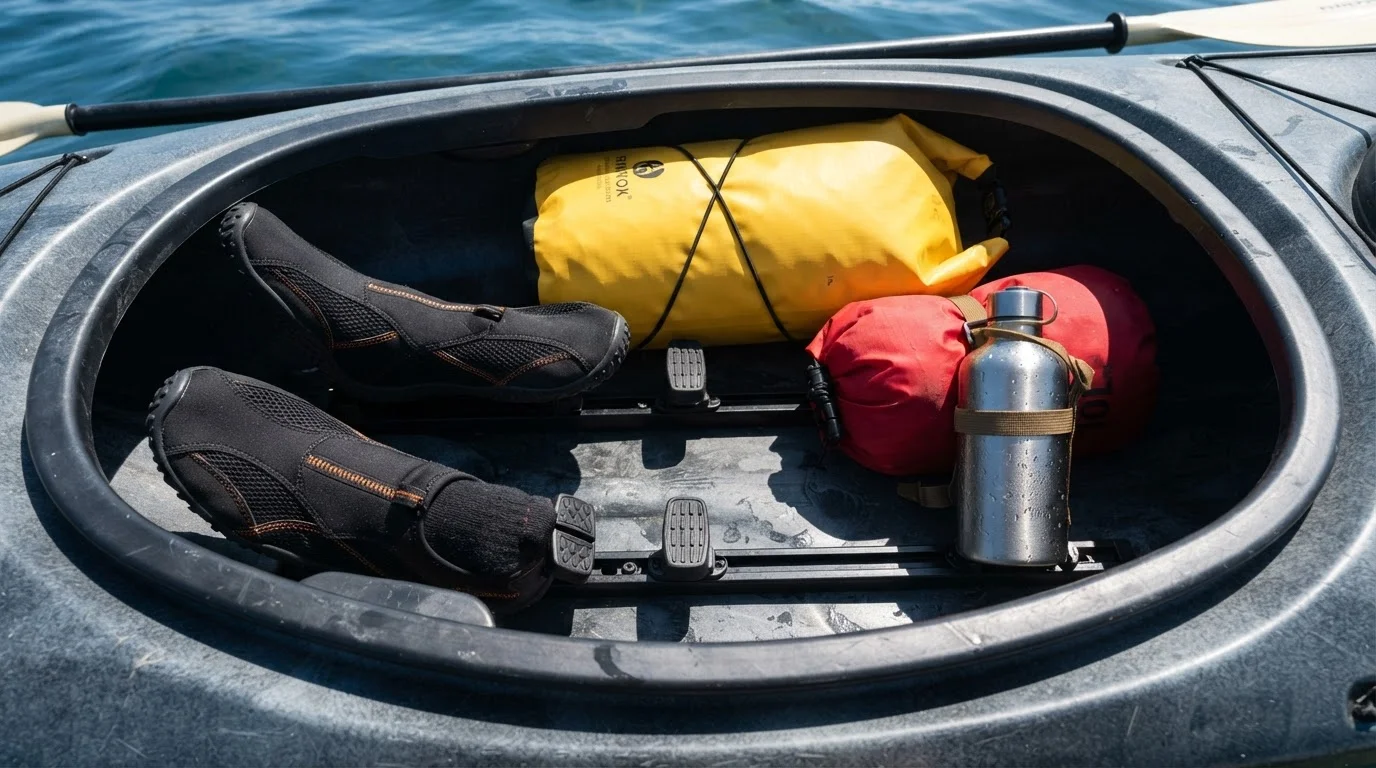
Thick-soled neoprene water booties or robust river shoes are far better than flip-flops or bare feet. Intertidal rock oysters encrust the lower roots and fallen branches throughout Thai estuaries; their razor-sharp shells easily slice through soft skin or thin foam soles if you need to steady the craft in shallow water.
Stow all snacks, sugary drinks, and plastic carrier bags entirely out of sight inside sealed dry bags. Coastal crab-eating macaques recognise plastic crinkling and clear drink bottles as food sources. If items are left exposed in an open cockpit, inquisitive monkeys will readily jump aboard the boat to grab them.
Apply insect repellent containing DEET or picaridin to your ankles, wrists, and neck before leaving the pier. Mangrove channels harbour biting midges that congregate in shaded, wind-sheltered backwaters where the lack of breeze allows swarms to gather undisturbed.
Carry at least two litres of fresh water per paddler for a half-day outing. Sheltered forest canopies trap moisture, pushing relative humidity towards eighty to ninety percent and accelerating dehydration through heavy perspiration, even at an easy paddling rhythm.
Tightly confined waterways call for short, high-angle paddle strokes. Keeping your paddle shaft relatively upright and the blades close to the kayak hull prevents you from clattering into overhanging stilt roots, which disrupts balance and damages blades. For sharp bends, quick draw strokes and gentle stern ruddering steer the hull far more neatly than wide sweep strokes.
Estuarine tidal flows can quietly sweep an untethered kayak off course within moments. When stopping to rest or take photographs, loop your painter line around a sturdy branch or trunk. Clip all loose items to deck bungees, as dropped objects vanish permanently into the murky silt.
Pack a reliable headtorch if embarking on a late afternoon or sunset outing. Natural light drops with remarkable speed beneath thick foliage once the sun dips behind adjacent karst ridges or tree canopies.
Compare certified mangrove eco-tours and reserve your tidal paddle slot across Thailand's premier estuarine reserves:
Quick Reference Table
| Item | Detail | Notes |
|---|---|---|
| Top Paddling Locations | Ao Thalane (Krabi), Bang Rong (Phuket), Ban Salak Khok (Koh Chang), Pranburi Forest Park | Enclosed karst canyons, community-run channels, and restored estuarine river wetlands |
| Independent Pier Hire | 100–200 THB (approx £2.30–£4.50) per hour | Sit-on-top polyethylene craft rented from village piers; requires self-navigation |
| Half-Day Guided Tour | 800–1,200 THB (approx £18.20–£27.30) per person | Includes local community guide, hotel minivan transfers, buoyancy aids, and dry bags |
| Sunset Tour with Dinner | 1,200–1,800 THB (approx £27.30–£40.90) per person | Avoids midday heat; includes guided afternoon paddle and seafood barbecue meal |
| Private Expedition Charter | 2,500–3,500 THB (approx £56.80–£79.50) per boat or person | Tailored departure strictly aligned with peak spring high water for photography and birding |
| Protected Area Entry | 100–200 THB (approx £2.30–£4.50) | Statutory cash fee for foreign adults at gazetted national parks and forest reserves |
| Tidal Launch Window | 1–2 hours before local high water | Flood tide provides inward momentum and adequate clearance over shallow root shelves |
| Grounding Emergency Protocol | Remain seated in the hull; never step overboard into deep silt | Push off using flat paddle blade or stay shaded under canopy until the flood tide returns |
| Paddling Technique | Compact, high-angle strokes; draw strokes and stern ruddering | Avoid wide sweeps, deployable skegs, or rudders that snag on submerged roots and mud |
| Recommended Clothing | Long-sleeved rash vest, quick-drying trousers, neoprene river shoes | Protects against biting midges, harsh sun, scratching timber, and sharp rock oysters |
| Wildlife Safety & Etiquette | Maintain 10m buffer; stow all food and drinks inside sealed dry bags | Prevents opportunistic macaque raids; never grab overhead branches where pit vipers rest |
| Essential Supplies | Minimum 2 litres of drinking water per person, insect repellent, headtorch | Enclosed canopies trap 80–90% humidity; headtorches essential for late afternoon runs |
| Official Website | Bang Rong Community-Based Tourism (bangrongconnect.com) | Community eco-tourism cooperative managing mangrove tours in northeast Phuket |
| Website | Bang Rong Pier (bangrongpier.com) | Mainland departure pier for northeast Phuket estuarine channels and boat services |
| Book Direct | Ban Salak Khok Local Tour Club (+66 8 7748 9497) | Local fishing cooperative running community mangrove kayak hire in southeast Koh Chang |
FAQ: Mangrove Kayaking
How does kayaking in mangrove forests differ from open-water sea kayaking?
What type of kayak is best for paddling in Thai mangroves?
What are the risks of paddling near mangrove roots?
How should kayakers observe wildlife ethically in Thai mangroves?
How can kayakers avoid issues with crab-eating macaques in mangrove areas?
What safety precautions should kayakers take regarding snakes in mangroves?
What are the pros and cons of independent kayak hire versus a guided tour in Thai mangroves?
What is the best time to launch a kayak in Thailand's mangrove channels?
What should a kayaker do if their boat gets grounded on a mudbank in the mangroves?
What kind of clothing is recommended for mangrove kayaking in Thailand?
Reviewed by the Thailand Guide Editorial Team • Last reviewed: 17 November 2026
This page is provided for general information only. While we aim for accuracy, details can change — please verify anything important independently before relying on it.