Kayaking in Phuket


Beyond the crowded speedboat corridors of the Andaman Sea, kayaking along Phuket’s immediate coastline reveals sheltered granite coves, offshore islets such as Koh Man, and estuarine mangrove waterways that remain inaccessible to motorised craft. Launching from southern beaches like Ya Nui to circle coastal reefs or paddling into the winding tidal channels of Bang Rong connects visitors directly with working fishing communities and protected marine ecosystems. The island presents distinct geographic zones for paddlers: exposed southern and western headlands provide open-sea routes over clear water, while the eastern coast shelters extensive mangrove estuaries and quiet bays.
On-island paddling operates primarily across two models: independent sit-on-top rentals hired by the hour from beach vendors, and guided eco-tours led by community enterprises or licensed marine outfitters. Distinct from full-day boat excursions into the dramatic limestone karst of neighbouring Phang Nga Bay, paddling within Phuket focuses entirely on the island’s own perimeter and tidal rivers. This setup avoids the rigid schedules and high fuel surcharges of motorised tours, giving independent travellers, couples, and active families a self-paced way to explore marine wildlife and coastal landscapes without leaving the island.

Southern Coastal Headlands and Offshore Islands
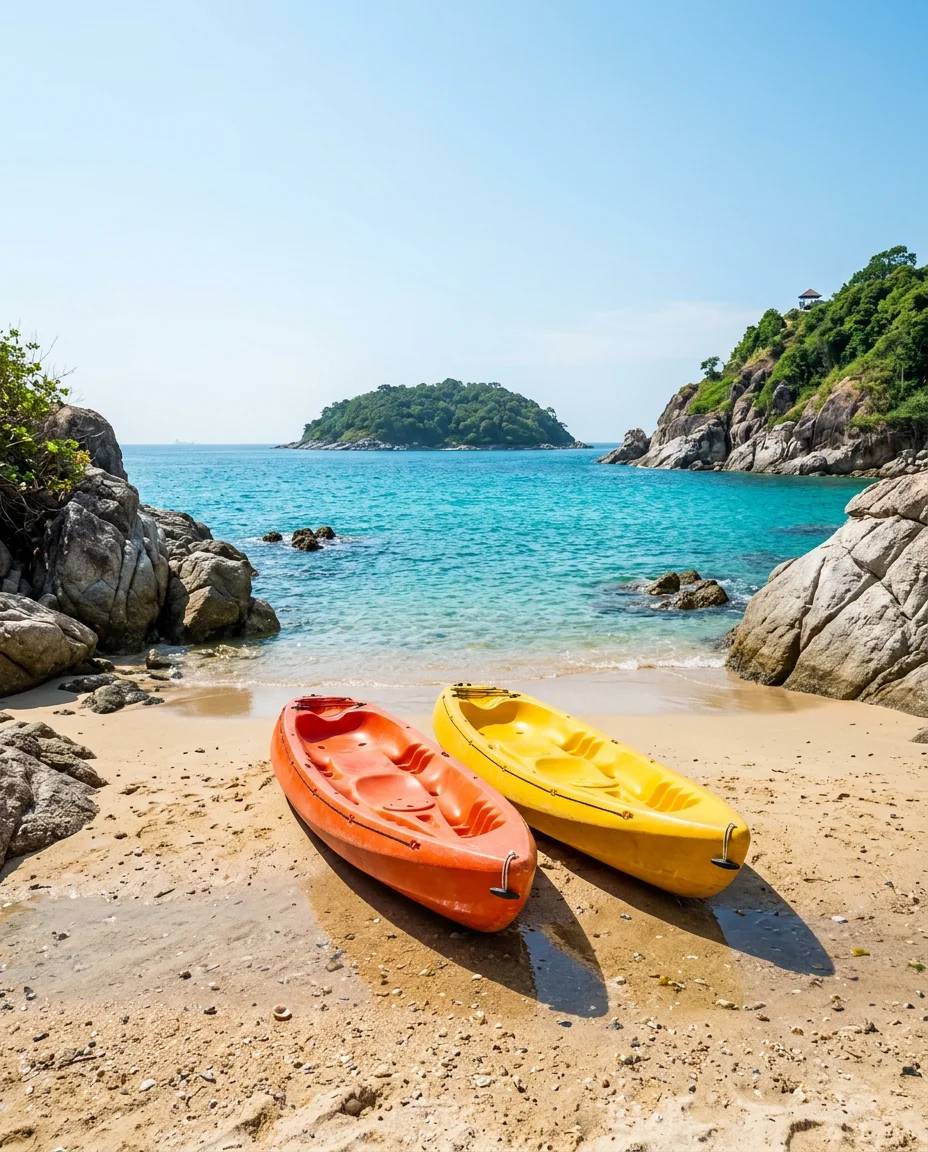
Phuket's southern and south-eastern coastlines provide two contrasting coastal kayaking environments, dividing between exposed granite headlands and sheltered all-weather bays.
Ya Nui and Southern Headlands
Independent sea kayaking in the far south centres on Ya Nui Beach, a compact cove located between the Windmill Viewpoint and Promthep Cape in Rawai. From Ya Nui's sand, paddlers tackle a channel crossing of roughly 400 metres to Koh Man, an uninhabited granite islet. The eastern side of Koh Man lies in the island's lee, providing flat water and shallow coral patches suitable for snorkelling, whereas its exposed western flank faces open-ocean waves. Local beach vendors hire single and tandem sit-on-top plastic kayaks on a walk-up basis, typically charging between 200 THB and 300 THB (£4.60 to £7) per hour, with paddles and basic buoyancy aids included.
Experienced sea kayakers sometimes extend their route northward around the rocky cliffs into Ao Sane and Nai Harn Bay, or eastward towards Promthep Cape and Koh Bon. However, open-ocean swells rebounding off the steep granite headlands generate confused chop and heavy backwash. Launching between 08:00 and 10:30 secures the calmest water before midday thermal breezes and tide changes agitate the channel. Crossing to Koh Man early in the morning ensures you complete the open-water transit before afternoon winds build up across the passage.
Sheltered Eastern Bays and Cape Panwa
In contrast to the exposed south-western coastline, the eastern littoral benefits from deep natural protection against the prevailing southwest monsoon. Ao Yon, positioned along the southern flank of Cape Panwa, serves as the island's primary all-season coastal paddling location. When western beaches face breaking surf and red-flag closures between May and October, Ao Yon remains calm because the Panwa peninsula blocks incoming ocean swells. The bay has a gently sloping sand seabed with negligible shore break, making launches straightforward at most tides. Watersports operators along the beach rent single and tandem sea kayaks for approximately 300 THB (£7) per hour or 800 THB (£18.50) for a full day. Paddling out from Ao Yon leads past local pearl-farming floats to quiet sandy coves and rocky outcrops that cannot be reached by road.
North of Cape Panwa, Chalong Bay presents a broader coastal touring ground. Paddlers must maintain constant vigilance around working boat traffic, including longtails, dive tenders, and speedboats using the primary navigation channels around Chalong Pier. Directly across from the mainland lies Koh Lon, an agricultural and fishing island spanning four kilometres in length. The open crossing from Phuket's eastern shore across to Koh Lon measures roughly two kilometres and requires 40 to 45 minutes of steady paddling. Koh Lon features quiet sand spits, fringing mangroves, and unpaved village footpaths free from motor traffic, providing an accessible island-crossing itinerary for intermediate sea kayakers.
Estuarine Mangroves and Tidal Forest Channels
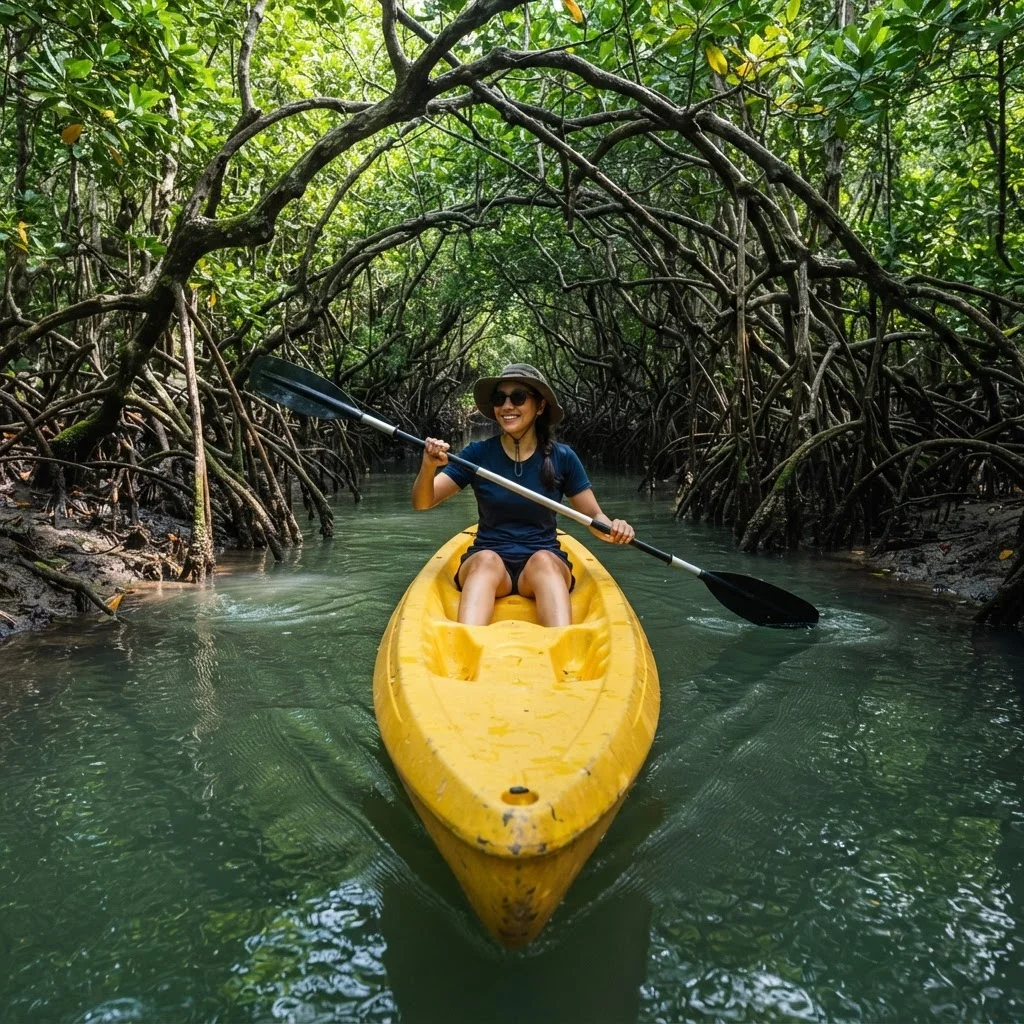
Phuket's eastern and northern river mouths preserve substantial mangrove wetlands that provide a sheltered paddling environment shielded from open ocean swell. Unlike the exposed surf beaches of the west coast, these tidal estuaries remain flat throughout the southwest monsoon, making them dependable year-round waterways for touring kayaks and open sit-on-tops.
The primary gateway for estuarine paddling is Ban Bang Rong, a traditional Muslim fishing village in Pa Khlok along Phuket's northeastern shore. Launching from the floating pontoon and wooden walkways beside Bang Rong Pier, paddlers head directly into Khlong Bang Rong. This tidal river splits into narrow channels that twist through mature stands of Rhizophora mangroves and past traditional stilt houses and floating fish farms. Community-based tourism initiatives hire kayaks directly at the waterfront. Paddling quietly along these brackish waterways often brings kayakers close to crab-eating macaques, mudskippers, fiddler crabs, and striated herons hunting along the muddy shorelines.
At Phuket's northern tip near the Sarasin Bridge, Sirinat National Park encompasses the Tha Chatchai mangrove forest, managed alongside the local Marine National Park Research Centre. A 600-metre raised wooden boardwalk guides walkers over the mudflats, while parallel water routes allow kayakers to follow designated paddling circuits between 800 metres and two kilometres in length. Here, dense canopies drop low over the water, requiring paddlers to duck beneath arching prop roots and overhanging branches.
In southern Phuket, Khlong Mudong near Ban Bo Rae provides an estuarine route on the eastern side of Chalong Bay. Kayaks launched from local piers glide past working longtail moorings and stilt-borne seafood huts before entering winding forest reaches. Plan estuarine paddles around mid-tide: low water leaves shallow creeks grounded in impassable mud, whereas peak high tide submerges the root systems and leaves little overhead clearance beneath the canopy.
Discover Phuket's diverse landscapes, from granite mountains and tropical forests to stunning beaches and eastern bays. Plan your Thai island adventure now!
Guided Excursion Formats and Independent Logistics
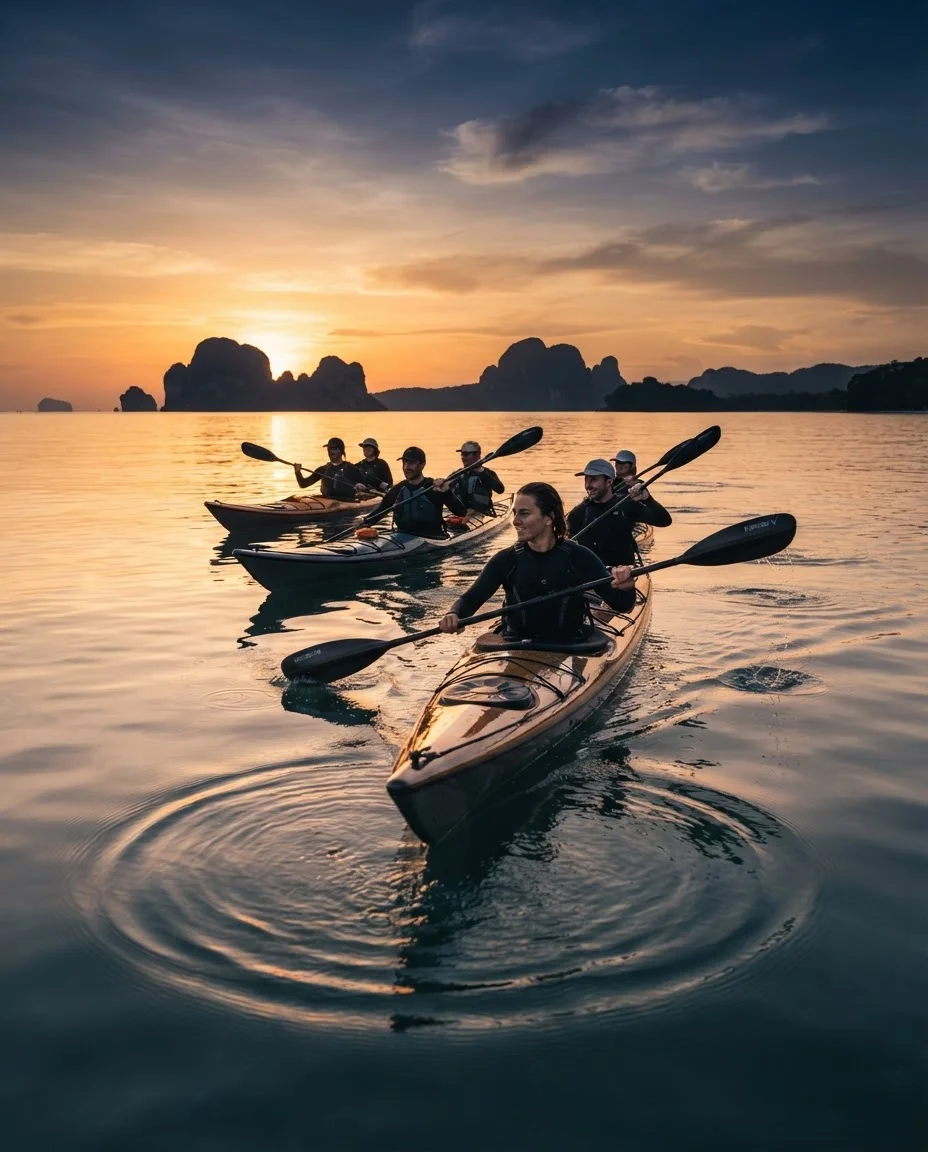
Paddlers exploring Phuket choose between informal beach-based hires and structured guided excursions, each answering distinct technical requirements and tidal conditions. Self-directed rentals operate across sheltered bays and calm-season tourist beaches, including Ya Nui, Ao Yon, Nai Yang, and Kata. At these locations, beach vendors hire out rotomoulded sit-on-top craft by the hour or half-day. These open-deck plastic kayaks are exceptionally buoyant and stable, fitted with self-draining scupper holes, moulded foot braces, and double-bladed paddles. Because they require no formal wet-exit training or roll techniques, novices can take to the water immediately for casual shoreline pottering, headland exploration, or short hops to nearby islets.
In contrast, navigating Phuket's tidal estuaries and mangrove waterways demands a structured guided approach. The island's eastern drainage systems, such as the extensive creeks around Bang Rong and the saltwater channels of Tha Chatchai in Sirinat National Park, present labyrinthine routes where channels branch repeatedly into dead ends. Guided tours run by community cooperatives and professional eco-paddlers supply route leadership, buoyancy aids, and commercial dry bags. Local guides track tidal curves closely, steering groups into interior creeks at mid-to-high tide and navigating through narrow root tunnels before low water exposes impassable mudflats. Several community-run itineraries also combine paddling with walks through coastal community plantations or lunches at floating seafood restaurants.
Choosing between independent and guided paddling depends heavily on wind exposure, open-water currents, and the complexity of the coastline. Independent rentals give complete freedom of pace in well-defined bays, whereas guided excursions prevent paddlers from being stranded by fast-receding spring tides in mangrove river mouths or swept off course by coastal currents. For travellers comparing paddling destinations across southern Thailand, our Kayaking in Krabi guide explains how mainland karst canyons differ from Phuket's mix of coastal coves and mangrove creeks.
| Paddling Zone | Water Conditions | Typical Route & Distance | Suited Skill Level |
|---|---|---|---|
| Ya Nui to Koh Man | Open coastal sea; moderate chop | 350 m open-channel crossing each way | Intermediate |
| Ao Yon Bay | Sheltered basin; calm year-round | 2 to 3 km headland and cove circuit | Beginner to all levels |
| Bang Rong Mangroves | Tidal estuarine channels; zero swell | 3 to 4 km winding creek loop | Beginner and families |
| Tha Chatchai (Sirinat) | Enclosed saltwater mangrove swamp | 1.5 to 2 km sheltered loop | Beginner |
| Kata Beach to Koh Pu | Open sea; calm in high season only | 1 km offshore island circumnavigation | Intermediate to advanced |
Choose independent rentals for straightforward coastal coves in fair weather, but book guided community tours when navigating intricate mangrove creek systems prone to tidal stranding.
Location and Getting There
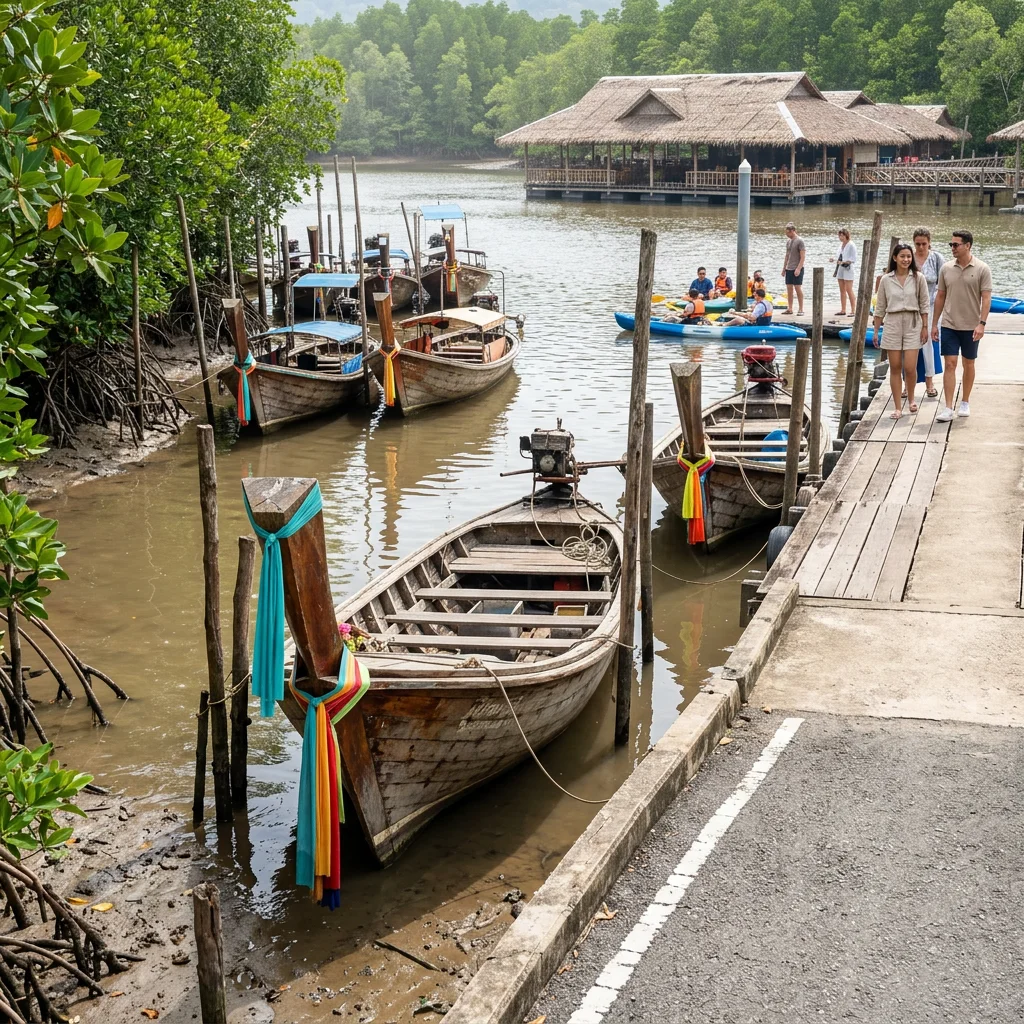
Phuket's kayaking launch sites are distributed across the island's southern, eastern, and northern coasts rather than concentrated at a single marina.
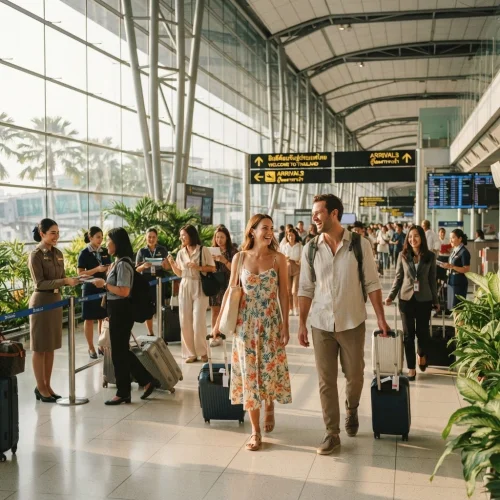
Ya Nui Beach lies in Rawai sub-district at Phuket's southern tip, approximately 48 kilometres south of Phuket International Airport (HKT). A taxi or ride-hailing transfer takes around 70 minutes and typically costs between 900 THB and 1,100 THB (£21 to £25.50). Budget travellers can take the Phuket Smart Bus from the airport to Rawai for a 100 THB flat fare before making the short final connection to the cove.
Ao Yon sits on Cape Panwa in Mueang Phuket district, roughly 42 kilometres south of the airport and 15 minutes from Phuket Old Town, with taxi transfers costing around 800 THB (£18.50).
For mangrove paddling, Bang Rong Pier lies in Pa Khlok in Thalang district, approximately 18 kilometres east of the airport via Route 4027, taking 25 to 30 minutes by taxi (roughly 500 THB to 600 THB / £11.50 to £14).
Tha Chatchai sits at the island's northern tip alongside Route 402, roughly 15 kilometres north of the airport, reached in 15 to 20 minutes by taxi for approximately 400 THB (£9.30).
Ride-hailing applications like Grab and Bolt operate reliably across the island, with designated pick-up areas outside the airport arrivals hall. Traditional blue songthaews also run daytime routes from Phuket Old Town to Rawai and Cape Panwa.
Costs and Booking
Kayaking expenses across Phuket divide into casual beach hires and organised guided eco-tours. Beach rentals for single and double sit-on-top kayaks charge flat hourly rates of 100 THB to 300 THB (£2.30 to £7), with full-day hires settling between 600 THB and 900 THB (£14 to £21). These shoreline setups operate on a walk-up, cash-only basis at bays like Ya Nui, Ao Yon, and Nai Yang. Vendors do not demand cash deposits, typically noting a hotel room number or holding photographic identification. Hires include the kayak, double-bladed paddles, and buoyancy aids.
Guided mangrove excursions and community eco-packages range from 800 THB to 2,500 THB (£18.50 to £58) per person. Half-day community tours in Bang Rong cost 800 THB to 1,500 THB (£18.50 to £35), providing a local guide, equipment, and light refreshments. Full-day packages at 1,800 THB to 2,500 THB (£42 to £58) combine hotel transfers, Tha Chatchai mangrove paddling, rainforest trails, and lunch. Paddling within Sirinat National Park requires an official entrance fee of 200 THB (£4.60) for foreign adults and 100 THB (£2.30) for foreign children, which organised tours either bundle or collect at the ranger checkpoint.
| Option | Cost (THB) | Cost (GBP) | Details |
|---|---|---|---|
| Hourly Beach Kayak Hire | 100 to 300 per hour | £2.30 to £7 | Walk-up rate at Ya Nui, Ao Yon, or Nai Yang; includes paddle and life vest |
| Full-Day Independent Rental | 600 to 900 per day | £14 to £21 | Beach vendors or outfitters; includes buoyancy aid and optional dry bag |
| Half-Day Bang Rong Mangrove Tour | 800 to 1,500 per person | £18.50 to £35 | Guided paddle through tidal channels; includes local guide and light refreshments |
| Full-Day Eco-Kayak & Trekking Tour | 1,800 to 2,500 per person | £42 to £58 | Includes transfers, Tha Chatchai mangroves, guided rainforest walk, and lunch |
| Sirinat National Park Entry Fee | 200 per adult / 100 per child | £4.60 / £2.30 | Government admission fee when launching inside national park boundaries |
Beach hires require no reservations, but carry small Thai Baht notes as vendors do not accept payment cards. High season (November to April) maintains firm beach rates. During the southwest monsoon (May to October), vendors on sheltered eastern bays like Ao Yon often agree to negotiated multi-hour rates. Guided tours run year-round on sheltered channels and should be booked one or two days ahead, with operators rescheduling or refunding if squalls prevent launching.
Who It Suits
Kayaking around Phuket suits active travellers, couples, and outdoor enthusiasts who prefer independent exploration to motorised group excursions. Because paddling requires sustained physical exertion under tropical humidity, it appeals to those comfortable with steady cardiovascular activity and open-air conditions.
Families travelling with children generally fare well in sheltered environments, provided they use tandem sit-on-top craft. The protected waters of Ao Yon on the southeast coast and the winding mangrove channels around Bang Rong provide gentle paddling conditions without breaking surf. Wildlife photographers and birdwatchers will also appreciate these tidal estuaries, where quiet approaches allow unhurried views of kingfishers, brahminy kites, egrets, and water monitor lizards.
By contrast, the island is not geared towards visitors expecting dramatic karst landscapes. Phuket’s native shoreline comprises granite headlands, sandy coves, and mangrove waterways. Anyone specifically seeking sheer limestone towers, tidal caves, or enclosed sea lagoons known as hongs should book an excursion into Phang Nga Bay instead.
What to Know Before You Book
Phuket experiences a semidiurnal tidal cycle with tidal ranges reaching approximately 2.5 to 2.6 metres during spring tides, according to Royal Thai Navy hydrographic records. Launching into estuarine mangrove channels around low water risks leaving paddlers stranded on exposed mudflats where navigating is impossible until the tide returns. Checking local tide tables before planning a departure is necessary for any estuarine route.
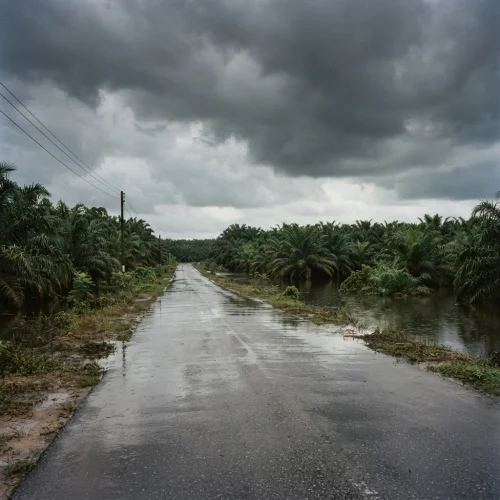
Seasonal weather dictates where you can take to the water. Between May and October, the southwest monsoon drives heavy ocean swells, crashing surf, and hazardous rip currents directly onto Phuket's exposed western beaches. Coastal paddling during these months shifts to sheltered eastern bays such as Ao Yon or protected inland mangrove waterways, where headlands and dense root systems block open swells.
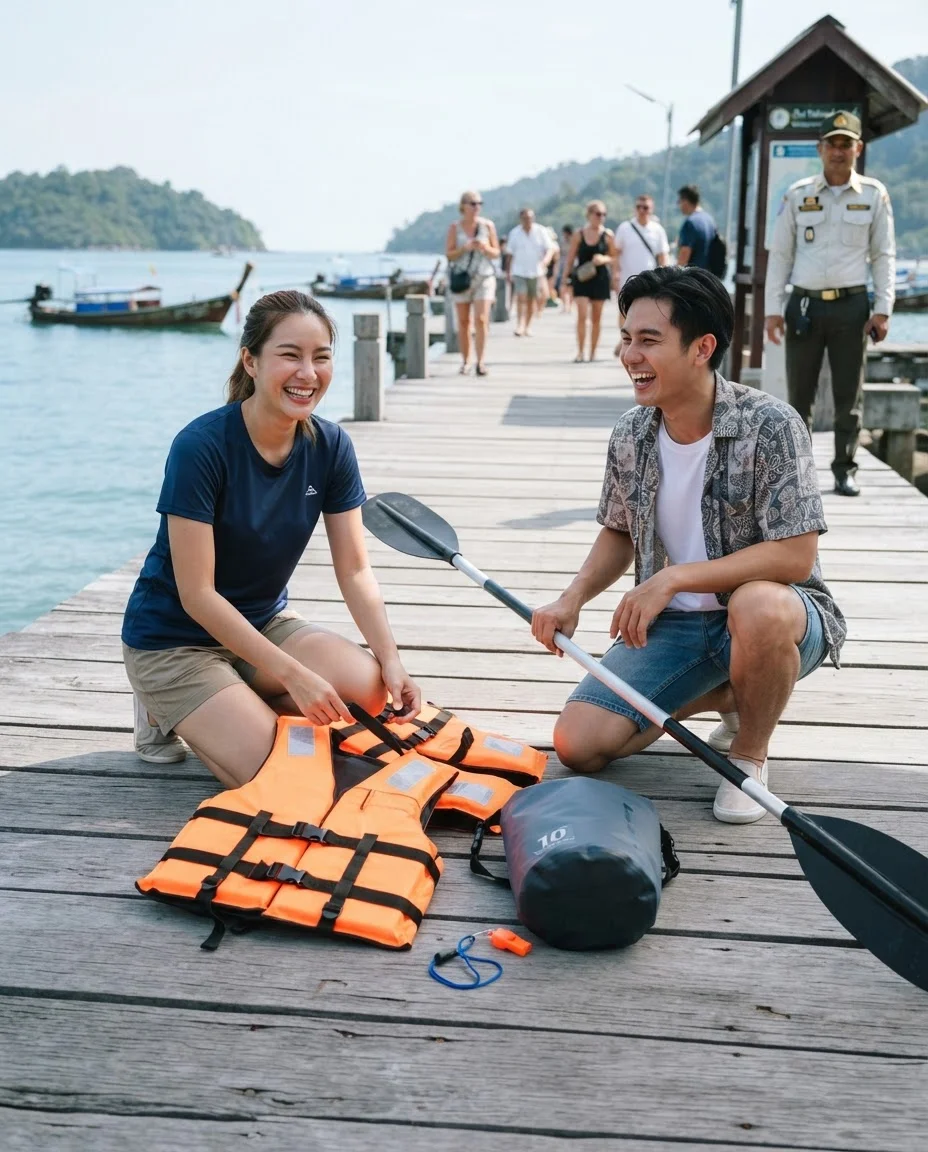
Independent beachfront kayak vendors rarely carry third-party liability insurance or international safety accreditations. Before pushing off from the sand, inspect the hull for cracks, check that drain bungs are sealed, and verify that buoyancy aids fit snugly and provide genuine flotation. Tropical ultraviolet radiation also reflects intensely off the water; high-protection sunscreen, polarised sunglasses, and UV-rated rash vests prevent rapid sunburn, even under overcast skies.
Practical Tips
Check the Thai Meteorological Department marine forecast before heading out on the water. Sudden tropical squalls develop rapidly across the Andaman Sea, bringing gusty winds that reduce visibility and create hazardous offshore surface drift within minutes.
Inspect any rental sit-on-top craft before paying your fee or launching from the beach. Check the scupper holes, drain bung, and hull seams for hairline cracks or deep gouges. Cracked rotomoulded plastic hulls can slowly take on water between the double walls, which reduces buoyancy and makes the kayak sluggish and unstable to steer. Ensure the buoyancy aid fits snugly and has working buckles.
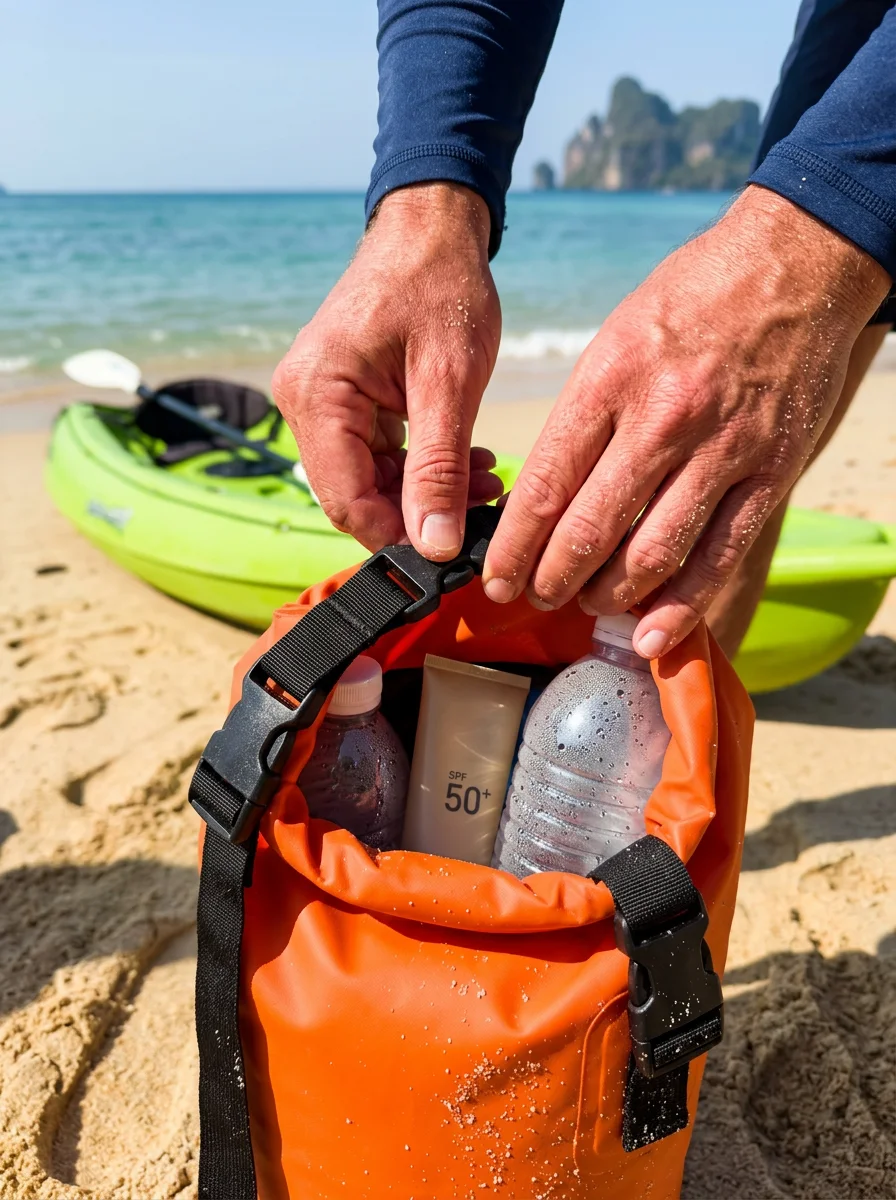
Bring a dedicated marine-grade dry bag for phones, keys, and cameras. Beachside hire stalls often hand out complimentary dry sacks, but these loan bags are frequently worn, creased, and prone to minor seepage when resting in wet footwells.
Wear secure, strap-on water shoes or neoprene booties rather than loose flip-flops. Mangrove channels and rocky headlands conceal submerged granite shelves and dense clusters of sharp oyster shells that easily lacerate bare feet during shallow-water landings.
Pack at least 1.5 litres of fresh drinking water per person for a typical two-hour paddle. High tropical humidity, strong salt air, and physical exertion accelerate dehydration, leading to fatigue far from shore.
Secure your paddle to the boat with a leash when stopping for a swim or snorkelling over shallow reefs. Unanchored paddles can quickly drift away in tidal currents, leaving you stranded.
Avoid feeding or approaching crab-eating macaques along mangrove banks. These wild primates readily recognise plastic packaging and bags, becoming aggressive and occasionally attempting to board low-riding kayaks in search of snacks.
Quick Reference Table
| Item | Detail | Notes |
|---|---|---|
| Hourly Beach Hire | 100 to 300 THB (£2.30 to £7) per hour | Walk-up cash rentals at Ya Nui, Ao Yon, and Nai Yang; includes paddle and buoyancy aid |
| Full-Day Independent Rental | 600 to 900 THB (£14 to £21) per day | Available from beach vendors and local outfitters (Ao Yon full-day rental roughly 800 THB / £18.50) |
| Half-Day Guided Mangrove Tour | 800 to 1,500 THB (£18.50 to £35) per person | Community-based tours in Bang Rong; includes route guide and light refreshments |
| Full-Day Eco-Kayak & Trekking | 1,800 to 2,500 THB (£42 to £58) per person | Combines Tha Chatchai mangroves, rainforest trail walking, lunch, and return hotel transfers |
| Sirinat National Park Fee | 200 THB (£4.60) adult / 100 THB (£2.30) child | Mandatory government entry charge for foreigners paddling in Tha Chatchai waterways |
| Primary Coastal Launch Sites | Ya Nui Beach (south) & Ao Yon (Cape Panwa) | Ya Nui accesses Koh Man (350–400 m crossing); Ao Yon provides year-round sheltered paddling |
| Primary Mangrove Launch Sites | Bang Rong Pier (northeast) & Tha Chatchai (north) | Enclosed tidal estuaries and Rhizophora channels sheltered from open Andaman Sea swell |
| Recommended Launch Window | 08:00 to 10:30 for open-sea routes | Early starts avoid midday thermal winds, confused channel chop, and afternoon surface drift |
| Tidal Variations | 2.5 to 2.6 m tidal range on spring tides | Semi-diurnal tides; estuarine mangrove routes require mid-tide to avoid grounding in shallow mud |
| Monsoon Considerations | May to October (southwest monsoon) | Western surf beaches become hazardous; coastal paddling shifts to sheltered eastern bays and mangroves |
FAQ: Kayaking in Phuket
What is the best time to launch a kayak for calm water around Ya Nui Beach?
Where can I kayak in Phuket during the southwest monsoon season?
What is the best tide level for kayaking in Phuket's mangrove estuaries?
When should I choose an independent kayak rental versus a guided tour in Phuket?
What payment method should I use for beach kayak rentals in Phuket?
What kind of landscapes can I expect when kayaking in Phuket?
Why is it important to check tide tables before kayaking in Phuket's mangrove channels?
What safety checks should I perform before using a rented kayak in Phuket?
What kind of footwear should I wear for kayaking in Phuket?
Should I feed the crab-eating macaques while kayaking in Phuket's mangroves?
Reviewed by the Thailand Guide Editorial Team • Last reviewed: 17 November 2026
This page is provided for general information only. While we aim for accuracy, details can change — please verify anything important independently before relying on it.