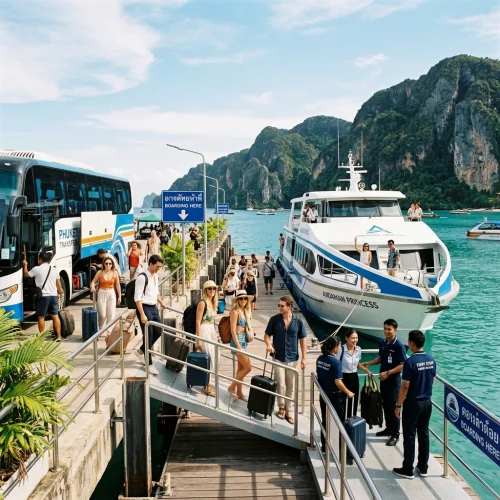
Bookings for combined transport journeys across Thailand increased by 49 per cent in 2025, driven by travellers using linked road, rail and ferry services to reach provincial destinations.
Data released by ticketing platform 12Go shows this growth outpaced the 40 per cent increase recorded for single-mode domestic trips during the same period. Combined transport routes, which link coaches or minivans with marine crossings, represented a significant portion of internal movement, with 88 per cent of these journeys terminating on an island.
The figures reflect an operational shift in how long-term foreign residents and relocating expatriates navigate the country. Rather than relying exclusively on domestic air routes between major hubs, travellers are using single-ticket ground networks to bypass regional airports entirely.
Shift Away from Domestic Flights
British expatriates living in Thailand face distinct logistical choices when travelling outside Bangkok. Domestic aviation provides speed between primary hubs such as Chiang Mai, Phuket and Samui, but it entails ancillary costs that accumulate quickly. Baggage fees, airport transfers and transit delays often reduce the efficiency of short-haul flights.
Combined ground and sea routes offer an alternative pricing structure. Minivans and long-distance coaches operating from Bangkok terminals connect directly to coastal piers, where ferry boarding passes are issued as part of a single itinerary.
This model reduces transit friction. It eliminates the need to change transport providers at regional hubs. For British residents managing monthly living budgets, the price stability of fixed-rate road tickets avoids the seasonal price surges standard across domestic flight schedules during peak dry-season months.
The route between Bangkok and Koh Chang recorded a 77 per cent increase in bookings in 2025, making it the most utilised combined corridor on the platform. Situated in Trat province, Koh Chang lacks a commercial airport on the island itself. Reaching the island previously required either an expensive private transfer, an indirect domestic flight to Trat Airport followed by private taxis, or navigating separate public bus and ferry ticket counters. The consolidation of coach connections directly from Bangkok terminals to the Ao Thammachat and Centrepoint piers has standardised the crossing into a six-to-eight-hour overland journey.
A similar pattern emerged on the route from Bangkok to Koh Samet, which recorded a 56 per cent year-on-year increase. The island relies entirely on pier transfers from Ban Phe in Rayong province. Direct road-to-boat ticketing has made the route a primary weekend corridor for foreign residents based in the capital.
Cross-Peninsula Transit Corridors
The data shows substantial movement between Thailand’s western Andaman coastline and the Gulf of Thailand. Bookings on the route connecting Ao Nang in Krabi to Koh Samui rose by 513 per cent year on year.
This represents the fastest-growing transit corridor in the country. The route between Krabi town and Koh Samui expanded by 60 per cent, while journeys from Koh Tao to Ao Nang grew by 87 per cent.
Cross-peninsula transit has historically presented logistical difficulties for residents without private transport. A road journey from Krabi to the ferry ports of Surat Thani spans roughly 160 kilometres, followed by an offshore sea crossing of up to two hours. Independent transport operators frequently ran irregular services with variable safety standards and inconsistent departure times.
Commercial operators now coordinate coach arrivals with passenger ferry departures at Donsak Pier. This timetable alignment cuts layover intervals. It also provides an overland alternative to direct inter-island flights, which remain among the most expensive domestic routes in Southeast Asia due to private airport ownership on Koh Samui. British nationals residing in the southern provinces can now move between eastern and western coastlines without paying commercial aviation premiums.
Consolidation of Digital Ticketing
The fragmentation of Thailand’s transport sector has long posed challenges for newly arrived expatriates. Hundreds of independent minivan companies, state-run bus networks and private marine operators have traditionally handled ticket sales through local kiosks, telephone reservations or Thai-language booking desks.
Platform aggregation is standardising these operations. In 2025, 12Go processed more than 8.7 million tickets, covering roughly 730,000 routes operated by 20,000 regional transport providers.
The introduction of natural-language booking systems has accelerated this shift. Travellers can now enter broad origin and destination parameters into automated interfaces, which generate continuous itineraries using differing transport types.
The software selects matching transfer windows between regional buses, private minivans and speedboats. This capability reduces the language barrier that often complicates provincial travel. It also standardises refund terms, seat selection rules and luggage allowances under unified terms of carriage.
Logistical and Safety Considerations
Despite operational improvements, combined transport introduces variables that British expatriates must evaluate. Road transport in Thailand carries higher statistical safety risks than domestic rail or aviation. Minivan fleets operating along high-speed corridors have faced regulatory scrutiny regarding driver working hours, mechanical maintenance and speed compliance.
Journey times remain vulnerable to infrastructure constraints. Highway maintenance, seasonal agricultural transport and local holiday traffic frequently cause delays on major arteries such as Route 4 and Route 3.
Expatriates planning connections must build conservative buffers into their itineraries. Missing a scheduled ferry due to highway congestion can result in overnight delays at mainland ports, as marine operators generally suspend sailings after dark due to navigational safety rules.
Monsoonal weather patterns also dictate marine schedules. Between May and October, Andaman sea crossings face cancellations due to rough swell conditions, while Gulf routes experience similar disruptions during the northeast monsoon later in the year. Single-platform tickets generally provide rebooking or refund mechanisms during weather cancellations, but passenger transfers between transport modes remain subject to maritime authority directives.
Long-Term Impact on Expatriate Relocation
The expansion of linked regional transit is altering settlement patterns for foreign nationals moving to Thailand. Traditionally, British retirees and remote workers concentrated their housing searches within urban areas served by international airports, such as central Bangkok, Chiang Mai city and central Phuket.
Access to regional destinations without private car ownership makes provincial relocation viable for a broader demographic. Secondary towns and quieter coastal areas are now connected to national transit hubs through regular, pre-bookable transport services.
Retirees living in areas such as Hua Hin, Rayong, Khanom or Chumphon can reach regional administrative offices, immigration headquarters and healthcare facilities using scheduled passenger networks. These links also facilitate border runs for expatriates renewing non-immigrant visas, allowing direct passage to immigration checkpoints along the Cambodian and Malaysian land borders without relying on ad-hoc private transport.
Thailand's Department of Land Transport continues to integrate long-distance coach networks with the State Railway of Thailand’s expanding rail routes. As these public investments mature, foreign residents will see further alternatives to private vehicle ownership. Connected public transport provides a practical framework for living outside traditional population centres while maintaining access to international transport corridors.
Source: nationthailand.com
Reviewed by the Thailand Guide Editorial Team • Last reviewed: 26 September 2026
This page is provided for general information only. While we aim for accuracy, details can change — please verify anything important independently before relying on it.


