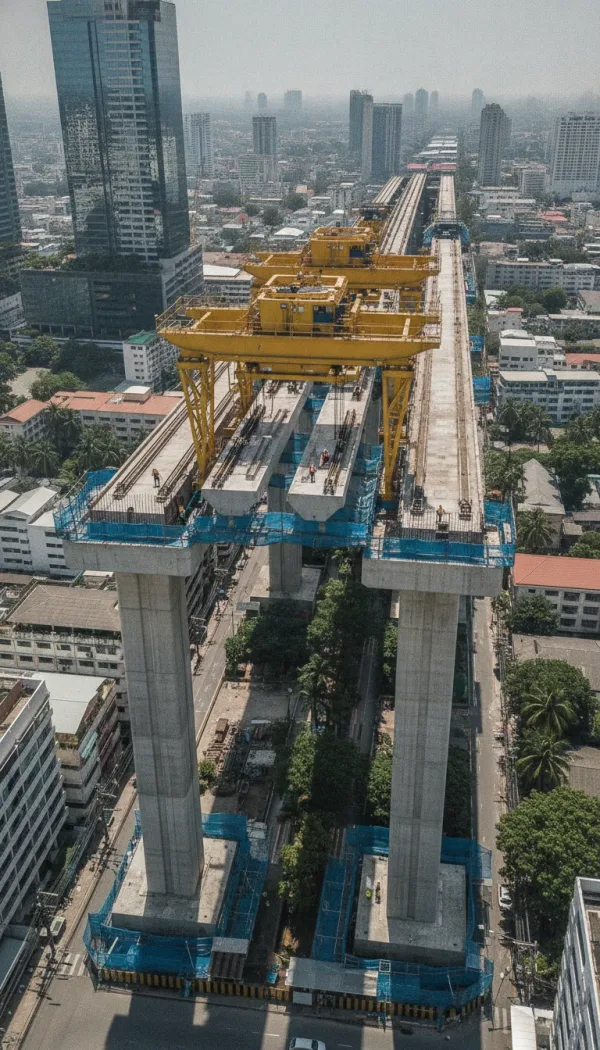
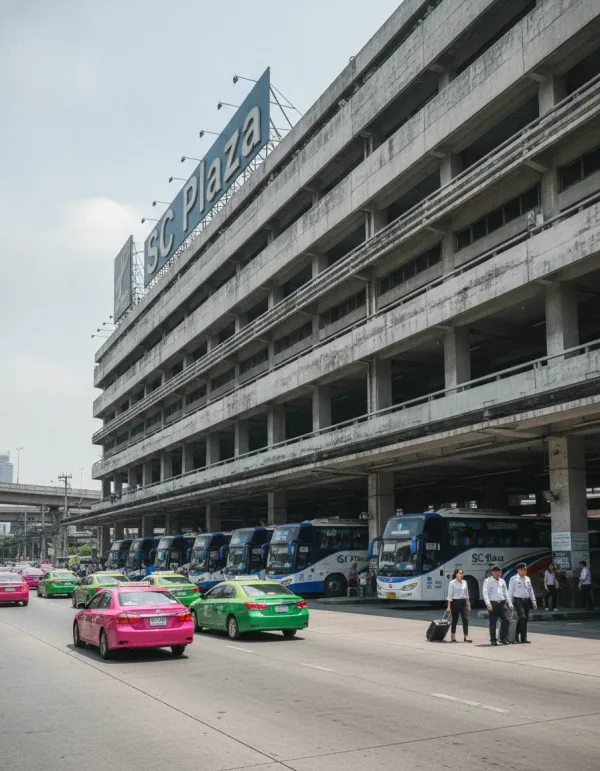
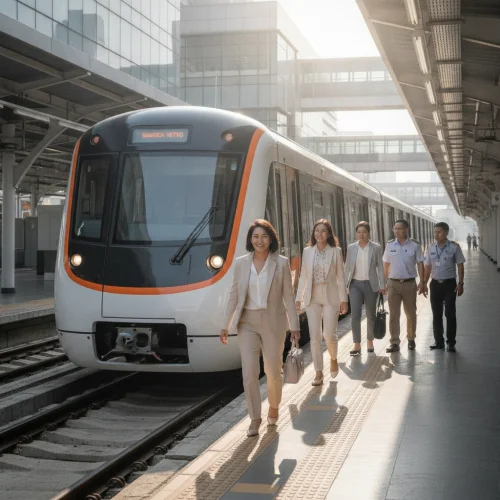
MRT Purple Line
The MRT Purple Line, officially the Chalong Ratchadham Line, opened in August 2016 as the second heavy-rail line in Bangkok's MRT network. Its construction extended the capital's rapid transit system across provincial borders into neighbouring Nonthaburi.
The fully elevated 23-kilometre railway links Tao Poon station in Bangkok's Bang Sue district with Khlong Bang Phai in Nonthaburi, spanning 16 stations. Owned by the Mass Rapid Transit Authority of Thailand (MRTA) and operated by Bangkok Expressway and Metro (BEM), the line connects with the wider rail network through an interchange with the MRT Blue Line at Tao Poon.
Built primarily to bypass severe road congestion for commuters travelling to and from the capital, the Purple Line also provides visitors with a reliable transit corridor into northwestern Greater Bangkok, reaching local riverside communities, temples, and provincial markets.

Route Overview and Stations
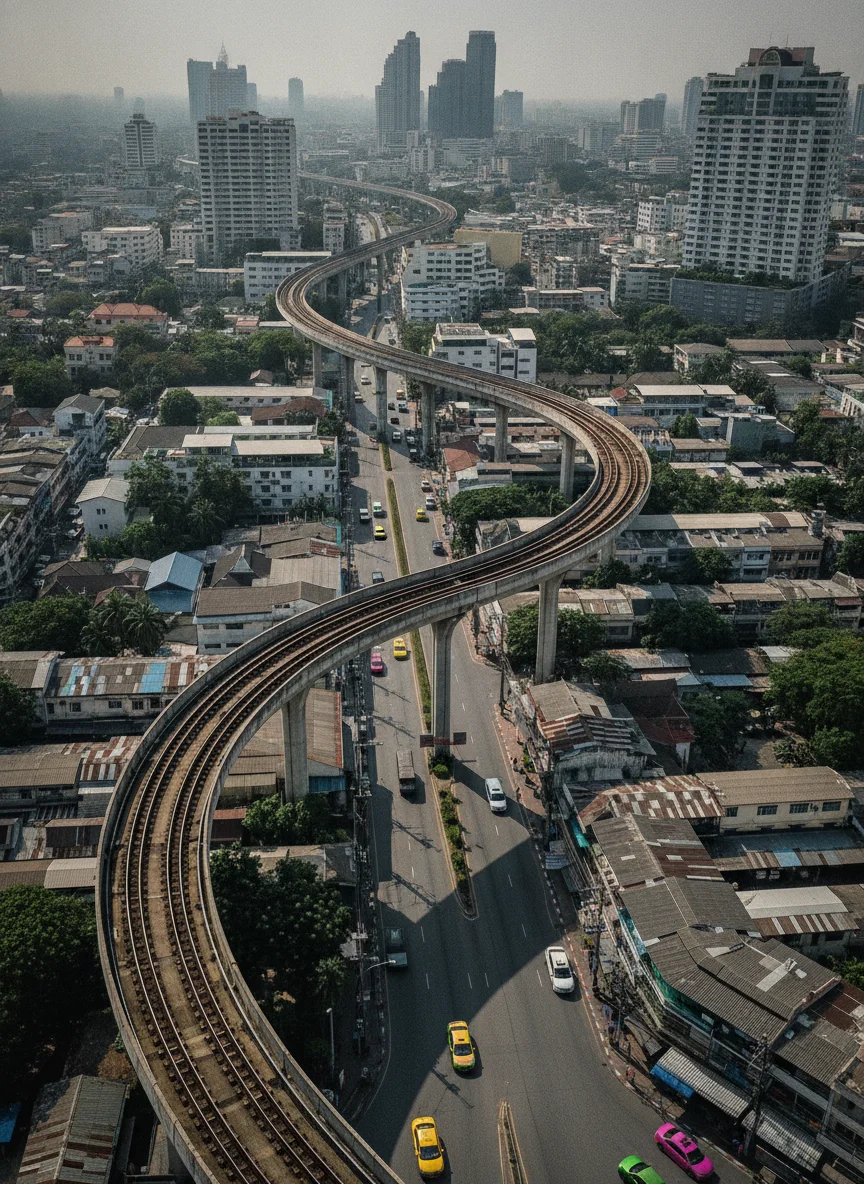
The MRT Purple Line, officially designated the Chalong Ratchadham Line, spans 23 kilometres entirely on an elevated viaduct between Bangkok and neighbouring Nonthaburi Province. The railway comprises 16 elevated stations, starting at Tao Poon in Bangkok's Bang Sue district and terminating at Khlong Bang Phai in Nonthaburi's Bang Bua Thong district. Built to relieve road congestion across the northwestern metropolitan corridor, the line links residential suburbs and administrative centres directly to the capital's rapid transit network. An end-to-end journey across the full route takes approximately 40 minutes.
From Tao Poon, the track heads north along Krung Thep–Nonthaburi Road, stopping at Bang Son and Wong Sawang before crossing into Nonthaburi. The line follows Tiwanon Road past Yaek Tiwanon and the Ministry of Public Health, then turns west along Rattanathibet Road through Nonthaburi Civic Centre, Bang Krasor, and Yaek Nonthaburi 1. After traversing the Chao Phraya River on a purpose-built viaduct alongside Phra Nang Klao Bridge, the route continues past Sai Ma, Bang Rak Noi Tha It, Bang Rak Yai, and Bang Phlu. It then curves north along Kanchanaphisek Road, running through Sam Yaek Bang Yai and Talad Bang Yai before reaching the depot and northern terminus at Khlong Bang Phai.
All 16 stations feature an elevated concourse level with ticket machines and barrier gates, situated below the train platforms. Every stop provides escalators, passenger lifts, and clear directional signage in both Thai and English.
Passenger Experience and Amenities
Passenger services on the MRT Purple Line operate with three-car Sustina electric trainsets built by Japan Transport Engineering Company (J-TREC). Each climate-controlled carriage features stainless-steel longitudinal seating, overhead grab rails, dedicated priority seats, and wide gangways to facilitate passenger flow during busy commuter periods. Route maps and automated bilingual audio announcements in Thai and English alert passengers to approaching stations and interchange opportunities.
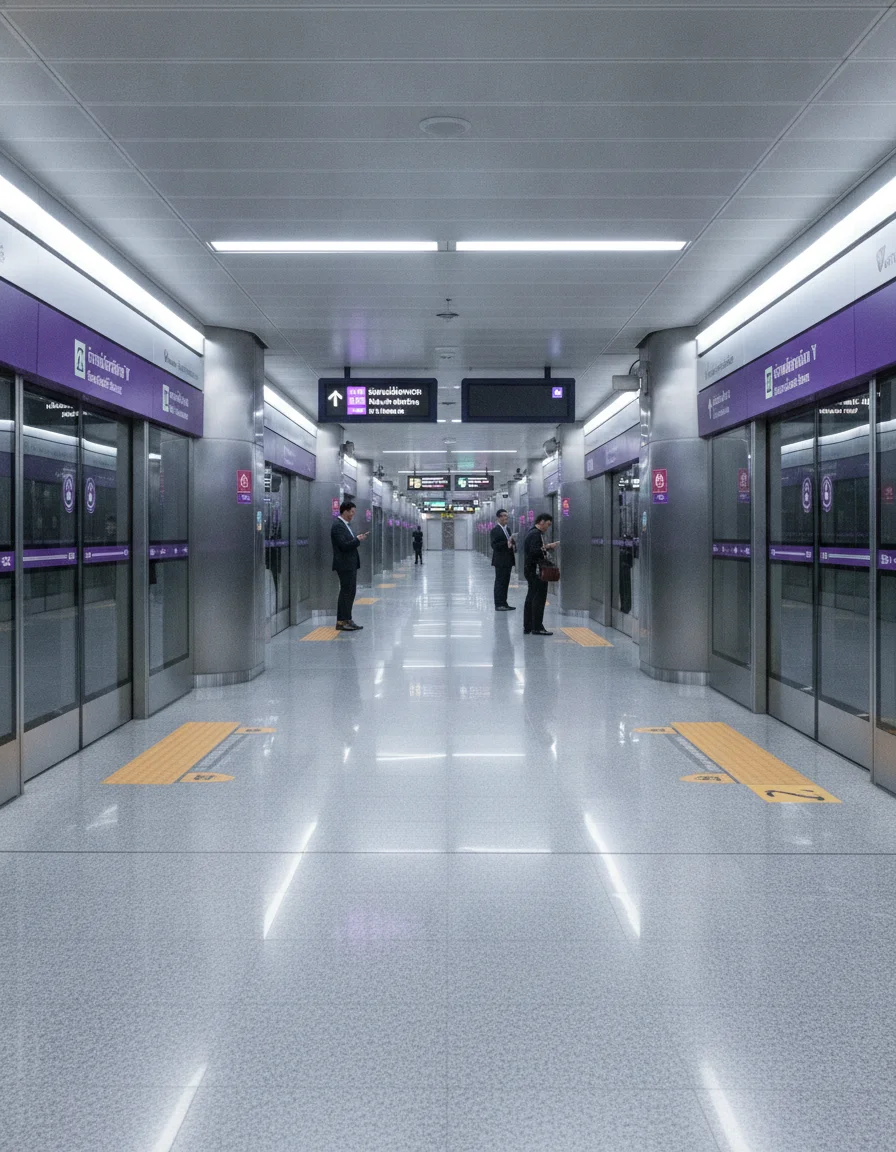
Elevated stations follow a standardised multi-level layout designed for efficiency and straightforward navigation. At platform level, automatic half-height platform screen doors line the tracks until trains come to a complete stop, while digital information displays show real-time train destinations and countdowns to the next arrival.
Concourse levels house staffed customer service offices alongside touchscreen ticket vending machines, which accept Thai Baht coins and banknotes for single-journey tokens. Unlike older transit infrastructure elsewhere in Bangkok, Purple Line stations incorporate accessible public toilets directly on the concourse level, open during operating hours. Step-free accessibility is consistent across the line, with wide ticket gates, dedicated lifts, escalators, and tactile ground paving guiding travellers from street pavement to the boarding platforms. Stations maintain a clean, orderly interior under active security monitoring, though stations do not provide open public Wi-Fi networks for waiting passengers.
Bangkok’s food culture marries royal tradition with street-side energy. Find locals stacking ten small 15 THB Boat Noodle bowls high in the dedicated alley near Victory Monument.
Connectivity and Integration
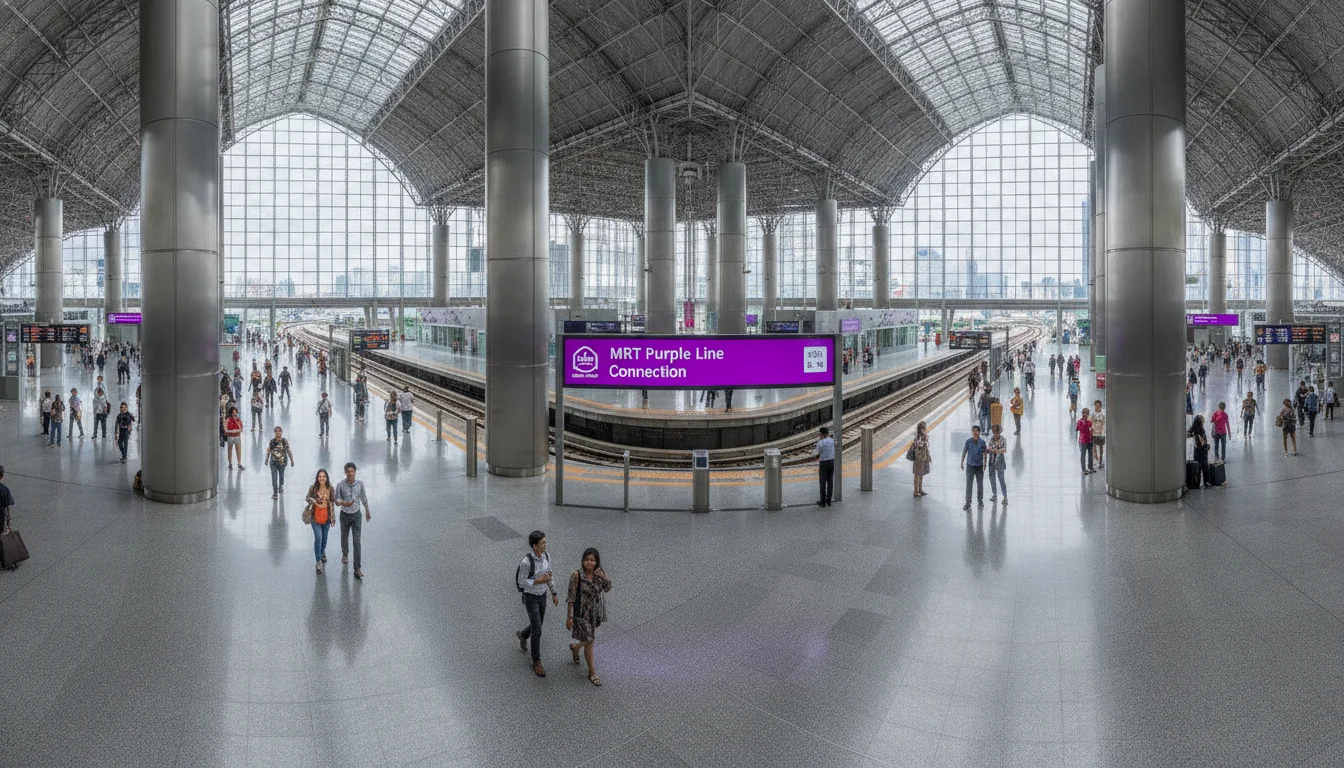
The MRT Purple Line connects Nonthaburi Province with Bangkok's broader transport network through several interchange hubs along its route. At its southern terminus, Tao Poon Station, passengers transfer directly to the MRT Blue Line across stacked platform levels. This interchange provides onward access into central Bangkok, loops towards commercial hubs like Sukhumvit and Silom, and connects to Krung Thep Aphiwat Central Terminal in Bang Sue.
Further along the route, Bang Son Station offers an elevated interchange with the SRT Light Red Line commuter railway, providing transit westbound towards Taling Chan. At Nonthaburi Civic Centre Station, passengers can transfer to the elevated MRT Pink Line monorail, which runs along Chaeng Watthana Road towards northern Bangkok and Min Buri.
Water transport connects at Phra Nang Klao Bridge Station, where a dedicated pedestrian walkway links the concourse to Phra Nang Klao Pier on the Chao Phraya River. Travellers can board scheduled Chao Phraya Express Boats or electric MINE Smart Ferry services to travel south towards central Bangkok pier terminals. Across the 16 stations, ground-level access points also link directly with Bangkok Mass Transit Authority (BMTA) bus routes, local songthaew pickup points, and taxi stands for last-mile journeys.
Impact on Local Development and Tourism
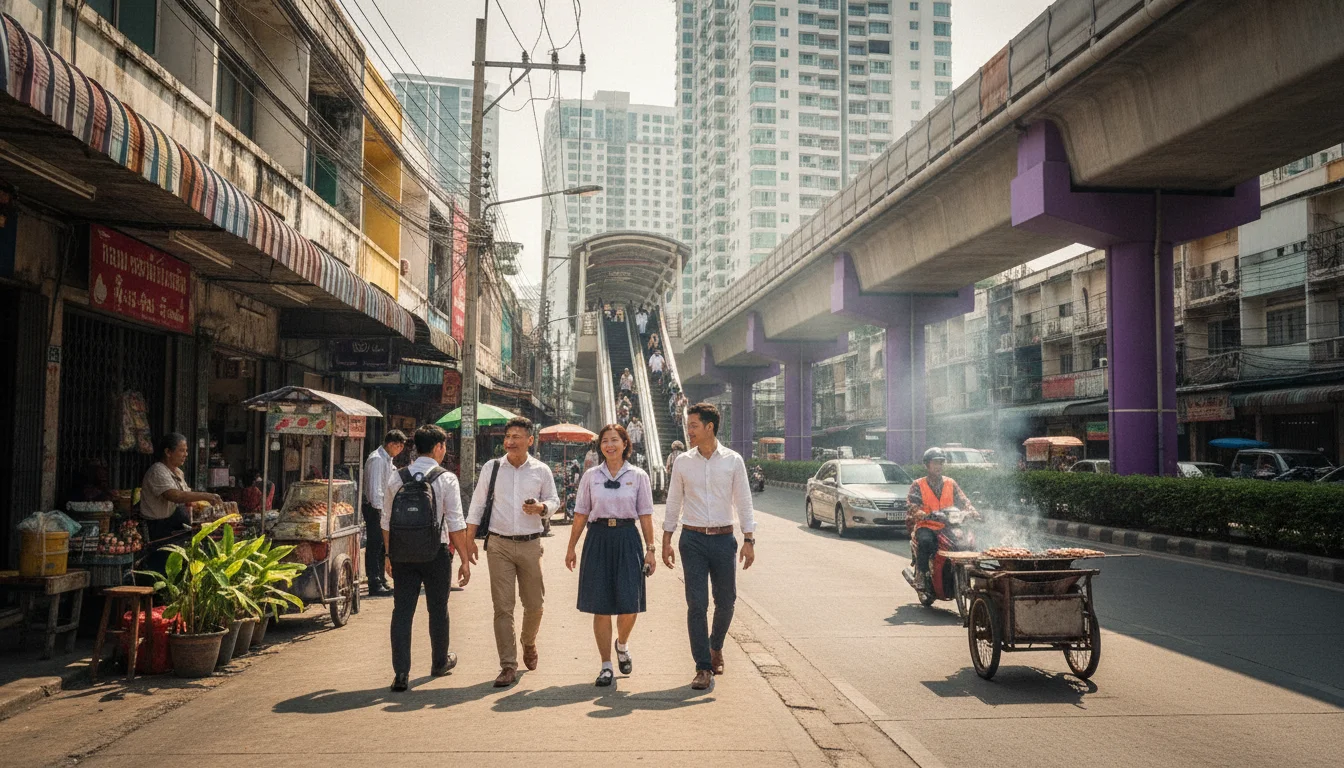
The opening of the MRT Purple Line in 2016 reshaped the urban landscape of Nonthaburi province, converting a heavily road-dependent suburban corridor into an integrated part of the greater Bangkok transit network. By providing reliable travel times into the capital, the line spurred extensive real estate investment along Rattanathibet and Tiwanon roads. High-rise apartment towers, office spaces, and modern commercial hubs quickly emerged around key stations, replacing traditional low-density residential pockets. At Talad Bang Yai station, an elevated walkway connects directly to Central Westgate, a major regional shopping and entertainment complex.
Although built primarily to serve suburban commuters, the line opens access to riverside communities, cultural landmarks, and local trade centres beyond central Bangkok. Phra Nang Klao Bridge station sits beside the Chao Phraya River, allowing passengers to transfer to riverboat services and visit waterfront temple communities. Further northwest, Bang Phlu station provides access to Wat Boromracha Kanchanapisek Anusorn (Wat Leng Nei Yi 2), a prominent Chinese-style Buddhist temple complex founded in 1996. Stations such as Talad Bang Yai and Bang Krasor place visitors steps away from traditional open-air markets and local food vendors operating alongside modern retail centres, presenting an informative perspective on modern suburban expansion in Thailand.
Location and Getting There
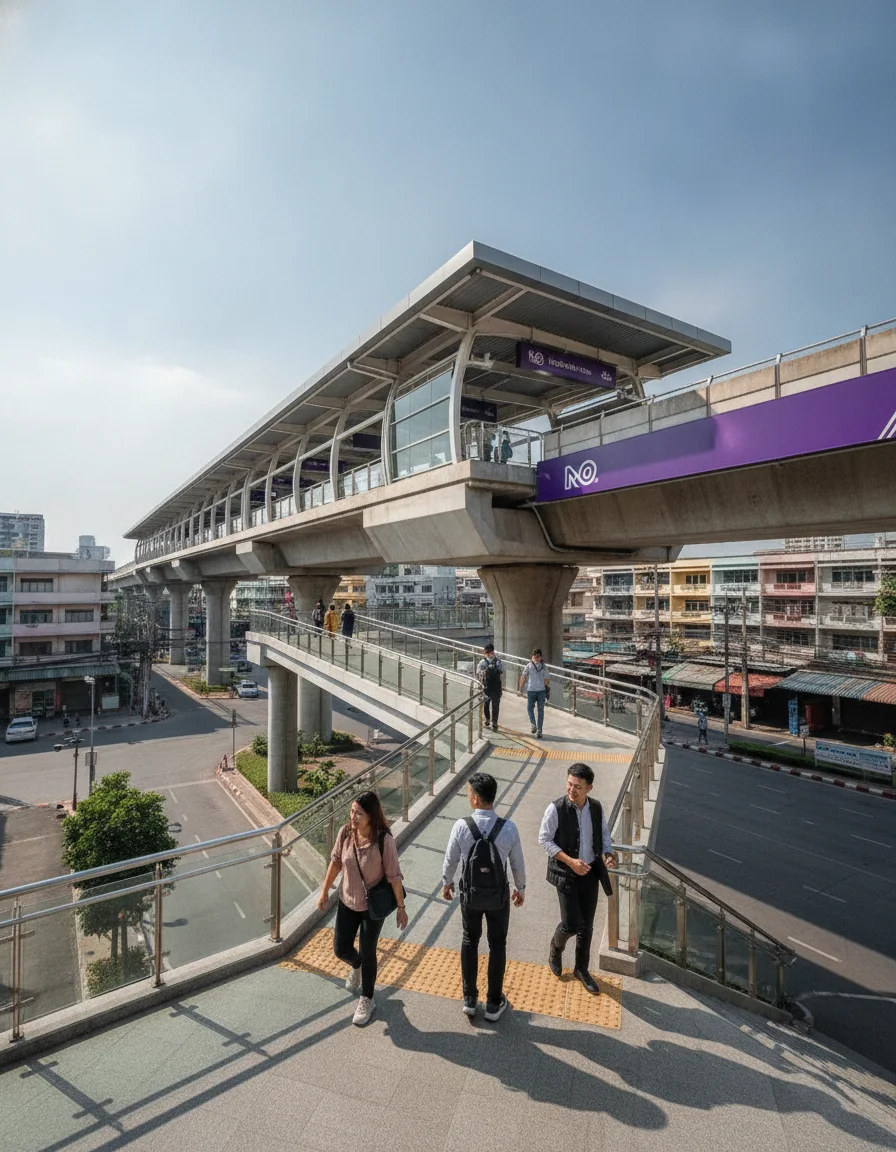
The MRT Purple Line runs through northern Bangkok and the neighbouring province of Nonthaburi. Operating along a fully elevated viaduct, the 16-station line spans approximately 23 kilometres between its southern terminal at Tao Poon Station in Bangkok's Bang Sue district and its northern terminus at Khlong Bang Phai.
Arriving international travellers from the UK land at either Suvarnabhumi Airport (BKK) or Don Mueang International Airport (DMK).
From Suvarnabhumi, the most straightforward public transport route avoids road congestion. Take the Airport Rail Link from the airport basement to Makkasan Station, walk across the enclosed skybridge into Phetchaburi MRT Station, and board a northbound MRT Blue Line train directly to Tao Poon. Combined rail tickets cost 77 THB (around £1.75), and the total journey typically takes 60 to 75 minutes.
From Don Mueang, passengers can walk straight into SRT Don Mueang Station via the terminal skybridge. The SRT Dark Red Line reaches Krung Thep Aphiwat Central Terminal in roughly 15 to 17 minutes for 33 THB (around £0.75). From there, enter Bang Sue MRT Station via the underground walkway to take the Blue Line one stop to Tao Poon, or transfer to the SRT Light Red Line to connect with the Purple Line at Bang Son. Alternatively, a metered taxi from Don Mueang to Tao Poon covers roughly 15 kilometres in 20 to 35 minutes outside peak traffic.
From central Bangkok districts such as Sukhumvit or Silom, travel directly on the MRT Blue Line to Tao Poon. Inside the station, stairs and escalators link the Blue Line and Purple Line platforms within a single interchange complex.
Costs and Booking
The MRT Purple Line operates on a distance-based fare structure managed by the Mass Rapid Transit Authority of Thailand (MRTA) and Bangkok Expressway and Metro (BEM). Fares for a single journey along the 16-station line range from 14 THB to 42 THB, depending on the total distance travelled. Converted to Pounds Sterling, this equates to approximately £0.33 to £1.00 per trip. Standard fares apply throughout operating hours, without peak-time surcharges. When continuing onto the connecting MRT Blue Line at Tao Poon, passengers remain within the ticketed transit area, with combined through-fares capped at 71 THB.
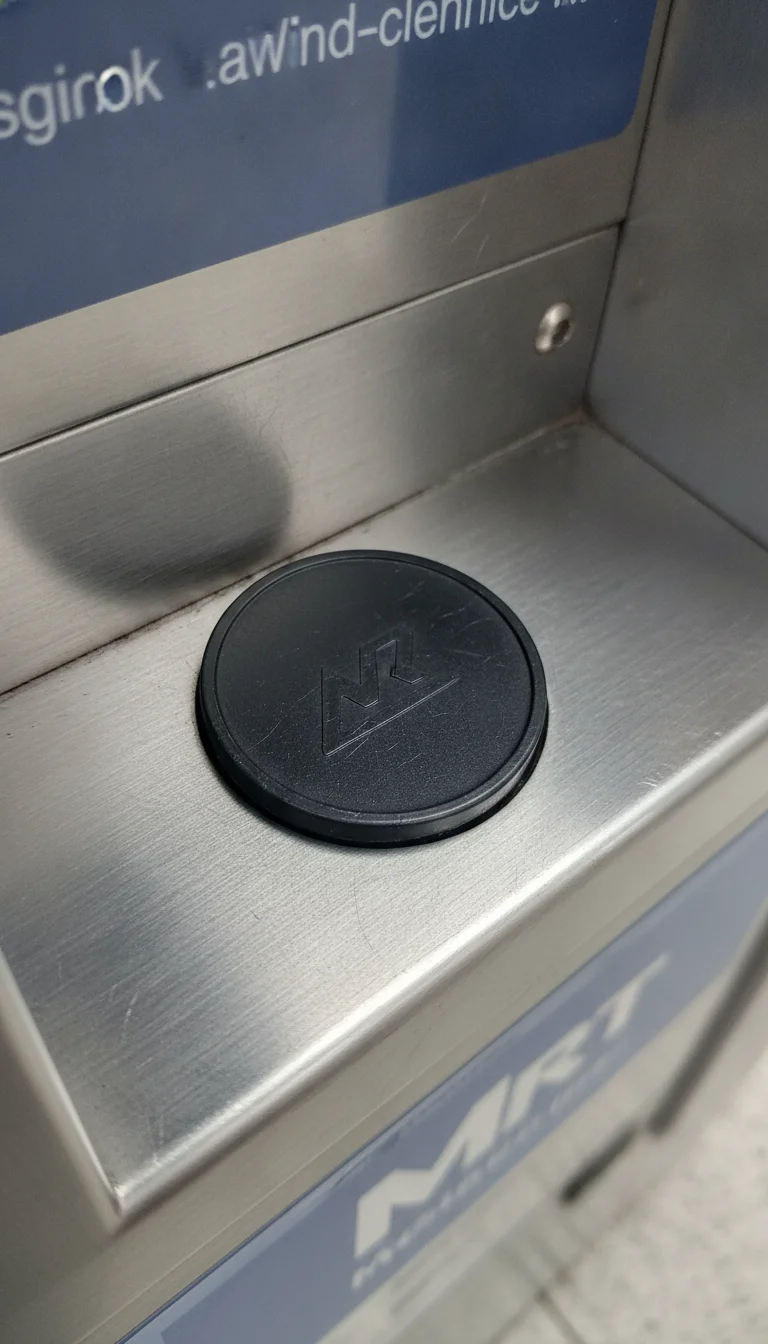
Ticketing is straightforward and automated at every station concourse. Single journeys use RFID tokens purchased with cash from touchscreen ticket machines or station service windows. Machines take Thai baht coins and notes, dispensing change automatically. Alternatively, turnstiles accept contactless EMV payment cards. UK visitors can tap contactless Visa or Mastercard debit and credit cards directly at the entry and exit gates to pay standard distance fares without queuing for tokens. Bangkok MRT has largely retired legacy stored-value cards in favour of open-loop contactless payments, and adult cardholders pay identical rates to single tokens without special discounts.
| Ticket Type | Cost (THB per journey) | Cost (GBP approx per journey) | Notes |
|---|---|---|---|
| Single Journey Token | 14 - 42 | 0.33 - 1.00 | Fare depends on distance travelled; purchased with cash at stations. |
| Stored Value Card | 14 - 42 | 0.33 - 1.00 | Legacy cards phased out for EMV contactless; charged at standard token rates. |
| Day Pass (if available) | N/A | N/A | Not offered on the Bangkok MRT network. |
Individual metro journeys do not require advance booking, as fares are handled entirely on arrival at the station. Travellers organising broader itineraries across Bangkok and neighbouring provinces can arrange onward travel connections and regional transit passes in advance.
Who the Route Suits
The MRT Purple Line primarily serves suburban commuters, expatriates living in Nonthaburi, and travellers heading to destinations outside the central tourism corridor. It provides direct elevated transport through northern Bangkok into Nonthaburi Province, making it practical for anyone visiting local markets, administrative complexes such as the Ministry of Public Health and Nonthaburi Civic Centre, or major commercial hubs like Central Westgate at Talad Bang Yai. Independent visitors exploring everyday residential districts along the Chao Phraya basin also find it a reliable alternative to sitting in highway traffic.
Conversely, the line is poorly suited for short-stay tourists prioritising Bangkok’s main historical landmarks, nightlife districts, or luxury riverfront hotels. Its tracks terminate at Tao Poon in the north, well away from commercial centres such as Sukhumvit, Silom, and Siam. Reaching those areas requires changing onto the MRT Blue Line and often transferring again onto the BTS Skytrain. Unless your itinerary includes suburban destinations in Nonthaburi, standard central sightseeing rarely requires using this corridor.
What to Know Before You Travel
Unlike intercity railways or private tour transfers, the MRT Purple Line cannot be booked in advance. It operates entirely as an urban walk-up service, where you pay as you enter using a contactless payment card or by purchasing a single-journey token at the station concourse.
Service runs from 05:30 to midnight on weekdays, and from 06:00 to midnight on Saturdays, Sundays, and public holidays. Headways average up to nine minutes during off-peak periods, dropping to six minutes or less during weekday commuter rushes. The heaviest peak crowds occur from 06:30 to 08:30 and 17:00 to 19:30, when suburban commuters travel between Nonthaburi and Bangkok. If you prefer a quieter journey with available seating, schedule your trip for mid-morning or early afternoon.
Navigating the route is straightforward because every stop features bilingual signage in English and Thai. Each station is also assigned an alphanumeric code running sequentially from PP01 at Khlong Bang Phai to PP16 at Tao Poon. Keeping note of these station codes simplifies route planning and helps you track your stop without needing to read Thai script.
Because the route functions strictly as a rapid transit commuter line, do not expect dedicated luggage racks, onboard entertainment, or catering facilities. Ensure you allow sufficient travel time if connecting onwards, and bear in mind that the system enforces a 180-minute maximum stay within the ticketed zone.
Practical Tips
Security personnel carry out brief visual bag inspections at station entrance checkpoints, so having backpacks unzipped before stepping through the scanners speeds up access. Once past the fare barriers and aboard carriages, strict transit regulations apply. Consuming food or drink—including bottled water and takeaway beverages—is prohibited, and carrying pungent items like fresh durian onto the system is forbidden.
Platform etiquette is structured and widely observed. Floor markings indicate designated queue lines on either side of the automated platform doors, keeping the central area open so arriving passengers can alight first. When travelling on station escalators, stand on the right-hand side and keep the left unobstructed for walking commuters. Inside crowded trains, remove backpacks and hold them down by your legs to preserve standing room. Priority seats near train doors are reserved for elderly passengers, pregnant women, disabled commuters, and Buddhist monks.
When travelling on single-journey black tokens, tap your token on the entry turnstile sensor and store it securely for the duration of the trip. The exit gates collect the token into a drop slot before releasing the barrier. Digital overhead displays and station maps provide clear journey details and train countdowns in both Thai and English.
Arranging your suburban connections and day excursions in advance ensures smooth transit when exploring beyond central Bangkok.
Quick Reference Table
| Item | Detail | Notes |
|---|---|---|
| Official name | Chalong Ratchadham Line | Opened in August 2016 as Bangkok's second heavy-rail MRT line |
| Route corridor | Tao Poon (Bangkok) to Khlong Bang Phai (Nonthaburi) | Spans 23 km along a fully elevated viaduct |
| Number of stations | 16 elevated stations | Sequential alphanumeric station codes from PP01 to PP16 |
| Full journey time | Approximately 40 minutes | Tao Poon to Khlong Bang Phai end-to-end |
| Operating hours | 05:30 – 00:00 (Weekdays); 06:00 – 00:00 (Weekends and public holidays) | Trains operate daily throughout the year |
| Peak frequencies | 6 minutes or less | Weekday peak periods run 06:30–08:30 and 17:00–19:30 |
| Off-peak frequencies | Up to 9 minutes | Mid-morning and early afternoon provide the quietest services |
| Single-journey fare | 14 THB – 42 THB (£0.33 – £1.00) | Distance-based fare; through-fare capped at 71 THB with the MRT Blue Line |
| Payment methods | Cash tokens or contactless EMV bank cards | Turnstiles accept contactless Visa and Mastercard debit and credit cards |
| Time limit in ticketed zone | 180 minutes | Maximum permitted stay within fare-paid station areas |
| Key rail interchanges | Tao Poon (MRT Blue Line), Bang Son (SRT Light Red Line), Nonthaburi Civic Centre (MRT Pink Line) | Direct transfers across platforms or enclosed skybridges |
| Riverboat connection | Phra Nang Klao Bridge | Direct pedestrian walkway to Chao Phraya Express Boat and MINE Smart Ferry pier |
| Rolling stock | 3-car J-TREC Sustina electric trainsets | Climate-controlled carriages with longitudinal stainless-steel seating |
| Accessibility and facilities | Step-free throughout with lifts, escalators, and accessible concourse toilets | Half-height platform screen doors installed; no public Wi-Fi |
| System owner and operator | MRTA (owner) / Bangkok Expressway and Metro (operator) | Public-private operational partnership |
| Website | https://metro.bemplc.co.th | Official operator portal for timetables and route maps |
FAQ: MRT Purple Line
How much does it cost to ride the MRT Purple Line in Bangkok?
How can I pay for a ride on the MRT Purple Line?
What are the operating hours for the MRT Purple Line?
What are the peak travel times on the MRT Purple Line?
What items are prohibited on the MRT Purple Line?
How do I get to the MRT Purple Line from Suvarnabhumi Airport (BKK)?
How do I get to the MRT Purple Line from Don Mueang Airport (DMK)?
What kind of accessibility features does the MRT Purple Line offer?
Is the MRT Purple Line suitable for tourists visiting central Bangkok attractions?
What should I do with my backpack on crowded MRT Purple Line trains?
Reviewed by the Thailand Guide Editorial Team • Last reviewed: 22 September 2026
This page provides general information only and is not financial, legal, or immigration advice. Always verify current rules with official Thai government sources or a qualified professional before making decisions.