MRT Pink Line
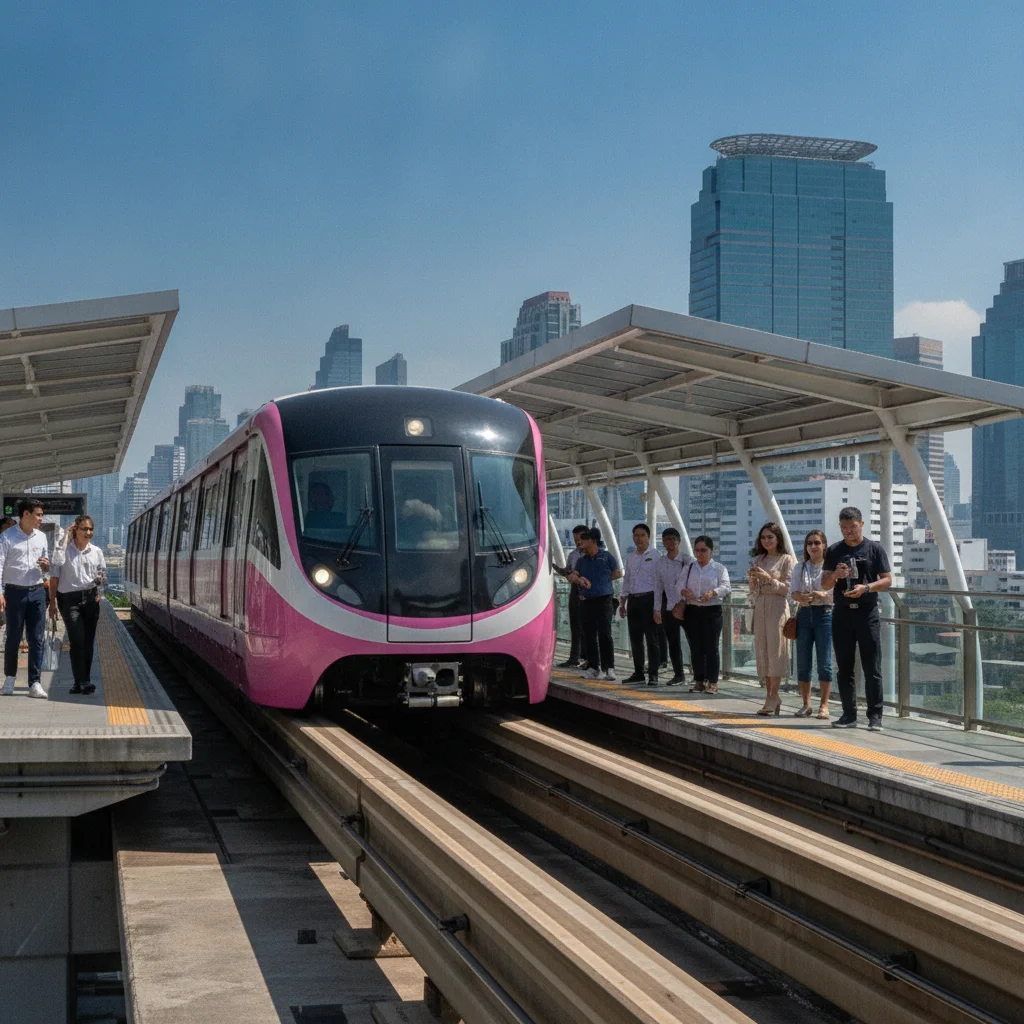
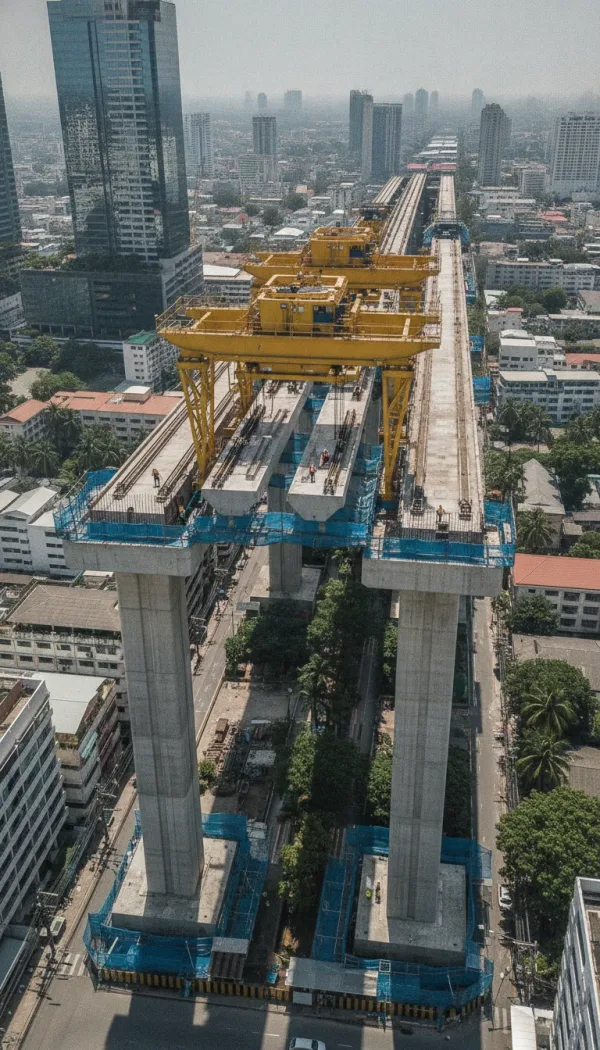
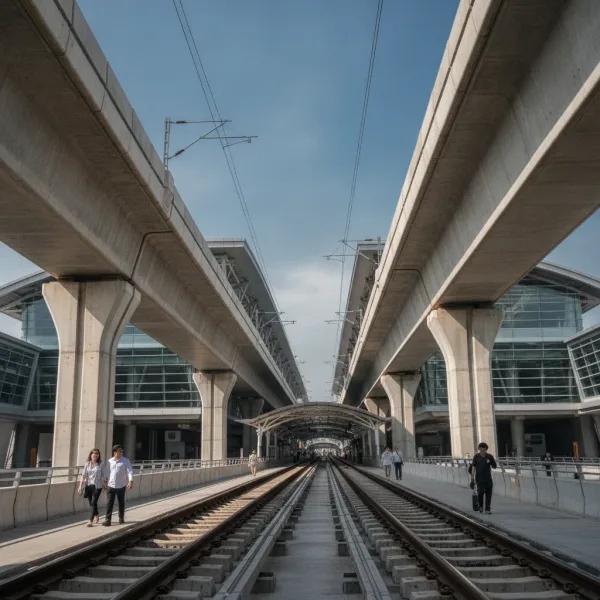
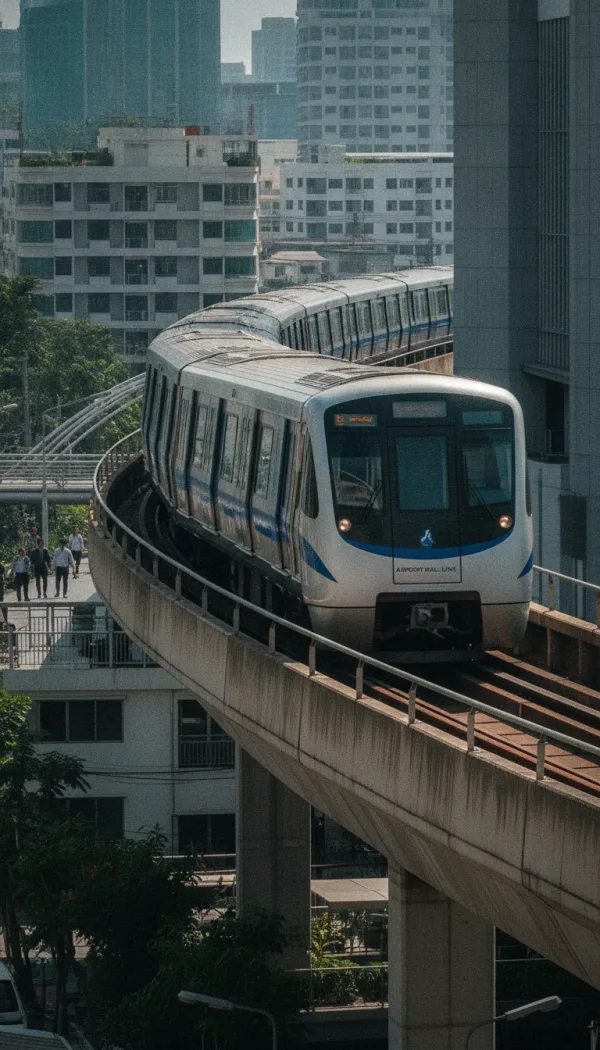
The MRT Pink Line is an elevated straddle monorail operating across northern Bangkok and neighbouring Nonthaburi Province. Commissioned by the Mass Rapid Transit Authority of Thailand (MRTA) and operated by Northern Bangkok Monorail Company Limited, the line opened for full commercial service in early 2024 following public trial operations in late 2023. Running on dedicated overhead guideways, it bypasses several of the capital region's heavily congested surface corridors to provide an efficient east-west transit link through the northern suburban belt.
The 34.5-kilometre main alignment comprises 30 elevated stations, running from Nonthaburi Civic Centre in the west to Min Buri in the east. The route traces Highway 304 along Chaeng Watthana and Ram Inthra roads, directly serving major administrative, retail, and residential districts including Khae Rai, Pak Kret, and the Chaeng Watthana Government Complex. Each elevated station features escalators, lifts, and clear bilingual signage, connecting easily to local feeder buses and taxis below.
Rather than requiring slow cross-town bus journeys or expensive highway taxi rides, the line integrates closely with the wider metropolitan transit network. Interchange stations provide transfers to the MRT Purple Line at Nonthaburi Civic Centre, the SRT Dark Red Line at Lak Si, and the BTS Sukhumvit Line at Wat Phra Sri Mahathat. These junctions allow passengers to cross between northern suburbs and central Bangkok reliably without getting trapped in rush-hour bottlenecks.

Ridership and Capacity
Bangkok's MRT Pink Line deploys a fleet of 42 driverless Alstom Innovia Monorail 300 trains, running in four-car formations that can be extended to seven cars as demand grows. Each four-car trainset accommodates over 500 passengers across interconnected, air-conditioned carriages. The elevated monorail system was engineered for a design capacity of over 28,000 passengers per hour per direction, supporting up to 470,000 journeys daily. At the time of research, actual weekday passenger traffic averages between 60,000 and 80,000 riders per day.
Train intervals are scheduled around Bangkok's suburban commuter rhythm. Services depart every five minutes during weekday peak hours—specifically 06:30 to 08:30 and 16:30 to 19:30—and widen to 10-minute intervals during off-peak daytime periods, weekends, and public holidays. Inside each carriage, overhead digital screens provide route announcements and next-stop displays in Thai and English. Cabins feature longitudinal bench seating, standing stanchions, priority seating for elderly and pregnant travellers, and dedicated spaces with safety fixtures for wheelchair users.
Connectivity and Integration
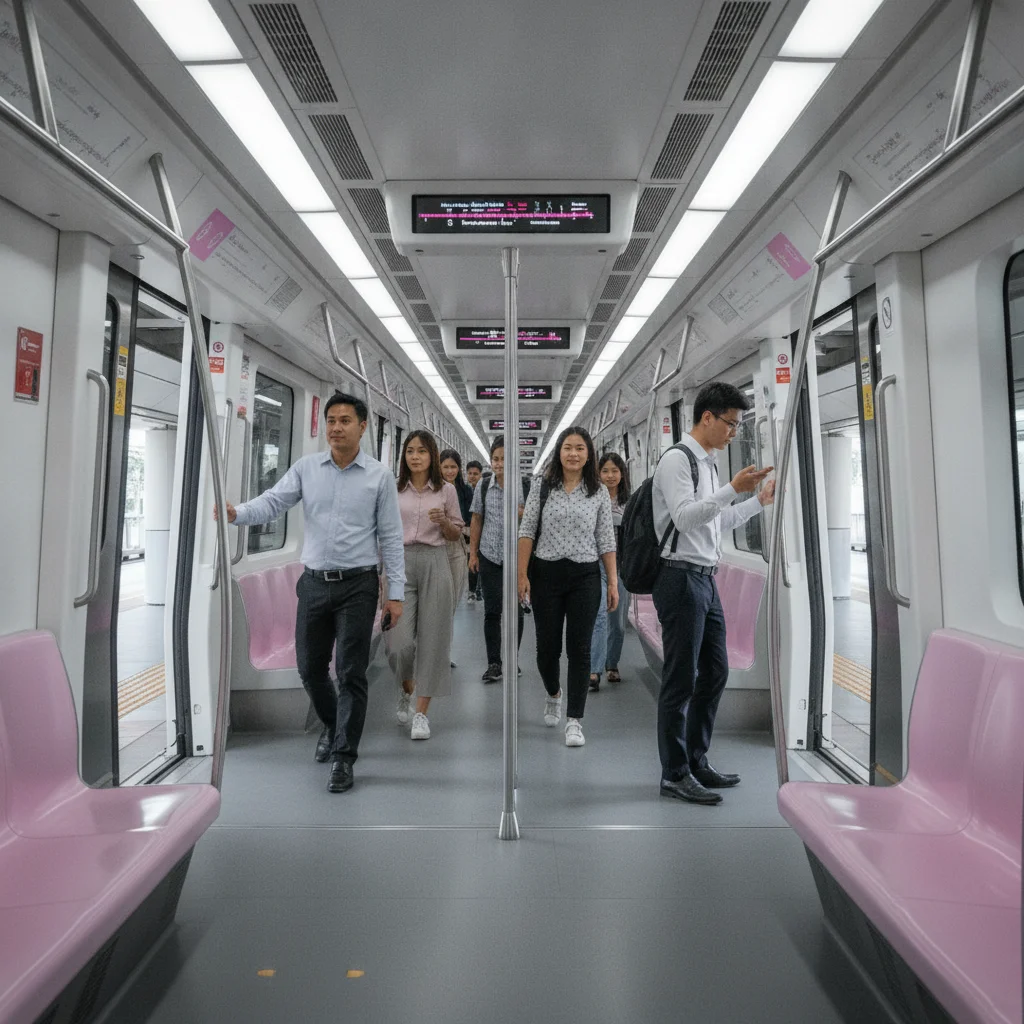
The MRT Pink Line functions as a northern orbital link across Greater Bangkok, bridging several major radial rail routes that head into the city centre. Key transfer hubs connect passengers to the wider rail network: Nonthaburi Civic Centre links to the MRT Purple Line, Lak Si provides a skywalk connection to the SRT Dark Red Line, and Wat Phra Sri Mahathat joins directly to the BTS Sukhumvit Line. At Min Buri, the eastern terminus provides a future connection point with the MRT Orange Line. At Muang Thong Thani station, a spur line branches off to serve the IMPACT exhibition complex.
Physical integration relies heavily on elevated skywalks that cross wide arterial roads, including Chaeng Watthana and Ram Inthra. These pedestrian walkways allow passengers to change lines or exit above street traffic directly to commercial hubs and roadside feeder points. Transferring between rail operators generally involves exiting through the ticket barriers of one system and tapping into the next across the designated pedestrian bridge. At ground level, designated bays beneath stations connect with local bus routes, songthaews, and motorbike taxis, linking nearby residential neighbourhoods to the rapid transit network.
Bangkok’s food culture marries royal tradition with street-side energy. Find locals stacking ten small 15 THB Boat Noodle bowls high in the dedicated alley near Victory Monument.
Ticketing and Fares
Fares on Bangkok's MRT Pink Line operate on a distance-based structure, starting at 15 THB (around £0.35) for short journeys of one or two stops and rising to 45 THB (around £1.05) for travel across the entire monorail route. Standard passenger fares reflect the specific number of stations travelled, making the line an economical option for suburban journeys across northern Bangkok.
| Fare Option | Cost (THB per trip) | Cost (GBP approx) | Notes |
|---|---|---|---|
| Minimum Fare | 15 | £0.35 | For short distances |
| Mid-Range Fare | 25-35 | £0.58-£0.81 | Typical journey lengths |
| Maximum Fare | 45 | £1.05 | For the longest journeys |
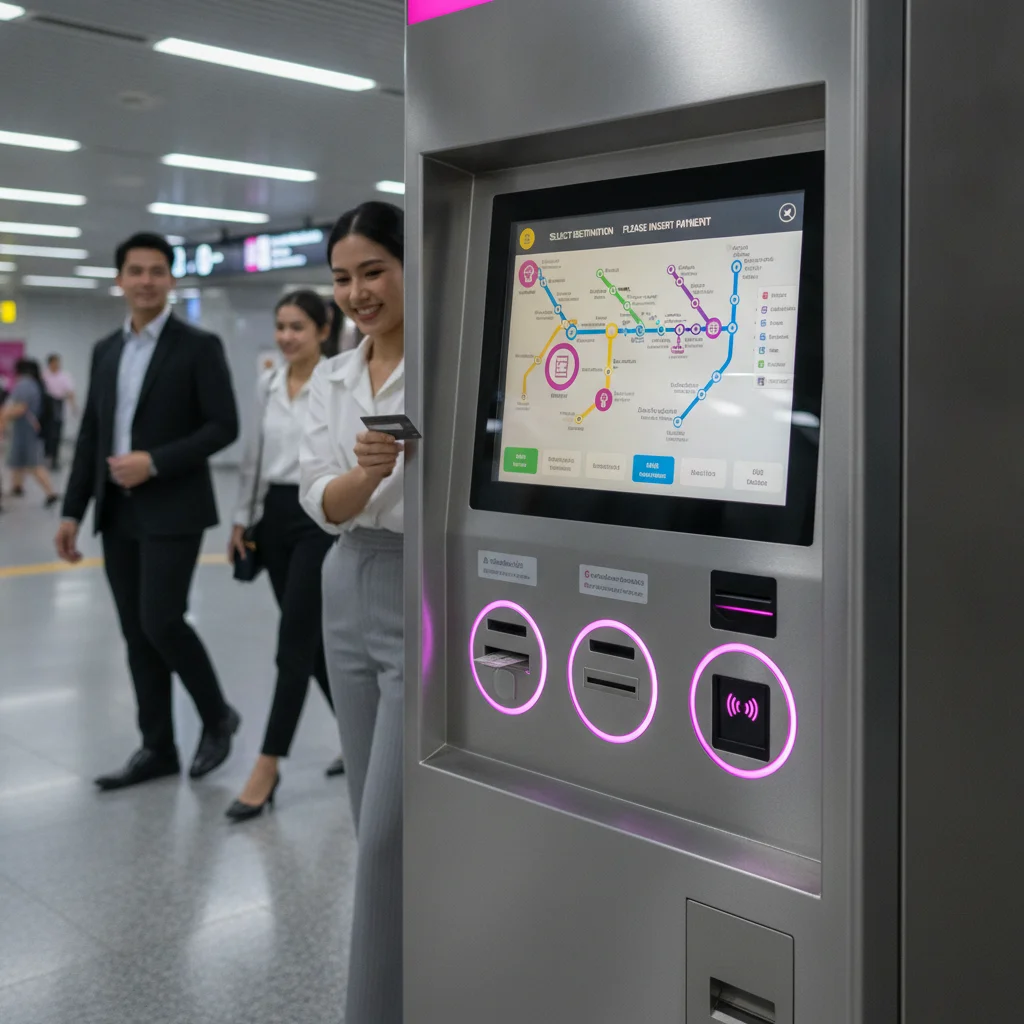
Single-journey travel uses contactless smart cards, which can be purchased from automated ticket machines at every station using cash or Thai QR payment codes. The monorail does not issue the round plastic tokens found on Bangkok's underground metro lines. Passengers can also tap through the automatic entry gates using stored-value Rabbit Cards, which are shared with the BTS Skytrain network, or contactless EMV credit and debit cards issued by Visa and Mastercard.
Stored-value cards deduct standard distance fares rather than providing an automatic top-up discount. However, travellers who use the same contactless bank card to transfer between the Pink Line and the MRT Purple Line at Nonthaburi Civic Centre receive an entry-fee waiver when changing lines within thirty minutes.
Accessibility and Facilities
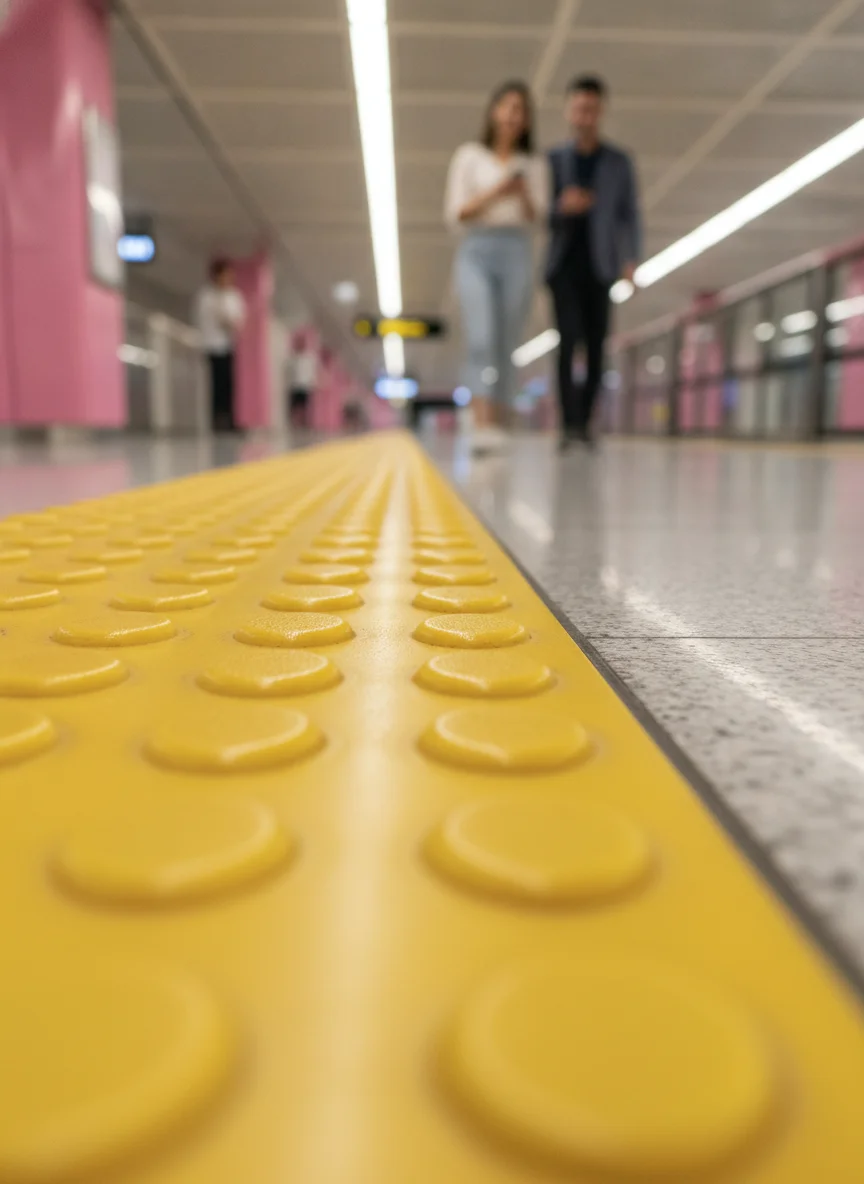
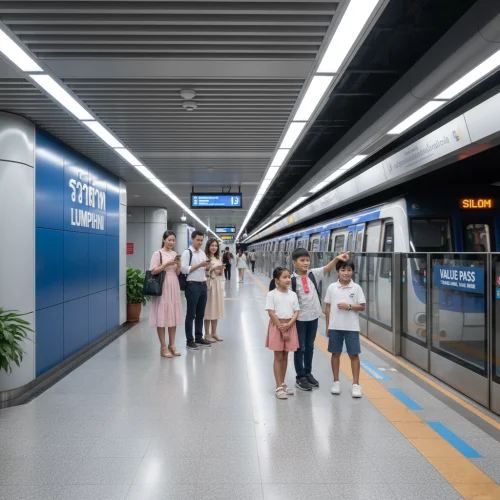
MRT Pink Line stations are designed to modern accessibility standards, providing step-free access between street level and train platforms. Dedicated street-level lifts and escalators carry passengers to elevated concourses and boarding platforms, complemented by tactile guide paving, braille signage, and wide automatic fare gates to assist wheelchair users, families with prams, and passengers travelling with heavy luggage.
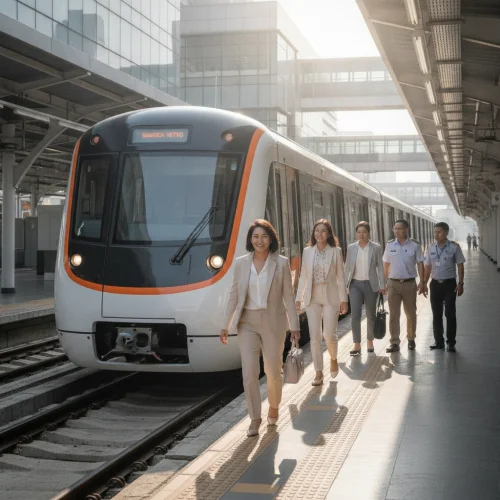
Concourse amenities include staffed customer service offices, automated ticket vending machines, and clean public toilets, including dedicated wheelchair-accessible restrooms, which are absent from many older elevated transit stations in Bangkok. For passenger safety, every station features uniformed security personnel, baggage screening checkpoints, extensive CCTV surveillance, platform-level emergency stop buttons, and 1.5-metre-tall half-height platform screen doors that prevent falls onto the monorail guideway. At the eastern terminus, Min Buri station incorporates a multi-storey park-and-ride building accommodating over 3,000 vehicles, linked directly to the station concourse by an elevated walkway.
On the development side, the Pink Line's major recent addition is the two-station branch line extending from Si Rat station into Muang Thong Thani. Opened for commercial service in mid-2025, this spur provides direct rail transport to the IMPACT Exhibition and Convention Centre and surrounding residential districts.
LOCATION AND GETTING THERE
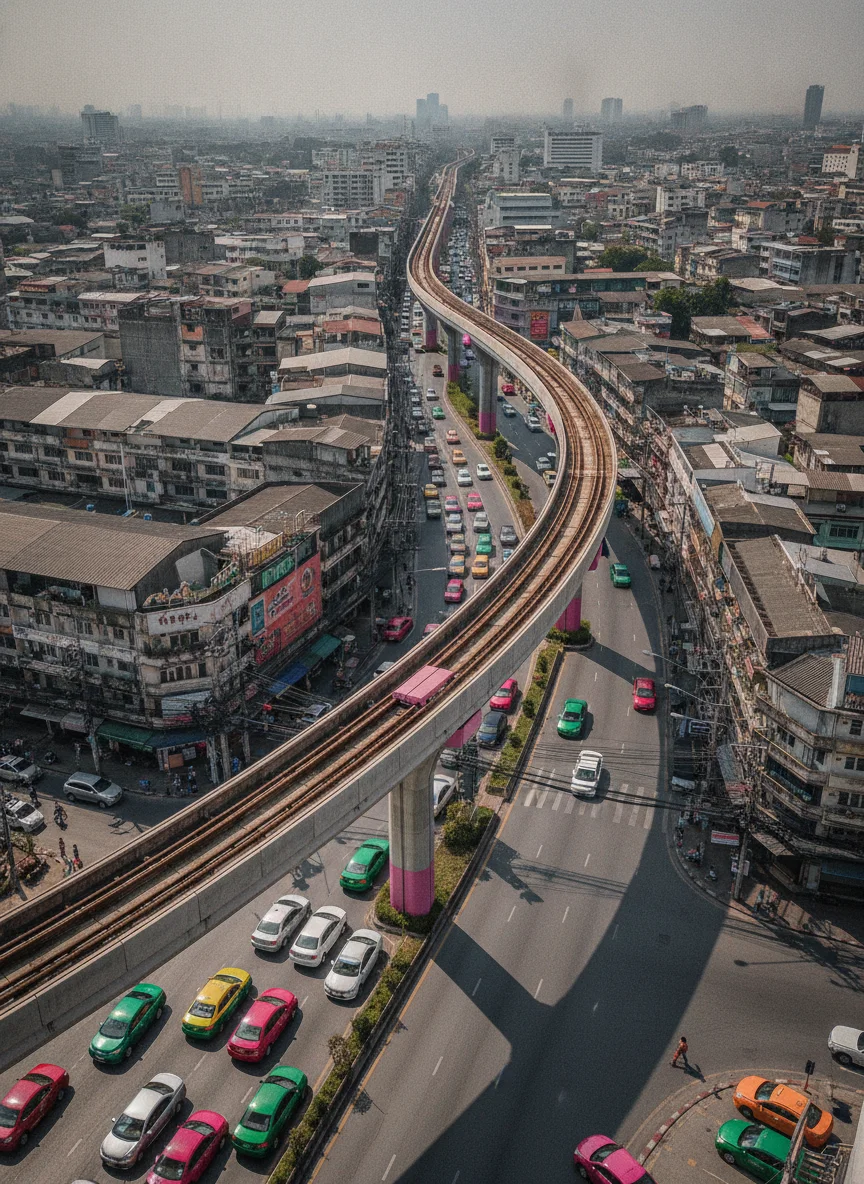
The MRT Pink Line spans 34.5 kilometres across the northern outer arc of Greater Bangkok, connecting Nonthaburi province in the west to Min Buri in the east. Rather than cutting through the city centre, this elevated monorail follows Highway 304 along Tiwanon, Chaeng Watthana, and Ram Inthra roads, functioning as an orbital corridor that links dense residential suburbs, government complexes, and regional commercial centres to Bangkok's radial rail lines.
Reaching the monorail from Bangkok’s international airports is straightforward by rail or road. From Don Mueang International Airport (DMK), the easiest rail connection is the SRT Dark Red Line: trains run directly from Don Mueang station to Lak Si station in roughly five minutes, where an elevated walkway connects to the Pink Line. A metered taxi from DMK to Lak Si covers around eight kilometres, taking 10 to 15 minutes outside rush hour for roughly 120 to 180 THB (£2.70 to £4.00).
From Suvarnabhumi Airport (BKK), rail travellers can take the Airport Rail Link to Phaya Thai terminus, then transfer to the northbound BTS Sukhumvit Line towards Khu Khot. The BTS connects directly with the Pink Line via the skywalk at Wat Phra Sri Mahathat station, taking about 60 to 75 minutes in total. Alternatively, a taxi from Suvarnabhumi to Min Buri station at the line’s eastern end takes 20 to 30 minutes, while travelling across to central stations such as Chaeng Watthana costs approximately 350 to 500 THB (£8.00 to £11.40) and takes 45 to 70 minutes via the expressways.
COSTS AND BOOKING
The MRT Pink Line operates on an entirely walk-up, pay-as-you-go system, with fares calculated by distance. Single journeys cost between 15 THB and 45 THB (roughly £0.35 to £1.05), making the monorail an economical way to traverse northern Bangkok and neighbouring Nonthaburi province. Passengers do not need to book tickets in advance, as reservations do not exist for the line; all travel is arranged at stations on demand.
| Ticket Type | Cost (THB per journey) | Cost (GBP approx) | Notes |
|---|---|---|---|
| Single Journey Ticket | 15–45 THB | £0.35–£1.05 | Purchased at station vending machines or counters |
| Stored-Value Card (Rabbit) | 15–45 THB | £0.35–£1.05 | Standard fares deducted per trip; top up at stations |
| Daily Pass | N/A | N/A | Not currently offered; single or stored-value media standard |
Single-journey smart cards can be bought from touchscreen vending machines at every station using cash notes, coins, or Thai mobile banking QR codes. Staffed ticket offices also sell cards and assist with change. Frequent commuters and longer-stay visitors can use a Rabbit card, the contactless stored-value card shared with the BTS Skytrain and Yellow Line. Rabbit cards are purchased and topped up with credit at station ticket windows. Alternatively, passengers can tap through fare gates using contactless Visa or Mastercard credit and debit cards, avoiding ticket machines altogether.
WHO THE ROUTE SUITS
The MRT Pink Line serves daily suburban commuters and long-stay visitors travelling across Bangkok's northern perimeter between Nonthaburi and Min Buri. Foreign residents and expats heading to the Chaeng Watthana Government Complex for visa renewals, immigration appointments, or consular services gain a dependable rail alternative to congested roadway taxis. It also suits sports enthusiasts travelling to fight nights at Lumpinee Boxing Stadium on Ram Inthra Road, as well as attendees heading towards events around Muang Thong Thani.
Conversely, short-term holidaymakers focused on central Bangkok landmarks around Sukhumvit, Silom, or Rattanakosin will rarely need the line. Because the monorail runs as an outer suburban orbital corridor rather than cutting into the city centre, reaching it from central accommodation requires changing trains on radial lines such as the BTS Sukhumvit Line or SRT Dark Red Line. Travellers carrying bulky luggage or bound for destinations far from the elevated stations will still find taxis more practical.
WHAT TO KNOW BEFORE YOU RIDE
Bangkok's MRT Pink Line functions as a public mass transit monorail rather than an excursion railway or private tour service, so advance seat reservations and ticket bookings do not exist. Passengers travel on a walk-up, pay-as-you-go basis, either by purchasing a single-journey pass or tapping an accepted card at the ticket barriers.
Regular services operate daily from 06:00 until midnight, with the earliest departures setting out from terminal stations around 05:30. Every station features bilingual signage in English and Thai alongside an alphanumeric identifier prefixed with "PK" (running from PK01 at Nonthaburi Civic Centre through to PK30 at Min Buri). These alphanumeric codes help non-Thai speakers confirm stops without needing to decipher complex transliterated road names.
Because the entire route runs on an elevated viaduct above Highway 304 arterial roads, station facilities sit above street level. Commuters access the line via stairs, escalators, or lift towers from the pavement to reach the mezzanine ticket concourse before proceeding up to the train platforms.
Before entering the paid transit area, travellers pass through a standard security checkpoint where uniformed guards may request a brief visual inspection of bags. Once through the gates and on board the monorail carriages, operational rules are strictly enforced: eating, drinking, smoking, and vaping are entirely prohibited across all stations and trains. Carrying open beverage cups or takeaway food through the gates will result in station staff asking you to finish or discard them first.
PRACTICAL TIPS
Mapping services such as Google Maps help chart journeys, track transfers, and check station locations along the northern corridor. Because the line traverses major arterial roads rather than central tourist districts, planning connections beforehand ensures you alight at the most convenient stop for your destination.
Weekday peak travel runs from 06:30 to 08:30 and 16:30 to 19:30. Monorails run every five minutes during these hours, though carriages fill quickly with local commuters. Travelling outside these windows—during mid-morning, early afternoon, or after 20:00—provides a noticeably calmer journey, although departures drop to ten-minute intervals.
Be mindful of transfer locations. The route does not serve central interchange hubs such as Mo Chit or Lat Phrao. Key connections instead occur at Nonthaburi Civic Centre for the MRT Purple Line, Lak Si for the SRT Dark Red Line, and Wat Phra Sri Mahathat for the BTS Sukhumvit Line. At Wat Phra Sri Mahathat, direct walkways link the monorail platforms directly to the Skytrain concourse.
Station concourses along Chaeng Watthana and Ram Inthra roads are lengthy, so check exit maps before clearing the fare barriers to avoid unnecessary walking in the heat. Local buses, motorcycle taxis, and songthaews wait around ground-level exits for onward travel into side streets.
QUICK REFERENCE TABLE
| Item | Detail | Notes |
|---|---|---|
| Route Length | 34.5 km | 30 elevated stations between Nonthaburi Civic Centre and Min Buri |
| Operating Hours | 06:00 to midnight daily | First departures commence around 05:30 from terminus stations |
| Service Frequency | 5 to 10 minutes | 5-minute intervals during weekday peak hours; 10 minutes off-peak and weekends |
| Single Fares | 15–45 THB (£0.35–£1.05) | Distance-based walk-up fare structure; no advance reservations |
| Payment Methods | Contactless smart cards, Rabbit cards, EMV bank cards | Visa and Mastercard contactless accepted at fare gates; no plastic tokens |
| Key Interchanges | Nonthaburi Civic Centre, Lak Si, Wat Phra Sri Mahathat | Links to MRT Purple Line, SRT Dark Red Line, and BTS Sukhumvit Line |
| Fleet & Capacity | 42 driverless Alstom Innovia 300 four-car trains | Carries 500+ passengers per train; design capacity of 28,000 pphpd |
| Park and Ride | Min Buri terminus | Multi-storey parking facility for over 3,000 vehicles |
| Spur Line | Si Rat to Muang Thong Thani | Two-station branch serving IMPACT Exhibition and Convention Centre |
| Station Coding | PK01 to PK30 | Alphanumeric station identifiers used alongside Thai and English names |
| Website | https://www.nbm.co.th | Official operator website (Northern Bangkok Monorail) |
FAQ: MRT Pink Line
What is the MRT Pink Line?
What are the operating hours of the MRT Pink Line?
How often do MRT Pink Line trains run?
How much do MRT Pink Line tickets cost?
What payment methods are accepted on the MRT Pink Line?
What are the key interchange stations for the MRT Pink Line?
How can I get to the MRT Pink Line from Suvarnabhumi Airport (BKK)?
Who is the MRT Pink Line suitable for?
Are there any prohibited activities on the MRT Pink Line?
Is the MRT Pink Line accessible for people with disabilities?
Reviewed by the Thailand Guide Editorial Team • Last reviewed: 22 September 2026
This page provides general information only and is not financial, legal, or immigration advice. Always verify current rules with official Thai government sources or a qualified professional before making decisions.