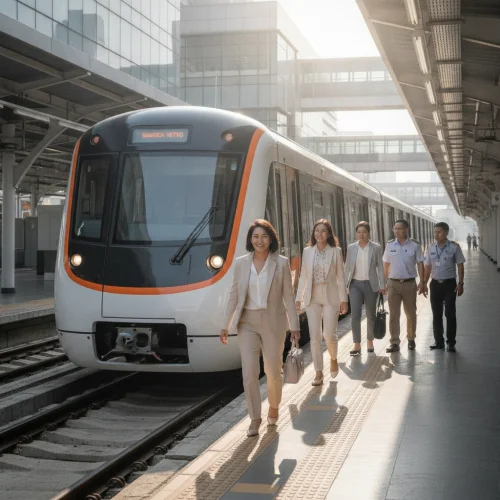
The first train for Bangkok’s new MRT Orange Line will arrive in Thailand in late November, ahead of passenger services starting on the eastern section in 2028.
Factory testing in Turkey is complete. The train has been sent to Germany for secondary safety evaluations before shipment to Southeast Asia. Operator Bangkok Expressway and Metro Public Company Limited (BEM) confirmed that a second train is undergoing identical trials, with subsequent units remaining on schedule.
Eastern Section Timelines and Interchanges
The initial operational phase covers 22.6 kilometres from Thailand Cultural Centre to Min Buri.
Civil construction is finished. Track and rail system installations reached 71.58 per cent by the end of August. Trial runs without passengers will begin in late 2027, followed by full commercial operations in early 2028.
The route contains seventeen stations. For British expatriates living in eastern suburbs, the line will provide direct interchanges to the existing MRT Blue Line at Thailand Cultural Centre, enabling travel into commercial hubs such as Asok and Silom without leaving the transit network. Further east, passengers can transfer to the Yellow Line at Yaek Lam Sali and the Pink Line at Min Buri.
Initial daily ridership is estimated at 100,000 journeys.
Western Route Progress Across Central Bangkok
Construction on the 13.4-kilometre western extension remains at an earlier stage.
Overall progress between Bang Khun Non and Thailand Cultural Centre stood at 35.52 per cent in August. Civil works are 39.13 per cent complete, while rail systems sit at 7.87 per cent.
This section will run entirely underground. Commercial services are scheduled to begin in 2030. The route passes through central districts including Pratunam, Ratchathewi, and Din Daeng before crossing beneath the Chao Phraya River towards Siriraj Hospital.
Once linked, daily patronage across both sections should reach 300,000 trips.
Implications for British Residents and Commuters
The published timetable provides practical guidance for UK expatriates planning tenancy agreements or property purchases.
Suburbs along Ramkhamhaeng Road offer lower rental costs and larger properties than central Bangkok. Commuting from these areas has historically involved severe road congestion during peak hours, complicating travel to central offices and international schools. The rail link will establish fixed journey times.
Public transport costs are also shifting. Thailand's transport ministry is capping urban rail fares at 45 baht per journey under an updated ticketing framework, helping lower daily travel expenses for residents. Meanwhile, the State Railway of Thailand has introduced daily train services between Bangkok and Ayutthaya, alongside ongoing negotiations over a four-month operating extension for the Airport Rail Link.
These developments gradually improve outer-city connectivity for foreign residents, providing dependable cross-city transit options without relying on private vehicles or expressway toll routes.
Source: thethaiger.com
Reviewed by the Thailand Guide Editorial Team • Last reviewed: 22 September 2026
This page is provided for general information only. While we aim for accuracy, details can change — please verify anything important independently before relying on it.