Loi Krathong (Loy Krathong) in Thailand
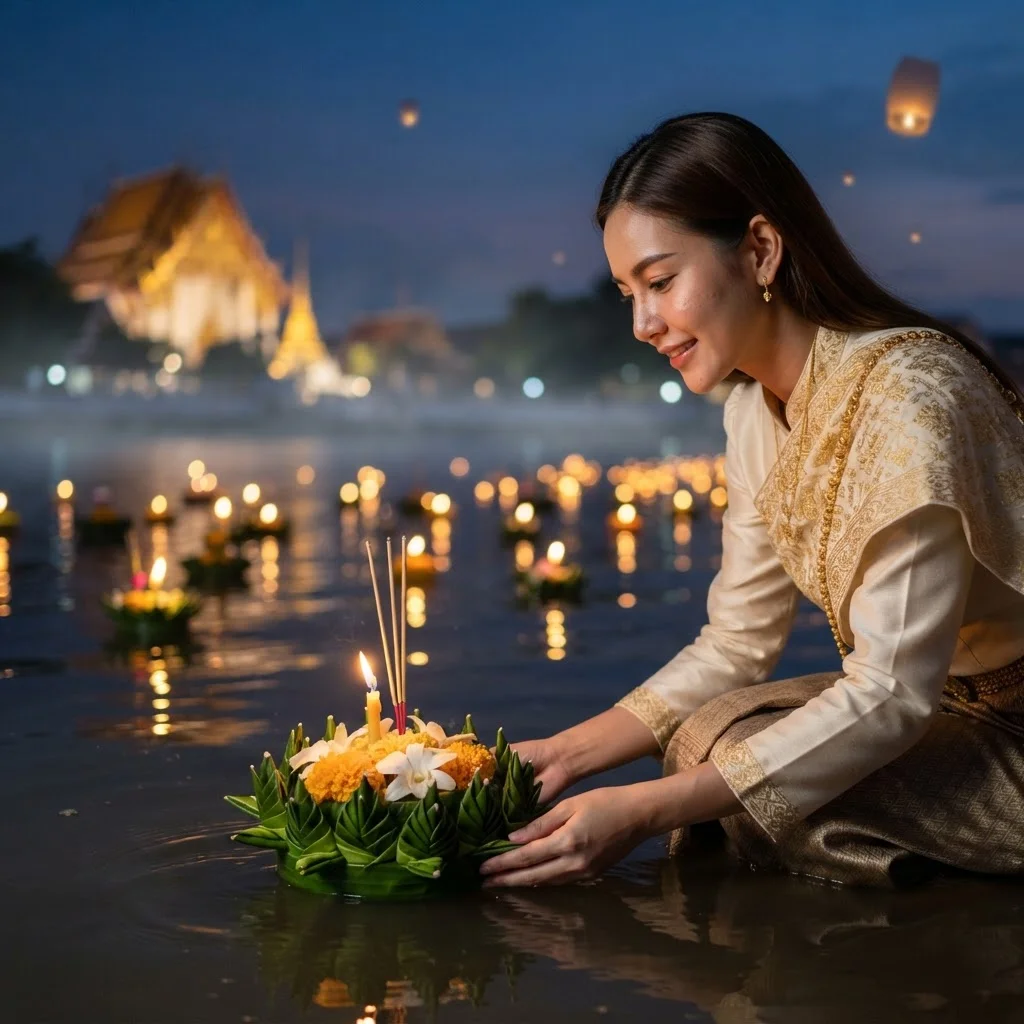
Loi Krathong (also commonly romanised as Loy Krathong) is one of Thailand’s principal annual festivals, observed nationwide on the night of the full moon of the twelfth lunar month, typically falling in November. Across the kingdom, celebrants gather beside rivers, canals, lakes, and coastal waters to launch decorated floating baskets, known as krathongs. Traditionally crafted from slices of banana-tree trunk and folded banana leaves, these small buoyant vessels are adorned with fresh flowers, incense sticks, and a lit candle.
The observance unites several cultural layers: an animist apology and expression of gratitude to the water goddess; an act of Theravada Buddhist devotion; and a symbolic casting away of misfortune as the rainy season retreats. Although popular Thai folklore attributes the ritual to a thirteenth-century court consort from the Sukhothai Kingdom, historical scholarship demonstrates that this origin narrative was a literary creation from nineteenth-century Bangkok. From regional river pageantry to contemporary environmental adaptations, Loi Krathong remains an enduring celebration of communal gratitude and spiritual renewal.
The Origins of Loi Krathong: History Versus Folklore
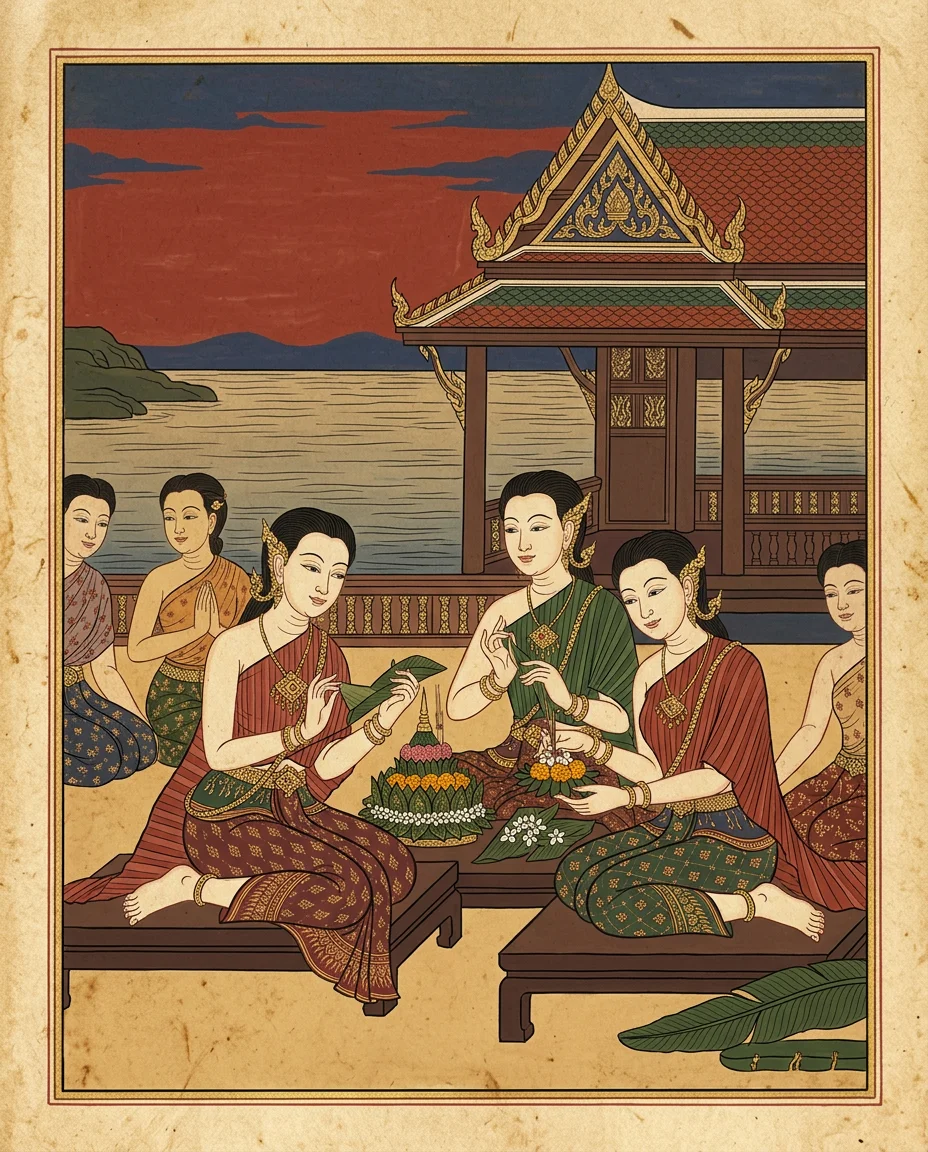
Popular Thai tradition attributes Loi Krathong, also spelled Loy Krathong, to a thirteenth-century noblewoman named Nang Nopphamat, known by her court title Lady Si Chulalak. According to this narrative, she was a consort of the Sukhothai ruler King Ram Khamhaeng who fashioned the first lotus-shaped floating vessel to delight the monarch during an autumn water festival. Impressed by her ingenuity, the king supposedly decreed that releasing floating lotus lanterns would become an annual royal rite across the realm.
Historical scholarship demonstrates that this account is romantic folklore rather than fourteenth-century history. The primary text recording her exploits, the Treatise of Lady Si Chulalak, was not composed in Sukhothai. In 1914, Thai historian Prince Damrong Rajanubhab showed that the work originated in early Bangkok, dating to the reign of King Rama III between 1824 and 1851. Linguistic analysis revealed obvious nineteenth-century details, including mentions of American foreigners, European firearms, and administrative ranks that did not exist during the Sukhothai period.
Sukhothai Inscription No. 1, dated to around 1292, describes seasonal illuminations with the phrase "burning candles and playing with fire". However, this stone stele makes no mention of floating vessels, lotus baskets, or Lady Nopphamat. Historians conclude that nineteenth-century writers romanticised the narrative during the early Rattanakosin period to provide contemporary Siamese rituals with an ancient, unbroken pedigree.
Brahmanical Roots and Buddhist Assimilation
The historical origins of Loi Krathong lie in Indic Brahmanical ceremonies carried to Southeast Asia over centuries of maritime trade. The practice shares clear roots with Indian festivals such as Deepavali and Kartik Purnima, particularly the coastal Odisha tradition of Boita Bandana, in which miniature boats carrying lit lamps are launched on waterways. In its early Indic form, the rite sought blessings from water deities, notably the river goddess Ganga and the Vedic deity Varuna.
As Theravada Buddhism became established across the central plains of Siam, court scholars and monastic authorities reinterpreted these Brahmanical customs to align with Buddhist cosmology. Casting a lit vessel upon the water became linked to several sacred traditions:
- Honouring the footprint left by Gautama Buddha on the banks of the Nammatha River, identified with the modern Narmada in India.
- Veneration of the celestial Chulamani stupa in the Tavatimsa heaven, which enshrines the Buddha's hair relic.
- Paying homage to Elder Upagupta, an enlightened monk in regional folklore who dwells in the cosmic ocean.
Through this synthesis, celebrants honour the Buddha while thanking the waterways, sustaining a harmony between animist respect and Buddhist devotion.
Spiritual Anatomy of the Krathong: Meaning and Ritual
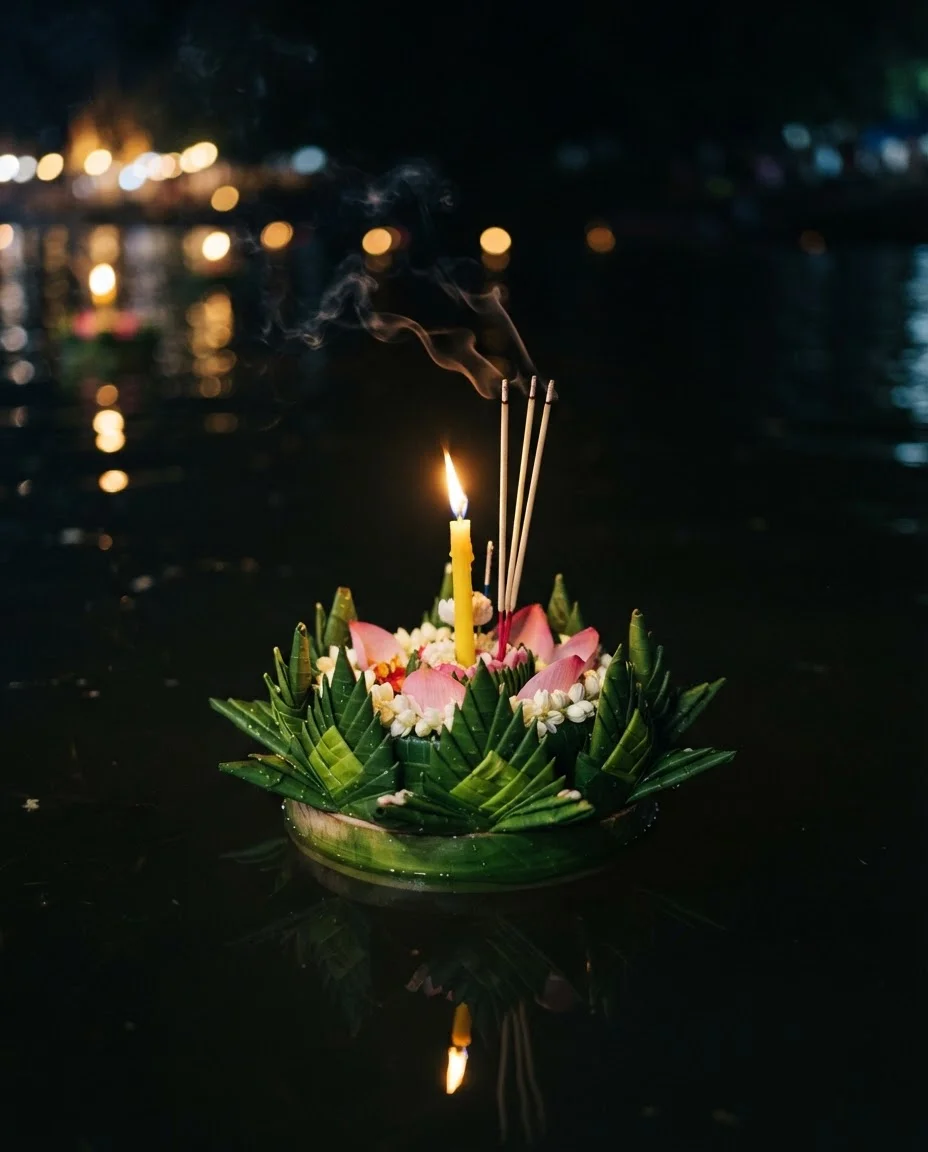
The name of the festival explains its physical form: loi means to float, while krathong refers to a small, buoyant basket or raft. Far from acting merely as festive craftwork, every natural element assembled into a traditional vessel carries deliberate spiritual, symbolic, and psychological meaning in Thai culture.
Reverence for the Water Goddess
At the heart of the ceremony is an act of worship directed towards the river goddess Ganga, revered in Thailand as the Mother of Waters. In an agricultural society where seasonal rains govern rice farming, water represents life, transport, and community survival. By November, the monsoon season has filled the rivers and canals of central Thailand to their brim.
Floating a vessel functions as a collective ritual apology. Worshippers acknowledge that over the preceding year, their daily activities have soiled, drained, and contaminated natural waterways through agriculture, household washing, and waste. By returning an illuminated, scented float to the current, participants formally ask forgiveness for exploiting the water while expressing gratitude for its life-giving sustenance.
Symbolic Shedding and Renewal
Alongside collective thanksgiving, the ceremony serves an intimate psychological purpose: releasing personal misfortune and inviting renewal. The vessel acts as a container for carrying away accumulated spiritual burdens. Celebrants frequently place a clipped fingernail, a lock of hair, or a thread from their clothing among the foliage.
These biological fragments act as personal stand-ins, representing illness, sorrow, anger, and negative karma accumulated across the past twelve months. Holding the vessel with both hands raised to forehead level, the celebrant utters a silent prayer before releasing it onto the water. Watching the candlelight drift downstream provides a visual detachment from past troubles, clearing the way for a fresh start.
Anatomy of an Offering
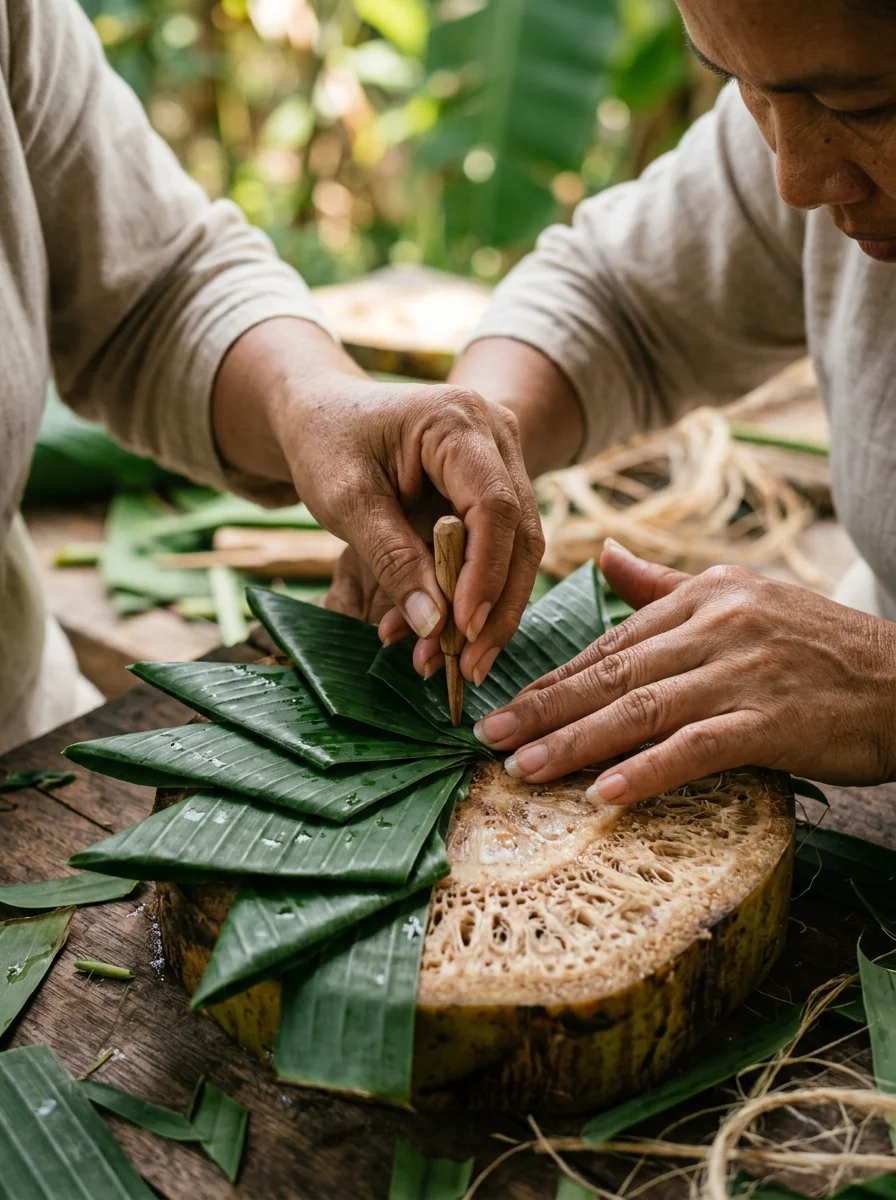
Constructing an authentic vessel relies on specific plant materials shaped by customary craftsmanship. The foundation is a circular slice cut from a banana tree trunk, usually between five and ten centimetres thick. This fibrous stem provides natural buoyancy while breaking down organically in the riverbed.
Artisans wrap the disc in fresh banana leaves, pleating them into decorative borders using classical folding methods. The leaves are pleated into overlapping forms resembling lotus petals, birds, or crowns, pinned securely into the base with shaved bamboo slivers. The interior bed is then layered with fresh blooms chosen for their symbolic attributes.
| Krathong Component | Traditional Material | Symbolic and Cultural Meaning |
|---|---|---|
| Buoyant base | Banana tree trunk section | Natural buoyancy, returning organic matter to the water |
| Decorative rim | Folded banana leaves | Craftsmanship, folding styles honouring the sacred lotus |
| Three incense sticks | Fragrant joss sticks | Devotion to the Buddhist Triple Gem: Buddha, teachings, and monastic order |
| One wax candle | Beeswax or paraffin candle | Spiritual wisdom, enlightenment, dispelling inner darkness |
| Marigolds | Golden yellow blooms | Prosperity, economic flourishing, auspicious solar energy |
| Lotus | White or pink blossoms | Spiritual purity, detachment, rising clean from muddy water |
| Globe amaranth | Purple flower heads | Longevity, durable affection, emotional endurance |
| Crown flower | Star-shaped white blooms | Enduring love, spiritual loyalty, devotion |
| Low-denomination coin | Coins of 1, 5, or 10 THB (approx 2p to 23p) | Making merit, symbolic alms to water spirits, releasing wealth attachment |
| Hair and nail clippings | Personal biological tokens | Physical proxies to cast away accumulated bad luck and illness |
Coins nestled among the flowers, regarded as tokens of fortune and merit, create an informal tradition along riverbanks. Local youths and divers often wade or paddle into the water with buckets, gathering floating rafts within metres of the bank to retrieve the money. While some participants find this practice intrusive, many view it as an accepted festival custom that converts symbolic merit into practical charity.
Plan a Gulf of Thailand trip with clear guidance on island groups, ferries, weather, marine parks, accommodation costs and mainland gateways.
Regional Expressions Across Thailand
While the central plains model—banana-trunk discs launched onto the Chao Phraya River—dominates national media, Thailand’s diverse regions celebrate Loi Krathong with striking provincial distinctions. These variations reflect local materials, distinct cultural heritages, and local waterways.
Tak: The Thread of Thousand Floating Lanterns
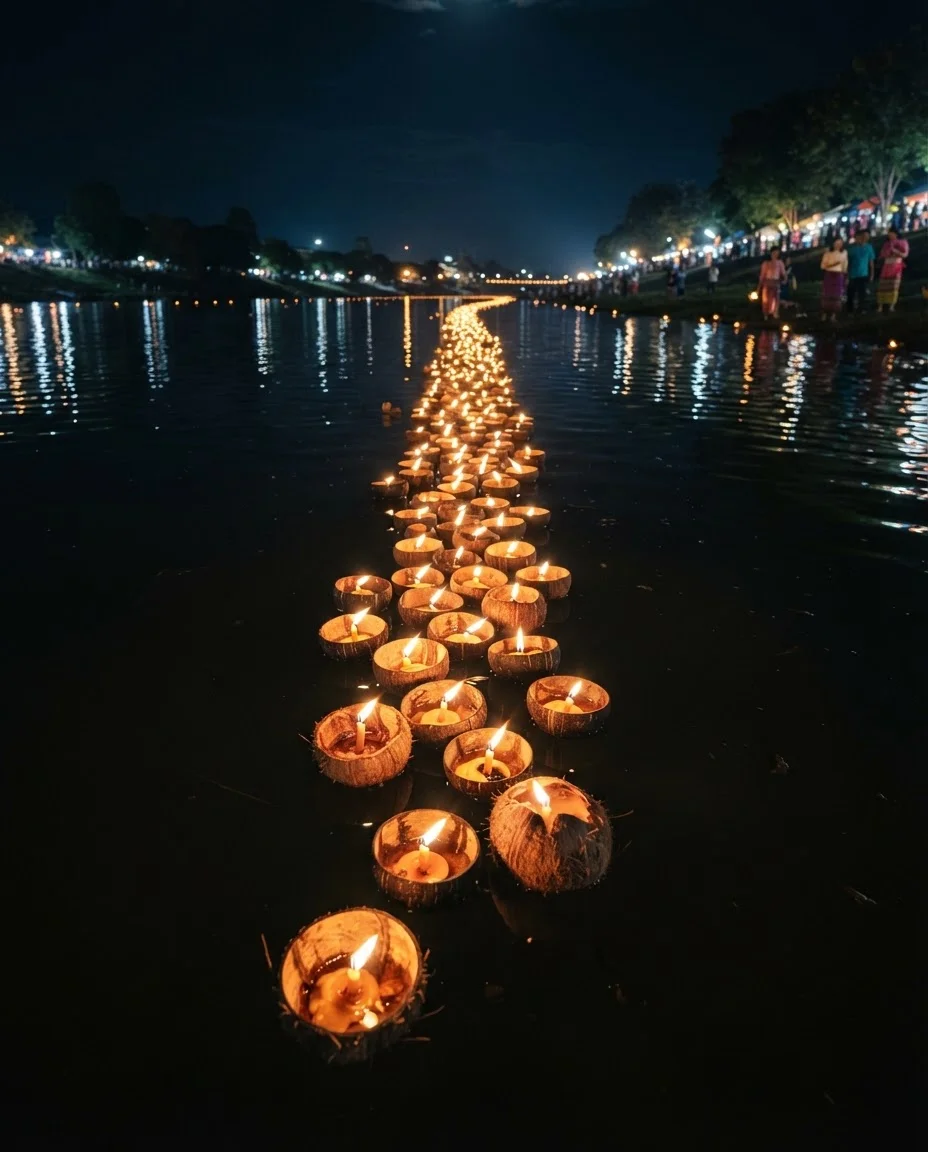
In northern-central Tak, along the Ping River, the festival centres on a communal spectacle of floating lines of a thousand lanterns. Rather than banana trunks, communities use discarded coconut shells, an abundant byproduct of the local trade in traditional coconut snacks.
Residents smooth and clean coconut halves, filling them with wax mixed with pine resin or castor oil to prolong burn time, fitted with a heavy cloth wick. On festival nights, teams gather beneath the Rattanakosin Bicentennial Bridge and launch these shells into the current in rapid succession.
Because the Ping River is wide and shallow here, with linear sandbars, the current funnels the flickering shells into a tight ribbon of light drifting across kilometres of dark water. Local teams compete for a royal trophy, judged on how evenly their chain of light flows downriver.
Sukhothai: The Dawn of Light Displays
Despite the fictional origins of the Lady Nopphamat story, Sukhothai remains the spiritual showpiece of modern state-endorsed Loy Krathong. Held within Sukhothai Historical Park, the celebration revives the phrase "lighting candles and playing with fireworks" from the thirteenth-century King Ram Khamhaeng inscription.
Celebrations take place around rectangular reservoirs—such as the Silver Pond and Gold Pond—surrounding the brick ruins of Wat Mahathat and Wat Sa Si. Because these are placid temple reservoirs rather than flowing rivers, the krathongs sit motionless on the mirror-like water. Sukhothai augments the floating rites with sound-and-light pageants, classical dance, fireworks, and the national Miss Nopphamat beauty contest.
Central Waterways and Southern Coastlines
In the central delta basin, including Ayutthaya and Bangkok, celebrations cluster around major rivers and municipal canals. Historic court celebrations featured colossal floating pavilions crafted by royal artisans that measured several metres across. In nearby Samut Songkhram, communities craft buoyant floats from fibrous banana-tree sheaths, launching tens of thousands along the Mae Klong River.
In the coastal south, along the Andaman Sea and Gulf of Thailand, Loi Krathong adapts to the sea. Inland rivers are less prevalent across peninsular provinces like Phuket and Krabi, so celebrants release floats into open ocean surf, tidal estuaries, and coastal lagoons. In fishing communities, floats are launched to pray for calm seas and safe voyages.
| Northern Central | Tak (Ping River) | Coconut-shell lantern chains | Polished coconut shells filled with wax; released in thousands to form continuous chains |
|---|---|---|---|
| Historic Sukhothai | Sukhothai Historical Park | Candle and firework festival | Ancient rectangular reservoirs; historical reenactments, sound-and-light shows |
| Central Basin | Bangkok, Ayutthaya, Amphawa | River and canal krathongs | Banana trunks, folded leaves, and banana sheaths; royal barge displays; temple fairs |
| Northeast (Isan) | Roi Et, Mekong provinces | Lake pageants and river craft | Large illuminated floats on provincial lakes; small illuminated bamboo craft along the Mekong |
| Peninsular South | Phuket, Songkhla, Krabi | Coastal and estuary releases | Ocean surf and tidal creek launches; prayers for maritime safety and calm fishing waters |
In the northeastern region, celebrations centre on regional reservoirs and border waters. In Roi Et, festivities gather around the artificial lake of Bueng Phlan Chai for large illuminated float competitions and mass folk dances. Along the Mekong River, where the grand illuminated boat procession takes place a month earlier at the close of Buddhist Lent, Loi Krathong sees border communities float smaller illuminated bamboo and leaf craft onto the international river.
Loi Krathong and Yi Peng: Untangling the Twin Celebrations
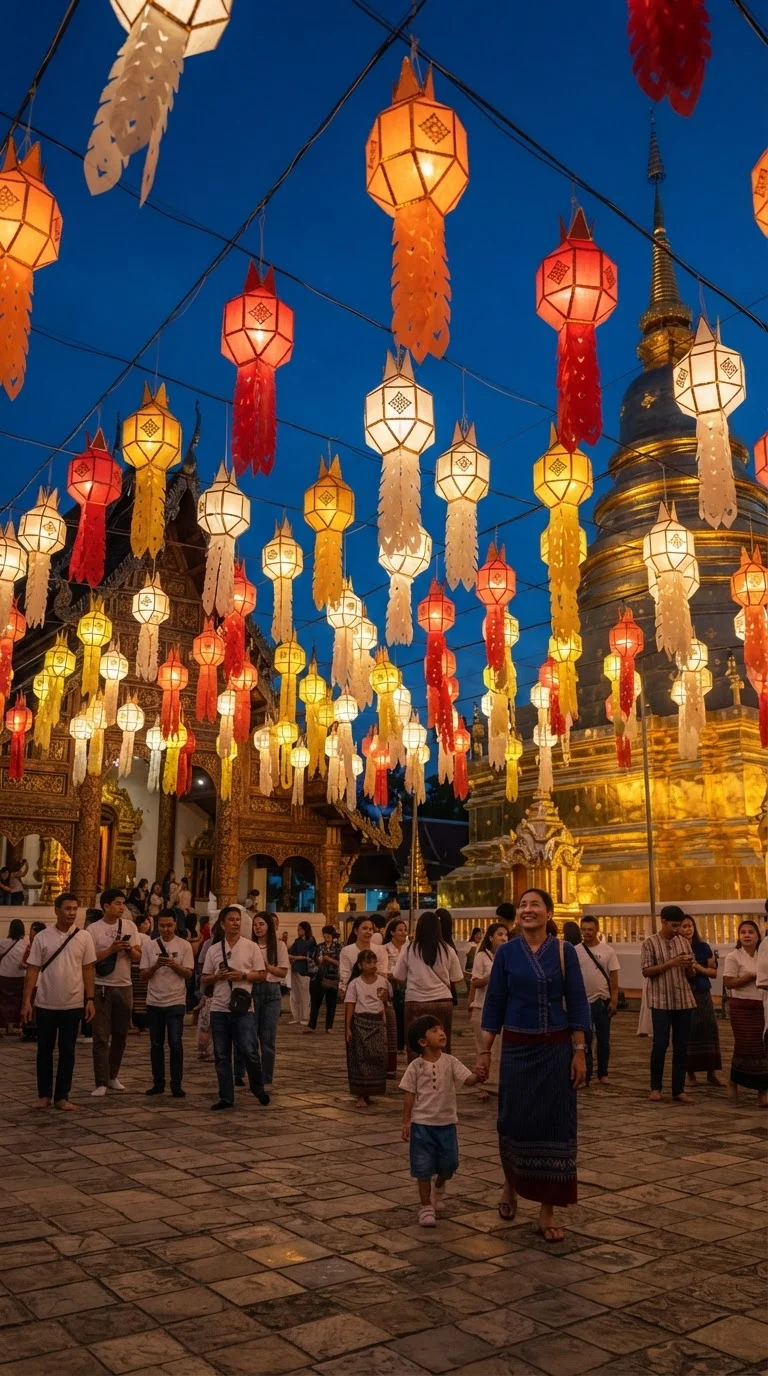
Visitors frequently conflate Loi Krathong with Yi Peng (also written Yee Peng), treating them as interchangeable names for the same festival. In northern centres such as Chiang Mai, Lamphun, and Lampang, both events take place concurrently, illuminating both rivers and the night sky. Historically and culturally, however, they represent two distinct traditions originating from separate civilisations.
Two Calendars, One Night
The simultaneous occurrence of Loi Krathong and Yi Peng results from differing lunar calendar systems. Central Thailand follows the Siamese lunar calendar, celebrating Loi Krathong on the full moon of the twelfth lunar month. By contrast, the northern provinces once formed the sovereign kingdom of Lanna, which maintained its own astronomical reckoning.
Under the Lanna lunar calendar, the months run two cycles ahead of the central plains. In the northern language, the name Yi Peng translates directly as the full moon of the second month. Because the second Lanna lunar month corresponds to the twelfth month of the central Siamese calendar, the two celebrations naturally coincide on the full moon in November.
Air Versus Water: The Cultural Distinction
The principal distinction lies in the physical medium chosen for ritual release. While Loi Krathong entrusts buoyant leaf baskets to rivers and waterways to thank the water goddess and cast off misfortune, Yi Peng commits prayers to the sky.
The defining vessel of Yi Peng is the sky lantern, constructed from thin mulberry paper stretched over a lightweight bamboo frame. A wax-soaked fuel disc suspended across the base heats the air inside the chamber, creating convection currents that carry the lantern high into the night atmosphere. Within northern Buddhist practice, releasing these lanterns honours the sacred Chulamani stupa in the heavens, which is believed to enshrine a hair relic of the Buddha. Releasing an airborne lantern symbolises letting go of personal grievances, misfortune, and mental defilements. Alongside sky lanterns, northern communities hang decorative paper lanterns across temple eaves, doorways, and city gates, directing spiritual devotion upward while Loi Krathong flows across the water below.
The Ecology of Celebration: Waste, Reform, and Innovation
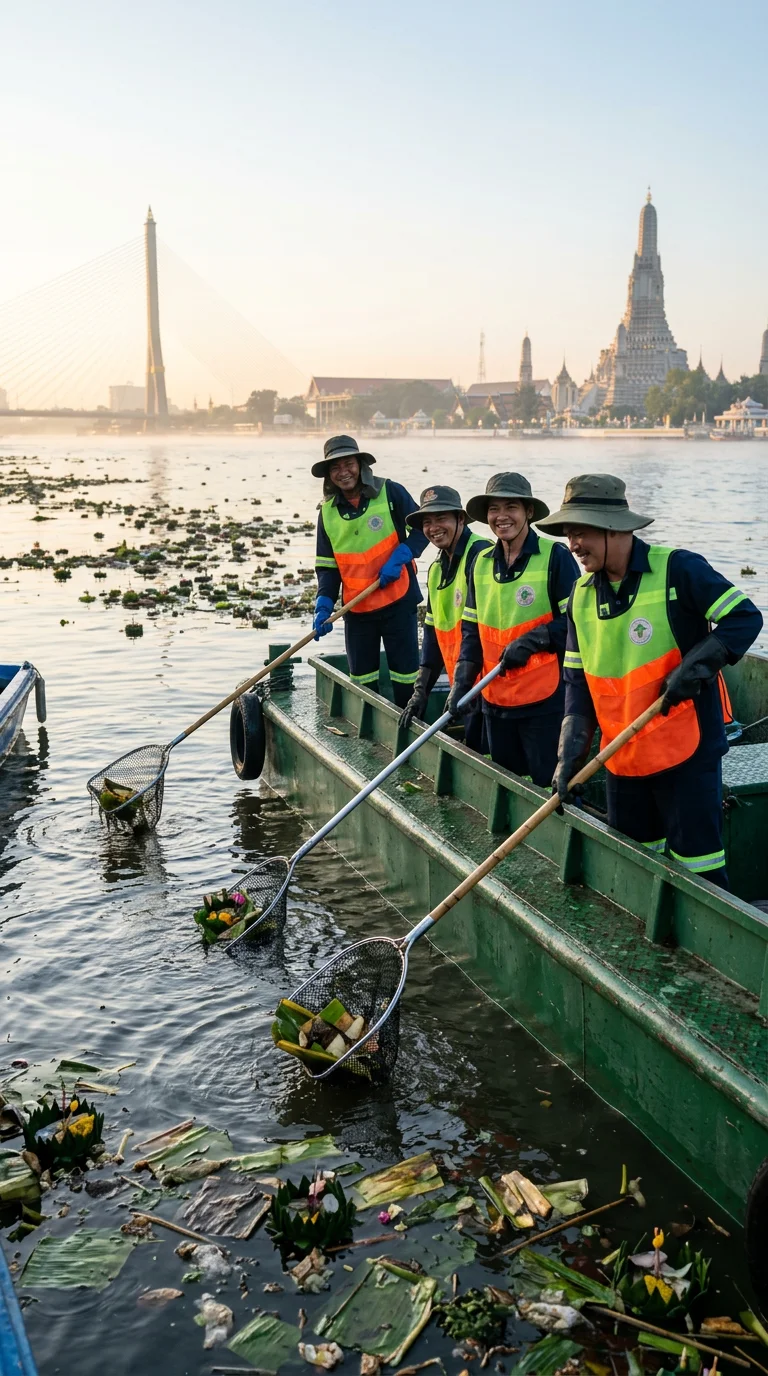
In recent decades, Loi Krathong has faced intense scrutiny over the ecological impact of modern consumer materials. Rapid urbanisation transformed a modest village custom into a dense, mass-market event in major cities. The resulting accumulation of festive debris in waterways has sparked national debate and prompted municipal authorities to overhaul environmental policy.
The Problem with Bread and Polystyrene
During the economic expansion of the 1970s and 1980s, hand-crafted banana-trunk floats were largely supplanted by mass-produced expanded polystyrene bases. Polystyrene was cheap and buoyant, but by the 1990s millions of synthetic discs choked the Chao Phraya River and coastal waters. These bases degraded into microplastics, harmed wildlife, and blocked municipal drainage pumps.
Public awareness campaigns subsequently urged revellers to choose baked bread floats, marketed as a biodegradable alternative that would nourish fish. In enclosed waters, however, this substitute produced severe unintended harm. While fish consume bread in flowing rivers, thousands of floats launched into stagnant park ponds and city moats trigger rapid bacterial decay. Fermenting dough strips dissolved oxygen from the water overnight, causing widespread fish kills and foul eutrophic conditions that require months of dredging and pond rehabilitation.
Modern Municipal Clean-ups and Digital Krathongs
Clearing festival waste is now an intensive overnight municipal operation. In Bangkok, the city administration deploys dozens of collection boats and hundreds of sanitation workers starting at eight in the evening. Teams work through the night to clear debris from the Chao Phraya River, drainage canals, and over 30 public parks before dawn. Collected floats are segregated: organic material is sent to composting plants in the Nong Khaem district, while non-biodegradable waste is buried in landfills.
How Thailand Is Adapting to Environmental Concerns
- Natural materials now dominate collections, with organic banana stems and leaves comprising over 95 per cent of Bangkok's retrieved floats in recent years, down from synthetic peaks above 20 per cent.
- Authorities promote a "one family, one vessel" policy, encouraging households and groups to share a single float to reduce total volume.
- Eco-designers have introduced floats made of cast ice embedded with flower petals, which melt within minutes and leave no solid waste.
- Municipalities now host digital events. Along Bangkok's Ong Ang Canal, visitors colour paper or tablet designs that are scanned and projected onto the water surface, maintaining the ritual without physical debris.
For those planning to experience the festival calendar across the kingdom, our broader Festivals guide details how Loi Krathong fits into the annual rhythm of Thai spiritual and seasonal observances.
Quick Reference Table
| Item | Detail | Notes |
|---|---|---|
| Timing | Full moon of the twelfth lunar month (typically November) | Coincides with the end of the rainy season when waterways are at peak volume |
| Core ritual | Launching buoyant, decorated baskets (*krathongs*) on water | Combines reverence for the water goddess Ganga with Theravada Buddhist devotion |
| Traditional materials | Sliced banana-tree trunk base, pleated banana leaves, and fresh blooms | Assembled with bamboo slivers; includes three incense sticks and one wax candle |
| Personal tokens | Hair clippings, fingernail clippings, or clothing threads | Placed in vessels as physical proxies to symbolically discard bad luck and illness |
| Monetary offerings | Coins of 1, 5, or 10 THB (approx 2p to 23p) | Nestled among flowers as merit tokens; routinely collected by local youths |
| Origins and history | Derived from ancient Indic Brahmanical river rituals | The popular Lady Nopphamat Sukhothai narrative was an early 19th-century Bangkok literary invention |
| Tak variation | Continuous chains of wax-filled coconut shells | Floated on the Ping River from beneath the Rattanakosin Bicentennial Bridge |
| Sukhothai celebrations | Light displays and pageantry at Sukhothai Historical Park | Staged around still temple reservoirs such as the Gold and Silver Ponds |
| Yi Peng distinction | Sky lantern (*khom loi*) release celebrated across northern Thailand | Occurs on the same night due to the Lanna lunar calendar running two months ahead |
| Environmental measures | Digital projections, ice krathongs, and "one family, one vessel" guidance | Over 95 per cent of Bangkok floats are now natural; polystyrene and bread bases are discouraged |
FAQ: Loi Krathong in Thailand
What is Loi Krathong?
What is the origin story of Loi Krathong?
What is the spiritual meaning behind floating a krathong?
What items are typically included in a traditional krathong?
Why do people put coins in their krathongs?
How do different regions in Thailand celebrate Loi Krathong?
What is the difference between Loi Krathong and Yi Peng?
Why do Loi Krathong and Yi Peng occur on the same night?
What environmental concerns are associated with Loi Krathong?
How are authorities addressing the environmental impact of Loi Krathong?
Reviewed by the Thailand Guide Editorial Team • Last reviewed: 24 November 2026
This page is provided for general information only. While we aim for accuracy, details can change — please verify anything important independently before relying on it.