Cycling in Sukhothai
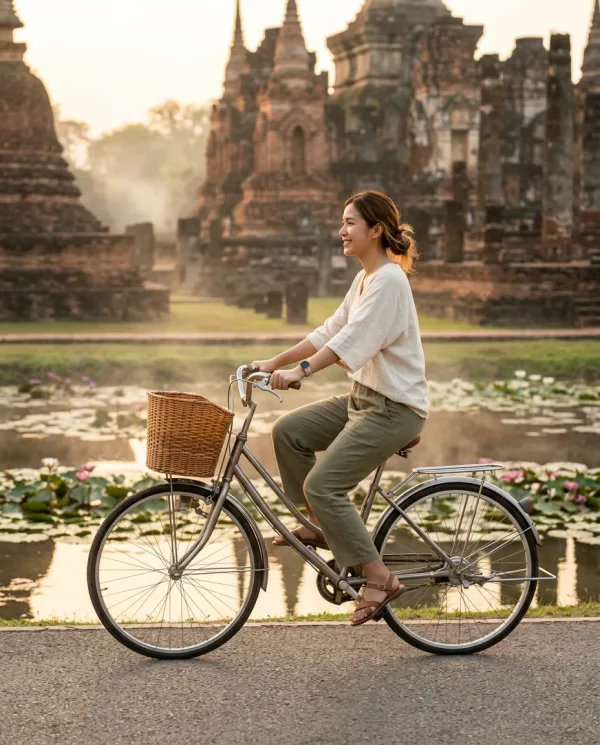
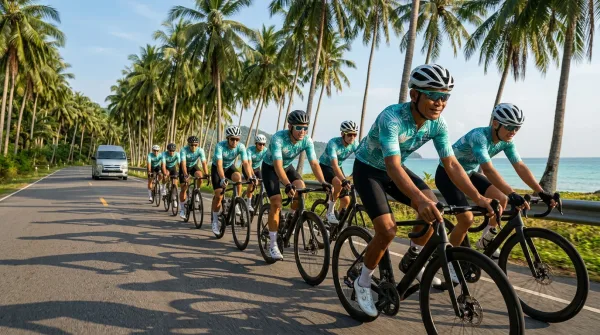
Covering 70 square kilometres of flat plains and landscaped grounds, Sukhothai Historical Park preserves 193 recorded archaeological ruins across five distinct zones. Founded in the 13th century as the first capital of Siam, the ancient city is one of Thailand's most rewarding historical sites to explore on two wheels. Private cars are prohibited within the central walled enclosure, leaving smooth, paved pathways that wind between reflective lotus ponds, brick ramparts, and laterite chedis.
Administered by the Fine Arts Department of Thailand alongside the nearby satellite city of Si Satchanalai, the park forms part of a UNESCO World Heritage site situated roughly midway between Bangkok and Chiang Mai. The surrounding countryside extends into quiet rural lanes passing farmland and traditional hamlets. Daily bicycle hire is available directly outside the main park entrance for 30 THB to 50 THB (approximately £0.70 to £1.15), providing independent riders with an easy, low-cost way to navigate both the inner monument compounds and the outlying temples.

Central Historical Park and Sacred Monument Circuits
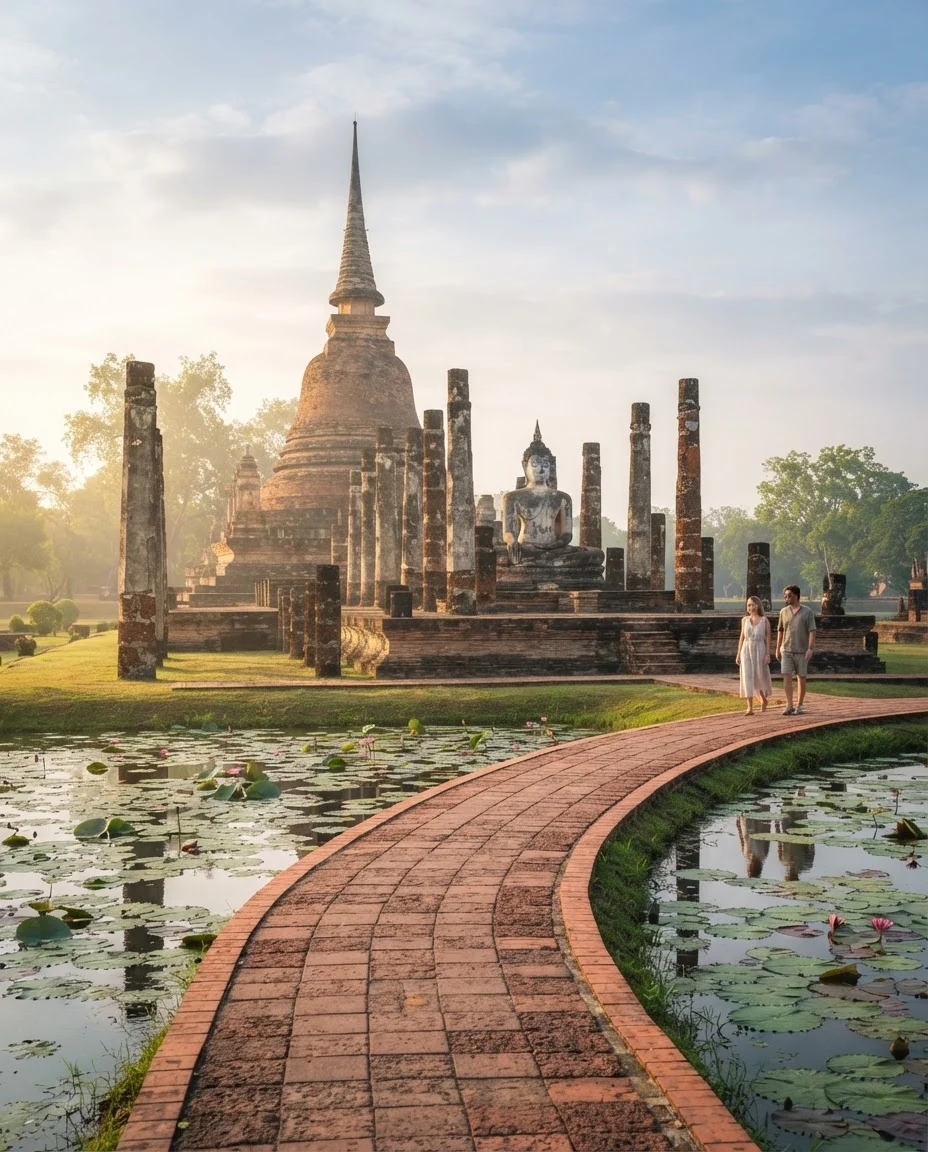
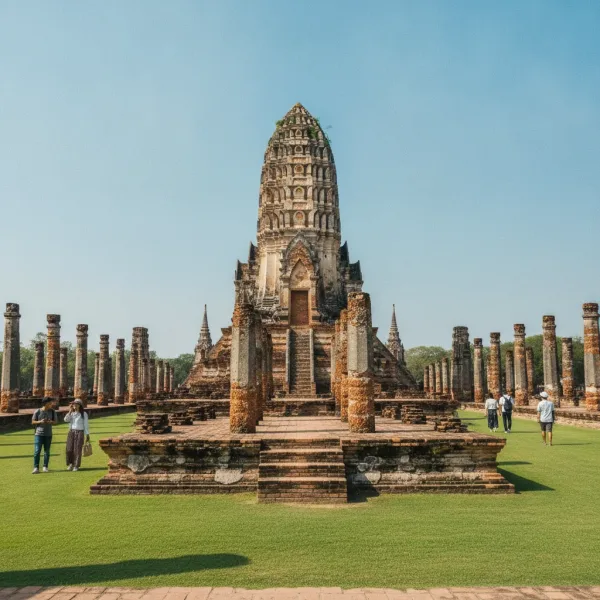
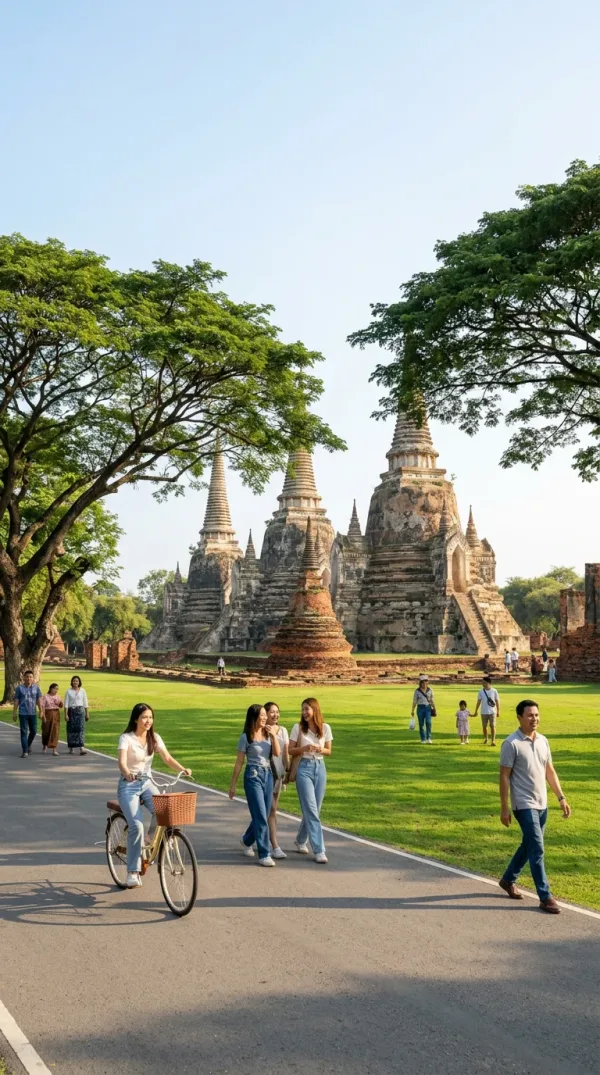
The central zone of Sukhothai Historical Park provides a level, traffic-free environment where smooth asphalt avenues and compacted laterite tracks weave directly between the kingdom's principal monument compounds.
Enclosed by triple earthen ramparts and ancient moats, the inner royal city measures roughly 1.8 by 1.3 kilometres, presenting virtually zero gradient and straightforward navigation for riders of all abilities. Broad tarmac pathways link the expansive brick platform of Wat Mahathat, where cycling along the perimeter water basins yields unobstructed views of the central lotus-bud chedi and weathered laterite colonnades. Trails continue northwest towards Wat Sa Si, situated on an island in the Traphang Tra Kuan reservoir and reached via a wooden footbridge, where a bell-shaped chedi and walking Buddha image overlook the water. Paved avenues run south towards Wat Si Sawai, where three Khmer-style laterite prangs from the late twelfth century rise above mown lawns, and past the brick stupa of Wat Traphang Ngoen. Private cars and motorbikes are prohibited within these inner walls; riders share the paths only with pedestrians, official park electric trams, and small electric carts. Park regulations require cyclists to dismount and leave bicycles in designated wooden bike racks before entering sacred ruin precincts, as riding across temple plinths, stepped terraces, or fragile archaeological brickwork is strictly forbidden. A thorough central circuit covers approximately 5 to 7 kilometres of relaxed riding, which typically takes two to three hours when combined with exploration of the monuments on foot.
Collect your park entrance ticket and bicycle permit slip at the main eastern gatehouse on Route 12 before riding onto the inner perimeter paths.
Outer Countryside, Village Trails, and Western Ruins
Passing through the ancient city gates leads onto quiet tarmac backroads and gravel tracks that connect the outlying historical zones with farming hamlets, canal paths, and forested foothills.
The Northern Zone, situated roughly two kilometres outside the city walls, is reached via quiet secondary roads leading to Wat Si Chum. Here, a colossal 15-metre seated Buddha, known as Phra Achana, sits tightly enclosed within a roofless brick mondop, viewed through a narrow vertical entrance slit. Continuing half a kilometre northeast brings riders to Wat Phra Phai Luang, an expansive pre-Sukhothai Khmer-era compound bordered by a broad moat, where hardpack singletracks run alongside irrigation canals and the ancient Tao Thuriang celadon kilns.
Cyclists wanting greater distance and varied terrain can pedal west through the Or Gate along Rural Road 1272 into the Western Zone, historically known as the Aranyik forest monastery sector. Here, the flat paddy plain transitions into rolling teak and dry dipterocarp forest along the foothills of the Khao Luang range. At Wat Saphan Hin, riders leave their bicycles in ground-level racks and ascend a 300-metre slate stone pathway up the hillside to inspect Phra Attharot, a 12.5-metre standing Buddha that gazes eastward across the valley. Other forest ruins in this sector, including Wat Khao Phra Bat Noi and Wat Chedi Ngam, sit along quiet woodland tracks that see minimal visitor traffic.
To the south, passing through the Namo Gate opens onto quiet country lanes leading to Wat Chetuphon. This compound features a perimeter wall of upright slate slabs and a central brick mandapa housing four large Buddha images in standing, walking, seated, and reclining postures. Directly opposite stands Wat Chedi Si Hong, noted for the surviving stucco reliefs of deities, lions, and elephants around the base of its bell-shaped stupa. Beyond the temples, unpaved agricultural tracks meander through working rice fields and orchards where irrigation ditches support grazing water buffalo.
Mount a secure smartphone holder to your handlebars to help track junctions across the network of unpaved irrigation tracks linking the outer ruin clusters.
| Cycling Circuit | Distance | Road Surface | Difficulty Level | Key Highlights |
|---|---|---|---|---|
| Central Enclosure Loop | 5–7 km | Paved tarmac and fine packed gravel | Easy (Flat) | Wat Mahathat, Wat Sa Si, Wat Si Sawai |
| Northern Ruin Extension | 6–8 km return | Paved roads and dirt paths | Easy (Flat) | Wat Si Chum, Wat Phra Phai Luang, Tao Thuriang kilns |
| Western Forest Monastery Route | 10–14 km loop | Asphalt backroads and gentle incline | Moderate (Rolling) | Wat Saphan Hin, Wat Khao Phra Bat Noi, forest trails |
| Southern Rural Countryside Loop | 15–22 km circuit | Narrow paved lanes and canal paths | Moderate (Flat) | Wat Chetuphon, Wat Chedi Si Hong, ceramic kilns |
| Si Satchanalai Forest Park Loop | 8–12 km circuit | Shaded tarmac and hardpack dirt | Easy to Moderate | Wat Chang Lom, Wat Chedi Chet Thaeo, Yom River |
Essential travel guide to Sukhothai Historical Park for UK travellers, covering ancient temple zones, bicycle routes, travel options from Bangkok, costs, and practical tips.
Si Satchanalai Historical Park Forest Network
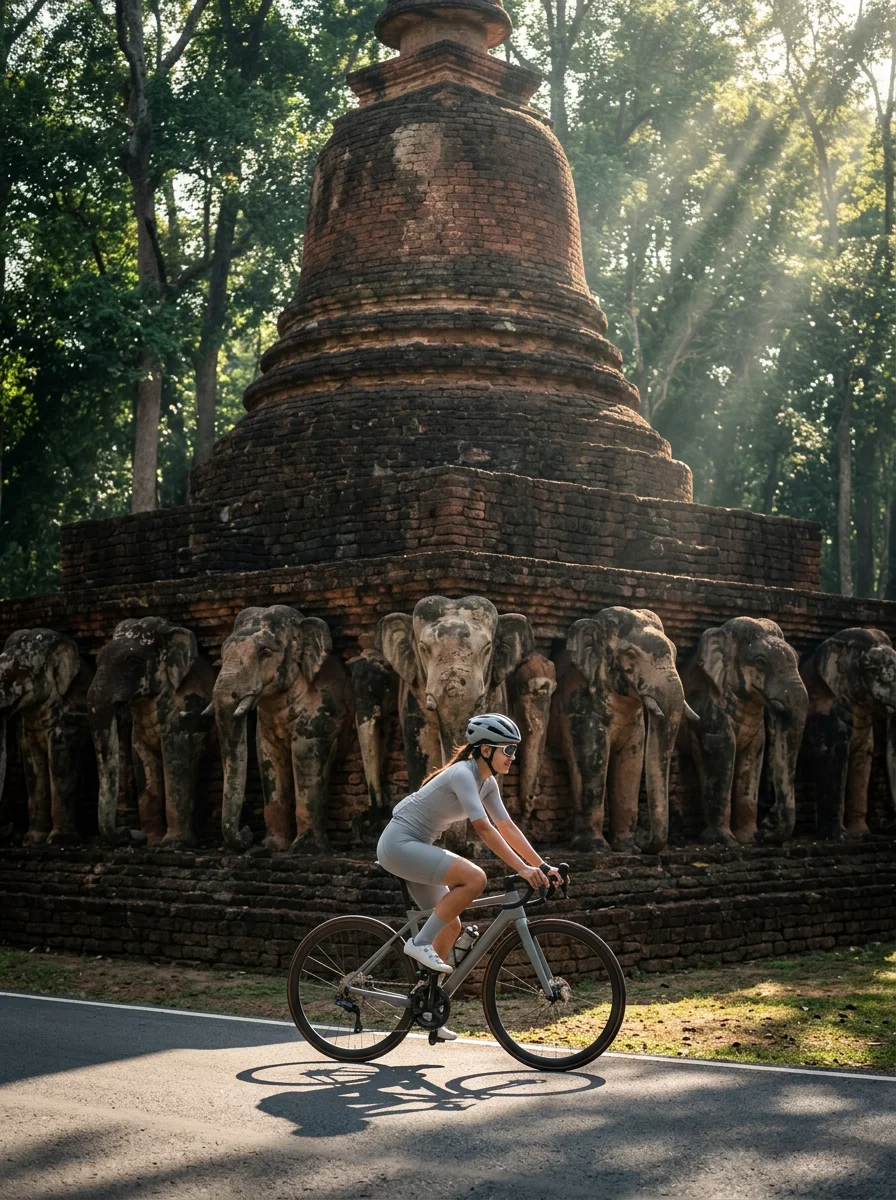
Roughly 55 kilometres north of Sukhothai, Si Satchanalai Historical Park provides a quiet woodland cycling circuit beneath dense teak canopies along the western bank of the Yom River. Established as the secondary seat of the Sukhothai kingdom, this World Heritage site receives far fewer visitors than the central Sukhothai park, leaving its paved routes and hardpack tracks mostly clear of traffic.
The riding begins near Wat Phra Si Rattana Mahathat Chaliang, an ancient temple complex featuring a prominent Khmer-style prang set in a sharp bend of the Yom River. Visitors arriving from the main road cross a pedestrian suspension footbridge over the water, wheeling their bicycles across before entering the archaeological area. From here, flat, shaded routes run westward into the main park gate, where quiet tarmac paths weave through tall forest toward the central monuments.
The core circuit centres on Wat Chang Lom, where 39 full-bodied laterite elephant sculptures encircle the base of a bell-shaped Sri Lankan stupa. Directly opposite stands Wat Chedi Chet Thaeo, displaying more than 30 subordinate stupas built in a striking blend of Sukhothai, Lanna, Bagan, and Ceylonese architectural traditions. Further along the trail, the remains of Wat Nang Phaya preserve intricate stucco carvings along its ruined prayer hall.
Because the temples spread across several square kilometres of forest floor, a bicycle is the most practical way to cover the distances between ruins. For elevated views across the tree canopy, cyclists can leave their bikes at the base of two connected hills, Wat Khao Phanom Phloeng and Wat Khao Suwankhiri, and climb the steep laterite stairways to explore the ridgeline shrines.
Bicycle Hire, Guided Excursions, and Day Itineraries
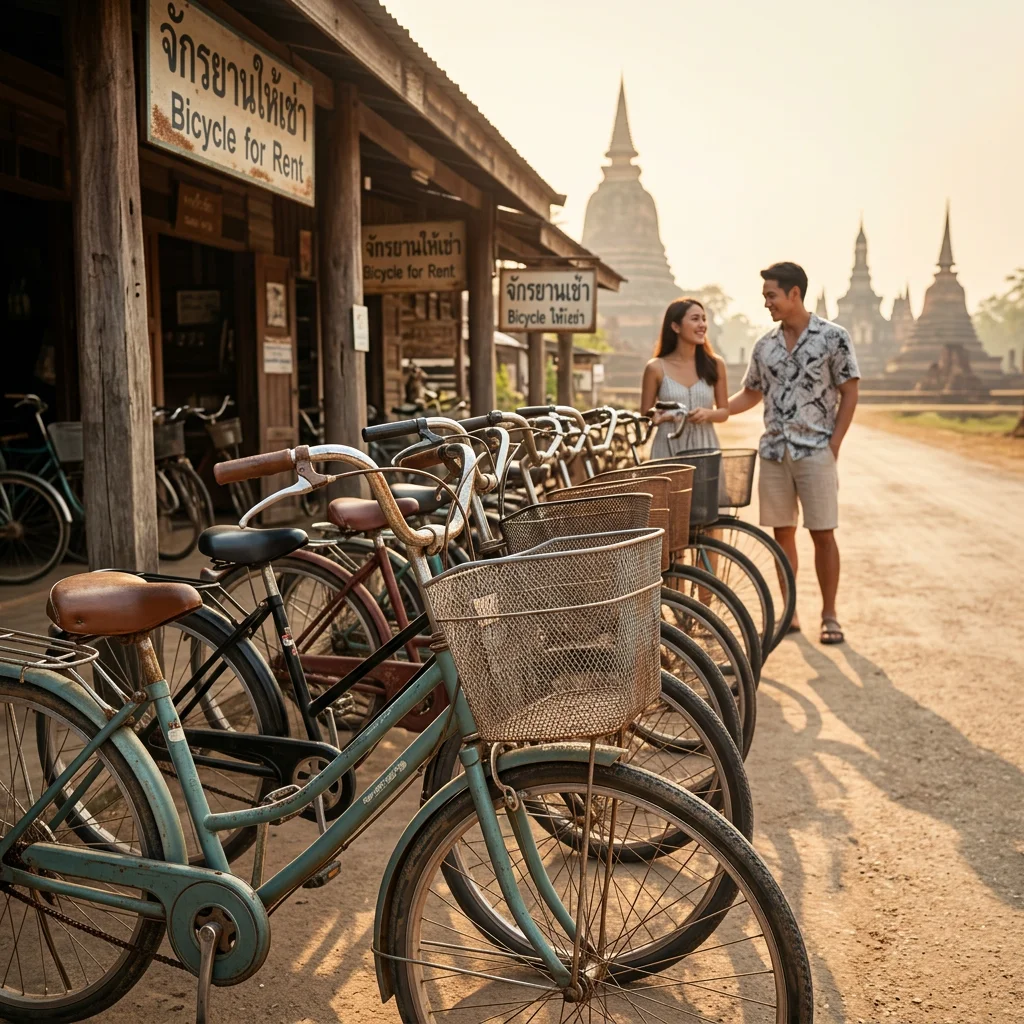
Independent bike hire infrastructure in Old Sukhothai is concentrated directly along the commercial strip fronting the park's main east entrance, allowing visitors to collect transport within minutes of arriving. Most rental outfits supply Japanese-style step-through utility bicycles equipped with single-speed gearing, rear kickstands, and front wire baskets for water bottles and bags. These city bikes rent for 30 THB to 50 THB (£0.70 to £1.15) per calendar day and typically include a basic cable lock. Many local guesthouses also keep fleets for their guests, sometimes free of charge. Most independent hire shops open around 06:00 or 06:30 and close between 17:30 and 18:00, so riders planning sunset excursions should arrange overnight retention in advance.
For longer rides into the western foothills or rural agricultural loops, several specialist guesthouses and tour outfits rent multi-speed mountain bikes and hybrid touring bicycles for 150 THB to 250 THB (£3.40 to £5.70) per day. Travellers seeking cultural context can book half-day guided cycling excursions, which cost 800 THB to 1,500 THB (£18 to £34) per rider. These guided routes use geared mountain bikes and helmets, following irrigation canals and dirt tracks through farming hamlets, market gardens, and village temples alongside archaeological sites.
A well-paced full-day independent itinerary begins at 06:30, entering the central zone as gates open to catch early light over the lotus moats of Wat Mahathat and Wat Sa Si. A morning pedal north to Wat Si Chum and Wat Phra Phai Luang fills the cooler hours before the midday sun intensifies. Cyclists typically retreat between 11:30 and 14:30 for lunch and rest in Old Sukhothai, resuming in the late afternoon along the quiet southern canal tracks to Wat Chetuphon and Wat Chedi Si Hong.
Location and Getting There
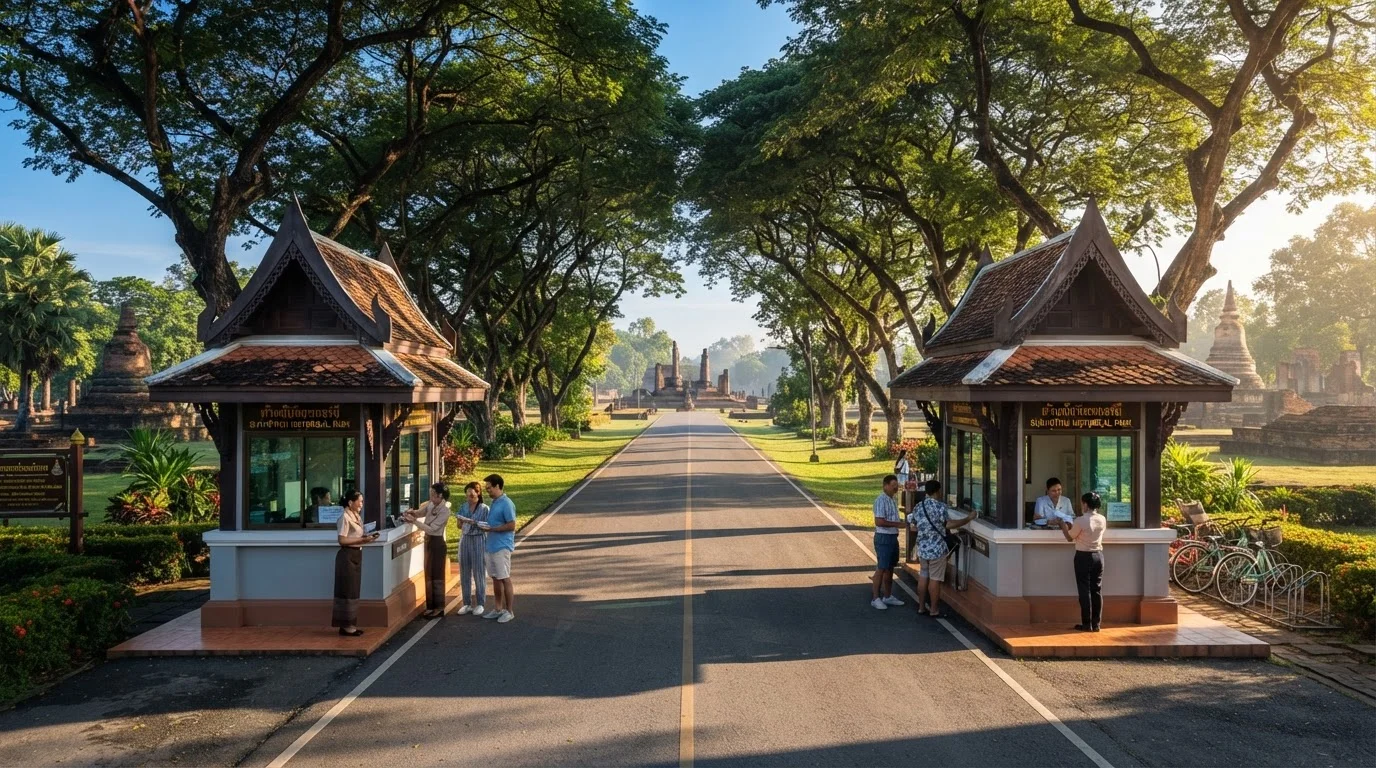
Sukhothai Historical Park lies at Mueang Kao (Old Sukhothai), roughly 12 kilometres west of the modern provincial capital, New Sukhothai (Sukhothai Thani), in lower northern Thailand. Cyclists heading directly to the ruins can fly with Bangkok Airways, which operates daily flights from Bangkok Suvarnabhumi into Sukhothai Airport (THS), situated around 40 kilometres north of the historical park. Shared minivan transfers meet incoming flights and carry passengers directly to Old Sukhothai hotels for 300 THB (about £6.80) per person, taking roughly 45 minutes.
Travel by rail requires taking a train on the Northern Line from Bangkok's Krung Thep Aphiwat Central Terminal to Phitsanulok (5 to 6 hours, with second-class fares usually between 300 THB and 470 THB / £6.80 to £10.70). From Phitsanulok, local buses and minivans depart every 30 to 60 minutes for the one-hour journey to Sukhothai (50 THB to 70 THB / £1.15 to £1.60). Buses bound for Tak via the old city can drop passengers right outside the historical park entrance.
Direct air-conditioned coaches depart Bangkok's Mo Chit 2 terminal (6 to 7 hours, around 380 THB to 460 THB / £8.60 to £10.50) and Chiang Mai's Arcade terminal (roughly 5 hours, around 250 THB to 350 THB / £5.70 to £8.00). For travellers based in New Sukhothai, traditional blue wooden songthaews run between the provincial town and the historical park entrance every 20 to 30 minutes from 06:00 to 17:30, costing 30 THB (£0.70) each way.
Costs and Booking
Independent bicycle hire in Sukhothai and Si Satchanalai involves minimal daily expenditure. Rental shops along the main strip in Old Sukhothai opposite the park entrance hire bicycles on the spot without advance reservations. Most vendors accept a passport photocopy or a small cash deposit rather than holding an original passport. Standard single-speed city bicycles cost 30 to 50 THB (£0.70 to £1.15) per day, complete with a front wire basket and cable lock. Geared mountain bikes suitable for longer excursions cost 150 to 250 THB (£3.40 to £5.70) per day.
Sukhothai Historical Park charges admission by zone rather than selling an all-inclusive ticket. Foreign adult visitors pay 200 THB (£4.55) for the Central Zone, 120 THB (£2.75) for the Northern Zone covering Wat Si Chum and Wat Phra Phai Luang, and 120 THB (£2.75) for the Western Zone covering Wat Saphan Hin and forest shrines. Cyclists pay an additional 10 THB (£0.23) access surcharge per bicycle at each ticketed zone. The Southern and Eastern zones charge no admission fees. Tickets remain valid for the entire calendar day of issue, allowing riders to exit during the hottest midday hours and return in the late afternoon.
Si Satchanalai Historical Park charges 100 THB (£2.25) for foreign adult admission alongside a 10 THB bicycle surcharge, with basic rental bicycles available at the gate for 30 THB per day. Guided cycling excursions across surrounding farming villages cost 800 to 1,500 THB (£18 to £34) per person for half-day routes and up to 2,200 THB (£50) for full-day programmes with lunch and vehicle support. Booking guided trips a few days ahead is sensible during the November-to-February peak season, whereas independent bicycle hire rates remain unchanged year-round. All ticket counters and rental stalls operate strictly on cash in Thai Baht.
| Option | Cost (THB) | Cost (GBP approx) | Notes |
|---|---|---|---|
| Standard City Bicycle Rental | 30–50 | £0.70–£1.15 | Per bike per day; single speed with basket and cable lock |
| Mountain / Multi-Speed Bike Hire | 150–250 | £3.40–£5.70 | Per bike per day; aluminium frame, front suspension, helmet |
| Central Zone Park Admission | 200 | £4.55 | Per adult foreigner; valid for single-day entry to inner enclosure |
| Northern Zone Park Admission | 120 | £2.75 | Per adult foreigner; covers Wat Si Chum and Wat Phra Phai Luang |
| Western Zone Park Admission | 120 | £2.75 | Per adult foreigner; covers Wat Saphan Hin and forest shrines |
| Bicycle Park Access Surcharge | 10 | £0.23 | Per bicycle per paid zone; payable at ticket counters |
| Si Satchanalai Park Admission | 100 | £2.25 | Per adult foreigner; covers central monument forest reserve |
| Guided Countryside Half-Day Tour | 800–1,500 | £18.00–£34.00 | Per person; includes multi-gear bike, guide, water, snacks |
Who Cycling Suits
Cycling around Sukhothai suits independent travellers, couples, and heritage enthusiasts who prefer exploring at an unhurried pace rather than following coach excursions. Families with children confident on two wheels will find the central historical zone straightforward to navigate, as standard motor vehicles are prohibited and the paved paths traverse flat parkland. Photographers also benefit from cycling, moving easily between water reservoirs and temple compounds during the softer dawn light.
Conversely, the terrain is ill-suited to road cyclists seeking demanding climbs, as the historical park and surrounding countryside remain uniformly level. Visitors with reduced physical mobility or those looking to avoid prolonged exposure to tropical heat can opt for the shaded electric tram or hire low-speed golf carts operating around the central ruins.
What to Know Before You Book
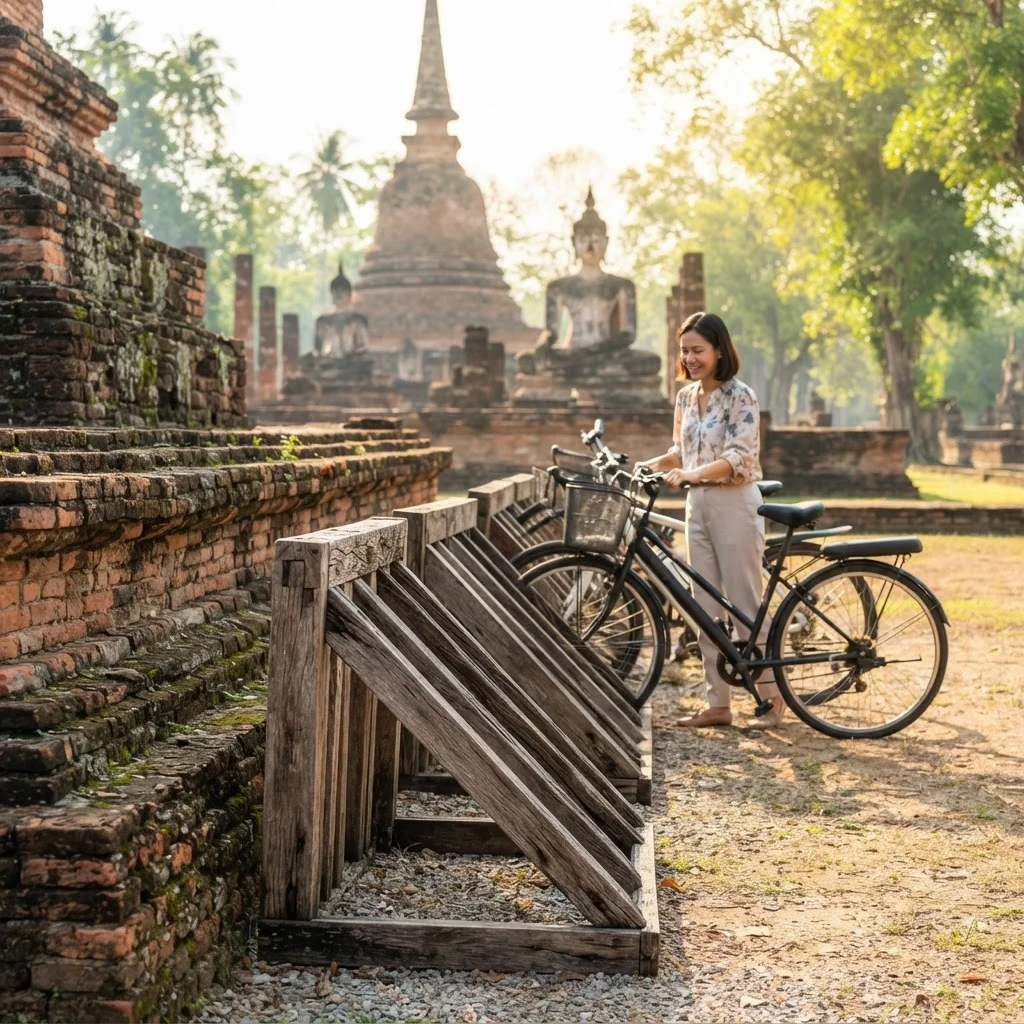
Base yourself in Old Sukhothai (Mueang Kao) rather than New Sukhothai if cycling the historical park is your main priority. New Sukhothai sits roughly 12 kilometres to the east, meaning an inconvenient morning commute by songthaew or taxi. Staying within the old settlement places you minutes from the gates, allowing you to cycle into the central ruins when they open at 06:30, well before tour buses arrive and the sun intensifies.
Prepare for separate zone ticketing. Sukhothai Historical Park does not operate a single universal day pass; entry is paid at individual gatehouses for the Central, Northern, and Western zones, alongside a nominal bicycle entry surcharge at each checkpoint. Keep small cash notes accessible throughout the day.
Pack temple-appropriate clothing in your basket. While cycling between monuments feels like riding through open parkland, the ruins contain active shrines and revered Buddha images. Covering shoulders and knees is required when stepping onto monument platforms, so carry lightweight trousers or a sarong.
During the hot season from March to May, temperatures frequently approach 40 degrees Celsius. Split your riding into early-morning and late-afternoon sessions, resting indoors over midday to avoid heat exhaustion.
Practical Tips
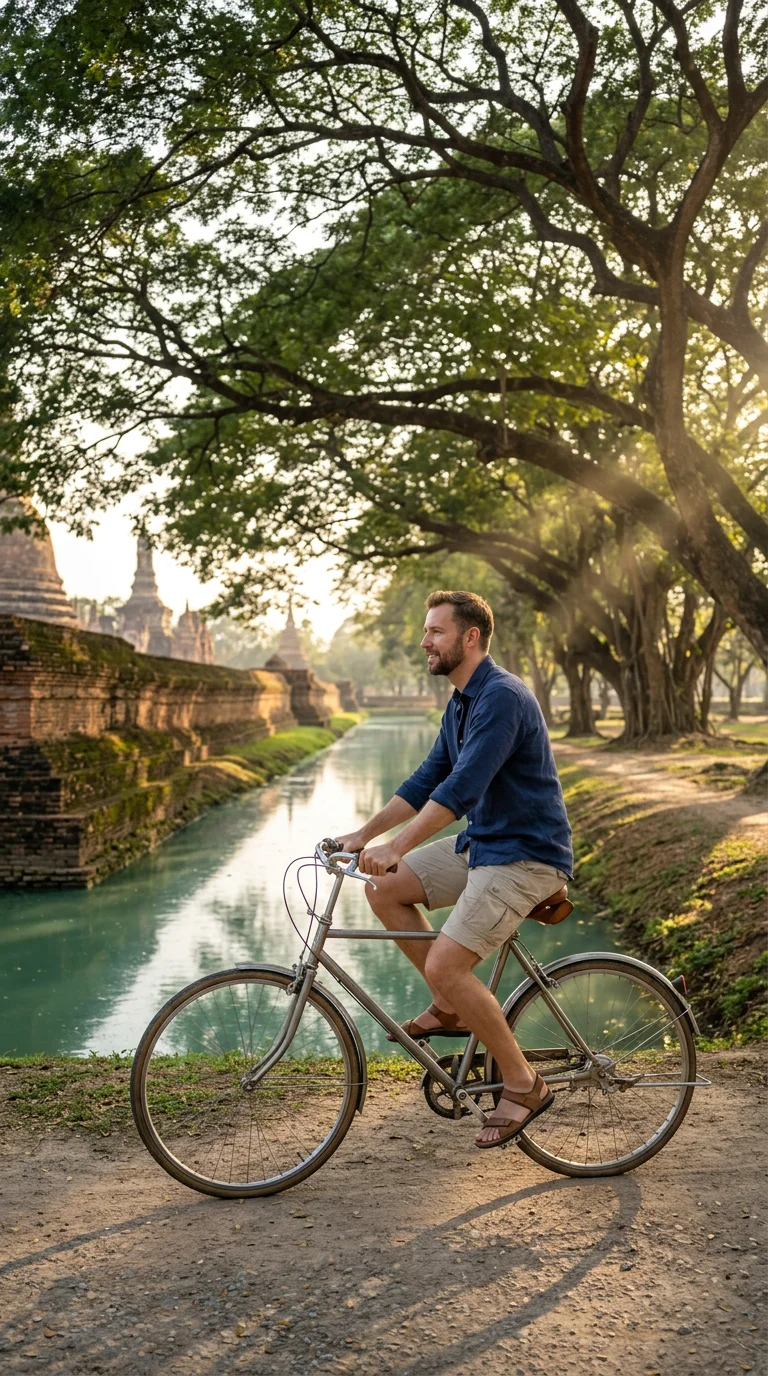
Collect your hire bicycle the afternoon before your primary riding day. Sukhothai Historical Park opens its central ticket gates at 06:30 daily, but the independent hire shops along the main strip outside the park rarely open before 07:00 or 07:30. Arranging your rental before shops close around 17:30 lets you ride straight up to the entrance as the gates unlock. Early arrivals enjoy lower temperatures, quiet roadways, and soft morning light over the central water reservoirs before tour groups arrive.
Give any rental bicycle a thorough mechanical check before pedalling away from the shop. The standard fleet across Old Sukhothai consists of single-speed utility cruisers and basic city step-through models that endure continuous daily use. Test both hand brakes to confirm the cables have adequate tension and that pads grip the wheel rims firmly. Squeeze the tyres to verify proper inflation, as soft tyres dramatically increase rolling resistance on unshaded tarmac. Adjust the saddle height so your legs extend comfortably without straining your knees, ensure the seat clamp holds tightly under your weight, and verify that the shop provides a working cable lock.
Keep bicycle cargo secure, particularly water bottles. Most rental bikes come fitted with an open wire front basket rather than frame-mounted bottle cages. Standard plastic bottles easily bounce out of these baskets when rattling over cattle grids, speed humps, or broken paving. Carry a hydration pack, a secure daypack, or a bottle with a carabiner strap. While cold drinks vendors cluster near the main central gates, the outer northern and western forest circuits feature long stretches of quiet road with no refreshments. Pack at least 1.5 litres of water before departing the central zone.
Carry sufficient small Thai Baht bank notes and coins. Park ticket offices, vehicle admission counters, roadside fruit stalls, and village drink shacks do not take international credit cards. While domestic PromptPay digital transfers are common across Thailand, overseas banking apps cannot process them. Keep a supply of 20, 50, and 100 Baht notes handy to pay admission fees and minor bicycle tolls. ATMs in Old Sukhothai are clustered along the main road near the historical park entrance, so withdraw cash before heading out to outer ruins.
Park at marked bicycle racks and respect the archaeological fabric. The Fine Arts Department permits cycling along all paved roads and designated park tracks, but riding across grass lawns, earthen earthworks, and moat banks is prohibited. Avoid leaning bicycles against ancient laterite pillars, stupas, or brick temple bases. Park wardens patrol the central grounds regularly and issue verbal reprimands to cyclists who wheel bikes onto sacred plinths. Dismount and secure your bike at the perimeter stands before walking through temple compounds.
Apply mosquito repellent generously if you plan to cycle around sunrise or sunset. The ancient city is surrounded by historical reservoirs, moat channels, and lotus ponds that harbour high insect activity once daylight dims. A botanical or DEET-based repellent protects against bites when lingering by Wat Sa Si or Wat Traphang Ngoen in the late afternoon.
For a cycling side-trip to Si Satchanalai Historical Park, catch an early departure such as the 06:40 Win Tour bus from Sukhothai Bus Terminal. Ask the conductor or driver to set you down near the historical park turn-off, roughly 55 kilometres north of Sukhothai town. Local bicycle hire stands operate near the Si Satchanalai park gate, allowing a full morning of woodland cycling before the midday heat.
Arranging your transport from Bangkok, Chiang Mai, or Phitsanulok ahead of travel ensures a straightforward arrival in Sukhothai with plenty of daylight to collect your bicycle.
Quick Reference Table
| Item | Detail | Notes |
|---|---|---|
| Standard City Bicycle Rental | 30–50 THB (£0.70–£1.15) per day | Single-speed step-through cruiser with basket and cable lock |
| Multi-Speed / Mountain Bike Hire | 150–250 THB (£3.40–£5.70) per day | Geared hybrid or mountain bike suitable for forest and dirt trails |
| Central Zone Park Admission | 200 THB (£4.55) | Foreign adult entry; valid for full calendar day of issue |
| Northern & Western Zone Admission | 120 THB (£2.75) each | Foreign adult entry per zone; covers Wat Si Chum and Wat Saphan Hin |
| Bicycle Park Access Surcharge | 10 THB (£0.23) per zone | Cash surcharge paid at ticket checkpoints per bicycle |
| Si Satchanalai Park Admission | 100 THB (£2.25) | Foreign adult entry; 10 THB bike surcharge and 30 THB bike rentals available |
| Guided Cycling Tours | 800–1,500 THB (£18–£34) | Half-day guided countryside excursions including bike, helmet, and snacks |
| Operating Hours | 06:30–18:00 daily | Central gates open at 06:30; independent hire stalls open by 07:00 |
| New to Old Sukhothai Songthaew | 30 THB (£0.70) each way | Blue wooden passenger trucks run every 20–30 minutes (06:00–17:30) |
| Sukhothai Airport Transfer | 300 THB (£6.80) per person | Shared minivan service from Sukhothai Airport (THS) to Old Sukhothai (45 mins) |
| Website | https://finearts.go.th/sukhothaihistoricalpark | Official Fine Arts Department portal for Sukhothai Historical Park |
| Phone | +66 55 697 241 | Historical park visitor and administrative enquiry line (+66 55 697 527) |
| Address | Mueang Kao, Mueang Sukhothai District, Sukhothai 64210 | Main ticket gatehouse and hire cluster situated along Route 12 |
FAQ: Cycling in Sukhothai
What are the rules for cycling near temples in Sukhothai Historical Park?
How much does it cost to rent a standard bicycle in Sukhothai?
What is a recommended itinerary for a full day of cycling in Sukhothai?
How does admission work for Sukhothai Historical Park?
What payment methods are accepted at Sukhothai Historical Park ticket counters and rental stalls?
Who is cycling in Sukhothai suitable for?
Where should I stay when planning to cycle Sukhothai Historical Park?
What kind of clothing should I wear when cycling in Sukhothai?
How should I manage cycling during Sukhothai's hot season?
When should I pick up my rental bicycle for cycling in Sukhothai?
Reviewed by the Thailand Guide Editorial Team • Last reviewed: 17 November 2026
This page is provided for general information only. While we aim for accuracy, details can change — please verify anything important independently before relying on it.