Cycling in Ayutthaya


Ayutthaya provides an exceptionally accessible heritage cycling landscape. The ancient Siamese capital sits on a flat river island formed by the Chao Phraya, Pa Sak, and Lop Buri rivers, where quiet backstreets, municipal roads, and paved park trails link dozens of historic Buddhist temples across a compact area. Cycling here allows visitors to explore archaeological ruins independently, bypass motorised tuk-tuk negotiations, and move between shaded park pathways and working riverside lanes at their own pace for under £3 a day.
Unlike enclosed heritage sites with single access gates, cycling in Ayutthaya operates across an open public infrastructure model. The terrain is flat throughout, managed jointly through the municipal road network and the Fine Arts Department’s UNESCO-inscribed historical park. Scores of independent rental vendors cluster opposite the railway station and alongside island guesthouses, providing basic single-speed city bicycles, geared hybrids, and e-bikes. The setup suits independent budget travellers, couples, and active families seeking flexible sightseeing, while road cyclists frequently use the quiet rural corridors flanking the Chao Phraya River for longer training rides from Bangkok.

Inner Island Circuit: Historical Park and Central Temples
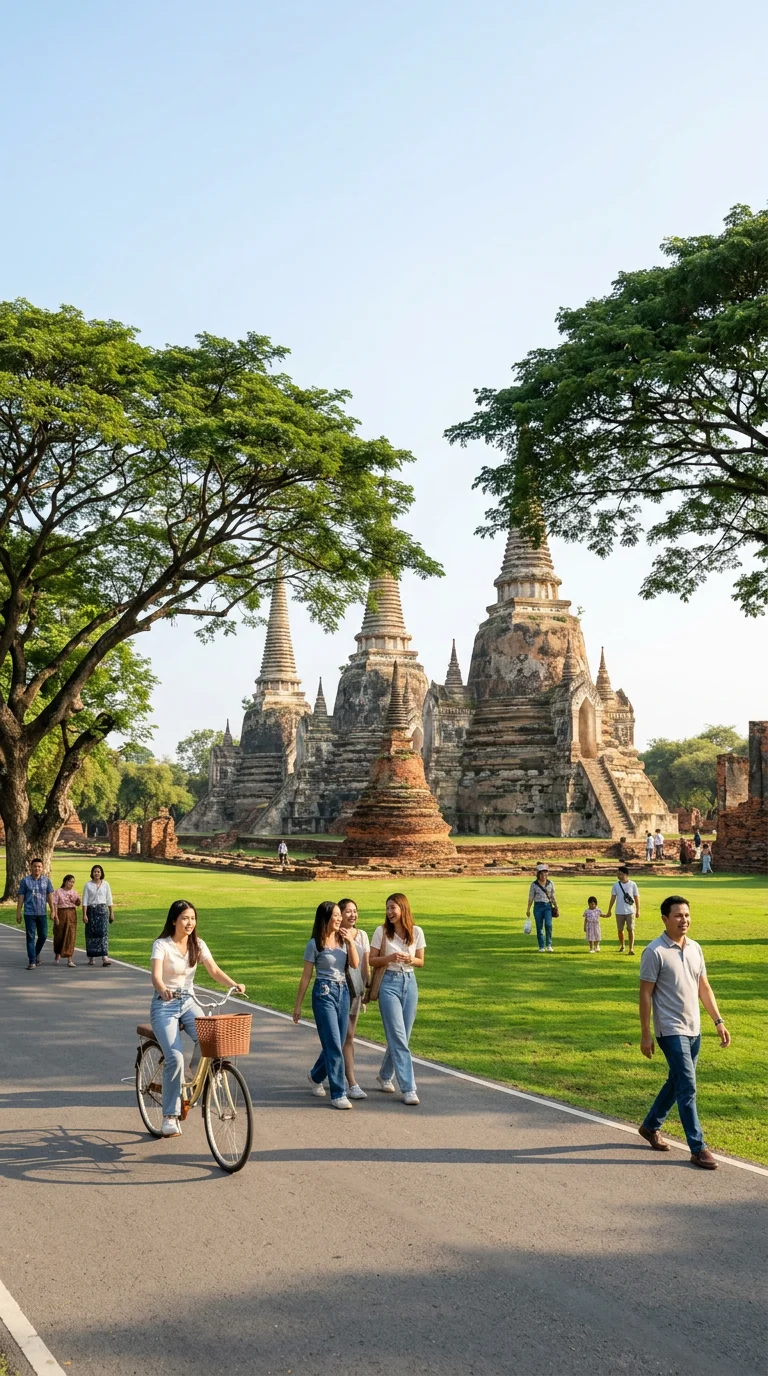
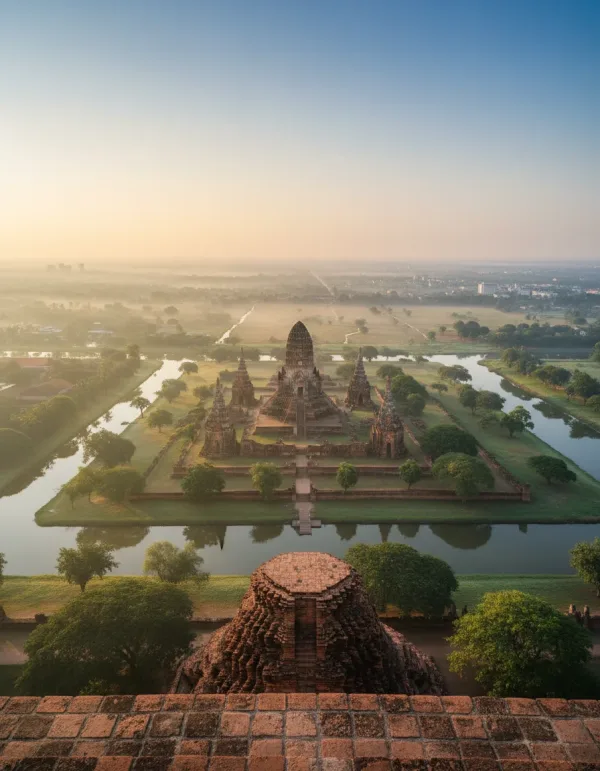
The inner island circuit provides the most sheltered cycling environment in Ayutthaya, centring on the parklands of Bung Phra Ram and the core royal monastery ruins. This flat eight- to ten-kilometre loop links the primary historical monuments on the central island, including Wat Maha That, Wat Ratchaburana, Wat Phra Ram, Wihan Phra Mongkhon Bophit, and the three restored chedis of Wat Phra Si Sanphet. The terrain throughout is level, running across smooth asphalt park lanes and wide paved paths insulated from heavy motor traffic. Cyclists share these internal routes with walkers and occasional electric sightseeing carts rather than lorries or commuter buses. Broad rain trees line several stretches, casting patches of shade over the roads, though the interior brick courtyards of the ruins remain completely open to the tropical sun.
Archaeological preservation regulations prohibit riding bicycles directly onto the brick platforms, stupas, or temple foundations. Instead, cyclists leave their machines in designated bicycle parking racks placed beside the ticket kiosks at each major monument. A basic single-speed city bicycle fitted with a front basket and a kickstand handles this central terrain without difficulty, giving riders an easy way to carry water bottles and secure light purchases. Because the ruins sit closely grouped within a three-kilometre radius, pedalling times between temples rarely exceed five to ten minutes, leaving plenty of energy for exploring the grounds on foot or pausing at open-air food stalls along Chikun and Naresuan roads.
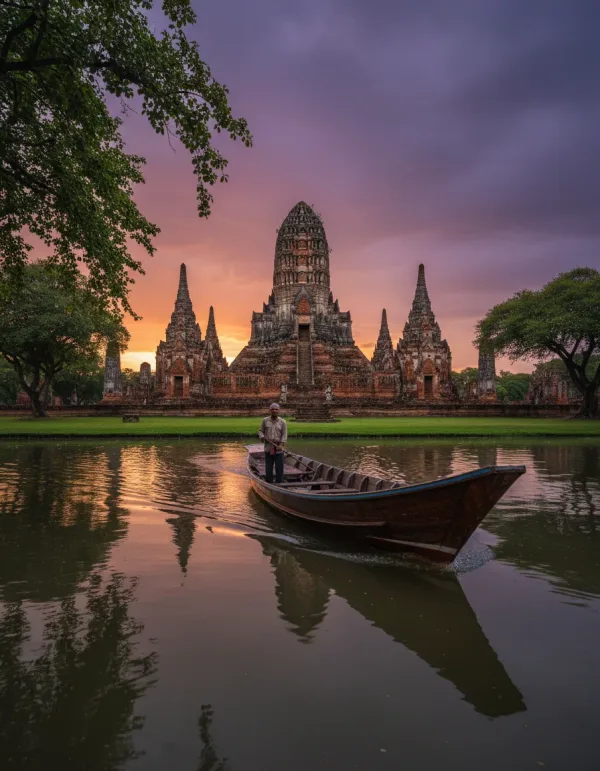
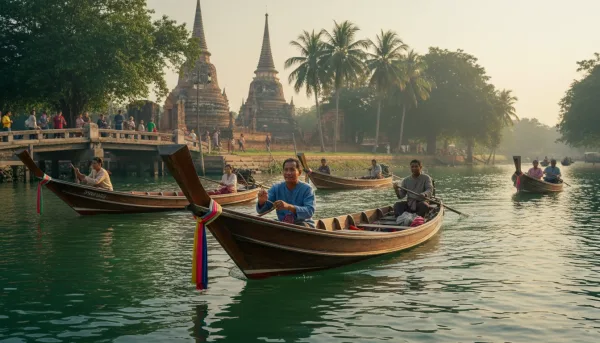
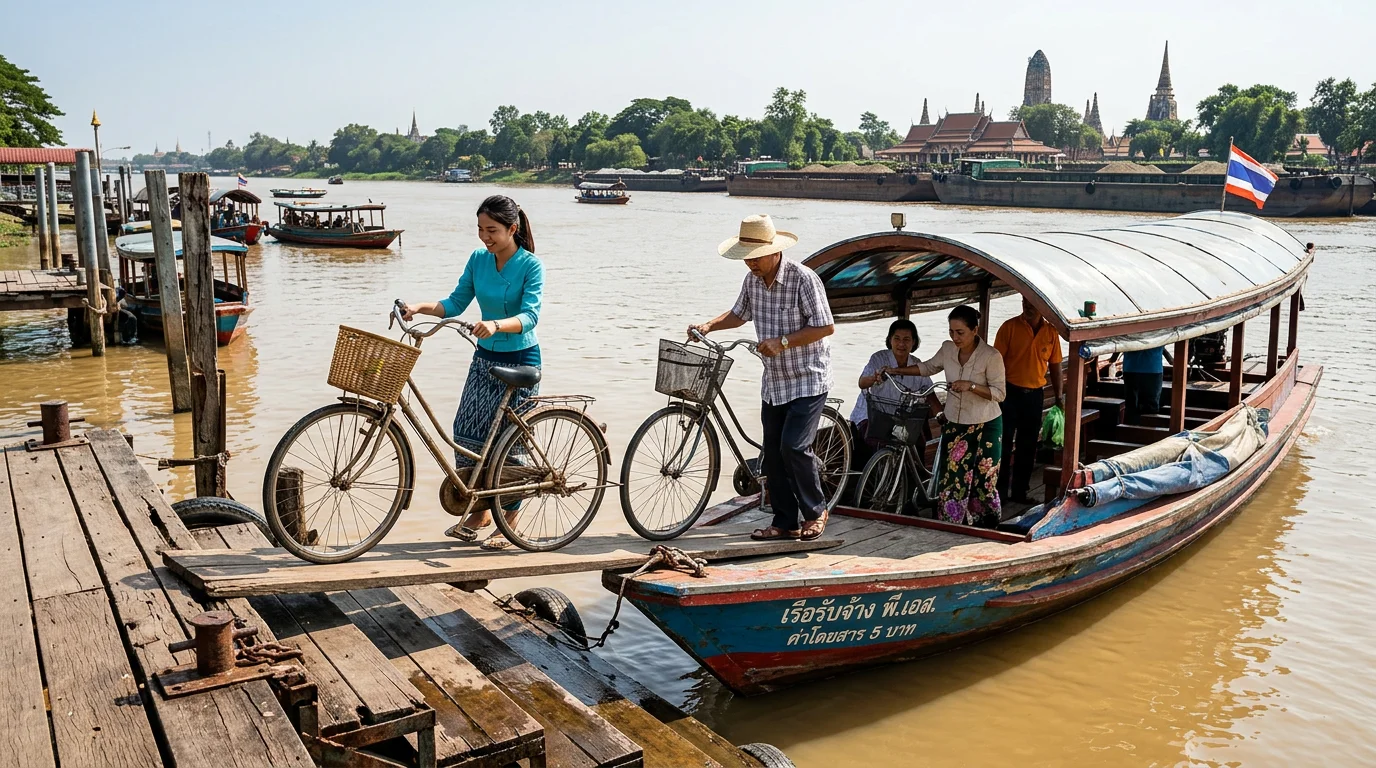
Venturing beyond the central moat expands the ride into an outer island circuit of 20 to 24 kilometres across the three rivers encircling Ayutthaya: the Chao Phraya, the Pa Sak, and the Lopburi. This broader route brings riders to monumental peripheral temples, most notably Wat Chaiwatthanaram on the western bank of the Chao Phraya, Wat Phutthaisawan on the southern bank, and Wat Yai Chai Mongkhon and Wat Phanan Choeng to the east. Cyclists can cross between the island and the outer riverbanks using traditional passenger cross-river ferries, such as the crossing between the railway station pier and Chao Phrom Market on the Pa Sak River, or the southern crossing near Pom Phet fortress over the Chao Phraya. These river craft accept bicycles for a nominal fee of a few baht, allowing riders to bypass busy multi-lane highway bridges.
Road conditions on the peripheral loop shift between smooth concrete residential lanes, minor tarmac byways, and occasional stretches of compacted canal-side gravel. Traffic on these outer roads is moderate; cyclists must feel comfortable sharing road space with local pick-up trucks, delivery vans, and motor scooters. In return, the outer circuits lead through traditional working waterfronts, wooden stilted neighbourhoods, boatyards, and the historical foreign quarters where Portuguese, Dutch, and French trading settlements once stood along the southern reaches of the Chao Phraya. Timing the western leg of this outer circuit for late afternoon allows riders to watch the sun drop behind the towering Khmer-style prangs of Wat Chaiwatthanaram before heading back towards the island.
| Circuit Name | Distance & Duration | Road Surface & Traffic | Key Highlights & Difficulty |
|---|---|---|---|
| Inner Historical Park Loop | 8–10 km (2–3 hours) | Smooth asphalt and paved paths; minimal traffic | Wat Phra Si Sanphet, Wat Maha That, Wat Phra Ram; Easy |
| Outer Island Heritage Route | 20–24 km (4–5 hours) | Asphalt roads, concrete alleys, ferries; moderate traffic | Wat Chaiwatthanaram, Wat Yai Chai Mongkhon, Wat Phanan Choeng; Moderate |
| Rural Bang Pa-In Corridor | 22–26 km one-way (3–4 hours) | Flat rural asphalt, minor backroads; light traffic | Chao Phraya riverbanks, rice paddies, Summer Palace; Moderate |
| Elephant Kraal & North Canals | 14–16 km (2–3 hours) | Rural tarmac, concrete canal berms; light traffic | Royal Elephant Kraal, Wat Phu Khao Thong, countryside villages; Easy to Moderate |
Rural South Corridor: Chao Phraya Paths to Bang Pa-In
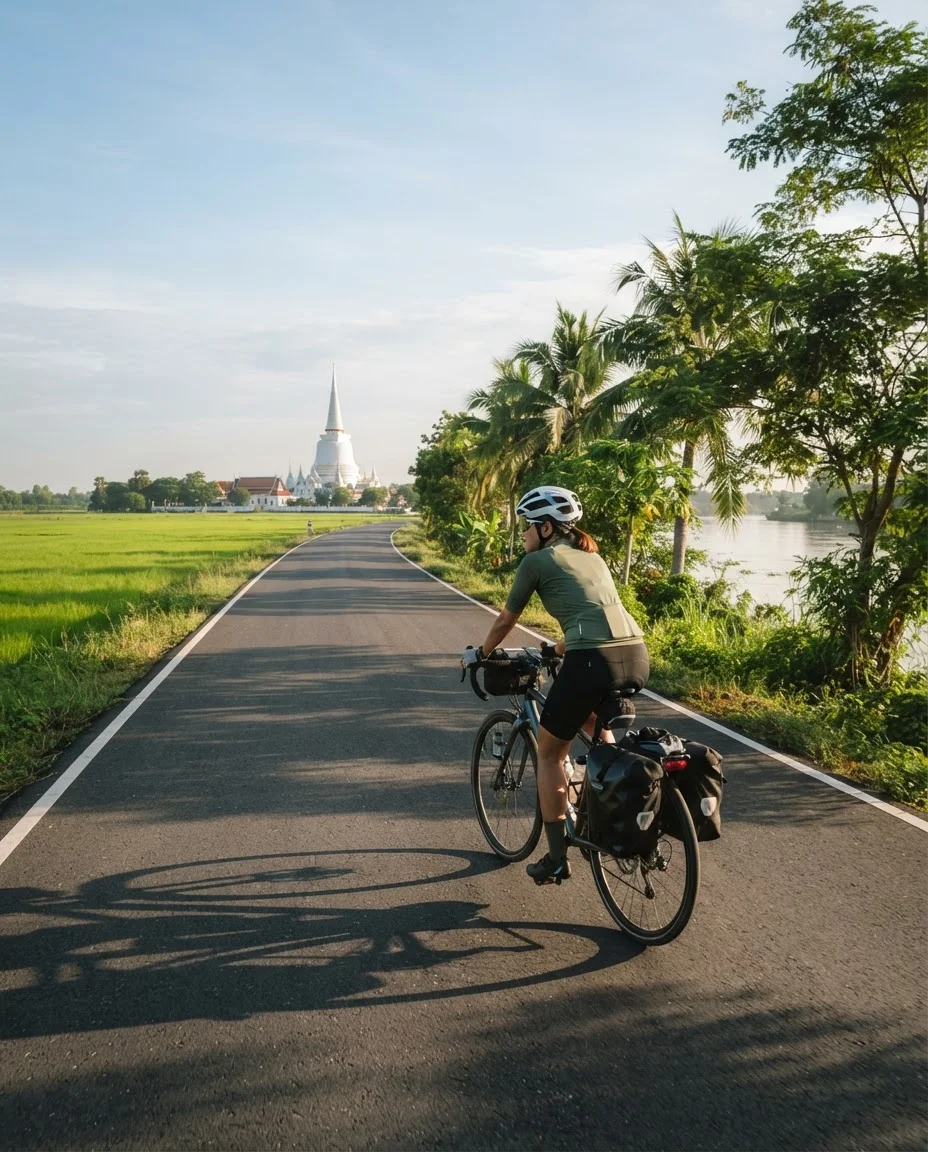
The rural southern corridor provides a quiet route of roughly 20 to 24 kilometres through the central river plains, connecting Ayutthaya to Bang Pa-In. Departing south from the city outskirts near Wat Phanan Choeng along Highway 3477 and rural backlanes, cyclists leave busy city traffic behind. The surrounding terrain is flat, dominated by rice paddies, irrigation canals, and fish ponds. Road surfaces along the eastern bank of the Chao Phraya consist mostly of paved single-lane tarmac in good repair, linked by occasional narrow concrete paths and small canal bridges that require steady bike handling. Open agricultural stretches can encounter moderate headwinds during the dry season between November and February.
The route terminates near two major architectural sites in Bang Pa-In. On the mainland sits the Bang Pa-In Summer Palace, featuring expansive landscaped gardens and royal pavilions combining Thai, Chinese, and European designs. Across the river stands Wat Niwet Thammaprawat, a Buddhist monastery founded in 1878 by King Chulalongkorn. Built in the form of a Neo-Gothic church with stained-glass windows and vaulted ceilings, the temple is reached via an overhead cable car strung across the Chao Phraya River. Refreshment stalls along these rural lanes can be spaced several kilometres apart, so carrying two water bottles is sensible. For a practical one-way excursion, you can cycle south in the morning, explore the palace grounds on foot, and board a local State Railway of Thailand train at Bang Pa-In station to return to Ayutthaya with your bicycle.
Pack linen for Ayutthaya's 35C heat and 80% humidity. Our practical weather guide covers monsoon flood risks, AQI levels, and the best times to visit.
Bicycle Hire Outlets, Equipment Standards, and Guided Tours
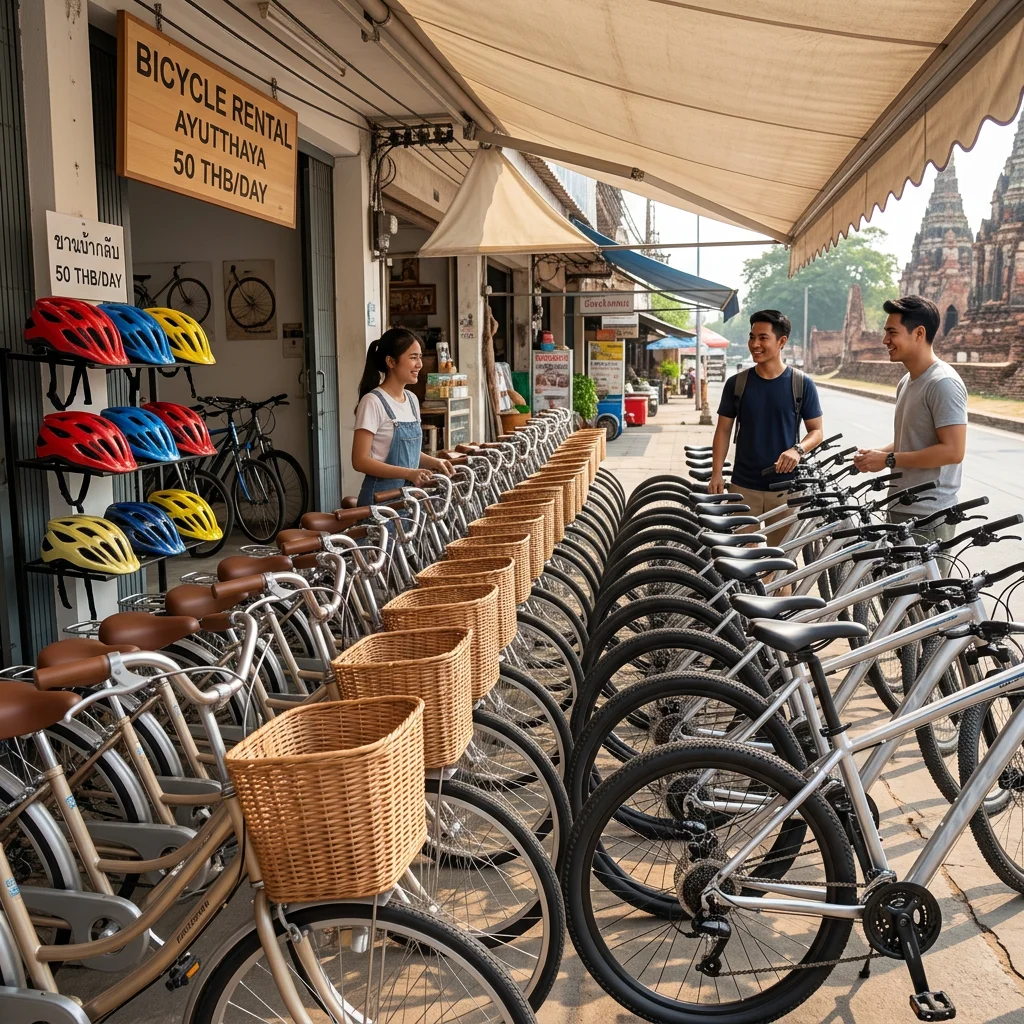
Bicycle hire operations in Ayutthaya are plentiful and concentrated across three primary areas: directly opposite the railway station, along Naresuan Road near the backpacker quarter, and within island guesthouses. Travellers arriving by train can rent immediately upon stepping out of the terminal, pedalling straight down the lane to cross the Pa Sak River by passenger ferry or taking the northern road bridge onto the island.
The standard rental machine is a classic Japanese-style step-through utility bicycle. These single-speed bikes feature upright handlebars, a front wire basket, a kickstand, and a rear luggage rack. They are geared low for easy pedalling across the flat roads of the inner historical park. Most hire outlets supply a basic cable lock and a printed sightseeing map alongside the bicycle. However, their rim brakes, firm saddles, and single gear make them less practical for full-day touring across outer districts.
Specialist shops near the railway station and select central agencies maintain fleets of multi-gear aluminium mountain bikes, lightweight hybrids, and electric bicycles. E-bikes and geared bikes prove particularly useful for navigating the wider outer river loop, where longer stretches between riverside ruins expose riders to heavier heat and headwinds.
Organised cycling excursions offer an alternative to independent exploration. Local tour operators run guided half-day morning departures and late-afternoon sunset rides that finish beside illuminated ruins. These escorted itineraries stick to shaded backstreets, village paths, and canal tracks to bypass arterial road traffic. Guided packages typically include multi-gear bicycles or e-bikes, fitted safety helmets, cold drinking water, light snacks, and historical commentary from a licensed guide. Specialist operators can also arrange child seats or tag-along attachments for families seeking a fully supported group ride.
Location and Getting There
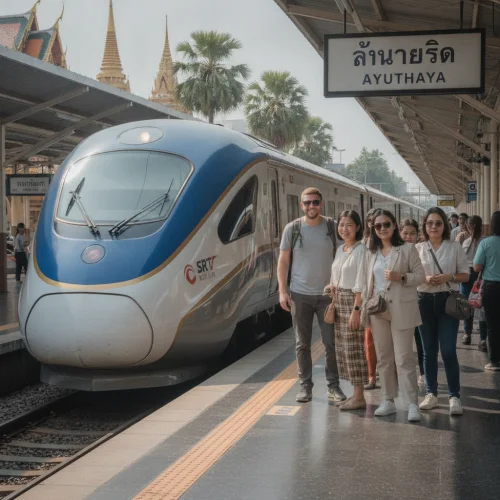
Ayutthaya lies in Phra Nakhon Si Ayutthaya Province, approximately 75 kilometres north of central Bangkok across the flat alluvial plains of the Chao Phraya River basin. Regular State Railway of Thailand services connect the capital to Ayutthaya, departing from both Krung Thep Aphiwat Central Terminal and the historic Bangkok (Hua Lamphong) Station. Ordinary third-class trains take between 80 and 100 minutes and cost 15 to 20 THB (roughly £0.35 to £0.45) one-way. Faster air-conditioned express services reach Ayutthaya in 50 to 65 minutes, with fares generally ranging between 245 and 345 THB (£5.50 to £7.80).
For road transport, passenger minivans depart from Mochit New Van Terminal (opposite Mo Chit 2) throughout the day, costing around 150 to 200 THB (£3.40 to £4.50) for a journey of roughly 90 minutes to Chao Phrom Market, depending on Bangkok motorway traffic. Private taxi transfers from Suvarnabhumi Airport or central Bangkok hotels typically cost between 1,200 and 1,600 THB (£27 to £36) one-way, taking about 75 to 90 minutes.
On arrival at Ayutthaya railway station, cyclists heading into the historical park should walk straight through the station concourse to the Pa Sak River pier on the opposite side of the road. A frequent passenger ferry charges 5 to 10 THB (about £0.11 to £0.23) for the three-minute crossing onto the main island, landing directly beside bicycle rental shops and the Chao Phrom Market area.
Costs and Booking
Bicycle hire in Ayutthaya is an economical way to explore the ancient capital, using simple flat-rate daily rentals payable in cash. Rates stay consistent year-round, though bike availability near the railway station can tighten on peak dry-season weekends between November and February. Most rental shops request a passport photocopy, driving licence, or a refundable deposit of around 500 THB (£11.40); avoid leaving your physical passport as collateral. Single-speed city bicycles with a front basket and lock rent for 50 to 80 THB (£1.15–£1.80) per day, while multi-geared bicycles suited to outer routes cost 100 to 150 THB (£2.30–£3.40). Rentals generally require return before 18:00.
Temple admissions are separate from bike hire. Ayutthaya Historical Park has no single perimeter enclosure or general admission fee. Major monuments—including Wat Maha That, Wat Ratchaburana, and Wat Chaiwatthanaram—charge individual foreign visitor fees, currently between 50 and 80 THB (£1.15–£1.80) per site. An optional 220 THB (£5.00) multi-temple pass covering six ruins is valid for 30 days, though paying individually per gate is more economical for standard day rides. Bring cash in small notes, as temple ticket counters and river ferries do not accept cards.
| Option | Cost (THB) | Cost (GBP approx) | Notes |
|---|---|---|---|
| Standard City Bike (per day) | 50–80 THB | £1.15–£1.80 | Single-speed with basket and lock; returned by 18:00 |
| Geared Mountain / Hybrid Bike (per day) | 100–150 THB | £2.30–£3.40 | 18–24 gears, hand brakes; suited to outer island routes |
| Electric Bike Hire (per day) | 250–400 THB | £5.70–£9.10 | Pedal-assist motor, 40 km range; deposit required |
| Half-Day Guided Cycling Tour (per person) | 450–900 THB | £10.20–£20.50 | Includes guide, bike, helmet, snacks, and ferry fares |
| Full-Day Supported Cycle Tour (per person) | 1,200–2,200 THB | £27.30–£50.00 | Includes support vehicle, lunch, park fees, and bike |
| River Passenger Ferry with Bike (per crossing) | 10 THB | £0.23 | Pasak and Chao Phraya crossings; cash only |
Who Cycling in Ayutthaya Suits
Cycling around Ayutthaya suits independent, active travellers who value flexibility, unhurried pacing, and spontaneous detours to street-food stalls and minor brick ruins. The flat terrain makes riding manageable for solo travellers, couples, and families with confident older children capable of handling gentle exercise in tropical heat.
It is less practical for visitors with balance concerns, reduced mobility, or low heat tolerance, where covered tuk-tuks or air-conditioned transport provide a more comfortable alternative. Families travelling with toddlers often struggle to hire equipment locally, as the town's standard walk-up rental stalls rarely stock child seats or junior helmets.
Riders who feel nervous sharing open tarmac with motor scooters, songthaews, and tour coaches should stick to the inner historical core. The shaded pathways through Bueng Phra Ram park let you cycle between ruins and lakes without contending with the busier multi-lane roads found beyond the central island.
What to Know Before You Book
Rental agreements in Ayutthaya operate on a calendar-day basis rather than a 24-hour hire window. Most independent shops by the railway station and ferry pier require bicycles back by dusk, typically between 18:00 and 19:00. Cyclists wanting to view illuminated monuments such as Wat Chaiwatthanaram during evening floodlighting hours must negotiate an overnight return in advance or hire directly through their guesthouse.
Fleet quality varies considerably, with most budget rentals consisting of single-speed utility bicycles equipped with basic rim or hub brakes. Check the brakes, tyre pressure, and seat-post clamp on the street outside before concluding the hire. Helmets are rarely stocked by roadside shops, so riders requiring head protection should carry their own, though basic cable locks are usually provided upon request.
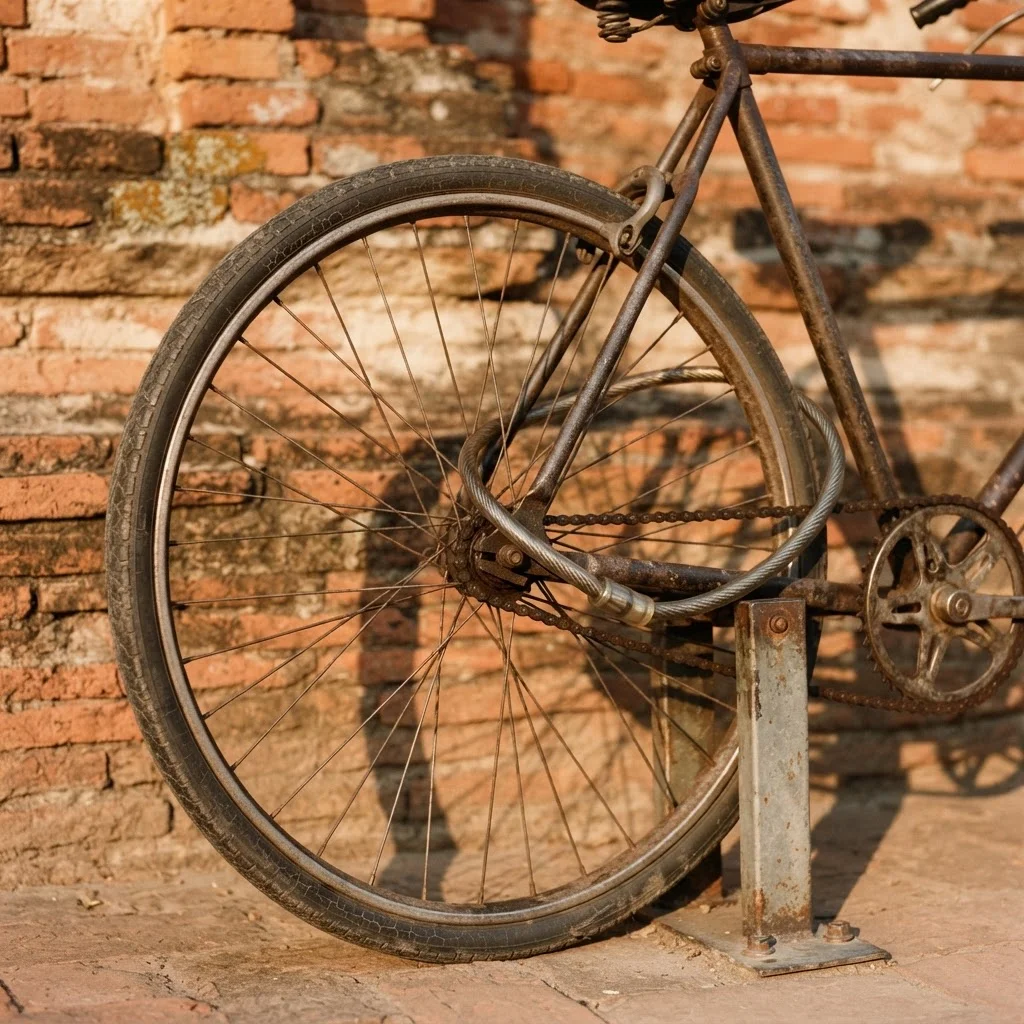
Within Ayutthaya Historical Park, cycling is confined to paved perimeter roads, marked park lanes, and shared paths. Riding across ancient brick foundations, stupa mounds, or pedestrian temple platforms is strictly prohibited by the Fine Arts Department. Cyclists must dismount and leave their bikes in designated parking bays outside each monument before exploring the ruins on foot.
Practical Tips
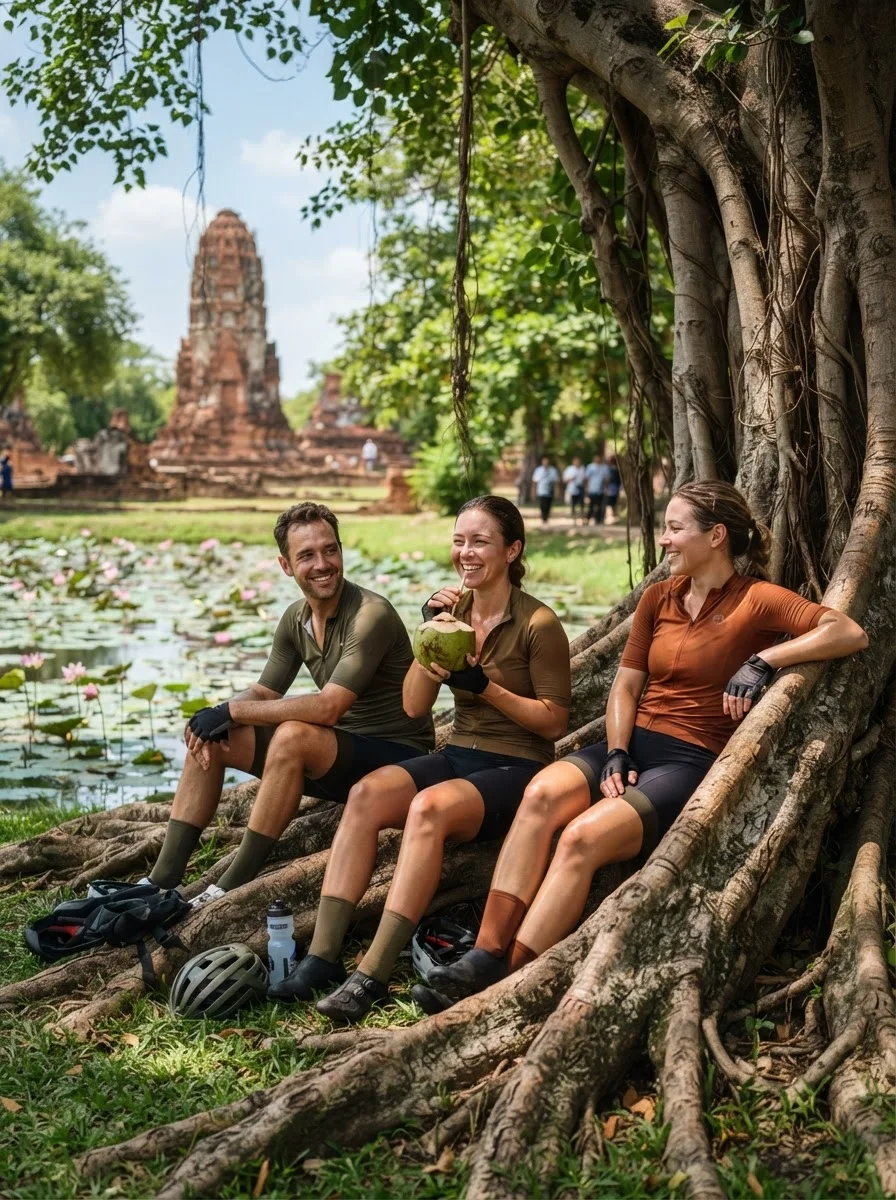
Setting off around 07:30 allows you to tour key outdoor ruins before the midday heat peaks. Central Ayutthaya has very little tree canopy, and the exposed red-brick complexes radiate heat intensely from late morning onwards. Early starts also help you reach prominent sites such as Wat Mahathat and Wat Ratchaburana ahead of the tour coaches arriving from Bangkok. Pack oral rehydration electrolyte sachets to stir into bottled water, as cycling in the central plains leads to rapid fluid loss.
Keep a lightweight sarong, scarf, or loose linen trousers in your front bicycle basket. Active monasteries such as Wat Phanan Choeng and major historical sites require modest attire, mandating that both shoulders and knees remain covered. Standard cycling shorts and sleeveless vests fail these requirements, and while vendors sell wrap-around trousers outside major gates, carrying your own saves delay. Slip-on footwear or cycling sandals prove practical, as entering active prayer halls requires taking shoes off at the threshold.
Download offline mapping data before departing your guesthouse. Although 4G and 5G signals remain steady across the island, running GPS continuously under direct sunlight drains phone batteries rapidly. Avoid multilane arterial corridors such as Highway 309 (Rojana Road) and Highway 3263 during morning and late afternoon commuting hours, when regional freight and fast lorries share the tarmac. When arriving at Ayutthaya railway station, cross the Pa Sak River using the small passenger ferry rather than pedalling across the busy Pridi-Damrong road bridge.
Secure your rental bicycle to a fixed post or rack whenever exploring ruins on foot. Rental fleets across Ayutthaya consist primarily of identical single-speed basket bikes; locking both the frame and rear wheel prevents other sightseers from riding off on your bike by accident. Watch for street dogs along quieter canal lanes and temple boundaries, especially in the early morning; slowing down and pedalling steadily without shouting or making sudden swerves prevents confrontations.
Quick Reference Table
| Item | Detail | Notes |
|---|---|---|
| Location | Phra Nakhon Si Ayutthaya Province | Flat river island 75 km north of Bangkok |
| Standard Bike Hire | 50–80 THB (£1.15–£1.80) per day | Single-speed with front basket and lock; return by 18:00 |
| Geared Bike Hire | 100–150 THB (£2.30–£3.40) per day | Mountain or hybrid bike (18–24 gears); recommended for outer routes |
| E-Bike Hire | 250–400 THB (£5.70–£9.10) per day | Pedal-assist with ~40 km range; deposit required |
| Hire Deposit | ~500 THB (£11.40) refundable or ID copy | Provide a driving licence or passport photocopy; do not leave physical passport |
| Inner Island Circuit | 8–10 km (2–3 hours) | Smooth park paths linking Wat Phra Si Sanphet, Wat Maha That, and Wat Phra Ram |
| Outer Island Route | 20–24 km (4–5 hours) | Road and ferry route taking in Wat Chaiwatthanaram and Wat Yai Chai Mongkhon |
| Rural Bang Pa-In Route | 22–26 km one-way (3–4 hours) | Scenic corridor along Chao Phraya; return with bike via local train |
| Station River Ferry | 5–10 THB (£0.11–£0.23) per crossing | 3-minute crossing from railway station pier to Chao Phrom Market; 10 THB with bike |
| Temple Admissions | 50–80 THB (£1.15–£1.80) per major site | Cash only at ticket kiosks; optional 220 THB (£5.00) 6-temple pass available |
| Train from Bangkok | 15–20 THB (ordinary) / 245–345 THB (express) | 50–100 minutes from Krung Thep Aphiwat or Hua Lamphong |
| Recommended Start Time | ~07:30 | Avoids peak midday heat and tour coach crowds |
| Temple Dress Code | Shoulders and knees covered | Keep a sarong or light trousers in your basket for active shrines |
FAQ: Cycling in Ayutthaya
Are there rules for cycling within Ayutthaya Historical Park?
How can cyclists cross the rivers around Ayutthaya?
What type of bicycles are typically available for rent in Ayutthaya?
When are geared or electric bikes recommended for cycling in Ayutthaya?
How do cyclists get from Ayutthaya railway station to the main island?
What is required to rent a bicycle in Ayutthaya?
Are there admission fees for temples in Ayutthaya Historical Park?
What is the best time to start cycling in Ayutthaya?
What should I wear or bring for temple visits while cycling in Ayutthaya?
How should I secure my rental bicycle in Ayutthaya?
Reviewed by the Thailand Guide Editorial Team • Last reviewed: 17 November 2026
This page is provided for general information only. While we aim for accuracy, details can change — please verify anything important independently before relying on it.