Birdwatching in Thailand
More than 1,080 documented bird species occupy Thailand's varied terrain, representing nearly ten percent of all avian life on Earth packed into a country smaller than France. Within a single fortnight, an observant birder can watch iridescent sunbirds feeding among Himalayan rhododendrons in the northern highlands, track hornbills across evergreen rainforest canopies, and scope globally threatened waders along coastal salt pans.
Thailand's position at the crossroads of the Indomalayan realm and the East Asian–Australasian Flyway creates exceptional seasonal variety. Resident tropical species mix with vast influxes of migratory waterfowl, raptors, and passerines escaping the Siberian and northern Asian winter.
This guide details Thailand's primary birdwatching locations, distinct regional habitats, seasonal migration windows, and practical logistics for independent and guided field trips. You will find realistic equipment advice for humid tropical conditions, national park entry arrangements, and responsible field ethics. Whether you are adding regional specialities to your global life list or planning a first wildlife holiday in Southeast Asia, this resource provides the concrete data needed to plan your trip.

Diverse Habitats and Regional Birding Terrains
Thailand occupies a pivotal ecological crossroads where three major zoogeographical realms meet: the Sino-Himalayan, Indochinese, and Sundaic subregions. Because these distinct biogeographical zones overlap across a relatively compact landmass, birdwatchers can encounter radically different bird communities within a few hours' travel. In the northern highlands around Chiang Mai, granite and limestone ridges rise above 2,500 metres. These upper elevations support moist hill evergreen forest, moss-draped cloud forest, and high-altitude sphagnum bogs that shelter montane species adapted to cool conditions. Down on the lower foothills below 800 metres, the vegetation shifts to open, fire-prone dry dipterocarp and mixed deciduous woodland.
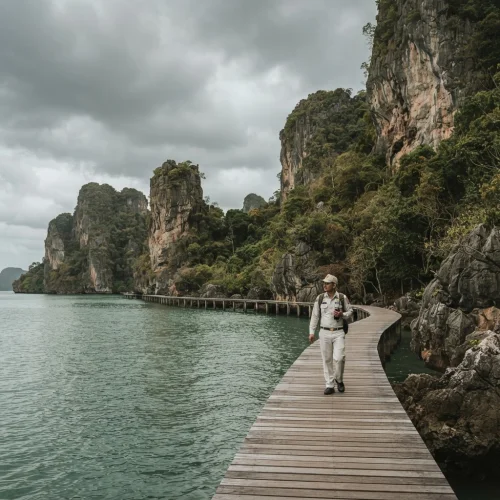
Moving into western and central Thailand, the rugged Tenasserim mountain spine and the Dong Phaya Yen range protect vast expanses of semi-evergreen and dry evergreen jungle. Here, dense multi-tiered canopies, bamboo thickets, and colossal strangler figs support thriving populations of large forest birds. Further south, north of the Isthmus of Kra, Thailand marks the primary avifaunal boundary between the Indochinese and Sundaic realms. South of this divide, the landscape transitions into the humid equatorial climate of the Malay Peninsula. Lowland dipterocarp rainforest, wet evergreen jungle, and towering limestone karst formations take over, creating shaded valleys and micro-habitats for specialist understorey and ground-dwelling birds.
The central alluvial floodplains and the inner Gulf of Thailand complete the country's habitat mosaic. Broad river basins, freshwater marshes, commercial salt evaporation pans, and coastal mangrove belts provide vital feeding and roosting grounds along the East Asian-Australasian Flyway. Working these varied terrains requires distinct practical approaches. Tracking canopy flocks through dark western rainforest demands patient neck-craning and sharp acoustic detection, whereas birding northern montane trails involves cool morning climbs and quiet boardwalk strolls. Out on the exposed coastal salt pans, birders face blinding glare, heat haze, and long-range scanning across wide, flat bunds.
| Habitat Zone | Elevation & Geography | Signature Forest Type | Key Locations | Representative Avian Families |
|---|---|---|---|---|
| Northern Montane Highlands | 800m – 2,565m; rugged ridges | Moist hill evergreen, pine, rhododendron | Doi Inthanon, Doi Ang Khang, Doi Chiang Dao | Sunbirds, laughingthrushes, minlas, rosefinches |
| Central & Western Rainforests | 200m – 1,200m; Tenasserim hills | Semi-evergreen, dry dipterocarp, bamboo | Kaeng Krachan, Khao Yai, Huai Kha Khaeng | Hornbills, broadbills, pheasants, woodpeckers |
| Southern Peninsular Jungle | Sea level – 900m; karst valleys | Sundaic lowland evergreen, wet rainforest | Khao Sok, Sri Phang Nga, Hala-Bala | Pittas, trogons, babblers, spiderhunters |
| Inner Gulf Coastal Salt Pans | Sea level; intertidal marine zone | Coastal salt pans, mudflats, remnant mangroves | Pak Thale, Laem Phak Bia, Khok Kham | Calidrid waders, plovers, terns, egrets |
Because each regional terrain holds its own specialised avifauna and field conditions, plan your trip around one or two distinct bioregions rather than exhausting yourself attempting cross-country travel. Pairing a northern montane circuit with the coastal salt pans of the inner Gulf, or combining western rainforest with southern peninsular lowland jungle, gives you a rich variety of habitats while keeping travel times manageable.
Flagship Resident Species and Forest Rarities
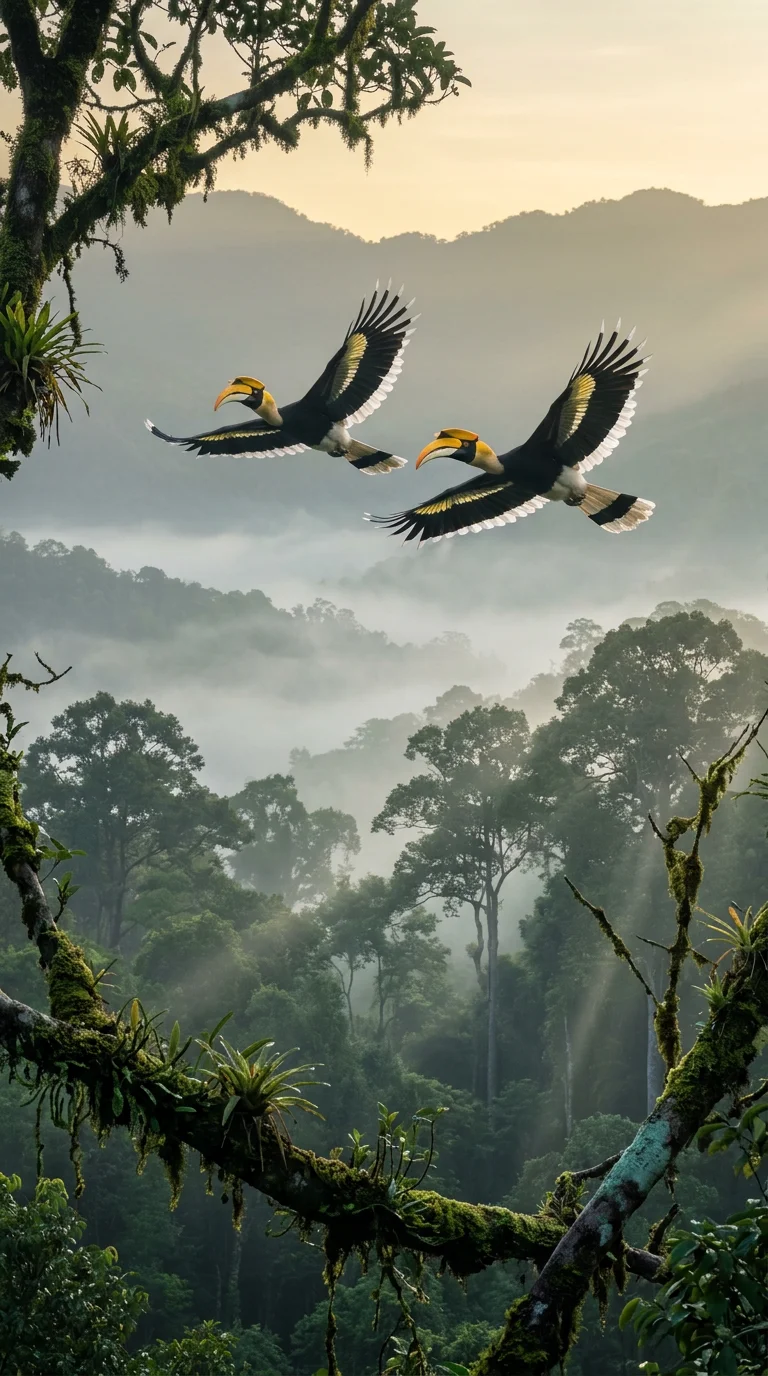
Thailand's resident forests shelter several of mainland Asia's most sought-after avian specialists, led by the canopy hornbills. The Great Hornbill commands attention with a 1.5-metre wingspan and heavy wingbeats producing a locomotive-like whoosh overhead. Along forested ridges in Khao Yai and Kaeng Krachan, Great Hornbills join Wreathed Hornbills and Austen's Brown Hornbills around fruiting fig trees (Ficus species). Further south, Hala-Bala Wildlife Sanctuary protects remnant numbers of the Critically Endangered Helmeted Hornbill, depleted across its range by poaching for its solid casque.
At ground level, dense evergreen understorey conceals prized terrestrial species. The Siamese Fireback—Thailand's national bird—moves through bamboo thickets and quiet tracks at daybreak. Males display lead-grey plumage, crimson facial wattles, and an iridescent golden-buff lower back in Khao Yai and the Sakaerat Biosphere Reserve. Sharing this shaded litter is the Coral-billed Ground Cuckoo, a secretive resident with coral-red legs, a red bill, and a violet-black hood. Encountering one requires patience along quiet forest trails between December and March.
Forest undergrowth and mid-storey branches also harbour pittas and broadbills. The Blue-winged Pitta arrives as a breeding visitor during the southwest monsoon, calling loudly from damp gullies between May and July. It shares shaded floors with elusive residents, including the Malayan Banded Pitta in southern reserves and the Rusty-naped Pitta in northern mountains. In the mid-storey, the Long-tailed Broadbill moves in vocal flocks. Sporting lime-green plumage, a turquoise-and-black helmet, and an azure tail, it weaves pendulous nests suspended over forest streams between February and June.
| Species Name | Thai Conservation Status | Preferred Micro-Habitat | Prime Observation Sites | Peak Detection Season |
|---|---|---|---|---|
| Great Hornbill (*Buceros bicornis*) | Vulnerable | Tall primary forest, fruiting fig trees | Khao Yai, Kaeng Krachan, Khao Sok | November to April (courtship and nesting) |
| Siamese Fireback (*Lophura diardi*) | Least Concern | Dense evergreen undergrowth, quiet tracks | Khao Yai, Sakaerat, Nam Nao | Year-round; earliest at sunrise |
| Blue-winged Pitta (*Pitta moluccensis*) | Least Concern (Seasonal Resident) | Shaded forest floor, damp gullies | Sri Phang Nga, Khao Sok, Kaeng Krachan | May to July (calling during breeding) |
| Long-tailed Broadbill (*Psarisomus dalhousiae*) | Least Concern | Mid-storey submontane mixed evergreen | Kaeng Krachan, Doi Chiang Dao, Khao Yai | February to June (nest building) |
| Coral-billed Ground Cuckoo (*Carpococcyx renauldi*) | Vulnerable | Heavy leaf litter, lowland forest floor | Khao Yai, Sakaerat Biosphere Reserve | December to March (dry season rustle) |
Targeting fruiting fig trees in primary jungle reserves remains the most reliable way to observe multiple canopy frugivores in a single morning.
Plan a Northern Thailand trip covering Chiang Mai, Chiang Rai, Sukhothai, mountain routes, Lanna food, transport, seasons and air quality.
Migration Dynamics Along the East Asian-Australasian Flyway
Thailand occupies a strategic crossroads along the East Asian-Australasian Flyway, linking Arctic tundra and Siberian breeding territories with wintering grounds across Southeast Asia and Australasia. Between late August and May, millions of migratory birds traverse the country's north-to-south geographical corridor. The Isthmus of Kra acts as a natural funnel, constricting overland flight paths into a narrow land bridge flanked by the Andaman Sea and the Gulf of Thailand, whilst northern mountain ridges channel descending passerines into sub-montane forests.
The southward autumn passage begins in late August with early waders reaching coastal mudflats, before gathering pace through October as Palearctic passerines and raptors arrive in heavy concentrations. On northern highland peaks, migratory warblers, thrushes, and flycatchers settle into mid-elevation evergreen forest to feed on insects and seasonal fruits. Along the southern peninsula, Khao Dinsor in Chumphon Province forms an established raptor observation point. Tens of thousands of migratory birds of prey pass overhead during peak October passage, including Black Bazas, Oriental Honey-buzzards, Chinese Sparrowhawks, Japanese Sparrowhawks, and Grey-faced Buzzards moving south towards Malaysia and Indonesia.
From November to February, Thailand supports maximum wintering densities across both coastal and inland habitats. Intertidal mudflats and coastal salt pans along the Inner Gulf fill with vast congregations of feeding shorebirds escaping frozen northern latitudes. By late February and March, the spring return migration commences. Northbound waders and passerines stage across Thailand to replenish fat reserves, with shorebirds moulting into bright breeding plumage before undertaking the non-stop flight back to Arctic and Siberian nesting grounds by early May.
| Months | Migration Phase | Key Avian Groups | Weather & Field Conditions | Primary Geographic Focus |
|---|---|---|---|---|
| September – October | Early Autumn Passage | Coastal shorebirds, migrating raptors | Lingering monsoon showers, high humidity | Chumphon coastline, Gulf shorelines |
| November – February | Peak Wintering Season | Montane passerines, waterfowl, coastal waders | Dry, cool mornings; clear mountain air | Northern peaks & Inner Gulf salt pans |
| March – April | Spring Return Migration | Waders in breeding colours, northbound passerines | Rising temperatures, dry terrain, early heat haze | Central wetlands, Phetchaburi salt pans |
| May – August | Wet Season Breeding | Resident breeders, southern monsoon arrivals | Tropical downpours, leech activity in rainforests | Southern peninsular rainforest reserves |
Travellers planning a birdwatching visit will find the window between late November and February most productive, pairing manageable daytime temperatures with the highest cumulative species counts across resident and wintering populations.
Coastal Wader Sanctuaries and the Spoon-Billed Sandpiper
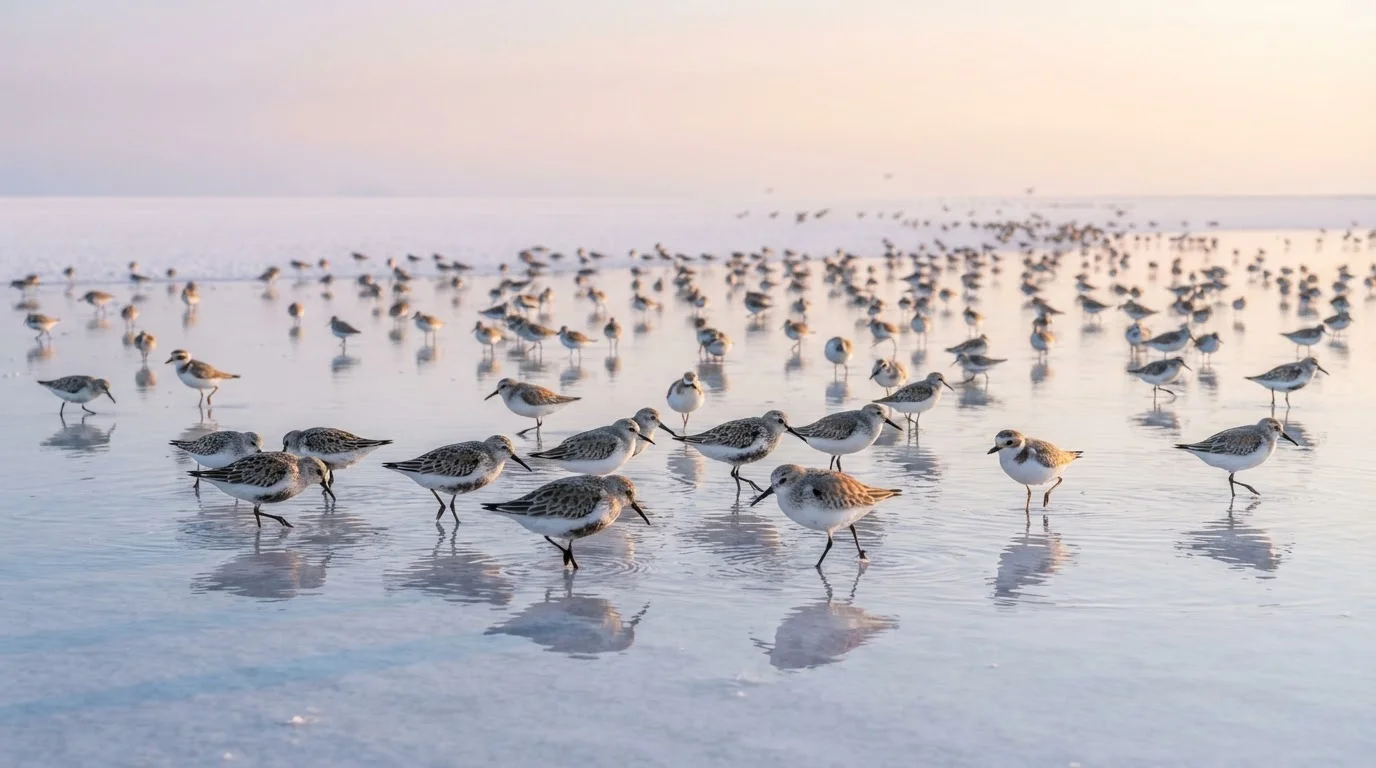
The intertidal mudflats and operational salt evaporation pans of the Inner Gulf of Thailand form one of the most critical shorebird wintering landscapes along the East Asian-Australasian Flyway. Situated in Phetchaburi Province, roughly two hours south of Bangkok by road, the interconnected coastal wetlands of Pak Thale and Laem Phak Bia attract birdwatchers from across the globe seeking rare, long-distance migratory waders.
The primary target is the Critically Endangered Spoon-billed Sandpiper (Calidris pygmaea). With fewer than five hundred mature individuals surviving globally, a dependable handful of these small waders winter across the shallow brine pans at Ban Pak Thale from late October through March. They feed by sweeping their spatulate bills through thin surface water and soft mud with a brisk side-to-side action, straining out micro-invertebrates. The surrounding pans provide vital roosting and feeding grounds for several other globally threatened waders, including the Endangered Nordmann's Greenshank, the Endangered Great Knot, and small gatherings of Asian Dowitchers. Traditional sea-salt farming maintains shallow water depths and high salinity levels, which nurture abundant populations of brine shrimp and larvae that these migratory flocks require.
South along the coast, the Environmental Research and Development Project at Laem Phak Bia provides contrasting freshwater and brackish habitats. Initiated to treat municipal wastewater through oxidation ponds, reedbeds, and mangrove channels, this open facility attracts Black-capped Kingfishers, wintering warblers, and resting waders. From the nearby fishing harbour, chartered longtail boats navigate the mangrove estuary out to the Laem Phak Bia sandspit. This exposed sand barrier is one of the few accessible coastal locations where resident Malaysian Plovers nest on sandy ridges above the high-tide line, alongside wintering White-faced Plovers and Chinese Egrets. Closer to Bangkok in Samut Sakhon Province, the salt farms of Khok Kham provide a convenient half-day alternative for finding wintering waders.
| Shorebird Location | Primary Wetland Habitat | Key Target Species | Access Practicalities | Best Observation Window |
|---|---|---|---|---|
| Pak Thale Salt Pans | Commercial salt pans, brine ponds | Spoon-billed Sandpiper, Great Knot, Red-necked Stint | Public dirt bunds; free entry; flat walking | Morning high tides, November to March |
| Laem Phak Bia Environmental Project | Mangrove channels, oxidation ponds, reedbeds | Black-capped Kingfisher, sandpipers, warblers | Free entry; walking trails and observation tracks | Year-round; peak months November to February |
| Laem Phak Bia Sandspit | Sandspit, exposed offshore sand bars | Malaysian Plover, Chinese Egret, White-faced Plover | Chartered longtail boat (approx 1,200–1,500 THB, approx £26–£33) | Mid-tide to high tide roosting times |
| Khok Kham Salt Pans | Shallow salt farms, aquaculture ponds | Broad-billed Sandpiper, Long-toed Stint, waders | Roadside tracking near local education centre | November to February early mornings |
Field success across the Inner Gulf depends on local tide cycles. Arrive at the salt pans during an incoming high tide, which submerges the outer mudflats and forces feeding flocks onto the shallow artificial pans beside the access tracks. During low water, waders disperse over vast mud stretches extending kilometres offshore, making identification difficult even through high-magnification optics.
Specialised Field Optics, Photography Hides, and Forest Gear
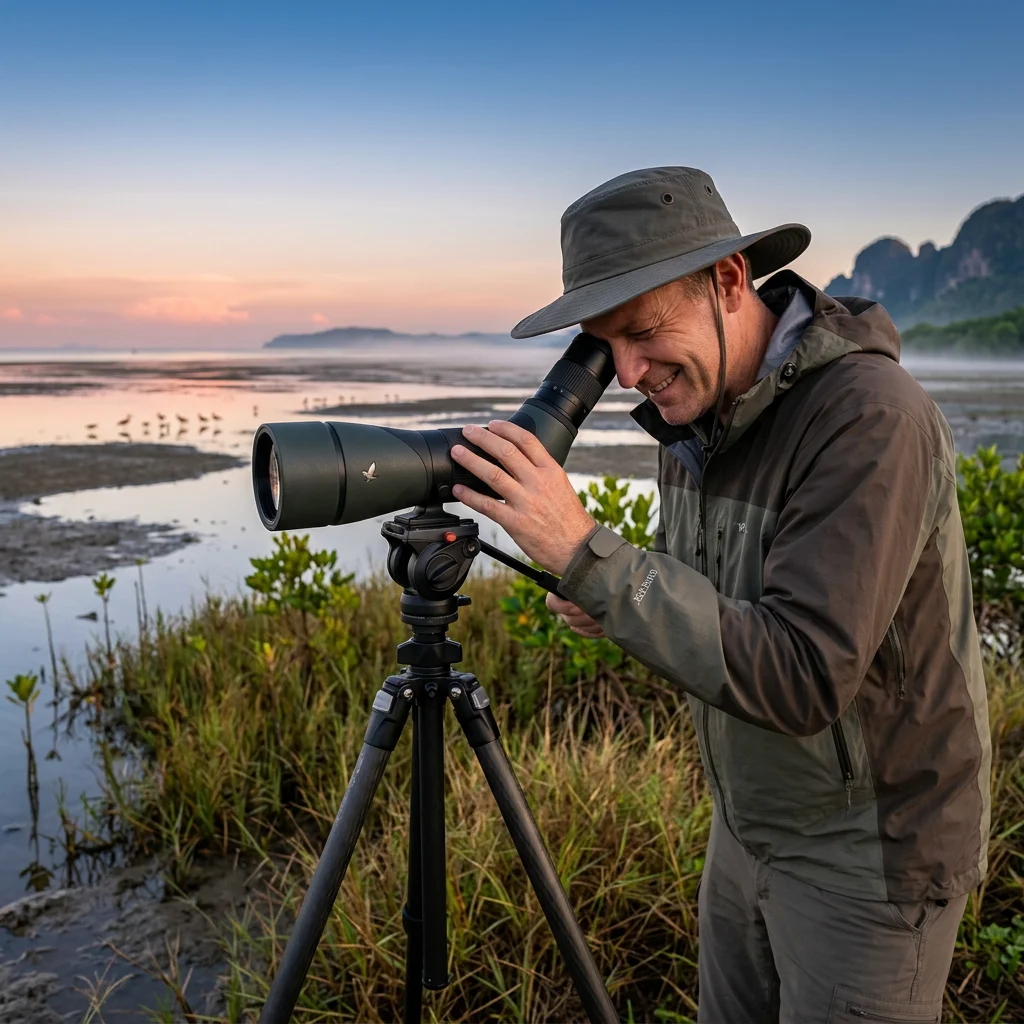
Equipping yourself thoughtfully makes the difference between resolving subtle plumage details and struggling against dense evergreen canopies, humidity, or shimmering heat haze. Quality optics and tropical field gear are foundational for birding across Thailand's varied terrain. In deep rainforest environments like Kaeng Krachan and Khao Yai, 8x42 binoculars offer the practical balance of a wide field of view and strong light gathering under shaded lower storeys. By contrast, on the vast coastal salt pans of Pak Thale and Laem Phak Bia, waders frequently feed hundreds of metres from access bunds. Identifying small stints, plovers, and rare wintering sandpipers here calls for a spotting scope with 20–60x magnification and an 80mm or larger objective lens, secured to a rigid carbon-fibre tripod that dampens coastal wind shake and resists salt corrosion.
Wildlife photography has grown significantly across central Thailand, stimulated by drinking-pool blinds situated on private land bordering national parks. Local landowners around Kaeng Krachan have converted former forest waterholes into camouflaged hides. Specialised birding bases such as Baan Maka Nature Lodge arrange access to these hides for around 250 THB (approx £6) per person per day. Rather than commercial hides with one-way glass, these structures are simple timber and canvas blinds fitted with lens ports and narrow viewing slots. Photographers sit quietly on low stools just four to six metres from shallow forest pools, capturing clean portraits of shy ground birds including Blue Pittas, Scaly-breasted Partridges, Ferruginous Partridges, and Large Scimitar-babblers. Sound fieldcraft requires remaining inside the blind until scheduled pick-up times, keeping movement minimal, packing out all litter, and avoiding acoustic playback near active feeding or bathing stations.
| Gear Category | Recommended Specification | Purpose in Thai Field Conditions | Critical Considerations |
|---|---|---|---|
| Forest Binoculars | 8x42, waterproof, multi-coated glass | Canopy scanning and low-light undergrowth | Nitrogen purging prevents internal condensation in high humidity |
| Coastal Spotting Scope | 20–60x zoom, 80mm+ objective, angled body | Shorebird identification at distances exceeding 100m | Carbon-fibre tripod resists sea-spray corrosion and wind shake |
| Forest Attire | Quick-drying neutral greens or khakis, leech socks | Concealment and protection against forest leeches | Leech socks protect ankles on wet-season rainforest trails |
| Optical Maintenance | Lens pens, silica gel packs, dry bags | Preventing optical fungus and moisture ingress | Acclimatise lenses gradually before stepping into humid morning air |
On unpaved jungle trails, particularly during the wet season, tightly woven leech socks pulled over tucked trousers provide reliable barrier defence against forest leeches.
Key Birdwatching Destinations Across Thailand

In northern Thailand, Doi Inthanon National Park in Chiang Mai Province provides exceptional montane birding. Rising to 2,565 metres, the park protects high-altitude cloud forest where temperatures drop significantly below the surrounding valleys. The wooden boardwalk through the Ang Ka peat bog at roughly 2,500 metres allows birders to inspect moss-draped branches for montane specialists, including the resident subspecies of the Green-tailed Sunbird, Chestnut-tailed Minla, and secretive Rufous-throated Partridge. Contact the park or the Department of National Parks for current entrance tariffs.
Kaeng Krachan National Park in Phetchaburi Province protects extensive evergreen rainforest along the Tenasserim Range on the Myanmar border. Bird activity concentrates along the unpaved forest track around Ban Krang Campsite and adjacent stream crossings. Here, the dense mid-storey and canopy shelter Silver-breasted Broadbills, Kalij Pheasants, and Great Hornbills. Reaching the higher ridge toward Phanoen Thung requires a high-clearance four-wheel-drive vehicle, operating under designated one-way driving schedules.
Approximately three hours northeast of Bangkok, Khao Yai National Park provides accessible birdwatching along sealed roads and designated trails. Official entry for foreign adults is 400 THB (approx £9.10). The quiet road toward Haew Suwat waterfall, clearings around the former golf course, and early morning forest borders often yield sightings of Austen's Brown Hornbill, Great Hornbill, and Siamese Fireback. Quiet observers may also encounter the elusive Coral-billed Ground Cuckoo stepping through roadside undergrowth.
In southern Thailand, Sri Phang Nga National Park preserves humid peninsular rainforest threaded by rocky streams. The trails leading past stream beds and toward local waterfalls provide reliable opportunities to spot the colourful Malayan Banded Pitta, Chestnut-naped Forktail along the water's edge, and day-roosting Gould's Frogmouth in shaded undergrowth.
Costs and Budgeting
Independent birdwatching in Thailand caters well to modest budgets while supporting fully catered guided expeditions. National park entrance fees set by the Department of National Parks (DNP) for foreign adult visitors range from 200 THB to 400 THB (£4.50 to £9.10) per day at major reserves, including 300 THB (£6.80) at Doi Inthanon and Kaeng Krachan, and 400 THB (£9.10) at Khao Yai's main gates. Tickets are valid for a single calendar day, with vehicle fees adding 30 THB (£0.70). Independent birders hiring an economy car (roughly 900 THB to 1,400 THB / £20 to £32 per day) and staying in simple guesthouses can comfortably operate on 2,200 THB (£50) per person per day.
Mid-range visitors staying at dedicated eco-lodges receive purpose-built birding amenities; for example, Baan Maka Nature Lodge near Kaeng Krachan charges 1,400 THB to 1,800 THB (£32 to £41) per night for private air-conditioned chalets and villas, which includes a 5:30am breakfast tailored to early field departures. Dedicated local bird guides charge between 3,500 THB and 6,500 THB (£80 to £148) per group for full-day field excursions in private 4x4 vehicles, helpful for rough interior tracks. Specialist activities, such as renting a private rural bird blind (200 THB to 500 THB / £4.50 to £11.40 per person) or chartering a longtail boat to the Laem Phak Bia sandspit (1,200 THB to 1,500 THB / £27 to £34 for up to four passengers), offer practical ways to access premier forest species and coastal waders.
| Option | Cost (THB) | Cost (GBP approx) | Notes |
|---|---|---|---|
| National Park Day Entry | 200 – 400 THB | £4.50 – £9.10 | Per adult foreign national; valid for one calendar day |
| Private Bird Blind / Photo Hide | 200 – 500 THB | £4.50 – £11.40 | Per person per session at rural photography hides |
| Coastal Longtail Boat Charter | 1,200 – 1,500 THB | £27 – £34 | Private boat to Laem Phak Bia sandspit (up to 4 passengers) |
| Local Specialist Bird Guide | 3,500 – 6,500 THB | £80 – £148 | Full day (6:00am–6:00pm); includes 4x4 vehicle and driver |
| Dedicated Birding Lodge Room | 1,400 – 3,200 THB | £32 – £73 | Per night, double occupancy, often includes early breakfast |
| Field Reference Guidebook | 950 – 1,400 THB | £22 – £32 | "Birds of Thailand" (Robson); available in Bangkok bookshops |
What to Know Before You Go

Aim to reach national park checkpoints as soon as gates open, typically between 5:00am and 6:00am depending on the reserve. In tropical evergreen forest and northern montane woods, mixed feeding flocks and elusive understorey birds are most active during the first three hours of daylight. By 9:30am, mid-morning heat drives canopy birds and shy ground-dwelling species into dense cover, causing vocalisation and visible movement to drop sharply.
Keep your original passport or photographic identification with you whenever travelling between reserves. National park rangers check foreign documentation at entrance gates and internal checkpoints prior to issuing official, dated paper receipts. Carry cash for these admissions, as card machines at remote forest barriers frequently fail or lack network connections.
Mobile connectivity disappears quickly across steep mountain valleys and dense jungle tracks. Remote sectors of Kaeng Krachan, Doi Chiang Dao, and western forest reserves rarely have cellular reception, so download regional field recordings, audio calls, and offline trail maps before leaving your base.
Finally, verify seasonal wilderness closures before booking rural accommodation. The Department of National Parks, Wildlife and Plant Conservation routinely closes specific high-altitude trails, camping areas, and access roads during the wet season to allow habitat regeneration and road repairs. In Kaeng Krachan, for example, the upper tracks and the high-altitude Phanoen Thung campsite close annually from 1 August to 31 October.
Practical Tips

Knee-high leech socks are invaluable for rainforest walking during the southwest monsoon, which runs broadly from May to November. Worn over trousers and inside boots, these canvas or dense cotton barriers stop ground leeches from penetrating footwear on damp trails in reserves such as Khao Yai and Kaeng Krachan.
Humidity and air conditioning pose a recurring hazard for optical equipment. Moving cold binoculars, spotting scopes, or camera lenses straight from an air-conditioned bedroom into warm tropical morning air causes condensation on optical glass. Keep gear sealed inside a padded camera bag or zip pouch for twenty to thirty minutes outdoors so the glass warms gradually before use. Storing rechargeable silica gel desiccant packs inside equipment bags helps absorb residual moisture overnight.
Download birding applications, such as Merlin Bird ID and eBird, with complete offline Southeast Asia packs before departure. Mobile reception drops out across many steep montane valleys and dense forest tracks, making offline digital guides and recorded reference calls practical necessities on the trail.
Carry cash in small-denomination Thai Baht banknotes, such as 100 THB (approx. £2.30) and 500 THB (approx. £11.50) notes. National park entrance booths, rural photography hides, and coastal boat charters rarely accept card payments or foreign mobile transactions.
When exploring coastal salt pans around the inner Gulf, such as those at Pak Thale, remain strictly on established vehicular perimeter tracks and wide bunds. Avoid walking along the narrow mud ridges dividing individual pans; these fragile dikes are easily crushed underfoot, damaging working salt operations and straining relations with local landowners.
Wear lightweight, quick-drying clothing in dull earth tones such as olive green, muted brown, or dull khaki. Bright colours and stark white fabrics stand out sharply against dark undergrowth, alarming skittish forest species before you can raise binoculars.
Open salt pans offer no tree shade, and sun glare off shallow water creates intense thermal load. Carry at least two litres of drinking water and electrolyte tablets during coastal outings. Securing comprehensive travel insurance that covers outdoor wildlife exploration in remote areas is equally sensible before visiting rural reserves.
Quick Reference Table
| Item | Detail | Notes |
|---|---|---|
| Peak Season | Late November to February | Combines cool, dry mornings with peak wintering migrant numbers and resident species |
| Autumn Raptor Migration | September to October | Major passage of birds of prey at Khao Dinsor, Chumphon |
| Spring Shorebird Passage | March to April | Northbound waders stage along coastal pans, moulting into full breeding plumage |
| Wet Season Rainforests | May to August / November | Breeding activity for pittas and broadbills; requires leech socks on wet forest trails |
| Park Entry Hours | 5:00am – 6:00am opening | Mixed feeding flocks most active during the first three hours of daylight until 9:30am |
| National Park Fees | 200 – 400 THB (£4.50 – £9.10) | Per foreign adult per day; vehicle fee 30 THB (£0.70); cash only at gates |
| Specialist Bird Guide | 3,500 – 6,500 THB (£80 – £148) | Full day (6:00am–6:00pm); includes private 4x4 vehicle and driver |
| Private Photo Hides | 200 – 500 THB (£4.50 – £11.40) | Per person per session at rural drinking-pool blinds near Kaeng Krachan |
| Boat Charter to Sandspit | 1,200 – 1,500 THB (£26 – £34) | Longtail boat from Laem Phak Bia to offshore sandspit for up to 4 passengers |
| Dedicated Birding Lodges | 1,400 – 3,200 THB (£32 – £73) | Per night double occupancy; typically includes early 5:30am birder breakfast |
| Daily Independent Budget | Approx 2,200 THB (£50) | Per person per day including economy car rental (900–1,400 THB) and simple guesthouse |
| Key Montane Destination | Doi Inthanon National Park | Cloud forest boardwalks at 2,500m for Green-tailed Sunbirds and Chestnut-tailed Minlas |
| Key Rainforest Destinations | Kaeng Krachan & Khao Yai | Prime habitats for Great Hornbills, broadbills, pheasants, and Coral-billed Ground Cuckoos |
| Key Coastal Wader Sites | Pak Thale & Laem Phak Bia | Working salt pans hosting wintering Spoon-billed Sandpipers; best scoped at incoming high tide |
| Recommended Optics | 8x42 binoculars & 20–60x scope | 8x42 for low-light forest canopies; high-magnification scope and rigid tripod for coastal mudflats |
| Essential Gear | Leech socks & muted clothing | Dull earth tones (khaki/olive); tight-weave leech socks for monsoon rainforest trails |
| Seasonal Wilderness Closures | 1 August to 31 October | Phanoen Thung upper sectors and campsites in Kaeng Krachan close annually for regeneration |
| Official Source | Department of National Parks (DNP) | https://www.dnp.go.th |
| Website | Khao Yai National Park | https://www.khaoyainationalpark.com |
| Website | Laem Phak Bia Environmental Project | lerd.org |
| Book Direct | Baan Maka Nature Lodge | https://www.baanmaka.com |
FAQ: Birdwatching in Thailand
How should I plan my birdwatching trip to Thailand to experience diverse habitats?
What is the best time of year for birdwatching in Thailand?
What tide conditions are best for observing waders at Thailand's coastal salt pans?
What type of optical equipment is recommended for birdwatching in Thailand's rainforests versus coastal areas?
How can I protect myself from leeches when birdwatching in Thailand's rainforests?
What is the best time of day to go birdwatching in Thailand's national parks?
How can I prepare for limited mobile connectivity in Thailand's remote birdwatching areas?
How can I prevent condensation on my optical equipment in Thailand's humid climate?
What denominations of cash should I carry for birdwatching expenses in Thailand?
What is important to remember when birdwatching on coastal salt pans in Thailand?
Reviewed by the Thailand Guide Editorial Team • Last reviewed: 15 November 2026
This page is provided for general information only. While we aim for accuracy, details can change — please verify anything important independently before relying on it.