Samui International Airport
Owned and operated by Bangkok Airways, Samui International Airport (USM) is one of Thailand's most distinctive aviation hubs, designed with open-air thatched pavilions and tropical gardens rather than a standard enclosed terminal. Situated in the Bo Phut subdistrict on the north-eastern coast of Koh Samui, the airfield sits roughly two kilometres north of Chaweng.
Bangkok Airways constructed the private airport, opening it for commercial service in April 1989. Handling more than two million passengers annually, the facility operates as the island's primary aviation gateway, linking Koh Samui with direct domestic services from Bangkok, Phuket, and Chiang Mai, alongside direct international routes from regional hubs including Singapore. It is also the main transit point for passengers travelling onward by ferry to Koh Phangan and Koh Tao. The compact, low-rise layout keeps walking distances short from check-in to boarding, though direct flights to the island generally command higher fares than mainland alternatives.

Architectural Design and Tropical Open-Air Concept
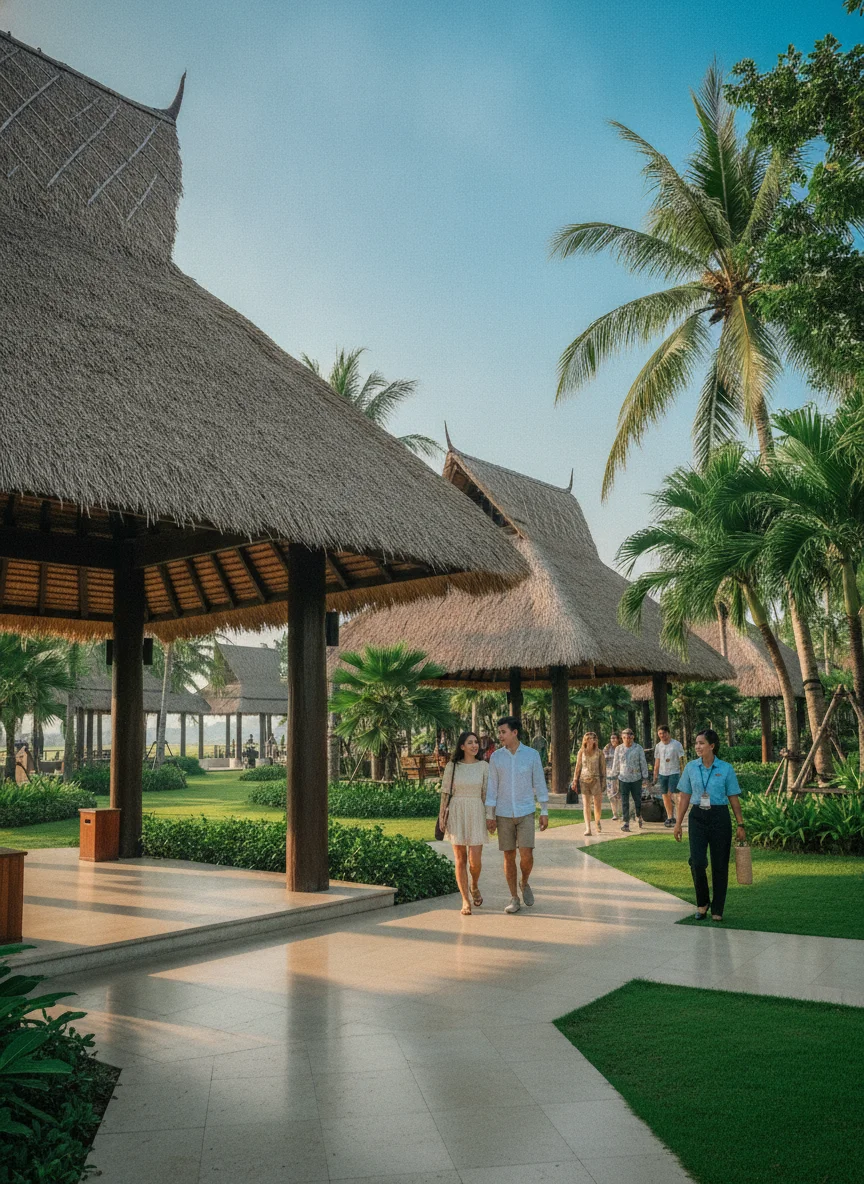
Samui International Airport departs from conventional glass-and-steel aviation architecture, utilising a low-rise, open-air layout that integrates naturally into the surrounding coconut groves of Bo Phut. Originally designed in collaboration with Habita Architects, the airport complex relies extensively on locally sourced building materials, including coconut palm timber, rattan, bamboo, and woven thatch roofing. Rather than navigating enclosed corridors, arriving and departing passengers move through open-sided pavilions and covered walkways flanked by palm gardens, flowering frangipani, and water lily ponds.
Natural cross-ventilation forms the foundation of the terminal cooling strategy. High-pitched thatched canopies channel coastal breezes across passenger zones, supplemented by large overhead ceiling fans rather than power-intensive central air conditioning. While enclosed facilities like airline lounges, ticket desks, and boutique shops feature standard air conditioning, general waiting areas and transit gates remain open to the island atmosphere. During seasonal monsoon squalls, staff lower heavy roll-down weather blinds along pavilion perimeters to protect passenger seating from wind-driven rain.
On the tarmac, open-sided passenger trams transfer travellers directly between aircraft parking positions and the terminal pavilions, replacing traditional enclosed jet bridges. Because the open-air design means you encounter Koh Samui's tropical heat and humidity immediately upon disembarkation, packing lightweight, breathable clothing in your cabin luggage ensures a comfortable arrival experience.
Terminal Layout and Passenger Flow
Samui International Airport operates across two distinct low-rise pavilion clusters separated into domestic and international passenger zones, situated roughly 50 metres apart. The entire terminal layout occupies a compact, single-storey footprint that makes wayfinding straightforward without navigating multiple levels or extensive corridors.
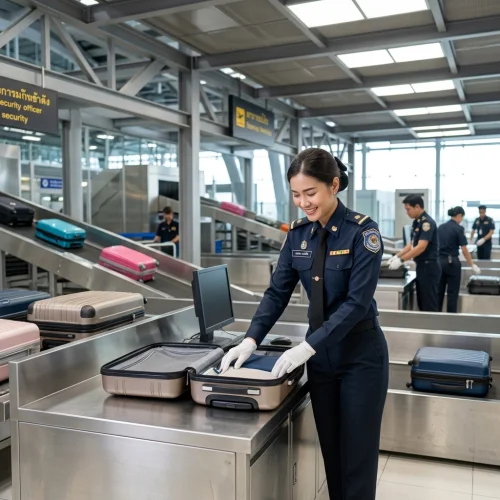
Departing passengers begin at an open-air check-in concourse before passing through security screening, which opens directly into the central Samui Park Avenue thoroughfare leading towards the departure gates. Walking distances between check-in, passenger lounges, and gates rarely exceed three minutes. For arriving travellers, domestic baggage reclaim features open-air carousels, whereas international arrivals proceed through dedicated passport control, luggage collection, and customs facilities within the international wing.
Bangkok Airways specifies arriving at the airport at least 90 minutes before domestic flights and at least two hours before international departures, with check-in desks closing 40 and 50 minutes prior to take-off respectively. Even with brief walking times across the single-level concourses, allowing this buffer accounts for potential queues at bag drop, screening lanes, and immigration counters when several regional flights touch down in close succession.
Master Koh Samui's unique climate with our practical guide. Discover exact temperatures, the truth about November monsoons, and why you must pack your own SPF.
Dining, Retail, and Lounge Access Options
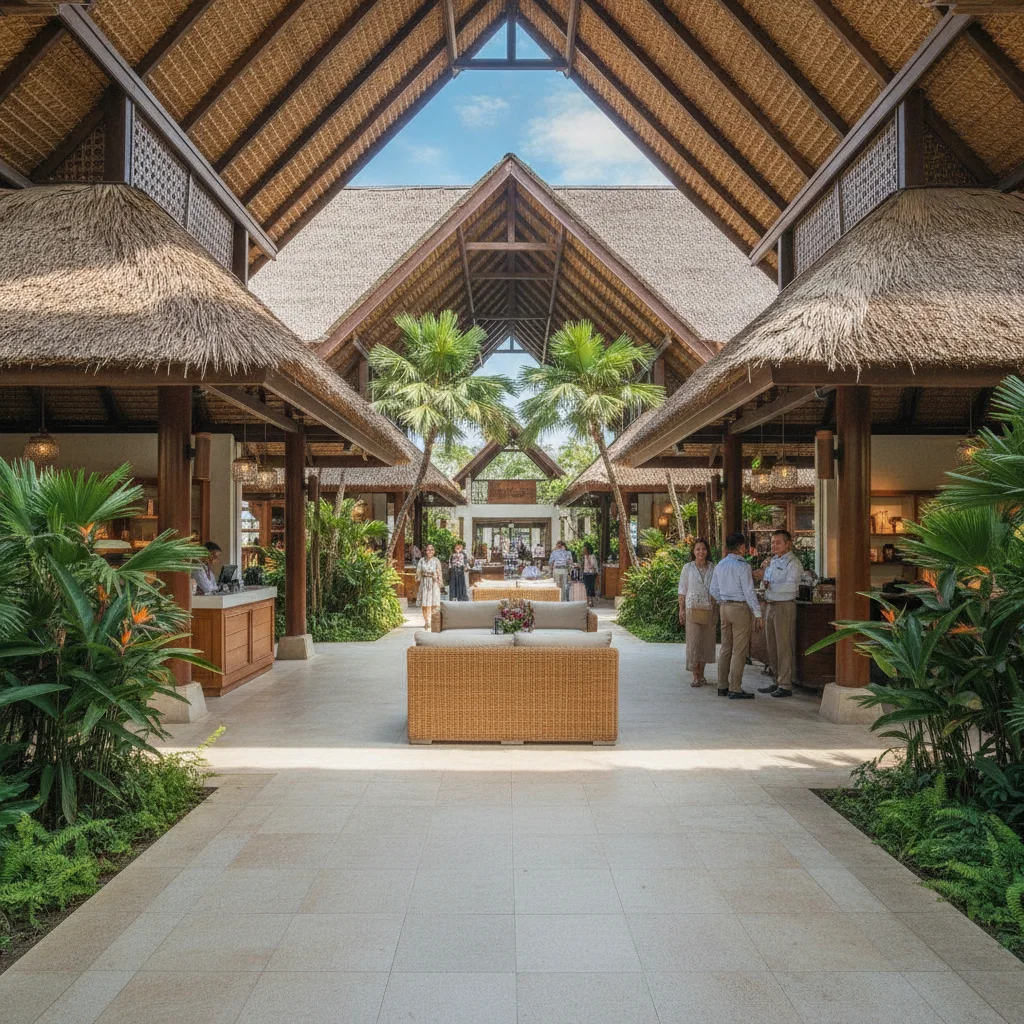
Samui Park Avenue forms the airport's central open-air commercial precinct, linking the terminal check-in areas with departure gates. Framed by palm trees and landscaped gardens, this pedestrian promenade contains boutique shops, travel convenience outlets, cafes, and restaurants. Travellers can browse regional Thai handicrafts, silk clothing, beachwear, and duty-free goods, or choose from sit-down restaurants and bakeries preparing Thai classics and Western dishes.
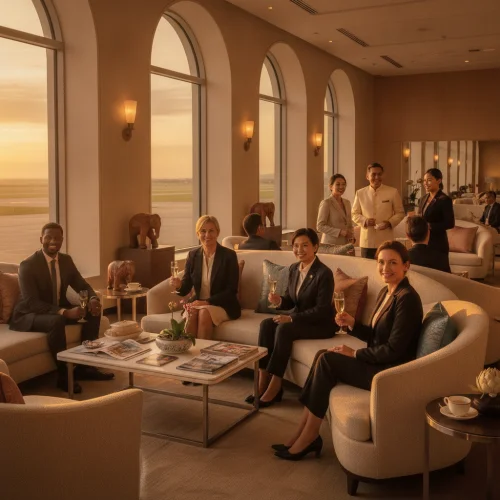
A distinct feature of flying through Samui International Airport with Bangkok Airways is the complimentary lounge access extended to all passengers. In both domestic and international departure areas, standard ticket holders can use the airline's Courtesy Corner lounges without an extra fee or frequent flyer status. These stations supply complimentary hot coffee, tea, fruit juices, soft drinks, fresh pastries, and light Thai snacks alongside free Wi-Fi.
For travellers seeking extra comfort or a quiet air-conditioned workspace, Bangkok Airways operates dedicated Blue Ribbon Club lounges in both terminal sections. Accessible to business class passengers, select elite frequent flyers, and economy passengers purchasing an on-the-day upgrade, these lounges provide hot à la carte food, private seating areas, runway views, and massage chairs before boarding.
Flight Connectivity and Airline Operations Profile
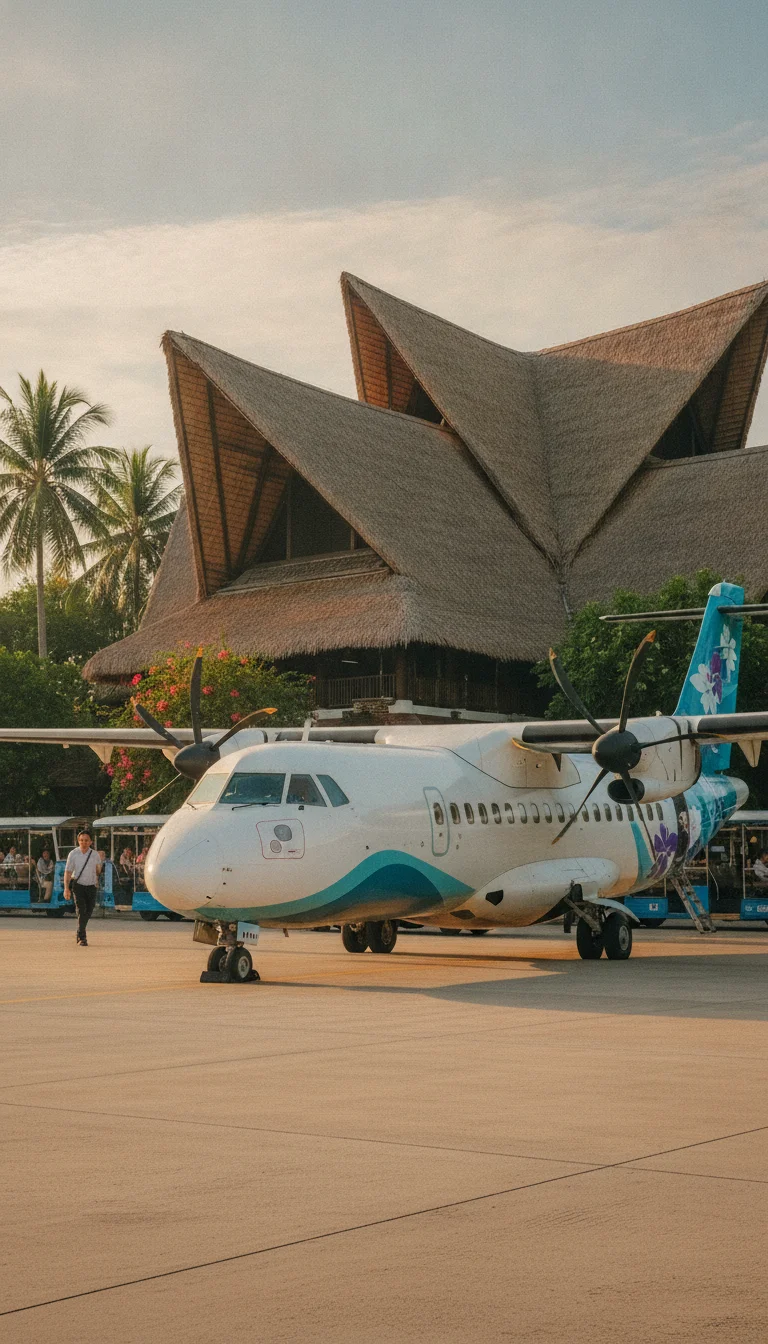
Bangkok Airways privately owns and operates Samui International Airport, having opened the facility in April 1989. Because the carrier built the infrastructure, it controls the vast majority of landing slots and runs the airfield as a core regional hub. The primary air corridor connects Koh Samui with Bangkok’s Suvarnabhumi Airport (BKK), operating with near-hourly shuttle frequency throughout the day, supplemented by flights to Don Mueang (DMK).
Direct domestic routes also link Samui to key provincial destinations, including Phuket (HKT), Chiang Mai (CNX), Krabi (KBV), and Pattaya U-Tapao (UTP). International travellers can fly non-stop to Singapore Changi (SIN) aboard either Bangkok Airways or budget carrier Scoot, as well as to Hong Kong (HKG) and mainland Chinese cities such as Chengdu on scheduled and seasonal services.
Flight operations are physically shaped by the airport's 2,060-metre runway and strict local environmental limits on daily aircraft movements. These conditions prevent large widebody aircraft from landing, restricting traffic almost entirely to regional narrowbodies like the Airbus A319 and A320, Embraer E190-E2 jets, and ATR 72 turboprops.
Because regional aircraft carry fewer passengers than long-haul airliners, seat capacity remains constrained despite the high number of daily departures. Fares on routes into Samui are noticeably higher than standard domestic flights across mainland Thailand, and popular services from Bangkok and Singapore routinely sell out during high season. Securing flight tickets several months ahead of peak holiday periods is advisable.
Regional Gateway Comparison: Samui vs Southern Thailand Hubs
Samui Airport prioritises speed and convenience over the lower flight costs available at mainland public airports. Flying directly into Koh Samui (USM) avoids the multi-leg bus and ferry journeys required when landing on the mainland, saving up to four hours of transit time. Because Bangkok Airways owns and operates USM, airfares carry a noticeable price premium over domestic routes into public airports. For travellers with limited holiday time, direct arrivals eliminate long connection windows. Passengers travelling onward to Koh Phangan or Koh Tao can also transfer straight from the airport to nearby northern ferry piers within twenty minutes.
Mainland airports such as Surat Thani (URT) and Nakhon Si Thammarat (NST) receive low-cost domestic flights via carriers including Thai AirAsia, Nok Air, and Thai Lion Air. These routes offer lower airfares, though reaching Samui requires a bus transfer to Donsak Pier followed by a ferry crossing. On the Andaman coast, Phuket (HKT) and Krabi (KBV) provide entry for multi-destination trips, connected to Samui by 55-minute Bangkok Airways flights or cross-peninsula road-and-ferry routes.
| Airport | Key Airlines | Transit to Koh Samui | Typical Traveller |
|---|---|---|---|
| Samui International (USM) | Bangkok Airways, Scoot | Direct island landing; 15–30 min drive to hotels | Short-stay visitors, direct island hoppers |
| Surat Thani Airport (URT) | Thai AirAsia, Nok Air, Thai Lion Air | 2.5 to 5 hours (bus to Donsak Pier plus ferry) | Budget travellers, long-stay visitors |
| Phuket International (HKT) | International carriers, Thai Airways, Thai AirAsia | 55-minute flight to USM, or 6-hour overland link | Multi-destination travellers touring southern Thailand |
| Krabi Airport (KBV) | Thai AirAsia, Bangkok Airways, Flydubai | 4 to 5.5 hours (coach plus ferry), or regional flight | Travellers combining the Andaman coast with Samui |
Travellers visiting the Gulf for under ten days typically gain the most value by booking direct flights into USM, trading higher ticket prices for extra time on the island.
Location and Ground Transportation
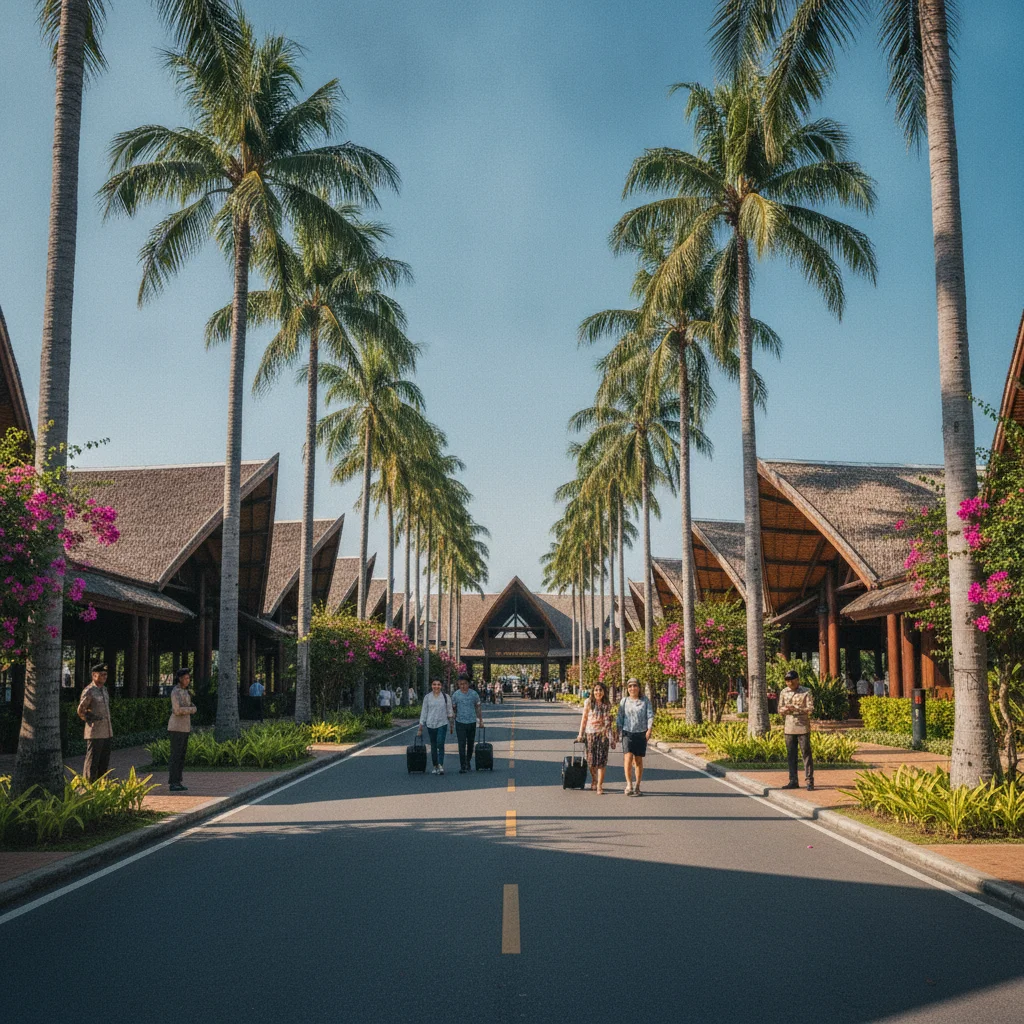
Situated in the Bo Phut subdistrict in the north-eastern corner of Koh Samui, Samui International Airport provides straightforward road access to the island's primary resort enclaves. Chaweng Beach sits approximately 2 to 4 kilometres south of the terminal (a 10-minute drive), while the dining and shopping precinct of Bophut Fisherman's Village lies 5 kilometres to the west (roughly 12 minutes). Bangrak Pier, the departure point for speedboats and passenger ferries to Koh Phangan, is just 3 kilometres away (8 to 10 minutes). Choeng Mon Beach occupies the peninsula roughly 5 kilometres to the east.
Arriving passengers arrange onward transit at the official transport counters situated directly past the baggage reclaim area. Because the airport is privately operated, local street taxis cannot solicit fares inside the terminal, and ground transport operates on fixed zone-based pricing established by the airport concessionaire.
Shared minivans depart once a minimum group of passengers has assembled, dropping travellers directly at hotel doorsteps across major northern beach areas for 150 to 200 THB (£3.30 to £4.40) per person. Private airport taxis and limousines provide immediate point-to-point transfers at regulated flat rates: trips to north-eastern destinations such as Chaweng, Choeng Mon, Bangrak, and Bophut cost between 400 and 600 THB (£8.80 to £13.20). Reaching further destinations, such as Lamai or Maenam, costs between 700 and 1,000 THB (£15.40 to £22.00), while journeys to southern and western shores like Lipa Noi or Taling Ngam range from 1,000 to 1,500 THB (£22.00 to £33.00).
App-based ride-hailing services, including Grab and Bolt, operate across Koh Samui, but drivers are restricted from entering the airport arrivals pick-up lanes. Passengers opting for app rides must walk past the main airport security barrier to meet their driver. For travellers planning extensive island exploration, on-site car hire desks—including Sixt, Hertz, and Drive Car Rental—operate in the arrivals concourse, with daily vehicle rates generally starting from 1,000 to 1,800 THB (£22.00 to £39.60).
| Transport Option | Price (THB) | Approx. Price (GBP) | Service Details |
|---|---|---|---|
| Shared Minivan (Chaweng / Bophut) | 150 - 200 per person | £3.30 - £4.40 | Fixed rates; drops off directly at hotel doorsteps |
| Private Airport Taxi (North Samui) | 400 - 600 flat rate | £8.80 - £13.20 | Covers Chaweng, Bophut, Bangrak, and Choeng Mon |
| Private Airport Taxi (South/West Samui) | 800 - 1,500 flat rate | £17.60 - £33.00 | Covers Lamai, Maenam, Lipa Noi, and Taling Ngam |
| Daily Car Rental | 1,000 - 1,800 per day | £22.00 - £39.60 | Major brands available in the arrival terminal |
Who Samui Airport Suits
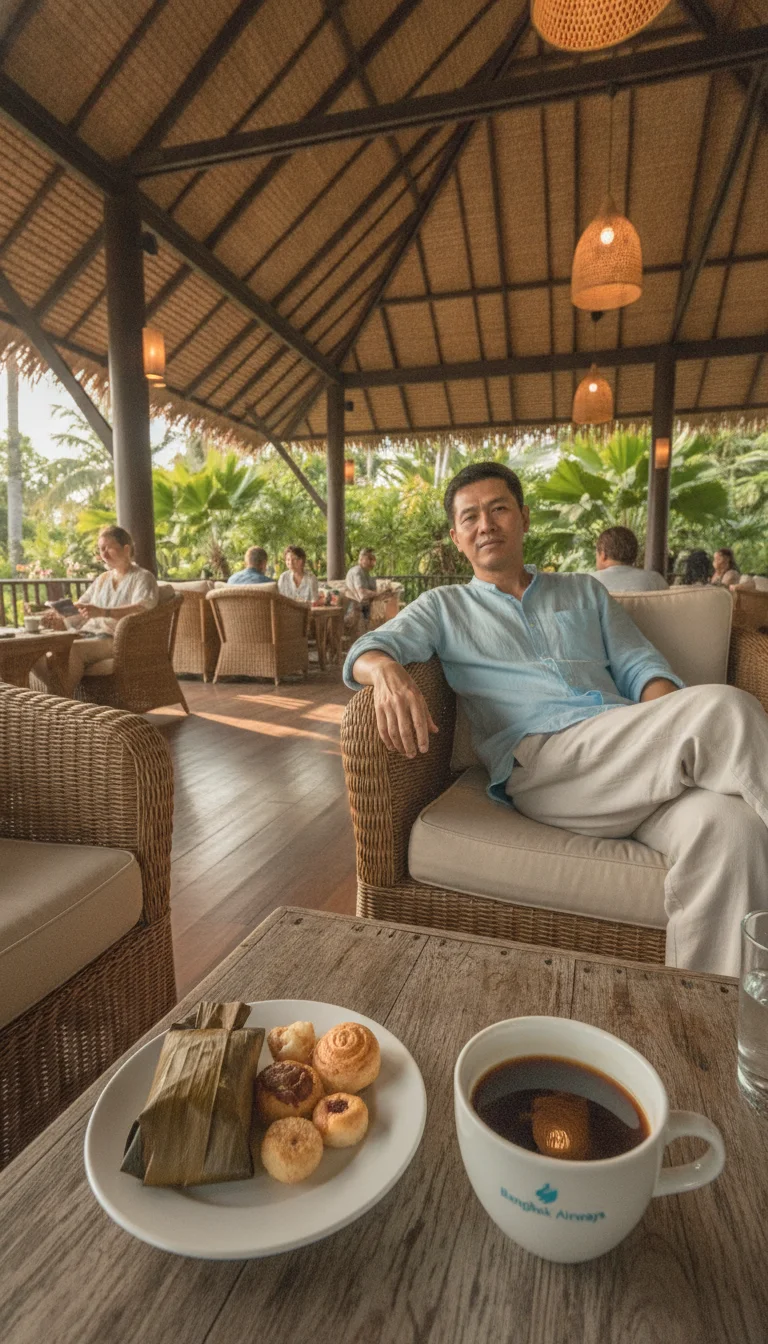
Samui International Airport suits travellers prioritising convenience, short-stay holidaymakers, families, and those connecting directly to Koh Phangan or Koh Tao. Direct flights cut mainland transit times significantly, and the airport's location in the north-east provides quick road access to major resort areas such as Chaweng and Bo Phut. For budget-conscious travellers or those with flexible itineraries, flying into Surat Thani on the mainland followed by a joint bus and ferry transfer provides a lower-cost alternative.
Because Bangkok Airways owns the airport and operates the majority of its scheduled services, flight prices into Samui remain higher than standard domestic routes across Thailand. Booking flights several months ahead helps secure lower fare tiers. The open-air terminal layout relies on natural ventilation and ceiling fans rather than enclosed air conditioning throughout, so wearing light, breathable clothing ensures greater comfort during humid periods.
Heavy rainfall during the Gulf monsoon peak in October and November can lead to occasional flight delays or rough sea conditions that disrupt ferry timetables. Travellers visiting during late autumn should allow extra buffer time between flight arrivals and boat departures. For island connections, Bangrak Pier sits roughly ten minutes from the terminal by taxi, making same-day crossings to Koh Phangan manageable when arriving earlier in the day.
Practical Travel Advice
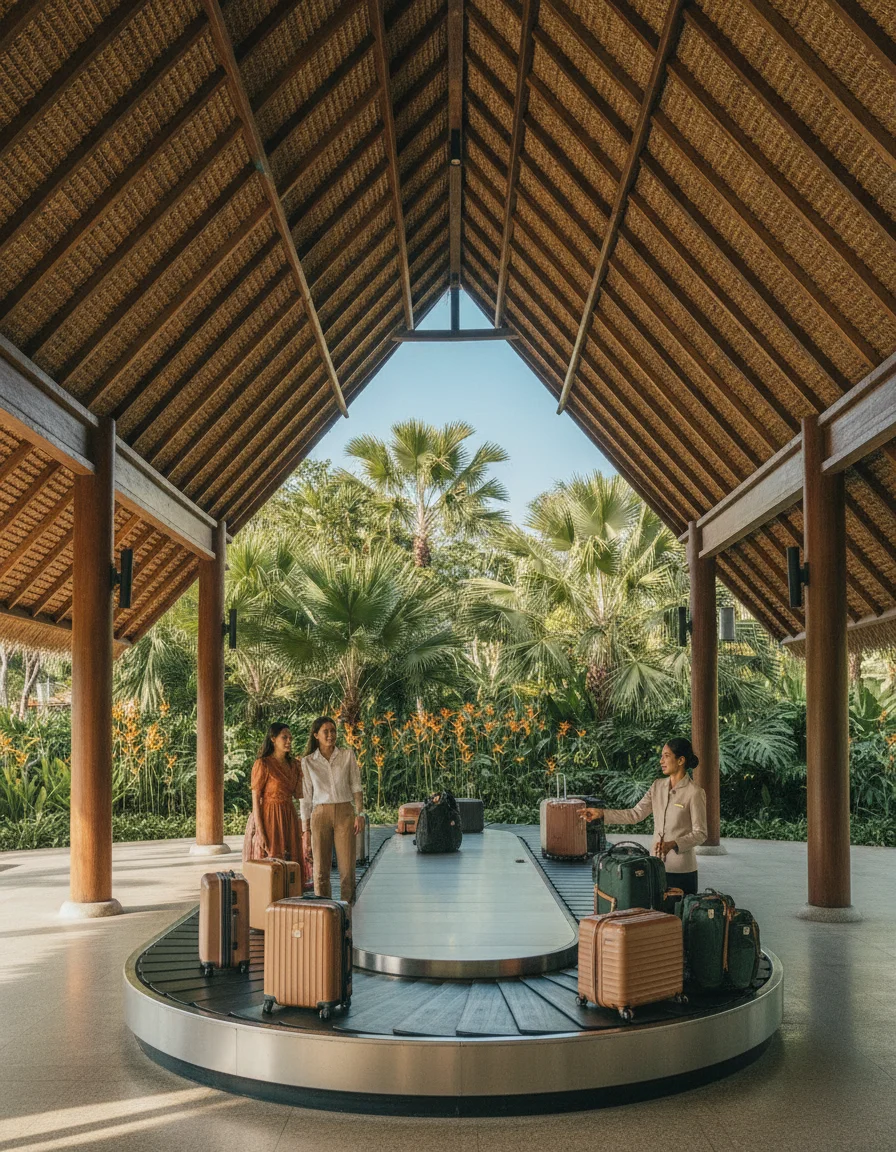
Organising onward travel before clearing arrivals saves significant hassle. App-based ride-hailing services are prohibited from picking up passengers directly on airport grounds, meaning travellers must either use the official transport service desks inside the arrivals concourse, pre-arrange a private hotel transfer, or use the dedicated taxi rank. When paying cash at local counters or for taxis, keep smaller denominations handy, as drivers and kiosks frequently struggle for change against 1,000-baht notes dispensed by airport ATMs.
If you are travelling onwards to Koh Phangan or Koh Tao on the same day, check ferry timetables before booking flights. Most passenger ferries from nearby Bangrak or Maenam piers stop running by late afternoon, typically between 16:30 and 17:30. Flights arriving in the evening will require an overnight stay on Koh Samui before catching a morning crossing.
For island connectivity, dedicated telecom kiosks in the arrivals area sell tourist SIM cards with on-the-spot passport registration. Self-service luggage lockers near the meeting area also allow short-term bag storage for travellers wishing to explore nearby Fisherman's Village in Bo Phut before checking into accommodation. Given the airport's open-sided pavilion architecture and open tarmac trams, keep a compact waterproof jacket or umbrella in your cabin bag if travelling during the wetter monsoon months of October and November.
Quick Reference Table
| Item | Detail | Notes |
|---|---|---|
| IATA Airport Code | USM | Primary aviation gateway for Koh Samui and the Gulf archipelago |
| Airport Ownership & Operation | Bangkok Airways | Privately built and opened for commercial service in April 1989 |
| Annual Passenger Traffic | Over 2 million passengers | Compact, single-storey open-air layout |
| Location | Bo Phut, north-eastern Koh Samui | Roughly 2 km north of Chaweng and 5 km east of Fisherman's Village |
| Runway Length | 2,060 metres | Restricted to regional narrowbodies (A319/A320, E190-E2) and ATR 72 turboprops |
| Check-in Times (Domestic) | Arrive 90 mins before departure | Check-in desks close 40 minutes prior to take-off |
| Check-in Times (International) | Arrive 2 hours before departure | Check-in desks close 50 minutes prior to take-off |
| Domestic Direct Destinations | Bangkok (BKK/DMK), Phuket, Chiang Mai, Krabi, Pattaya U-Tapao | High-frequency daily connections operated primarily by Bangkok Airways |
| International Direct Destinations | Singapore, Hong Kong, Chengdu | Scheduled and seasonal routes via Bangkok Airways and Scoot |
| Complimentary Lounge Access | Bangkok Airways Courtesy Corner | Free hot drinks, snacks, and Wi-Fi for all Bangkok Airways passengers |
| Premium Lounge Access | Blue Ribbon Club Lounges | Available to business class, elite tier flyers, or via paid day-upgrade |
| Shared Minivan Transfer | 150 – 200 THB (£3.30 – £4.40) per person | Fixed concession rates to major northern resorts (Chaweng/Bophut) |
| Private Taxi (North Samui) | 400 – 600 THB (£8.80 – £13.20) flat rate | Regulated fares covering Chaweng, Bophut, Bangrak, and Choeng Mon |
| Private Taxi (Lamai / Maenam) | 700 – 1,000 THB (£15.40 – £22.00) flat rate | Fixed pricing booked at official arrivals counters |
| Private Taxi (South / West Samui) | 1,000 – 1,500 THB (£22.00 – £33.00) flat rate | Covers Lipa Noi, Taling Ngam, and surrounding areas |
| On-Site Daily Car Hire | 1,000 – 1,800 THB (£22.00 – £39.60) per day | Desks in arrivals including Sixt, Hertz, and Drive Car Rental |
| Bangrak Ferry Pier Transit | 3 km (8 to 10 minutes by road) | Main departure pier for passenger ferries to Koh Phangan |
| Same-Day Island Ferry Window | 16:30 – 17:30 last departures | Evening arrivals require an overnight stay on Koh Samui |
| Peak Monsoon Period | October to November | Heavy rainfall can cause flight delays or rough sea conditions |
FAQ: Samui International Airport
What is unique about the design of Samui International Airport?
How is Samui International Airport cooled?
What clothing should I pack for arrival at Samui International Airport?
How early should I arrive for flights at Samui International Airport?
Does Samui International Airport offer complimentary lounge access?
Why are flights to Samui International Airport often more expensive?
Who should consider flying directly to Samui International Airport?
Can I use app-based ride-hailing services like Grab or Bolt from Samui International Airport?
What should I know about connecting to ferries from Samui Airport on the same day?
What should I pack for Samui Airport if travelling during the monsoon season?
Reviewed by the Thailand Guide Editorial Team • Last reviewed: 1 September 2026
This page provides general information only and is not financial, legal, or immigration advice. Always verify current rules with official Thai government sources or a qualified professional before making decisions.