Koh Chang Property
Koh Chang presents a distinct property landscape for British buyers. Much of the island's mountainous interior forms part of Mu Koh Chang National Park, which restricts commercial development and leaves private titled land in comparatively short supply. While foreign nationals can acquire freehold apartment units directly—provided total foreign ownership within a building remains within the statutory 49% ceiling on sellable floor space—freehold apartment developments on the island are limited. Instead, transactions frequently involve villas, detached residential properties, or commercial land plots held under registered long-term leases.
Navigating property acquisition in Thailand requires strict compliance with domestic legislation that differs significantly from English conveyancing practices. This guide outlines the formal legal pathways, registration requirements at the Trat Land Department, offshore fund transfer rules, and financial liabilities involved in buying or leasing property on Koh Chang. It provides practical, objective guidance for UK purchasers planning an acquisition, helping you conduct thorough due diligence and avoid costly structural pitfalls.

Understanding Ownership Options for Foreigners
Under Thailand's Condominium Act, foreign nationals can purchase registered apartment units freehold, holding direct, perpetual title registered in their own name. This freehold entitlement is legally capped at 49% of the total sellable floor space within any single apartment development. While purpose-built, registered apartments are far less common on Koh Chang than on mainland resort destinations, securing an eligible unit within this foreign quota provides a secure form of individual property ownership under Thai law.
The Land Code prohibits foreign individuals from owning land outright, meaning detached villas and residential plots on Koh Chang are predominantly secured through registered leaseholds. Under Section 540 of the Civil and Commercial Code, the maximum legal term for a lease of immovable property is 30 years. Any lease longer than three years must be formally registered on the land's title deed at the local Land Department office to remain legally binding. Property listings frequently promote renewal clauses—often described as rolling extensions—yet Thai law does not permit renewals to be registered in advance. Contractual promises to renew bind the original landlord rather than subsequent registered titleholders, and the Thai Supreme Court has ruled that prepaid future extensions designed to bypass the 30-year statutory ceiling are void.
Thai property law treats land and the buildings standing upon it as separate legal assets. A foreign buyer can hold lawful freehold title to the physical house or villa structure, while leasing the underlying plot. To strengthen this arrangement, buyers frequently register a right of superficies at the Land Department alongside the land lease.
Using a Thai limited company to purchase land carries severe legal restrictions. Thai law requires at least 51% of company shares to be owned by Thai nationals, capping foreign shareholding at 49%. Forming a company with Thai nominee shareholders who hold equity purely to circumvent foreign land restrictions is strictly illegal under the Land Code.
The Property Purchase Process on Koh Chang

Acquiring property on Koh Chang follows a structured multi-stage process from initial selection through to formal registration at the government land office.
Once a buyer agrees on a purchase price with the seller or developer, the initial step involves signing a reservation agreement. This document temporarily secures the property, removes it from the open market, and fixes the commercial terms while formal legal checks proceed. At this stage, the buyer pays a reservation deposit, which commonly ranges between 5% and 10% of the agreed purchase price, though off-plan developments may structure initial commitments slightly differently.
Before committing to a binding contract or paying substantial capital, an independent property lawyer should examine the property's title and structure. Following successful checks, both parties execute the formal Sale and Purchase Agreement. This contract defines the definitive payment schedule, completion deadlines, handover standards, and the agreed allocation of statutory transfer taxes and administrative fees. Signing the contract typically requires a further instalment, bringing the total deposit committed prior to completion to between 10% and 30% of the purchase price.
Final completion takes place at the Trat Provincial Land Office branch in Laem Ngop on the mainland, which maintains jurisdiction over land and apartment titles for Koh Chang. Both parties, or their appointed legal representatives acting under an official Land Department power of attorney, attend the office to settle registration fees, pay applicable transfer taxes, and endorse the title deed. Buyers unable to travel across to the mainland in person can instruct their lawyer to complete the registration on their behalf. From initial reservation to the transfer of the title deed, a standard purchase typically completes within four to eight weeks.
Complete guide for UK nationals buying property in Thailand, covering title deeds, foreign condo quotas, FETF fund transfers, and Land Department fees.
Financing Your Koh Chang Property Purchase
Mortgage lending from Thai commercial banks is rarely accessible to non-resident foreign buyers. Thai banks strictly limit home loans to individuals with long-term residency, local employment, or a valid Thai work permit, alongside substantial down payments. Consequently, UK buyers on Koh Chang almost universally finance purchases using overseas capital, home-country equity release, or developer staged-payment schedules for off-plan builds.
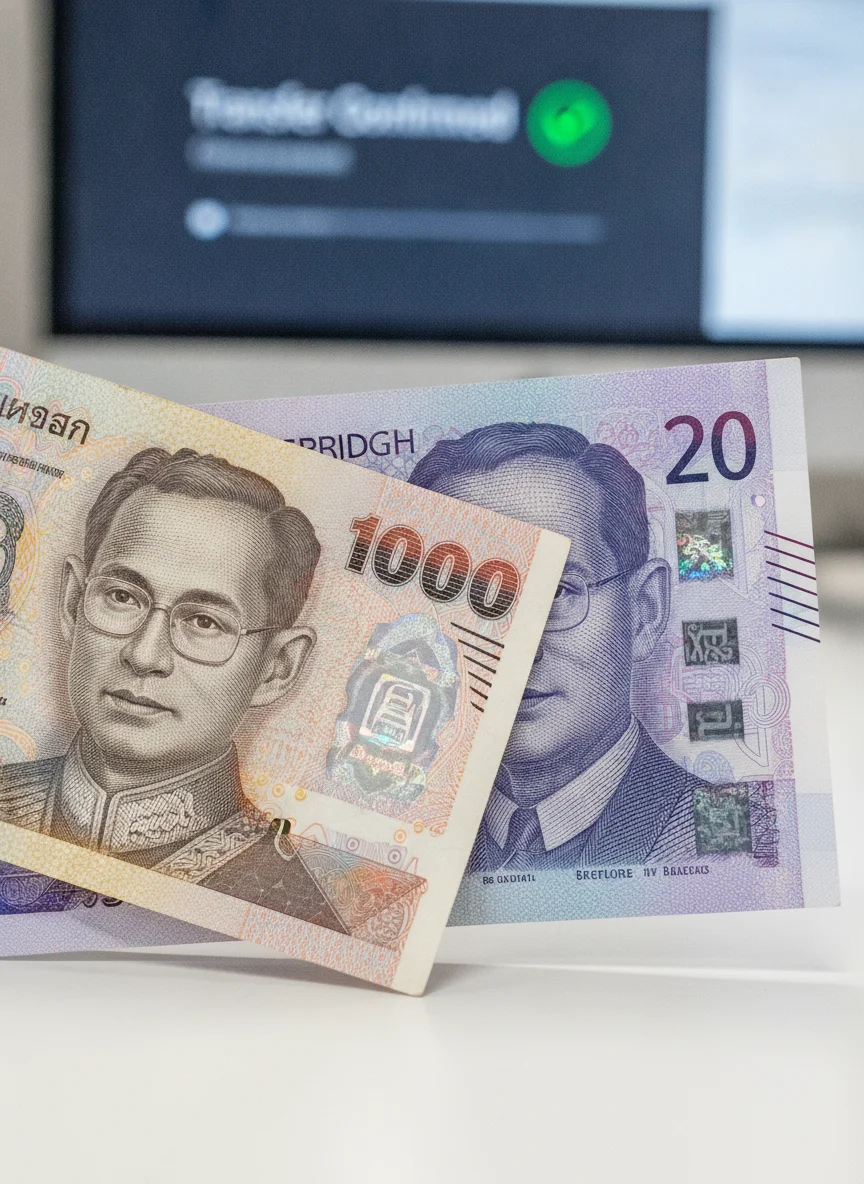
Securing freehold ownership of a apartment under Thai law requires specific cross-border banking procedures. Under Section 19 of the Condominium Act, a foreign national must prove that the entire purchase price entered Thailand from overseas in foreign currency and was converted into Thai Baht by a licensed receiving bank in Thailand. Funds transferred directly in Thai Baht do not qualify.
When transferring funds from the UK, ensure the remittance is sent in foreign currency (such as GBP) directly to your Thai bank account or the developer's registered account. The transfer instructions must state the buyer's full name—matching their passport—and specify the exact purpose, such as "for the purchase of apartment unit [details]".
Under Bank of Thailand regulations, the receiving bank issues a Foreign Exchange Transaction Form for any inward transfer of USD 50,000 (approx £38,000) or its foreign-currency equivalent. For transfers below this threshold, the bank issues a credit advice note and an official confirmation letter certifying the inbound foreign currency and purpose. The Land Department requires these bank documents at settlement to verify that inward foreign-currency remittances equal or exceed the declared purchase price before registering foreign freehold title.
Due Diligence and Legal Protection
Conducting rigorous due diligence before signing contracts or paying a non-refundable deposit is a fundamental safeguard when buying property on Koh Chang. Thailand does not operate a statutory seller-disclosure system, meaning the responsibility falls entirely on the buyer to uncover potential liabilities, restrictions, or title defects.
A thorough legal review begins with an official title search conducted directly at the relevant Land Department office. An independent property lawyer must examine the government's official registry copy of the deed rather than relying on paperwork supplied by the seller or agent. This search confirms legitimate ownership, verifies that the seller possesses the legal right to transfer the asset, and uncovers any registered mortgages, liens, servitudes, or long-term third-party leases recorded against the plot. For corporate sellers, company registry filings should be checked to verify director signing authority and corporate status.
For apartment purchases, due diligence must verify that the building's statutory 49% foreign ownership quota has not been reached. Legal counsel should also review the juristic person's regulations, sinking fund reserves, and communal maintenance accounts, obtaining an official clearance certificate confirming the unit carries no outstanding fee liabilities before completion.
Physical and regulatory checks are equally important across the island. A boundary inspection ensures physical markers match the registered survey map and rules out neighbouring encroachments. For houses or villas, your lawyer should review local municipal records to verify that building permits were properly issued and that the structure complies with island planning and environmental regulations.
Instructing an independent Thai property lawyer with no commercial ties to the seller, developer, or estate agent ensures your interests remain protected throughout the process. Legal counsel will scrutinise sale contracts, secure deposit terms, and ensure all filings conform strictly to Thai property statutes.
Costs and Fees
Acquiring property on Koh Chang requires budgeting for statutory transfer taxes, professional fees, and ongoing maintenance charges. Official transaction duties are assessed and collected on completion day at the Trat Land Department. The allocation of these costs depends on Thai law, consumer protection regulations, and private contractual terms.
The Land Department charges a transfer fee of 2% of the Treasury Department's official appraised value, which is generally lower than the open-market price. In island resale transactions, this cost is customarily split equally between buyer and seller. For new developments, Thai consumer protection law limits the buyer's contribution to a maximum of 1%.
Two transaction taxes operate on a mutually exclusive basis. Specific Business Tax of 3.3% applies to the higher of the appraised value or declared sale price if the seller is a company, or an individual who has held the property for less than five years without qualifying house registration. Where Specific Business Tax does not apply, Stamp Duty of 0.5% is payable on the higher valuation instead. Both are legally the vendor's obligation, though private contracts can negotiate different cost-sharing terms.
Withholding tax is deducted at completion on behalf of the Revenue Department. For individual sellers, it is calculated using progressive personal income tax brackets between 5% and 35% on the appraised value, adjusted for the holding period. Corporate sellers incur a flat 1% rate on the higher of the appraised or registered sale price. By law, the seller bears this liability.
Independent legal representation typically costs 1% to 2% of the purchase price, or a flat fee between 30,000 THB and 80,000 THB (approx £670 to £1,800). Agent commissions of 3% to 5% are paid by the seller. For apartment buyers, common area maintenance fees typically cost 40 THB to 80 THB (approx £0.90 to £1.80) per square metre monthly, billed periodically. A one-off sinking fund contribution of roughly 400 THB to 1,000 THB (approx £9 to £22) per square metre is also payable at handover into the capital reserve.
| Cost Item | Rate or Amount | Paid By | Notes |
|---|---|---|---|
| Transfer Fee | 2% of appraised value | Split 50/50 (custom) | Levied by Land Department; developer sales limit buyer share to a maximum of 1%. |
| Stamp Duty | 0.5% of appraised value or sale price | Seller (customary) | Applies only when Specific Business Tax does not apply; calculated on higher valuation. |
| Business Tax (SBT) | 3.3% of appraised value or sale price | Seller | Applies if seller is a company or owned property under 5 years. |
| Withholding Tax | Progressive 5%–35% (individual) / 1% (company) | Seller | Individual rate based on appraised value; corporate rate on higher valuation. |
| Legal Fees | 1% - 2% of purchase price | Buyer | Independent contract review, title checks, and Land Department registration. |
| Property Agent Commission | Typically 3% - 5% of purchase price | Seller | Paid by vendor under standard agency agreements; built into asking prices. |
| Apartment Maintenance Fees | 40 THB - 80 THB (approx £0.90 - £1.80) / sq m / month | Owner (periodic) | Recurring charge covering communal facilities, security, and building management. |
| Sinking Fund | 400 THB - 1,000 THB (approx £9 - £22) / sq m | Owner (at handover) | One-off reserve contribution for long-term repairs and structural replacements. |
Common Mistakes and How To Avoid Them

Navigating property transactions on Koh Chang requires caution, as standard UK conveyancing assumptions do not apply under Thai law. Overlooking local statutory limits or failing to verify official records creates serious legal and financial exposure.
Relying on weak or unverified land documents is a frequent pitfall. A large proportion of Koh Chang falls within national park and forest reserve boundaries where private ownership is prohibited. Acquiring property based on agricultural receipts or possessory certificates rather than a verified full title deed or confirmed-possession certificate can lead to property confiscation or unregistrable leases. An independent title search at the Land Department confirms whether a plot carries legitimate boundaries and clean ownership.
Treating contractual lease extensions as enforceable property rights is another major mistake. Under Thai civil law, the maximum registrable lease term is 30 years. Additional promised terms, such as rolling 30-year extensions, remain private agreements between the original parties rather than registered rights attached to the land, leaving subsequent landowners or heirs under no statutory obligation to honour them.
Purchasing an apartment unit without verifying the foreign freehold quota also risks transaction failure. Foreign buyers may hold freehold title provided total foreign ownership remains at or below 49% of the sellable area in the building. If a building has met this threshold, the Land Department will reject foreign registration.
Using nominee shareholders in a domestic limited company to acquire restricted land is illegal under the Land Code. Where Thai nationals hold shares solely to bypass foreign ownership limits without genuine capital contribution, authorities can investigate and invalidate the holding structure. Retaining an independent property lawyer ensures all arrangements comply fully with Thai statutes.
Practical Advice for Koh Chang Property Buyers
Visiting Koh Chang during different seasons is sensible before completing a property purchase. The island experiences a distinct climate shift, moving from dry, calm conditions between November and March to heavy southwest monsoon rains from late May to October, with annual precipitation exceeding 3,000 millimetres. Inspecting a property during the wet season lets you evaluate how the building, access roads, and local drainage handle torrential downpours, while giving you a realistic picture of island life when tourist businesses quieten down and inter-island passenger boats pause.
Island property ownership demands proactive ongoing maintenance. Koh Chang's combination of tropical heat, high humidity, and coastal salt air accelerates wear on exterior paintwork, metal fittings, air-conditioning compressors, and timber decking. If you do not plan to live on the island full-time, arranging reliable local property management is vital. Routine inspections, regular ventilation to deter mould, scheduled pest control, and roof clearance help protect your home during prolonged absences.
Establishing a comprehensive financial buffer is equally prudent. Adding a contingency of 10% to 15% to your estimated acquisition budget accommodates currency exchange movements, independent structural surveys, immediate minor refurbishments, and utility connection deposits. Planning your international transfer schedule well in advance also avoids unexpected settlement delays.
Finally, keep meticulous physical and digital copies of every document generated throughout the transaction. Retaining signed purchase agreements, Land Department registration receipts, building permits, utility contracts, and foreign transfer records ensures smooth ongoing administration and simplifies any future resale.
Quick Reference Table
| Item | Detail | Notes |
|---|---|---|
| Foreign Apartment Ownership | Freehold title registered in buyer's name; capped at 49% of total sellable floor space | Available under the Condominium Act; units must fall within the building's foreign ownership quota. |
| Land and Villa Ownership | 30-year registered leasehold; structural building freehold | Direct individual foreign land ownership is prohibited under the Land Code; leases over 3 years must be registered at the Land Department. |
| Thai Nominee Companies | Prohibited under the Land Code | Using Thai nominee shareholders holding 51%+ equity purely to circumvent foreign land restrictions is illegal and subject to investigation. |
| Deposit Requirements | 5%–10% at reservation; total 10%–30% upon signing Sale and Purchase Agreement | Paid prior to completion; terms and refund conditions should be reviewed by an independent lawyer. |
| Purchase Timeline | Typically 4 to 8 weeks | From initial reservation and legal due diligence through to final registration at the Land Department. |
| Inward Fund Transfer Rules | Full purchase price must enter Thailand in foreign currency (e.g. GBP) | Foreign Exchange Transaction (FET) form issued for USD 50,000+ (approx £38,000); credit advice/confirmation letter for lower amounts. Mandatory for apartment freehold. |
| Transfer Fee | 2% of official appraised value | Customarily split 50/50 between buyer and seller; developer sales cap the buyer's share at a maximum of 1%. |
| Specific Business Tax (SBT) | 3.3% of appraised value or sale price (whichever is higher) | Payable by seller if owned for less than 5 years or if the seller is a registered corporate entity. |
| Stamp Duty | 0.5% of appraised value or sale price (whichever is higher) | Payable by seller only when Specific Business Tax does not apply. |
| Withholding Tax | Progressive 5%–35% (individual) or flat 1% (corporate) | Statutory liability of the vendor, deducted at completion on behalf of the Revenue Department. |
| Legal Fees | 1% to 2% of purchase price, or 30,000 THB to 80,000 THB (approx £670 to £1,800) | Covers independent title search, contract review, and Land Department representation. |
| Estate Agent Fees | Typically 3% to 5% of purchase price | Customarily paid by the vendor under standard agency agreements. |
| Sinking Fund & Maintenance | Sinking fund 400–1,000 THB/sq m; CAM fees 40–80 THB/sq m/month | Sinking fund is a one-off capital contribution at handover; common area maintenance is billed periodically. |
| Recommended Contingency | 10% to 15% above estimated purchase budget | Buffers against exchange rate fluctuations, independent surveys, initial repairs, and utility connections. |
| Competent Registration Office | Trat Provincial Land Office (Laem Ngop Branch) | Mainland office holding statutory jurisdiction over Koh Chang title registrations and property transfers. |
| Official Source: Land Administration | Department of Lands (DOL) | dol.go.th / dol.go.th/trat |
| Official Source: Revenue & Taxation | Revenue Department | rd.go.th |
FAQ: Koh Chang Property
Can foreigners own property in Koh Chang?
Can foreigners own land in Koh Chang?
What is the maximum lease term for property in Koh Chang?
What is a common mistake regarding lease extensions for property in Koh Chang?
What is a common mistake regarding company ownership for land acquisition in Koh Chang?
Can foreign non-residents get a mortgage from Thai banks to buy property in Koh Chang?
How should foreign buyers transfer funds for a apartment purchase in Koh Chang?
Why is due diligence important when buying property in Koh Chang?
What is a common mistake when buying a apartment in Koh Chang?
Why should I visit Koh Chang during different seasons before buying property?
Reviewed by the Thailand Guide Editorial Team • Last reviewed: 22 September 2026
This page provides general information only and is not financial, legal, or immigration advice. Always verify current rules with official Thai government sources or a qualified professional before making decisions.