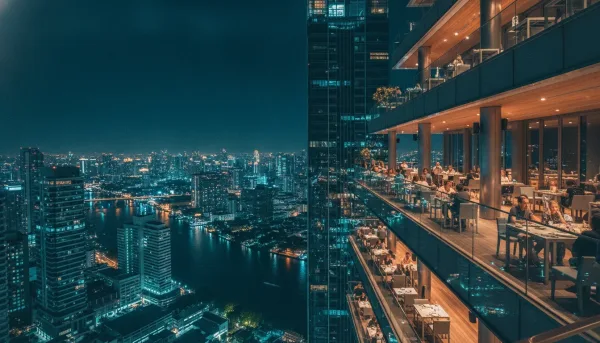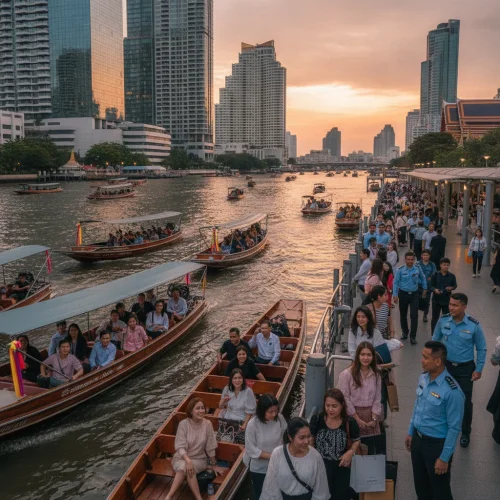
Bangkok’s Chao Phraya River is undergoing significant commercial development, with major corporations investing in new hotels, entertainment venues, and mixed-use properties. This expansion aims to bolster the capital's tourism sector.
Riverside Regeneration
The current wave of development follows the establishment of Iconsiam, a large mixed-use complex that has helped define the riverfront as a key area for investment and tourism. This project, part of a wider national plan to transform the riverbanks into an international destination, has already seen a substantial increase in land values in the surrounding Charoen Nakhon Road area. Property prices per square wah have risen considerably, and businesses along the river have reported significant growth. Hotel occupancy and room rates have also seen consistent increases, with a notable concentration of new property developments within a kilometre of the river. To support this growth, transport infrastructure, including road, rail, and river connections, has been improved, featuring new electric train lines. These developments are credited with contributing to a significant influx of international visitors to Thailand.
Developers are now focusing on new attractions and luxury accommodations, often repurposing historic sites and buildings. This approach mirrors urban regeneration projects seen in other major cities, such as Singapore’s Marina Bay and Shanghai’s Huangpu River waterfront, where former industrial areas have been transformed into public spaces and commercial districts. London's regeneration of the River Thames, including the conversion of Battersea Power Station, offers a similar precedent.
Asiatique Expansion Plans
Asset World Corp Public Company Limited (AWC) is planning a substantial expansion of Asiatique The Riverfront, a well-established riverside destination. The company, which controls assets valued at approximately 220 billion baht, is allocating 10 billion baht towards the redevelopment of Asiatique and its surrounding areas. A further 8 billion baht is earmarked for the next phase of Asiatique itself, with an additional 4 billion baht designated for adjacent locations, with the timing of these investments dependent on market conditions.
Recent additions to Asiatique include immersive attractions like Jurassic World: The Experience, which opened in August 2025, and Skyflyers: Wings of Garudapterus, which opened in November 2025. The latter is described as one of the tallest aerial rides globally. AWC intends to significantly increase the total area of Asiatique, expanding it from around 40,000 square metres to 224,000 square metres, a sixfold increase.
A key project within this expansion is Avatar: Guardians of Eywa, an immersive attraction developed under licence from the Avatar film franchise. This 4,000-square-metre experience will utilise a specific format to place visitors within the fictional world of Pandora. It will be housed in a new structure called the Blue Dome at Asiatique Destination, designed by Pritzker Prize-winning architect Shigeru Ban. These domes were originally created for Expo 2025 in Osaka, with AWC acquiring two large structures for reuse. The Blue Dome zone, covering 16,000 square metres and intended to integrate entertainment, culture, retail, and dining, is scheduled to open in the fourth quarter of 2026. Avatar: Guardians of Eywa is planned to launch in 2027.
Cross-River Connectivity and Art Installations
Beyond Asiatique, AWC plans a 2-billion-baht investment in an environmentally focused cable car system that will cross the Chao Phraya River. This cable car is intended to provide a direct link between Asiatique and MONA Bangkok, a planned immersive art museum to be located in the Charoen Nakhon area. MONA Bangkok is being developed in collaboration with Australia’s Museum of Old and New Art. The cable car is positioned to connect directly to MONA Bangkok, aiming to attract international visitors.
AWC has also re-evaluated a previous proposal for a 100-storey mixed-use tower on its riverfront property adjacent to Asiatique's Ferris wheel. While the land has been reserved, the company indicated that construction will not proceed until economic and market conditions are favourable. The decision to postpone the skyscraper project reflects a measured approach to development, prioritising market readiness.
Luxury Accommodation Developments
AWC is developing The Ritz-Carlton Bangkok, The Riverside across three plots of land situated on both sides of the Chao Phraya. The largest of these sites is The Lhong 1919 Riverside Heritage Destination, where AWC has secured an 8-rai lease for 64 years. This location will feature a 20-storey main building with 167 luxury rooms, a rooftop restaurant offering panoramic views, a large ballroom, and additional dining facilities. The top floor is planned to include a presidential suite, anticipated to achieve the highest room rate in Bangkok. A portion of the rooms will be designed to accommodate larger groups and longer stays.
Two additional plots in the Song Wat district, on the opposite bank, will accommodate 24 luxury rooms, a convention centre, and restaurants. The total investment for this Ritz-Carlton project is estimated at 5 billion baht. Developed in partnership with Marriott International under the Ritz-Carlton brand, the hotel is expected to open in 2028. It will also integrate with AWC’s The River Journey initiative, a low-carbon tourism route connecting cultural sites along the Chao Phraya, with planned extensions to other historic areas.
Separately, AWC is converting the historic East Asiatic Company building, over a century old, into The Plaza Athénée Nobu Hotel and Spa Bangkok. Scheduled to open in 2026, this project will preserve the building's original architectural features while incorporating modern luxury accommodation and amenities.
Customs House Redevelopment and Investor Interest
Rabbit Holdings, part of the BTS Group, is collaborating with Langham Hospitality Group to develop The Langham, Custom House Bangkok. This luxury hotel, with an investment exceeding 6 billion baht, is set to open in 2026. It is being developed at the former Customs House, a historic riverside property dating back approximately 130 years, which was once considered a significant example of European architecture in Siam. The surrounding area developed into a prosperous commercial hub following the construction of Charoen Krung Road.
The planned auction of the Royal Orchid Sheraton Hotel and its associated riverfront land has attracted considerable interest from investors. Property analysts highlight the site's unique location, noting that current regulations would likely preclude the construction of a similar building so close to the river today. The property spans over five rai and includes a substantial built area of 69,600 square metres, with the hotel comprising 726 rooms.
The minimum investment for the Royal Orchid Sheraton is estimated at 5 billion baht, though the final price could be higher. This asset is seen as having long-term appreciation potential, attracting both Thai and foreign investors looking for portfolio assets or properties to renovate and resell. However, bidders will need to consider competition and potential long-term renovation costs.
Industry sources indicate that the Royal Orchid Sheraton is a rare opportunity due to limited available land along the river for new hotel or condominium developments. Several well-capitalised Thai and international groups, including AWC, Minor Group, and IHG, are expected to consider bidding. Developers heavily reliant on borrowing may face challenges, given existing inventory and bond repayment obligations. The hotel sector also demands specialised operational expertise and operates in a highly competitive environment. Bids for the Royal Orchid Sheraton are forecast to range between 6 and 7 billion baht.
Reviewed by the Thailand Guide Editorial Team • Last reviewed: 5 August 2026
This page is provided for general information only. While we aim for accuracy, details can change — please verify anything important independently before relying on it.