Chanthaburi Town
Chanthaburi Town, the administrative capital of Chanthaburi Province, sits along the banks of the Chanthaburi River in eastern Thailand, roughly 250 kilometres southeast of Bangkok. Established as a historic trading post and river port, the provincial centre has long operated as a major commercial hub for cutting and trading rough coloured stones, particularly sapphires and rubies.
Beyond its precious stone markets, the town provides access to eastern Thailand's fertile agricultural interior and Gulf of Thailand coastline. The surrounding province produces much of the country's tropical fruit harvest, including durian, rambutan, and mangosteen, with expansive orchards stretching towards the foothills of the northern ranges and nearby protected reserves like Namtok Phliu National Park. With its mix of historic riverside communities, multi-faith architecture reflecting French and Vietnamese influences, and practical transport connections to Trat and the Cambodian border, Chanthaburi Town functions as an engaging stop for travellers exploring the eastern seaboard.

The Gemstone Heart of Thailand
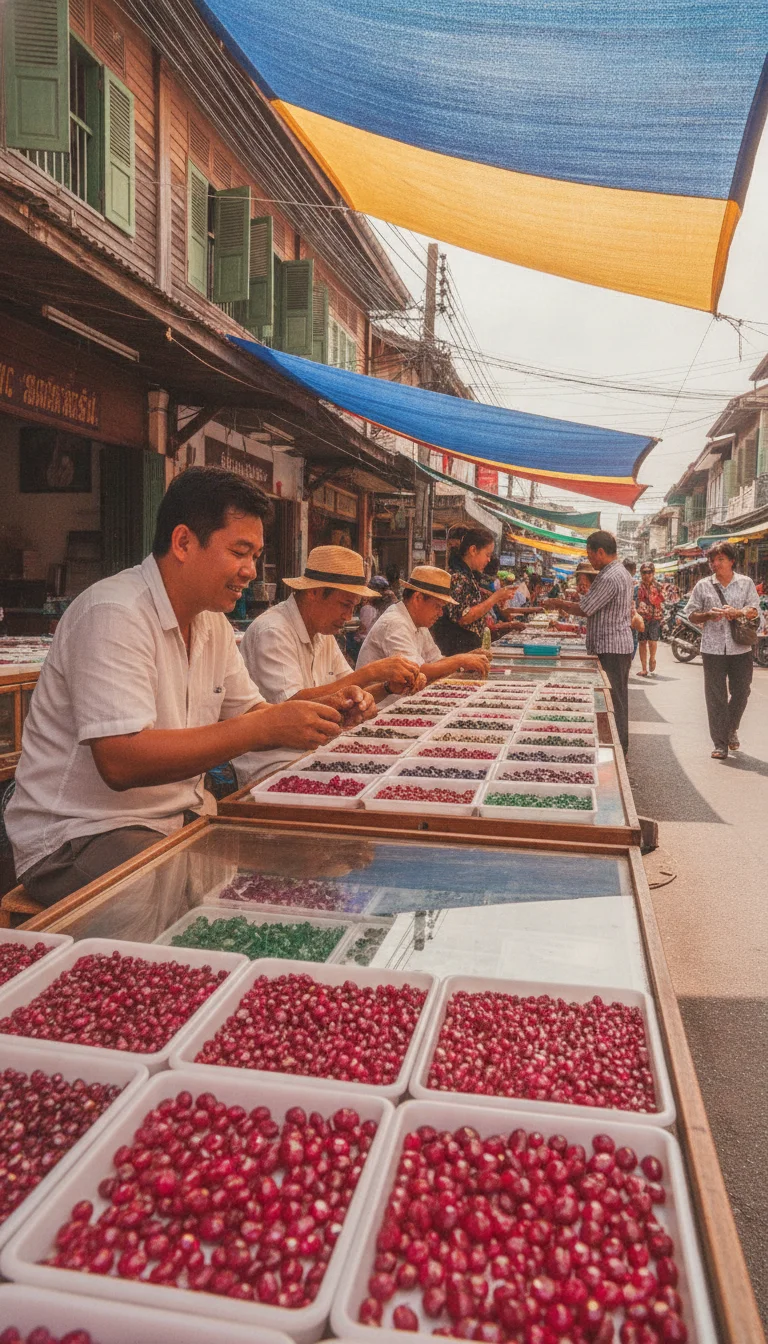
Chanthaburi Town is Thailand's primary hub for processing and trading coloured gemstones. Although provincial mines that yielded rubies and sapphires were largely worked out by the late twentieth century, local craftspeople secured the town's commercial role by pioneering high-temperature heat treatments that enhance corundum clarity and colour. Today, dealers import rough stones from Africa, Sri Lanka, and Southeast Asia to be treated, cut, and polished in neighbourhood lapidary workshops.
The core of this trade concentrates on Si Chan Road and the narrow alleys of Trok Kachang. Known locally as the Talad Ploy, this wholesale exchange operates from Friday through Sunday. Unlike standard street markets, the commercial dynamic is reversed: buyers rent desks inside open-fronted shophouses or sit at pavement tables, while independent brokers circulate between them presenting parcels of cut stones and rough crystals wrapped in paper. Appraisals take place under natural daylight using loupes and tweezers, with prices negotiated wordlessly on electronic calculators.
Surrounding shophouses supply trade equipment, including precision scales, sorting trays, and magnification lenses. While wholesale transactions dominate weekend trading hours, independent travellers can walk the district to observe the exchange or browse retail showcases of finished jewellery. Professional gemmological laboratories in the quarter provide independent certification, allowing buyers to verify stone quality before concluding any purchase.
Riverside Life and Daily Rhythms
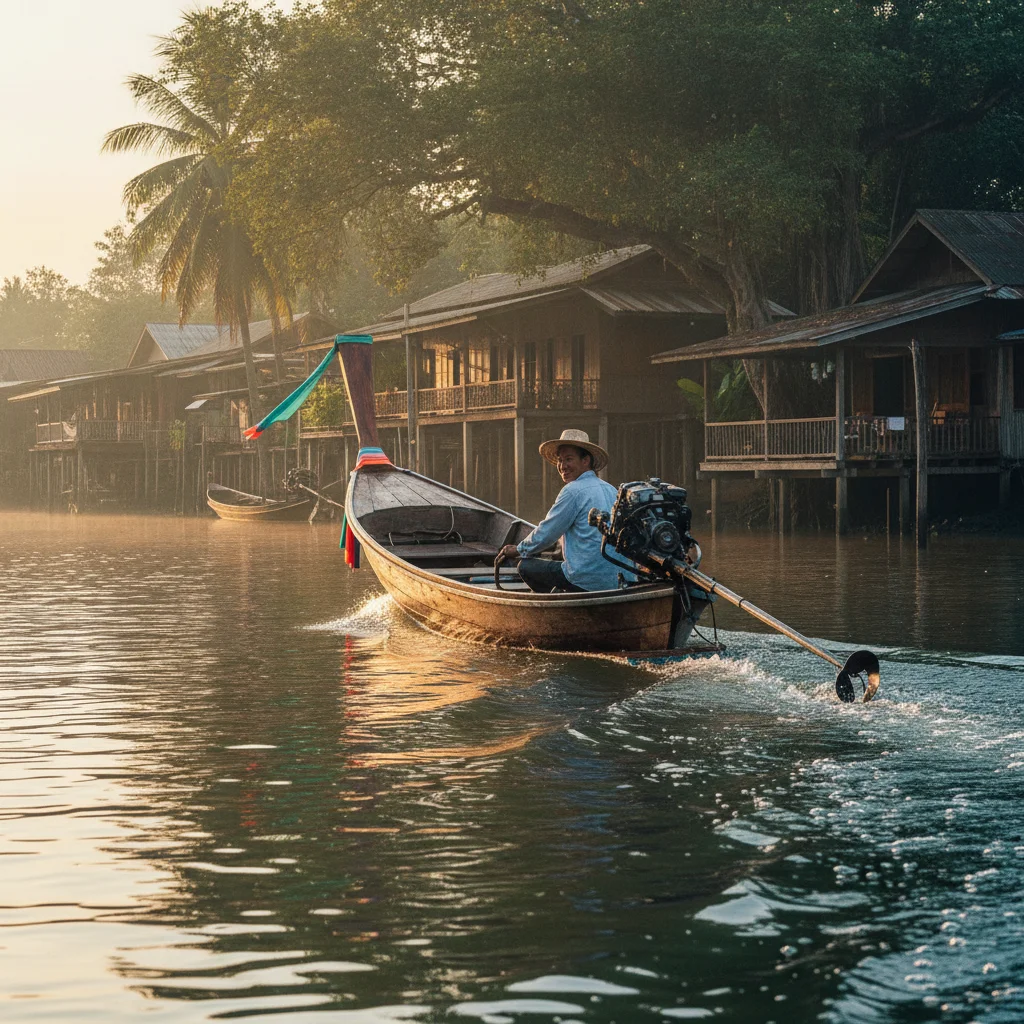
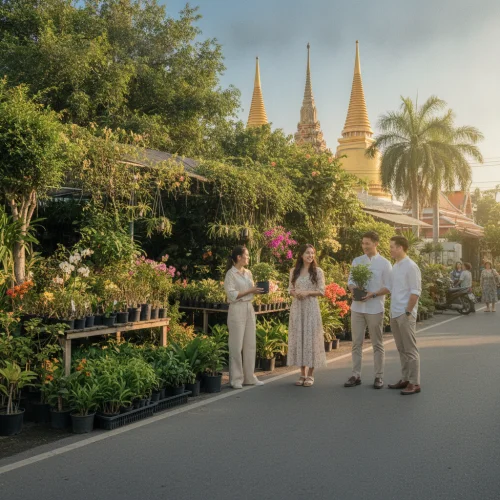
The Chanthaburi River bisects the provincial capital, shaping the town's geography and daily routines. Along the western bank, Sukhaphiban Road runs parallel to the water, where rows of wooden stilt houses, family-run cafes, and small trading shops sit directly over the river. Rather than river taxis or passenger boats, concrete footbridges and road bridges link the two shores. Niramon Bridge, a pedestrian footbridge, connects the western waterfront directly to the opposite bank, carrying residents, schoolchildren, and two-wheeled traffic across the water throughout the day.
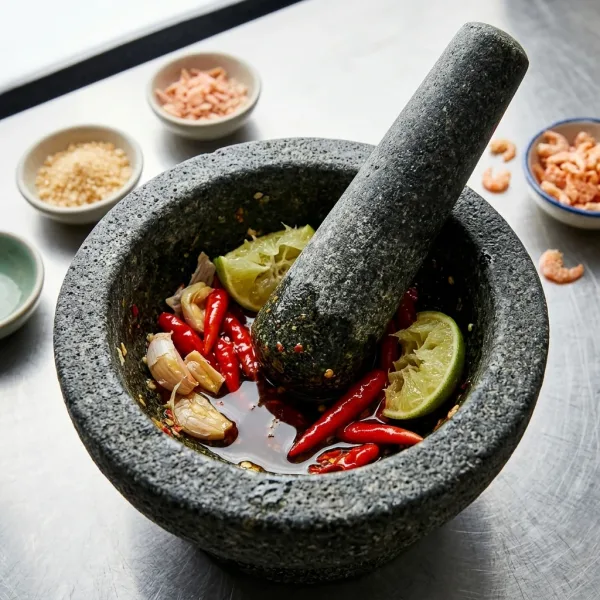
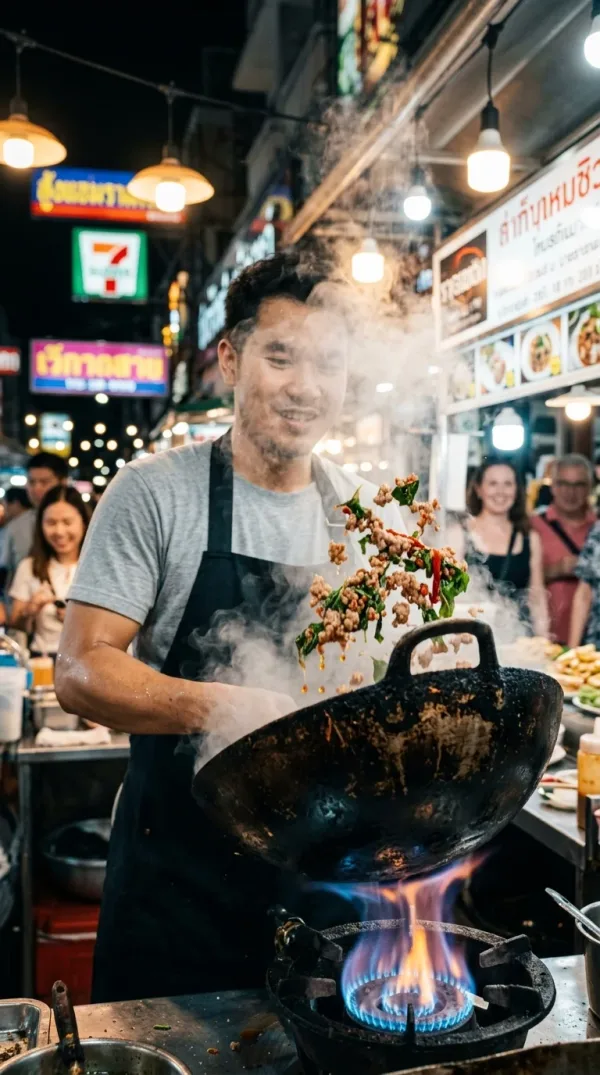
Life along the water follows a gentle rhythm, with early mornings and late afternoons seeing the most activity as temperatures drop. A short walk inland from the riverbank leads to Talat Namphu, the municipal market surrounding the central fountain roundabout. The market operates from dawn with stalls piled with regional produce, fresh river prawns, dried squid, and local herbs, before shifting into a street-food market in the evening. River catches and coastal seafood strongly shape the town's menus; local restaurants along the riverfront regularly serve grilled freshwater prawns, soft-shell crab, and sen chan—the town's distinctive local rice noodles stir-fried with crab and tamarind.
Plan the perfect Thai cooking class. Compare half-day and full-day courses, farm and urban kitchens, regional menus, dietary options, and costs across Thailand.
Exploring Chanthaburi's Heritage
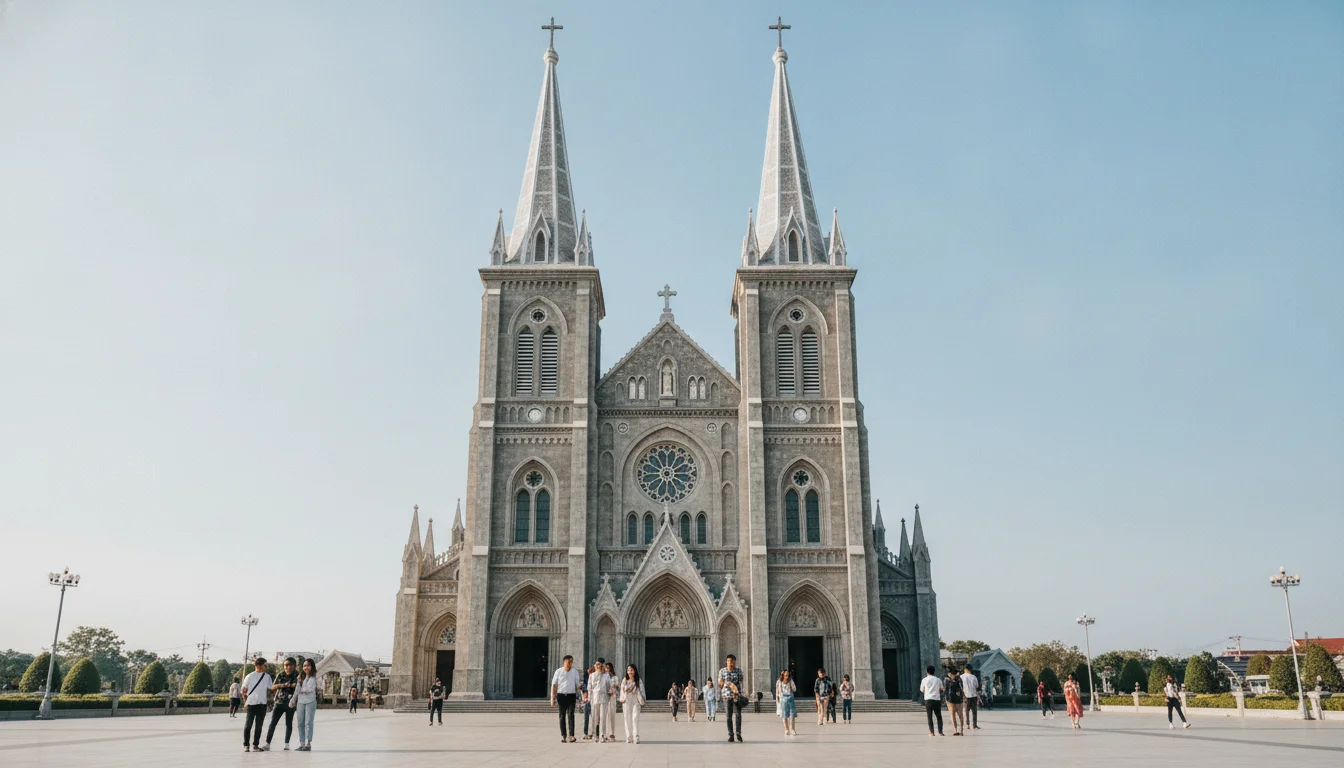
Chanthaburi Town's heritage reflects centuries of Siamese, Vietnamese, and French contact. Across the river in the Chanthanimit district stands the Cathedral of the Immaculate Conception, consecrated in 1909 after construction led by French missionaries and local Vietnamese Catholics. The neo-Gothic structure features twin spires, imported French stained-glass windows, and an interior statue of the Virgin Mary detailed with thousands of local sapphires and rubies. Vietnamese families first settled here during the eighteenth century to escape religious persecution, establishing a lasting Catholic enclave on the eastern bank.
West of the river on Tha Luang Road, the King Taksin the Great Shrine commemorates the monarch who assembled an army in Chanthaburi in 1767 to retake Ayutthaya. The nonagonal marble building features a roof shaped to resemble Taksin's military helmet, housing a blackened-brass statue of the king. Directly behind the shrine lies Camp Taksin, an active military base on the site of the former French garrison occupied between 1893 and 1905, where several colonial-era brick barracks and defensive ramparts remain visible. Opposite sits the town's City Pillar Shrine. Independent travellers can cover these central historical sites on foot or book a local guided tour to explore the surrounding area.
A Gateway to Natural Wonders
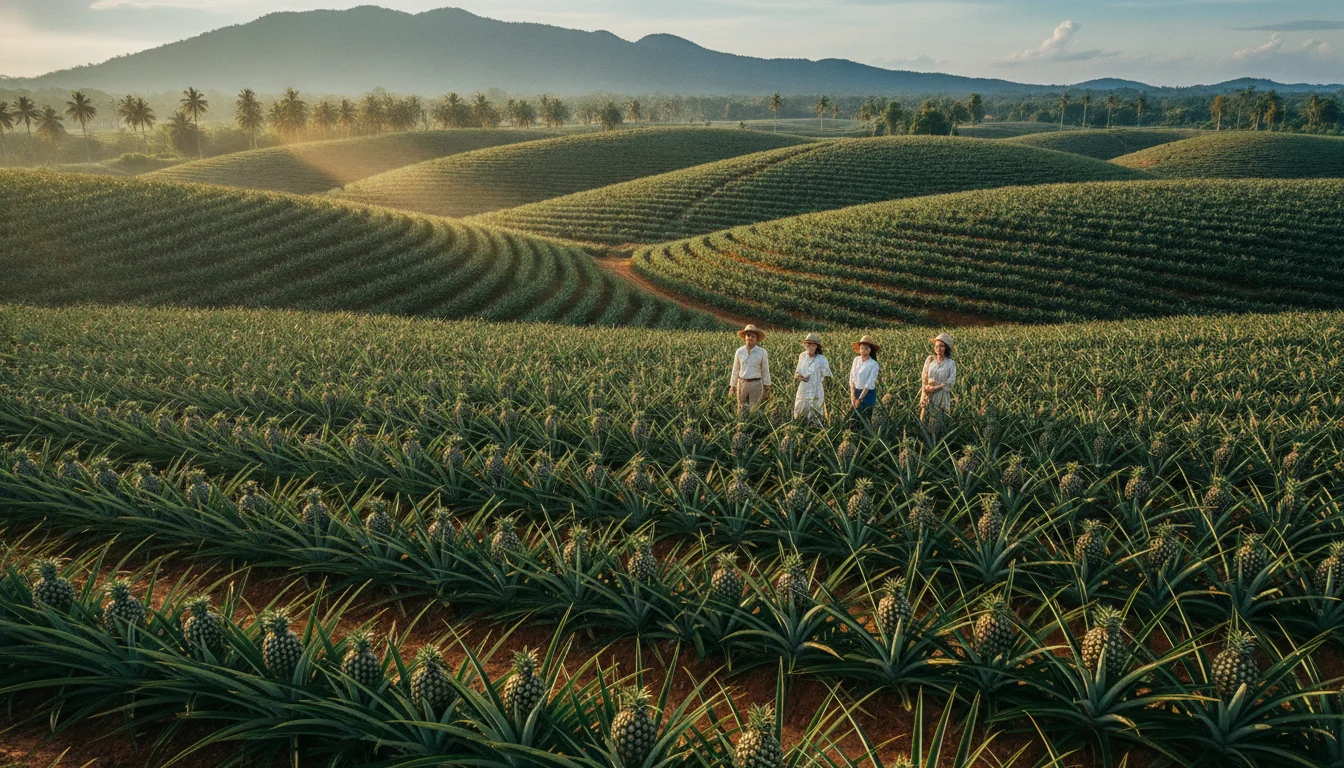
Beyond the provincial capital, Chanthaburi Town provides a convenient base for exploring eastern Thailand's forested hills, coastal parks, and agricultural heartland.
Approximately 14 kilometres south of town, Namtok Phlio National Park protects rugged evergreen forest surrounding Phlio Waterfall, where cascades tumble into natural pools populated by schools of freshwater brook carp. The park also contains 19th-century stone monuments commissioned by King Chulalongkorn (Rama V). Farther north, roughly 70 kilometres along Highway 317, Khao Soi Dao Wildlife Sanctuary encloses high peaks in the Chanthaburi Mountains, featuring a 16-tiered waterfall and upland forest trails that form part of the Cardamom Mountains ecosystem.
To the south and south-west along the Gulf of Thailand coast, mainland beaches replace the forested interior. Hat Chao Lao and Hat Laem Sing provide long stretches of sand shaded by casuarina trees, alongside roadside seafood kitchens and coastal nature walks such as the mangrove boardwalks around Ao Khung Kraben. Surrounding the town's outer limits, extensive orchards establish Chanthaburi as one of Thailand's most productive fruit-growing provinces, with farms harvesting durian, mangosteen, and rambutan between April and July. Day trips from the town centre connect easily to both mountain trails and coastal shores.
Getting There and Getting Around
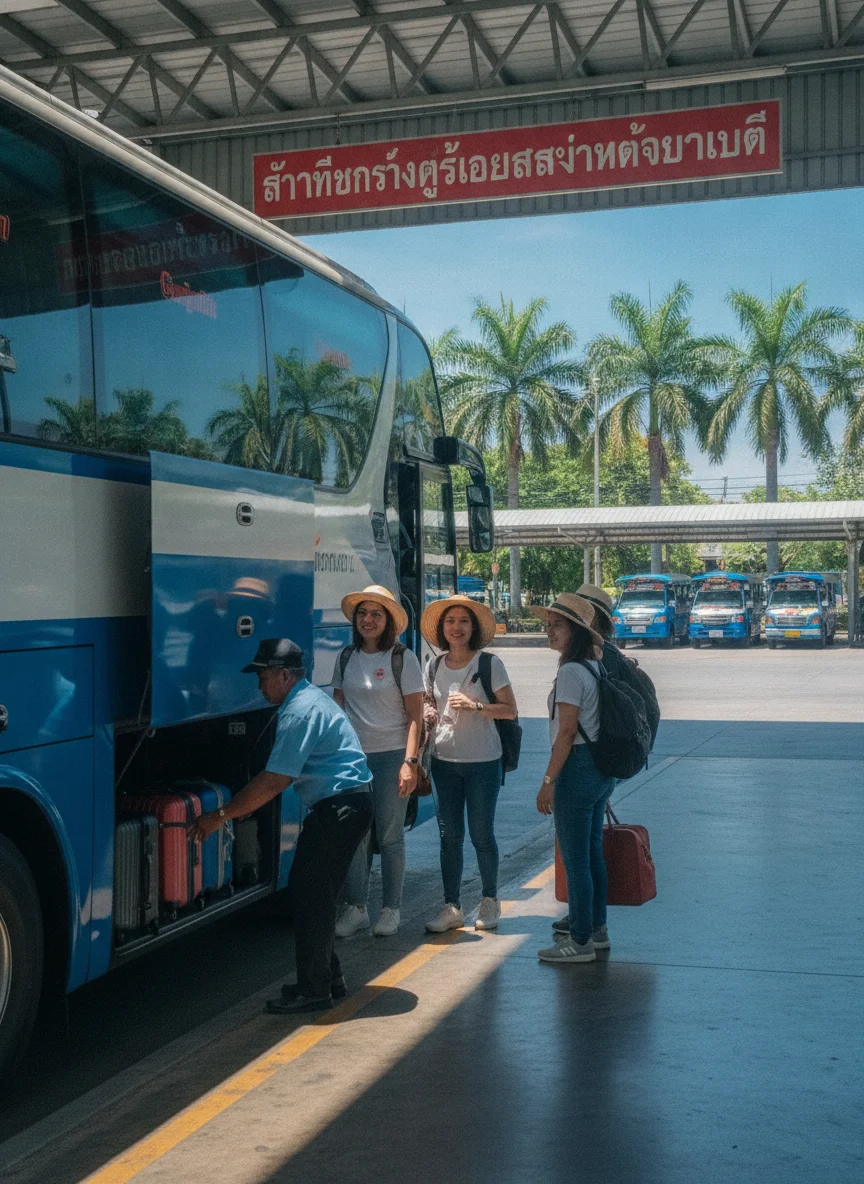
Travel from the UK requires flying into Bangkok’s Suvarnabhumi or Don Mueang airports before continuing overland. Chanthaburi sits roughly 245 kilometres south-east of Bangkok. Because the town lacks a railway station and the nearest airport is 65 kilometres away in Trat, almost all travellers arrive by road. Scheduled coaches and minivans depart throughout the day from Bangkok’s Eastern Bus Terminal at Ekkamai and the Mochit 2 terminal in Chatuchak. Minivans typically complete the journey in 3.5 to 4 hours, while full-sized coaches require 4 to 5 hours, depending on traffic along Route 7 and Route 344. Private transfers and taxis from Bangkok or Suvarnabhumi Airport take around 3 to 3.5 hours.
Long-distance services arrive at Chanthaburi Bus Terminal on Tha Luang Road, located roughly 1.5 kilometres west of the town centre. From the terminal, fixed-route and chartered songthaews—locally called Mazda taxis—wait outside the concourse alongside motorbike taxis to carry passengers into the centre. Ride-hailing apps also operate in town for car transfers. The central quarter itself is compact and pedestrian-friendly, so walking is the most practical way to move between the riverfront, the cathedral precinct, and the gemstone quarter. For trips beyond the town limits, scooters and motorbikes can be hired through guesthouses and local rental shops, though riders must hold an appropriate licence and valid insurance.
Costs and Budgeting
Daily travelling costs in Chanthaburi Town remain modest across lodging, food, and local transport. Accommodation spans simple guesthouses, converted shophouses, and standard hotels. A room in a basic guesthouse typically costs between 400 and 800 THB (£9 to £18) per night, while mid-range hotels generally charge between 1,000 and 2,000 THB (£22 to £44) per night.
Dining is equally reasonable. Meals at street stalls, night markets, and casual noodle shops run between 50 and 100 THB (£1.10 to £2.20) per dish. Sit-down meals at mid-range riverside restaurants generally come to between 200 and 400 THB (£4.40 to £8.80) per person.
Local journeys require little expenditure. Shared songthaew rides within the urban centre cost between 20 and 40 THB (£0.45 to £0.90) per trip, while hiring an automatic scooter costs around 250 to 350 THB (£5.50 to £7.80) per day, excluding fuel. A comfortable daily spending allowance of 800 to 1,500 THB (£18 to £33) per person easily covers three meals, daily transport, and entry tickets.
Cash remains necessary for daily transactions. Market vendors, food stalls, and songthaew drivers rarely accept international payment cards. ATMs operated by major Thai commercial banks are located across the town centre and levy a standard fee of 220 THB (£4.90) on foreign card withdrawals.
Practical Fit and Trade-offs
Chanthaburi Town suits independent travellers who prefer an active provincial hub over a dedicated tourist resort. Its daily rhythm revolves around fruit agriculture, local markets, and weekday-to-weekend gemstone trading, making it a functional working community rather than an entertainment centre. It works well as a base for exploring eastern Thailand, though several practical trade-offs require consideration before planning a stay.
The town itself is compact, and its central historic sights can be covered comfortably in a day or two. Nightlife is quiet, consisting of riverside restaurants, night food stalls, and neighbourhood beer bars that wind down before midnight. Visitors looking for late-night music venues, beach parties, or resort complexes will not find them here.
Logistics reflect the town's local orientation. English is not widely spoken in neighbourhood shops, markets, or family-run diners, and English signage can be sparse away from hotels and heritage boards. The town also sits roughly 30 kilometres inland from the Gulf of Thailand. Travellers seeking a coastal holiday must travel 30 to 40 minutes by road to reach beaches such as Chao Lao or Laem Sing. Beyond the walkable riverside core, independent transport—such as a hired car or scooter—is necessary to explore the wider province.
What to Know Before You Go
Planning a trip to Chanthaburi Town requires attention to weekly trading rhythms and regional seasons. The open-air gemstone market concentrated along Si Chan Road and the adjacent alleys operates exclusively on weekends, running from Friday to Sunday between roughly 10:00 and 17:00. Arriving from Monday to Thursday reveals a quiet commercial district where trading desks remain closed, although regular jewellery shops and cutting studios maintain standard weekday business hours.
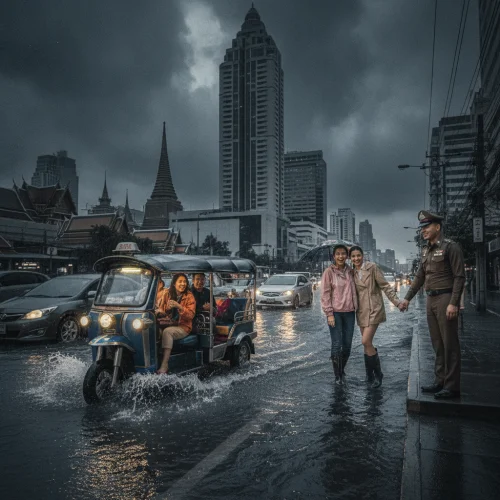
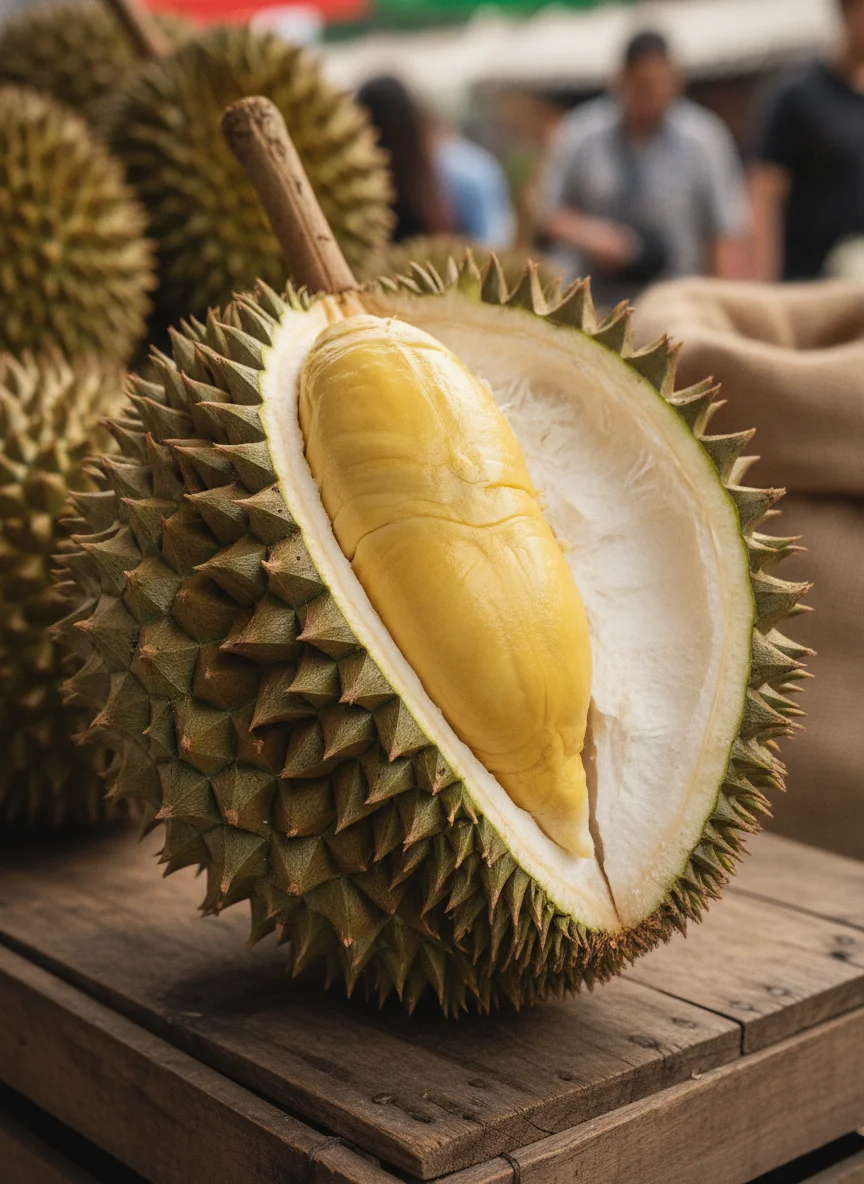
The province experiences substantial rainfall due to coastal moisture sweeping towards the surrounding hills. The wet season spans May to October, with downpours peaking in September. For comfortable conditions on foot, the drier window from November to February brings lower humidity and clearer skies. Travellers planning a trip around the regional fruit harvest should visit between April and June, when durian, mangosteen, and rambutan fill local markets and roadside stalls at peak ripeness.
While mobile networks provide consistent 4G and 5G coverage throughout the town centre, daily payment habits remain cash-focused. Established hotels and larger restaurants take credit cards, but street-food stalls, fresh-produce vendors, and songthaew drivers operate on cash. Bank branches with international ATMs line Tha Chalaep Road and Si Chan Road, making cash withdrawals straightforward. Relying on foreign cards alone can leave visitors unable to make purchases from smaller independent vendors.
Religious sites enforce clear standards for dress and decorum. When visiting Buddhist temples or the Cathedral of the Immaculate Conception, shoulders and knees must be covered, and hats removed before entering. Footwear must come off before stepping into temple interiors or private residences. Within the gemstone trading streets, casual visitors are welcome to observe the desks, but touching loose stones uninvited or interrupting negotiations is considered poor form.
Quick Reference Table
| Item | Detail | Notes |
|---|---|---|
| Distance from Bangkok | Roughly 245–250 km south-east | Overland access via Route 7 and Route 344 |
| Travel time from Bangkok | 3.5 to 5 hours by road | Minivans take 3.5–4 hours; coaches 4–5 hours; private taxis 3–3.5 hours |
| Nearest airport | Trat Airport (65 km) | Town has no railway station; long-distance arrivals rely on road transport |
| Gemstone market days | Friday to Sunday, ~10:00–17:00 | Talad Ploy trading area on Si Chan Road and Trok Kachang |
| Dry season | November to February | Lowest humidity and clearest conditions for walking |
| Wet season | May to October | Rainfall peaks during September |
| Fruit harvest season | April to July | Peak harvest runs April to June for durian, mangosteen, and rambutan |
| Guesthouse accommodation | 400 to 800 THB (£9 to £18) per night | Basic rooms and converted shophouses |
| Mid-range hotel | 1,000 to 2,000 THB (£22 to £44) per night | Standard local hotels |
| Street & market dining | 50 to 100 THB (£1.10 to £2.20) per dish | Street stalls, night markets, and casual noodle shops |
| Mid-range dining | 200 to 400 THB (£4.40 to £8.80) per person | Sit-down riverside restaurants |
| Local songthaew fares | 20 to 40 THB (£0.45 to £0.90) per trip | Shared Mazda taxis operating within town limits |
| Scooter hire | 250 to 350 THB (£5.50 to £7.80) per day | Excludes fuel; requires appropriate driving licence and valid insurance |
| Daily spending budget | 800 to 1,500 THB (£18 to £33) per person | Covers three meals, local transit, and entry fees |
| Foreign card ATM fee | 220 THB (£4.90) per withdrawal | Standard charge levied by major Thai commercial banks |
| Distance to coast | Roughly 30 km inland | 30 to 40 minutes by road to Hat Chao Lao and Hat Laem Sing |
| Official website | cathedralchan.or.th | Cathedral of the Immaculate Conception |
FAQ: Chanthaburi Town
What is Chanthaburi Town known for?
When does the Chanthaburi gem market operate?
How does the gemstone market in Chanthaburi work?
What is the best time of year to visit Chanthaburi Town?
How do I get to Chanthaburi Town from Bangkok?
What are the typical costs for accommodation and food in Chanthaburi Town?
Should I use cash or credit cards in Chanthaburi Town?
What is the dress code for visiting religious sites in Chanthaburi?
What is the nightlife like in Chanthaburi Town?
Are there beaches near Chanthaburi Town?
Reviewed by the Thailand Guide Editorial Team • Last reviewed: 12 September 2026
This page is provided for general information only. While we aim for accuracy, details can change — please verify anything important independently before relying on it.