Ao Nang - Krabi
Framed by steep limestone cliffs and fronting the Andaman Sea, Ao Nang is Krabi’s primary mainland resort town and marine transport hub. Located in Krabi Province roughly 20 kilometres southwest of Krabi Town, this coastal subdistrict forms the operational centre of the regional tourism economy. Dense strips of hotels, restaurants, dive shops, and tour kiosks line the shoreline and the main access roads running inland.
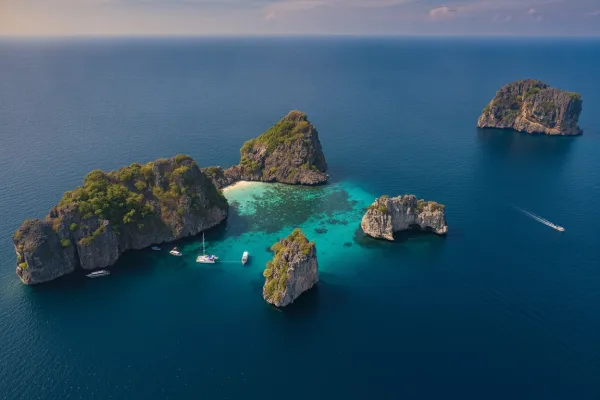
The town centres on two neighbouring coastal bays: Hat Ao Nang and Hat Noppharat Thara. A continuous beachfront promenade runs along Hat Ao Nang, where passenger longtail boats depart directly from the water to ferry visitors to the roadless headland of Railay and offshore islands within Hat Noppharat Thara–Mu Koh Phi Phi National Park. Travellers primarily choose Ao Nang as a practical base, pairing comprehensive mainland amenities, reliable road transfers, and extensive commercial facilities with rapid marine access to Krabi’s surrounding karsts and island archipelagos.
Coastal Geography and Beachfront Layout
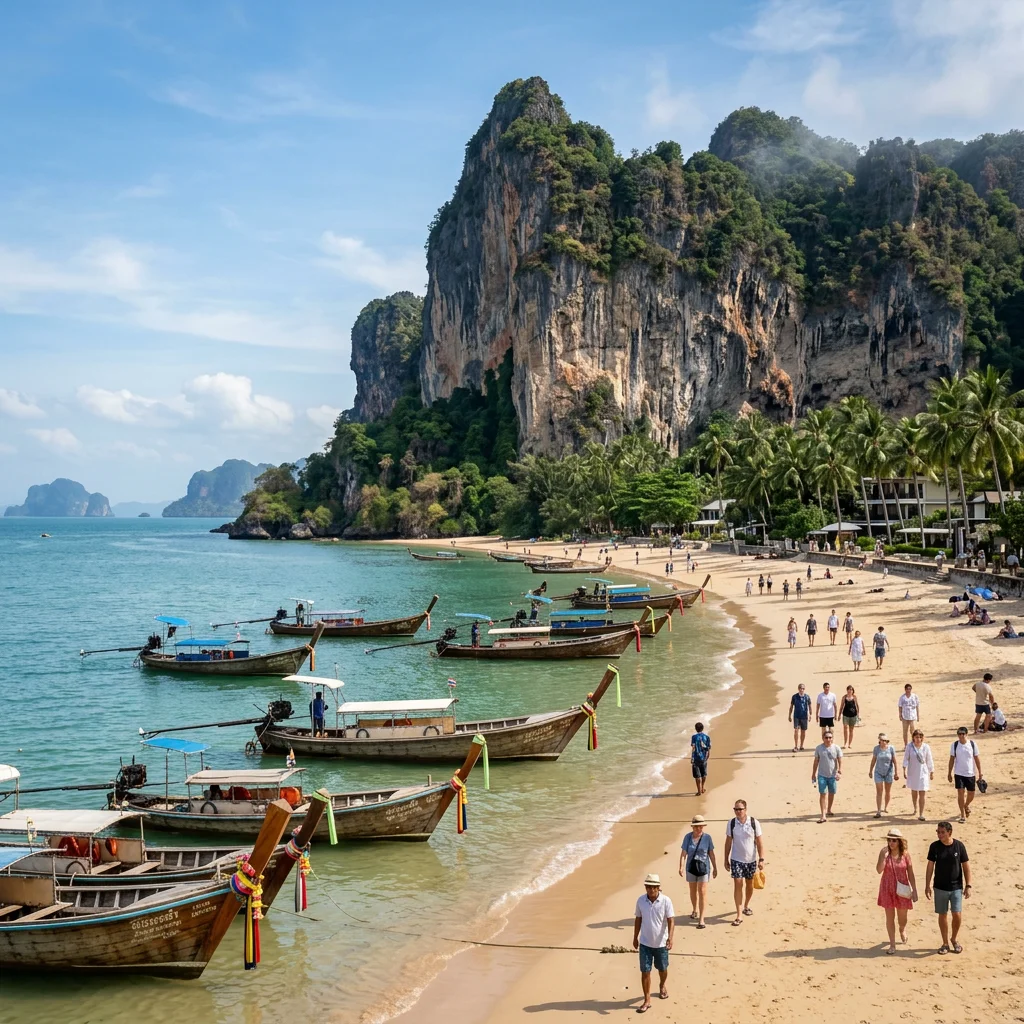
Ao Nang’s physical layout is defined by its coastal topography, set in an arc beneath towering limestone karst cliffs. The primary resort strip centres on Hat Ao Nang, a curved bay spanning roughly 1.4 kilometres of coarse yellowish sand. Along this seafront runs the coastal road (Route 4203), bordered by a broad pedestrian promenade, low-rise hotels, open-front restaurants, and ticket booths for local boats. Because the beach faces southwest across the Andaman Sea, it provides an open vantage point over offshore limestone islands and evening sunsets.
At its southern boundary, Hat Ao Nang terminates abruptly against sheer vertical karst crags. These cliffs sever overland road connections to the Railay peninsula, ensuring transit south remains maritime. In the far southern corner, a steep wooden footpath and boardwalk known as the Monkey Trail crosses the headland. Taking 10 to 15 minutes to traverse, this walkway provides direct pedestrian access to Pai Plong, a neighbouring cove dominated by a single resort development.
To the northwest, around a modest rocky headland, the coastline transitions into Hat Noppharat Thara. Stretching for roughly three kilometres, this strand forms part of Hat Noppharat Thara–Mu Koh Phi Phi National Park, which maintains its mainland headquarters and visitor office at the far western end near the Khlong Son estuary. Unlike the commercialised frontage of Ao Nang, Noppharat Thara is shaded by rows of casuarina trees rather than concrete developments. The bay features an unusually shallow gradient; during low spring tides, the sea retreats hundreds of metres to expose vast rippled sandflats, allowing walkers to wade across to nearby rocky islets such as Koh Khao Pak Klong. Inland, tourist accommodation and local amenities occupy the narrow coastal plain before tapering into rural plots and limestone towers.
Town Zones and Commercial Corridors
Ao Nang’s commercial activity splits across three distinct zones: the coastal promenade, the inland arterial corridor, and the newer northern expansion around Hat Noppharat Thara. Along the sea-facing strip of Route 4203, holidaymaker services dominate the shopfronts. Tour desks, massage parlours, dive operators, tailors, convenience stores, and international restaurant chains crowd the pavement, drawing steady foot traffic between the beach and the shops from mid-morning into late evening.
Moving inland along Route 4203 toward the limestone cliffs and Ao Nang Mosque (Masjid Ao Nang Al-Munuawarah), the town's atmosphere changes noticeably. This inland corridor has a higher density of budget guesthouses, residential shophouses, independent scooter hire shops, and practical trade services. Southern Thai Muslim culture is clearly reflected along this stretch, marked by family-run tea shops, small grocery outlets, and everyday halal food stalls.
A third commercial pocket sits to the northwest across Khlong Haeng, stretching toward Hat Noppharat Thara. Developed around the modern Ao Nang Landmark retail plaza, this area features wider avenues, large resort properties set back from the coastal road, and an open layout with evening market spaces. It provides a less cramped alternative to the dense central beachfront strip.
Plan a stay on Koh Ngai with practical advice on beaches, room costs, snorkelling, boats from Pak Meng, seasonal access and island facilities.
The Longtail Boat Hub and Coastal Departures
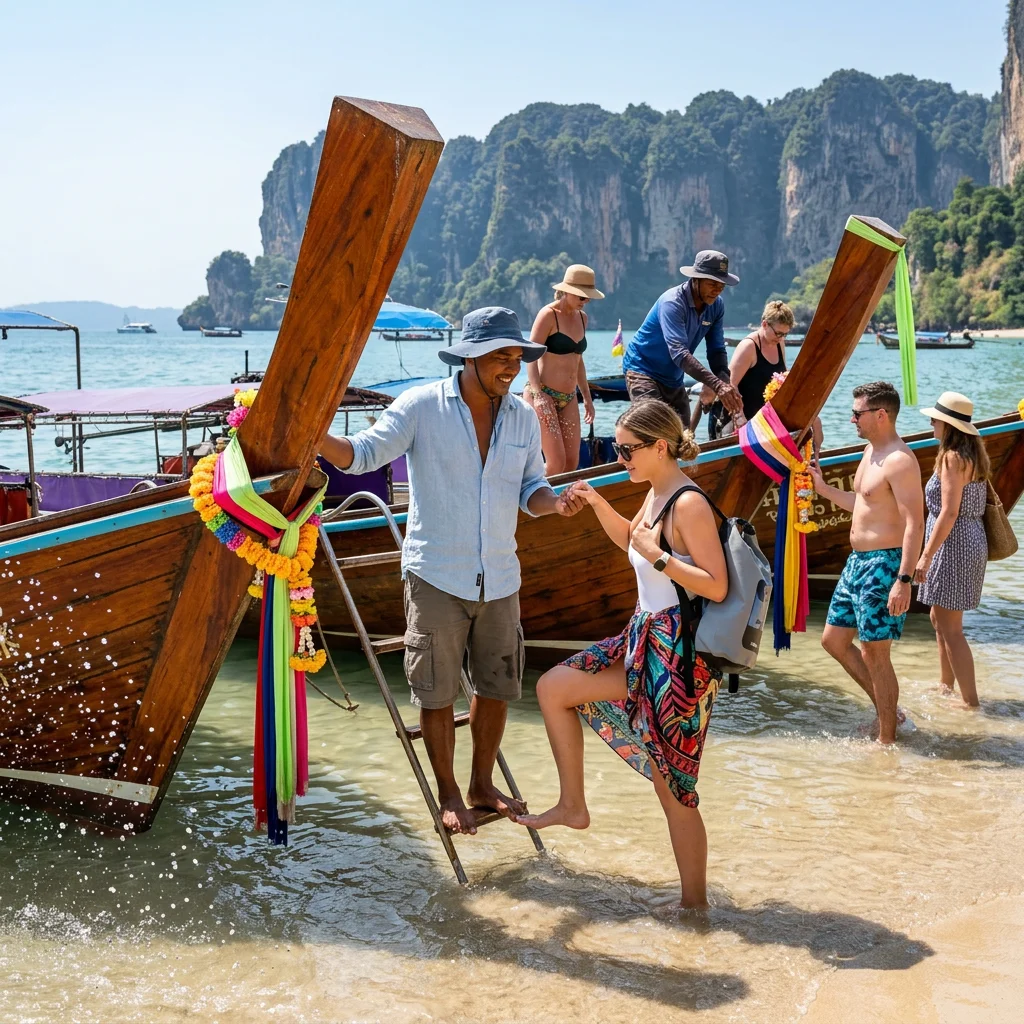
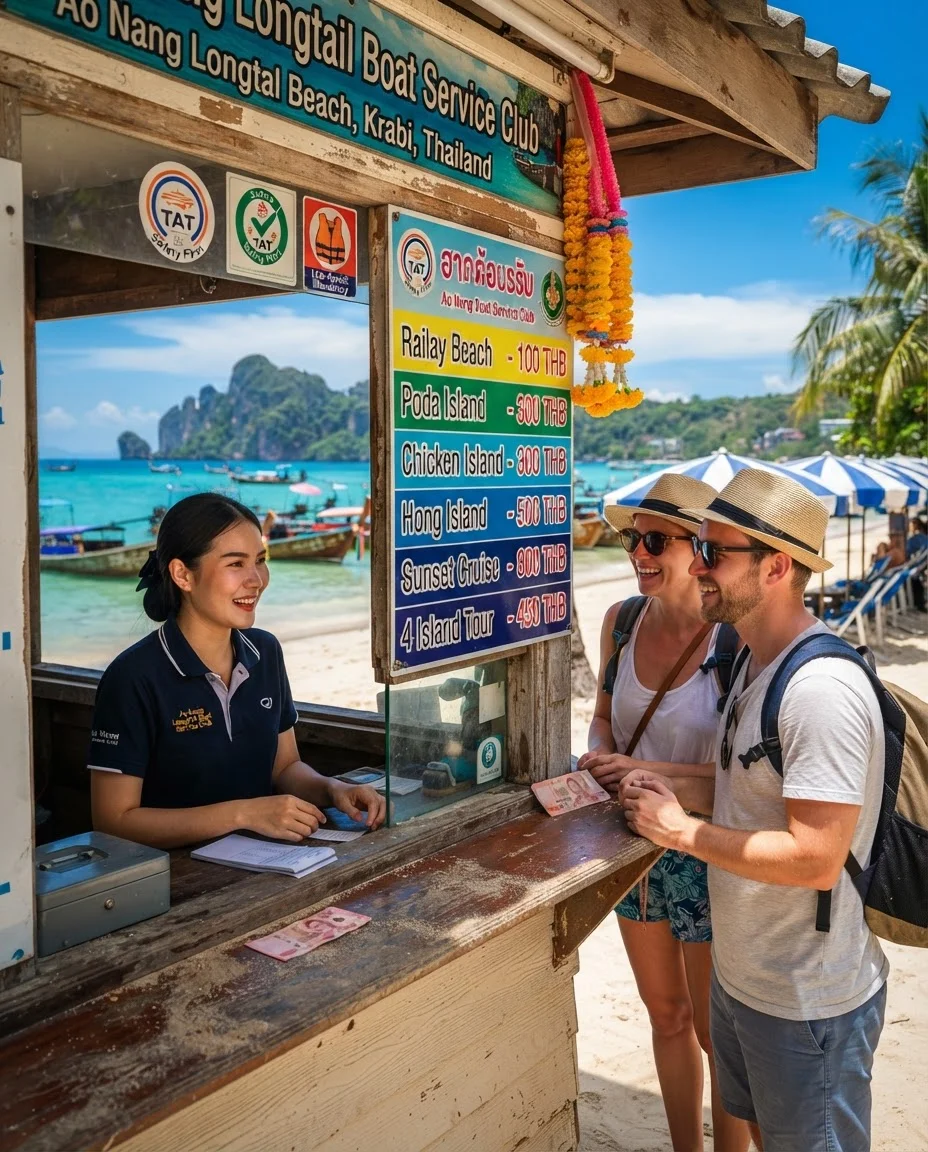
Ao Nang functions as the primary mainland departure point for the Andaman Sea’s wooden longtail boats. Because towering limestone cliffs cut off neighbouring coastal strips from the road network, these motorised vessels act as practical water taxis rather than recreational excursion craft. The Ao Nang Longtail Boat Service Club manages routes as a local cooperative, operating official ticket booths along the beachfront to standardise fares and eliminate unregulated beach touting.
During standard daytime hours, shared longtail boats provide point-to-point connections to Railay West and Ton Sai Beach. These crossings run collectively, with boats departing once enough passengers have assembled to fill the vessel. In the busier high-season months, boats typically fill within minutes. During quieter periods, travellers can either wait for other passengers to arrive or choose to buy out the remaining vacant seats to secure an immediate departure. As dusk approaches and daylight services wind down, shared runs give way to private charters, which command higher rates agreed at the counters or arranged directly for late-evening returns.
Beyond shuttling between mainland bays, the cooperative arranges private charters and island excursions to the limestone formations offshore. Popular day routes depart directly from the Ao Nang shoreline to destinations across the bay, including Koh Poda, Chicken Island (Koh Gai), Koh Tub, and Koh Mor. Fares for both point-to-point beach transfers and island charters follow posted cooperative rates, which visitors should confirm directly at the beachfront ticket booths on the day of travel.
Dining Areas, Local Amenities, and Night Markets
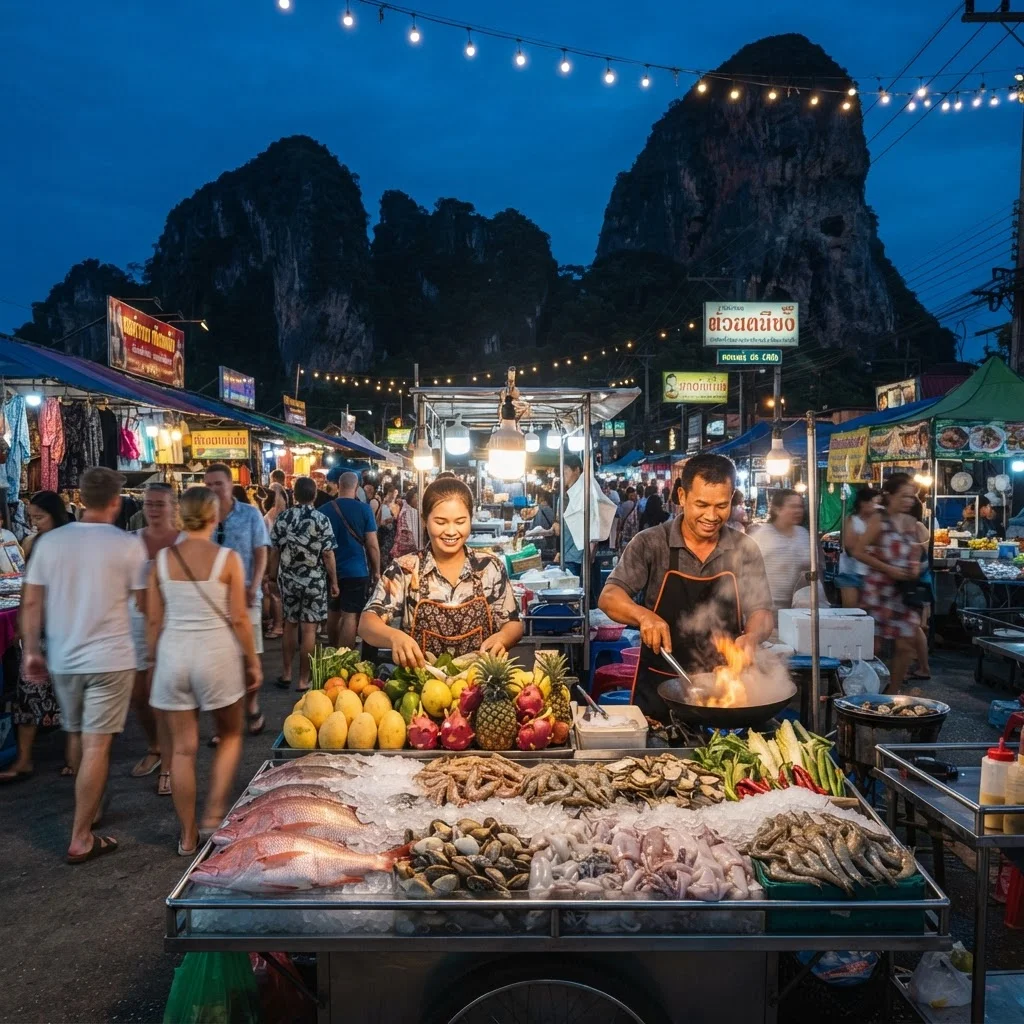
Dining in Ao Nang reflects a mix of resort tourism and regional southern Thai culture. Along the beachfront road, particularly around the northern corner known locally as Seafood Street, open-air restaurants are built on stilts extending towards the water. These venues display iced selections of daily catches, including red snapper, sea bass, king prawns, and squid, catering to evening crowds seeking sunset views over the bay alongside standard Thai and international menus.
Further inland along Route 4203 around the central mosque, the food scene turns distinctly local and halal. Roadside stalls and casual open-fronted eateries prepare regional southern dishes such as rich massaman curries, turmeric fried chicken, and chicken biryani (khao mok gai). Stalls here also fry fresh roti, served either sweet with condensed milk and banana or savoury alongside small bowls of spiced curry sauce.
For street food in one central location, the Ao Nang Landmark Night Market opposite Hat Noppharat Thara opens daily from late afternoon until late evening. The market gathers dozens of vendors cooking pad Thai, grilled meat skewers, som tam, and mango sticky rice, alongside fruit smoothie stalls and central covered bench seating.
Practical amenities are dense throughout the town. Main roads are lined with 24-hour convenience stores, licensed currency exchange booths, ATMs, and pharmacies stocking imported and generic medicines. Healthcare needs are served by walk-in medical and dental clinics as well as Wattanapat Hospital Ao Nang, a full-service private facility with a 24-hour emergency department located just inland.
Getting There and Getting Around
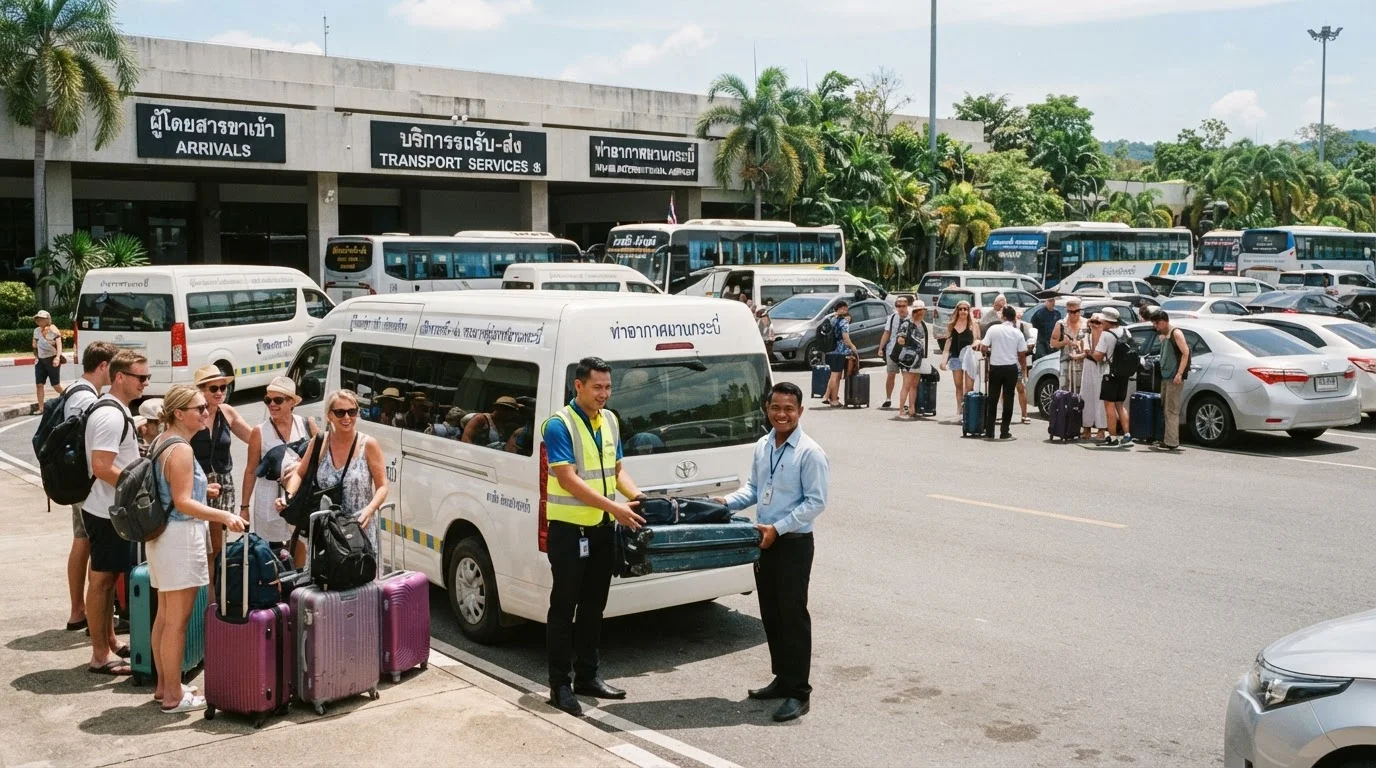
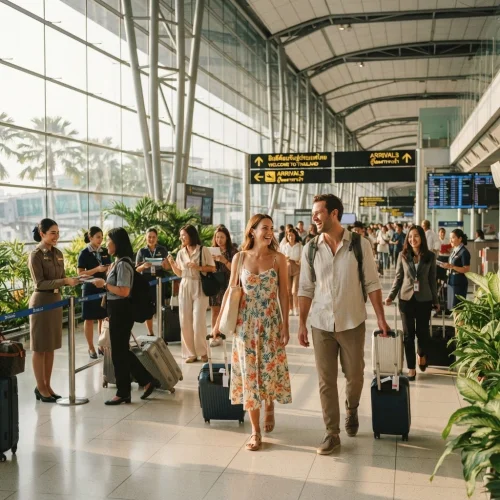
Most travellers arrive in Ao Nang via Krabi International Airport (KBV), situated approximately 27 kilometres east along Route 4034 and Highway 4. Three primary transport options connect the airport terminal directly to the resort.
The official airport bus, operated by Pichet Transport, departs from the ground-floor terminal entrance with departures scheduled every 40 to 60 minutes throughout the day. Tickets cost 150 THB (~£3.50) per passenger, and the route runs via Krabi Town and Chao Fah Pier before terminating along the Ao Nang beachfront, taking between 45 and 60 minutes. Shared air-conditioned passenger minivans operate on demand for 150 to 200 THB (~£3.50 to ~£4.60) per person and include direct hotel drop-offs, though journey times can extend past an hour as other guests are unloaded. For private travel, fixed-rate taxi vouchers purchased at the official airport transport desks cost 600 to 800 THB (~£14 to ~£18.50) for a standard saloon car or up to 1,050 THB (~£24.50) for a private passenger van, completing the drive in 30 to 40 minutes without intermediate stops.
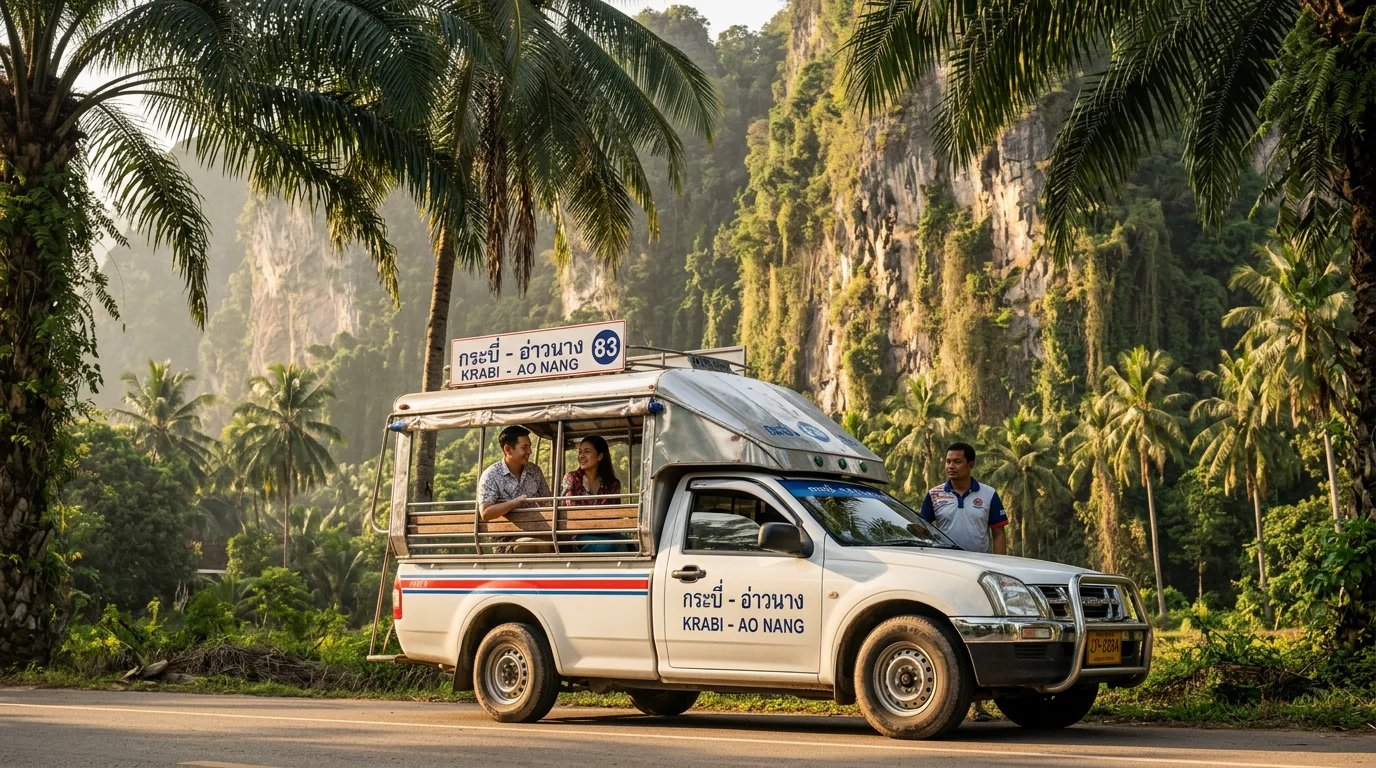
Public transit between Ao Nang and Krabi Town relies on open-air white songthaews (converted pick-up trucks with covered bench seating). These vehicles ply the main road every 15 to 20 minutes from roughly 06:00 until dusk. Passengers flag them down from the roadside and pay the driver upon exit; standard daytime fares are 50 THB (~£1.20) per person, rising to 60 THB (~£1.40) after 18:00 or when travelling onwards to the provincial bus terminal.
Local travel within the resort itself is handled by motorised tricycles with passenger sidecars (samlors), which operate as informal local taxis for 50 to 100 THB (~£1.20 to ~£2.30) per person on short hops along the coastal strip. Independent rental shops across town hire scooters for 200 to 300 THB (~£4.60 to ~£7.00) per 24-hour period. Thai law requires riders to carry an appropriate motorcycle category on their domestic driving licence alongside a valid International Driving Permit.
Costs and Budgeting
Ao Nang accommodates a wide spectrum of travel budgets, offering a middle ground between inland provincial market towns and higher-cost island enclaves. Daily expenses depend heavily on travel timing: room rates fluctuate significantly between the dry high season (November to April) and the southwest monsoon season (May to October), when resort hotels frequently reduce standard room tariffs by 30 to 50 per cent.
| Expense Category | Typical Cost (THB) | Approximate Cost (GBP) | Details & Notes |
|---|---|---|---|
| Budget Guesthouse / Hostel | 400 - 900 THB | £9.30 - £21.00 | Fan or basic AC room, usually located inland along Route 4203. |
| Mid-Range Resort Hotel | 1,500 - 3,500 THB | £35.00 - £81.00 | Standard double room with pool and breakfast; higher in December-January. |
| Street Food & Night Market Meal | 60 - 150 THB | £1.40 - £3.50 | Single dish (such as pad Thai or noodle soup) plus fresh fruit shake at local food markets. |
| Casual Restaurant Dinner | 250 - 500 THB | £5.80 - £11.60 | Sit-down Thai meal with drink in town or along the secondary commercial road. |
| Seafood Promenade Dinner | 600 - 1,200 THB | £14.00 - £28.00 | Fresh grilled fish or prawns with sides at beachfront seafood venues. |
| Shared Longtail Boat to Railay | 100 THB (day) / 150 THB (night) | £2.30 / £3.50 | Fixed cooperative price per person, one way, from Ao Nang Beach ticket kiosks. |
| Airport Shuttle Minivan / Bus | 150 - 200 THB | £3.50 - £4.60 | Per person from Krabi International Airport directly to Ao Nang lodging. |
| Motorbike Rental (24 Hours) | 200 - 300 THB | £4.60 - £7.00 | Excludes fuel; standard 110–125cc scooter; requires cash deposit and IDP. |
| Marine National Park Entry Fee | 400 THB (adult) / 200 THB (child) | £9.30 / £4.60 | Official fee for foreign visitors entering offshore marine park islands. |
Cash remains the dominant payment method for everyday transactions throughout the town. While larger hotels, established dive centres, and full-service beachfront restaurants accept credit cards—often adding a 3 per cent processing surcharge—street food vendors, local transport operators, and longtail boat kiosks deal exclusively in cash. Thai bank ATMs charge a flat operator fee of 220 THB (roughly £5.10) on international cards for each withdrawal, meaning larger, less frequent lump-sum withdrawals are far more cost-effective than taking out small amounts every few days.
For daily budgeting, an independent backpacker staying in an inland guesthouse, dining at local stalls, and using songthaews can manage on 800 to 1,200 THB (£19 to £28) per day, excluding island tours. A couple travelling at a mid-range standard—staying in a resort with a swimming pool, eating at casual sit-down restaurants, hiring a scooter, and taking occasional boat trips—typically spends between 2,200 and 4,000 THB (£51 to £93) per person per day.
Practical Fit and Trade-Offs
Ao Nang suits travellers prioritising regional transport links and resort infrastructure, but the town presents distinct compromises in noise, topography, and local character. Evaluating these factors helps determine whether basing here matches your itinerary.
Pedestrian Convenience versus Topographical Spread
The immediate beachfront promenade is level and straightforward to navigate on foot. Inland, however, the terrain rises steadily towards the surrounding limestone hills. Properties situated along Route 4203 and secondary lanes require uphill walking along busy carriageways where pavements are narrow, uneven, or intermittently absent. Travellers with pushchairs or restricted mobility benefit from staying along the flat coastal strip to avoid continuous dependence on local songthaews or motorcycle sidecars.
Active Transit Base versus Secluded Beach Destination
Hat Ao Nang operates primarily as a departure point for waterborne transport rather than a tranquil swimming beach. Dozens of motorised longtail boats moor directly along the shoreline, loading passengers throughout daylight hours. The engine noise from unbaffled propeller shafts is persistent across the sand, and moving craft restrict open-water swimming. Visitors seeking quiet sunbathing or clear coastal waters generally prefer taking day boats out to Railay or the offshore Andaman islands.
Holiday Amenities versus Distinct Cultural Identity
The town developed rapidly to cater to international tourism, resulting in commercial streets filled with dive centres, tour desks, massage parlours, tailoring shops, and Western restaurant chains. While this provides practical convenience alongside private medical clinics, pharmacies, and currency exchanges, it lacks civic heritage. Travellers wanting historic temples, working fresh markets, and a local southern Thai pace will find those in Krabi Town, twenty kilometres inland.
What to Know Before You Go
A trip to Ao Nang runs smoothly when you prepare for the practicalities of its coastline, marine regulations, and local customs.
Wade landings require waterproof preparations
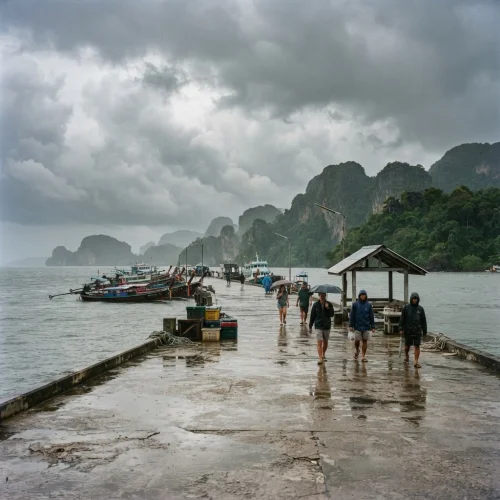
Ao Nang Beach and Railay West have no passenger jetties or floating piers. Longtail trips from Ao Nang Beach begin and end directly in the surf. Passengers must wade out into the sea, where water levels often reach knee to thigh depth depending on the swell and tide. Pack mobile phones, passports, and cameras into sealed dry bags, and wear shorts and water shoes or strap sandals that can handle wet sand and submerged rocks.
Offshore excursions incur compulsory national park cash fees
The limestone islands directly off the coast, including Koh Poda, Koh Gai, and the distant Phi Phi archipelago, fall under the jurisdiction of Hat Noppharat Thara-Mu Koh Phi Phi National Park. Foreign adult travellers pay an entry fee of 400 THB (~£9.30), while foreign children pay 200 THB (~£4.60). Package boat tours occasionally roll this charge into the booking price, but private longtail charters do not. Park rangers inspect tickets and collect the payment in cash upon landing on the protected islands.
Tides substantially alter beach character twice daily
The Andaman Sea experiences notable semi-diurnal tidal shifts that reshape the shoreline throughout the day. At high tide, Ao Nang Beach contracts sharply, with waves lapping against the concrete promenade embankment. During low tide, the sea retreats dozens of metres to reveal extensive sand and mud flats. Longtail skippers anchor further offshore to avoid grounding, which substantially lengthens the walk through shallow water when boarding or stepping ashore.
Local cultural norms call for modest street attire
Standard swimwear is commonplace on the sand, but Ao Nang belongs to a southern province where roughly 40% of the local community is Muslim. Strolling along public pavements, entering convenience stores, or browsing evening food stalls in bikinis, unfastened shirts, or bare swimwear causes offence. Throwing on a light shirt, dress, or sarong when stepping off the beach respects local community standards.
Practical Tips
A few straightforward habits make everyday travel and island excursions around Ao Nang run smoothly.
Buy longtail tickets at official cooperative kiosks
Purchase boat tickets directly from the signed wooden cooperative booths at the beachfront rather than from street intermediaries. Fares are fixed and posted on display boards, protecting you from inflated quotes.
Watch afternoon return times from Railay
Regular shared longtails back to Ao Nang run until 18:00. After 18:00, shared departures stop and operators switch to evening charter rates that cost significantly more. Head to the Railay West sand before 17:30 to avoid queues as day-trippers assemble for the final shared crossings.
Carry small banknotes for local transport
Drivers of local songthaews, airport buses, and sidecar taxis rarely carry change for 1,000 THB banknotes. Break large notes at convenience stores and keep 20, 50, and 100 THB notes handy for ground transport fares.
Choose footwear suitable for wet landings
Ao Nang and Railay lack passenger piers, requiring travellers to wade through knee-deep surf to board longtails. Waterproof sandals, water shoes, or slip-on flip-flops are practical; enclosed trainers quickly become waterlogged and fill with coarse sand.
Confirm national park fees when booking boat tours
Street agencies frequently advertise headline tour rates that exclude government marine park fees. Entry charges for protected areas such as Hat Noppharat Thara–Mu Koh Phi Phi National Park (typically 200 to 400 THB for foreign adults) are usually collected separately in cash by rangers on arrival.
Budget extra time for afternoon airport transfers
Krabi International Airport lies roughly 30 to 40 kilometres east of Ao Nang. While the drive normally takes 40 to 45 minutes, two-lane roads leading to Highway 4 experience congestion between 16:00 and 18:30. Allow at least an hour for the journey during these windows, or arrange your transfer in advance to fix your departure time.
Quick Reference Table
| Item | Detail | Notes |
|---|---|---|
| Location | Krabi Province, Southern Thailand | Approximately 20 km southwest of Krabi Town and 27 km west of Krabi Airport. |
| Main Beaches | Hat Ao Nang (1.4 km) & Hat Noppharat Thara (3 km) | Hat Ao Nang is the primary resort strip; Noppharat Thara sits within the national park. |
| High Season | November to April | Drier weather; shared boats run frequently. Monsoon season spans May to October. |
| Shared Longtail to Railay | 100 THB (~£2.30) daytime / 150 THB (~£3.50) evening | Per person one way; fixed cooperative pricing from beachfront ticket kiosks until 18:00. |
| Marine Park Entry Fee | 400 THB adult / 200 THB child (~£9.30 / ~£4.60) | Hat Noppharat Thara–Mu Koh Phi Phi National Park; cash payable to rangers on offshore islands. |
| Krabi Airport Bus | 150 THB (~£3.50) per person | Pichet Transport service departing every 40–60 minutes; takes 45–60 minutes to the beach. |
| Krabi Airport Private Taxi | 600 - 800 THB (~£14 - ~£18.50) saloon / up to 1,050 THB (~£24.50) van | Fixed-rate vouchers bought inside terminal; journey time is 30–40 minutes. |
| Local Songthaew to Krabi Town | 50 THB (~£1.20) day / 60 THB (~£1.40) evening | White songthaews run every 15–20 minutes from 06:00 until dusk along the main road. |
| Scooter Rental | 200 - 300 THB (~£4.60 - ~£7.00) per 24 hours | Requires cash deposit, motorcycle driving licence category, and International Driving Permit. |
| ATM International Fee | 220 THB (~£5.10) per transaction | Flat fee applied by Thai bank ATMs on non-Thai bank cards. |
| Official Tourism Authority | Tourism Authority of Thailand (TAT) | https://www.tourismthailand.org/Attraction/ao-nang |
| National Park Office | Hat Noppharat Thara–Mu Koh Phi Phi Headquarters | 79 Moo 5, Ao Nang, Mueang Krabi; Phone: +66 7 566 1145 |
| Local Commercial Centre | Ao Nang Landmark Plaza & Night Market | 79/45 Moo 3, Ao Nang; https://www.aonanglandmark.com |
| Airport Bus Operator | Pichet Transport | Phone: +66 82 468 2426; krabibus.com |
FAQ: Ao Nang
What should I pack or wear for longtail boat trips from Ao Nang?
Are there any fees for visiting the offshore islands near Ao Nang?
What is the recommended dress code for walking around Ao Nang?
Where should I purchase tickets for longtail boats in Ao Nang?
What time should I plan to return from Railay to Ao Nang by shared longtail boat?
What kind of currency denominations should I carry for local transport in Ao Nang?
Should I confirm national park fees when booking boat tours from Ao Nang?
How much time should I allow for airport transfers from Ao Nang to Krabi International Airport in the afternoon?
Is Ao Nang Beach suitable for swimming and relaxing?
What are the requirements for renting a scooter in Ao Nang?
Reviewed by the Thailand Guide Editorial Team • Last reviewed: 24 November 2026
This page is provided for general information only. While we aim for accuracy, details can change — please verify anything important independently before relying on it.