Towering limestone karsts punch straight through the earth here, creating a dramatic, labyrinthine landscape that instantly separates this stretch of the Andaman from the flatter, easily developed sands of Phuket.
The sheer verticality of these ancient coral reefs means roads are forced to snake wildly around them, turning what looks like a two-kilometre drive on a map into a thrilling ten-kilometre jungle expedition where a quick roadside iced coffee costs a mere 40 THB (£0.80). It is exactly this impenetrable geology that preserves the province's wild, frontier feel, making it the ultimate playground for anyone looking to build a secluded villa or drop off the grid into a hidden cove.
Covering an expansive 4,709 square kilometres, the province forms an irregular wedge of coastal lowlands violently interrupted by the Khao Phanom Bencha mountain range. The land feels sharp and sudden. Habitation is entirely dictated by the massive limestone sinkholes and sheer cliff faces; developers simply cannot build through them, so towns have organically spilled into the flat river valleys and coastal pockets between the rock. This creates isolated, highly distinct neighbourhoods separated by immense walls of green-draped stone. To get a true sense of this fractured layout, a 30-minute private taxi ride crossing the 20-kilometre width from Krabi Town out to the beach enclaves of Ao Nang will set you back around 600 THB (£13.30). The journey acts as a perfect geological showcase, winding past monolithic rocks rising hundreds of metres straight out of the palm plantations.
The jagged 160-kilometre coastline is a masterclass in topographical drama, shattered into over 130 offshore islands and deep, mangrove-choked estuaries. Along the primary mainland beaches like Railay and Phra Nang, the sand is a coarse, heavy silica that grips your soles. The sea shelf drops off sharply within just ten metres of the high-tide line, making it brilliant for proper swimming rather than endless wading. The true magic lies at the fringes. Getting to the furthest southern edge of this marine perimeter, such as the remote twin islands of Koh Rok, requires chartering a long-tail boat for a solid two-hour battering across the swell, costing roughly 3,500 THB (£77.70) for the day. Much of this aquatic boundary falls strictly under the protection of the Hat Noppharat Thara-Mu Ko Phi Phi National Park. Wardens here are fiercely protective of the coral reefs, and as a foreign visitor, you will need to hand over an entry fee of 400 THB (£8.80) to step foot on the protected sands. It is a small price to pay for coastlines that remain aggressively pristine.
CONCRETE VS CANOPY
Despite the steady march of tourism, the ratio of concrete to canopy sits at a reassuring 20 to 80 percent. The dominant vegetation is thick, primary monsoon forest gripping the higher slopes, blending down into dense tidal mangrove swamps along the river mouths. While the flatlands around Ao Nang are rapidly losing ground to boutique villa construction, the verticality of the karsts acts as an untouchable fortress for the remaining jungle. Developers simply cannot pour concrete onto a 90-degree cliff. If you want to get deep into the untouched thickets, the Khao Pra-Bang Khram Wildlife Sanctuary offers an exceptional immersion into the local lowland forest. Hiring an independent guide for a three-hour nature walk tracking down the rare Gurney's Pitta bird costs around 1,200 THB (£26.60). You get proper mud on your boots and a genuine sense of the province's raw, breathing lungs.
Wedged firmly on the eastern shore of the Andaman Sea, the province shares its northern border with Phang Nga and its southern edge with Trang. The entire region is anchored by the immense Phang Nga Bay to the northwest. From the central town pier, it is exactly 42 kilometres across the open water to the looming eastern cape of Phuket, a crossing that costs roughly 700 THB (£15.50) on the standard public ferry.
VERTICAL LIMITS & VIEWPOINTS
The undisputed roof of the province is the summit of Khao Phanom Bencha, peaking sharply at 1,397 metres above sea level. The terrain surrounding it is brutally steep, dictating strict local building regulations that forbid any structural development above 80 metres on the karst faces to preserve the skyline. For a more accessible altitude fix, the Tiger Cave Temple demands a punishing 1,260-step ascent up a sheer limestone pinnacle, rewarding the heavy breathing with an unmatched 360-degree panorama of the Andaman. Grabbing a local red songthaew from the town centre to the base of this towering viewpoint costs a highly agreeable 50 THB (£1.10) per passenger.
HYDROLOGY & WATERWAYS
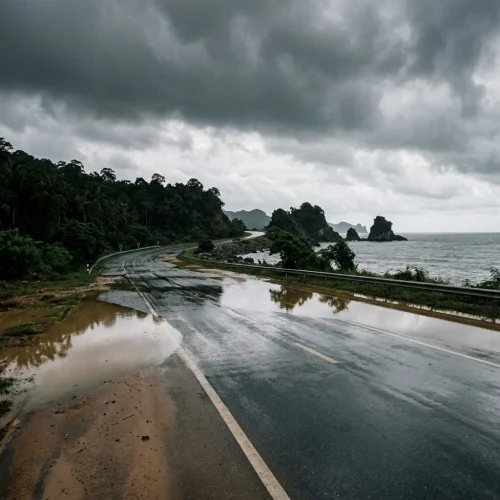
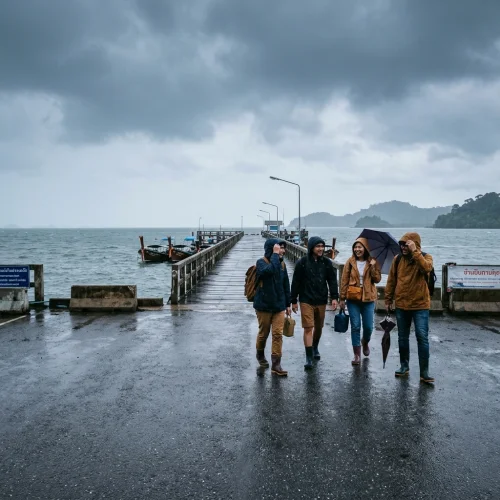
The primary artery is the Krabi River, fed by a complex network of narrow khlongs that carve through the limestone. Inland water clarity is generally crystalline, though the monsoon swells between September and October regularly push the river banks into the lower streets of Krabi Town. The locals adapt quickly with raised wooden walkways, turning a flood into a minor logistical puzzle rather than a crisis. For daily hydration, a one-litre bottle of drinking water from any 7-11 sets you back 15 THB (£0.33).
Navigating this fractured landscape will quickly chew through your transport budget. The constant, aggressive hill climbs decimate the fuel economy of a standard scooter, and the red laterite mud on the secondary jungle roads becomes incredibly slick after a brief tropical downpour. The trick is to avoid the cheap coastal rentals if you plan to head inland to scout property or hike. Upgrading to a 150cc mountain-rated scooter, like a Honda ADV with proper grip tyres, costs around 500 THB (£11.10) per day, compared to 250 THB (£5.50) for a standard city moped. It is the smartest investment you can make for these hills.