Boatbuilders in Thailand
Across the coastal industrial bays of Rayong and the deep-water hardstands of Jomtien, Thai shipyards build ocean-going composite sailing multihulls alongside certified aluminium commercial craft. Thailand's established boatbuilding sector pairs international naval architecture from European and Australian design offices with specialised vacuum resin infusion, marine-grade aluminium fabrication, and solar-assisted electric propulsion. Facilities range from boutique custom yards to high-volume commercial producers building passenger ferries, dive boats, and blue-water luxury catamarans.
This independent guide introduces Thailand's yacht manufacturers, custom shipyards, and commercial builders for British and international buyers. We examine where genuine manufacturing facilities operate across Rayong, Pattaya, Sattahip, and Huai Yai, distinguishing active construction yards from marina offices and charter bases. The overview also explores composite and metal engineering standards, hybrid propulsion integration, and realistic vessel construction costs in Thai Baht and British Pounds, giving you the practical grounding required before commissioning a build.

Major Yacht Builders and Commercial Shipyards in Thailand
Thailand's commercial and leisure boatbuilding sector concentrates along the Eastern Seaboard, where deep-water access, skilled composite and metal trades, and Board of Investment (BOI) privileges support specialised marine manufacturing. Eight established yards form the core of the country's yacht and commercial vessel production.
Island Spirit Catamarans builds series-production bluewater sailing catamarans from a 5.5-acre manufacturing yard in Huay Pong, Rayong, operating under Group Island Spirit Manufacturing. The yard constructs ocean-going multihulls engineered to European CE Category A standards, including the Island Spirit 410. Its production range also features the Island Spirit 525e, a 52-foot solar-electric sailing catamaran nominated for Cruising World Boat of the Year 2026. In August 2020, Group Island Spirit acquired commercial builder Austhai Marine, consolidating multihull assembly, private charter fleet construction, and composite engineering within the Huay Pong site.
Austhai Marine constructs series-production commercial power catamarans spanning 8 to 18 metres, utilising hull designs from naval architect Dr Albert Nazarov of Albatross Marine Design. Fabricated using vacuum-infused composites compliant with ISO Small Craft standards, Austhai vessels operate across twelve countries in passenger transfer, commercial diving, and coastal patrol roles. The company's primary commercial platform, the AT40, provides a 12.99-metre twin-outboard design configured as a high-density passenger ferry, resort transfer boat, or dedicated 30-diver support vessel.
SeaCat Ships builds commercial aluminium catamarans, monohulls, and specialist workboats measuring up to 60 metres from a waterfront shipyard at Ocean Marina Jomtien. Founded by Australian naval architect Paul Birgan and supported by project manager Murray Birgan, the BOI-promoted yard combines Australian design oversight with local aluminium fabrication. Hulls are assembled from certified 5083-H116 marine-grade aluminium plate using computer-routed kits. Construction conforms to international classification standards, notably the Australian National Standard for Commercial Vessels (NSCV) and Lloyd's Register Special Service Craft rules.
Pantawee Marine is an artisanal composite boatyard based inland in Huai Yai, Chon Buri, established in 1986 by New Zealand boatbuilder Jack Hall. After decades constructing heavy-displacement Hans Christian offshore cruising monohulls, the facility transitioned to custom and semi-custom composite multihulls measuring up to 65 feet (20 metres). Working regularly with Schionning Designs naval architecture, Pantawee combines vacuum-consolidated epoxy sandwich composites with handcrafted teak and timber joinery. Builds comply with American Boat and Yacht Council (ABYC) and CE small craft standards, with completed vessels voyaging globally.
PMG Shipyard operates from a 20,800-square-metre beachfront site on Suchada Beach in Rayong. Founded by Swiss entrepreneur Philippe Guénat under BOI promotion, the yard builds custom luxury catamarans and solar-assisted vessels up to 120 feet. PMG launched the Heliotrope 65 solar-assisted catamaran in 2013 and has constructed multiple hulls for the Silent 60 solar-electric series. Yard infrastructure includes enclosed lamination halls, an on-site testing pool, and a 50-tonne Magicart mobile boat hoist with a 14.4-metre clearance to launch wide-beam multihulls directly into the sea.
Serenity Shipyard, situated inside Ocean Marina Jomtien, was founded in 2001 under BOI promotion by French boatbuilder Jean-Marie Obry. The company constructs and refits custom composite sailing and power catamarans from 40 to over 100 feet. The facility contains dedicated composite construction bays, yacht refit hardstands, and an on-site marine-grade stainless-steel fabrication workshop supplying architectural metalwork. Beyond private yachts, the shipyard fabricates commercial passenger multihulls, including the 21-metre Serenity 71 used for regional day charters.
Pi Marine & Engineering is based within the Navalian Dock Yard industrial complex along Highway 331 in Huai Yai. Staffed by qualified naval architects and marine engineers, the company designs and fabricates custom aluminium workboats, glass-reinforced plastic (GRP) tour catamarans, and zero-emission vessels. A notable delivery is the EGAT Chonlapat 1, a 12.9-metre all-electric commercial passenger catamaran built for the Electricity Generating Authority of Thailand under Thai Marine Department survey, powered by twin 35-kilowatt electric motors with a 54-kilowatt-hour battery system.
Seat Boat on South Pattaya Road is Thailand's longest-running leisure marine builder, established in 1967. The company operates production workshops, retail chandleries, and service centres across Pattaya, Bangkok, and Phuket, producing fibreglass sportfishers, offshore centre consoles, and commercial passenger speedboats up to 60 feet. Seat Boat also acts as an official Mercury Marine distributor and authorised Yamaha Marine dealer, providing engine engineering, parts supply, and vessel registration assistance.
Identifying whether a builder's core capability centres on recreational composite cruising, survey-certified commercial aluminium fabrication, or series passenger transport ensures your naval specifications match the right production yard.
Vessel Types Manufactured Across Thai Yards
Thai shipyards produce a broad spectrum of recreational yachts and commercial working craft, reflecting the country's dual position as a global cruising ground and an active regional marine transit hub.
Multihulls form a major share of private leisure orders. Custom and semi-custom sailing catamarans—such as those produced by Pantawee Marine and Island Spirit—span from 38 to 65 feet. These craft provide generous bridgedeck accommodation, structural rigidity for blue-water passages, and shallow draughts suited to tropical archipelagos. Alongside sailing craft, luxury power catamarans from yards like PMG Shipyard deliver high transverse stability, lower fuel burn than displacement monohulls, and wide upper coachroofs capable of carrying extensive solar arrays. Custom monohull sailing yachts and motor cruisers are also produced to order, tailored with bespoke timber joinery and domestic marine systems.
Commercial passenger and tourism craft represent an equally prominent manufacturing segment. Thai builders construct island passenger ferries, day-charter catamarans, resort transfers, and dedicated dive boats operating across Thailand and the wider Indo-Pacific. Builders such as Austhai Marine produce composite powercats engineered for punishing daily running hours in high-salinity waters. While private yachts prioritise acoustic insulation, hand-finished cabinetry, and luxury amenities, commercial hulls require heavy-duty laminate schedules, watertight crash bulkheads, anti-slip deck coatings, and accessible service channels for rapid turnaround maintenance.
Specialist working craft form a technically demanding category led by aluminium fabricators such as SeaCat Ships and Pi Marine. These yards build landing craft, patrol boats, and harbour utility vessels to international classification rules, including Lloyd's Register and Australia's National Standard for Commercial Vessels (NSCV). Featuring reinforced bow ramps, heavy fendering, and commercial deck gear, these vessels are engineered to withstand continuous contact with quaysides and support ships.
Plan a journey along Thailand’s Andaman coast, with practical guidance on island gateways, marine parks, diving, ferries and monsoon travel.
Boatbuilding Materials and Marine Construction Methods
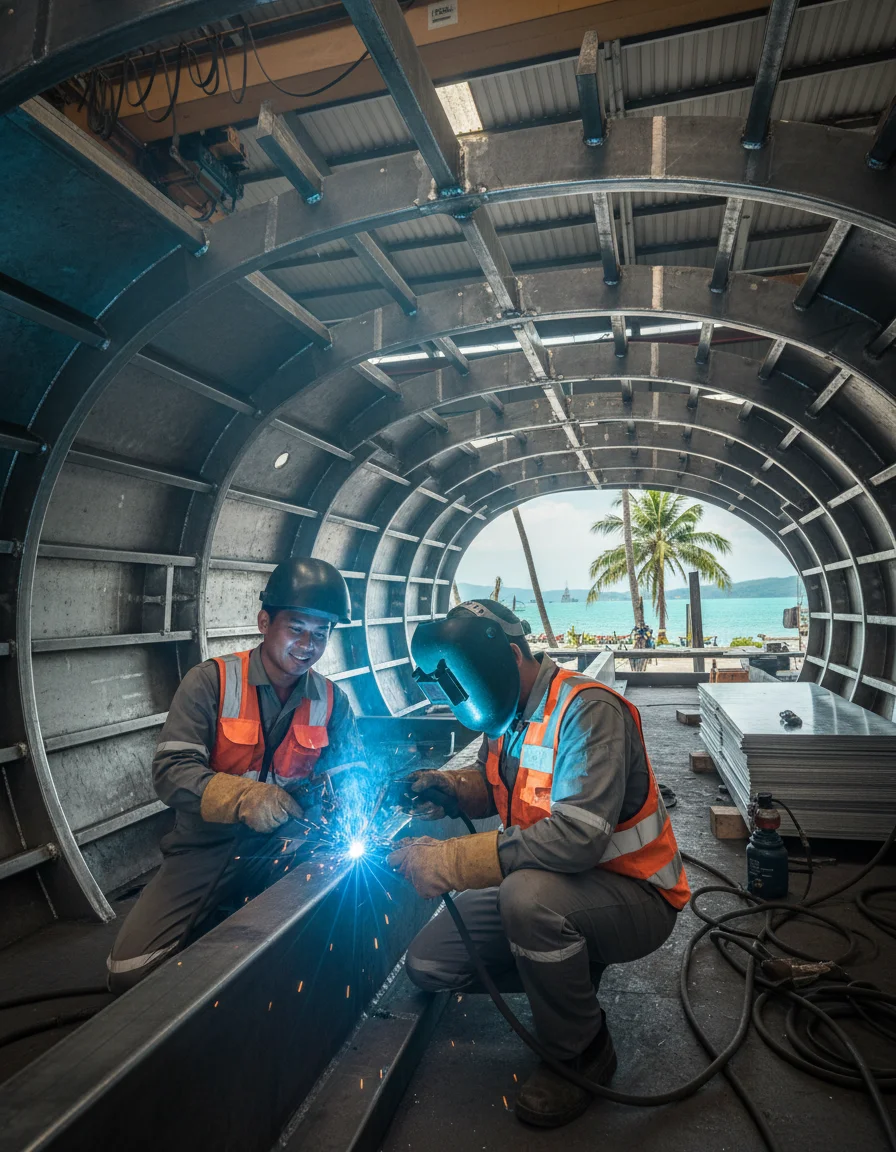
Thai boatyards match construction methods to the structural demands of their specific vessel sectors, dividing broadly between high-tech composite sandwich production and commercial aluminium fabrication.
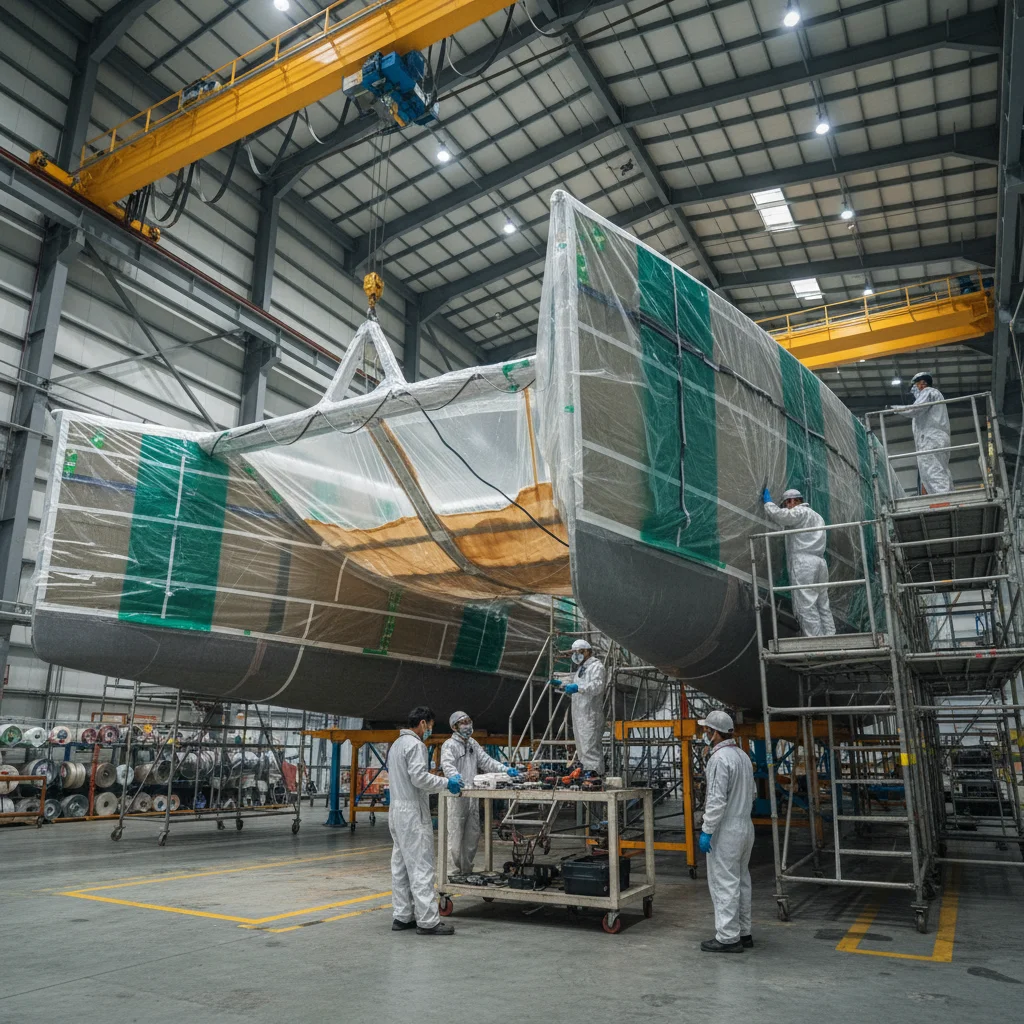
Composite multihull yards across Rayong and Huai Yai rely primarily on vacuum-assisted resin infusion. Technicians dry-lay multiaxial E-glass fabrics and closed-cell PVC structural foam cores into female moulds, sealing the assembly beneath airtight bagging film. Drawing negative pressure pulls high-grade vinyl ester or epoxy resin through dedicated feed channels, impregnating the laminate without the trapped air voids inherent to manual wet layups. This achieves a high glass-to-resin ratio, creating lightweight, stiff structures with natural resistance to osmotic blistering. High-load stress areas, including bridgedeck crossbeams and chainplates, incorporate strategic unidirectional carbon-fibre reinforcements. For custom hulls, yards such as Pantawee Marine combine epoxy systems with CNC-routed composite panels.
Commercial yards, notably SeaCat Ships in Jomtien and Pi Marine in Huai Yai, specialise in marine-grade aluminium fabrication. Hulls and structural bulkheads utilise certified 5083-H116 plate alongside 6061-T6 extruded framing. Naval architects convert 3D CAD models into nested cutting files, precision-cut by CNC routers to millimetre tolerances. Coded shipyard welders then assemble the interlocking plate kits using pulsed-MIG and TIG welding shielded by inert argon gas. Aluminium provides superior tensile toughness, flame resistance, and impact tolerance for shallow reef environments where groundings would puncture composite shells.
Interior fit-outs balance marine aesthetics with displacement control. Multihull builders construct modular joinery using lightweight foam-cored or paper-honeycomb composite panels faced with hardwood veneers, preventing excess top-hamper weight.
Mechanical installations rely on established global supply chains. Thai builders standardise on tier-one marine diesels from Yanmar, Volvo Penta, and Cummins, alongside navigation suites from Simrad and Raymarine and spar rigging from Selden. Sourcing globally supported machinery ensures owners can obtain replacement parts, diagnostic support, and scheduled servicing in any international cruising ground.
Electric Propulsion and Hybrid Marine Engineering
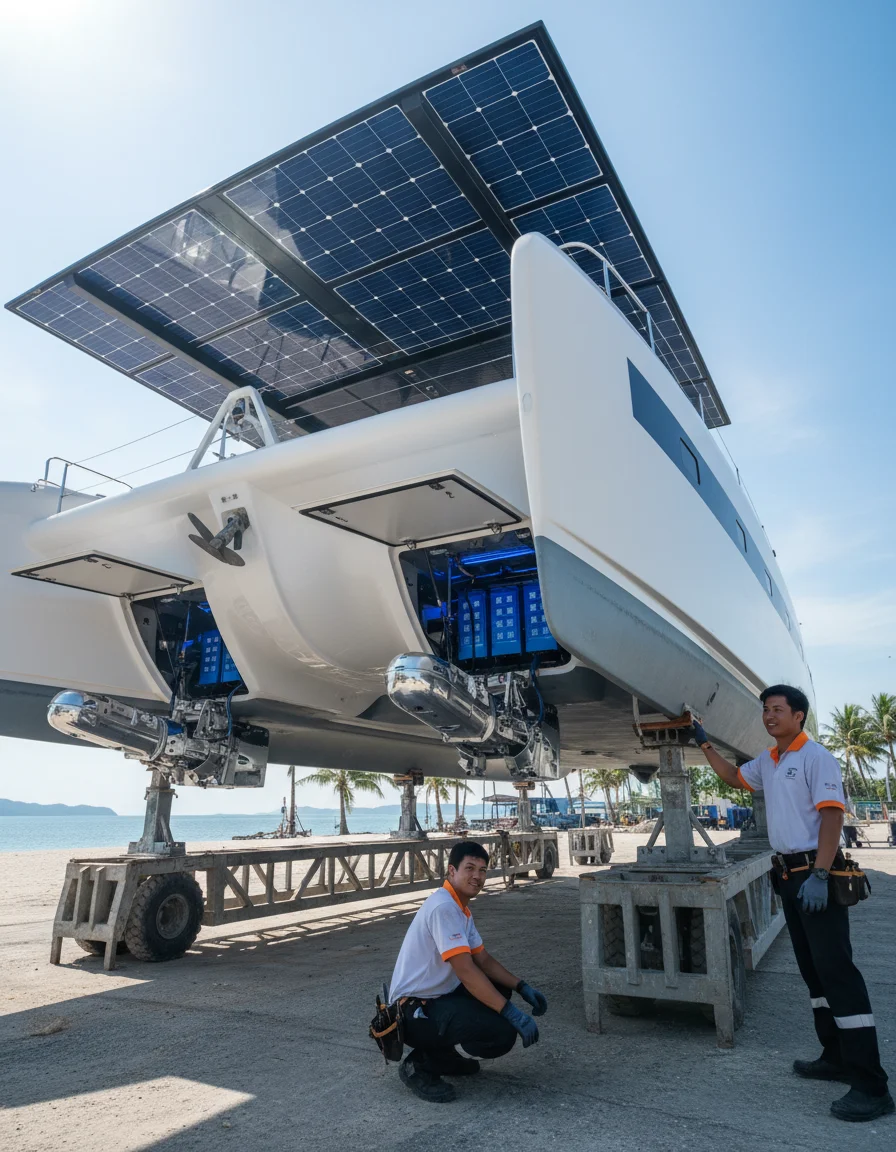
Thai shipbuilders have made steady technical progress in electric propulsion and hybrid naval architecture. Multihulls provide an ideal platform for these installations, as broad bridge decks, coachroofs, and hardtops present expansive surface areas for high-output solar arrays without compromising living space or stability.
In Rayong, PMG Shipyard established early expertise in solar-assisted multihulls with the 2013 launch of the Heliotrope 65. The 65-foot powercat incorporated rooftop solar panels generating up to 8 kW of power, alongside digital switching to run domestic hotel loads without running a diesel generator continuously. The yard later manufactured hulls for the Silent 60 solar-electric series, integrating 42 roof-mounted solar panels rated at 17 kWp, large lithium battery banks, and twin electric motors designed for silent, fuel-free displacement cruising.
Sailing catamarans built on the eastern seaboard also reflect this transition. Island Spirit Catamarans developed the Island Spirit 525e at its Huai Pong facility in Rayong. The 15.77-metre sailing multihull combines dual electric drive motors with a 210 kWh marine lithium battery bank, coachroof photovoltaic panels, and hydrogeneration under sail. To ensure offshore redundancy during extended passages or poor weather, the build incorporates a 55 kW auxiliary commercial diesel generator.
Commercial passenger craft are adopting similar technology for coastal and inland waters. At Navalian Dock Yard in Huai Yai, Pi Marine & Engineering constructed the EGAT Chonlapat 1 for the Electricity Generating Authority of Thailand. Built to Thai Marine Department standards, the 12.9-metre zero-emission ferry operates with twin 35 kW electric motors and a 54 kWh battery bank to transport 15 passengers on scheduled routes.
Battery energy density dictates operating boundaries. Commercial ferries operating fixed harbour routes can top up through quayside three-phase chargers between sailings. In contrast, blue-water cruising yachts require realistic hybrid planning: calculating actual hotel loads such as air conditioning alongside propulsion demands ensures you specify sufficient battery capacity and backup generation rather than over-relying on solar yields during tropical squalls.
Choosing a Builder and Navigating the Commissioning Process
Selecting a boatbuilder in Thailand requires matching your operational requirements with the shipyard's demonstrated construction portfolio and classification compliance. Yards fall into two distinct engineering philosophies: series production and bespoke custom shipwrighting. Island Spirit Catamarans and Austhai Marine maintain standardised tooling and production moulds, allowing predictable build schedules, verified naval stability books, and transparent baseline pricing. Conversely, yards such as Pantawee Marine, Serenity Shipyard, and PMG Shipyard handle custom one-off or semi-custom commissions where clients can adapt bulkhead positions, interior timber joinery, and electrical specifications. Custom builds require substantial owner engagement and longer lead times, but deliver craft tailored to specific offshore cruising routes or commercial passenger profiles.
Before committing to a build, commission an independent marine surveyor to inspect the yard's active construction bays and quality control systems. Confirm whether the facility holds Board of Investment (BOI) privileges, which permit duty-free importation of foreign marine machinery, electronics, and specialised materials, alongside duty-exempt export of completed hulls. In addition, verify that the builder's design office can deliver full naval architectural packages and stability calculations that satisfy your intended flag state registry.
| Boatbuilder | Location | Hull Material | Primary Vessel Focus | Regulatory Standards |
|---|---|---|---|---|
| Island Spirit Catamarans | Huay Pong, Rayong | Vacuum-infused composite | Sailing & electric catamarans | CE Category A |
| Austhai Marine | Huay Pong, Rayong | Vacuum-infused composite | Commercial ferries & dive boats | ISO Small Craft, CE |
| SeaCat Ships | Ocean Marina Jomtien | Marine aluminium 5083 | High-speed ferries & workboats | NSCV, Lloyd's SSC |
| Pantawee Marine | Huai Yai, Chon Buri | Epoxy composite / wood | Custom sailing & powercats | Custom offshore survey |
| PMG Shipyard | Suchada Beach, Rayong | Advanced composite | Luxury solar-electric catamarans | CE Category A, Custom class |
| Serenity Shipyard | Ocean Marina Jomtien | Vacuum-infused composite | Custom luxury multihulls & refits | Custom class, CE |
| Pi Marine & Engineering | Huai Yai, Chon Buri | Aluminium & GRP composite | Commercial workboats & EV craft | Thai Marine Department |
| Seat Boat | South Pattaya, Chon Buri | Hand-laid & infused GRP | Sportfishers & utility tenders | Thai Marine Department |
Commissioning a vessel follows eight structured milestones. The project begins with establishing functional design requirements and operational parameters, followed by selecting an existing stock design or commissioning bespoke naval architecture. The shipyard then produces detailed technical specifications, equipment schedules, and milestone-based quotations. A formal build contract defines stage payments tied strictly to verified physical progress rather than arbitrary calendar dates. Hull construction and structural assembly—whether mould tooling, composite infusion, or metal plating—form the initial construction phase, followed by mechanical engineering, electrical wiring, and interior joinery. Independent marine surveyors conduct structural and systems inspections prior to launch. Dockside testing leads into sea trials in the Gulf of Thailand to evaluate handling, cruising speeds, fuel burn, and stability. Finally, the yard completes formal handover, providing warranty documentation, compliance certificates, and export clearances.
Structuring construction agreements around independent surveyor sign-offs provides vital financial protection and maintains quality control before milestone funds are released at each major build phase.
Where to Find Thailand's Boatbuilding Hubs
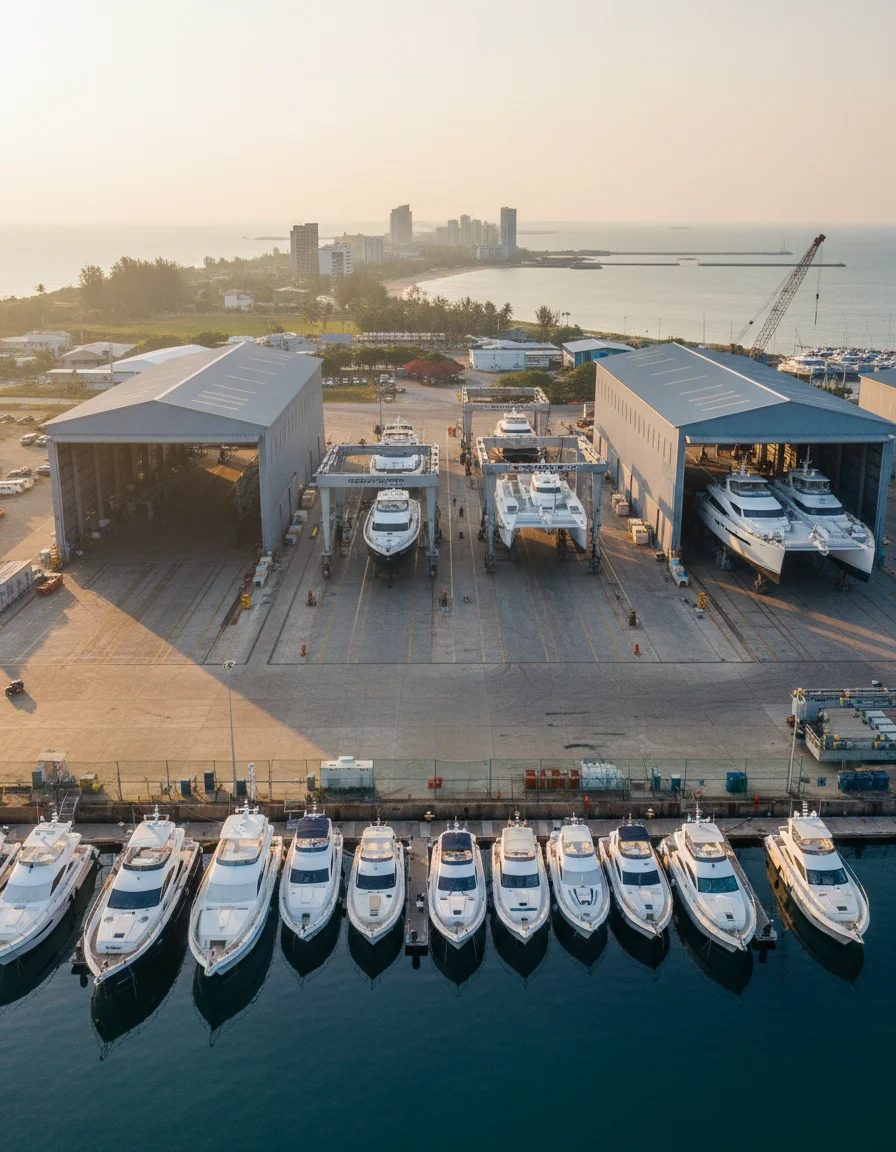
Thailand's boatbuilding industry is heavily concentrated along the Eastern Seaboard in Chon Buri and Rayong provinces, with Phuket functioning primarily as a commissioning, refit, and charter base rather than a primary hull lamination centre. Understanding these regional distinctions helps prospective buyers differentiate actual production shipyards from sales offices, marina berths, and maintenance yards.
Rayong acts as the heavy industrial and composite multihull centre. Inland at Huay Pong, Group Island Spirit operates a dedicated 5.5-acre manufacturing compound on Chakklang-Mitpracha Road, building Island Spirit cruising catamarans and Austhai commercial powercats. On Suchada Beach, roughly ten kilometres west of Rayong city centre, PMG Shipyard maintains a beachfront facility with direct water access to the Gulf of Thailand, enabling the launch of wide-beam luxury catamarans without overland transport constraints.
The coastal corridor of Jomtien, Na Jomtien, and Sattahip provides deep-water marine infrastructure. Ocean Marina Jomtien accommodates on-site waterfront manufacturing sheds for SeaCat Ships and Serenity Shipyard, allowing builders to construct aluminium workboats and composite catamarans with immediate slipway access, travel hoists, and deep-water berths for dock trials. Further north, Seat Boat operates its long-running fibreglass workshop, showroom, and engine engineering facility on South Pattaya Road.
Inland at Huai Yai, positioned in rural Bang Lamung near Highway 331, composite and metal fabricators benefit from spacious plots. Pantawee Marine runs its custom composite yard on Soi Tessaban Huai Yai 12, building multihulls before hauling completed hulls overland to Ocean Marina Jomtien for mast stepping and sea trials. Nearby, Pi Marine & Engineering manufactures aluminium and composite craft at the Navalian Dock Yard industrial complex.
By contrast, Phuket centres on post-delivery logistics. Facilities at Phuket Boat Lagoon and Yacht Haven handle commissioning, mechanical overhauls, and charter operations, while heavy composite infusion and aluminium hull fabrication remain focused across Rayong and Chon Buri.
Costs and Budgeting
Vessel construction costs in Thailand depend on hull dimensions, structural materials, regulatory survey standards, and propulsion machinery. Semi-custom builders and commercial yards typically quote on milestone contracts rather than fixed retail price lists, because bespoke naval architecture, cabin layouts, and mechanical specifications vary considerably between builds. Series-production utility hulls begin at modest entry points, whereas custom carbon-reinforced multihulls and expedition yachts reach multi-million-pound budgets.
Machinery selection drives a major portion of any shipyard quotation. Outfitting a commercial catamaran with twin four-stroke outboard engines costs significantly less than installing inboard diesel engines with shaft or pod drives, while high-capacity marine lithium battery banks and electric propulsion systems command a substantial technical premium. Export builds are quoted net of Thailand's 7% value-added tax when handled under Board of Investment customs privileges. Overseas buyers must separately budget for naval architect licensing fees, independent classification surveys, international shipping logistics, transit insurance, and import duties at their home port.
| Vessel Type | Price Range (THB) | Approx Price (GBP) | Typical Specification |
|---|---|---|---|
| 8m–10m Utility Workboat / Transfer Cat | 3,500,000 – 6,500,000 | £80,000 – £148,000 | Twin outboards, basic commercial survey, composite |
| 12m–13m Passenger Dive / Tour Catamaran | 12,000,000 – 18,500,000 | £273,000 – £420,000 | High-capacity deck, twin outboards or inboards |
| 40ft–42ft Production Cruising Sailing Cat | 19,500,000 – 26,000,000 | £443,000 – £591,000 | 3 or 4 cabins, CE Category A, Yanmar diesels |
| 16m–18m Aluminium High-Speed Ferry | 24,500,000 – 38,000,000 | £557,000 – £864,000 | Commercial NSCV survey, heavy passenger fit-out |
| 50ft–55ft Solar-Electric Luxury Catamaran | 43,800,000 – 68,000,000 | £995,000 – £1,545,000 | 200+ kWh lithium bank, twin electric motors, solar roof |
| 60ft–70ft Custom Luxury Powercat / Superyacht | 85,000,000 – 175,000,000+ | £1,930,000 – £3,975,000+ | Bespoke composite, luxury timber interior, full survey |
What to Know Before You Go
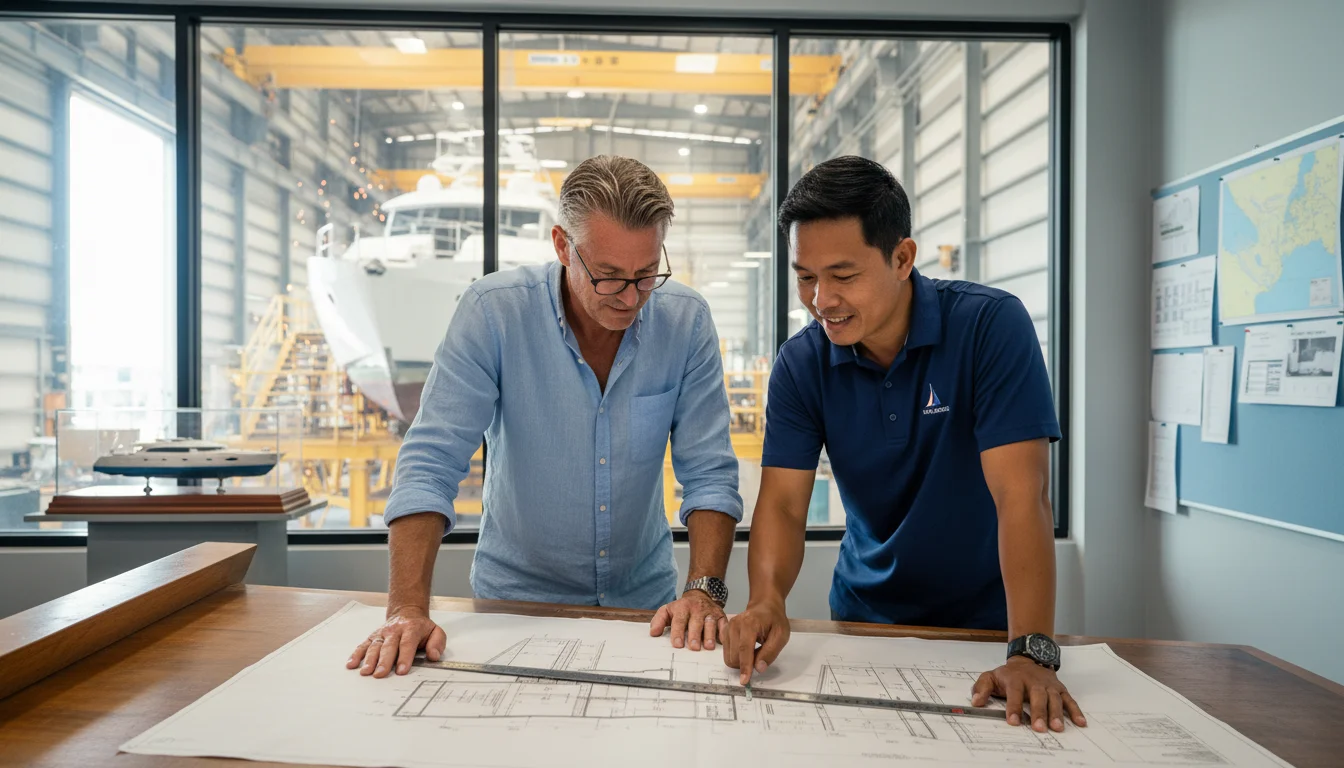
Visiting a Thai shipyard requires structured commercial planning rather than turning up as a casual visitor. Shipyards across Rayong, Sattahip, and Huai Yai operate as secure industrial manufacturing compounds. Gated security facilities turn away unannounced visitors because of strict liability and workplace safety policies, so arrange meetings and factory access well in advance through the builder’s commercial office.
British buyers intending to import a newly built recreational craft into the United Kingdom must clarify regulatory compliance before commissioning work starts. Under the Recreational Craft Regulations 2017, vessels between 2.5 and 24 metres placed on the market or put into service in Great Britain require formal conformity assessment and must carry either UKCA marking or recognised CE marking. Bringing an uncertified craft into the UK creates legal liabilities under trading standards, risks invalidating marine insurance policies, and requires an expensive post-construction assessment to rectify.
Budgeting requires looking well beyond quoted ex-works factory prices. Base build quotes exclude international shipping, marine transit insurance, customs tariffs, and local destination taxes, including standard 20 percent UK import VAT. Securing heavy-lift ocean freight or hiring a professional delivery crew across the Indian Ocean adds substantial logistical expense to final handover figures.
On-site inspections mean navigating working composite shops, metal fabrication sheds, and scaffolding under tropical heat and humidity. Wear practical, breathable clothing and sturdy, closed-toe safety boots or shoes, as open footwear is strictly prohibited across active production floors.
Practical Tips for Working with Thai Shipyards
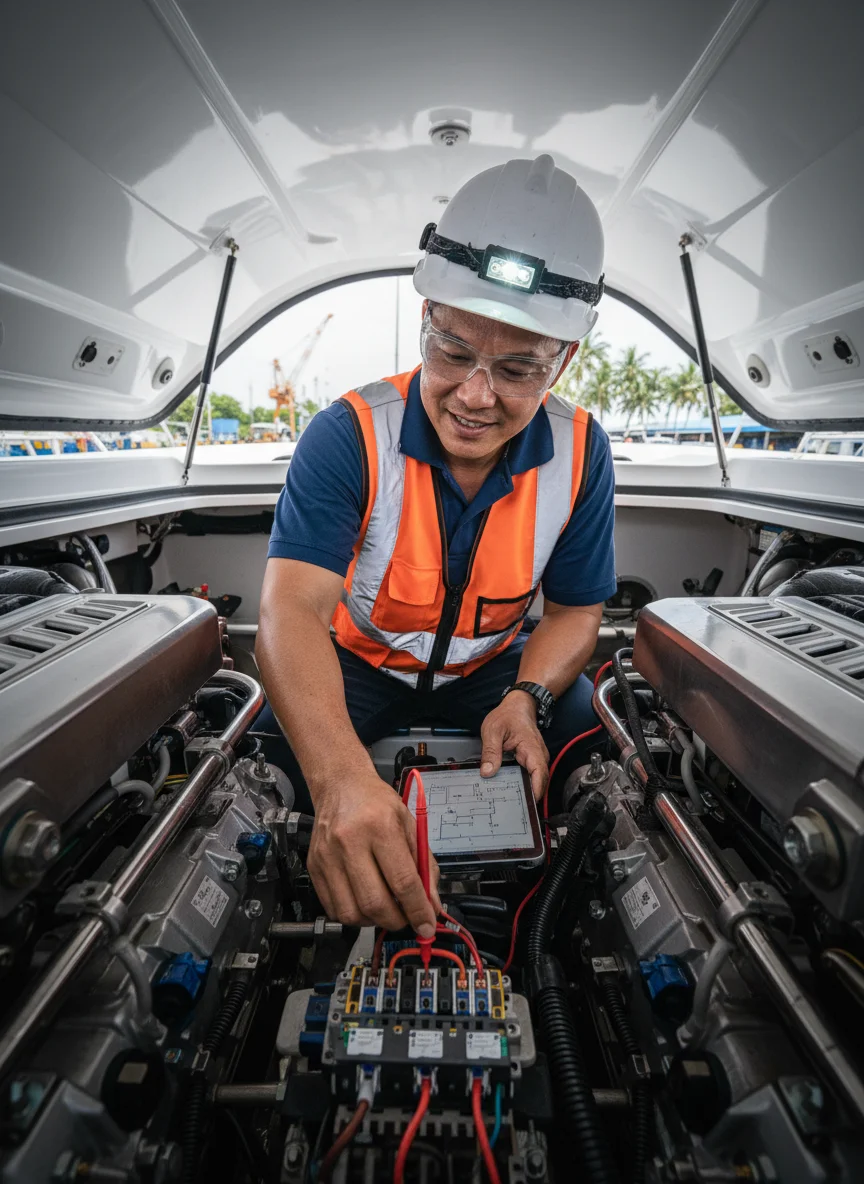
Book shipyard visits at least a fortnight in advance. Yards in Chon Buri and Rayong are active industrial facilities, and booking ahead ensures senior project managers and naval architects are on site to review structural drawings and build schedules.
Appoint an independent marine surveyor registered with recognised bodies such as the Yacht Designers and Surveyors Association (YDSA), the Royal Institution of Naval Architects (RINA), or the International Institute of Marine Surveying (IIMS). Having an independent surveyor inspect milestone stages—including hull infusion, structural bulkheads, electrical wiring, and seacocks—ensures compliance with classification standards before staged payments leave your account.
Schedule factory visits and sea trials between November and February during the dry season. Calmer coastal waters in the upper Gulf of Thailand provide consistent conditions for open-water trials, whereas southwest monsoon downpours between June and October can interrupt outdoor testing and delay motorway travel from Bangkok.
When touring shipyards in Huai Yai, Sattahip, and Rayong, base yourself around Jomtien or Na Jomtien rather than central Pattaya. This puts you close to Ocean Marina Jomtien and provides direct access to Highway 7 and Highway 36 without city traffic delays.
Confirm the builder's Board of Investment (BOI) promotion status. BOI-certified yards enjoy statutory import duty exemptions on machinery and raw materials used for export vessels, avoiding customs delays on specialised foreign marine equipment.
Specify internationally recognised brands across all mechanical and electrical orders. Selecting established equipment from manufacturers such as Yanmar, Volvo Penta, Raymarine, and Mastervolt ensures warranty coverage, spare parts, and qualified servicing remain accessible across the UK and Europe.
Join sea trials in the Gulf of Thailand personally before signing off acceptance. Testing cruising speed, fuel burn, acoustic levels, and engine temperatures under full load verifies that performance meets agreed contractual specifications.
Quick Reference Table
| Item | Detail | Notes |
|---|---|---|
| Primary boatbuilding hubs | Chon Buri and Rayong provinces (Huai Yai, Jomtien, Sattahip, Huay Pong, Suchada Beach) | Heavy industrial and lamination yards concentrate along the Eastern Seaboard; Phuket operates primarily for refit, charter, and commissioning |
| Dominant vessel sectors | Composite multihulls, commercial passenger ferries, aluminium workboats, solar-electric craft | Catamarans represent the largest share of leisure and commercial production; monohulls built to custom order |
| Entry commercial boat costs | THB 3,500,000 – 6,500,000 (£80,000 – £148,000) | Typical baseline for 8m–10m composite utility workboats or transfer cats with twin outboard engines |
| Bluewater sailing catamaran costs | THB 19,500,000 – 26,000,000 (£443,000 – £591,000) | Standard range for 40ft–42ft series-production sailing catamarans built to CE Category A standards |
| Solar-electric & luxury multihull costs | THB 43,800,000 to 175,000,000+ (£995,000 to £3,975,000+) | Covers 50ft–55ft solar-electric production multihulls through to 70ft+ bespoke composite superyachts |
| Best time for visits & sea trials | November to February (dry season) | Calm conditions in the upper Gulf of Thailand facilitate sea trials; avoids southwest monsoon squalls (June to October) |
| Yard access & booking notice | Minimum 14 days advance booking required | Yards are secure industrial compounds with gated security; unannounced visitors are refused entry |
| Recommended visitor base | Jomtien or Na Jomtien | Direct transit via Highway 7 and Highway 36 to Sattahip, Huai Yai, and Rayong yards while bypassing central Pattaya traffic |
| Yard visit dress code | Sturdy closed-toe safety boots or shoes and breathable attire | Open footwear is strictly prohibited across active composite shops and welding bays |
| Quality assurance standard | Independent surveyor sign-off (YDSA, RINA, or IIMS) | Build contracts must tie stage payments strictly to physical surveyor sign-off rather than calendar milestones |
| UK import regulations | Recreational Craft Regulations 2017 (UKCA or CE marking mandatory) | Applies to craft from 2.5m to 24m placed on the UK market; ex-works prices exclude ocean shipping and standard 20% UK VAT |
| Customs & tax status | Board of Investment (BOI) promotion | BOI-certified yards import foreign marine equipment duty-free and export completed hulls exempt from 7% Thai VAT |
| Website | PMG Shipyard: pmgshipyard.com | Official builder portal for luxury custom multihulls and solar-electric catamarans based in Rayong |
| Website | Island Spirit Catamarans: groupislandspirit.com | Official manufacturer portal for bluewater sailing and electric catamarans based in Huay Pong |
FAQ: Boatbuilders in Thailand
How can I choose the right boat builder in Thailand for my specific needs?
What types of vessels are manufactured by Thai shipyards?
What are the primary construction materials and methods used by Thai boatyards?
What should be considered when planning electric propulsion for blue-water cruising yachts built in Thailand?
What are the main differences between series production and custom boat builders in Thailand?
What steps should a buyer take before committing to a boat build in Thailand?
How can buyers protect their investment during the boat construction process in Thailand?
Where are Thailand's main boatbuilding hubs located?
What additional costs should overseas buyers budget for when commissioning a boat in Thailand?
Can visitors tour Thai shipyards without an appointment?
Reviewed by the Thailand Guide Editorial Team • Last reviewed: 7 November 2026
This page is provided for general information only. While we aim for accuracy, details can change — please verify anything important independently before relying on it.