PMG Shipyard



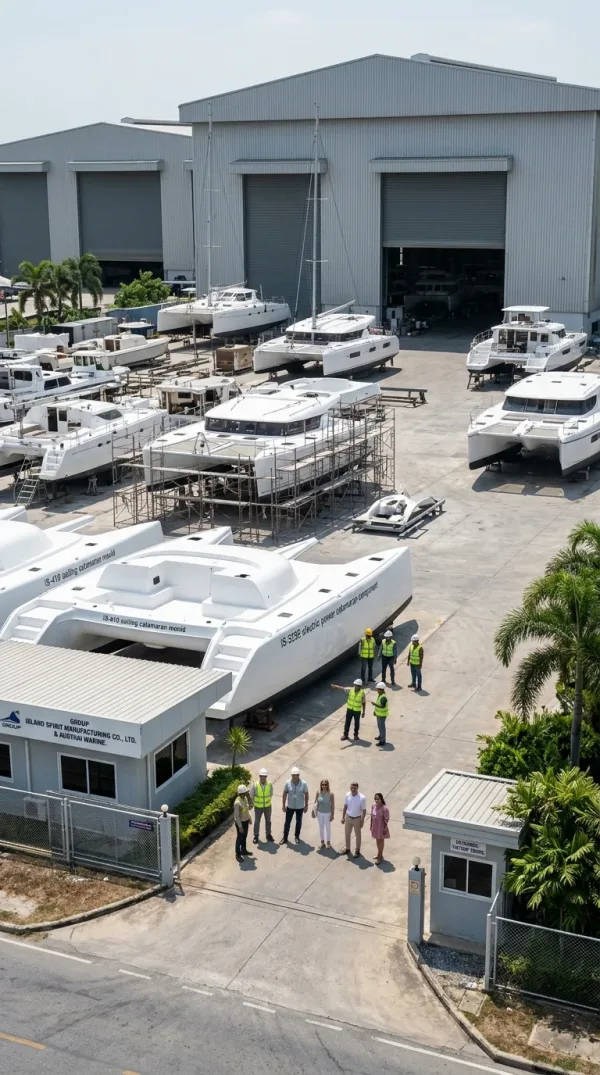
Set across 20,800 square metres of beachfront land on Suchada Beach in Rayong, PMG Shipyard operates as a private, full-service yacht builder and refit facility specialising in custom multihulls and solar-assisted catamarans. Established and directed by Swiss entrepreneur Philippe Guénat, the company combines European naval management and skilled local boatbuilders with Thai Board of Investment (BOI) privileges to construct ocean-capable vessels measuring up to 120 feet in length.
The yard has established a prominent international profile in sustainable marine construction, developing custom catamarans that include the solar-assisted Heliotrope series and production hulls for Austrian solar-electric brand Silent-Yachts. Its waterfront site accommodates multiple dedicated assembly halls, heavy boat hoists, an on-site testing pool, and specialised workshops handling vacuum resin infusion, custom joinery, stainless-steel fabrication, and upholstery.
This integrated set-up bridges the divide between boutique custom workshops and high-volume boatyards. The facility caters to private buyers commissioning bespoke cruising catamarans, commercial charter fleet operators, and captains arranging wide-beam multihull refits or technical surveyor audits on Thailand's eastern seaboard.

Custom Yacht Construction and Shipyard Facilities
PMG Shipyard operates an integrated boatbuilding complex on the Rayong coastline, engineered for the construction, assembly, and refit of ocean-going multihulls. Facing the Gulf of Thailand, the facility houses all naval manufacturing stages within a single industrial perimeter, combining heavy composite production halls with specialist engineering workshops, heavy-lift transport machinery, and dedicated commissioning infrastructure.
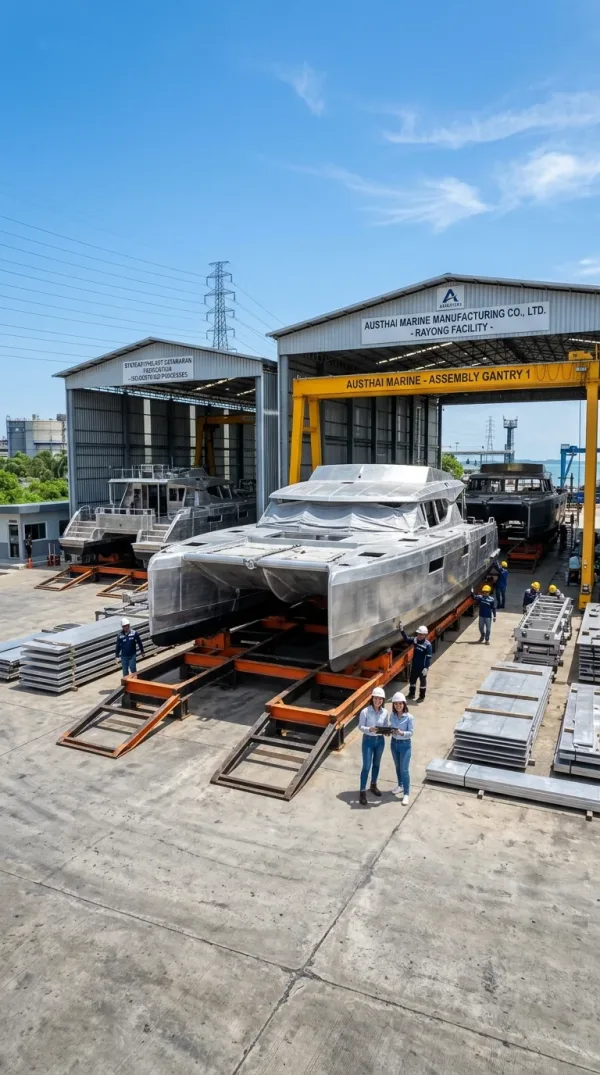
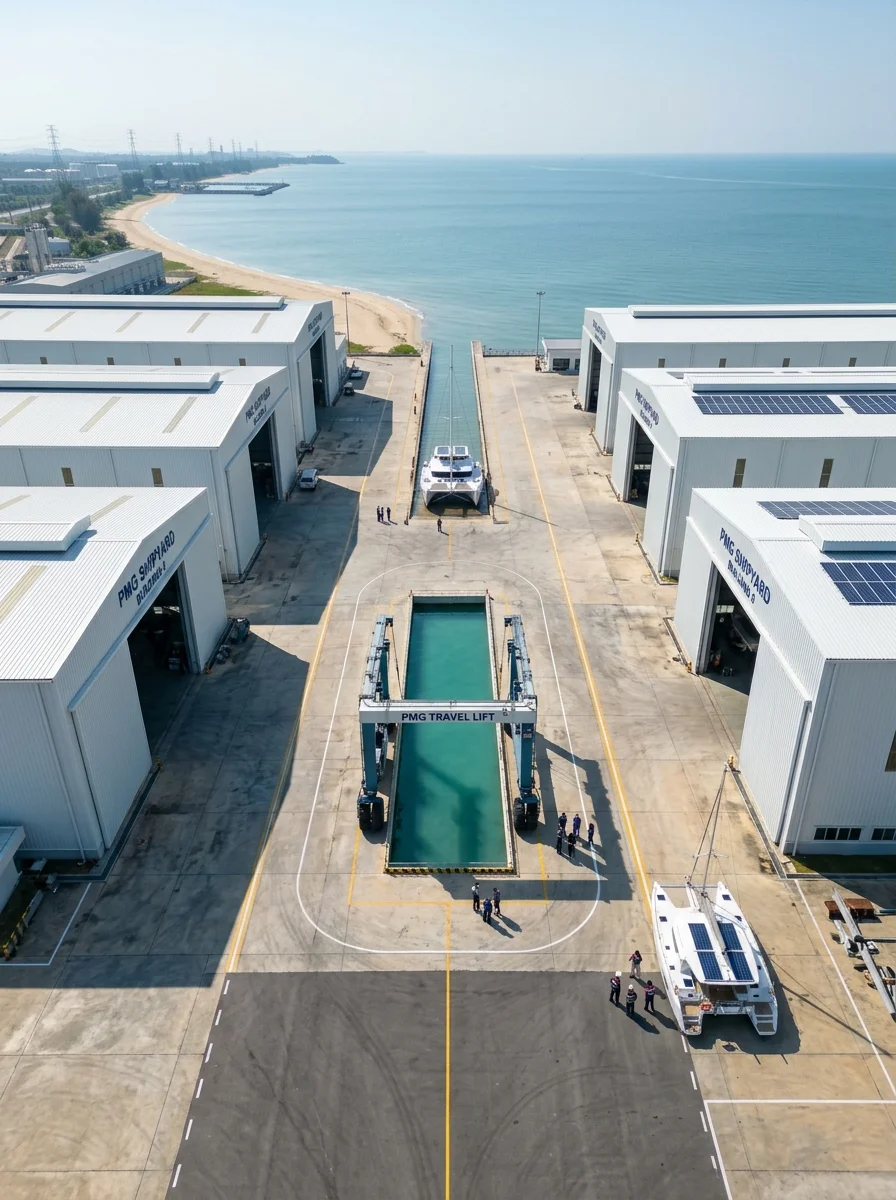
Covering approximately 20,000 square metres on a two-hectare waterfront estate, the shipyard incorporates 200 metres of frontage along the coastal road in Rayong. The layout features eight production buildings, including four enclosed construction halls measuring 50 metres by 12 metres, with an internal ceiling clearance of 12 metres. This clearance and covered floor space allow wide-beam catamarans to be assembled under regulated conditions. Shaded construction shields structural composite laminates and vacuum infusion consumables from tropical ultraviolet radiation and sudden monsoon downpours, ensuring reliable resin curing and dimensional consistency.
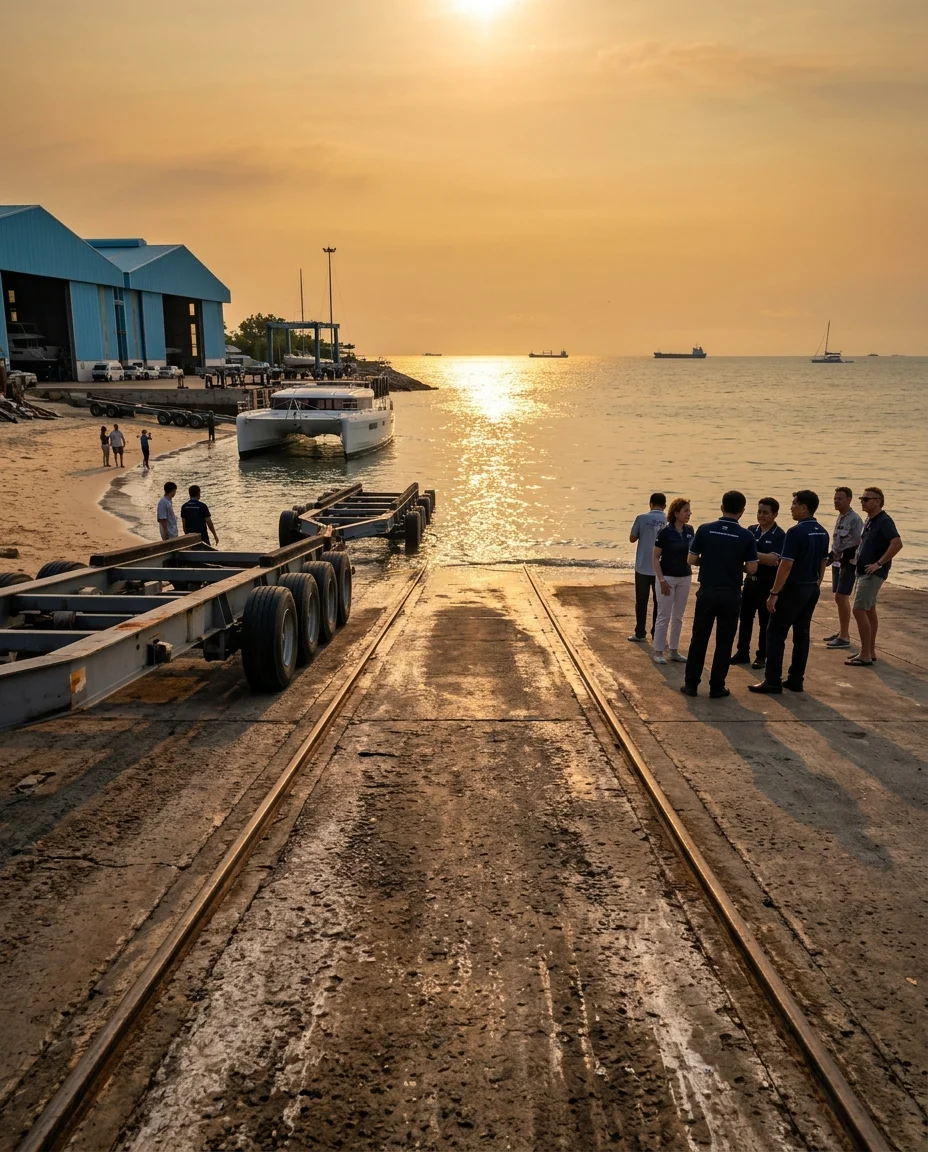
Moving large multihulls between production bays, outdoor hardstanding, and the shoreline requires specialised heavy equipment capable of handling exceptional beam dimensions. PMG Shipyard operates a custom-built 50-tonne Magicart mobile boat hoist measuring 14.4 metres wide and 9.6 metres high. This purpose-built gantry lift manoeuvres catamarans directly between the build halls and the yard's outdoor infrastructure. For shoreline transit, the yard uses a bespoke hydraulic catamaran trailer engineered specifically for multihulls up to 80 feet (24 metres) in length. This transporter transfers vessels out of the yard, across the coastal road, and down the sand directly into the sea in approximately 15 minutes, while the reinforced launch slipway is rated to support vessels up to 160 tonnes.
Before entering open water, newly built vessels undergo commissioning in an on-site testing pool. Measuring 25 metres by 13 metres, this basin accommodates catamarans up to 80 feet. Engineers verify hull watertightness, calibrate CZone digital power distribution, run inboard engines, inspect stern gland seals, and align drive shafts in calm conditions. Completing flotation tests and stationary propulsion runs in the pool resolves technical issues before open-water trials.
Multihull model portfolio and bespoke naval architecture
Organising travel to the Rayong facility for initial build consultations, contract reviews, or stage-payment inspections typically requires booking direct private road transport from Bangkok's international airports or regional marinas along the eastern seaboard.
The shipyard's vessel construction portfolio centres on long-range solar-assisted catamarans, series-built electric multihulls, and one-off commercial and private builds. The yard achieved international prominence in 2013 with the launch of the Heliotrope 65, designed in collaboration with naval architect Dr Albert Nazarov. Regarded as one of the world's earliest solar-assisted luxury power catamarans, the vessel incorporated rooftop solar panels generating up to 7 to 8 kilowatts of electricity, demonstrating that solar power could significantly offset generator running hours on extended passages.
That design heritage evolved into the Heliotrope 48 and subsequently the Cora Cat 48, a semi-custom power catamaran developed alongside international multihull distributors, including The Yacht Sales Co. Measuring 14.75 metres in overall length with a 7.23-metre beam, the Cora Cat 48 utilises fast-displacement hull forms engineered for fuel efficiency and seakeeping stability across cruising ranges of up to 1,500 nautical miles. Its shallow draft of 0.99 metres allows owners to navigate shallow tropical anchorages inaccessible to deep-draft monohulls, while the flybridge spans the full beam to provide exceptional exterior living volume.
Between 2019 and 2023, PMG Shipyard served as an Asian manufacturing hub for European brand Silent-Yachts, completing series hulls of the Silent 60 and Silent 62 3-Deck solar-electric catamarans. These vessels integrated high-output photovoltaic arrays and lithium storage for silent electric propulsion and full domestic autonomy. Alongside leisure catamarans, the shipyard undertakes bespoke naval architecture contracts for vessels up to 120 feet (36.5 metres), including commercial passenger ferries, diving catamarans, and specialised patrol craft. Prospective owners can select from conventional twin diesel shaft drives, hybrid configurations, or fully electric solar drivetrains, tailoring interior arrangements to suit private cruising or commercial charter operations.
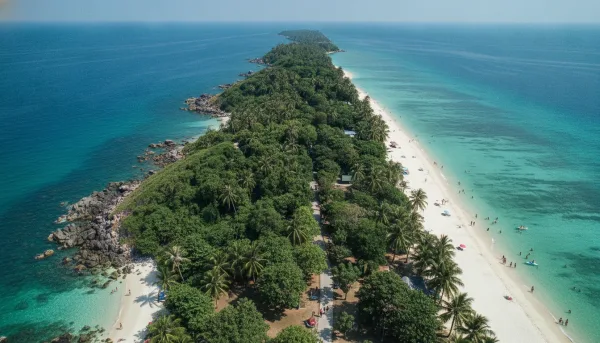
Plan a Koh Samet stay with clear guidance on beaches, accommodation areas, park fees, boats from Ban Phe and transport around the island.
Vacuum-assisted infusion and solar-electric engineering
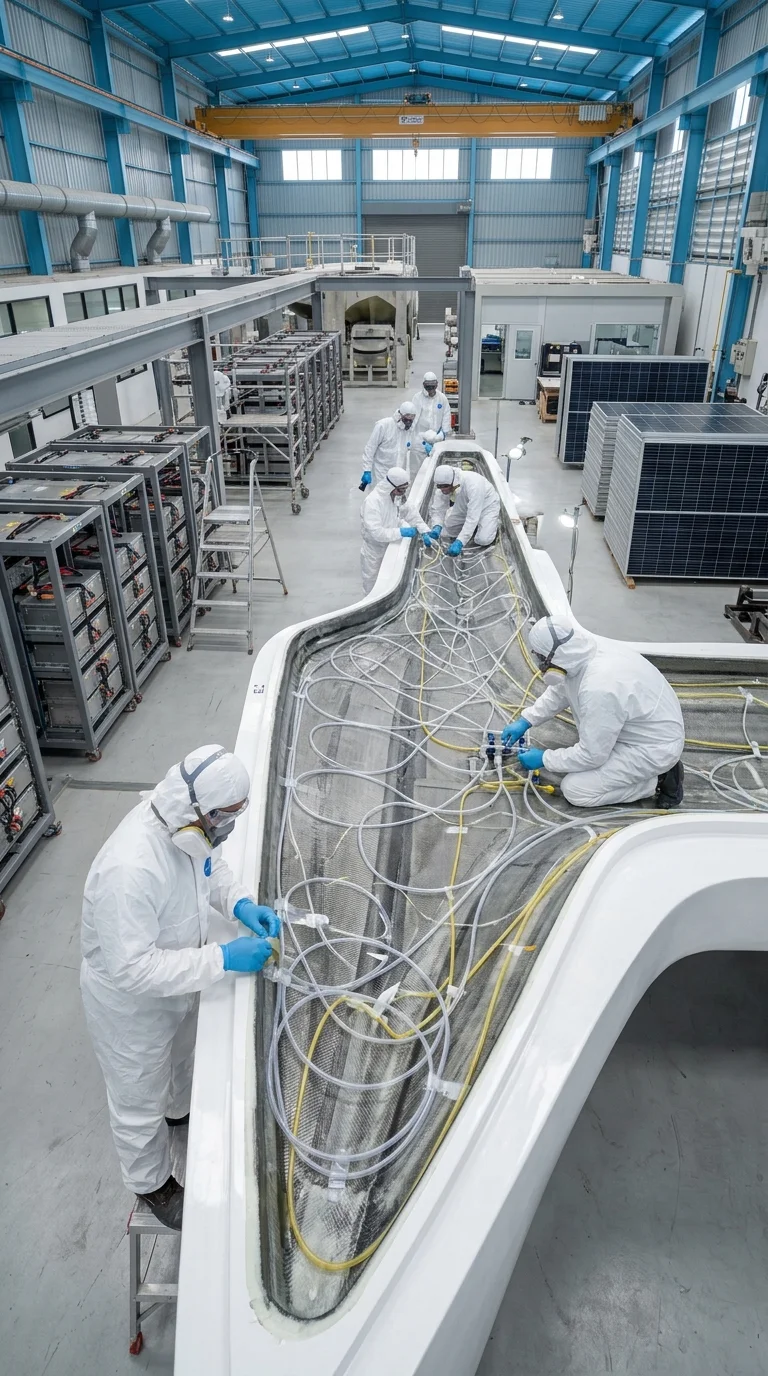
Advanced composite construction techniques underpin the structural integrity and weight discipline of every vessel built at PMG Shipyard. Hull and deck mouldings are fabricated using closed-mould vacuum-assisted resin infusion, combining high-grade vinylester resins with multi-axial glass fabrics and structural closed-cell foam cores. This closed infusion process draws resin through the laminate under continuous negative pressure, achieving a high glass-to-resin ratio while eliminating the voiding and air entrapment common in traditional hand-laid fibreglass. Selected models incorporate an additional layer of core mat material, such as 5-millimetre SORIC, to enhance local impact resistance without adding excessive structural weight.
Precision shaping of interior structural members takes place inside a dedicated computer numerical control (CNC) workshop. The facility houses an industrial 3 x 8-metre CNC router that cuts composite bulkheads, stringers, floor frames, and marine ply cabinetry panels to sub-millimetre tolerances. Digital pre-cutting guarantees exact alignment across port and starboard hulls, accelerating assembly times and maintaining structural stiffness throughout the vessel's operational life.
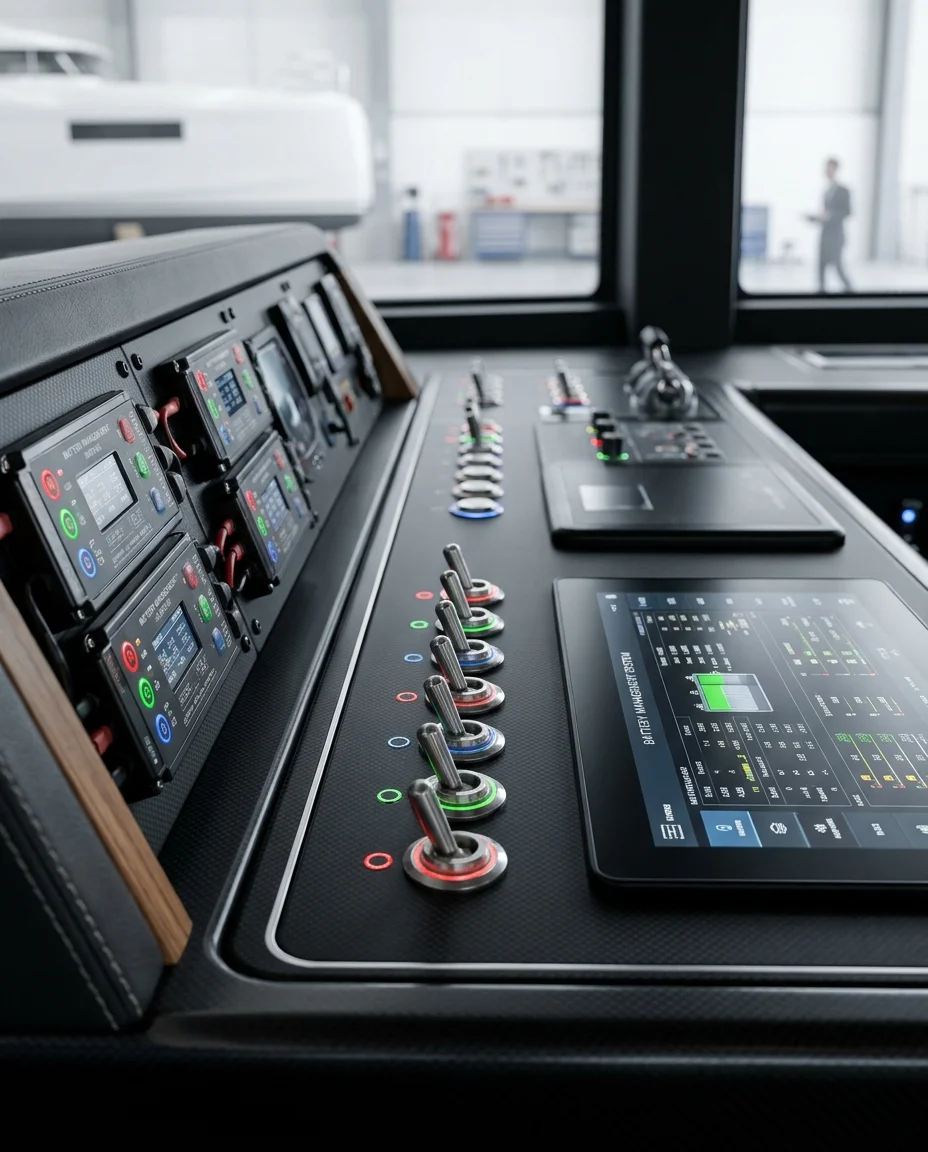
Solar-electric engineering represents a core technical specialisation of the yard. Technicians integrate marine-grade monocrystalline solar panels flush into the coachroof and flybridge hardtop mouldings, generating between 7 kWp on solar-assisted models and up to 17 kWp on dedicated solar-electric catamarans. Power harvested from these arrays feeds into high-voltage lithium battery banks managed by smart inverters and CZone digital switching architecture. At anchor, the stored energy powers high-draw domestic systems—including air conditioning, induction cooktops, refrigeration, and reverse-osmosis watermakers—silently overnight without firing a diesel auxiliary generator. Hull engineering and electrical installations comply with stringent international classification rules, including CE Category A ocean ratings, Bureau Veritas, DNV, Lloyd's Register, and Australian Maritime Safety Authority (AMSA) standards.
In-house trades and wide-beam catamaran refit services
PMG Shipyard also operates a refit and repair division addressing a common regional challenge: the shortage of haul-out facilities for multihulls in Southeast Asia. Standard marina hoists rarely accommodate beam widths beyond six or seven metres, leaving wide catamarans with few dry-dock options. PMG Shipyard's 14.4-metre-wide Magicart hoist and heavy-duty slipway trailer accommodate multihulls with beams exceeding nine metres and lengths up to 80 feet, allowing owners to schedule major structural modifications, hull extensions, or scheduled maintenance that standard marinas cannot facilitate.
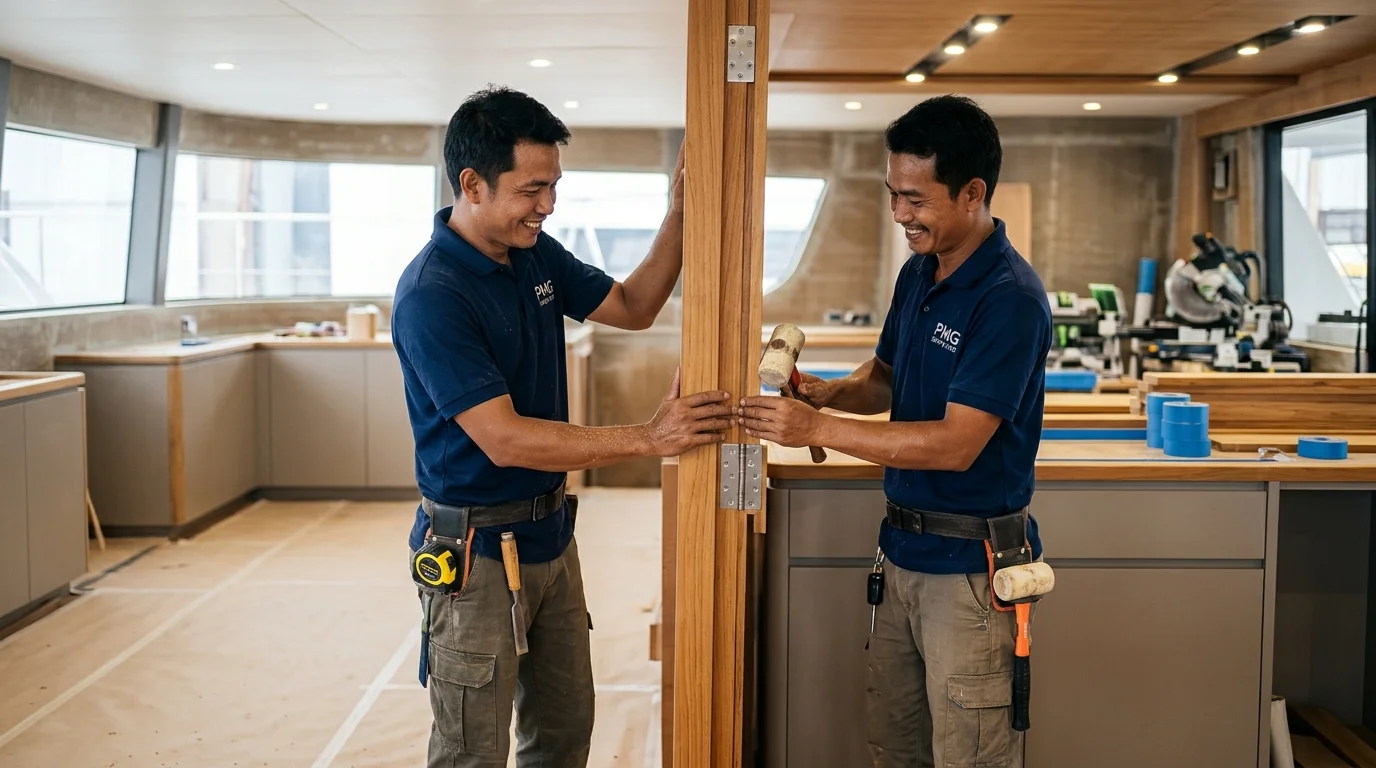
Artisanal trades are housed in dedicated workshops within the facility perimeter. The carpentry division is staffed by skilled Thai boatbuilders, including graduates of regional marine colleges, who craft custom interiors using solid teak, white oak, and marine-grade veneers. Joinery craftsmen fabricate flush saloon cabinetry, dining tables, and hand-laid exterior teak decking. A neighbouring metal fabrication workshop handles precision welding, bending, and electro-polishing of 316L marine stainless steel, producing bespoke solar gantries, bimini frames, safety pulpits, stanchions, and boarding ladders.
The yard's in-house upholstery workshop produces weather-resistant exterior cushions, sunbeds, and helm seating utilising high-density reticulated foam that drains moisture rapidly in tropical climates. The refit team regularly undertakes running gear overhauls, shaft realignments, osmosis remediation, antifouling treatments, and conversions to modern lithium energy storage. Situated close to the industrial ports of Map Ta Phut and Laem Chabang, the yard benefits from rapid regional logistics for heavy hardware, marine hydraulics, and diesel propulsion components.
Location and Getting There
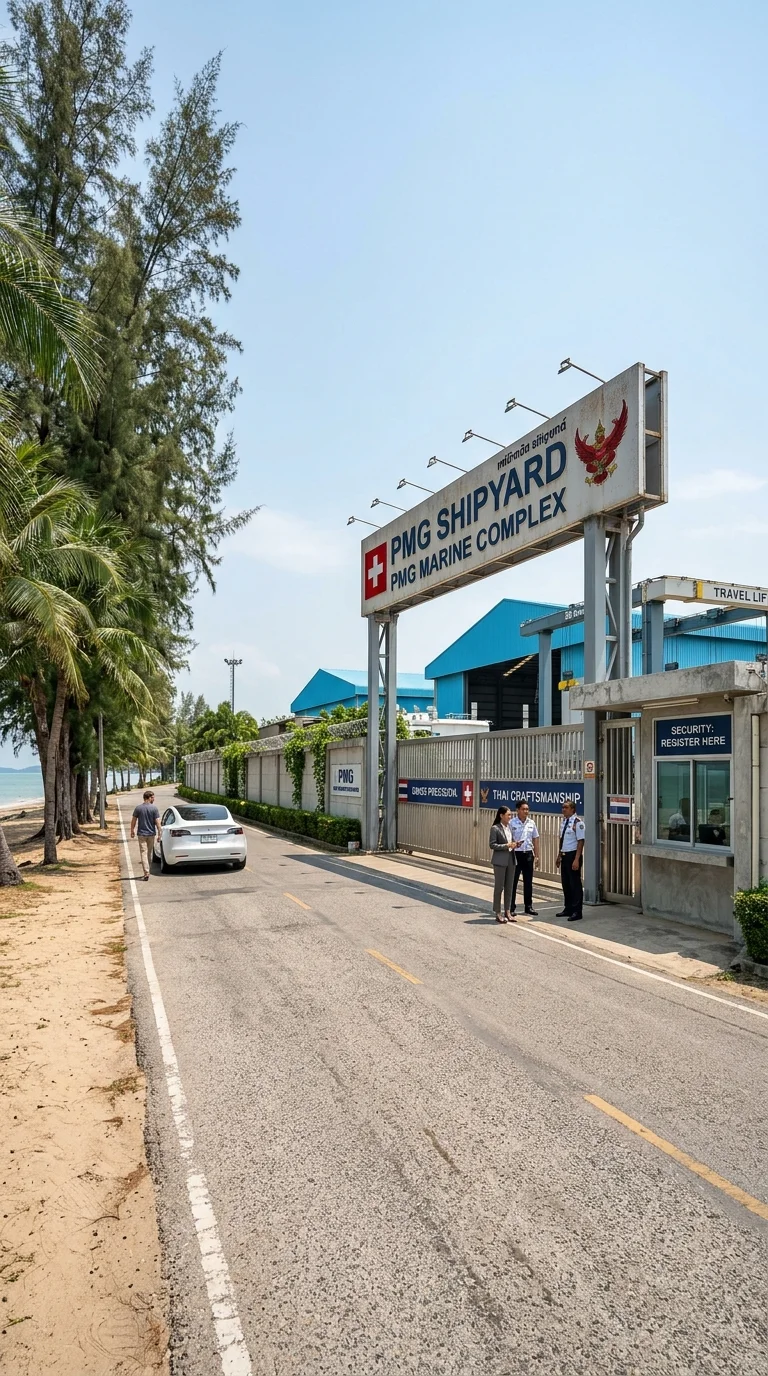
PMG Shipyard is situated at 5/7 Moo 4, Leab Haad Suchada Beach Road in the Noen Phra subdistrict of Mueang Rayong, fronting the Gulf of Thailand. Positioned approximately ten kilometres west of Rayong city centre and adjacent to the Map Ta Phut coastal industrial area, the waterfront complex is easily identified from the beach road by its large sky-blue construction hall roofs. Arriving visitors register at the main security gatehouse before proceeding into the facility's administrative offices and workshops.
International visitors landing at Bangkok's Suvarnabhumi Airport (BKK) reach the yard in roughly two hours by road, travelling approximately 160 kilometres southeast along Route 7 Motorway. Pre-arranged private car transfers and airport limousines generally cost between THB 2,200 and THB 2,800 (£50 to £64) each way. U-Tapao Rayong-Pattaya International Airport (UTP) provides a much closer commercial flight option, located roughly 35 kilometres to the west. Taxis from U-Tapao take around 35 minutes and typically charge THB 800 to THB 1,200 (£18 to £27). Motorists driving from central Pattaya or Ocean Marina Yacht Club cover roughly 65 kilometres in about an hour, approaching Rayong via Highway 36, exiting onto Route 363 towards Map Ta Phut, and following the final stretch down to the coastal road.
Costs and Booking
Commissioning a custom multihull or scheduling engineering refit work at PMG Shipyard is handled through tailored commercial marine contracts rather than fixed retail price lists. Because the facility focuses on bespoke yacht construction and specialised catamaran servicing, standard walk-in tariffs do not apply. Prospective vessel owners, naval architects, and commercial buyers can arrange initial shipyard tours, technical consultations, and project feasibility reviews free of charge, strictly by prior appointment.
Refit and engineering costs depend on the vessel's beam width, displacement, and project requirements. The yard accommodates catamarans up to 80 feet using its custom beach-launch trailer and 50-tonne hoist, with work encompassing composite infusion repairs, marine electrical systems, stainless-steel fabrication, and custom cabinetry. Rather than billing against standard marina rate cards, the shipyard assesses project scope individually and issues formal commercial quotations based on estimated workshop hours and materials.
Turnkey new builds vary in price according to naval architecture, propulsion systems, and interior specifications. Semi-custom power catamarans, such as the Cora Cat 48, have been priced at around AUD 2,530,000 (£1,300,000) for new builds at testing, with pre-owned models listed internationally at roughly USD 1,500,000 (£1,180,000). Bespoke solar-electric platforms and larger multi-deck explorer yachts scale significantly higher depending on battery capacity and layout. Build contracts operate on formal milestone stage payments, requiring an initial deposit to secure build slots and order core materials, followed by staged disbursements linked to structural infusion, engine installation, interior joinery, and sea trials.
| Service | Cost (THB) | Cost (GBP) | Notes |
|---|---|---|---|
| Prospective Buyer Consultation & Yard Tour | Free | Free | Arranged strictly by prior appointment for qualified purchasers |
| Catamaran Haul-Out & Refit Services | Price on application | Price on application | Quoted individually based on vessel beam, displacement, and scope of work |
| Cora Cat 48 Power Catamaran | Price on application | Around £1,300,000 | Indicative build price (tested at AUD 2,530,000); staged milestone contract |
| Custom Solar-Electric Catamaran Build | Price on application | Price on application | Turnkey commercial contract scaled to vessel length, battery banks, and interior |
Who It Suits Best
PMG Shipyard caters to private yacht buyers, commercial charter operators, and multihull owners seeking custom power or sailing catamarans built to European classification standards at competitive regional rates. It is equally geared towards skippers and fleet managers in Southeast Asia requiring specialist wide-beam haul-out, composite repairs, and refit works. The facility is completely unsuited to day-trippers, casual beach tourists, or holidaymakers looking for walk-in charter booths; there are no leisure amenities, passenger lounges, or retail hospitality services on site.
Visiting the yard requires genuine commercial intent and a confirmed appointment arranged in advance. Because the 20,800-square-metre waterfront complex is an active industrial manufacturing site operating 50-tonne travel lifts, heavy hoists, and enclosed vacuum resin infusion halls, management enforces strict safety and security protocols. Unannounced arrivals are turned away at the perimeter. Visitors must present formal identification and register at the main security gate before receiving an escort to the offices or construction sheds.
Commissioning a new build or scheduling extensive yard work proceeds under staged commercial contracts rather than retail transactions. Stage payments correlate with verifiable construction milestones, typically spanning naval architecture approval, composite infusion, engineering installation, and pre-handover sea trials. Waterfront launch and retrieval operations across the shoreline ramp rely on a dedicated hydraulic trailer and require careful coordination with Rayong's coastal tide windows to ensure adequate keel clearance. For international buyers, the facility operates under Board of Investment (BOI) privileges, enabling duty-free importation of high-grade European marine electronics, propulsion systems, and deck fittings without punitive domestic import tariffs.
Practical Tips
Arrange yard walk-throughs and technical inspections for the early morning. Boatbuilding halls and composite laminating bays accumulate significant heat as the tropical sun rises, making morning hours far more bearable when checking hull fairness, examining bilge compartments, and reviewing interior joinery.
Appoint an independent, accredited marine surveyor to oversee critical construction milestones. Having an impartial surveyor verify structural vacuum resin infusions, watertight bulkheads, and electrical wiring looms provides reassurance and independent documentation ahead of stage payments.
Choose accommodation along Rayong's coastline rather than commuting from Pattaya. Hotels along Suchada Beach and neighbouring Saeng Chan Beach sit within minutes of the gates, cutting out daily hour-long drives along busy industrial highways and granting flexibility if evening technical debriefs run late.
Wear sturdy, closed-toe footwear and robust trousers for every yard visit. PMG Shipyard is an active heavy industrial facility with overhead machinery, sharp composite offcuts, metal fabrication zones, and travel-lift movements, meaning trainers or lightweight clothing offer inadequate protection.
Work closely with the yard's electrical engineers to balance your solar array specifications against realistic domestic consumption. Air conditioning in tropical anchorages places heavy demands on lithium storage, so calculating solar panel surface area and battery bank capacity around your intended cruising grounds prevents power shortages later.
Plan offshore sea trials between November and February where possible. The northeast monsoon brings the driest weather and comparatively settled water to the eastern Gulf of Thailand, creating reliable conditions for calibrating electronic compasses, measuring cruising speeds, and logging electrical discharge rates.
Book international freight and custom transport cradles well ahead of your completion date. While Laem Chabang and Map Ta Phut deep-water ports sit within convenient reach of the shipyard, securing deck-cargo space on specialised heavy-lift carriers frequently requires several months of forward planning.
Pre-booking private executive vehicle hire ensures dependable transport between regional airports, coastal hotels, and the shipyard throughout your survey schedule.
Quick Reference Table
| Item | Detail | Notes |
|---|---|---|
| Facility footprint | 20,800 sq m (2-hectare site) | Beachfront location on Suchada Beach with 200 m of coastal road frontage |
| Construction halls | 4 enclosed bays (50 m x 12 m) | Features 12 m vertical ceiling clearance across 8 total production buildings |
| Maximum build length | Up to 120 ft (36.5 m) | Covers bespoke catamarans, commercial passenger ferries, and patrol vessels |
| Mobile boat hoist | 50-tonne Magicart gantry | Measures 14.4 m wide by 9.6 m high to handle wide-beam multihulls |
| Shoreline launch capacity | Up to 160 tonnes | Custom hydraulic trailer transfers catamarans up to 80 ft (24 m) into sea |
| On-site testing pool | 25 m x 13 m | Accommodates vessels up to 80 ft for watertightness and propulsion tests |
| Indicative build cost (Cora Cat 48) | Around £1,300,000 (AUD 2,530,000) | Semi-custom 14.75 m catamaran; staged milestone contract payments apply |
| Buyer consultations & yard tours | Free of charge | Strictly by prior appointment; active industrial site closed to walk-ins |
| Travel from Suvarnabhumi Airport (BKK) | ~160 km (approx. 2 hours) | Route 7 Motorway; private car transfers cost THB 2,200–2,800 (£50–£64) |
| Travel from U-Tapao Airport (UTP) | ~35 km (approx. 35 minutes) | Taxis typically cost THB 800–1,200 (£18–£27) each way |
| Travel from Pattaya / Ocean Marina | ~65 km (approx. 1 hour) | Accessible via Highway 36 and Route 363 via Map Ta Phut |
| Recommended sea trial season | November to February | Northeast monsoon provides settled seas and dry weather in the eastern Gulf |
| Website | https://pmgshipyard.com | Official website for vessel portfolios, technical data, and consultations |
FAQ: PMG Shipyard
What kind of vessels does PMG Shipyard specialise in building?
What specialised equipment does PMG Shipyard use for moving and launching large catamarans?
How does PMG Shipyard test newly built vessels before they enter open water?
What types of propulsion systems can be chosen for vessels built at PMG Shipyard?
What advanced construction technique does PMG Shipyard use for hull and deck mouldings?
How does PMG Shipyard integrate solar-electric technology into its vessels?
What challenge does PMG Shipyard address for multihull owners in Southeast Asia regarding refit services?
Where is PMG Shipyard located?
What are the requirements for visiting PMG Shipyard?
How are costs determined for new builds or refit work at PMG Shipyard?
Reviewed by the Thailand Guide Editorial Team • Last reviewed: 6 November 2026
This page is provided for general information only. While we aim for accuracy, details can change — please verify anything important independently before relying on it.