Learning to Skydive in Thailand
Standing in the aircraft doorway at up to 13,000 feet above the Gulf of Thailand, solo skydivers experience an entirely different discipline to a tandem passenger. Instead of being harnessed to an instructor, you wear your own parachute system, manage your own exit, control body position in a 120 mph slipstream, and deploy your canopy at the planned altitude.
Thailand has become an established destination for structured skydiving instruction, primarily operating under the United States Parachute Association (USPA) framework. Aspiring jumpers travel here to undertake Accelerated Freefall (AFF) courses, where certified instructors accompany you in freefall before releasing you into supervised solo progression. Crucially, passing the initial AFF stages does not make you a fully licensed skydiver. Completion merely clears you to jump solo as a student; securing an internationally recognised USPA A-Licence requires at least 25 logged jumps, canopy piloting assessments, packing proficiency, and formal examinations.
This practical guide outlines the complete route for British visitors and expatriates aiming to qualify in Thailand. We examine the full training syllabus, realistic course costs in Thai Baht and British Pounds, active dropzone operations along the Eastern Seaboard, and the process of converting your credentials with British Skydiving upon returning to the UK.

The Student Progression: From First Jump to A-Licence
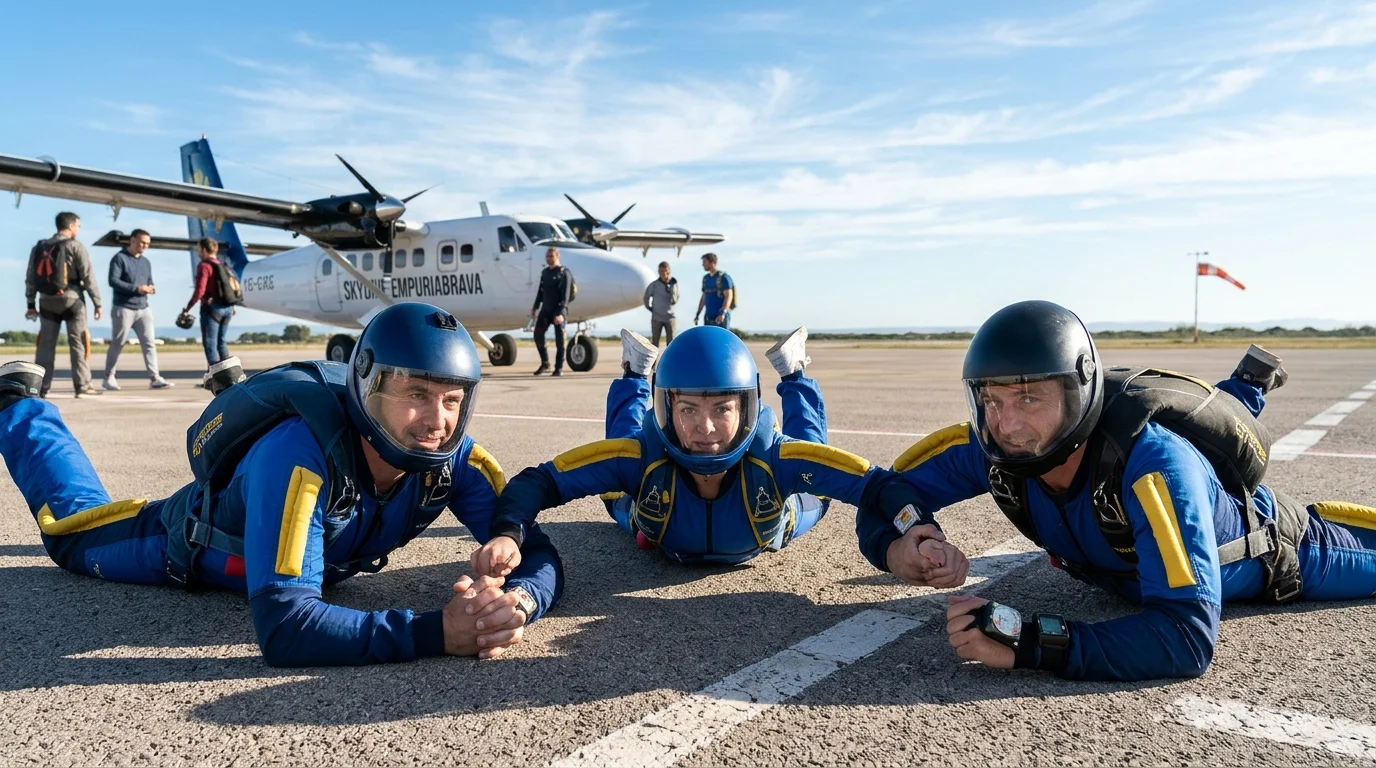
While a tandem jump introduces the sensation of freefall, you remain an attached passenger throughout the descent. Learning to skydive independently transforms that dynamic, placing you in command of your own equipment from your very first jump. The journey from beginner to qualified solo skydiver follows an internationally recognised progression divided into three distinct phases: ground school and instructor-assisted jumps, solo consolidation, and licensing evaluation.
Ground training teaches equipment mechanics, altitude awareness, aircraft exits, canopy flight, and emergency cutaway procedures. You then advance to the Accelerated Freefall (AFF) programme, which consists of seven or eight progressive levels. On your initial jumps, two instructors hold your harness in freefall to maintain stability; as you master heading control, turns, and altitude-conscious parachute deployment, you transition to jumping with a single instructor before qualifying for complete freefall release.
Completing an AFF course is a major milestone, but it does not make you a fully licensed skydiver. Finishing the programme qualifies you for supervised solo student status. At this stage, you are cleared to exit the aircraft alone, but you cannot jump with friends or travel between dropzones without direct instructor oversight.
To achieve full independence, you must build towards the internationally recognised United States Parachute Association (USPA) A-Licence used by training centres in Thailand. This qualification requires a minimum of 25 logged skydives, verified canopy landing accuracy, coached group formation jumps, unassisted parachute packing proficiency, and passing written and practical flying evaluations. Earning this licence—rather than the AFF completion certificate alone—is what officially grants you the freedom to skydive unsupervised worldwide.
Ground School and Accelerated Freefall (AFF) Breakdown
Ground school begins before anyone boards an aircraft. Ground training typically takes six to eight hours of intensive classroom tuition, equipment drills, and suspended-harness simulations. Instructors train students to handle high-speed and low-speed parachute malfunctions, canopy line twists, and off-dropzone landings. You spend hours in a suspended harness practising emergency procedures until the response becomes automatic: looking at and gripping the cutaway handle of the three-ring release system, pulling it to jettison the faulty main canopy, and peeling and pulling the reserve ripcord. You also rehearse the standard belly-to-earth arched posture, learn to scan your wrist-mounted altimeter every four to five seconds, and memorise dropzone hand signals used to communicate in freefall, where 120 mph wind rush makes speech impossible.
The practical skydiving phase follows the standardised Accelerated Freefall syllabus, operating from 13,000 to 14,000 feet. Levels 1 to 3 require two USPA-rated instructors who maintain a physical grip on your harness from exit through terminal-velocity descent. In these early stages, you focus on stable flight, heading control, constant altitude monitoring, and practice ripcord touches. Instructors remain on hand to correct body position with visual hand signals and will pull your deployment pilot chute if you lose altitude awareness. On Level 3, provided you maintain stable flight and good heading control, both instructors release their grip to let you fly independently. Once under canopy, a one-way radio receiver fitted inside your helmet allows an instructor on the ground to talk you through traffic patterns and landing flares.
From Level 4 onward, training scales down to a single instructor. These jumps build airborne agility and spatial control. You perform unassisted exits, execute controlled 90-degree and 360-degree flat turns, practise forward movement, and intentionally induce instability through backloops or barrel rolls before quickly recovering into a stable arch. Level 7 serves as a comprehensive evaluation dive, combining a solo exit, aerobatic manoeuvres, and directional tracking to create horizontal airspace separation prior to parachute deployment. Most curricula also incorporate a low-altitude exit—often designated as Level 8 or completed as an early consolidation jump—from around 5,000 feet, known as a hop and pop, where you exit and deploy your canopy within five seconds.
Progression through every AFF stage is strictly competency-based. An instructor debriefs each jump using helmet-camera footage to review your performance. If you fail to achieve a required learning objective, such as struggling to regain stability within five seconds or missing designated deployment altitudes, you must repeat that specific level before advancing. Repeat jumps incur additional individual jump costs, making thorough ground preparation vital for uninterrupted progression.
Plan a Gulf of Thailand trip with clear guidance on island groups, ferries, weather, marine parks, accommodation costs and mainland gateways.
Canopy Piloting, Consolidation Jumps, and Solo Skills
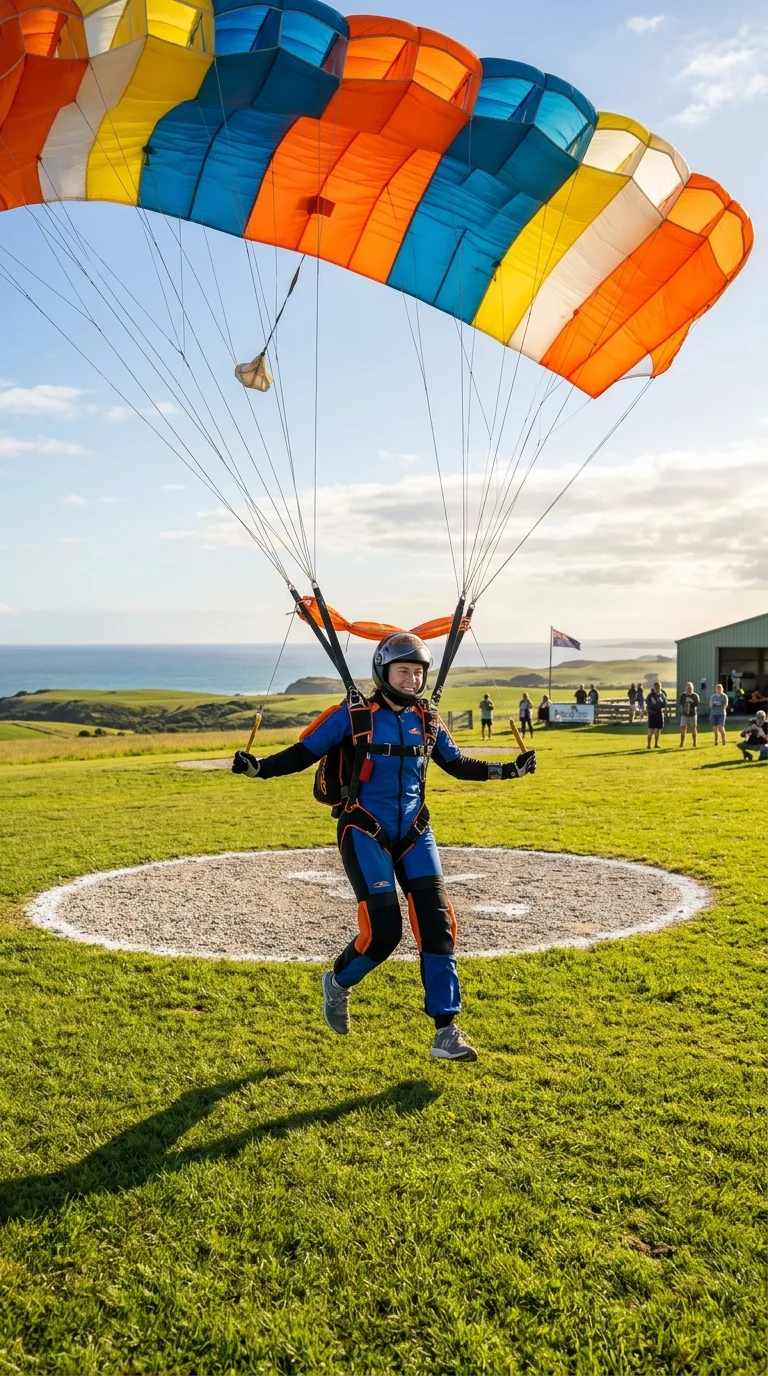
Steering a modern ram-air parachute down safely requires as much technical discipline as managing freefall. Once your main canopy deploys, you conduct an immediate visual check to confirm it is rectangular, fully inflated, and free from line twists. Releasing the steering toggles allows you to test controllability through a series of practice flares and turns well above decision altitude. Ground-to-air radio guidance supports your initial descents, but electronics can fail. Every student must master independent flight planning by reading ground winds from the dropzone windsock, estimating drift, and flying a standard landing circuit: a downwind leg, a crosswind base leg, and a final approach into the wind.
Between graduating from Accelerated Freefall (AFF) and reaching the 25-jump milestone required for an initial licence, you progress under solo student status. These consolidation jumps build the practical competence needed in active dropzone airspace. Under canopy, you practise flare timing, braked flight, flat turns, and landing within designated target areas, learning to judge approach angles without ground cues.
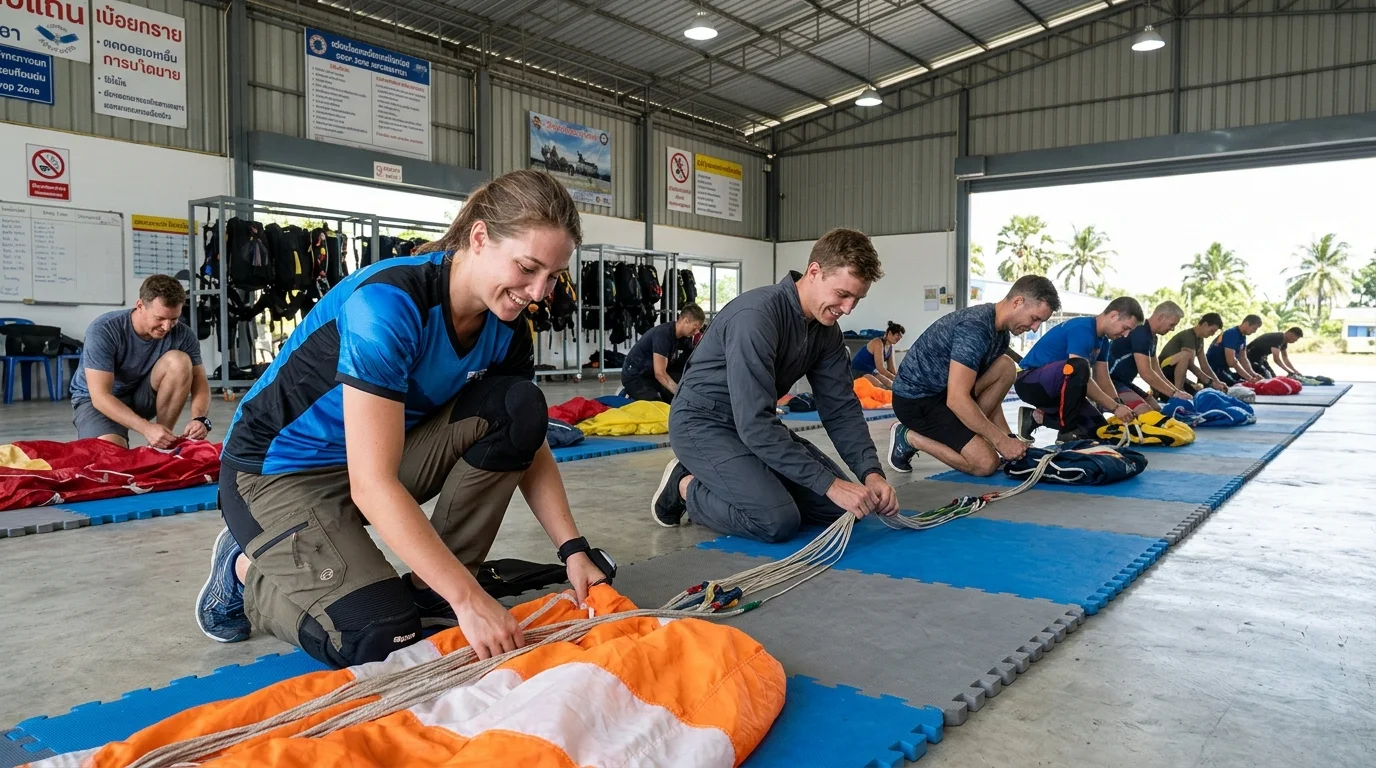
Alongside solo jumps, you must complete at least five coached jumps with an accredited USPA instructor or coach to learn group freefall skills. These flights teach relative work, including matching fall rates, controlled docking, and tracking cleanly away at break-off altitude to ensure safe horizontal separation before deployment. You must also demonstrate that you can independently inspect and pack your own main parachute, verified on the dropzone packing mats by a qualified instructor or rigger. Each consolidation jump replaces beginner reliance with the practical self-sufficiency demanded of a licensed skydiver.
International Licence Recognition and Converting to British Skydiving
Thailand's active dropzones train students under the United States Parachute Association (USPA) Integrated Student Program. Earning an official USPA A-Licence requires completing a minimum of 25 logged freefall jumps, fulfilling every technical skill on the USPA A-Licence Proficiency Card, passing a 40-question written examination alongside an oral test, and executing a successful check dive with an instructor. Because the USPA is the national air sport control body for parachuting in the United States and affiliated with the Fédération Aéronautique Internationale (FAI), a completed USPA licence is recognised at sport dropzones across the globe.
When returning to the United Kingdom, British Skydiving (formerly the British Parachute Association) does not automatically swap an overseas credential for a UK licence card over the counter. However, British Skydiving Parachute Training Organisations (PTOs) routinely accommodate USPA licence holders under established foreign qualification procedures.
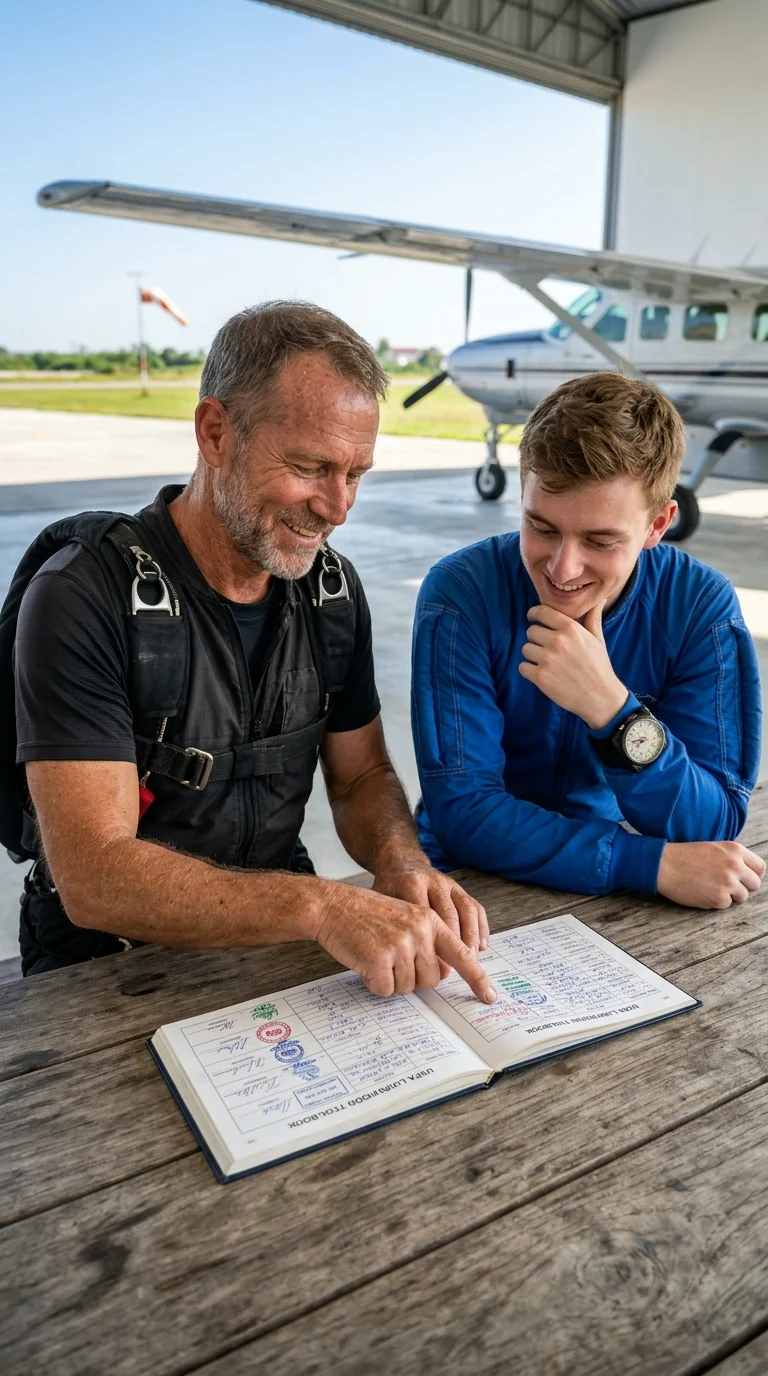
To jump independently at a British dropzone, you must purchase British Skydiving membership to secure mandatory third-party liability insurance, complete a medical fitness declaration, present your official USPA licence card, and provide a thoroughly documented logbook. Every training jump in Thailand should carry an instructor or coach signature and official dropzone stamp; unverified logbook entries cause immediate administrative friction.
Dropzone safety remains under the statutory authority of the dropzone's Chief Instructor (CI). Depending on your currency—USPA A-Licence holders require recurrency training after 60 days without a jump—the CI will inspect your equipment, conduct a dropzone orientation, and assess your paperwork. If your jumps are recent and fully endorsed, you will typically complete a brief equipment and canopy handling briefing, or occasionally a supervised check jump, before being cleared to manifest as an independent sport skydiver.
Weather Patterns, Timing, and Training Pace
Tropical coastal conditions govern skydiving training far more strictly than general tourism. Low cloud ceilings, convective rain, and unstable air ground jump aircraft without hesitation, as student training requires strict visibility minimums and manageable winds. Under United States Parachute Association (USPA) Basic Safety Requirements, solo students face a maximum surface wind limit of 14 mph (approximately 12 knots), and coastal dropzones typically call a weather hold for students when surface gusts reach 12 to 14 knots, even while experienced licence holders continue to jump.
Qualifying for an A-Licence in Thailand is not a brief holiday venture. While intensive ground school and the initial Accelerated Freefall (AFF) stages can theoretically take three to four days in unbroken clear weather, real-world progression requires patience. Along the Gulf of Thailand, convective heat creates afternoon cloud cover and sudden showers, meaning dropzones run the majority of student jump loads during the calm morning window between 07:30 and 11:30.
Achieving the full 25 jumps for an A-Licence realistically demands 10 to 14 days on-site. Factoring in surplus buffer days protects your investment, giving you ample time to absorb repeat jumps, wait out temporary weather holds, and complete mandatory consolidation tasks without cutting your training short.
Where to Learn Skydiving in Thailand
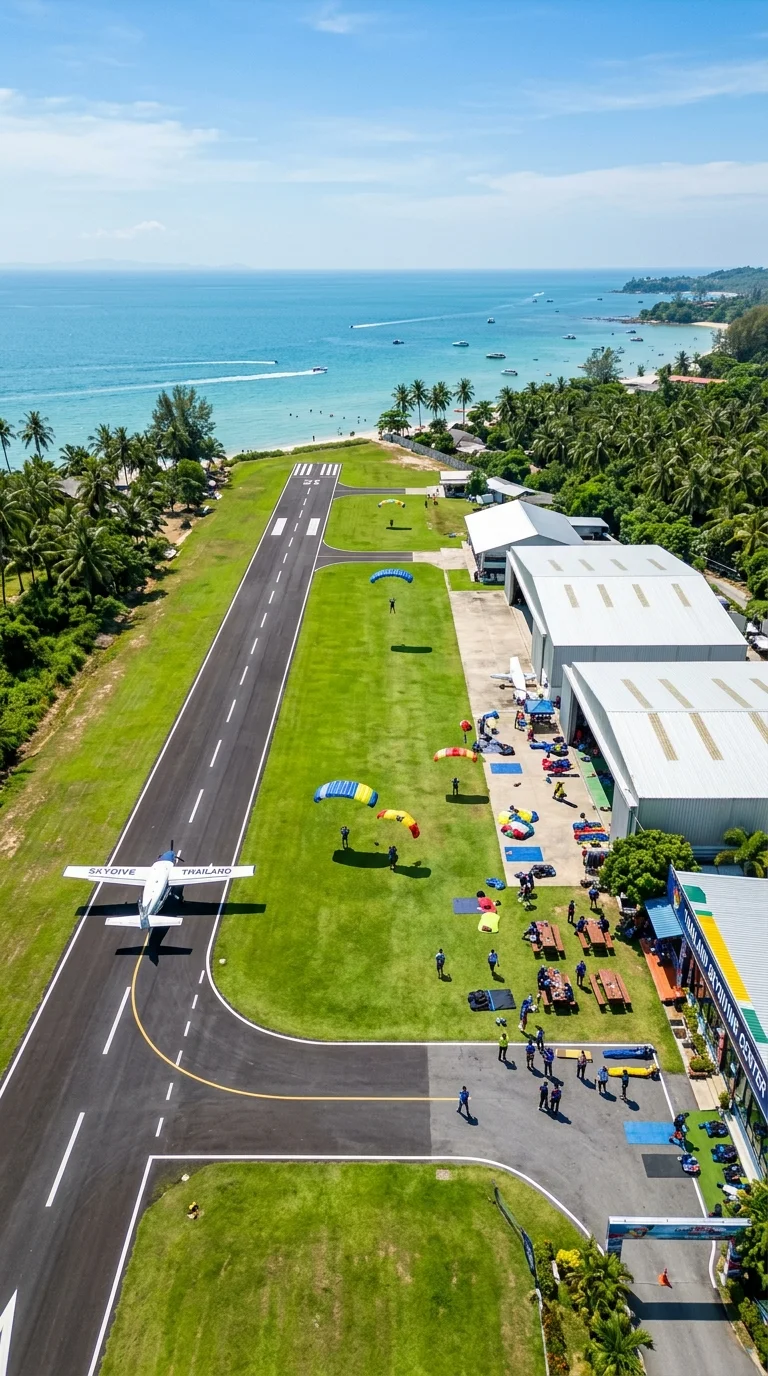
Structured skydiving tuition in Thailand is concentrated along the Eastern Seaboard, within two to three hours' drive of Bangkok. While tandem operations previously ran in the north outside Chiang Mai at Phusanfah Airfield, civil aviation suspensions halted flights there in mid-2026. Aspiring solo students must focus on the two fully operational coastal facilities that run USPA-affiliated Accelerated Freefall (AFF) and licence progression courses.
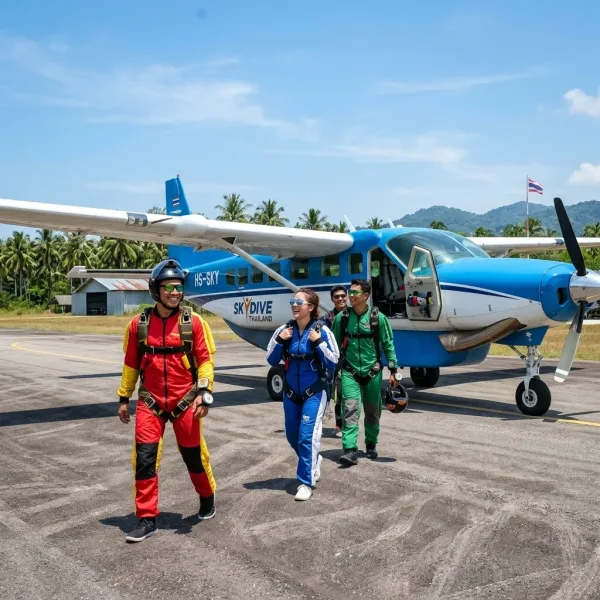
Thai Sky Adventures, based at Nong Khor Reservoir in Si Racha, Chonburi Province, is Thailand's longest-running training facility. Located approximately 96 km south of Bangkok Suvarnabhumi Airport and 40 km north of Pattaya, the centre is reached by highway taxi or pre-arranged road transfer. The dropzone operates a dedicated Pilatus Porter jump aircraft carrying students to 13,000 feet over coastal plains and the Gulf of Thailand. Facilities include air-conditioned briefing rooms, gear hire, parachute packing areas, and student accommodation, making it practical for trainees completing consecutive training days.
Further south-east along the coast lies Dropzone Thailand, situated in the rural Klaeng District of Rayong Province, roughly 180 km from Suvarnabhumi Airport. Flying a turbine Kodiak 100 to altitudes between 13,000 and 13,500 feet, the centre provides open airspace, dedicated training classrooms, and parachute landing areas with views across the ocean towards Koh Samet. Because the airfield sits four kilometres off the main highway with no local public transport, trainees need to hire a car from Bangkok or arrange private transport for their stay.
When booking an AFF course or an A-Licence package, organise training directly with the dropzone rather than through Bangkok tour agencies or activity resellers, which cater almost exclusively to tandem tourists and cannot manage student progression schedules. For broader background on jumping in the country, consult our national overview of Skydiving in Thailand.
Costs and Budgeting
Qualifying as an independent skydiver in Thailand requires budgeting for structured instruction, aircraft jump tickets, gear hire, licensing administration, and contingency repeat jumps. Total expenditure from your initial ground school briefing through to earning a USPA A-Licence typically falls between THB 140,000 and THB 165,000 (approx £3,180 to £3,750), assuming you pass most stages on your first attempt.
Thai Sky Adventures in Si Racha publishes clear package rates. An introductory package comprising ground school, a training tandem, and your AFF Level 1 jump costs THB 25,950 (approx £590). Their full seven-level AFF course is priced at THB 90,950 (approx £2,070), which includes all necessary equipment rental and parachute repacking. A complete 25-jump A-Licence package costs THB 149,550 (approx £3,400), covering ground school, AFF Levels 1 to 7, five coached jumps, twelve solo consolidation jumps, and kit hire. At Dropzone Thailand in Rayong, standalone AFF courses historically start from around THB 70,000 to THB 85,000 (approx £1,590 to £1,930), with complete licensing programmes running from THB 133,000 (approx £3,020).
Progression depends strictly on demonstrated competence rather than jump numbers, making repeat jumps a vital budget consideration. If you fail to achieve stability or altitude awareness on early stages, repeating Levels 1 to 3 costs THB 13,000 (approx £295) per jump because two instructors must accompany you in freefall. Repeating Levels 4 to 7 requires one instructor and costs THB 8,000 (approx £180) per jump.
Additional expenses include compulsory USPA student membership at THB 2,600 (approx £60) to log certified jumps, solo jump tickets at THB 1,400 to THB 1,500 (approx £32 to £34), and kit hire with repacking at THB 800 to THB 1,500 (approx £18 to £34) per jump. Dropzone lodging starts from THB 650 (approx £15) per night at Si Racha, and manifests typically apply a 2.5% card processing fee.
| Training Component | Cost (THB) | Cost (GBP) | Details |
|---|---|---|---|
| Ground School & AFF Level 1 | 25,950 | £590 | Theory, safety exams, training tandem, Level 1 jump, kit hire |
| AFF Full Course (Levels 1–7) | 88,000 – 90,950 | £2,000 – £2,070 | Complete 7-level programme with gear hire and packing |
| Complete A-Licence Package | 133,000 – 149,550 | £3,020 – £3,400 | 25 jumps: AFF 1–7, 5 coach jumps, 12 solos, kit hire |
| Repeat Jump: Levels 1–3 | 13,000 | £295 | Per-jump fee with two AFF instructors if objectives missed |
| Repeat Jump: Levels 4–7 | 8,000 | £180 | Per-jump fee with single AFF instructor for drills |
| Solo Jump Ticket | 1,400 – 1,500 | £32 – £34 | Lift to 13,000 ft once cleared for solo student status |
| Kit Rental & Repacking | 800 – 1,500 | £18 – £34 | Parachute rig, instruments, and pack job per jump |
| USPA Student Membership | 2,600 | £60 | Compulsory registration for logging sanctioned jumps |
What to Know Before You Go
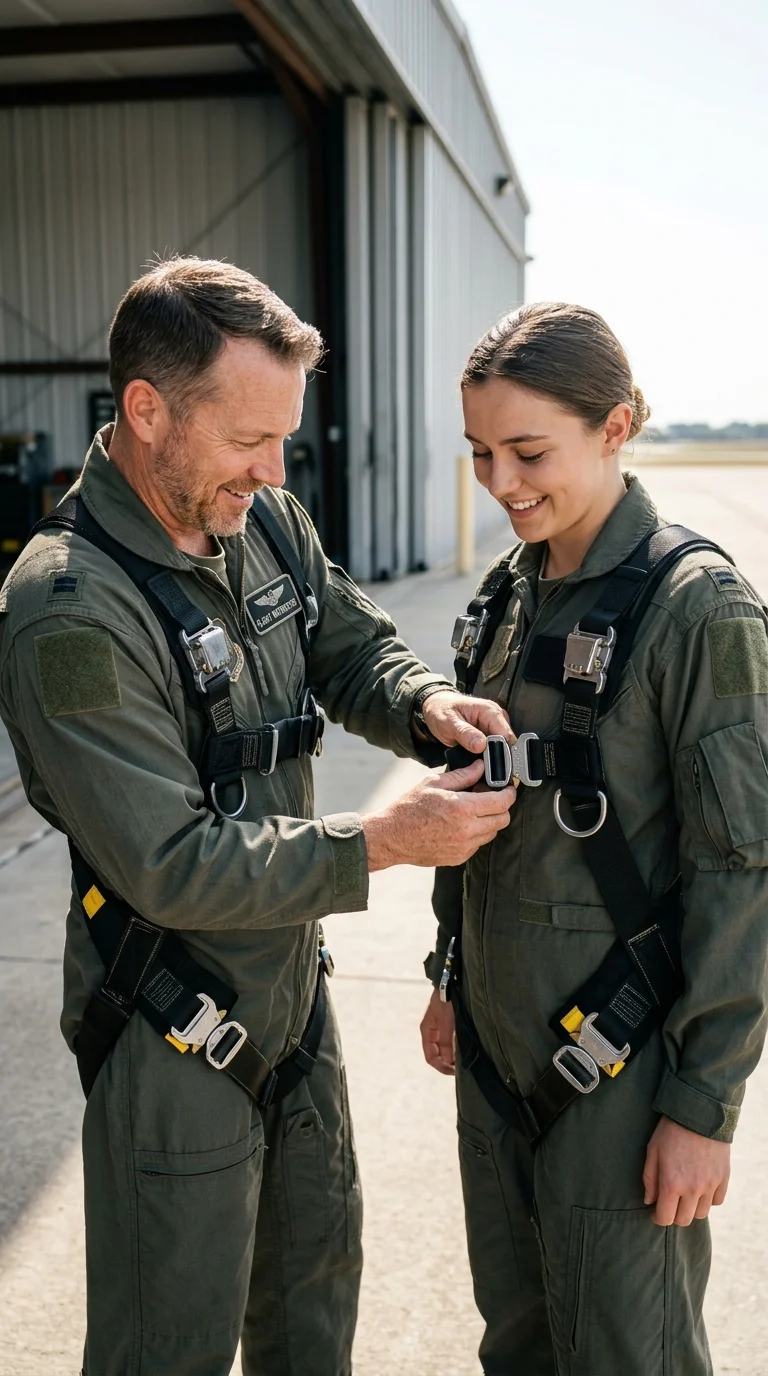
Weight limits are strictly enforced at Thai dropzones to preserve equipment tolerances and controlled canopy descent rates. Student cut-offs vary by facility, typically capped at 95 kg or 100 kg at Thai Sky Adventures, and 85 kg at Dropzone Thailand. Instructors weigh candidates upon arrival in jump attire, and exceeding the threshold results in refusal without a refund.
Ground school is mentally intense and conducted primarily in English or Thai. Clear comprehension is a mandatory safety requirement rather than a formality: trainees must absorb rapid malfunction procedures, emergency canopy drills, and live radio instruction under high-stress conditions.
Standard UK travel insurance policies strictly exclude solo sports parachuting. Trainees must arrange a dedicated extreme activity policy that explicitly covers solo skydiving training, high-altitude jumps, emergency medical care, and repatriation.
Do not combine skydiving with scuba diving on the same trip without careful planning. Ascending to dropzone altitudes after breathing compressed air creates a severe risk of decompression sickness. Aviation and hyperbaric authorities require a surface interval of at least 24 hours after scuba diving before making any skydive. While skydiving itself does not cause decompression illness before boarding a commercial airliner, keeping a buffer day before flying home allows your sinuses to equalise and absorbs unexpected weather delays.
Practical Training Tips
Renting a car upon arrival at Bangkok Suvarnabhumi Airport provides the flexibility required for a skydiving course. Both active dropzones in eastern Thailand—Thai Sky Adventures near Si Racha and Dropzone Thailand in Klaeng—are situated in rural settings several kilometres off main highways. Local ride-hailing mobile applications have very limited vehicle availability in these districts, making early-morning pickups and evening returns unreliable without private transport.
Choose accommodation within a short drive of the airfield rather than commuting from central Pattaya or coastal resort strips. Arriving at the dropzone by 07:30 to 08:00 allows you to attend the morning briefing, manifest on early aircraft rotations, and complete student jumps before midday heat thermals and rising coastal winds affect air conditions.
Pack lace-up trainers with flat rubber soles, such as classic skate shoes or low-profile running shoes. Footwear with deep heel treads can catch on turf during landing flares, while sandals and slip-ons are strictly banned. Footwear featuring open metal lace hooks is completely prohibited on dropzones because loose hooks present a severe line-snag hazard during parachute deployment.
Maintain a physical skydiving logbook from your very first jump and obtain an instructor signature immediately after each debrief. When returning home, British Skydiving safety officers require complete, countersigned records showing exit altitudes, freefall times, canopy flight tasks, and instructor licence numbers before recognising overseas training progression.
Budget a financial contingency for two or three repeat training jumps. Skydiving progression is strictly performance-based; students occasionally repeat an Accelerated Freefall stage due to minor heading drift, instability, or hesitation during deployment drills. Having dedicated reserve funds prevents course interruptions if you require an additional jump to meet progression standards.
Focus on core strength, hip flexor flexibility, and lower-back endurance before travelling. Sustaining the classic belly-to-earth arch position against 120 mph relative wind places substantial demands on your spinal muscles and neck extensors during intense training days.
Quick Reference Table
| Item | Detail | Notes |
|---|---|---|
| Governing body | United States Parachute Association (USPA) | Training follows the USPA Integrated Student Program leading to an A-Licence |
| Full A-Licence package cost | THB 133,000 – THB 149,550 (approx £3,020 – £3,400) | Covers 25 jumps: ground school, AFF Levels 1–7, 5 coached jumps, 12 solos, and gear rental |
| Total licensing budget | THB 140,000 – THB 165,000 (approx £3,180 – £3,750) | Realistic budget including USPA membership, admin, and potential repeat jumps |
| Full AFF course cost | THB 70,000 – THB 90,950 (approx £1,590 – £2,070) | 7 to 8 progressive levels with gear hire; qualifies you only for supervised student solo status |
| Repeat jump costs | THB 13,000 (£295) for Levels 1–3; THB 8,000 (£180) for Levels 4–7 | Progression is strictly performance-based; repeat jumps require additional instructor fees |
| Dropzone locations | Si Racha (Chonburi) & Klaeng (Rayong) | Active facilities are Thai Sky Adventures (Si Racha) and Dropzone Thailand (Rayong) |
| Recommended training duration | 10 to 14 days on-site | Allows time for ground school, 25 jumps, packing proficiency, and weather hold buffers |
| Daily jumping window | 07:30 to 11:30 | Calmest morning weather before coastal afternoon heat thermals, clouds, and winds develop |
| Wind limits for students | Maximum 14 mph (12 knots) | Surface gusts of 12–14 knots trigger mandatory weather holds for student skydivers |
| Weight restrictions | 85 kg to 100 kg strict maximum | Thai Sky Adventures caps at 95–100 kg; Dropzone Thailand caps at 85 kg; strictly weighed on arrival |
| Required footwear | Flat rubber-soled lace-up trainers | Skate or flat running shoes; shoes with deep treads or open lace hooks are strictly banned |
| Scuba diving interval | Minimum 24 hours | Must wait at least 24 hours after scuba diving before skydiving to prevent decompression sickness |
| British Skydiving conversion | Requires full USPA licence & signed logbook | Must join British Skydiving, hold third-party insurance, and complete Chief Instructor check |
FAQ: Learning to Skydive in Thailand
What licence can a person earn by learning to skydive solo in Thailand?
What does completing an Accelerated Freefall (AFF) course qualify a student for?
What is taught during skydiving ground training?
How does progression work in the Accelerated Freefall (AFF) skydiving course?
What are the requirements to earn a USPA A-Licence in Thailand?
What is needed to convert a USPA A-Licence to jump in the UK?
What are the wind limits for student skydivers in Thailand?
How long does it typically take to earn a USPA A-Licence in Thailand?
How should one book a skydiving course in Thailand?
What is the typical total cost to earn a USPA A-Licence in Thailand?
Reviewed by the Thailand Guide Editorial Team • Last reviewed: 4 November 2026
This page is provided for general information only. While we aim for accuracy, details can change — please verify anything important independently before relying on it.