Thai Sky Adventures

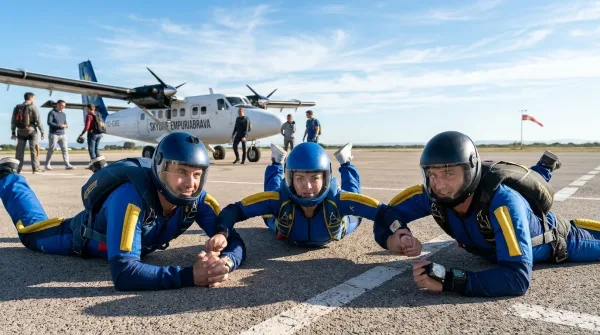
Established in November 2009 near Nong Khor Reservoir in Si Racha, Thai Sky Adventures is the longest-running full-time civilian dropzone in Southeast Asia. The airfield operates commercial tandem skydives, Accelerated Freefall (AFF) solo training courses, and regular turbine aircraft lifts for licensed sport jumpers, taking canopies to exit altitudes of up to 13,000 feet (approximately 4,000 metres).
Jumpers exit the aircraft into around 60 seconds of freefall, reaching speeds of approximately 120 miles per hour (200 kilometres per hour) before instructors deploy parachutes at roughly 5,000 feet above the Chon Buri coastal plain. The centre is staffed by United States Parachute Association (USPA) qualified instructors and commercial pilots, adhering to international safety frameworks. Operating seven days a week from 08:00 to 17:00, Thai Sky Adventures sits within convenient transfer range of both Pattaya and Bangkok, catering to first-time bucket-list jumpers and visiting international parachutists alike.

Airfield Infrastructure and Jump Aircraft
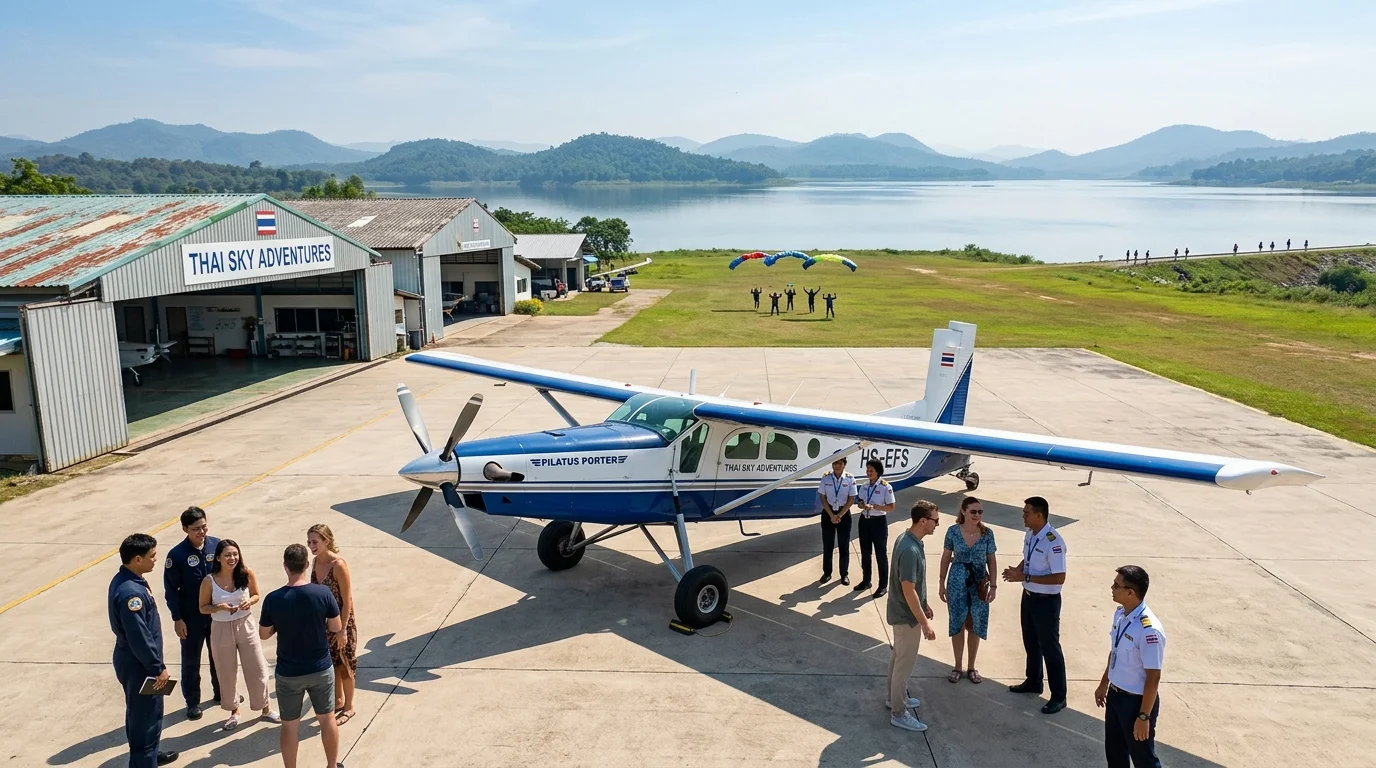
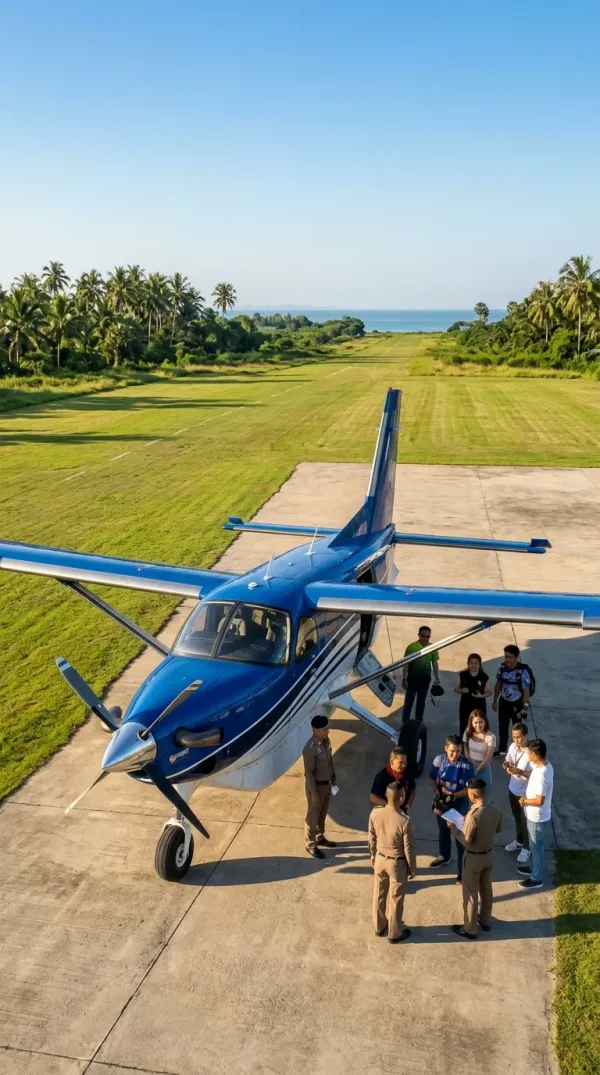
Thai Sky Adventures centres its flight operations around a private aviation facility in Si Racha, configured specifically for sport parachuting and accelerated student training. Situated adjacent to the Nong Khor Reservoir in rural Chon Buri, the complex includes a dedicated paved runway, an expansive open grass and sand landing area, and aircraft parking aprons. The flat surrounding countryside provides unobstructed approach corridors clear of commercial air traffic and high-rise structures, allowing regular flight rotations from early morning onwards.
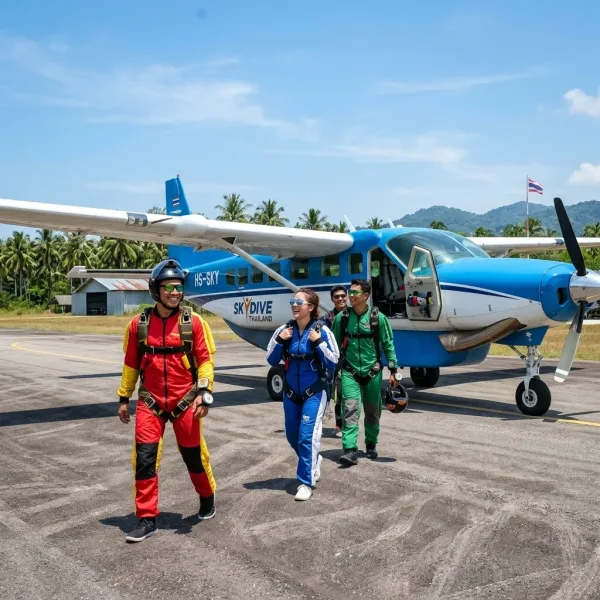
Flight operations revolve around specialised jump platforms, led by the Swiss-manufactured Pilatus Porter PC-6 turboprop. In skydiving operations, single-engine turboprop aircraft present substantial functional advantages over conventional piston-engine planes. The Pratt & Whitney turbine engine delivers a rapid rate of climb, reaching the target exit altitude of 13,000 feet in approximately 15 to 18 minutes. This climb profile shortens turnaround times between flight manifests, produces a stable cabin atmosphere, and enables the dropzone to cycle loads efficiently during favourable morning weather windows. Jumpers board through a wide roller door on the starboard side, sitting in file on the padded cabin floor as the aircraft climbs across eastern Thailand. Because coastal weather systems can shift quickly across Chon Buri, ground staff run dedicated weather-monitoring stations, wind-direction socks, and direct aviation radio communication to track surface gusts and cloud layers in real time. Every lift is scheduled through an active manifest desk that balances aircraft weight distribution and coordinates slots across tandem pairs, solo students, and licenced skydivers.
Tandem Skydiving and Freefall Profiles
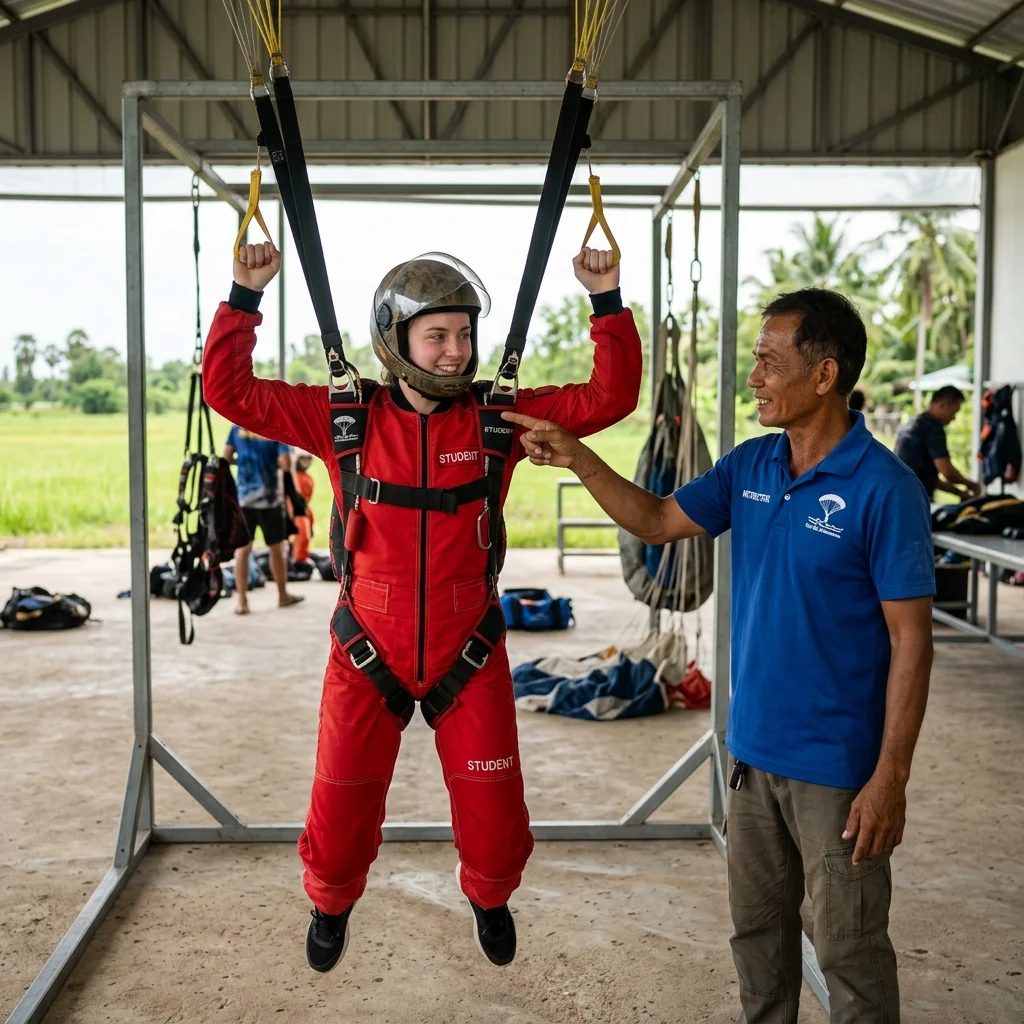
Tandem jumps form the backbone of daily operations, pairing unlicenced participants with experienced tandem masters certified by the United States Parachute Association (USPA). Before boarding, participants complete a concise 10 to 15-minute ground briefing. This session covers aircraft departure body mechanics, the hips-forward arch position required throughout freefall, and the landing flare drill where jumpers raise their legs to permit a seated slide across the turf. Once fitted into a heavy-duty four-point harness attached to the instructor's rig at structural points rated to thousands of kilograms of tensile stress, participants walk to the flight apron.
When the Pilatus Porter reaches 13,000 feet above ground level, the flight crew slides open the jump door. Moving to the sill, the tandem pair steps into the open air, experiencing roughly 50 to 60 seconds of terminal-velocity freefall at approximately 120 miles per hour (200 km/h). Air resistance balances gravitational pull to create a stable cushion under the body. Seconds after exit, the tandem master deploys a small drogue parachute; this fabric cone prevents unstable tumbling, controls descent velocity, and ensures proper orientation during high-speed descent.
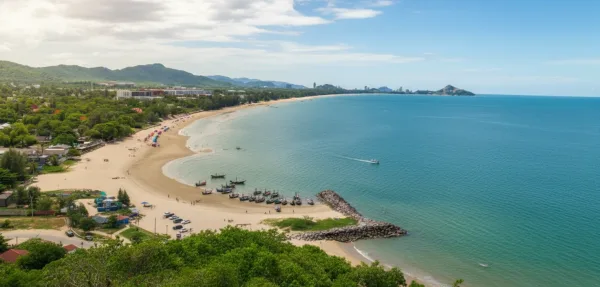
At approximately 5,000 feet above ground level, the instructor deploys the main ram-air canopy. The parachute opens progressively, causing rapid deceleration that converts the dive into a controlled descent lasting five to seven minutes. During this canopy phase, the instructor loosens harness tension points for comfort and hands control of the dual steering toggles to the student. Gliding down towards the airfield provides clear aerial views of Nong Khor Reservoir, rural Chon Buri farmland, and the Gulf of Thailand coastline reaching southwards towards Pattaya and northwards towards Chon Buri town. Touchdown takes place on the designated turf landing zone, where the instructor executes an aerodynamic flare for a seated slide or gentle stand-up landing. Visual media packages can be coordinated at manifest before takeoff, assigning either a wrist-mounted camera on the instructor or an outside camera flyer who descends alongside the tandem pair to film wide-angle freefall footage.
Complete guide to learning solo skydiving in Thailand. Details AFF course stages, USPA A-Licence costs, dropzone locations, and British Skydiving conversion.
Accelerated Freefall and Professional Training
Thai Sky Adventures also operates as a formal USPA-affiliated skydiving school, conducting Accelerated Freefall (AFF) training and A-Licence progression programmes for people seeking independent solo qualification. The AFF curriculum bypasses older static-line routines, placing the student in direct freefall from 13,000 feet on the very first jump. Training starts with an intensive ground school lasting roughly six hours. Classroom modules cover high-altitude aerodynamics, harness adjustments, flight instruments, canopy flight paths, holding patterns, and manual emergency drills using suspended training harnesses.
The school structures its full AFF course across seven progression levels, each requiring demonstration of specific competencies before advancement. During Levels 1 through 3, two certified USPA instructors grip the student's harness on either side through freefall, monitoring stability, hand-signal responses, and altitude awareness before the student initiates canopy deployment. Levels 4 through 7 transition to a single accompanying instructor who releases hold to observe solo manoeuvres. In these upper stages, students practise 360-degree flat turns, forward tracking, backloops, and unstable exit recoveries. Ground personnel maintain two-way radio communication with students during the solo canopy descent, giving vocal directions to steer into the landing pattern.
Students aiming for full sporting independence can continue into the USPA A-Licence programme. This package covers the 25 required skydives, gear rental, structured parachute packing lessons, canopy piloting exams, and oral and written tests. On-site USPA riggers inspect, repack, and certify student canopies and reserve parachutes in strict accordance with civil aviation standards. Earning the A-Licence grants international privileges, enabling skydivers to manifest solo at dropzones worldwide without direct instructor supervision.
Ground Facilities, Rigging Stations, and Dropzone Amenities
The airfield campus accommodates participants, licenced sports jumpers, and non-jumping companions. The main hangar centres on a spacious carpeted packing floor, where certified packers and riggers inspect gear, fold canopies, and prepare rigs beneath large overhead fans. Beside the packing zone, the administration and manifest office manages registrations, checks original passports, records body weight, and coordinates flight loads.
Visitors have access to an on-site restaurant and coffee shop located upstairs within the main complex. Elevated seating gives diners a clear view across the active runway, flight aprons, and landing lawns, allowing friends and family to follow parachute descents from opening altitude down to touchdown. The kitchen serves a selection of Thai dishes, noodle bowls, espresso drinks, and cold refreshments throughout operating hours. Non-jumping companions travelling on dropzone transfers can wait comfortably in this shaded viewing space while participants complete their briefings, flight cycles, and landings.
Beside the aviation facilities, the property grounds also feature an affiliated target shooting range. This facility operates pistol, rifle, and shotgun lanes, giving participants and companions a separate recreational option while waiting for flight manifests or canopy repacks. Digital editing booths on site process video footage and still photographs captured during the jump, delivering completed digital media files within 30 to 45 minutes of touchdown. Jumpers can review their footage on display screens before boarding their return transfers.
Location and Getting There
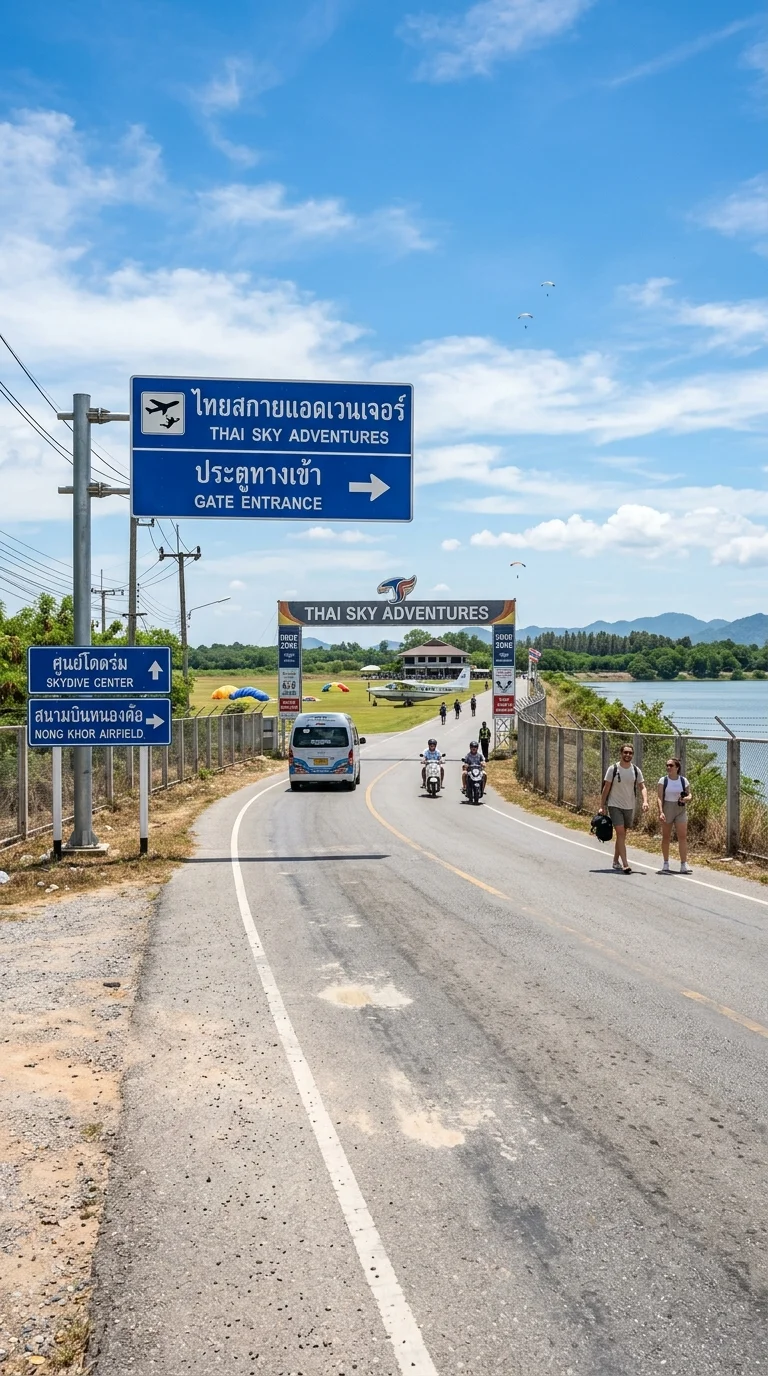
Thai Sky Adventures operates from an airfield at 777/77 Moo 11 in Nong Kham, Si Racha District, Chon Buri, right alongside the Nong Khor Reservoir. The dropzone sits roughly 25 to 30 kilometres north of central Pattaya and approximately 96 kilometres south-east of Bangkok via Route 7.
Road travel from Suvarnabhumi Airport (BKK) takes about an hour and fifteen minutes by metered taxi or ride-hailing app, generally costing between 1,200 THB and 1,500 THB (£27 to £34). Travellers arriving via Don Mueang Airport (DMK), 156 kilometres north, should anticipate a journey of around two hours, typically priced at roughly 1,800 THB (£41).
For tandem jumpers, the dropzone provides complimentary return transfers in air-conditioned minibuses from Pattaya hotels and the Pattaya North Bus Station. Pickup slots run between 07:00 and 07:30 or 10:00 and 10:30, with return runs leaving the airfield around 13:00 and 16:00 once jumping concludes. One non-jumping companion may ride along at no extra charge, though additional spectators pay 500 THB (£11).
Jumpers travelling from Bangkok can join a shared morning minibus departing outside the Novotel Bangkok on Siam Square, a short walk from Exit 6 of Siam BTS Skytrain Station. Passengers muster by 09:15 for a 09:30 departure, paying 500 THB (£11) per person for the return journey, which heads back once all riders complete their jumps.
Costs and Booking
Tandem skydiving rates at Thai Sky Adventures follow a fixed structure determined by media capture. At the time of writing, a standard 13,000-foot tandem jump costs 9,700 THB (approximately £220), covering flight time, instructor fees, gear hire, and return minibus transfers from Pattaya hotels. Jumpers can add media options: wrist-mounted instructor video costs 13,650 THB (£310), a combined wrist video and digital still photo package costs 14,650 THB (£333), and the Deluxe Package costs 15,650 THB (£355), which includes a separate camera flyer filming exterior freefall angles.
Solo training courses follow a separate tariff. The Accelerated Freefall (AFF) programme, covering ground school, an introductory jump, and seven instructional levels, costs 90,950 THB (£2,067). The complete USPA A-Licence package costs 149,550 THB (£3,398), bundling 25 jumps, coached progression, solo consolidation, and equipment rental. Unlike tandem packages, student courses exclude local transfers and accommodation.
Card transactions at the dropzone carry a 2.5 per cent surcharge, and anyone paying by card in advance must present that card at check-in. Supplementary weight charges apply for tandem passengers over 95 kg: 500 THB (£11) for 95 to 100 kg, 1,000 THB (£23) for 100 to 110 kg, and 1,000 THB plus 200 THB per kilogram between 110 kg and the 115 kg maximum limit. A daily round-trip minibus shuttle from Bangkok's Siam Square costs 500 THB (£11). Deposits remain valid and transferable for 12 months, with full refunds issued if flights are grounded by bad weather.
| Option | Cost (THB per night) | Cost (GBP approx) | Notes |
|---|---|---|---|
| Basic Tandem Jump (13,000 ft) | 9,700 THB | £220 | Includes Pattaya hotel transfer, flight, gear, and instructor |
| Tandem Jump with Video | 13,650 THB | £310 | Includes wrist-mounted HD video footage edited on-site |
| Tandem with Video & Photos | 14,650 THB | £333 | Full video footage plus high-resolution digital still images |
| Tandem Deluxe Experience | 15,650 THB | £355 | Dedicated external camera flyer recording exit and freefall |
| AFF Full Course (Levels 1–7) | 90,950 THB | £2,067 | Ground school, introductory jump, gear, and coached jumps |
| Complete A-Licence Package | 149,550 THB | £3,398 | 25 jumps, coached levels, solo consolidation, and gear hire |
| Heavy Weight Surcharge (95–100 kg) | 500 THB | £11 | Compulsory safety supplement paid at manifest desk |
| Bangkok Return Shuttle | 500 THB | £11 | Departs Siam Square BTS daily at 09:30 |
Who It Suits Best
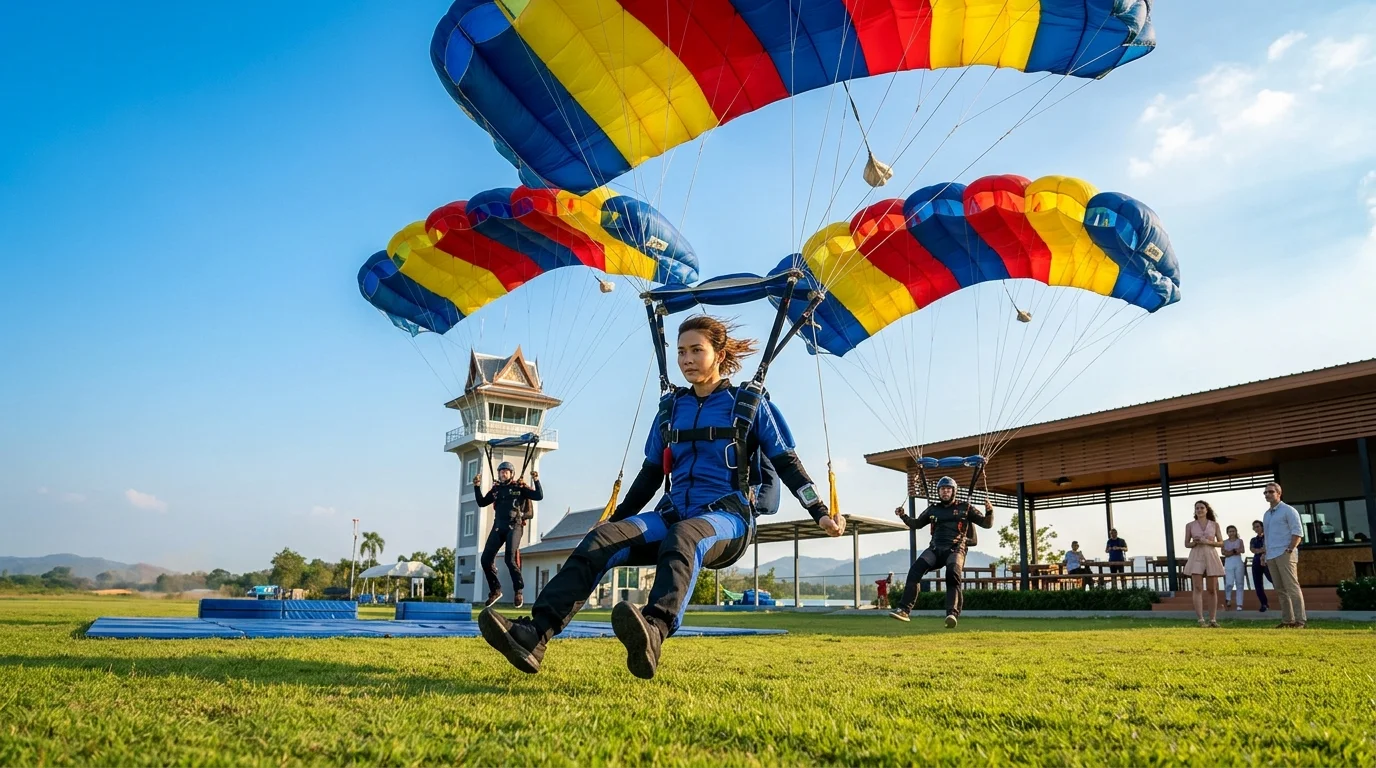
Thai Sky Adventures caters primarily to thrill-seekers, first-time tandem jumpers, and licensed sport parachutists, alongside students pursuing independent licence qualifications through the Accelerated Freefall programme. Both solo travellers and couples fit easily into the lively, social dropzone setting.
The facility is unsuited to visitors seeking a quiet resort day out. Tandem skydiving requires participants to be at least 12 years of age with written parental consent and to weigh a minimum of 25 kilograms, while solo training programmes are strictly limited to adults aged 18 and over. Young children have few distractions on an active operational airfield. Jumpers require a reasonable baseline of mobility to handle canopy deployment and landing; individuals with severe cardiovascular ailments, recurring shoulder or knee dislocations, chronic spinal conditions, or recent surgery should refrain from participating.
What to Know Before You Book
Scuba diving requires careful planning alongside a jump schedule. Residual nitrogen dissolved in the bloodstream expands under rapid atmospheric decompression at altitude, creating a serious risk of decompression sickness. The dropzone mandates an absolute minimum interval of 18 hours after diving before boarding the aircraft, though allowing a 24-hour gap is standard practice for deeper or repetitive dives.
Tandem skydivers must meet defined weight thresholds. The facility enforces a maximum limit of 115 kilograms, with tiered surcharges applied above 95 kilograms to account for parachute canopy tolerances and descent speeds. Jumpers are weighed on arrival during check-in to confirm harness fit and equipment tolerances.
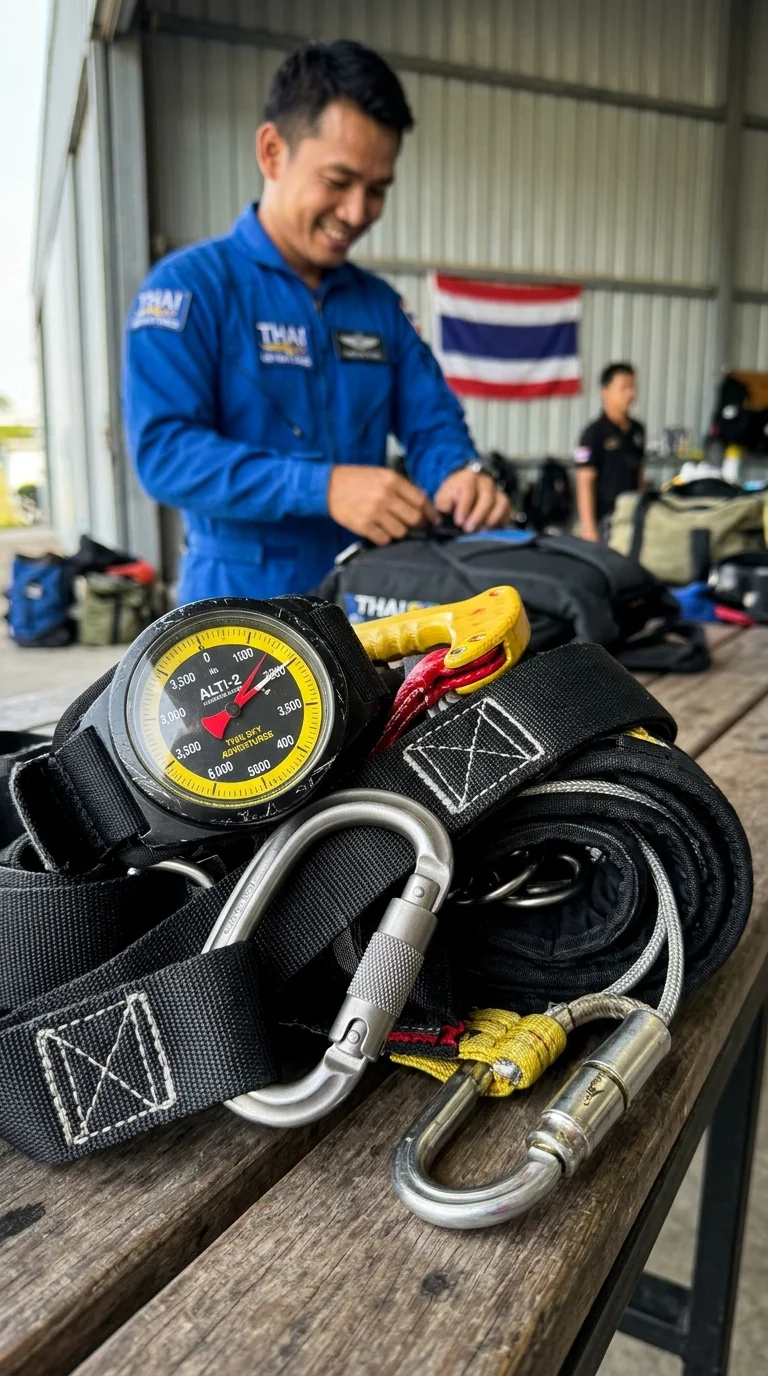
Aviation safety regulations prohibit passengers from carrying personal mobile phones or action cameras into the aircraft or during the jump. United States Parachute Association (USPA) safety rules require jumpers to log at least 200 jumps before handling cameras, as loose gadgets create dangerous drop hazards and parachute line-snag risks. All filming must be completed by dropzone crew.
Flight operations depend strictly on favourable weather. Heavy low cloud, rain squalls, or gusty winds cause immediate flight holds. If bad weather prevents jumping, tandem bookings qualify for free rescheduling or a full refund. Those paying in advance by credit or debit card must present the physical card at reception when checking in.
Practical Tips
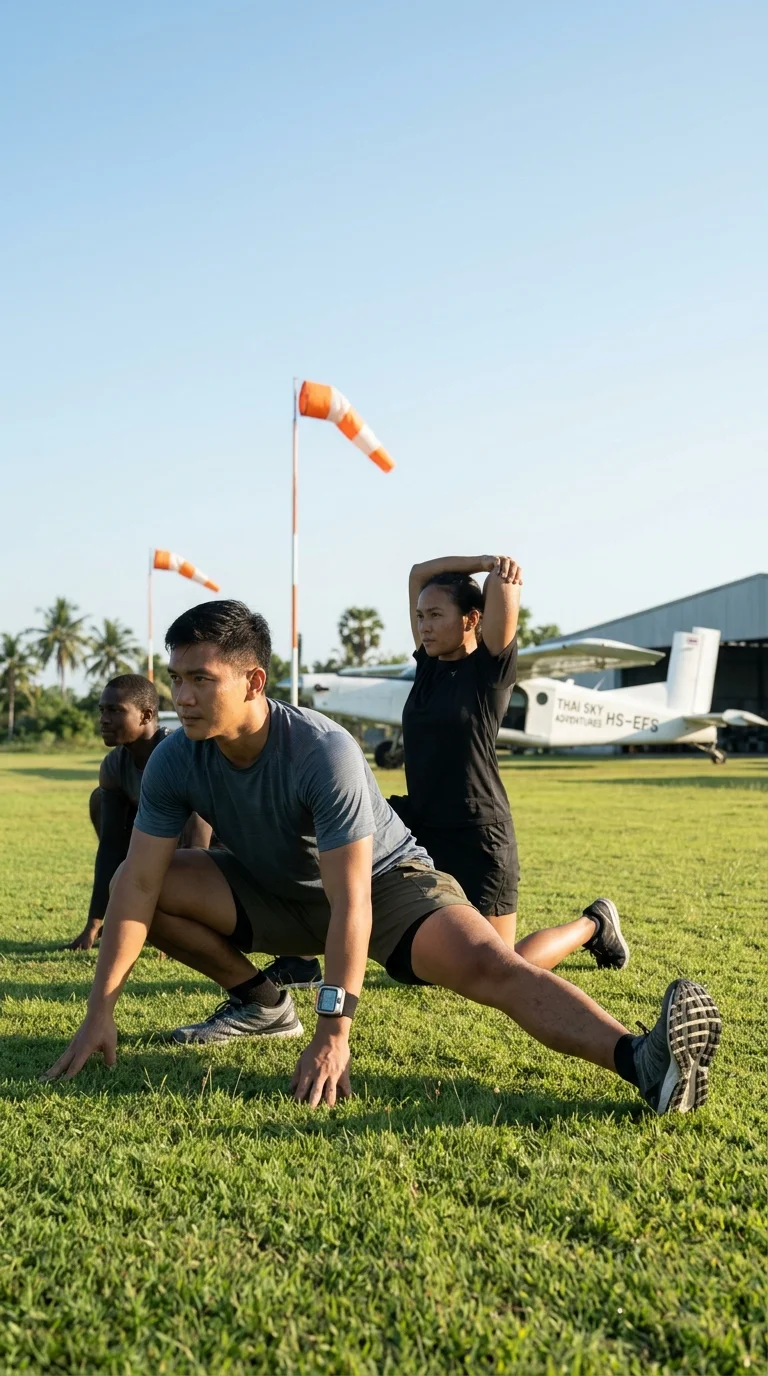
Book the earliest morning departure slot. Morning conditions over Nong Khor Reservoir generally feature lighter surface winds and clearer visibility, well before tropical afternoon thermals and convective cloud cover build up and trigger weather holds.
Wear secure lace-up trainers and athletic trousers or leggings. Slip-on shoes, sandals, and flip-flops are strictly prohibited on the jump plane, as loose footwear and unfastened jewellery detach instantly at 120 mph terminal velocity. Jumpers wearing prescription spectacles can request over-glasses goggles, though contact lenses are generally more comfortable.
Eat a moderate breakfast two to three hours before your jump rather than fasting or eating heavily. A settled stomach helps prevent motion sickness during canopy descent. Alcohol and recreational drugs are entirely prohibited; dropzone staff will bar anyone suspected of impairment with no refund.
Bring your physical passport for manifest registration. The check-in desk requires government-issued photo identification to verify your age, log manifest details, and process your liability waiver.
Allow at least five hours for the complete excursion from Pattaya, and a full day if travelling from Bangkok. The round trip incorporates minibus transit, ground briefings, harness fitting, the 20-minute flight to 13,000 feet, and on-site video editing, which typically takes 30 to 45 minutes after landing.
Keep Thai baht cash to hand. On-site expenses such as spectator minibus fares (500 THB), the mandatory local liability insurance fee, and the airfield café are simpler to settle in cash, avoiding card payment surcharges.
Check your UK travel insurance before booking. Standard holiday policies routinely exclude parachuting and skydiving unless you add an extreme sports or hazardous activities rider covering medical care and emergency repatriation.
Quick Reference Table
| Item | Detail | Notes |
|---|---|---|
| Operating hours | 08:00–17:00 daily | Operates 7 days a week, weather permitting |
| Jump altitude | 13,000 ft (approx. 4,000 m) | Parachute deployed around 5,000 ft AGL |
| Freefall profile | ~50–60 seconds at 120 mph (200 km/h) | Followed by a 5–7 minute canopy descent |
| Jump aircraft | Pilatus Porter PC-6 turboprop | Pratt & Whitney engine; 15–18 min climb to altitude |
| Safety certification | United States Parachute Association (USPA) | Affiliated school with USPA instructors and riggers |
| Basic tandem jump | 9,700 THB (~£220) | Includes gear, instructor, and Pattaya hotel transfers |
| Tandem with media packages | 13,650 THB to 15,650 THB (£310–£355) | Options range from wrist video to external camera flyer |
| Accelerated Freefall (AFF) course | 90,950 THB (~£2,067) | Ground school, introductory jump, and Levels 1–7 |
| Complete USPA A-Licence | 149,550 THB (~£3,398) | Bundles 25 jumps, coached progression, and gear hire |
| Tandem weight restrictions | Min 25 kg; max 115 kg | Surcharges apply above 95 kg (500–1,000+ THB) |
| Age limits | Min 12 years (tandem); min 18 years (AFF) | Parental consent required for jumpers under 18 |
| Scuba diving interval | Minimum 18 hours (24 hours advised) | Essential to avoid decompression sickness at altitude |
| Pattaya transfers | Complimentary return minibus for tandem jumpers | Departs 07:00–07:30 or 10:00–10:30; 1 spectator free |
| Bangkok transfers | 500 THB (~£11) per person return | Departs Novotel Siam Square daily at 09:30 |
| Payment surcharge | 2.5% fee on card payments | Physical card required at check-in if booked online |
| Time allowance | 5 hours (Pattaya) / Full day (Bangkok) | Covers round-trip transit, briefing, jump, and media edit |
| Website | https://thaiskyadventures.com/ | Official website and booking platform |
FAQ: Thai Sky Adventures
How long has Thai Sky Adventures been operating?
How long is the freefall during a skydive at Thai Sky Adventures and what speed is reached?
What qualifications do the instructors at Thai Sky Adventures hold?
What are the age and weight requirements for skydiving at Thai Sky Adventures?
How long must one wait to skydive after scuba diving?
Can I bring my personal phone or camera on the skydive?
What should I wear for skydiving at Thai Sky Adventures?
What identification do I need for skydiving registration?
Does Thai Sky Adventures offer transfers from Pattaya?
What happens if bad weather prevents skydiving?
Reviewed by the Thailand Guide Editorial Team • Last reviewed: 4 November 2026
This page is provided for general information only. While we aim for accuracy, details can change — please verify anything important independently before relying on it.