Songkhla
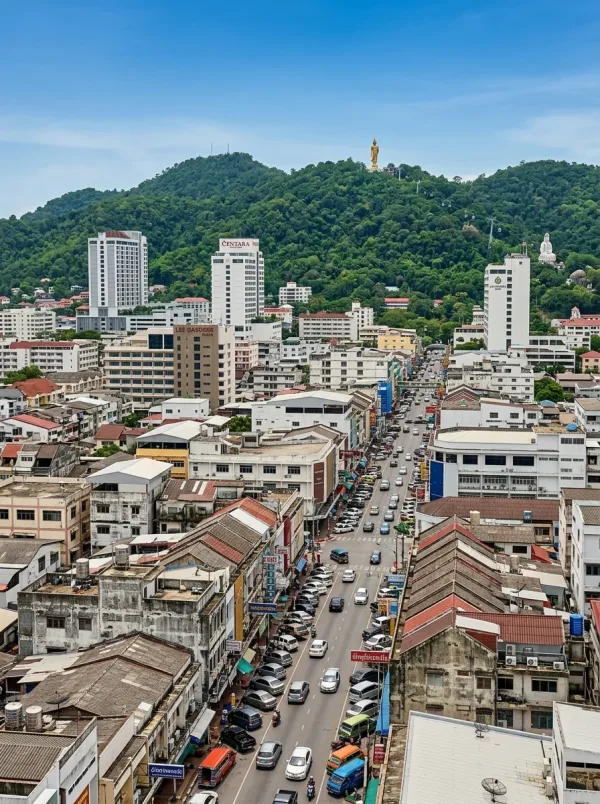
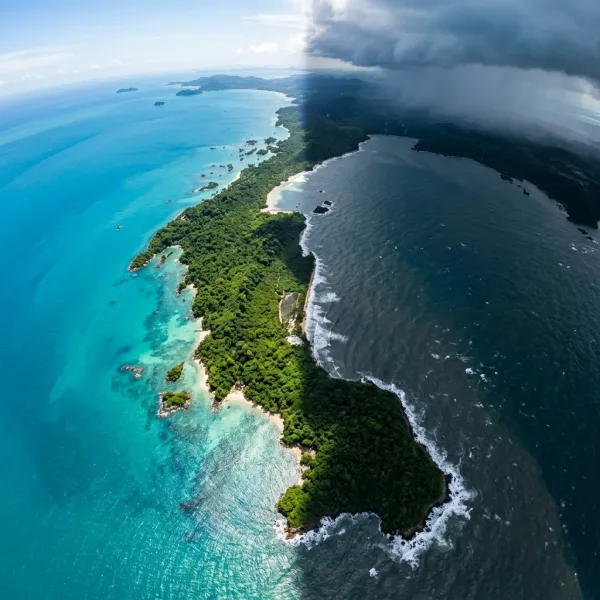
Songkhla occupies a narrow coastal peninsula between the open waters of the Gulf of Thailand and the brackish expanse of Songkhla Lake. Although neighbouring Hat Yai serves as southern Thailand's commercial and transport junction, Songkhla remains the formal administrative capital of its province. The town preserves centuries of southern Thai, Hokkien Chinese, and Malay maritime trade without the commercial sprawl and heavy traffic found further inland.
The municipality lies in lower southern Thailand, roughly 30 kilometres northeast of Hat Yai. Its historic urban centre, Bo Yang, developed after the provincial settlement was relocated across the lake channel in 1836. Today, the town's geography divides into three distinct zones: the mercantile quarter along the lake's eastern shore, a leafy civic district centred on provincial government compounds, and the sandy coastline fronting Samila Beach. Songkhla functions primarily as an administrative centre and an active fishing port. Travellers visit chiefly to explore its surviving nineteenth-century shophouse architecture, eat regional southern Sino-Thai food, and experience a relaxed provincial harbour that remains largely untargeted by mass resort tourism.

Songkhla Old Town and Shophouse Heritage
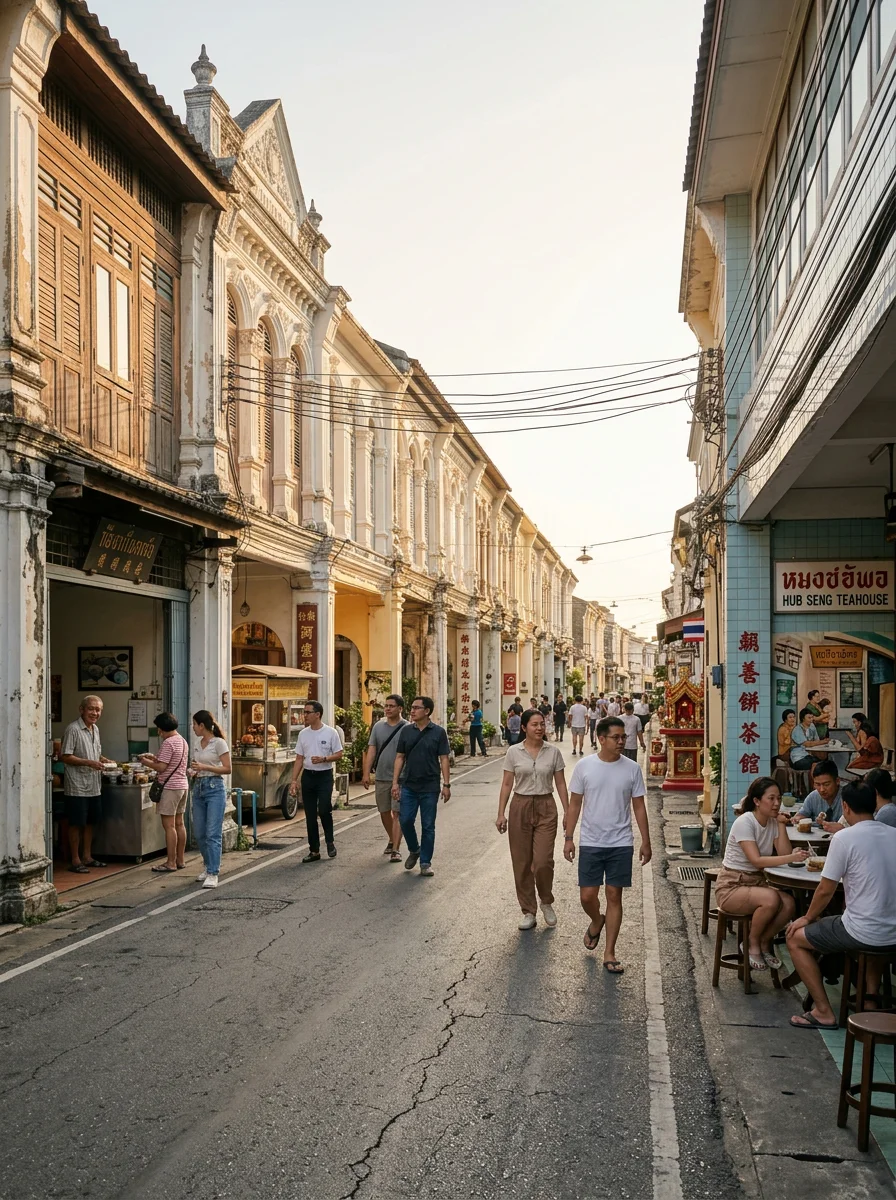
The historic quarter of Songkhla took shape after the settlement relocated across the lake channel from Laem Son to the Bo Yang peninsula in the 1830s under the orders of King Rama III. The district centres on three parallel north-south streets: Thanon Nakhon Nok, Thanon Nakhon Nai, and Thanon Nang Ngam. Nakhon Nok borders the lake, where cargo vessels historically unloaded timber, rice, and ceramics at private jetties. Nakhon Nai served as the primary commercial thoroughfare for wealthy merchants, whilst Nang Ngam, originally laid out as Thanon Kao Hong ("Nine Rooms Road"), developed into a street of confectioners, noodle stalls, and bakeries following the dedication of the municipal shrine.
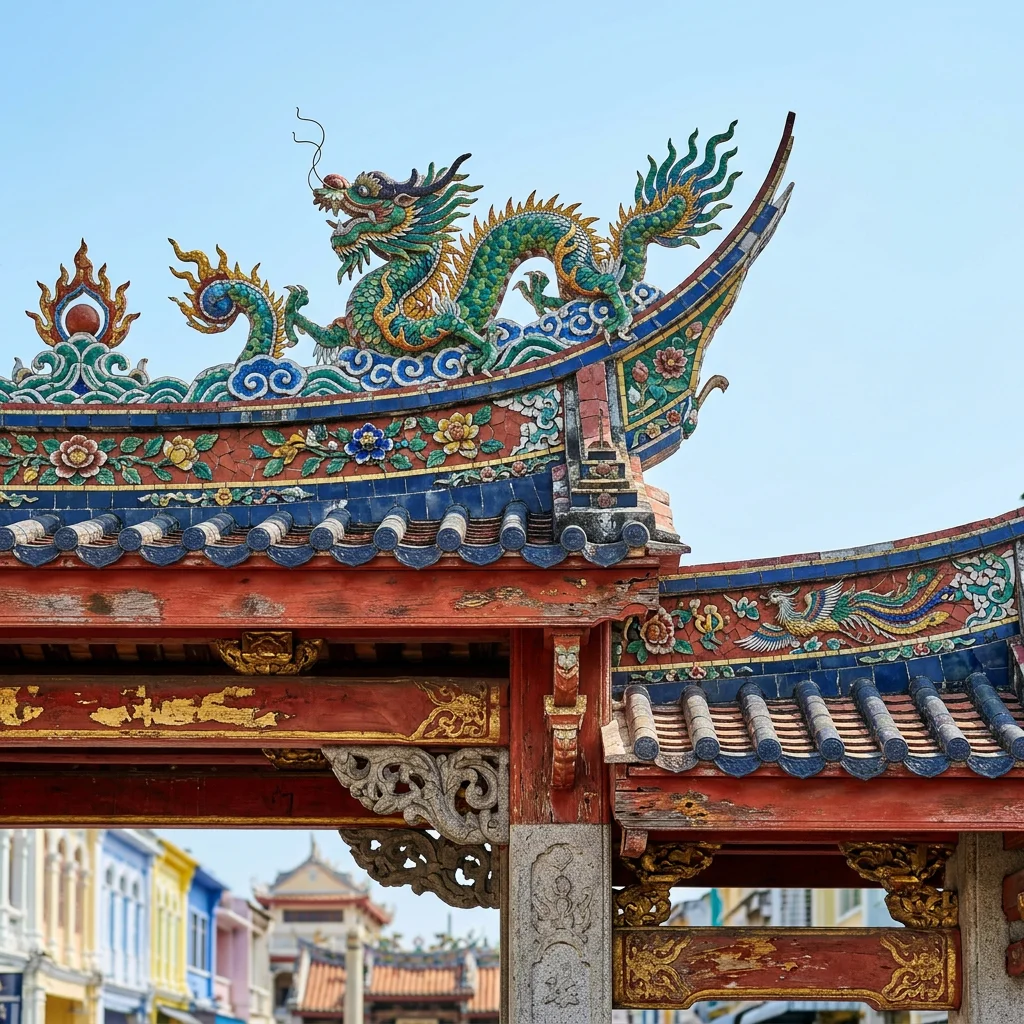
Exploring these three streets reveals a dense blend of nineteenth-century Hokkien timber-frame shophouses, early twentieth-century Sino-Portuguese masonry terraces, and wall murals depicting local market vendors, fishermen, and neighbourhood life. Key architectural landmarks include Baan Nakhon Nai on Nakhon Nai Road, a conserved dual-building heritage house combining a traditional southern Chinese wooden residence with an adjoining white neoclassical masonry townhouse filled with antique furniture and porcelain. Further inland on Nang Ngam Road stands the Songkhla City Pillar Shrine. Erected in 1842 under the governorship of Phraya Wichiankhiri (Tian Seng), the compound reflects southern Chinese temple architecture, featuring curved tiled gables, red lacquered wooden pillars, and gilded woodwork housing both the municipal foundation post and traditional Chinese deities.
Culinary traditions reflect the town's history as an international maritime crossroads. Multi-generational family kitchens line Nang Ngam Road throughout the day, serving regional specialities such as khao stu, a slow-simmered pork stew created by Hainanese cooks combining Western maritime recipes with local herbs and spices, accompanied by crispy pork, steamed rice, and a sharp chilli dipping sauce. Visitors also frequent long-running shops for ice cream served in miniature clay pots, handmade steamed buns, and traditional mung-bean sweets. A walking tour provides an efficient way to take in the architectural details and culinary stops across all three streets.
Hub Ho Hin and the Lake Shoreline
Thanon Nakhon Nok runs directly alongside the eastern shoreline of Songkhla Lake, where wooden jetties and commercial warehouses preserve the town's historic role as an inland water port. The focal point of this waterfront is Hub Ho Hin, an expansive, bright-red rice mill founded in 1914 by Hokkien Chinese merchant Jun Liang Liewsaowapruk. In the Hokkien dialect, the name translates to unity, harmony, and prosperity. Built with a timber frame, corrugated metal cladding, and an integrated jetty extending into the lagoon, the facility originally milled paddy delivered by wooden cargo barges from farming settlements around Songkhla Lake and neighbouring Phatthalung province.
Commercial milling ended in the mid-20th century, after which the complex served successively as an ice plant, a rubber storehouse, and a fishing wharf. Today, Hub Ho Hin operates as a community heritage centre and exhibition space under the care of local conservation trusts. Its high-ceilinged interior houses early twentieth-century milling machinery, vintage photographs of maritime commerce, rusted industrial tools, and interpretive boards detailing the district's rice-trading history.
Stepping through to the rear wooden pier reveals an open view across the lake channel toward Singhanakhon. This narrow waterway stays active throughout the day with passing wooden longtail boats, fishing trawlers, and municipal vehicle ferries shuttling between the peninsula and the mainland. In the surrounding blocks along Thanon Nakhon Nok, several former trade godowns and timber warehouses have been converted into art studios, cafes, and open-fronted seafood restaurants built directly over the water on stilts, providing shaded vantage points over the channel's daily boat traffic.
Complete Hat Yai travel guide covering Southern Thai cuisine, Kim Yong Market, Khao Kho Hong, transport to Koh Lipe and Malaysia, costs, and FCDO advice.
Samila Beach and Coastal Relics
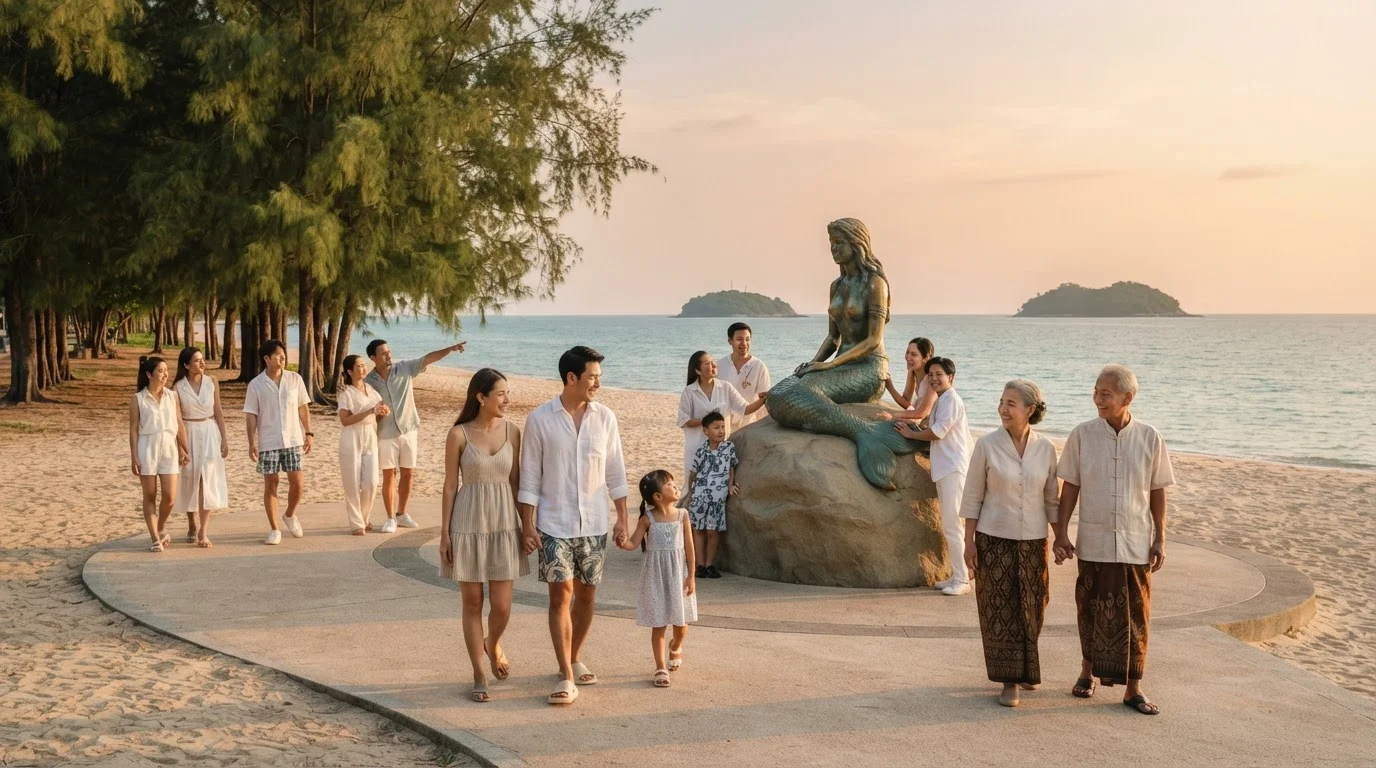
Laem Samila forms the eastern perimeter of Songkhla municipality, fronting the Gulf of Thailand with a broad sweep of sand bordered by casuarina groves. Unlike resort beaches on Thailand's Andaman coast or Gulf islands, Samila functions primarily as an open public park and social gathering ground for local residents. The seafront promenade is anchored by the Golden Mermaid statue, a bronze sculpture cast in 1966 by artist Jitr Buabus. The figure depicts a popular southern Thai folk tale about a mermaid who sat combing her hair on the shore on moonlit nights, only to flee when approached by a young fisherman.
Looking directly offshore from the mermaid statue, two rocky islets break the horizon: Koh Nu (Mouse Island) and Koh Maeo (Cat Island). Local folklore accounts for their shapes through a fable of a dog, a cat, and a mouse attempting to swim ashore from a Chinese trading vessel with a stolen magic crystal; the cat and mouse drowned to form the two islands, while the exhausted dog collapsed on the mainland. Further northwest along the spit, the shoreline curves towards Laem Son On, a quieter cape shaded by sea pines near the entrance to Songkhla Lake.
South of Samila, the coastline broadens into Chalatat Beach. Lined by Chalatat Road and tall pines, this long, straight stretch fills in the late afternoon with mobile food carts selling coconut ice cream, grilled seafood, and spicy salads, with vendors laying out woven mats on the grass. Water conditions along this coast vary considerably depending on the season. Steep underwater drop-offs, sudden shore breaks, and intermittent jellyfish mean both Samila and Chalatat are far better suited for evening walks, picnicking, and kite flying than for swimming or watersports.
Khao Tangkuan Viewpoint and Historic Shrines
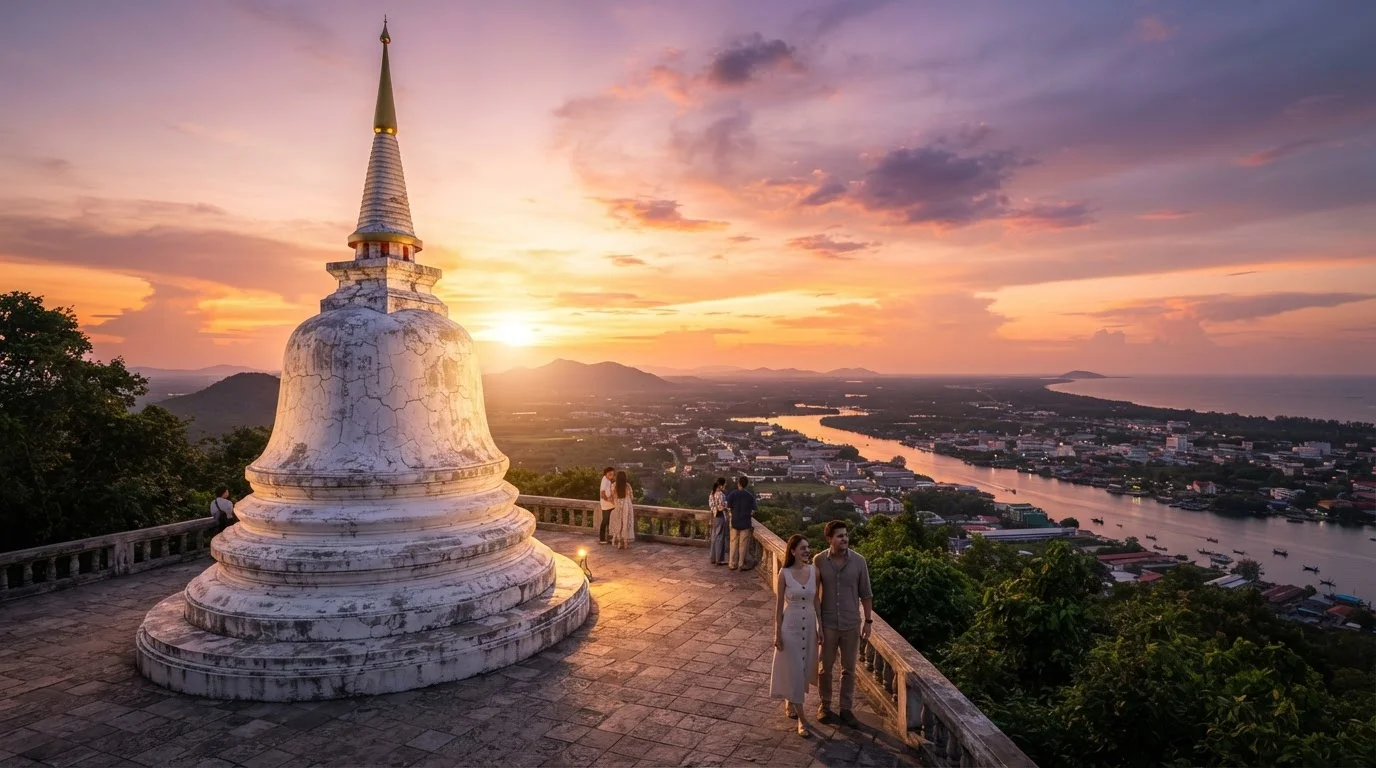
Khao Tangkuan is a wooded hill rising roughly 105 metres above sea level at the northern edge of Songkhla's old quarter. The summit provides an expansive vantage point for understanding the town's geography, looking directly out over the narrow peninsula pinched between the open Gulf of Thailand and the mouth of Songkhla Lake. From the observation terraces, the view takes in the historic shophouse grid, the deep-water shipping channel, Samila Beach, and the offshore islets of Koh Nu and Koh Maeo.
The hilltop has functioned as a sacred precinct for centuries. Its centrepiece is Phra Chedi Luang, a bell-shaped Buddhist stupa with origins dating to the ancient Nakhon Si Thammarat kingdom. King Rama IV visited the hill in 1859 and funded an extensive royal restoration of the stupa, which today enshrines sacred Buddhist relics. Standing just below the stupa is Sala Phra Wihan Daeng, a red-brick royal pavilion featuring European-style arched arcades. Commissioned by King Rama IV and completed in 1889 during the reign of King Rama V, the pavilion was designed as an airy retreat with open corridors facing the lake. A historic lighthouse constructed in 1896 also stands near the summit crest.
Visitors can reach the hilltop temple complex by two routes. On the western slope, a shaded brick staircase flanked by naga balustrades climbs through coastal forest. Alternatively, an inclined glass cable lift operates from a station on Sukhum Road at the base of the hill, carrying passengers directly to the summit terrace for a modest fee paid at the ticket counter. Troops of long-tailed macaques inhabit the lower slopes, particularly near the lift terminal and car park. At ground level, the surrounding municipal parkland links directly to Khao Noi, an adjoining green ridge laid out with walking paths, ornamental gardens, and a bronze monument to Prince Lop Buri Ramet, the former viceroy of southern Siam. Guided city tours and chartered transport can help link the hill with nearby heritage sights across the municipality.
Getting There and Getting Around
Songkhla municipality has no active passenger railway station or commercial airport of its own. Travellers journeying from the UK route through Hat Yai, the primary transport hub of southern Thailand. Hat Yai International Airport (HDY) sits roughly 42 kilometres southwest of Songkhla town by road. The airport receives frequent daily domestic services from Bangkok's Suvarnabhumi and Don Mueang airports, alongside regional international connections from Singapore and Kuala Lumpur. A pre-booked private transfer or metered taxi from Hat Yai Airport to central Songkhla takes between 45 and 60 minutes, depending on traffic through Hat Yai's urban ring roads, typically costing between 650 THB and 800 THB (£15.00 to £18.50).
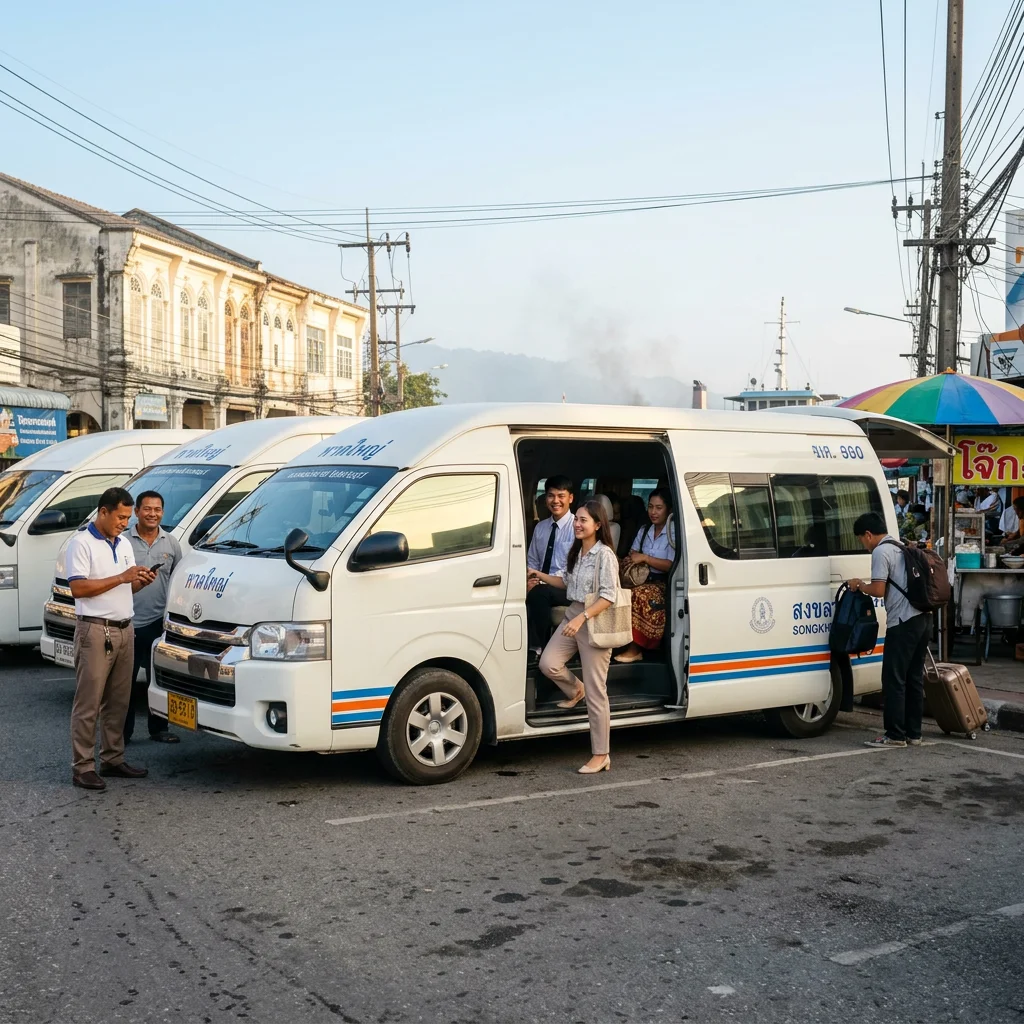
Rail passengers arrive at Hat Yai Junction, which links the capital with the Malaysian rail border at Padang Besar. From central Hat Yai, budget travellers can catch frequent road transport to Songkhla. Air-conditioned minivans run from Hat Yai Bus Terminal 1 and central pick-up points every 20 to 30 minutes from morning to early evening. Tickets cost roughly 35 THB to 40 THB (£0.80 to £0.90) per passenger, with journeys taking 45 to 60 minutes. Regular green shared songthaews also ply the main road between the two cities for a similar fare, though they make frequent roadside stops that extend travel times.
Once in Songkhla, exploring is straightforward. The historic core around Nakhon Nok, Nakhon Nai, and Nang Ngam roads is flat and compact enough to navigate entirely on foot. For longer hops between the heritage quarter, Khao Tangkuan, and the Samila Beach shoreline, local motorcycle taxis charge between 30 THB and 50 THB (£0.70 to £1.15). Shared songthaews circulate along the town's primary avenues for 15 THB to 20 THB (£0.35 to £0.45), while ride-hailing apps such as Grab operate reliably across the municipality for fixed-price private trips.
What to Know Before You Go
The Songkhla National Museum, housed in an 1878 Sino-Portuguese mansion built for deputy governor Phraya Sunthranurak, operates on strict civil-service working hours. The gallery opens from Wednesday to Sunday between 09:00 and 16:00, remaining closed on Mondays, Tuesdays, and official public holidays. Admission for foreign visitors is 200 THB, payable in cash at the counter. The collection provides valuable regional context, displaying southern Thai archaeological finds, shipwreck ceramics, and Srivijaya artefacts that trace the peninsula's centuries of maritime trade.
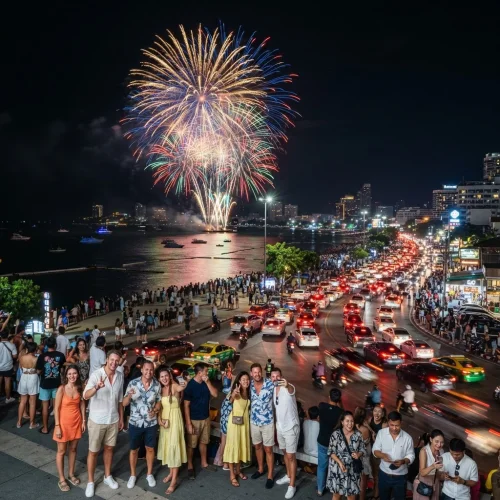
Unlike bustling resort centres, Songkhla functions primarily as an administrative provincial capital and university town, meaning daytime commercial activity winds down early. Most heritage cafes, bakeries, and family-run shophouse eateries along Nang Ngam and Nakhon Nai roads shutter their doors by 17:00 or 18:00. Evening dining shifts instead toward the waterfront seafood establishments lining Chalatat Beach and open-air street stalls. At weekends, the focal point is the Songkhla Tae Raek Walking Street, which sets up along Chana Road beside the remaining stretch of the old city wall on Friday and Saturday evenings from 17:00 to 22:00.
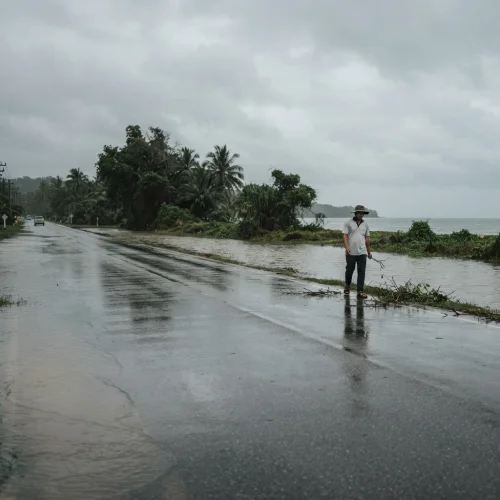
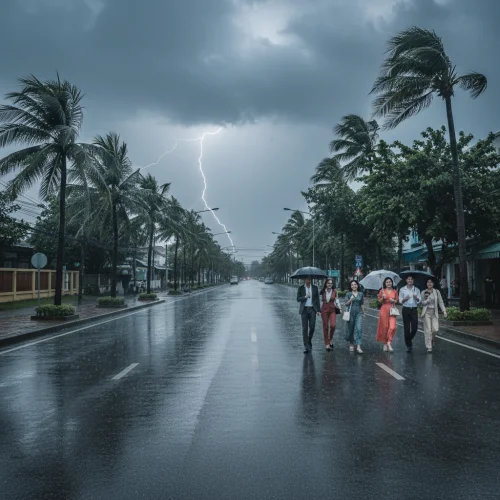
Songkhla's weather patterns differ markedly from the Andaman coast. Situated on the eastern flank of the Malay Peninsula, the province is exposed to the northeast monsoon rather than the southwest monsoon that affects Phuket and Krabi. The wettest window runs from late October through mid-January, with rainfall peaking during November and December. These months regularly bring persistent downpours, strong coastal winds, and rough swells along the Gulf of Thailand, making seaside walks along Samila Beach less hospitable. The driest and most settled conditions typically arrive between February and April.
Travellers heading north towards Sathing Phra and Ranot can avoid the lengthy road loop across the Tinsulanonda Bridges by taking the Songkhla Lake vehicle ferry. Operating from early morning until late evening, the vessels depart from the peninsula's northern spit near the naval base across to Singhanakhon, completing the water crossing in under ten minutes. The ferry handles foot passengers, motorbikes, and private cars; drivers should carry small Thai baht notes for the crossing charge, as digital payments and card facilities are not accepted at the boarding booths.
Practical Tips
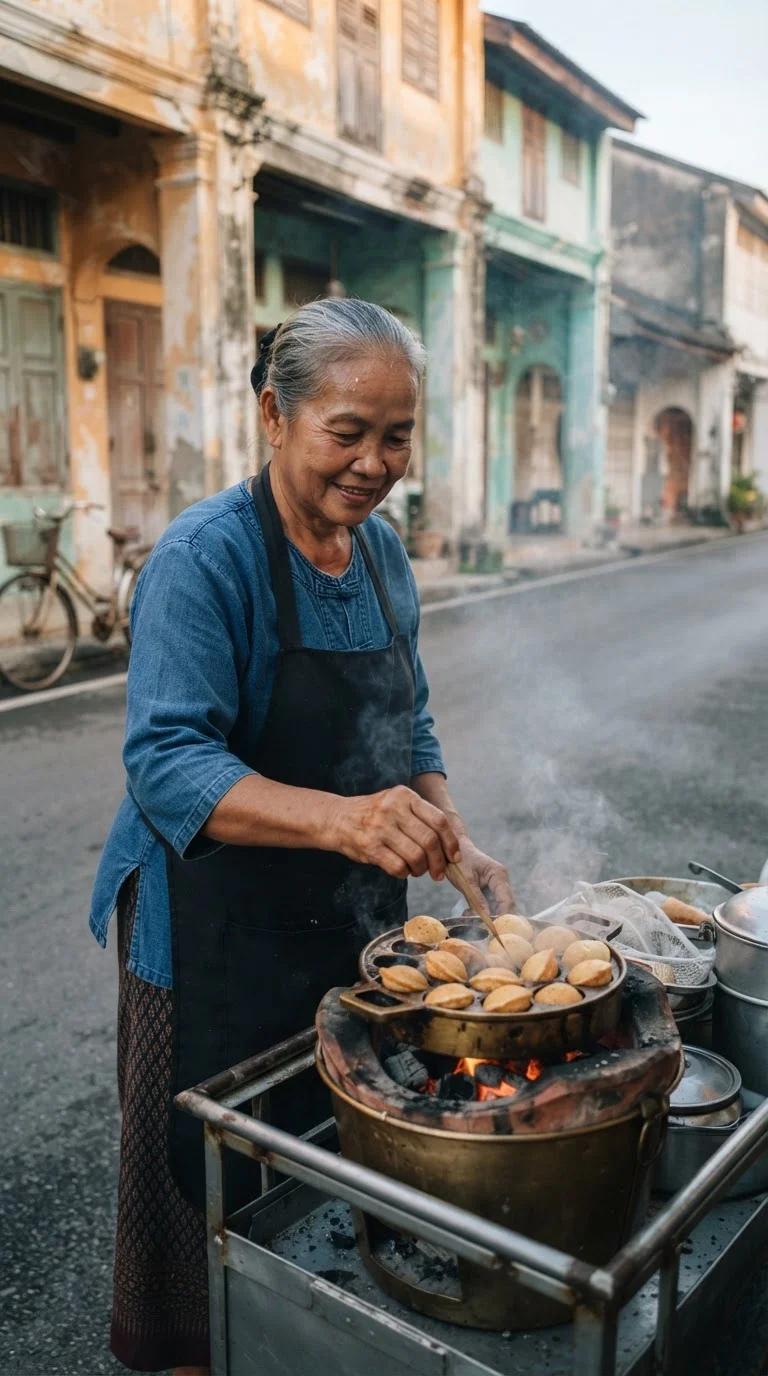
Plan walking routes around the historic Old Town during the early morning, preferably between 08:00 and 10:30. Streets such as Nakhon Nok, Nakhon Nai, and Nang Ngam feature narrow pavements and limited overhead shade, making midday walks uncomfortably hot. Morning hours also coincide with the busiest trade at local food stalls and fresh markets, giving photographers clear light against Sino-Portuguese shophouse facades before street traffic builds up.
Respectful attire is required when visiting cultural and religious sites across town, including the City Pillar Shrine and Guan Yu Shrine. Wear lightweight clothing that covers both shoulders and knees. Footwear must be removed before entering shrine interiors and temple halls, so slip-on shoes or sandals make moving between active worship spaces far more convenient.
Small-denomination cash is necessary for everyday purchases throughout Songkhla. While local vendors widely use Thailand's domestic PromptPay QR network, independent food stalls, traditional coffee shops, and local songthaew drivers rarely accept foreign payment cards. Carry plenty of 20, 50, and 100 baht notes, as small traders often struggle to break 500 or 1,000 baht notes.
For an excursion outside the urban centre, charter a songthaew or hire a private vehicle to cross into Songkhla Lake via the Tinsulanonda Bridge. Spanning 2,640 metres across two sections, it is the longest concrete bridge in Thailand and connects the mainland to Koh Yo. The island makes a rewarding half-day trip to explore traditional handwoven cotton workshops and the Institute for Southern Thai Studies folklore museum.
If travelling back to Hat Yai on a day trip, plan your departure early. Direct public minivans reduce frequency substantially after 18:00 and generally cease operating by 18:30. Visitors remaining in town for dinner or evening markets should arrange a metered taxi, use the Grab mobile app, or pre-book private return transport.
Quick Reference Table
| Item | Detail | Notes |
|---|---|---|
| Location | Lower southern Thailand | Sits on a narrow spit between Songkhla Lake and the Gulf of Thailand, 30 km northeast of Hat Yai |
| Nearest Airport | Hat Yai International Airport (HDY) | Located 42 km southwest; private transfers take 45–60 minutes and cost 650–800 THB (£15.00–£18.50) |
| Regional Public Transport | Minivans from Hat Yai Bus Terminal 1 | Depart every 20–30 minutes until early evening; 35–40 THB (£0.80–£0.90), 45–60 minutes |
| Local Getting Around | On foot, motorcycle taxi, shared songthaew, Grab | Motorcycle taxis charge 30–50 THB (£0.70–£1.15); town songthaews cost 15–20 THB (£0.35–£0.45) |
| Songkhla National Museum | Wed–Sun, 09:00–16:00 | Closed Mon, Tue, and public holidays; foreign visitor admission is 200 THB (cash only) |
| Songkhla Tae Raek Walking Street | Fri–Sat, 17:00–22:00 | Weekend night market situated along Chana Road beside the historic city wall |
| Best Time to Visit | February to April | Driest, most settled weather; late October to mid-January brings heavy northeast monsoon rains |
| Best Time for Old Town Walks | 08:00 to 10:30 | Avoids peak midday heat; captures active morning markets and quiet shophouse streets |
| Khao Tangkuan Viewpoint | 105 m summit overlooking peninsula | Accessible via brick naga staircase or an inclined glass cable lift from Sukhum Road |
| Songkhla Lake Vehicle Ferry | Peninsula northern spit to Singhanakhon | Crosses in under 10 minutes from early morning to late evening; small cash baht required |
| Tinsulanonda Bridge & Koh Yo | 2,640 m concrete bridge to Koh Yo | Thailand's longest concrete bridge; connects to island weaving workshops and folklore museum |
| Public Minivan Curfew | Cease operating by 18:30 | Day-trippers returning to Hat Yai after 18:00 must rely on pre-booked taxis or Grab |
| Official Website | finearts.go.th/songkhlamuseum | Songkhla National Museum (Fine Arts Department) |
| Official Website | hatyai.airportthai.co.th | Hat Yai International Airport (Airports of Thailand) |
| Official Website | ists.tsu.ac.th | Institute for Southern Thai Studies, Koh Yo |
FAQ: Songkhla
What are the main reasons to visit Songkhla?
Is Samila Beach suitable for swimming?
How do travellers get to Songkhla?
What are the best ways to get around Songkhla?
What are the opening hours and admission fee for the Songkhla National Museum?
When is the best time to visit Songkhla for dry weather?
What is the best time for walking tours in Songkhla's Old Town?
What should visitors wear when visiting religious sites in Songkhla?
Is cash or card preferred for payments in Songkhla?
What are the public transport options for returning to Hat Yai from Songkhla in the evening?
Reviewed by the Thailand Guide Editorial Team • Last reviewed: 14 November 2026
This page is provided for general information only. While we aim for accuracy, details can change — please verify anything important independently before relying on it.