Huai Kha Khaeng Wildlife Sanctuary
Spanning Uthai Thani and Tak provinces in western Thailand, Huai Kha Khaeng Wildlife Sanctuary forms part of mainland Southeast Asia's largest intact seasonal tropical forest complex. Managed by the Department of National Parks, Wildlife and Plant Conservation (DNP), the reserve was inscribed on the UNESCO World Heritage List in 1991 alongside the adjoining Thung Yai Naresuan Wildlife Sanctuary. The area protects threatened wildlife across an unfragmented wilderness, maintaining significant populations of Indochinese tigers, Asian elephants, and banteng.
Unlike Thailand's recreation-focused national parks, Huai Kha Khaeng functions primarily as a strict conservation zone and scientific research station. General visitor access is tightly regulated and restricted to designated nature study zones around the sanctuary headquarters and specific forest protection units. With no resort amenities and stringent safety rules governing movement within the reserve, Huai Kha Khaeng is suited to committed naturalists, wildlife observers, and researchers prepared for rustic field conditions rather than casual holiday travel.

Immersion in Pristine Forest

Huai Kha Khaeng Wildlife Sanctuary protects one of mainland Southeast Asia's least disturbed forest expanses. Inscribed alongside the contiguous Thung Yai Naresuan Wildlife Sanctuary as a UNESCO World Heritage Site in 1991, the reserve preserves an expansive wilderness free from commercial development and permanent human settlements. Established under royal decree in 1972, the sanctuary encompasses roughly 2,780 square kilometres across Uthai Thani and Tak provinces. Its contiguous canopy forms the biological core of Thailand's Western Forest Complex, providing a vast tract where natural ecological processes function without artificial fragmentation.
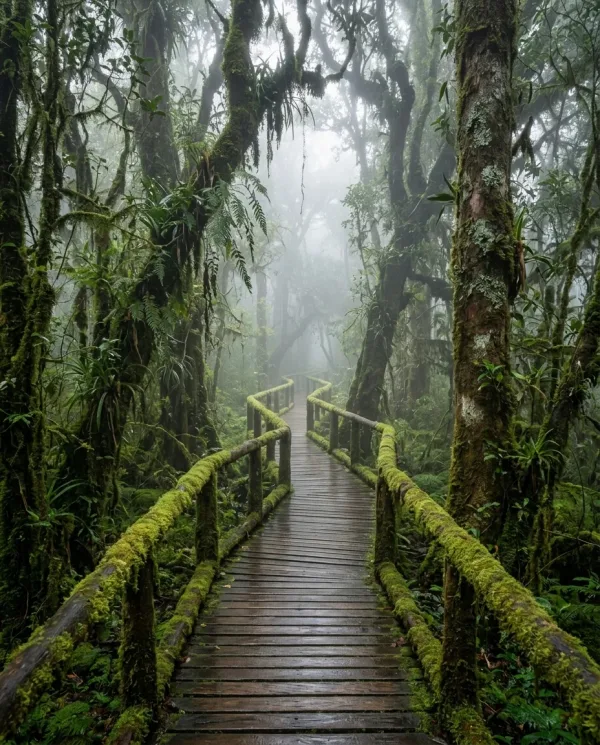
The interior combines dense riverine evergreen corridors, mixed deciduous woods, and dry dipterocarp ridges. This diverse habitat sustains viable breeding populations of the kingdom's threatened megafauna, including Indochinese tigers, Asian elephants, leopards, Asian tapirs, and banteng. Decades of strict state protection have kept the central Huai Kha Khaeng river basin free from dams, commercial agriculture, and paved highways. Deep within the reserve, animal territories remain undisturbed, while gibbon territorial calls and hornbill flights define the daily rhythm of the forest.
Unlike Thai national parks designed for recreational camping and mass tourism, Huai Kha Khaeng prioritises scientific research and species protection. Department of National Parks regulations strictly restrict casual visitors to defined perimeter zones, primarily around the sanctuary headquarters at Khao Hin Daeng in Lan Sak district and the Huai Mae Di station further south. Within these controlled sectors, marked nature trails and observation hides allow travellers to experience the solitude and scale of primary monsoon forest without compromising conservation work. Arranging excursions through registered nature-tour operators ensures all environmental protocols and permit conditions are observed.
Exploring the Ecosystems

Huai Kha Khaeng spans rugged terrain where mountain ridges rise from valley floors around 250 metres above sea level to peaks exceeding 1,600 metres, such as Khao Pai at 1,678 metres. This topography creates a diverse mosaic of tropical vegetation. Mixed deciduous forest, dry dipterocarp woodland, and seasonal semi-evergreen forest cover the lower and mid-elevation slopes, giving way to hill evergreen growth on higher ridges and gallery forests along the perennial Huai Kha Khaeng river basin. Ecologically, the sanctuary sits at a continental crossroads where four biogeographical realms meet—Sino-Himalayan, Indochinese, Indo-Burmese, and Sundaic—producing an unusually rich variety of plant communities and microhabitats.
Because Huai Kha Khaeng operates as a strict nature sanctuary rather than a conventional national park, visitor infrastructure remains deliberately minimal. Walking access is controlled and confined to designated perimeter areas around the sanctuary headquarters in Lan Sak, leaving the interior core undisturbed. The primary route for observing these distinct forest zones is the Khao Hin Daeng Nature Trail, a marked circuit offering a 2.2-kilometre short walk and an extended 4.7-kilometre option. Following this trail reveals how the forest structure changes over short distances, transitioning from open dry dipterocarp woods with grassy ground cover into dense mixed deciduous canopies and shadier evergreen stands. Hiking beyond designated paths is prohibited without formal administrative clearance and an accompanying sanctuary ranger.
Plan a visit to Khao Sam Roi Yot National Park, including Phraya Nakhon Cave, Thung Sam Roi Yot wetland, boats, fees and transport.
Wildlife Viewing Opportunities

Wildlife viewing in Huai Kha Khaeng centres on quiet observation from designated towers and river clearings rather than open vehicle safaris. Early mornings and late afternoons yield the highest activity, as temperatures drop and animals move towards watering holes and mineral licks along the Thap Salao river basin. Sambar deer, barking deer (muntjac), and wild boar represent the most regular mammalian sightings across the open deciduous woodland. Patient watchers stationed on observation hides—such as the Nok Yung (Peacock) tower near the headquarters area—also stand a credible chance of spotting endangered banteng, a wild cattle species that maintains one of its primary mainland habitats here, alongside Asian elephants and occasional herds of gaur.
Carnivores inhabit the sanctuary in significant numbers, including Indochinese leopards, clouded leopards, dholes (Asiatic wild dogs), and Thailand's largest surviving population of wild Indochinese tigers. Direct encounters with living big cats, however, are exceptionally improbable for casual visitors. Field observations of apex predators generally consist of fresh signs rather than visual sightings: rangers and trackers frequently point out distinct pugmarks pressed into dusty patrol roads, territorial claw scrapes on tree trunks, and prey remains along forest edges.
Birdwatchers find Huai Kha Khaeng particularly rewarding along open water margins and mixed forest fringes, where more than 270 bird species have been recorded. Conspicuous groups of endangered green peafowls forage regularly along dry riverbeds and gravel clearings. In the canopy, fruiting trees attract great hornbills, wreathed hornbills, and Tickell's brown hornbills, while the understorey shelters diverse pheasants, pittas, and woodpeckers. Viewing requires quiet discipline: remaining calm inside observation hides, refraining from sudden movements, and keeping strictly to permitted zones ensures animals remain undisturbed while keeping wildlife in view.
Conservation and Research

Huai Kha Khaeng functions as one of Southeast Asia's critical ecological benchmarks, combining rigorous scientific field research with intensive habitat protection. At the core of these scientific endeavours sits the Khao Nang Rum Wildlife Research Station, established in the 1970s. From this base, biologists from the Department of National Parks, Wildlife and Plant Conservation (DNP), local universities, and international organisations study forest dynamics, ungulate populations, and large carnivores. The sanctuary represents the main regional stronghold for Indochinese tigers, with long-term camera-trapping arrays tracking individual cats and their prey base to evaluate ecosystem health.
Field protection relies heavily on the SMART (Spatial Monitoring and Reporting Tool) patrol system. Pioneered in Thailand at Huai Kha Khaeng in collaboration with the Wildlife Conservation Society, this data-driven framework equips ranger teams with GPS navigation and standardised threat logging to deter illegal logging, encroachment, and commercial poaching. Monthly patrol data directly guide ranger deployments across more than 2,000 square kilometres of wilderness.
Under this strict conservation mandate, general visitors cannot enter the deep interior, which remains reserved for patrol teams and scientific personnel. Public education is concentrated around the sanctuary headquarters in Uthai Thani Province. Here, travellers can visit the Thung Yai–Huai Kha Khaeng World Heritage Exhibition Building, explore educational displays detailing biodiversity monitoring, and inspect the Seub Nakhasathien Memorial. Dedicated to the former sanctuary superintendent whose conservation advocacy led to the area's UNESCO inscription, the memorial site provides clear context on the ongoing work to protect Western Thailand's forests.
Location and Getting There

Huai Kha Khaeng Wildlife Sanctuary is situated in western Thailand across Uthai Thani and Tak provinces. The main public entry point and sanctuary headquarters sit at Khao Hin Daeng in Lan Sak district, roughly 100 kilometres west of Uthai Thani town and approximately 300 to 320 kilometres northwest of Bangkok.
Given the sanctuary's protected wilderness status, no public transport runs directly to the gates. For travellers arriving internationally, Bangkok's Suvarnabhumi Airport and Don Mueang International Airport are the primary arrival points. Driving from Bangkok takes between four and five hours. The standard route heads north via Highway 32 towards Chai Nat, turns west onto Route 333 towards Nong Chang, and continues on Route 3438 towards Lan Sak. At kilometre 53–54, a 14-kilometre unpaved laterite road branches off to the Khao Hin Daeng checkpoint. While saloon cars can manage in dry weather, a high-clearance vehicle is preferable, especially when seasonal rain softens the track.
Hiring a car in Bangkok or booking a private vehicle with a driver provides the simplest route, giving you transport once in the area. A one-way private transfer from Bangkok generally costs between 4,000 THB and 6,000 THB (around £90 to £135), depending on vehicle size and route negotiations.
Alternatively, regular buses and minivans depart Bangkok's Northern Bus Terminal (Mo Chit) for Uthai Thani town, taking roughly three to four hours for 200 to 250 THB (£4.50 to £5.50). From Uthai Thani, local songthaews run as far as Lan Sak and Pang Mai Phai, but you must hire local transport or arrange a return charter to cover the remaining rural stretch to the sanctuary entrance.
Costs and Booking
At the time of writing, admission to Huai Kha Khaeng Wildlife Sanctuary costs 200 THB (approximately £4.50) for foreign adults and 100 THB (£2.25) for foreign children, alongside a standard vehicle entry fee of 30 THB (around £0.70) for a car. Thai citizens pay 20 THB per adult and 10 THB per child. Day visitors settle these entrance fees at the checkpoint before continuing down the access road toward the sanctuary headquarters.
Unlike conventional national parks, Huai Kha Khaeng does not operate public tourist chalets or open campsites. General recreational camping inside the reserve is prohibited under safety regulations enforced by the Department of National Parks, Wildlife and Plant Conservation. On-site accommodation consists strictly of researcher quarters, which require formal official permission submitted at least 15 days in advance. Regular visitors stay outside the reserve boundaries. Surrounding rural settlements, including Rabam and Lan Sak, provide straightforward local guesthouses from around 600 THB (£13) per night, whilst hotels in Uthai Thani town, situated roughly 80 to 100 kilometres east, charge between 1,000 and 2,500 THB (£22 to £55).
Dining facilities within the reserve grounds are minimal. The headquarters area contains a simple riverside canteen, but provisions are limited, so visitors routinely purchase packed lunches, snacks, and drinking water before passing through the gate. Transport forms the most substantial portion of any trip budget. Public buses do not enter the sanctuary grounds, requiring visitors to arrange private transport. A private car and driver hired from Bangkok typically costs between 5,000 and 7,000 THB (£110 to £155) one-way, whereas organising transport locally from Uthai Thani incurs lower daily rates.
| Option | Cost (THB per night) | Cost (GBP approx) | Notes |
|---|---|---|---|
| Sanctuary Entrance Fee | 200 | 4.50 | Per adult, foreign |
| Guesthouse (nearby town) | 600 - 1,500 | 13 - 33 | More amenities, requires onward travel to sanctuary |
| Hotel (nearby town) | 1,000 - 2,500 | 22 - 55 | Comfortable options, requires onward travel to sanctuary |
| Private Car Hire (one way) | 5,000 - 7,000 | 110 - 155 | Bangkok to Sanctuary (approx.) |
Who It Suits Best

Huai Kha Khaeng Wildlife Sanctuary caters to dedicated naturalists, birdwatchers, and wildlife photographers who value rigorous conservation over standard tourism comforts. Because the sanctuary operates primarily as a scientific and ecological reserve rather than a recreational park, it suits visitors content to spend quiet hours in observation hides or along strictly monitored access roads. Those expecting paved boardwalks, manicured grounds, family amusement facilities, or resort-style hospitality will find the reserve unsuitable.
A trip here requires realistic expectations regarding wildlife encounters and living conditions. Unlike managed safari parks, animals roam across hundreds of thousands of hectares of rugged terrain, meaning encounters depend on patience, quiet vigilance, and seasonal animal movements. Sightings can take hours of waiting in watchtowers, and dense deciduous and evergreen cover often conceals passing fauna.
Travellers should also prepare for practical constraints. General visitor access is confined to a handful of designated education sites and observation posts around the headquarters perimeter, with interior wilderness zones strictly off-limits to casual tourism. On-site facilities are utilitarian, daytime visiting hours are tightly enforced, and mobile signal drops out across wide stretches of the reserve. Visitors who thrive here are self-reliant travellers who respect strict environmental regulations, accept rustic conditions, and appreciate the privilege of observing a functioning Southeast Asian wilderness on its own terms.
Practical Tips
The dry window between November and February provides the most comfortable conditions for exploring Huai Kha Khaeng, bringing milder daytime temperatures, lower humidity, and thinner vegetation that aids wildlife observation. Day visitors are admitted between 08:00 and 15:00, with all guests required to leave the sanctuary grounds by 16:30.
Practical packing centres on protective field clothing. Wear breathable long trousers and long-sleeved shirts to guard against ticks, biting insects, and thorny scrub, paired with sturdy closed-toe walking boots. Insect repellent, a broad-brimmed hat, and sunscreen are sensible additions, alongside quality binoculars for scanning clearings and riverbanks from designated observation towers. Independent walking into the forest interior is prohibited; visitors must remain within designated public zones or arrange an official ranger escort at headquarters.
On-site amenities are sparse, with sustenance limited to a basic canteen at headquarters. Carry plenty of drinking water, packed food, and sufficient Thai baht in cash, as card payment facilities are absent. Mobile network coverage drops significantly past the main checkpoint, making offline maps and pre-arranged rendezvous points a sensible precaution. If larger mammals appear near access tracks, stay inside your vehicle with the engine running and keep a respectful distance. Securing private transport or a guided tour in advance helps ensure straightforward travel to this protected reserve.
Quick Reference Table
| Item | Detail | Notes |
|---|---|---|
| UNESCO Inscription | 1991 | Inscribed jointly with Thung Yai Naresuan Wildlife Sanctuary |
| Sanctuary Area | Roughly 2,780 sq km | Forms biological core of Thailand's Western Forest Complex |
| Elevation Range | 250 m to 1,678 m | Rises from valley floors to Khao Pai peak |
| Visiting Hours | 08:00 – 15:00 (admission) | All day visitors must exit the grounds by 16:30 |
| Best Time to Visit | November to February | Dry season offering milder temperatures and clearer wildlife viewing |
| Foreign Adult Admission | 200 THB (approx. £4.50) | Payable at the Khao Hin Daeng entry checkpoint |
| Foreign Child Admission | 100 THB (approx. £2.25) | Payable at the Khao Hin Daeng entry checkpoint |
| Thai Citizen Admission | 20 THB adult / 10 THB child | Payable at the entry checkpoint |
| Vehicle Entry Fee | 30 THB (approx. £0.70) | Per car |
| Khao Hin Daeng Trail | 2.2 km or 4.7 km | Marked nature loop; ranger escort required for hiking beyond designated paths |
| On-Site Accommodation | Researcher quarters only | General camping and leisure chalets prohibited; requires 15 days advance permit |
| Nearby Accommodation | 600 – 2,500 THB (£13 – £55) per night | Guesthouses in Lan Sak/Rabam or hotels in Uthai Thani town |
| Website | dnp.go.th | Department of National Parks, Wildlife and Plant Conservation |
FAQ: Huai Kha Khaeng Wildlife Sanctuary
What is the main purpose of Huai Kha Khaeng Wildlife Sanctuary?
Who is Huai Kha Khaeng Wildlife Sanctuary best suited for?
What should visitors NOT expect at Huai Kha Khaeng Wildlife Sanctuary?
What are the visiting hours for Huai Kha Khaeng Wildlife Sanctuary?
What is the best time of year to visit Huai Kha Khaeng Wildlife Sanctuary?
Is there accommodation available inside Huai Kha Khaeng Wildlife Sanctuary?
How much does it cost for foreign visitors to enter Huai Kha Khaeng Wildlife Sanctuary?
What kind of vehicle is recommended for driving to Huai Kha Khaeng Wildlife Sanctuary?
What should visitors bring for food and payment at Huai Kha Khaeng Wildlife Sanctuary?
Is it common to see big cats like tigers at Huai Kha Khaeng Wildlife Sanctuary?
Reviewed by the Thailand Guide Editorial Team • Last reviewed: 10 September 2026
This page is provided for general information only. While we aim for accuracy, details can change — please verify anything important independently before relying on it.