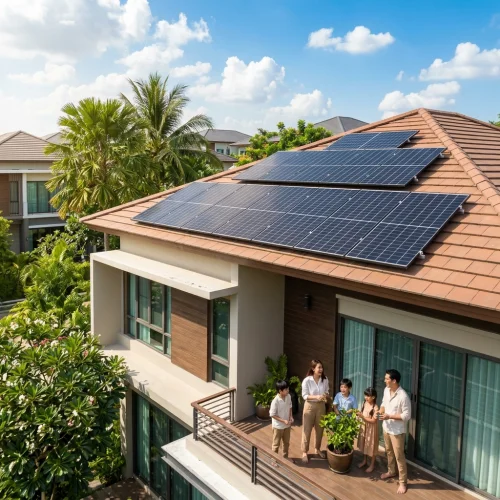
The Thai government has approved a preliminary 50-billion-baht funding package to provide direct subsidies of up to 50,000 baht for residential solar panel installations. Finance Ministry Permanent Secretary Lawaron Sangsanit confirmed that a government screening committee passed the proposal on 20 October. The initiative will be submitted to the Cabinet for formal approval on 26 October, with public registration tentatively scheduled to open in mid-November.
Grant Details and Power Buyback
The scheme offers a one-off subsidy capped at 50,000 baht per household, targeting up to one million domestic properties nationwide. Households will be permitted to install solar panels on rooftops or ground-mounted arrays to offset their private electricity consumption and export surplus generation into the public grid.
Under existing energy buyback programmes managed by the Metropolitan Electricity Authority (MEA) and the Provincial Electricity Authority (PEA), surplus power is purchased at 2.20 baht per unit under a 10-year contract. Official projections estimate that a five-kilowatt rooftop system could generate approximately 1,000 baht a month in export income. This figure remains an estimate rather than a guaranteed return, as household power use, system efficiency, and seasonal sunlight hours will dictate net output.
Eligibility for British Residents
Access to the financial support requires formal registration as the official electricity meter holder or utility customer.
For British expatriates living in Thailand, eligibility will depend heavily on residential status and property tenure. Foreigners who own houses through long-term land leases, usufruct agreements, or Thai spouses must ensure their domestic utility accounts match the criteria set out by the authorities. Those who rent detached properties will need to liaise directly with their landlords, as the registered property owner or meter account holder will hold the formal entitlement.
Residents in multi-unit developments face distinct practical barriers. Individual flat owners and apartment tenants rarely hold direct, standalone grid accounts with the state electricity authorities. Because most residential blocks operate through collective commercial transformers, individual flat dwellers are unlikely to qualify unless an entire building management committee applies collectively on behalf of the estate.
Financing Terms and Expat Borrowing
State-owned retail banks will offer supplemental loans to cover remaining installation expenses that exceed the 50,000-baht grant.
Participating lenders include the Government Savings Bank, the Government Housing Bank, and the Bank for Agriculture and Agricultural Cooperatives. The Ministry of Finance has proposed an uncollateralised interest rate of 2.5 per cent across a seven-year repayment term. Under this model, revenue earned from selling surplus power back to the grid can be credited directly against monthly loan repayments.
However, British nationals frequently encounter strict underwriting barriers when seeking unsecured credit from Thai state banks. Qualifying for these low-interest loans may require a Thai national co-signatory, permanent residency documentation, or extensive proof of local tax contributions and formal work authorisation.
Next Regulatory Steps
The Ministry of Interior will present the complete policy framework to the Cabinet on 26 October for formal sign-off.
Registration will not open until ministers ratify the financing structure and administrative guidelines. Should the Cabinet approve the plan without major alterations, the application portal is expected to launch around the middle of November, with full guidance on foreign property occupants expected alongside the general rollout.
Source: thethaiger.com
Reviewed by the Thailand Guide Editorial Team • Last reviewed: 21 October 2026
This page is provided for general information only. While we aim for accuracy, details can change — please verify anything important independently before relying on it.