Giant Mekong Catfish Fishing
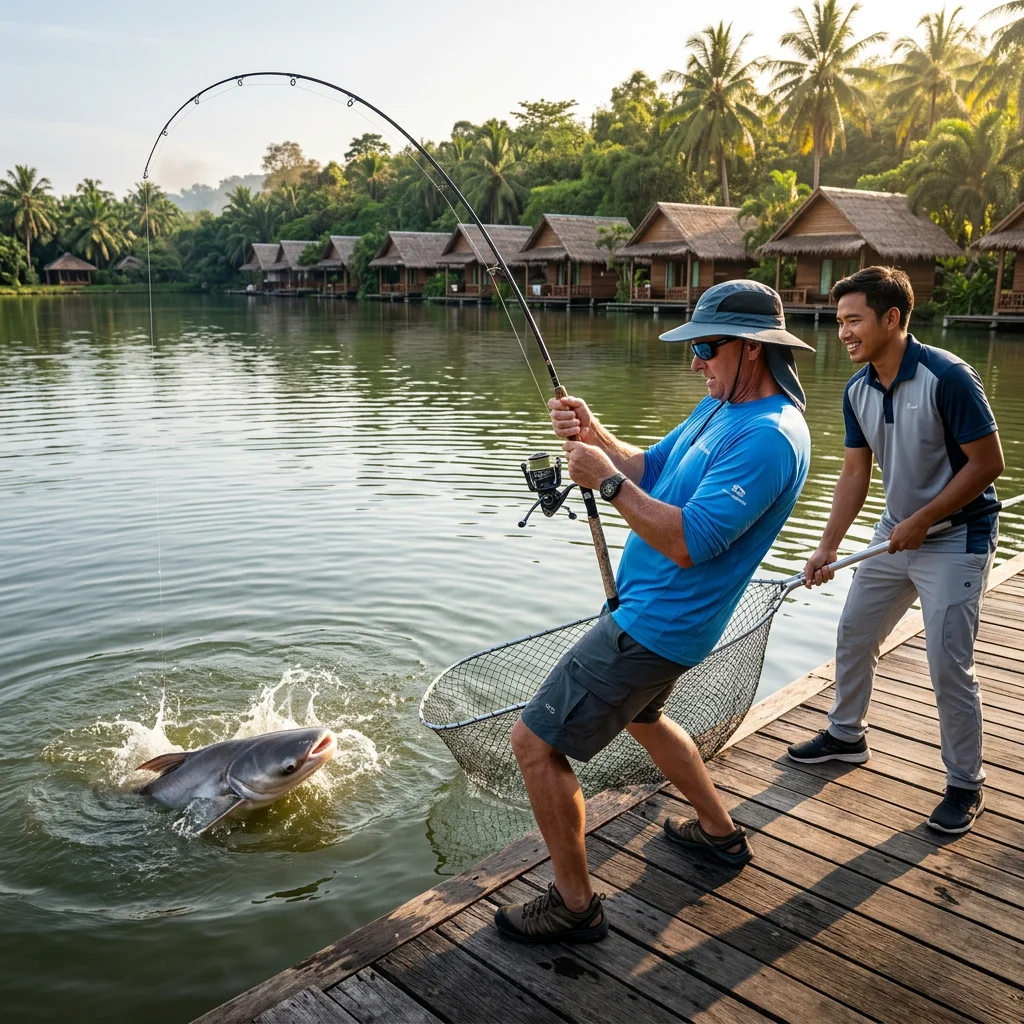
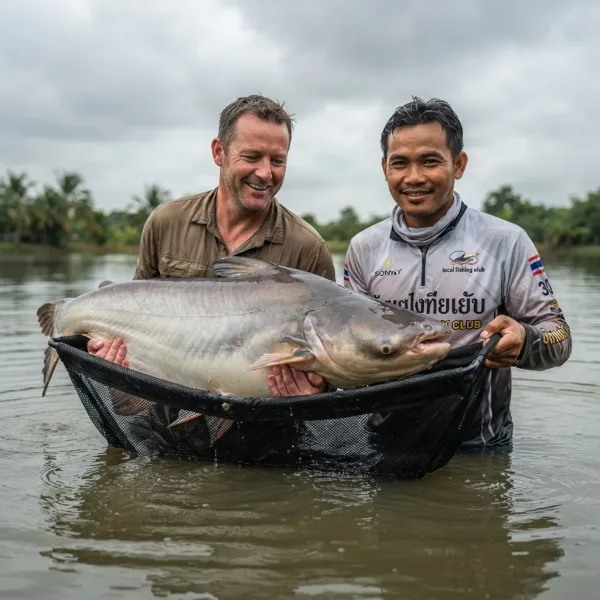
Thailand is virtually the only country where visiting anglers can reliably target the giant Mekong catfish on rod and line. An apex freshwater species of immense power, this fish routinely reaches weights between 30 and 100 kilograms in managed Thai fisheries, giving freshwater specimen hunters the kind of prolonged, tackle-testing battles usually associated with big-game sea fishing.
Scientifically classified as Pangasianodon gigas and known in Thai as pla buek, the species ranks amongst the heaviest purely freshwater fish on earth, historically growing up to three metres in length and exceeding 300 kilograms in its native river basin. In the wild, upstream dam construction, riverbed alteration, and decades of overharvesting have decimated natural stocks, placing the species as Critically Endangered on the IUCN Red List. Angling for wild catfish along the Mekong River and its tributaries is strictly prohibited under Thai fisheries legislation.
Commercial sport fishing in Thailand is therefore conducted in private, purpose-built catch-and-release fisheries stocked with captive-bred specimens. These fish originate from long-running artificial breeding programmes developed by the Thai Department of Fisheries to preserve the species. In their natural river habitat, adult Mekong catfish are toothless herbivores that feed almost entirely on filamentous algae and periphyton scraped from rocks, making them impossible to hook using conventional predatory lures. In managed park waters, however, captive-bred fish have adapted to feed on prepared breadcrumb, toasted rice bran, and grain pastes, opening the door to specialised feeder tactics.
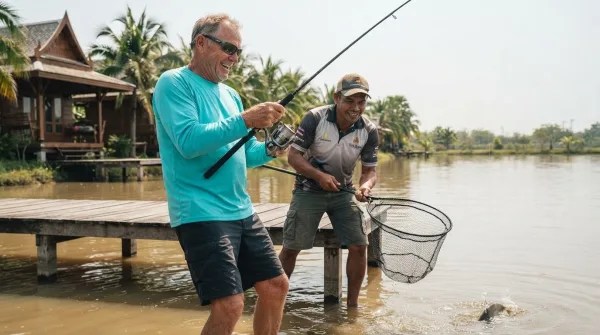
The resulting sport demands robust tackle and considerable physical stamina. Once hooked, these catfish embark on relentless, deep-surging runs that can last well over an hour on heavy gear. While the physical exertion suits experienced carp and sea anglers, novices can fish these venues effectively by working alongside resident lakeside guides who manage bait preparation, casting, and safe handling at the net.

Fishery Venues, Tackle and Techniques
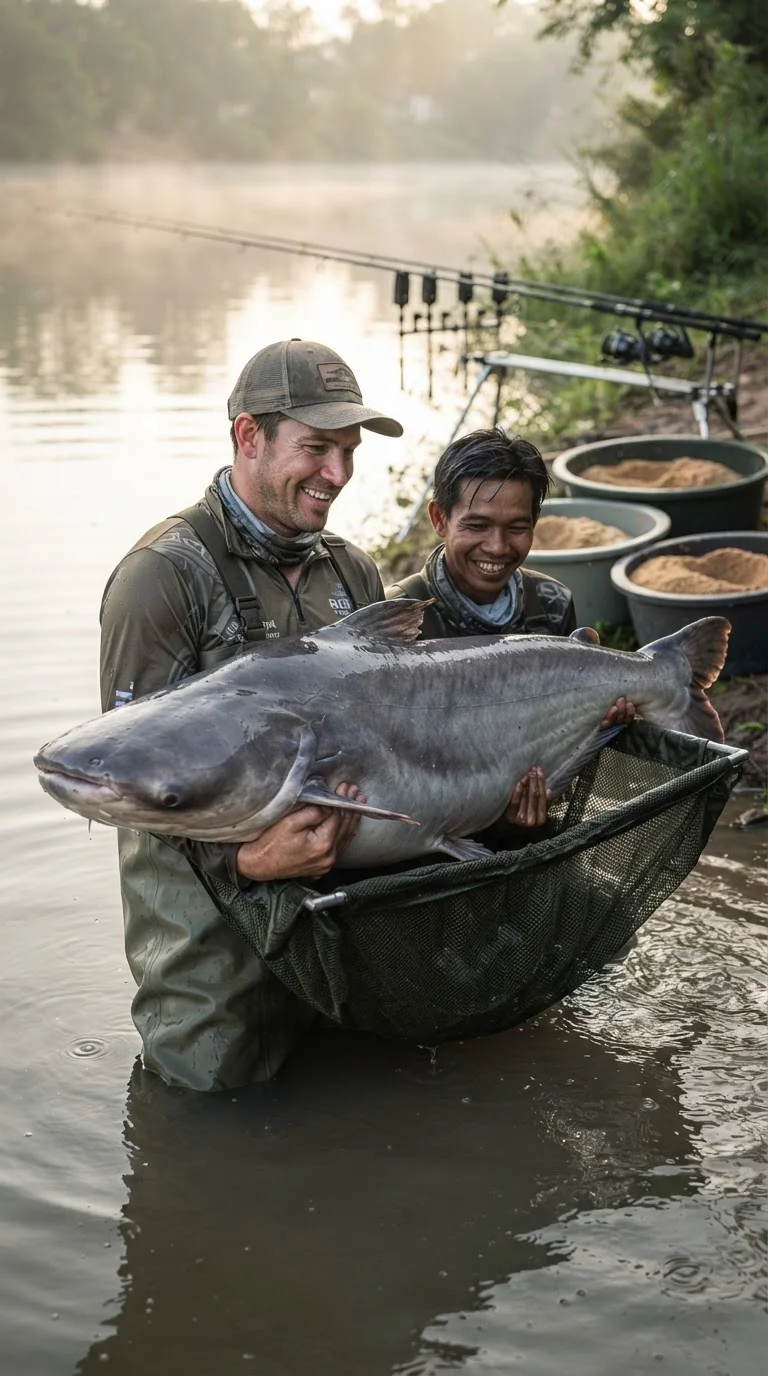
Two main destinations define commercial Mekong giant catfish angling in Thailand. Bungsamran Fishing Park, located in Chachoengsao Province roughly an hour east of central Bangkok, delivers high catch rates from extensive wooden boardwalks and private day bungalows. The lake holds dense stocks of Pangasianodon gigas, with typical catches weighing between 15 and 30 kilograms and specimen fish reaching up to 140 kilograms. For a lower-density specimen hunt against limestone karst hills, Jurassic Mountain Resort in Cha-am stocks a smaller population of giant catfish alongside other freshwater species, with resident specimens documented in excess of 150 kilograms.
Subduing these powerful fish requires specialised heavy tackle. Anglers rely on stiff carp rods with 3.5 lb to 5.0 lb test curves, or heavy 30–50 lb boat and jigging blanks capable of absorbing sustained downward surges. These rods are matched with heavy-duty multiplier reels or saltwater-rated fixed-spool reels in the 6000 to 10,000 size range, loaded with 50 lb to 80 lb braided mainline or heavy monofilament and set with smooth, high-capacity drag systems.
The standard presentation centres on an inline wire coil or method feeder packed with a softball-sized mix of damp ram (toasted rice bran) or fine breadcrumbs flavoured with coconut or syrups. A short hooklink of 50 lb to 60 lb braid, usually 10 to 15 centimetres long, connects to a single heavy-gauge barbless hook. Anglers bait the hook with a small bread crust cube or high-density foam bead to make it neutrally buoyant. As the feeding catfish vacuums the disintegrating food cloud, it inhales the floating hook.
Fish care rules are strictly enforced at reputable venues. Giant Mekong catfish lack rigid skeletal structures to support their body mass outside water, meaning that lifting them onto hard timber decking or suspending them vertically by the gills causes fatal internal organ crushing and spinal dislocation. Fishery rules require unhooking fish directly in the water or using waterborne retention slings and thick, padded cradles, with all photography kept low to the surface.
Getting There and Logistics
Reaching the primary fisheries requires dedicated private transport. Bungsamran sits in Bang Nam Priao District in Chachoengsao Province, roughly 50 to 65 kilometres east of central Bangkok. A metered taxi or ride-hailing car from the city centre takes 60 to 90 minutes depending on morning traffic, costing between 700 THB and 1,000 THB (£16 to £23) each way. You should agree a return journey and collection time with your driver before setting off, as hail-able taxis or app pickups are virtually impossible to secure around the rural lake later in the day. Further south, Jurassic Mountain Resort in Cha-am sits approximately two and a half hours southwest of Bangkok, with private taxi transfers arranged through the resort priced at 2,200 THB from Bangkok hotels or 2,500 THB from the airport (£50 to £57).
Bungsamran operates 24 hours a day, divided into distinct day (08:00–20:00) and night (20:00–08:00) sessions. Its standard day package for foreign anglers costs 6,000 THB (£136), covering a 12-hour ticket, one heavy rod and reel setup, an eight-hour fishing guide, and an introductory bait allowance. While major packages can often be settled by card, cash in Thai Baht remains necessary across the fishery: tackle hire requires a refundable 2,000 THB (£45) cash deposit, and guide tips, food, and replenishment bait must be paid out of hand. Extra 25-kilogram sacks of rice bran cost 800 THB (£18), smaller feed bags run to 90 THB (£2), and private lakeside bungalows can be hired for between 1,000 THB and 5,000 THB (£23 to £114) per 12-hour slot.
Plan a Central Thailand trip through Ayutthaya, Kanchanaburi, Lopburi and Amphawa, with current costs, transport advice and seasonal guidance.
Quick Reference Table
| Item | Detail | Notes |
|---|---|---|
| Primary venues | Bungsamran Fishing Park (Chachoengsao) and Jurassic Mountain Resort (Cha-am) | Stocked with captive-bred fish; targeting wild fish in natural waterways is illegal |
| Typical target weights | 30 kg to 100 kg | Specimen fish reach up to 140 kg at Bungsamran and over 150 kg at Jurassic Mountain |
| Core techniques | Inline method feeder or wire coil with toasted rice bran (*ram*) or breadcrumb | Paired with 3.5–5.0 lb test curve rods or 30–50 lb boat blanks and a single barbless hook |
| Bungsamran foreign angler day ticket | 6,000 THB (£136) | 12-hour session (08:00–20:00); includes 1 heavy rod setup, 8-hour guide, and starter bait |
| Additional fishery costs | 2,000 THB (£45) tackle deposit; 1,000–5,000 THB (£23–£114) for private bungalows | Refundable deposit, bait refills (800 THB per 25 kg sack), and guide tips require cash |
| Fish handling rules | In-water unhooking or padded cradles and slings | Lifting fish onto hard decking or by gills is strictly prohibited to prevent fatal injury |
| Website | https://bungsamran.com | Bungsamran Fishing Park |
| Website | https://jurassicfishingthailand.com | Jurassic Mountain Resort |
| Phone | +66 97 151 6688 | Bungsamran Fishing Park |
| Phone | +66 61 631 2614 | Jurassic Mountain Resort |
| Address | 98 Sala Daeng, Bang Nam Priao District, Chachoengsao 24000 | Bungsamran Fishing Park |
| Address | 43/6 Moo Baan Kokesehti, Tambon Na Yang, Cha-am District, Phetchaburi 76120 | Jurassic Mountain Resort |
FAQ: Giant Mekong Catfish Fishing
Is it legal to fish for wild Mekong catfish in Thailand?
Where does commercial sport fishing for Mekong catfish take place in Thailand?
What do Mekong catfish eat in managed fisheries?
Is giant Mekong catfish fishing suitable for novice anglers?
What are the main venues for giant Mekong catfish fishing in Thailand?
What type of fishing tackle is needed for giant Mekong catfish?
How should anglers handle giant Mekong catfish to ensure their safety?
How should I arrange transport to Bungsamran Fishing Park?
What payment methods are accepted at Bungsamran Fishing Park?
What are the typical weights of giant Mekong catfish caught?
Reviewed by the Thailand Guide Editorial Team • Last reviewed: 10 November 2026
This page is provided for general information only. While we aim for accuracy, details can change — please verify anything important independently before relying on it.