Mu Koh Ang Thong National Park



Spanning 102 square kilometres of the Gulf of Thailand, Mu Koh Ang Thong National Park protects an archipelago of 42 mostly uninhabited limestone islands, sheer karst cliffs, and coral reefs established by royal decree in 1980. Situated roughly 30 kilometres west of Koh Samui, it remains one of the few national marine reserves in southern Thailand where visitors can stay overnight directly on an island, swapping commercial resort strips for quiet dusk views across open marine basins.
The park is managed by Thailand's Department of National Parks, Wildlife and Plant Conservation (DNP) and holds international recognition as a Ramsar wetland site. Rather than commercial resort facilities, the reserve maintains modest government-run bungalows and beachfront camping on its administrative base, Koh Wua Ta Lap. The setting appeals particularly to self-reliant travellers, walkers, and photographers who want rugged coastal scenery and marine wildlife without commercial resort clutter.

Archipelago Geography and Protected Marine Environment
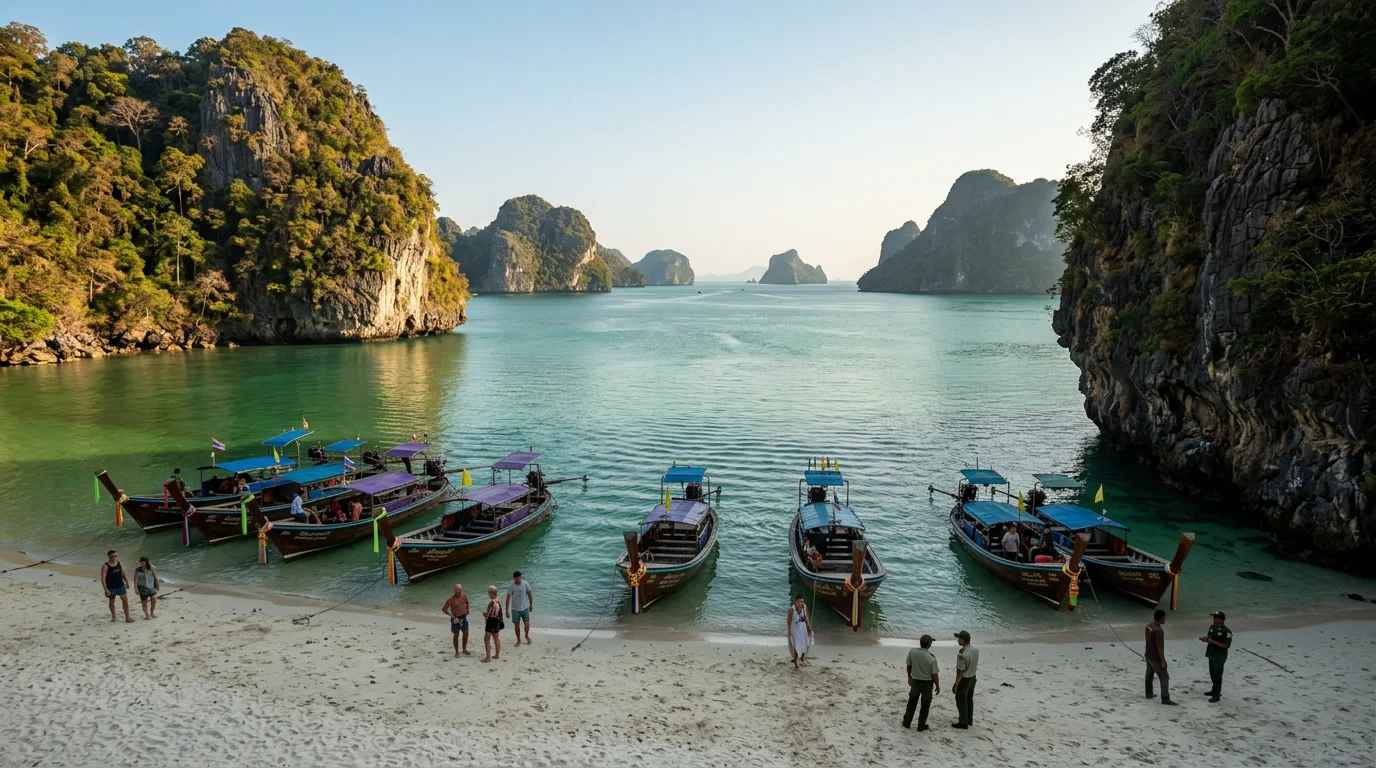
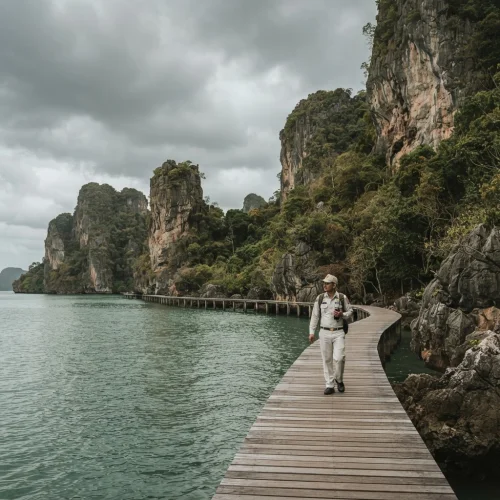
Towering limestone karst pillars rising out of emerald waters define the topography of this 42-island marine archipelago in the western Gulf of Thailand. Designated on 12 November 1980 as Thailand's 21st national park, the protected maritime territory encompasses 102 square kilometres (63,750 rai), though dry land accounts for roughly 18 square kilometres across the islets combined. Centuries of chemical weathering, rainwater erosion, and marine wave action have sculpted the steep limestone cliffs into sea caves, natural stone arches, collapsed sinkholes, and marine lakes. Karst peaks rise to 396 metres above sea level on Koh Phaluai. Dense dry evergreen forest covers the larger islands, while specialised limestone vegetation clings to sheer cliff faces, and beach forest lines sheltered coves. The archipelago also provides habitat for the Ang Thong lady's slipper orchid (Paphiopedilum angthong), an endemic flowering plant native to the islands.
Beneath the waterline, the marine reserve sits in relatively shallow waters averaging approximately 10 metres in depth. Water clarity fluctuates depending on seasonal weather and fine sediment carried seaward from the mainland by the Tapi River, keeping visibility lower than around deep-water islands such as Koh Tao. Even so, narrow fringing coral reefs thrive along sheltered southwestern coastlines protected from the northeast monsoon. These shallow reef flats support brain, staghorn, and plate corals populated by eight-banded butterflyfish, parrotfish, angelfish, and blue-spotted stingrays. Pods of Indo-Pacific humpback dolphins and finless porpoises occasionally transit the deeper channels between island clusters, while green and hawksbill sea turtles feed along the reef edges.
On land, strict conservation zoning protects fragile habitats, and commercial resort developments are prohibited throughout the archipelago. The park's ecological importance earned it international recognition in 2002 as a Ramsar Wetland of International Importance. Park authorities record 16 mammal species across the islands, most visibly troops of dusky leaf monkeys and long-tailed macaques feeding in the coastal canopy, alongside leopard cats, fishing cats, and smooth-coated otters. Avian life includes more than 50 recorded species, with white-bellied sea eagles, brahminy kites, and oriental pied hornbills nesting among high karst crevices. Crossing the exposed channels between islands requires sensible preparation; pack a dry bag for electronics, as open-water passages are prone to sudden tropical squalls and heavy sea spray.
National Park Bungalows and Island Campsites
Overnight stays in the park are concentrated on Koh Wua Ta Lap, providing a rustic base run directly by the Department of National Parks. Accommodation sits at Ao Kha beach, directly behind the park headquarters. The department maintains a small cluster of simple wooden bungalows equipped with wall-mounted electric fans, mosquito screening, and private cold-water shower rooms. Because the island operates off the main power grid, electricity is supplied by a communal generator that runs strictly on a timed evening schedule, generally from 18:00 to 23:00. Guests must recharge torches, cameras, and mobile phones during this evening window, as power shuts down overnight.
For campers, the park manages a grassy beachfront camping area shaded by coconut palms along Ao Kha bay. Travellers can pitch personal tents or hire heavy-duty park tents supplied with foam sleeping mats, light blankets, and pillows from the ranger station. Basic communal toilets and cold-water showers serve the campsite. When day-trip speedboats and tour vessels depart around 15:00, the island empties out, leaving overnight guests with quiet sands, starlit skies, and the sounds of resident wildlife.
Plan a Koh Samui holiday with practical guidance on beaches, accommodation areas, ferries, local transport, costs, weather and Ang Thong trips.
Park Ranger Headquarters, Visitor Infrastructure, and Island Dining
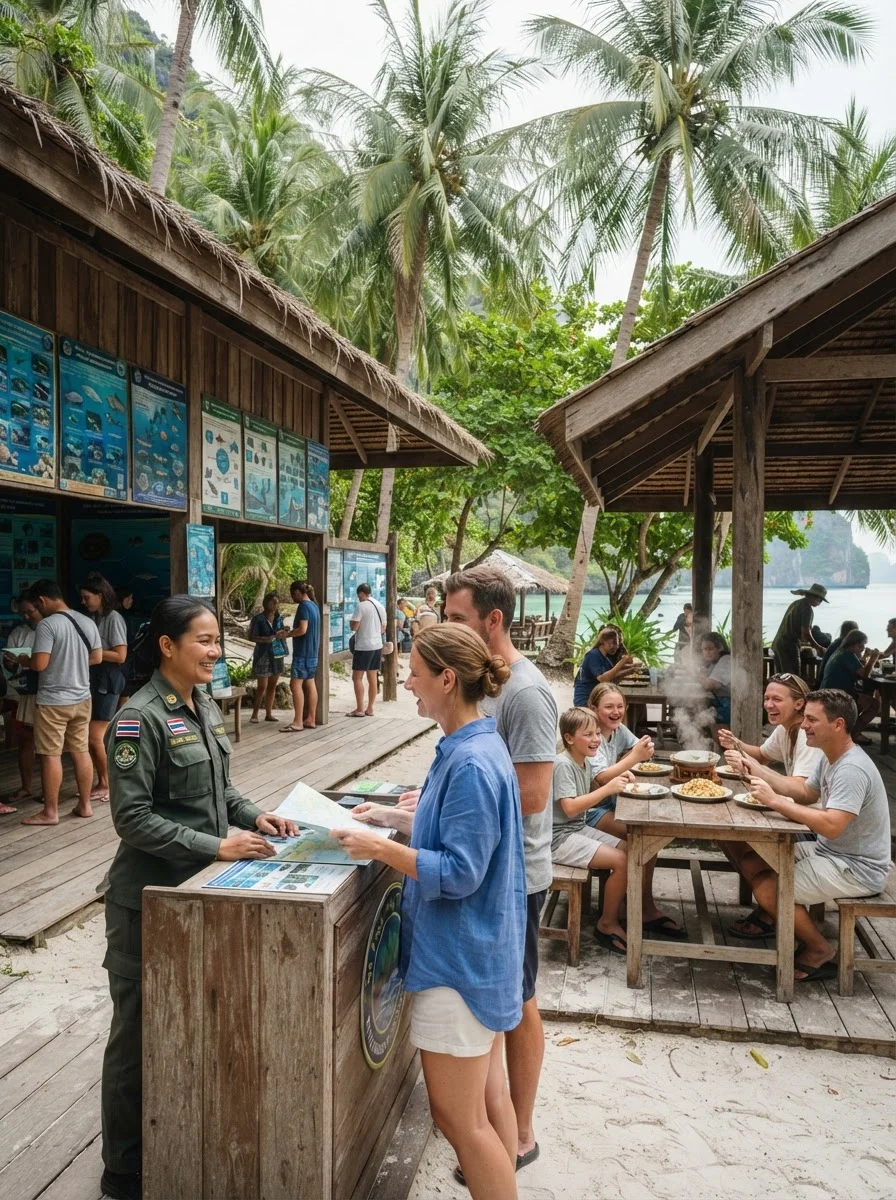
The park headquarters at Ao Kha, on Koh Wua Ta Lap, functions as the central hub for administration, visitor registration, and ranger operations across Mu Koh Ang Thong National Marine Park. Arriving travellers disembark along the main beach and report to the open-air visitor centre. Here, park rangers register overnight campers and bungalow guests, distribute trail maps, provide guidance on hiking routes, and collect national park admission fees from visitors whose tour operators have not prepaid them.
The headquarters compound provides straightforward, functional amenities designed for off-grid conservation conditions. Public facilities include communal flushing toilets, cold-water rinse showers, and basic washrooms, alongside a modest information area outlining the archipelago's marine habitats, limestone geology, and resident wildlife such as dusky leaf monkeys.
Next to the ranger station sits the island's single dining facility, a covered, open-sided canteen operated by park personnel. Catering primarily to daytime excursions and overnight campers, the kitchen typically serves food from 08:00 to 15:00, before closing during the late afternoon and reopening for dinner service between approximately 18:00 and 20:00. Meals consist of standard made-to-order Thai dishes, including fried rice, pad krapow (holy basil stir-fry), noodle plates, and curries, alongside fresh fruit, bottled water, coconuts, and soft drinks. Meal preparation is deliberately unhurried, and options are simple.
Outside this single canteen, there are no grocery shops, convenience stalls, or independent beach bars anywhere on Koh Wua Ta Lap. Visitors must bring sufficient physical Thai Baht cash to pay for all meals, extra drinking water, and incidental supplies, as card payment terminals and bank cash machines do not exist within the park.
Pha Chan Charat Viewpoint, Thale Nai Emerald Lake, and Marine Trails
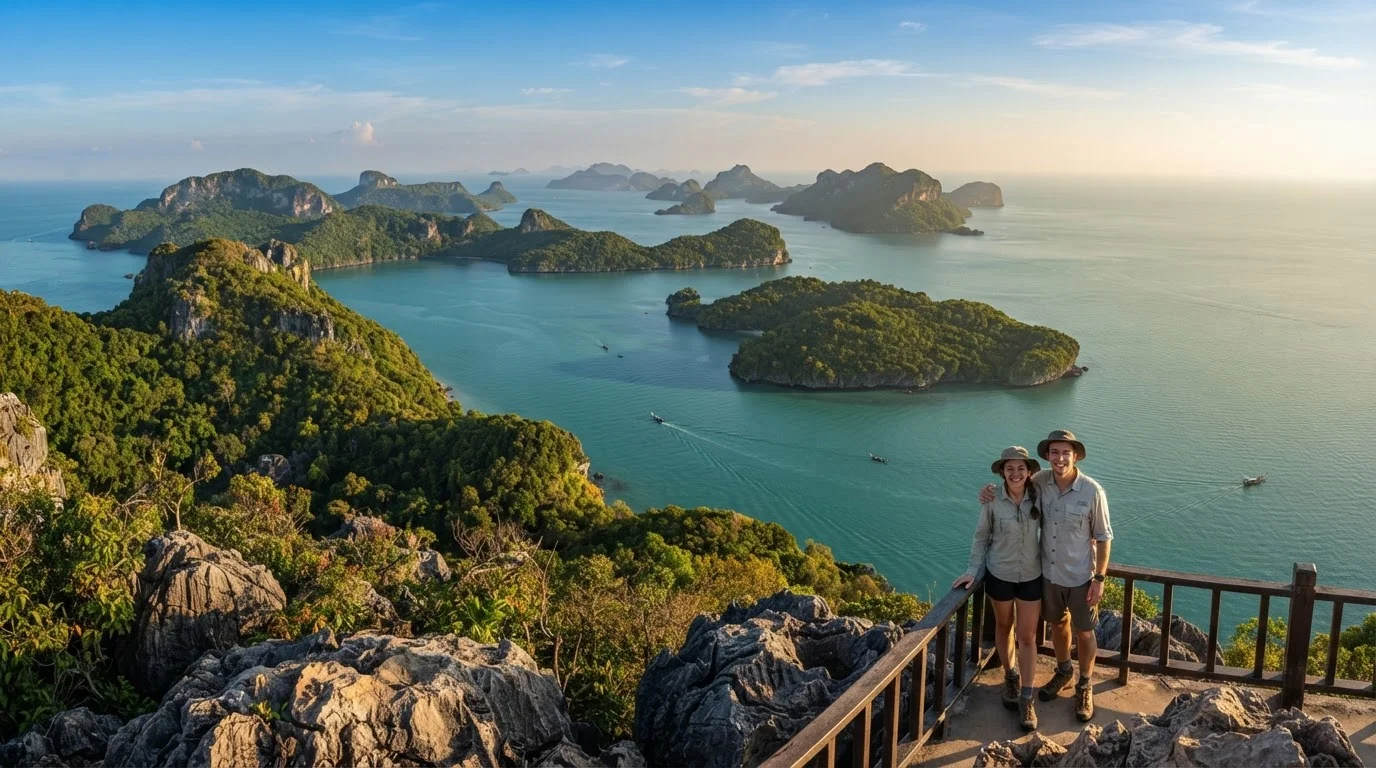
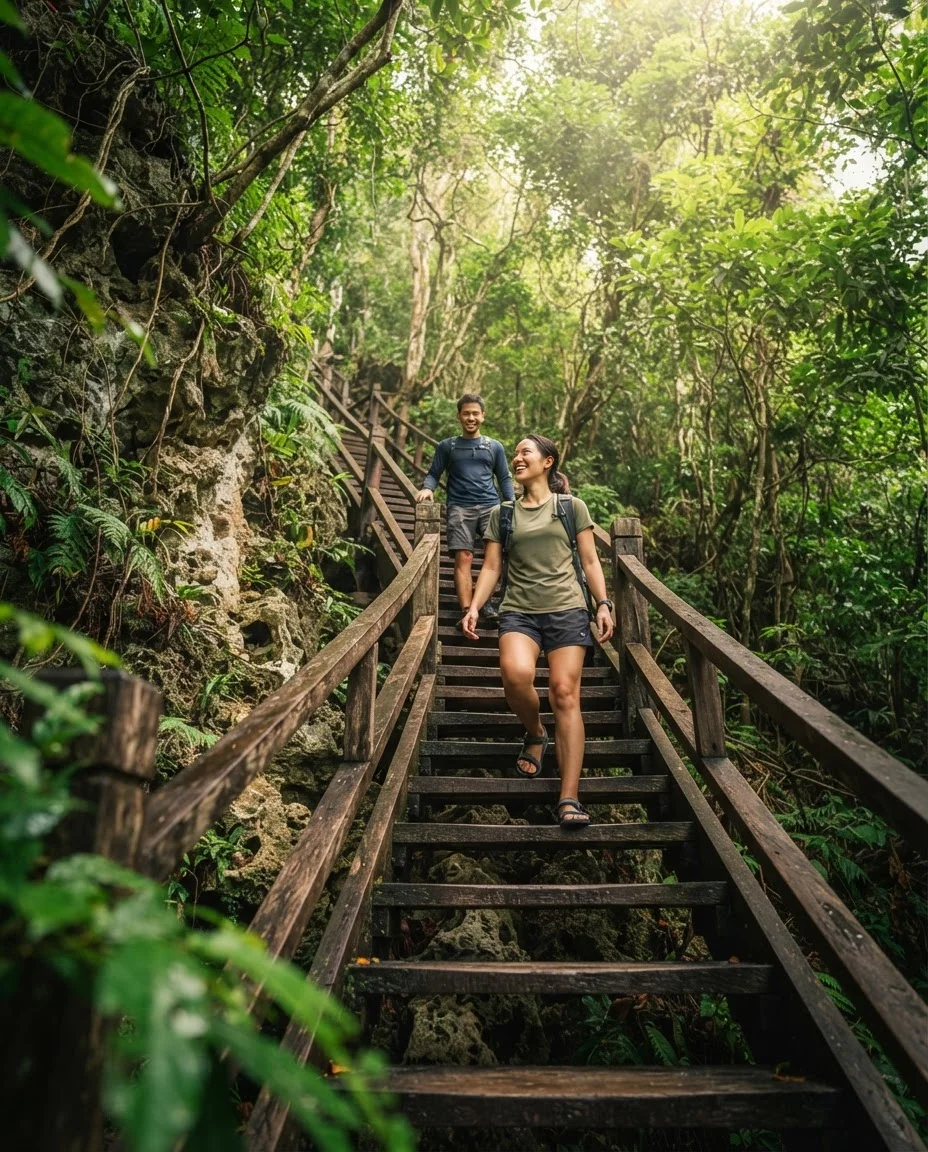
Walking trails and marine routes form the core of active exploration across Mu Koh Ang Thong. On Koh Wua Ta Lap, the Pha Chan Charat trail extends 500 metres in trail distance up a steep karst ridge, terminating at a 262-metre summit above sea level. Five intermediate rest platforms sit roughly every 100 metres along the way. While the lower path climbs through shaded forest via timber and stone steps, the upper third transitions into exposed, razor-sharp limestone terrain where fixed guide ropes assist climbers with handholds and balance. The sharp rock and steep gradient require sturdy trainers or walking shoes with reliable grip; flip-flops are hazardous on the karst. The summit rewards climbers with an expansive 360-degree panorama over the archipelago.
North of the park headquarters, Koh Mae Koh contains Thale Nai, an enclosed saltwater lagoon ringed by vertical limestone walls. Subterranean channels and rock fissures connect the lake to the Gulf of Thailand, allowing tidal exchange that alters the water tone between milky jade and deep emerald. An elevated timber boardwalk with around 240 steps leads from the boat mooring up to a wooden viewing platform above the water. Swimming, wading, and watercraft are strictly prohibited in Thale Nai to protect its fragile ecology and distinctive water chemistry.
Other marked trails and water routes explore the park's karst geology. A separate trail on Koh Wua Ta Lap leads to Bua Bok Cave, a limestone cavern containing stalactites and stalagmites shaped like blooming lotuses. The route uses guide ropes along uneven ground, and visitors require a torch to navigate the unlit interior. Across the channel, Koh Sam Sao provides a sheltered sea-kayaking circuit. Kayakers paddle under a natural stone archway projecting from the north shore, navigate past sea caves, and float over shallow fringing reefs into quiet coves.
| Trail or Activity Route | Difficulty Level | Typical Duration | Focus & Distinctive Features |
|---|---|---|---|
| Pha Chan Charat Summit Hike | Challenging | 45–60 mins return | 500 m steep trail; ropes, jagged limestone, 360-degree archipelago views |
| Thale Nai Lagoon Walkway (Koh Mae Ko) | Moderate | 30 mins return | Wooden boardwalk stairs leading to elevated viewing deck above enclosed saltwater lake |
| Bua Bok Cave Nature Trail | Moderate | 40 mins return | Forest trek leading to limestone cavern with stalactites and geological formations |
| Koh Sam Sao Sea Kayak Circuit | Easy to Moderate | 1–2 hours | Coastal paddling under natural limestone sea arches with shallow reef viewing |
Climbing the Pha Chan Charat trail either before 09:00 or after 16:00 allows overnight visitors to avoid extreme midday heat and heavy tour group traffic. Joining an organised day excursion or private boat charter provides practical access to these walking tracks, viewpoints, and paddling routes across the marine park.
Location and Getting There
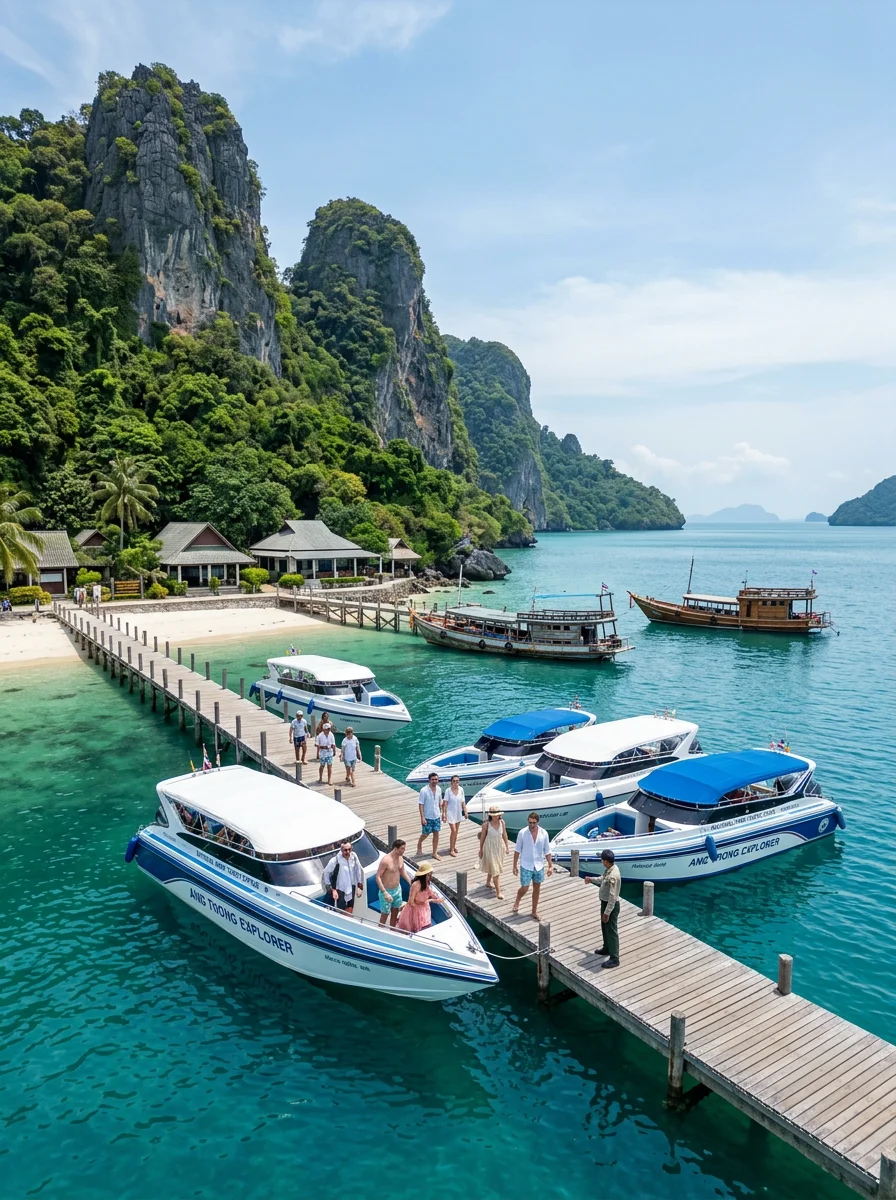
Mu Koh Ang Thong National Park lies in the western Gulf of Thailand within Surat Thani Province, roughly 30 kilometres north-west of Koh Samui and 32 kilometres west of Koh Phangan. The archipelago is reached entirely by boat, as no scheduled public ferry service runs to the islands. Visitors travel instead on licensed commercial day tours, private speedboats, or chartered vessels.
For UK travellers, the journey typically begins with an international flight into Bangkok, followed by a domestic connection. Samui Airport (USM) allows direct air access to Koh Samui, with flights operating from Bangkok multiple times daily. Alternatively, flights link Bangkok to Surat Thani International Airport (URT) on the mainland, which requires an onward coach transfer to the coastal ferry ports.
Koh Samui functions as the primary departure base for park excursions. Daily tour speedboats depart from northern and western piers, including Nathon, Maenam, and Bangrak, reaching the park in 45 to 60 minutes. Slower, multi-deck wooden cruisers operate out of Nathon Pier; these crossings take 90 to 120 minutes and provide a steadier ride for passengers prone to seasickness. Organised day tours also run from Thong Sala Pier on neighbouring Koh Phangan, crossing in roughly 45 to 60 minutes by speedboat. Visitors based on the mainland can arrange private vessel charters from Don Sak, situated approximately 65 kilometres east of Surat Thani town.
Costs and Booking
Visiting Mu Koh Ang Thong National Park requires budgeting for park entrance fees, boat transfers, and optional overnight stays or equipment rental.
Foreign adult admission is 300 THB (approximately £7.00), whilst foreign children aged 3 to 14 pay 150 THB (£3.50); children under three enter free. Thai nationals pay 40 THB for adults and 20 THB for children. Most day visitors must pay this fee in cash upon arrival at Koh Wua Ta Lap, though certain operators bundle it into upfront fares. Because no cash machines exist on the islands, carrying physical Thai baht notes is necessary.
Day excursions from Koh Samui or Koh Phangan range from roughly 1,530 THB (£36.00) on large boats to between 1,800 THB and 2,200 THB (£42.00 to £51.00) on speedboats, typically covering transfers, lunch, drinking water, and snorkel gear. Kayaks can be rented at Koh Wua Ta Lap headquarters for 500 THB (£11.60) per day.
Overnight stays on Koh Wua Ta Lap are arranged with the Department of National Parks. Two-person fan-cooled bungalows cost 600 THB (£14.00) per night, with eight-person units at 1,500 THB (£35.00). Campers can rent pre-pitched tents for 250 to 450 THB (£5.80 to £10.50) per night, alongside an 80 THB (£1.90) per-person camping fee. Favourable crossing conditions run from February to August; the park closes annually for conservation from 1 November to 15 December.
| Option | Cost (THB) | Cost (GBP approx) | Notes |
|---|---|---|---|
| Foreign Adult Park Entrance | 300 THB per person | £7.00 | Mandatory government fee; payable in cash upon arrival |
| Foreign Child Park Entrance (Ages 3–14) | 150 THB per child | £3.50 | Proof of age may be requested; children under 3 enter free |
| Shared Speedboat Day Excursion | 1,800–2,200 THB per adult | £42.00–£51.00 | Includes round-trip boat transfer, guide, mask, and lunch |
| Overnight 2-Person Park Bungalow | 600 THB per night | £14.00 | Fan-cooled; booked through DNP; generator power 18:00–23:00 |
| Pre-pitched Park Camping Tent | 250–450 THB per night | £5.80–£10.50 | Includes bedding kit; site fee of 80 THB (£1.90) per person applies |
| Ocean Kayak Rental | 500 THB per day | £11.60 | Double or triple kayaks rented at Koh Wua Ta Lap headquarters |
Who It Suits
Mu Koh Ang Thong National Marine Park suits self-sufficient backpackers, hikers, nature photographers, and adventurous travellers who prioritise wild scenery over resort comforts. Staying overnight on Koh Wua Ta Lap appeals particularly to those keen to walk rugged limestone trails, observe resident dusky leaf monkeys, and enjoy uncrowded beaches once the day-trip tour boats leave in the mid-afternoon.
The park is ill-suited to anyone seeking luxury amenities, nightlife, or full-service hospitality. Travellers with reduced mobility or pushchairs will struggle with the steep steps, sharp karst paths, and wet transfers between speedboats and shore. Facilities on the island remain distinctly rustic, with simple cold-water washing blocks and no evening entertainment. Enjoying an overnight visit depends on being comfortable with basic off-grid conditions.
What to Know Before You Book
Cash in Thai Baht must be carried for all on-island spending. No cash machines or card payment terminals exist on Koh Wua Ta Lap, and park rangers cannot process electronic bank transfers for admission fees, sundries, or canteen meals.
For overnight visitors staying in park bungalows or tents, mains electricity is non-existent. Power is supplied by local generators that operate only during set evening hours—typically between 18:00 and 22:00 or 23:00—before switching off for the night. Bringing portable power banks is strongly advised to keep mobile phones and cameras charged.
Packing appropriate footwear is equally sensible before boarding your transfer boat. Ascending to the Pha Chan Charat summit or crossing to the Thale Nai viewpoint involves negotiating sharp limestone crags, exposed tree roots, and steep wooden stairs. Flip-flops and smooth-soled sandals present a severe slipping hazard; wear trainers or lightweight walking shoes with reliable rubber grip.
The entire national park closes annually from 1 November to 15 December. During this period, the northeast monsoon generates hazardous ocean swells and severe winds across the Gulf of Thailand, prompting the Department of National Parks to shut the archipelago for visitor safety and environmental recovery. Operations typically resume on 16 December.
Practical Tips

Mineral reef-safe sunscreen is mandatory across Thai marine national parks. Formulations containing oxybenzone, octinoxate, 4-methylbenzylidene camphor, or butylparaben are prohibited by law to protect local coral ecosystems. Mosquito repellent is similarly useful, particularly in shaded foliage and along coastal clearings where midges and biting insects appear towards late afternoon.
Secure all food inside zipped luggage and sealed containers. Troops of dusky leaf monkeys and long-tailed macaques roam the beachfront groves on Koh Wua Ta Lap, and they will rifle through unattended bags in search of food. Feeding any wildlife is strictly prohibited under Department of National Parks regulations.
Pack a durable dry bag for personal electronics and valuables. Transit between tour vessels, small tenders, kayaks, and island shores routinely involves wet landings and sea spray. Visitors should also bring a refillable drinking bottle; single-use plastic carrier bags and polystyrene containers are barred from the park, and visitors are expected to carry all personal rubbish back to the mainland.
Swimming or wading in Thale Nai (Emerald Lake) on Koh Mae Koh is strictly prohibited. The saltwater lagoon connects to the open sea through submerged limestone caves, and access into the water is banned to preserve the fragile enclosed ecosystem. Visitors view the water from designated wooden platforms built along the ridge.
Travellers planning an overnight stay must confirm their return boat transfer with their tour operator before leaving Koh Samui or Koh Phangan. Because no scheduled public water taxis operate across the archipelago, your return journey relies entirely on your day-trip operator scheduling a designated pickup on your checkout date.
Quick Reference Table
| Item | Detail | Notes |
|---|---|---|
| Protected Area | 102 sq km (42 islands) | Established 12 November 1980; designated Ramsar Wetland site in 2002 |
| Location | Western Gulf of Thailand | Roughly 30 km north-west of Koh Samui and 32 km west of Koh Phangan |
| Foreign Adult Entrance Fee | 300 THB (£7.00) | Payable in cash upon arrival at Koh Wua Ta Lap headquarters |
| Foreign Child Entrance Fee | 150 THB (£3.50) | Ages 3–14; children under 3 enter free of charge |
| Thai National Entrance Fee | 40 THB adults / 20 THB children | Standard Department of National Parks domestic tariff |
| Annual Park Closure | 1 November to 15 December | Closed to visitors for environmental recovery and northeast monsoon swells |
| Boat Transfer Time | 45–60 mins (speedboat) | 90–120 mins on multi-deck tour boats from Nathon Pier, Koh Samui |
| Day Tour Cost | 1,530–2,200 THB (£36.00–£51.00) | Varies by vessel type; includes transfers, snorkelling gear, and lunch |
| Park Bungalow Hire | 600–1,500 THB (£14.00–£35.00) per night | 2-person fan units (600 THB) and 8-person family units (1,500 THB) |
| Island Camping Hire | 250–450 THB (£5.80–£10.50) per night | Pre-pitched tent hire; additional 80 THB (£1.90) per-person site fee applies |
| Ocean Kayak Rental | 500 THB (£11.60) per day | Double and triple sea kayaks available at Koh Wua Ta Lap |
| Electricity Hours | 18:00 to 22:00 or 23:00 | Off-grid generator power on Koh Wua Ta Lap; power banks recommended |
| Payment Methods | Cash only (Thai Baht) | No ATMs, card terminals, or electronic bank transfers on the islands |
| Key Walking Trails | Pha Chan Charat & Thale Nai | 500 m ridge climb (262 m summit) and 240-step boardwalk to Emerald Lake |
| Website | portal.dnp.go.th | Official Department of National Parks, Wildlife and Plant Conservation portal |
| Book direct | https://portal.dnp.go.th/Content/nationalpark?contentId=1025 | DNP reservation and national park information portal |
| Phone | +66 77 286 025 | Park headquarters line; secondary lines +66 77 286 588 / +66 61 285 7364 |
| Address | 145/1 Talat Lang Road, Talat, Mueang Surat Thani, Surat Thani 84000 | Mainland administrative office address |
FAQ: Mu Koh Ang Thong National Park
What kind of traveller is Mu Koh Ang Thong National Park best suited for?
What should visitors know about electricity supply on Koh Wua Ta Lap?
What payment methods are accepted within Mu Koh Ang Thong National Park?
What type of footwear is recommended for exploring Mu Koh Ang Thong National Park?
Is swimming allowed in Thale Nai (Emerald Lake)?
When is the best time to visit Mu Koh Ang Thong National Park, and when does it close?
What kind of sunscreen should visitors use in the marine park?
How should visitors manage food and interact with wildlife on Koh Wua Ta Lap?
What essential items should visitors pack for boat transfers and island activities?
What is important for overnight visitors to arrange regarding their return journey?
Reviewed by the Thailand Guide Editorial Team • Last reviewed: 14 November 2026
This page is provided for general information only. While we aim for accuracy, details can change — please verify anything important independently before relying on it.