Chiang Mai trades the heavy coconut creams and sharp palm sugars of the south for an earthy, bitter, and spice-heavy profile rooted in the Lanna forest.
The food here is rugged and often served with mountains of fresh, raw herbs that would seem excessive anywhere else. You will find that the local palate leans into fermented funk and creeping heat rather than the standard sweet-sour balance found in Bangkok.
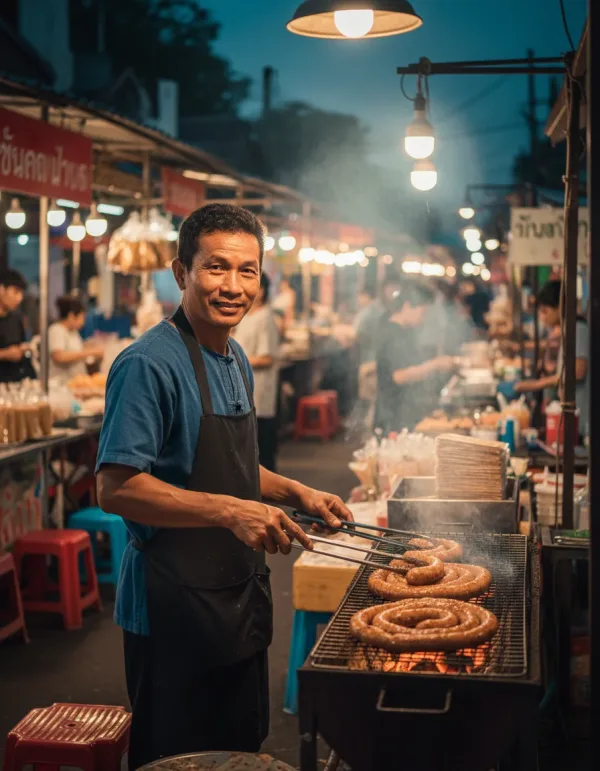
Start with khao soi, the undisputed king of Northern soups. It consists of yellow egg noodles submerged in a rich curry broth topped with a tangled nest of deep-fried crispy noodles. The broth carries a warm, cardamon-heavy fragrance rather than a sharp chili bite. You want to eat this at Khao Soi Mae Sai where a bowl costs about 50 THB, roughly £1.10. Next is sai oua, a grilled pork sausage packed so tightly with lemongrass, galangal, and kaffir lime leaves that it smells like a botanical garden. It is salty, fatty, and carries a slow-building heat. Pick up a coil for 60 THB or £1.30 at any wet market. Then there is gaeng hang ley, a Burmese-style pork belly curry. It is slow-cooked until the fat melts at the touch of a spoon, flavored with pickled garlic and ginger rather than coconut milk. It should cost around 80 THB or £1.75 at a sit-down spot like Huen Muan Jai. For something lighter, find nam prik noom, a dip made from charred green chilies and garlic pounded into a thick paste. It is smoky and pungent, usually served with crunchy pork crackling for 40 THB or £0.90. Finally, seek out khanom jeen nam ngiao, a fermented rice noodle soup with a tangy, tomato-based broth and cubes of pork blood. It is an acquired taste for some but essential for understanding the region. A portion at a street stall will set you back 35 THB or £0.80.
For those on a budget, the Chang Phuak Gate night market is the place to land. Look for the woman in the cowboy hat serving slow-braised pork leg for 60 THB or £1.30. If you have a mid-range budget, head to the Nimmanhemin area. While it feels modern, spots like Tong Tem Toh serve authentic Northern platters for roughly 300 THB or £6.50 per person. For a splurge, the riverside restaurants along Charoen Rat Road offer elevated Lanna dining for about 800 THB or £17.50, including drinks. Most visitors miss the Siri-wattana Market, also known as Thanin Market. It is located north of the old city and serves as a massive food hall where locals buy their daily meals. You can feast here for under 100 THB or £2.20 and experience the sheer variety of Northern ingredients without the tourist markup.
STREET FOOD GUIDE
Look for stalls with high turnover and a single-dish focus. If a vendor only makes one thing, they usually do it better than a restaurant with a fifty-page menu. Avoid the main Sunday Walking Street for serious eating; it is too crowded to enjoy the food properly. Instead, go to the Wua Lai Saturday Market or the South Gate market on any weekday evening. A useful tip for the best experience is to observe the communal seating etiquette. If a table is full, it is entirely normal to ask to sit in an empty chair next to a stranger. It keeps the line moving and often leads to better recommendations.
Local drinkers stick to Leo or Singha beer, usually served over ice to combat the humidity, costing about 70 THB or £1.50 for a large bottle. For something stronger, SangSom rum mixed with soda water and lime is the standard choice. If you want a non-alcoholic regional specialty, try nam kra-jeab, a deep red, tart hibiscus juice that is incredibly refreshing. It costs around 20 THB or £0.45 at most street markets.
Avoid the overpriced dinner shows marketed as Khantoke nights in the city center. They often prioritise the performance over the quality of the food. For a better experience, go to a local open-air garden restaurant where you can order a Lanna platter and hear live acoustic northern music for a fraction of the price. Do not bother with western-style breakfasts in the Old City; they are expensive and rarely hit the mark. Walk two blocks further to a congee stall instead.