About damnoen-saduak-floating-market
Damnoen Saduak Floating Market is Thailand's most famous waterborne trading hub. Located in Ratchaburi Province, roughly 100 kilometres south-west of Bangkok, the market centres on Khlong Damnoen Saduak, a 32-kilometre canal excavated between 1866 and 1868 by order of King Rama IV to link the Mae Klong and Tha Chin rivers. Although local waterborne commerce developed along these canals for over a century, the modern floating market evolved during the late twentieth century into a major international tourist destination.
Operating daily throughout the morning, the market features vendor-laden wooden sampans alongside boardwalk stalls, trading seasonal fruits, cooked dishes, and souvenirs. Visitors can tour the narrow waterways by boat or observe the activity from walkways along the banks. While modern operations are thoroughly commercialised and geared towards tourism rather than everyday village commerce, Damnoen Saduak remains a staple day-trip excursion from the capital, giving travellers a direct look at central Thailand's historic canal culture.

The Canal Network and Market Atmosphere
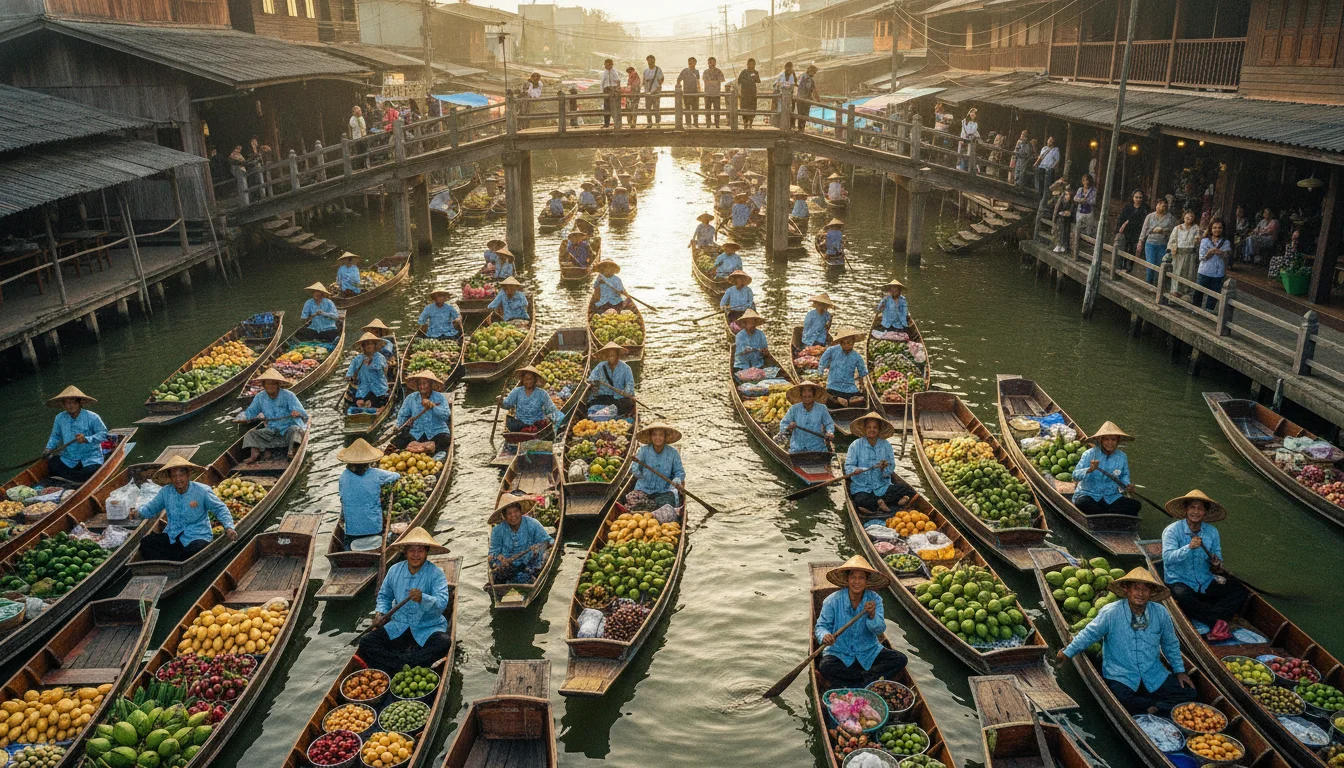
The market unfolds across an engineered grid of waterways centred on Khlong Damnoen Saduak, a 32-kilometre canal dug to link the Mae Klong and Tha Chin rivers. Hundreds of smaller tributary canals, or khlongs, branch off the main channel into the surrounding orchards, funneling wooden rowing boats directly into the commercial core around Ton Khem.
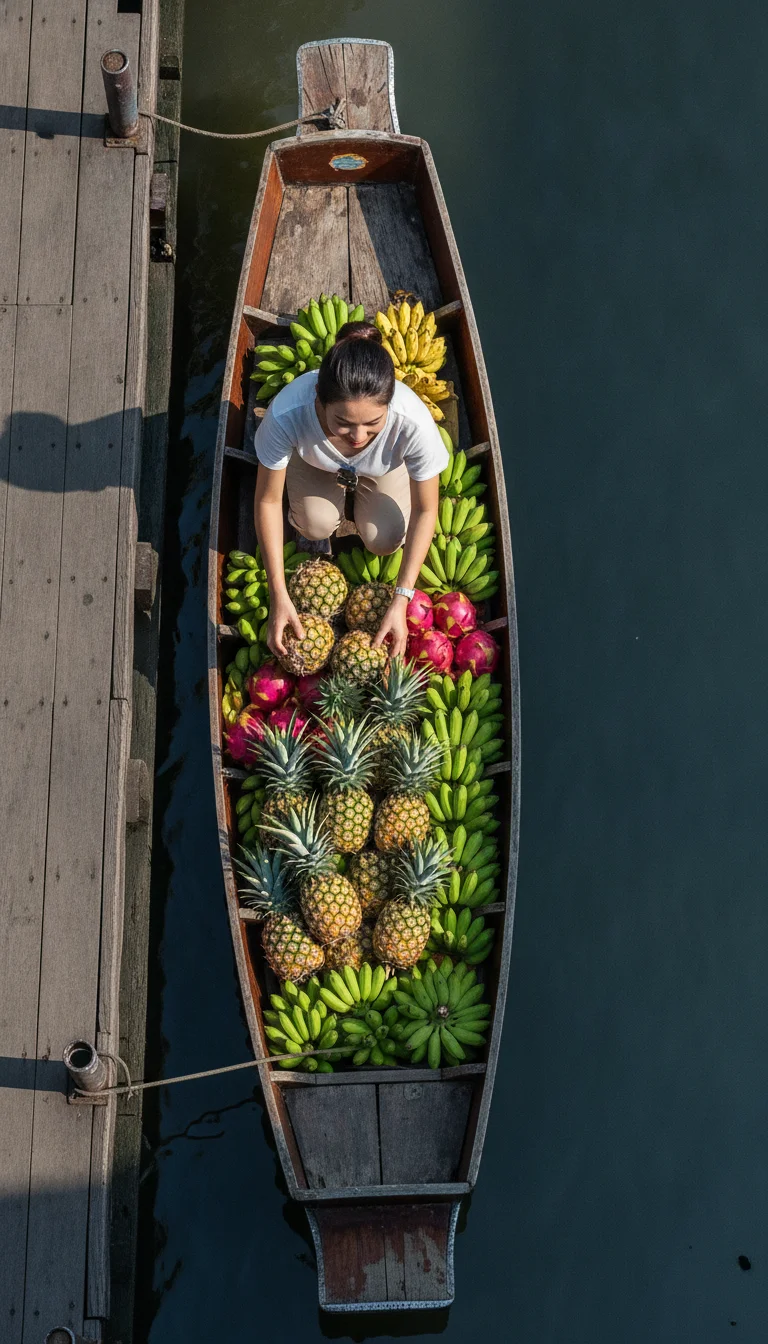
On the water, the atmosphere is brisk, loud, and densely packed. Rowers manoeuvre slender wooden sampans laden with pomelos, bananas, and charcoal burners, navigating an aquatic thoroughfare where hulls frequently wedge side by side at canal intersections. The trade operates simultaneously on two tiers: vendors sell directly from the water, while permanent wooden shophouses line the canal banks.
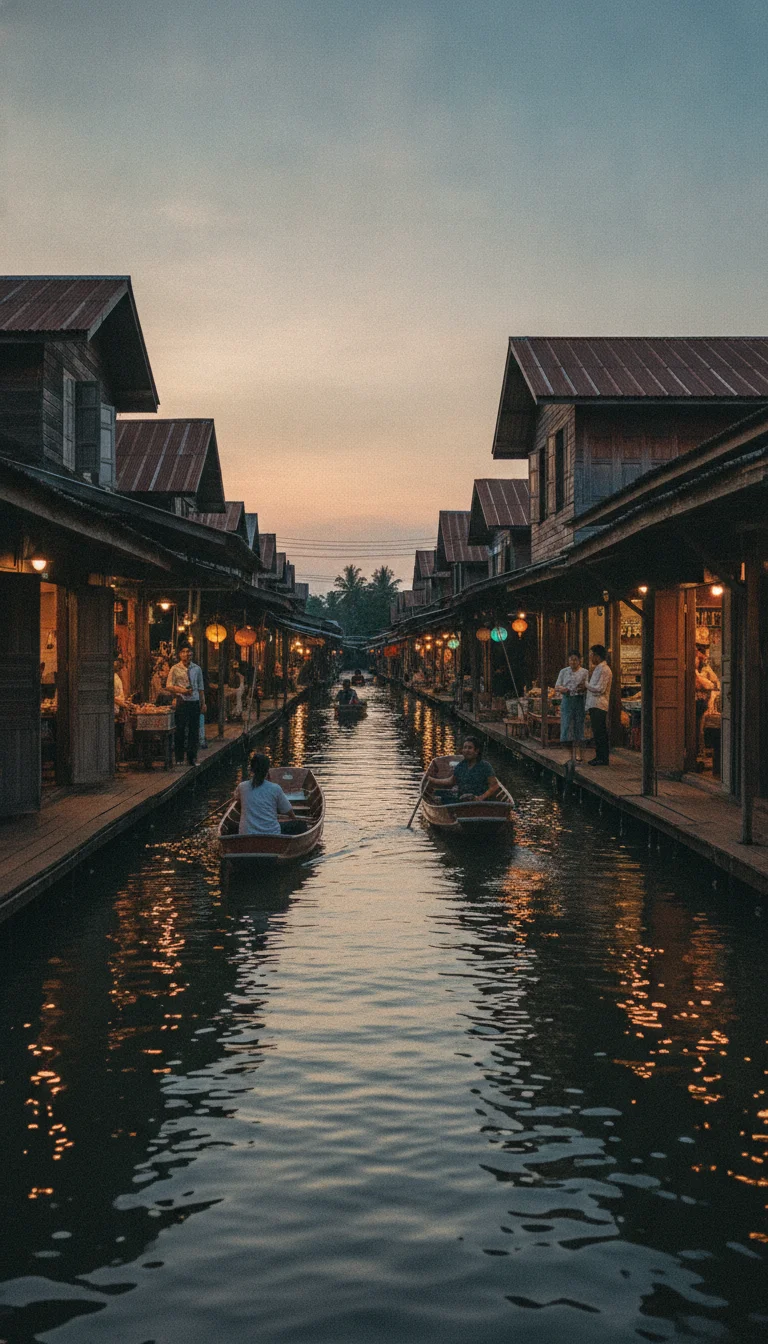
Covered boardwalks run along both sides of the watercourse, linked by narrow pedestrian footbridges that provide elevated vantage points over the gridlock below. Shoppers on foot can hail rowers directly from the railings, where boaters extend long-handled wicker baskets or metal hooks to pass purchases back and forth. The sensory mix is intense, combining the aroma of grilled meats and street broth with the steady hum of passing engines.
Activity peaks between 07:30 and 10:00, before rising midday temperatures thin out the waterborne traffic and vendors begin packing up their vessels. Arriving during this early window ensures you witness the waterways at full momentum.
Boat Rentals and Navigation Options
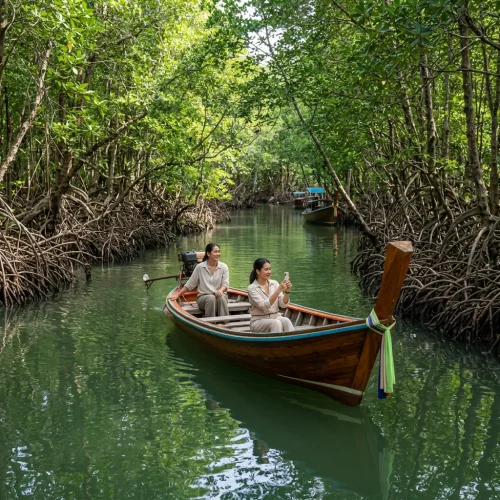
Exploring the market from the water requires choosing between traditional hand-paddled wooden boats and motorised long-tail craft. Hand-paddled sampans move at an unhurried pace, making them well suited for navigating the crowded inner market where vendors cluster tightly along the banks. While motorised long-tail boats are permitted throughout the waterways, their greater width and loud automotive engines can make weaving through congested vendor bottlenecks cumbersome. Instead, long-tails excel at covering longer distances, whisking visitors from outlying piers through residential fruit orchards and quieter branch canals before entering the market hub.
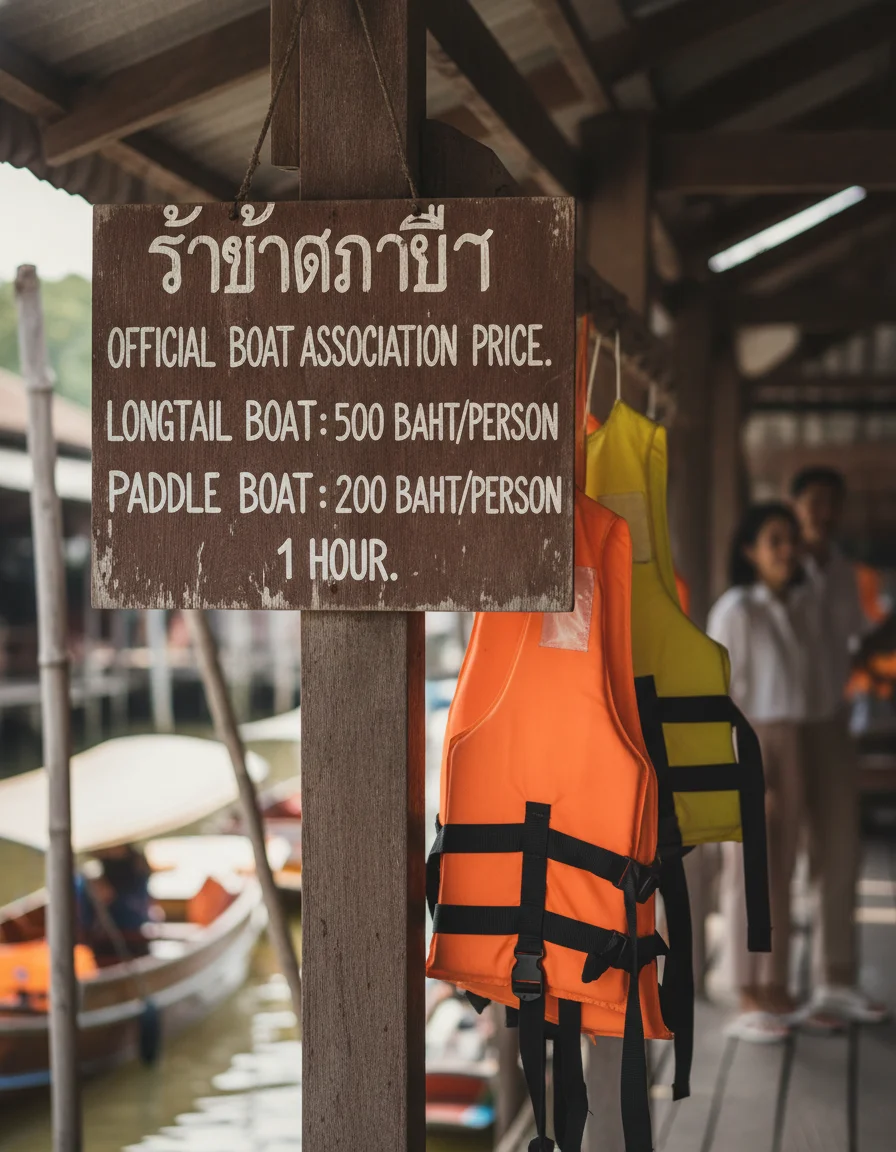
Rental operations run from separate piers managed by local operators and cooperatives, meaning hire rates depend heavily on where you board. Arranging a vessel directly at the central market piers consistently yields fairer rates, whereas outer docks along the highway approach roads frequently quote inflated figures. Standard hires last between 30 and 60 minutes for paddle craft, while long-tail excursions typically run for one to two hours to incorporate the broader canal network.
For close-up photography and buying snacks directly from floating kitchens, a hand-paddled boat provides a steady platform and direct contact with vendors. Long-tail boats usually feature canvas awnings that shield passengers from the morning sun, whereas open wooden sampans leave passengers exposed to the elements. Confirming the fare, duration, and intended canal route before stepping onto the boat prevents misunderstandings at the end of the trip.
| Boat Type | Hand-Paddled Wooden Sampan | Shared Motorised Long-tail | Private Motorised Long-tail |
|---|---|---|---|
| Capacity | 2 to 4 passengers | 6 to 8 passengers | 6 to 10 passengers |
| Average Cost (THB) | 500 - 800 per boat | 150 - 200 per person | 1,500 - 2,000 per boat |
| Average Cost (GBP approx) | £11.50 - £18.50 | £3.50 - £4.60 | £34.50 - £46.00 |
| Best Suited For | Inner market exploration and photography | Budget travellers and couples | Larger groups and transport from outer canals |
Plan your visit to Nobu Bangkok atop The Empire in Sathorn. Explore dining costs, omakase menus, dress codes, cocktail options, and rooftop booking tips.
Floating Food Vendors and Canal Dishes
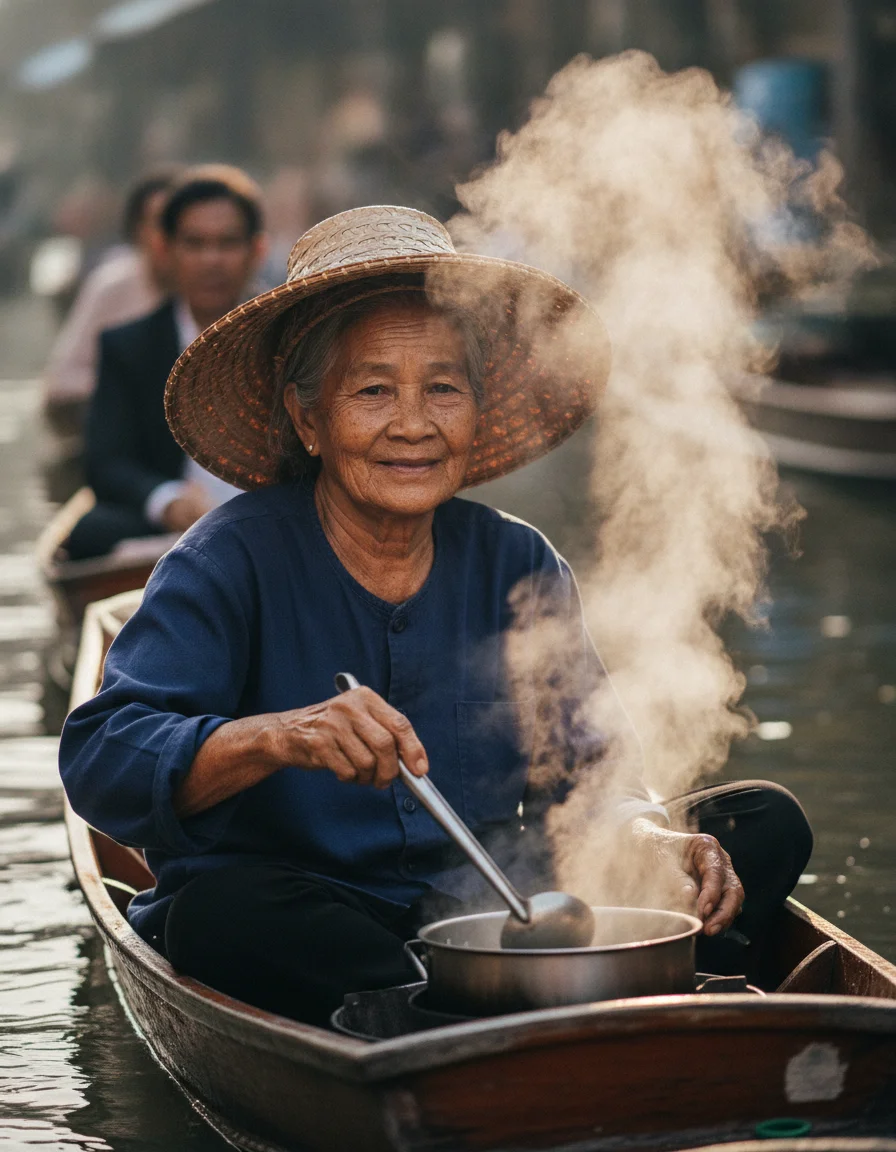
Paddling through Damnoen Saduak brings you alongside food vendors who cook directly aboard narrow wooden sampans. These floating kitchens carry compact gas burners or steaming stockpots, preparing meals on the water for passing passengers and boardwalk visitors. Sellers transfer hot food and retrieve payment across the canal using metal baskets or nets mounted on long wooden poles.
The hallmark dish is boat noodles (kuay teow ruea), historically served in small bowls to prevent hot broth from spilling as boats rocked. Vendors dish up rice noodles with pork or beef, water morning glory, and bean sprouts in a rich, five-spice dark broth. Other hot options include freshly tossed pad Thai, crispy spring rolls, and grilled pork skewers (moo ping) sizzling on small grills.
Sweet canal treats are equally prominent. Fresh coconut ice cream is traditionally served inside a hollowed coconut shell, scraped with tender coconut flesh and topped with roasted peanuts, sweetcorn, or sticky rice. You will also find sliced sweet mango with coconut sticky rice (khao niao mamuang), alongside trays of freshly cut pomelo, bananas, and rose apples. Portions are intentionally snack-sized, making it easy to sample several dishes across the morning.
Comparing Damnoen Saduak to Alternative Markets
Damnoen Saduak differs sharply from alternative canal markets such as Amphawa and Khlong Lat Mayom. Running daily from early morning, Damnoen Saduak caters primarily to foreign tour groups, with higher price tags and souvenir stalls lining the covered wooden boardwalks. It delivers the dense waterborne congestion of wooden sampans laden with fruit and cooking stoves, making it suited to travellers seeking classic morning boat-to-boat trade.
By contrast, Amphawa Floating Market sits roughly 15 kilometres south in neighbouring Samut Songkhram province and operates Friday to Sunday from midday until evening. Predominantly popular with Thai day-trippers from Bangkok, Amphawa centres on wooden shophouses, waterside grilled seafood, and evening long-tail boat trips through mangrove canals to observe synchronous fireflies. Water traffic here is much lighter during daylight hours because trading takes place along the quays rather than between boats.
Travellers wanting an alternative in greater Bangkok often choose Khlong Lat Mayom in Taling Chan district. Operating on weekends and public holidays, it functions mainly as a sprawling open-air dining market spread across covered land plots adjoining a quiet canal, rather than an active river commerce hub.
Choose Damnoen Saduak if your priority is early morning boat photography and waterborne congestion, or plan a weekend afternoon trip to Amphawa for canalside dining and evening river cruises.
Souvenirs and Local Crafts
Boardwalks flanking the canals house stalls selling a mixture of mass-produced novelties and regional handicrafts from Ratchaburi province. Stalls display rows of lightweight elephant trousers, conical straw hats, miniature wooden sampans, coconut-shell bowls, and hand-painted umbrellas. Alongside standard tourist merchandise, the area produces regional agricultural goods tied to local farming, notably traditional coconut sugar cakes solidified in discs, pure coconut flower nectar, dried spices, and local honey.
When browsing from a boat, stallholders frequently hook passing vessels with wooden poles to display their wares. Initial asking prices on non-food souvenirs are set deliberately high for foreign visitors, making good-natured bargaining customary. A polite opening counter-offer well below the quoted figure usually settles at a mutually acceptable compromise. Keep negotiations lighthearted; prepared snacks, fresh fruit, and drinks from paddle boats carry modest, largely fixed rates where aggressive haggling is considered poor form.
Location and Getting There
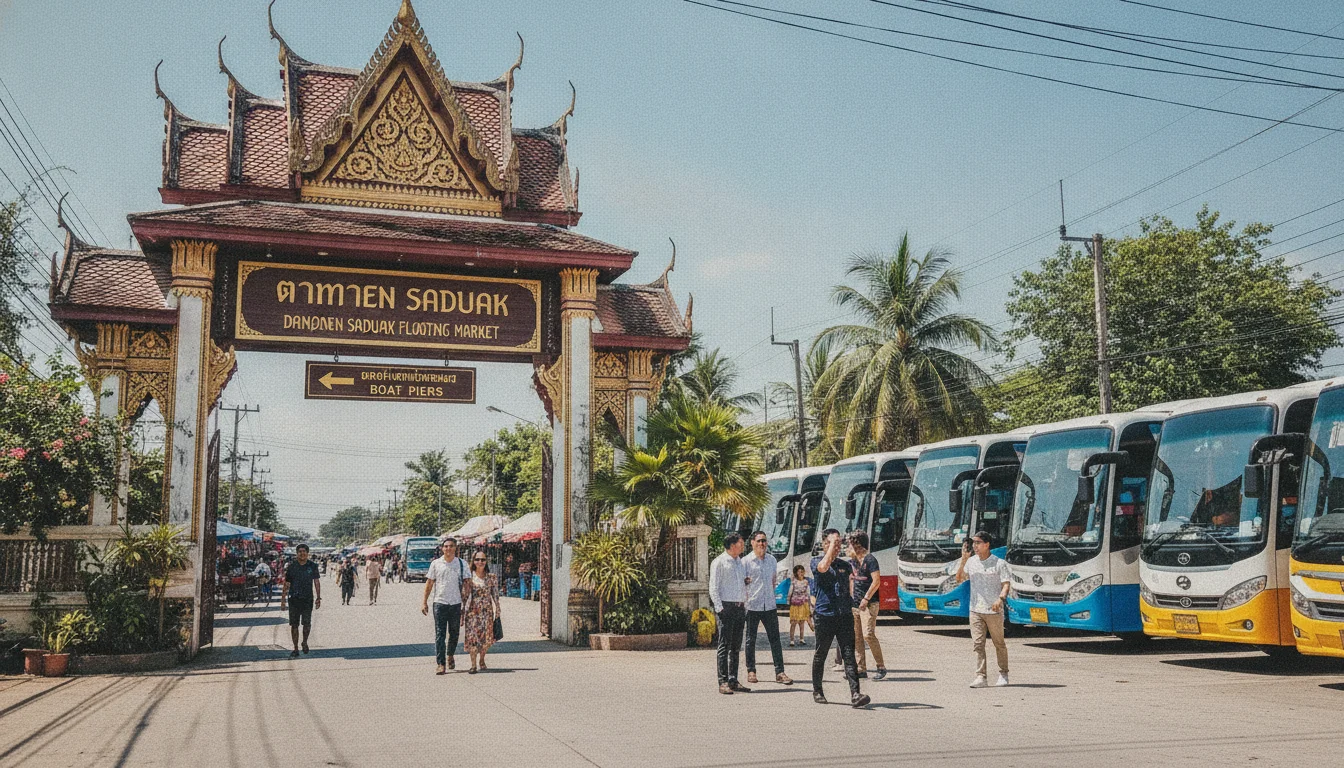
Damnoen Saduak Floating Market sits in Ratchaburi Province, approximately 100 kilometres southwest of central Bangkok. Most travellers arrive from the capital via one of three transport options.
A pre-arranged private transfer or chartered taxi provides direct door-to-door transit, taking roughly 1.5 to 2 hours depending on Bangkok traffic. Return hire usually costs between 1,500 THB and 2,000 THB (around £34 to £46), which generally includes driver waiting time while you explore the waterways.
Public bus services offer an economical alternative. Direct buses, including Bus 78, depart from Bangkok Southern Bus Terminal (Sai Tai Mai) from around 06:00. The journey takes upwards of two hours and costs around 70 THB to 80 THB (approximately £1.60 to £1.85) each way. Buses drop passengers along the main highway, leaving a walk of roughly one kilometre or a short local transfer to reach the market walkways.
Shared group excursions depart central Bangkok hotels between 06:30 and 07:00. These packaged morning trips include return air-conditioned minibus transport and often combine canal boat access or nearby regional stops.
Costs and Booking
Entering Damnoen Saduak Floating Market on foot is free, with pedestrian access across all canal bridges and boardwalks. Primary expenses consist of boat hire, transport, and food. Independent visitors hiring a boat directly at the central docks generally pay between 150 THB and 200 THB (£3.50 to £4.60) per person for a shared paddle boat, or 500 THB to 800 THB (£11.50 to £18.50) to charter a private paddle boat for 45 minutes, seating up to four passengers. Private motorised long-tail boats covering the outer residential canals typically cost 1,500 THB to 2,000 THB (£34.50 to £46.00) for a one-hour ride.
Canalside food and snacks remain inexpensive at the time of writing. A bowl of freshly cooked boat noodles from a floating vendor costs 50 THB to 80 THB (£1.15 to £1.85), and coconut ice cream served in a halved coconut husk costs 50 THB to 60 THB (£1.15 to £1.40). Floating traders deal solely in cash and struggle to break large banknotes, making small 20, 50, and 100 THB notes practical. Seasonal shifts do not influence boat or meal prices, though crowds increase from November to February. Pre-booking an organised shared tour from Bangkok covers return travel and avoids roadside touts.
| Option | Cost (THB) | Cost (GBP approx) | Notes |
|---|---|---|---|
| Pedestrian Market Entry | Free | Free | Access to all walkways and bridges |
| Private Paddle Boat (45 mins) | 500 - 800 | £11.50 - £18.50 | Per boat, fits up to 4 passengers |
| Private Long-tail Boat (1 hour) | 1,500 - 2,000 | £34.50 - £46.00 | Per boat, includes outer canal tour |
| Bowl of Boat Noodles | 50 - 80 | £1.15 - £1.85 | Purchased directly from a cooking boat |
| Fresh Coconut Ice Cream | 50 - 60 | £1.15 - £1.40 | Served in a half-coconut shell |
| Shared Minibus Tour from Bangkok | 800 - 1,200 | £18.50 - £27.60 | Per person, includes return transport |
Who It Suits
Damnoen Saduak suits first-time visitors to Thailand wanting to see classic postcard imagery of waterborne trading. Photographers benefit from the intense morning light reflecting off the water, the crowded arrangements of fresh produce, and the constant movement along the central canal. Families travelling with older children often enjoy the novelty of navigating narrow waterways and purchasing snacks passed directly between vessels.
Conversely, the market is poorly suited to anyone seeking a quiet, low-key community market, as commercial tour groups dominate the central waterways throughout the morning. It also presents substantial physical hurdles for travellers with limited mobility or wheelchair users. Boarding requires stepping down into low-slung, rocking wooden boats without ramps, while the canal banks rely on narrow boardwalks, raised thresholds, and steep pedestrian footbridges without handrails.
What to Know Before You Book
Timing dictates what you see at Damnoen Saduak. Although riverside stalls remain open into the afternoon, waterborne trading peaks between 07:00 and 09:00. Arriving after 09:30 brings heavy canal congestion as tour coaches from Bangkok arrive in volume, by which point many floating produce vendors begin packing up. Catching the main trading window requires departing central Bangkok by 06:00.
Travellers arranging private transport must be wary of private pier commissions. Bangkok taxi drivers frequently stop at roadside piers outside town, where operators attempt to charge inflated boat hire fees of 2,000 to 3,000 THB (roughly £45 to £68) under the guise of an official entrance. General pedestrian admission to the market is free. If travelling independently, agree in advance that your driver takes you directly to the central bridge piers.
Visitors should also factor in the physical environment before deciding on a boat hire. Narrow waterways packed with motorised long-tail boats generate significant engine noise and diesel fumes. Those sensitive to exhaust or seeking a calmer pace can opt for a hand-paddled wooden sampan rather than a motorised boat tour.
Practical Tips
Plan to arrive before 08:00. Damnoen Saduak operates early, and getting onto the water before tour buses arrive allows you to navigate the canals before waterways bottleneck under intense mid-morning heat.
Carry sufficient small cash notes, specifically 20, 50, and 100 THB denominations. Floating merchants and waterside food vendors rarely accept digital payments or cards and cannot provide change for 500 or 1,000 THB banknotes during quick transactions across the water.
Keep your hands and arms inside the boat throughout the ride. Canal channels become densely congested, and hulls frequently collide or grind against concrete embankments and neighbouring vessels, creating a hazard for fingers resting on the gunwales. Secure cameras and smartphones with neck straps or wrist lanyards; the canal water is opaque, making any dropped item unrecoverable.
Wear a secured sun hat, sunglasses, and high-factor sunscreen. Most traditional paddle sampans lack overhead canopies, leaving passengers exposed to direct sunlight and glare off the water. Flat shoes with reliable rubber grip are sensible, as wooden boarding docks and canal steps frequently become slick from splashing water.
Damnoen Saduak pairs conveniently with the Maeklong Railway Market, located approximately 18 to 20 kilometres away in neighbouring Samut Songkhram. Arranging private transport or a combined guided morning tour enables you to experience both landmarks before returning to central Bangkok by early afternoon.
Quick Reference Table
| Item | Detail | Notes |
|---|---|---|
| Location | Ratchaburi Province | Roughly 100 km south-west of central Bangkok |
| Pedestrian Entry | Free | Covers all canal boardwalks and pedestrian footbridges |
| Operating Hours | Daily morning | Trading activity peaks between 07:30 and 10:00 |
| Private Paddle Boat Hire | 500 – 800 THB (£11.50 – £18.50) | Per boat for 45 minutes; seats up to 4 passengers |
| Shared Boat Hire | 150 – 200 THB (£3.50 – £4.60) | Per person for shared paddle or long-tail boat |
| Private Long-tail Boat Hire | 1,500 – 2,000 THB (£34.50 – £46.00) | Per boat for 1 hour; includes outer residential canals |
| Canalside Food & Snacks | 50 – 80 THB (£1.15 – £1.85) | Fresh boat noodles; coconut ice cream costs 50 – 60 THB; cash only |
| Public Bus Fare | 70 – 80 THB (£1.60 – £1.85) | Bus 78 each way from Bangkok Southern Bus Terminal (Sai Tai Mai) |
| Shared Minibus Tour | 800 – 1,200 THB (£18.50 – £27.60) | Per person; includes return transport from central Bangkok hotels |
Reviewed by the Thailand Guide Editorial Team
This page is provided for general information only. While we aim for accuracy, details can change — please verify anything important independently before relying on it.