Emergency services in Rayong have ordered the evacuation of multiple residential communities after structural damage occurred at the Khlong Ra-ok Reservoir spillway.
The site is also known locally as Khao Chuk Dam. Following days of persistent monsoon downpours across eastern Thailand, the Thung Khwai Kin Subdistrict Administrative Organisation in Klaeng district confirmed that a section of the spillway structure had failed. Local officials issued an immediate instruction for residents living downstream to vacate their properties within sixty minutes to avoid rapid inundation.
Three emergency shelters were established to house those displaced. These facilities include Chamnan Samakkhi Witthaya School, Wat Chumnum Sung, and Wat Noen Sombun. British nationals residing in or near Klaeng district should verify whether their accommodation falls within the low-lying drainage paths running south from the reservoir.
Reservoir Capacity Reaches Critical Threshold
A parallel emergency has developed at the Prasae Reservoir.
Regional Irrigation Office 9 confirmed that water volumes have breached safety thresholds. The water level reached 36.62 metres above mean sea level on Monday, exceeding the reservoir’s operational limit of 36.57 metres. Total water storage was recorded at 331 million cubic metres. This represents 112.6 per cent of the facility’s normal holding capacity and exceeds the absolute limit by nine million cubic metres.
Engineers lowered the folding weir gates. This controlled release relieves mechanical pressure on the primary barrage but discharges large volumes of water into populated areas downriver.
The Royal Irrigation Department estimates the discharge rate at up to 279.65 cubic metres per second. That volume equates to roughly 24.16 million cubic metres of water directed into the local river basin every twenty-four hours. Officials stated the weir gates will remain lowered until upstream inflows decline and overall water levels return to safe structural parameters.
Scale of District Inundation
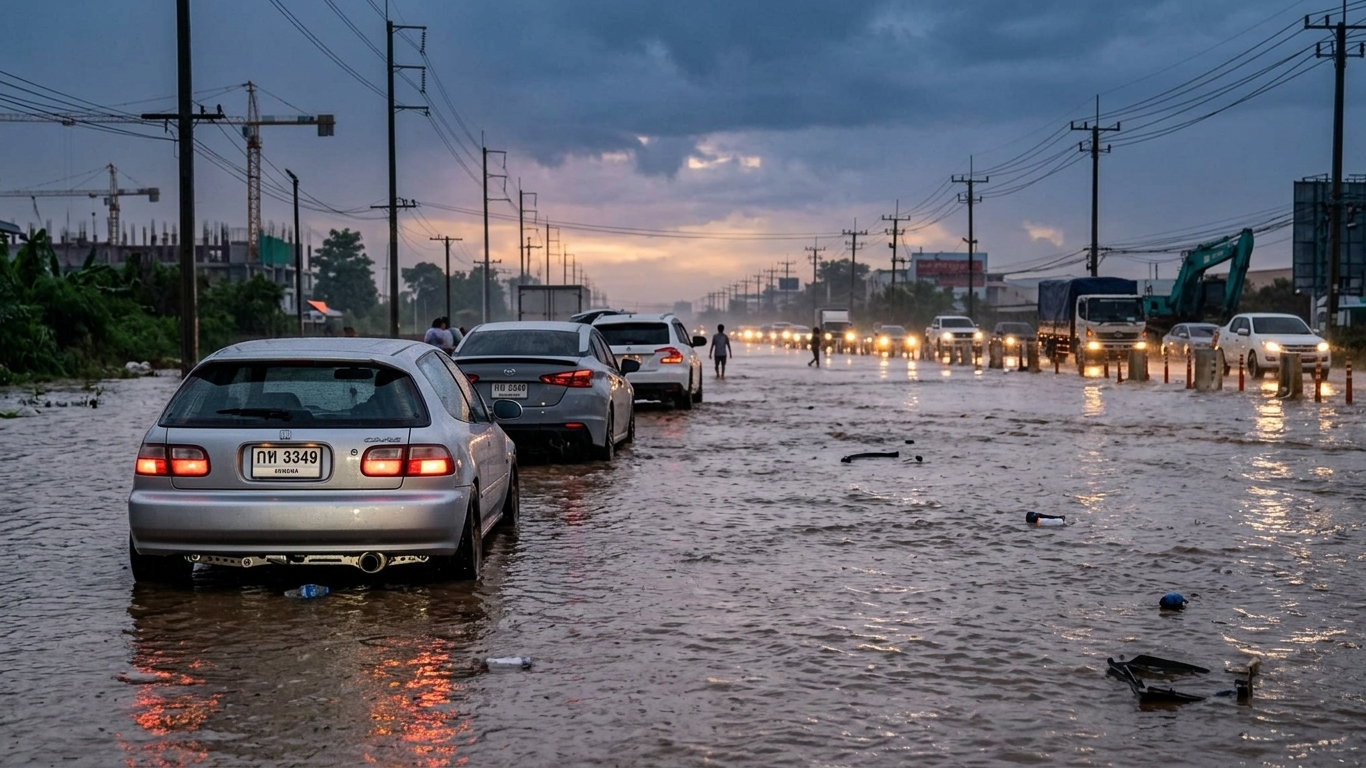
Flooding has spread across four administrative districts in Rayong province.
The Rayong Provincial Disaster Prevention and Mitigation Command confirmed significant water damage across ten distinct locations in Klaeng, Mueang Rayong, Wang Chan, and Ban Khai. No fatalities or serious injuries were recorded during the initial surge.
The flooding remains severe in Klaeng district. Water levels in Ban Na subdistrict reached depths of 80 centimetres, affecting eleven rural villages. A similar 80-centimetre depth was measured across ten villages in Thung Khwai Kin subdistrict, cutting off local access tracks. In the commercial centre of Klaeng municipality and the surrounding Thang Kwian subdistrict, floodwaters rose to 50 centimetres, entering approximately 250 properties.
Mueang Rayong district, where a considerable number of foreign residents rent or own property, has sustained widespread damage. In Choeng Noen subdistrict, floodwaters measuring 30 centimetres deep entered an estimated 1,500 homes. Kachet subdistrict registered water depths of 40 centimetres across ten communities. Similar water levels affected roughly 150 properties in Samnak Thong and fifty homes in Taphong.
Further inland, the Khlong Yai canal burst its banks in Ban Khai district.
Water submerged the main municipal market and reached the grounds of the Ban Khai District Office. Chak Bok subdistrict reported standing water 40 centimetres deep across ten communities, leaving approximately one hundred households isolated. District Chief Wichit Phaplongam led inspection teams through the municipal area on Sunday night to coordinate local relief and monitor ongoing canal discharge.
Road Disruptions and Regional Travel
Transport corridors connecting Bangkok, Chonburi, and Rayong face extensive delays.
Motorists on the primary motorway heading south-east from Chonburi towards Rayong met heavy tailbacks near the Bang Phra reservoir turn-off in Si Racha. Commuters should expect severe slowdowns on interprovincial routes. In Rayong itself, municipal authorities in Thap Ma declared the road link between Thap Ma and Khao Bot completely impassable.
Alternative routes must be used. Expatriates commuting to industrial estates in Map Ta Phut, Eastern Seaboard, or Pluak Daeng should anticipate diversions, particularly where secondary roads cross low-lying agricultural drainage basins. Those due to travel to U-Tapao International Airport are advised to depart substantially ahead of schedule.
Practical Considerations for British Expatriates
Flooding in eastern Thailand carries specific financial, logistical, and legal consequences for British residents.
Property insurance policies require careful examination. Standard residential buildings insurance purchased in Thailand often excludes flood damage unless specifically added via an extra peril endorsement. British homeowners must verify whether their policy defines rising ground water, river overflow, or reservoir release as covered events. Landlords are generally not obligated under Thai civil law to provide alternative accommodation if a rental property becomes uninhabitable due to natural disasters, unless such terms were explicitly drafted into the lease agreement. Tenants on ground-floor premises should move computer equipment, critical documents, and electrical appliances onto upper floors immediately.
Vehicle cover presents an additional operational risk.
Only comprehensive motor insurance, known locally as Class 1 insurance, routinely covers flood damage to vehicles. Policies categorised as Class 2, Class 3, or basic compulsory motor insurance (Por Ror Bor) provide no cover for water damage. Driving through standing water that enters the engine intake will frequently void mechanical coverage, as insurers classify this as contributory negligence. British drivers using low-clearance saloon cars should park on elevated multi-storey structures rather than ground-level car parks or street-side spaces.
Public utility networks in affected areas face ongoing disruption.
The Provincial Electricity Authority frequently cuts power supplies to inundated subdistricts to prevent accidental electrocution from submerged junction boxes and domestic meters. Municipal tap water supplies can suffer contamination when floodwaters compromise local pumping stations. Expatriates residing in the affected districts should maintain bottled drinking water reserves, ensure portable power banks remain fully charged, and obtain personal medical supplies sufficient for at least five days.
Official communications are predominantly issued in Thai through local government channels.
British nationals needing clarification on evacuation orders should contact their local Subdistrict Administrative Organisation (OrBorTor) office or village headman (Phu Yai Ban). The British Embassy in Bangkok does not provide emergency evacuation logistics for localised flooding, but it maintains regular consular updates and can issue emergency travel documents if passports are lost or damaged in the floods. Consular support can be requested via the Foreign, Commonwealth and Development Office in London.
Source: nationthailand.com
Reviewed by the Thailand Guide Editorial Team • Last reviewed: 28 September 2026
This page is provided for general information only. While we aim for accuracy, details can change — please verify anything important independently before relying on it.